I Paid for the Engagement Dinner Sylvia Draper Turned Into My Wine-Serving Shift, Until the Restaurant Owner Asked One Question and Her Plan to Take My House Collapsed
Part 1 of 5
“Make yourself useful, Harlan. Refill the wine.”
Sylvia Draper held her glass toward me without looking up.
Eighteen people sat around the table. I had put down $2,100 for their dinner.
My chair was beside the kitchen door.
Her daughter, Corinna, laughed into her napkin.
Across from her, my stepson straightened his fork.
I waited for Brendan to say something.
He moved the fork again.
“Certainly,” I said.
At sixty-three, I still knew how to lift a bottle without spilling.
Sylvia watched me stand.
“You see? Every family needs someone handy.”
A young man halfway down the table smiled at his plate.
I picked up the cabernet.
The restaurant was called Copper Hearth, an upscale steakhouse in downtown Columbus.
Sylvia had selected the private room, the menu, and the wines.
My part had been simpler.
Brendan had called three weeks earlier.
“Would you help with the engagement dinner?”
“How much help?”
“Whatever you’re comfortable with.”
I had offered $2,100 toward an estimated $2,800 evening.
That was money from my savings, not a loose handful from a dresser drawer.
Retired union electricians in Ohio don’t generally have dinner-party accounts.
But Brendan was getting married.
I had packed his lunches when he hated crusts and driven him to work when his first transmission failed.
Helping him celebrate seemed like an ordinary thing to do.
Then Sylvia handed me a seating card at the restaurant.
“Right down there, Harlan. You’ll have room to stretch out.”
My place was at the narrow end.
Every time the kitchen door opened, cool air brushed the back of my neck.
Brendan and Corinna sat beneath a brass light in the middle.
Sylvia had placed herself beside them.
I had arrived wearing a plain navy sweater and clean gray trousers.
My good jacket was in the truck.
“Everyone’s dressing comfortably,” Brendan had said that morning.
Apparently, comfort meant different things in different households.
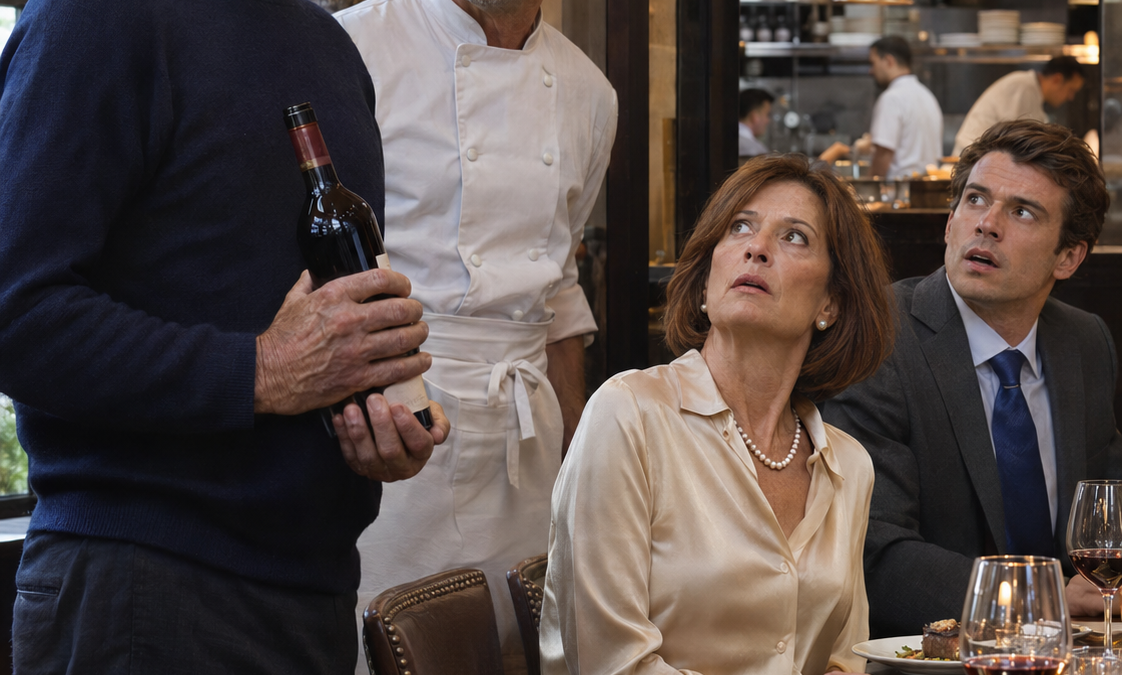
Sylvia wore pearls over a cream silk blouse.
Corinna’s dress had a little gold clasp at the shoulder.
Brendan wore the tie I had given him when he got his first office promotion.
He noticed me looking at it.
“Still a good tie,” he said.
“Looks that way.”
That was our longest conversation before the appetizers.
Sylvia introduced me to two cousins as “Brendan’s stepfather, the one who fixes things.”
“I also break down cardboard,” I said.
One cousin smiled.
Sylvia didn’t.
My wife, Annette, had been dead four years. I was a widower, and Brendan was her only child.
He had been nine when I married his mother.
I never asked him to call me Dad.
He started doing it when he was fourteen, after I sat through a whole school concert with a roofing nail in my boot.
Annette discovered the blood on my sock afterward.
Brendan discovered it too.
For twenty years, the name had stayed.
That night, he introduced me as Harlan.
I told myself he was keeping things formal.
Then Sylvia asked whether I was still doing “little repair jobs.”
“Only for people I like.”
“How sensible,” she said, and turned away.
The server brought our first wine.
Her name tag said Marla.
She asked whether I wanted a glass, and I said yes.
Before Marla could pour mine, Sylvia touched the bottle.
“We’ll handle that. You have enough to do.”
Marla glanced at me.
I nodded because I thought Sylvia meant herself.
That was before the order to make myself useful.
Now I stood beside Sylvia’s chair with the bottle tilted over her glass.
“Just there,” she said. “Don’t drown it.”
I stopped at the widest part.
Corinna pushed her glass forward next.
“Thanks, Harlan.”
Brendan stared at the little flame in the center of the table.
I could have set the bottle down.
I could have asked him whether he had misplaced his voice.
Instead, I moved to the next glass.
There are times when a man waits because he wants to know exactly how far somebody intends to go.
One cousin said, “You don’t have to do that.”
“He doesn’t mind,” Sylvia said.
I looked at Brendan.
He lifted his water and drank.
Sylvia leaned toward a woman beside her.
“He’s always been more comfortable doing something than joining in.”
I had spent thirty-six years reading plans, teaching apprentices, and telling contractors when their bright ideas would burn down a building.
Apparently, I couldn’t manage dinner conversation.
The kitchen door opened behind me.
A tray passed close to my elbow.
I stepped aside and kept the bottle upright.
At the center of the table, Brendan finally raised his head.
For a second, I thought he was going to stand.
Then Sylvia held up her empty water glass.
“While you’re on your feet, Harlan.”
I put the wine on the sideboard.
“The water pitcher is beside your right hand.”
Her fingers stopped above the stem.
Corinna looked from the pitcher to me.
Brendan said, “Mom always liked you helping.”
He meant Annette.
I rested my palm on the sideboard until the little tremor in my thumb settled.
“Your mother liked people asking.”
Nobody reached for the water.
Marla came through with a basket of warm rolls.
“Can I get anything for this end?” she asked me.
“A chair that isn’t in your path.”
“I can move your setting.”
Sylvia’s smile stayed in place.
“We’ve arranged everyone carefully.”
Marla waited for my answer.
I pulled my chair six inches toward the table.
“This will do for now.”
Brendan tore a roll in half.
I watched him set the larger piece on Corinna’s plate.
Then I picked up my napkin and laid it across my knees.
Part 2 of 5
The first steaks arrived at seven twenty.
Sylvia had ordered the filet without asking what anyone wanted.
“It avoids confusion,” she told the table.
Mine came with asparagus.
Annette used to steal that off my plate and leave me her potatoes.
I cut a piece of steak and listened while Sylvia discussed wedding venues.
“The house would make everything so much easier,” she said.
Corinna touched her mother’s wrist.
“Later.”
I assumed they meant a rental for the wedding weekend.
Brendan looked toward me, then down at his plate.
That should have been enough to make me ask.
Instead, I reached for the salt.
A man beside me introduced himself as Corinna’s uncle.
“Do you still work?”
“Retired last September.”
“Electrical?”
“Yes.”
“Good trade.”
“It fed us.”
He asked about the union apprenticeship program for his grandson.
We talked about applications, basic algebra, and showing up before the foreman.
For five minutes, I had a seat at a normal dinner.
Then Sylvia leaned past a flower arrangement.
“Harlan, we’re running dry up here.”
Marla was already approaching with a fresh bottle.
“I have it, ma’am,” she said.
Sylvia held out her hand.
“We’re practically family. No need to stand on ceremony.”
Marla set the bottle on the sideboard.
“Would you like me to open it?”
“I can manage,” I said.
I wanted a reason to stand somewhere other than beside that chair.
At the sideboard, Brendan caught up with me.
He held his plate in one hand.
“Can you ask them to wrap this?”
I looked at the steak.
“You can ask Marla.”
“She’s busy.”
“So am I.”
He glanced at the unopened bottle.
“Come on, Harlan.”
There was that name again.
I put the corkscrew down.
“Have I done something to you?”
“What?”
“Something I should know about.”
“No.”
“Then why are you talking to me like I’m working here?”
His eyes moved toward the table.
“Can we not do this tonight?”
“We haven’t done anything yet.”
He adjusted his grip on the plate.
“Corinna’s mother can be particular. I’m trying to keep the peace.”
“Whose?”
“Please.”
I took the plate because there was nowhere for him to put it without making a production.
Then I handed it straight to Marla when she passed.
“Brendan would like a box.”
“Absolutely.”
She took it from me.
Brendan returned to his seat without another word.
I opened the wine.
Behind me, Sylvia began explaining how marriage required generosity.
“You can’t keep separate little piles forever,” she told Corinna.
“People have to contribute according to what they have.”
The table nodded in the loose way people do when they are eating.
I wiped the bottle’s neck with a folded cloth.
My hands had scars across two knuckles and a thickened patch where pliers used to rest.
Annette could identify those hands in a crowded photograph.
She once said they looked like a road map.
Sylvia watched me bring the bottle back.
“There we are,” she said.
I filled the uncle’s glass first.
He put his hand over it after an inch.
“Thank you. That’s plenty.”
At least somebody knew what enough looked like.
Corinna was showing her ring to a cousin.
Brendan had bought it on payments.
I knew because he had asked whether stretching the purchase over eighteen months was foolish.
I had told him to start a marriage with a budget instead of a performance.
He bought it anyway.
Now he turned the little presentation box in his fingers beneath the table.
I hadn’t noticed him bring it.
Sylvia tapped her glass with a butter knife.
“A small toast before dessert.”
Chairs scraped closer.
I was still standing with the bottle.
“To our children,” she said, “and to the people willing to help them begin properly.”
Several guests lifted their drinks.
Brendan looked at me over his glass.
“Thanks for helping with tonight,” he said.
“You’re welcome.”
Sylvia waited.
I had the distinct impression she expected a larger speech or a larger promise.
When neither came, she drank.
The kitchen door bumped my heel.
I stepped forward.
Marla slipped through carrying empty plates, then stopped.
“Would you mind staying clear of the doorway?”
“Trying my best.”
“I meant the table placement.”
She looked at my chair.
“I can speak to someone.”
“Give me a minute.”
From the middle of the table, Sylvia asked who wanted coffee.
Corinna raised her hand.
So did three others.
Sylvia turned toward me.
I held up the wine.
“One department at a time.”
The uncle coughed into his napkin.
Brendan rubbed the back of his neck.
I moved around the corner of the table to refill Corinna’s glass.
The kitchen door opened wider than before.
This time no tray came through.
A man in a white coat stood in the doorway, looking directly at my face.
Part 3 of 5
His hair was darker than mine, with gray at the temples.
He had one hand braced against the door.
The color drained from his cheeks.
I recognized him a second later.
Vincent Russo.
Twenty years had added lines beside his mouth and taken the spring out of his hair.
He glanced at the bottle in my hand, then at my place beside the kitchen.
Later, Marla told me she had gone to him about a guest being used to serve wine and seated in the traffic path. That was why he had come out.
“Harlan Sutter?”
I nodded.
Sylvia set down her glass.
“Is there a problem with the wine?”
Vincent didn’t answer her.
He stepped close enough that I could see a small burn mark on his coat cuff.
Then he looked along the table.
“Why is the man who saved this restaurant serving your dinner?”
The bottle stayed tilted in my hand.
A red drop gathered at the lip.
I turned it upright before it fell.
Sylvia gave a short laugh.
“I’m afraid you’ve mistaken him for someone.”
“No,” Vincent said. “I haven’t.”
He took the bottle from me and placed it on the sideboard.
“May I?”
I let go.
Brendan pushed his chair back.
“What do you mean, saved it?”
Vincent looked at me.
I could have stopped him.
Instead, I said, “Tell it straight.”
“Twenty years ago, a fire gutted this building. I had insurance, but not enough to cover everything.”
A spoon touched a saucer at the far end.
Nobody picked it up.
“I’d put everything into opening this place,” Vincent said. “We’d been operating eleven months.”
I remembered him then, sitting on an overturned bucket outside the service entrance.
He had been thirty-one, with soot along his collar and estimates folded in his pocket.
“My wiring bid was more than I had left,” he said.
“So Harlan came in on Saturdays and Sundays. Six weekends.”
“Permits and inspections first,” I said.
Vincent nodded.
“He insisted on that. Rewired the damaged spaces for free. Wouldn’t even let me pay for his lunches.”
“Annette packed enough for two.”
His mouth tightened at her name.
“How is she?”
“She died four years ago.”
“I’m sorry, Harlan.”
“Thank you.”
I had not been back since her death. Dinner out had become takeout in front of the evening news.
Vincent had handled our annual paperwork through the trust’s accountant, which explained how we had missed each other.
Sylvia folded her napkin into a narrow strip.
“That was very kind. But surely tonight is about the children.”
“It is,” I said.
Brendan was still standing.
“You never told me.”
“You were fourteen and busy with band practice. Your mother knew where I was.”
“But this place?”
“Mostly that kitchen. Some upstairs circuits.”
Vincent pulled the empty chair from beside me.
“There’s more room at the middle.”
Sylvia touched the back of Corinna’s seat.
“We have a seating arrangement.”
“Then we can change it,” Brendan said.
It was his first useful sentence of the evening.
I didn’t sit yet.
Vincent asked whether Annette’s family trust still held the lease.
“It does. I’m the trustee now.”
Brendan looked between us.
“What trust?”
“Your mother’s family trust,” I said. “The one on the tax summaries I showed you after she died.”
“I thought that was just the old investments.”
“One of them is the master lease on this building.”
Vincent kept his voice level.
“My business operates under a sublease from the trust. The renewal that let us stay here came through the trust’s accountant.”
Sylvia’s folded napkin slipped onto her plate.
I hadn’t owned a secret steakhouse.
Annette’s parents had secured a long commercial lease decades earlier, with the right to sublet.
The remaining lease interest went into the trust.
After Annette died, I became its trustee and income beneficiary.
There were property bills, reserve accounts, and an accountant who charged by the hour.
It was useful money. It wasn’t a crown.
“I don’t run Vincent’s restaurant,” I said.
“No,” Vincent said. “You just helped make sure there was one.”
Corinna lowered her glass.
“I didn’t know.”
“You didn’t need to,” I said.
Vincent moved my place setting himself.
He put it beside Brendan, where a spare chair could fit without blocking anyone.
Then he asked Marla to bring me a fresh dinner.
“Mine’s fine.”
“It’s cold.”
“So am I, usually.”
He gave me the first honest smile I had seen that night.
“I’ll get it warmed.”
Brendan held the chair while I sat.
Sylvia watched the movement from across the table.
Then she reached into the cream handbag hanging from her chair.
“Well,” she said, drawing out a folder, “perhaps this is actually the right time to discuss the house.”
Part 4 of 5
Brendan shut his eyes.
Corinna took her hand off his sleeve.
“What house?” I asked.
Sylvia laid the folder between the bread plates.
“Annette’s house, naturally. The one you’re living in.”
“It’s my house.”
“Of course. In the immediate sense.”
Vincent stepped back.
“I’ll give you some room.”
“Stay,” I said. “You’ve already heard the opening.”
Sylvia slid a printed sheet toward me.
The address at the top was mine.
Beneath it were three empty spaces for signatures and a heading about a proposed wedding gift.
It wasn’t a deed.
It was the sort of worksheet a real estate office gives people before anyone pays for proper advice.
“Where did this come from?” I asked.
“A friend who sells homes helped me organize the idea.”
“Did you tell that friend I’d agreed?”
“I said we anticipated a family arrangement.”
Corinna stared at the paper.
“Mom, you said this was just a conversation.”
“It is.”
“With signature lines?” I asked.
Sylvia smoothed one corner.
“We planned to discuss gifting the house to Brendan and Corinna. They could move in after the wedding.”
“And where would I go?”
“There are wonderful maintenance-free communities.”
I waited.
“You wouldn’t have to shovel anymore,” Sylvia added.
“I own a snowblower.”
Brendan reached for the sheet.
I kept one finger on it.
“Did you know?”
“She brought it up last week.”
“What did you say?”
“I said I’d talk to you.”
“But you didn’t.”
“No.”
Corinna leaned forward.
“I thought Brendan had mentioned it.”
“He just said he hadn’t.”
Her eyes went to him.
Brendan set both hands flat on the table.
“I kept putting it off.”
Sylvia gave him a look sharp enough to stop him.
“We’re discussing an opportunity, not assigning blame.”
I turned the sheet over.
There was a list on the back.
Kitchen update. Nursery. Upstairs office.
My workshop was marked as future storage.
“Who wrote this?”
Corinna raised two fingers.
“I made notes. Mom said you were considering downsizing.”
“Did you ever hear me say that?”
“No.”
She pulled her hands into her lap.
“I should have asked.”
“Yes.”
Sylvia lowered her voice.
“Harlan, surely you don’t need all that space.”
“Apparently, I need enough to keep other people’s plans out.”
Someone at the far end moved a coffee cup away from the folder.
Brendan looked at the address again.
“Mom left you the house.”
“Yes.”
“She told me that.”
Annette had been plain about it.
Brendan received her retirement account and the savings she had kept in her own name.
The house was left to me outright.
She wanted me to stay where we had planted the pear tree and argued about wallpaper.
Brendan had signed the estate receipts. None of that had been hidden from him.
Sylvia tapped the proposed gift sheet.
“An inheritance isn’t always the end of a family’s obligations.”
“Neither is a marriage license the beginning of a claim on somebody else’s home,” I said.
Her pearls clicked against the table when she leaned closer.
“Some men understand that being included means being useful.”
Brendan stood so quickly his napkin fell.
“Stop.”
Sylvia looked up at him.
He picked up the napkin before speaking again.
“He paid for most of tonight. You put him beside a kitchen door. I watched you do it.”
“Brendan—”
“And then I handed him my plate.”
He looked at me.
“I did that.”
“Yes,” I said.
Corinna reached toward him.
He stepped out of reach, just enough to make her hand fall.
“Did you want the house?” he asked.
“I wanted a home with you.”
“This wasn’t ours.”
Corinna looked at the worksheet.
“I know that now.”
“You knew whose address it was.”
Her chin lowered.
“Yes.”
I slid the folder back to Sylvia.
“There won’t be a gift. There won’t be a move. Don’t bring paperwork about my home again.”
Sylvia closed the cover.
“Then perhaps we should finish dinner privately.”
“We are finishing it,” I said. “We just won’t be pretending.”
Marla returned with my warmed plate.
Vincent followed carrying the event bill.
I had asked him quietly for it while Sylvia was searching her handbag.
He set it beside my fork.
“My deposit is on there?” I asked.
“Yes.”
“I want to change what I’m paying.”
Sylvia’s chair scraped backward.
“You offered to host.”
“I offered help with a family dinner.”
“Those are the same thing.”
“Not tonight.”
Vincent opened the bill folder.
“Sylvia booked the event and guaranteed it with her card. Your payment was a separate advance contribution.”
I took out my wallet.
“Refund that contribution. Charge me for my steak, my glass of wine, tax, and a twenty-five percent tip.”
Vincent nodded.
Sylvia reached for the bill before he could lift it.
Part 5 of 5
“You can’t simply leave me with this,” Sylvia said.
Vincent kept the folder on the table.
“The booking agreement covers the balance. We can discuss payment at the front desk.”
“This is humiliating.”
I cut into my warmed steak.
“It’s a dinner check.”
Brendan sat down beside me.
“Harlan, let me cover yours.”
“No.”
“I mean it.”
“So do I.”
He nodded and left his hands beside his plate.
Sylvia looked around for someone to support her.
The uncle who had asked about the apprenticeship folded his napkin.
“I’ll pay for my wife and myself.”
“So will we,” a cousin said.
Vincent explained that the event stayed on Sylvia’s bill, but guests could settle their portions with her afterward.
Nobody argued with him.
Corinna turned the ring on her finger, looked at it, and folded her hands over it.
Brendan watched her.
“We need to stop the wedding planning,” he said.
“Tonight?”
“Yes.”
“Over one dinner?”
“Over what I did during it. And what we were willing to take.”
Sylvia reached for her daughter’s arm.
Corinna moved her chair an inch away.
For once, her mother had nothing ready.
I finished half my steak.
That felt important in a practical way. I had paid for it, and I was hungry.
Marla brought a receipt showing my own charge and a separate refund slip for the deposit.
The credit returned to my account three business days later.
Sylvia paid the remaining restaurant bill before leaving.
Brendan later reimbursed her for his friends and himself. He sent me the confirmation without asking for praise.
Outside that night, he followed me to my truck.
“Dad.”
I stopped with the key in my hand.
“I knew she’d be difficult,” he said. “I thought letting her have her way would get us through the night.”
“It got you through most of it.”
He looked down at the curb.
“While you stood there.”
“Yes.”
“I’m sorry.”
I unlocked the door.
“Don’t use that to finish the conversation.”
“What do I do?”
“Start with the people who watched.”
The next morning, he did.
He sent a message to everyone at the dinner.
He showed it to me before sending it, not for editing, but so I wouldn’t hear about it secondhand.
He said I had been treated as hired help at a dinner I had largely funded.
He said he had allowed it.
He explained that I had never offered my house, and that any suggestion otherwise was false.
Then he called me.
“Saturday. Can I come over?”
“For what?”
“The porch rail’s loose.”
“I know.”
“I’d like you to show me how to fix it.”
He arrived at eight with the right exterior screws and a box of doughnuts.
He had looked up the screws instead of buying the cheapest ones.
We worked until eleven.
When his phone rang, he checked the screen and put it facedown on the workbench.
“You can answer,” I said.
“I told Corinna where I’d be.”
“What happens there?”
“We’re not getting married.”
I set the drill down.
“Are you sure?”
“We talked without her mother. She still thinks the house would have solved everything.”
“That’s her answer, then.”
He rubbed sawdust from his wrist.
“I wanted you to say I should forgive her.”
“You’re asking the wrong person to make that decision.”
He nodded.
By the following week, they had ended the engagement and canceled the venue appointments.
Brendan didn’t make me deliver that news for him.
He also stopped arriving at my house with something broken under his arm.
One Tuesday, he brought groceries and cooked spaghetti.
The noodles stuck together.
We ate them anyway.
In May, Vincent called.
“I’d like permission to put Annette’s name on the private room.”
I sat at the kitchen table with the phone against my ear.
“Why hers?”
“She brought lunch. She kept the receipts straight. She told me to stop apologizing and start sweeping.”
“That sounds right.”
“And you’ve already turned me down twice when I offered to pay you.”
“Still not taking it.”
“I know. May I use her name?”
I told him yes.
He invited us on a Sunday afternoon before service.
The plaque beside the door said THE ANNETTE ROOM.
Underneath was one short sentence about six weekends and a second beginning.
Brendan ran his thumb along the edge without touching the lettering.
Inside, Vincent had set a small table away from the kitchen traffic.
There were three places: one for him, one for Brendan, one for me.
No speeches had been scheduled.
Brendan pulled out my chair.
When the wine arrived, he reached for the bottle.
“Would you like some, Dad?”
“A little.”
He poured, then waited until I had settled my napkin.
The following morning, I went home to the same house, put my keys in the same chipped bowl, and opened the back door.
Brendan was already on the porch with a paintbrush.
“Second coat?” he asked.
I handed him the can.
“Watch the drip by your shoe.”
THE END
More stories
I Was Brooke’s Unpaid Kitchen Helper at My Grandson’s Christening Until Her Father Recognized My Scar and Discovered the House Deed She Wanted Me to SignMy Sister Dropped My Daughter’s 42-Square Memory Quilt Into a Birthday Fire—Then a Teenager’s Phone Captured the Proof That Made Her Hand Back the KeysMy 72-Year-Old Former Mother-in-Law Mocked Me Over the Arena Speakers Before 412 People—Then the Manager Walked Past Her Son With the Pen, and the $200,000 He’d Collected Had to Go BackMy Husband Tapped the $1,067 Payment Line on My Paid-Off House—Then the Loan Officer Asked One Calm Question and Put Two Cancellation Notices in My HandsI Let the Owner’s Son Call Me “Just the Phone Girl” Before 90 People—Then His Own Messages Stopped the Three-Year Contract He Wanted Most at the PartyMy Landlord’s Son Ordered 43 Households Out by March 31—Then His 81-Year-Old Mother Refused to Sign, and All 43 Households Bought the Land Themselves Instead
You Might Also Enjoy

My Daughter-In-Law Told Me To Stay Elsewhere While Strangers Took My Condo — Then I Pushed Back







