I Was Serving Funeral Lunch When My Sister-in-Law Told Me to Pack My Husband’s Fishing Gear, Then Our Lawyer Found the Date That Undid Her Cabin Claim
Part 1 of 5
“Pack his fishing things by Sunday, Jean.”
My sister-in-law said it while I was carrying a casserole hot enough to burn through a folded dish towel.
Thirty-five people had come to my house after we buried my husband.
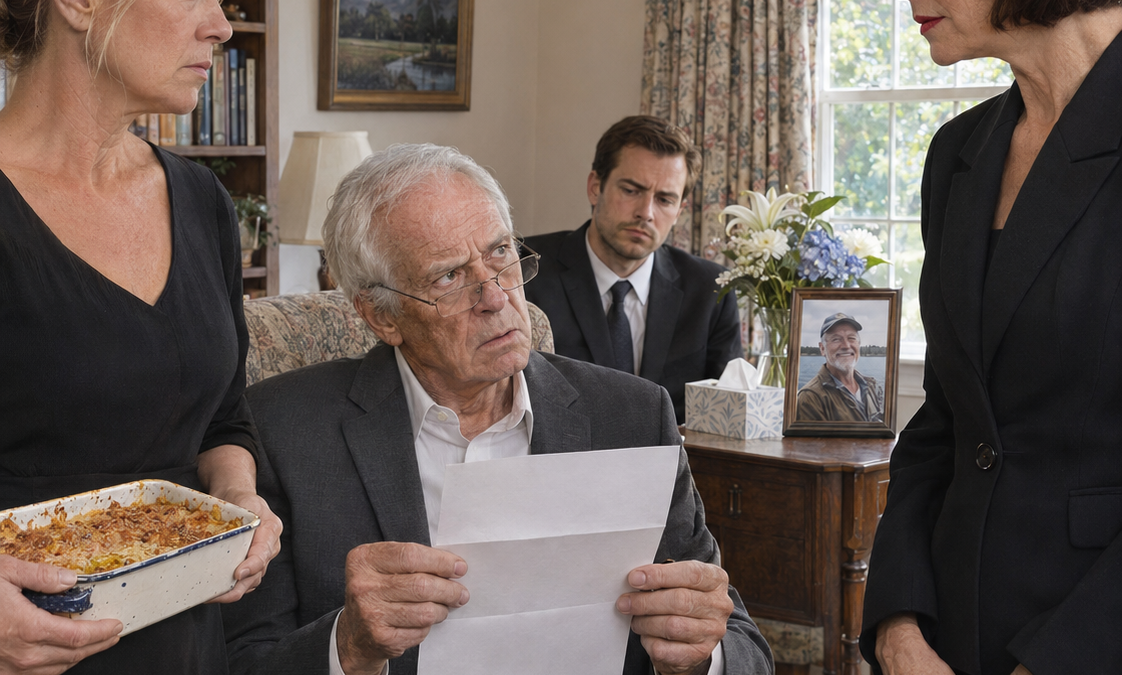
Lucille Sutter stood beside his empty chair with a folded paper held above her plate.
“This is Franklin’s new will,” Lucille said. “He left the lake cabin to me.”
A serving spoon struck somebody’s glass.
I stood between the living room and kitchen in the black dress I had bought for our fortieth anniversary dinner.
Four months later, I was wearing it to his funeral.
“Set that down before you drop it,” Lucille said.
I kept holding the casserole.
At fifty-eight, I managed a school cafeteria in rural Tennessee. I could carry hot food through a crowded room.
Apparently, I could also be handed an eviction notice between the ham and sweet potatoes.
“The cabin?” I said.
Lucille straightened the cuffs of her black suit.
“Franklin wanted it kept in his family.”
Our son, Patrick, sat on the piano bench with a paper plate on his knees.
I looked at him.
Patrick put his fork down.
He didn’t stand.
Around him, cousins lowered their voices without actually stopping their conversations.
Someone said Franklin had always loved that place.
Someone else said paperwork ought to settle things.
I had signed the checks for its roof, scrubbed its shower, and winterized its pipes for twenty-three years.
Still, I waited.
Lucille turned toward the guests nearest the fireplace.
“I’m not asking Jean to do it today. Sunday gives her time.”
Then came the line she had polished before arriving.
“A wife gets the memories. Blood gets the property.”
My casserole dish had a blue chip under one handle. I pressed my thumb into that small rough place.
Franklin had bought the dish at a church sale because its lid actually fit.
He had liked things that did what they were supposed to do.
“Did Franklin give you that?” I asked.
“He made his wishes clear.”
“That wasn’t my question.”
Lucille lowered the paper enough to hide its bottom edge behind her plate.
“We don’t need to make a scene.”
I looked around my living room.
Extra folding chairs stood against the wall. His fishing photograph sat beside a box of tissues.
The funeral flowers crowded the window where he used to start tomato seedlings.
“I’m serving lunch,” I said. “You stood up.”
A cousin reached for the television remote and moved it away from the gravy boat.
Small, useless movements filled the room.
Nobody wanted to be the first person to choose a side.
I had spent the morning accepting paper plates and embraces from people who kept telling me to sit down.
Now almost everyone was seated, and I was still standing.
Lucille tapped the folded page against her palm.
“I thought handling this with everyone present would prevent misunderstandings.”
“Whose misunderstanding?”
“Jean, please.”
That was how Lucille said please when she meant behave.
Franklin had been the younger brother. Lucille had never entirely forgiven him for making decisions without her permission.
When we replaced our truck, Lucille asked why we hadn’t consulted her.
When he entered hospice, she asked why the doctor hadn’t called her first.
Franklin had answered that one himself.
“Because Jean is my wife.”
I hadn’t repeated it afterward. He had been tired, and I wanted his remaining words spent on things he enjoyed.
Now his sister stood beside his chair, explaining which pieces of our life belonged to me.
A neighbor offered to take the casserole.
“Thank you,” I said. “I’ve got it.”
The dish gave me something useful to do with my hands.
On the piano bench, Patrick rubbed a thumb over the edge of his plate.
He was thirty-four, with his father’s broad shoulders and the same habit of looking down before saying something difficult.
I waited for him to look up.
Lucille noticed.
“Your father wouldn’t want you caught in the middle, Patrick.”
His mouth opened.
For a second, I thought he would tell her there was no middle between his mother and a folded sheet waved over funeral food.
Instead, Patrick glanced toward the hallway, where his children were eating at the little card table.
“They can hear us,” he said.
“Yes,” I said. “They can.”
Lucille smoothed the front of her jacket.
“Then let’s show them how adults settle family business.”
Patrick finally stood, but he stayed beside the piano.
“Mom,” he said, “maybe we should hear what the paper says.”
I shifted the casserole against my waist.
“Hearing it is fine,” I said. “Handing over keys is something else.”
“I didn’t say hand over keys.”
“You didn’t say much.”
Patrick picked up his plate again, then set it on the piano without taking another bite.
Lucille turned the page inward.
“There’s no reason to make Patrick responsible for your reaction.”
“Leave him out of your answer,” I said.
The front screen door creaked.
Malcolm Finch stood on the porch, white hair flattened by the wind, a covered bowl balanced on his briefcase.
He had called from the road before the service.
A wreck had closed the two-lane highway near his office. He had taken the long way around.
“Jean,” he said, stepping inside. “I’m sorry I missed the church.”
Then he saw Lucille’s paper and stopped taking off his coat.
Part 2 of 5
Malcolm had been Franklin’s friend longer than he had been our lawyer.
They met over a broken boat motor in 1987 and argued about the repair for the next thirty-nine years.
I had asked Malcolm to come early that morning.
He was supposed to sit beside Patrick at the church, then stay after lunch to go over the estate papers with me.
Now he stood in my doorway with potato salad.
“Kitchen counter,” I said.
Malcolm put the bowl down and returned without his coat.
“Did I interrupt something?”
“Lucille has a paper.”
“It’s Franklin’s new will,” Lucille said. “I was explaining his wishes.”
Malcolm held out his hand.
“May I see it?”
Lucille brought the page against her jacket.
“There’s no need to turn a family lunch into a legal appointment.”
“You introduced the will,” he said.
A chair scraped near the window.
Two cousins stopped whispering.
Patrick stepped between the piano and the coffee table, leaving a clear path from Malcolm to Lucille.
I noticed that small correction. I also noticed how late it came.
“Maybe we should move into the kitchen,” Patrick said.
Lucille nodded immediately.
“Yes. That would be more dignified.”
“You announced it here,” I said. “We can read it here.”
Nobody reached for another biscuit.
Malcolm pulled his reading glasses from his shirt pocket.
“Lucille, are you offering that document as Franklin’s signed will?”
“I’m saying he wanted the cabin to stay with the Sutters.”
“My name is Sutter,” I said.
“You know what I mean.”
“I do.”
Patrick looked at me then.
His face had the same drawn look it had worn outside the hospice room.
I had spent those days handing him coffee, reminding him to eat, making sure he went home to his children.
I couldn’t carry him through this room, too.
Lucille lifted her chin.
“Franklin and I grew up going to that lake.”
“The cabin wasn’t there when you were children,” I said.
“The land was.”
“His uncle sold us the lot. We paid for it.”
“I’m aware of that.”
“Then don’t leave the payment out.”
Malcolm kept his hand extended.
Lucille studied him as though he were a store clerk refusing a return.
“Surely you remember Franklin talking about family ownership.”
“I remember many conversations,” Malcolm said. “I’m asking to read this document.”
Patrick reached toward the casserole.
“Let me take that, Mom.”
I moved half a step away.
“I’ll set it down.”
But the coffee table was covered with plates, and the sideboard held flowers.
For a few seconds, finding a safe space for hot food became the only ordinary problem left in my house.
A cousin cleared a corner of the sideboard.
I still didn’t move.
Lucille watched Malcolm’s open hand.
“I don’t have the original envelope with me.”
“I asked for the page you’re holding.”
“It’s only one page.”
“That should make it quick.”
Outside, someone shut a car door.
The kitchen refrigerator hummed through the pause.
Patrick said, “Aunt Lucille, let him see it.”
Lucille’s eyes went to him.
“You were willing to listen a minute ago.”
“I’m still willing.”
“That isn’t how it sounds.”
He rubbed his palms against his trousers.
I recognized the gesture. He used it before parent conferences, loan appointments, anything he wanted to get through without trouble.
“Reading it should clear things up,” he said.
Lucille unfolded the paper halfway.
I could see a heading and several short paragraphs, but not enough to read a sentence.
She folded it again.
“Jean, there are things siblings understand that spouses don’t.”
I looked at the dish in my hands.
Franklin had carried it out of that church sale wrapped in his jacket so it wouldn’t break against the other purchases.
He had called me from the parking lot to ask whether eight dollars was too much.
“Did he tell you to announce this over lunch?” I asked.
“He didn’t specify a convenient time.”
“Then you chose one.”
A man near the hallway stood to let the children pass.
Lucy, nine, came through carrying two empty cups. Oscar, seven, followed with a handful of crumpled napkins.
Patrick took the cups.
“Back to the kitchen, please.”
Lucy looked from me to the folded paper.
“Are we leaving?”
“No,” I said. “Put the napkins in the trash.”
Oscar obeyed. Lucy waited until Patrick nodded.
After they disappeared into the kitchen, Malcolm lowered his hand.
He didn’t put away his glasses.
“Lucille,” he said, “either let me examine what you’ve presented, or stop asking anyone to act on it.”
Lucille looked around the room for someone who might object.
No one did.
She placed the paper in his hand.
Part 3 of 5
Malcolm opened the sheet carefully along its two creases.
I watched his eyes move from the heading to the paragraph beneath it.
Lucille clasped both hands in front of her waist.
“There’s no point dragging this out,” she said.
Malcolm didn’t answer.
He moved closer to the window, where the afternoon light fell across the bottom of the page.
Patrick pulled a chair away from the sideboard.
“Here, Mom. There’s room now.”
I took one step toward it.
Malcolm touched a line with his forefinger.
Then he looked up sharply at Lucille.
“Why is this signed on October 12, two days after Franklin died in hospice?”
The casserole touched the sideboard with a small click.
I kept both hands on its handles until I knew it was steady.
Lucille’s lipstick had left a red crescent on the rim of her water glass.
She picked it up, held it, and put it back without drinking.
“That must be a typing mistake.”
“Whose typing?” Malcolm asked.
“I don’t know what you’re suggesting.”
“I’m asking who prepared it.”
Patrick moved beside me.
This time, he stayed there.
Malcolm turned the paper so Lucille could see the date beneath the signature.
“October twelfth,” he said. “Who put that date here?”
Lucille looked toward the hallway.
“Can we speak privately?”
“You can answer here,” I said. “You wanted witnesses.”
One of the cousins quietly took the children outside.
I saw her point toward the porch swing through the kitchen window.
Malcolm laid the paper on the cleared corner of the coffee table.
“I have Franklin’s executed will in my office,” he said. “Signed in July, with two witnesses present.”
Lucille’s fingers closed around the edge of her jacket.
“He could have changed it.”
“He could have,” Malcolm said. “He could not have signed this after his death.”
Nobody supplied her with another explanation.
Malcolm opened his briefcase.
“I brought a copy because Jean and I had arranged to review the estate papers after lunch.”
That was why he had it. No grand entrance, no secret errand.
Just the appointment I had lost track of somewhere between the church and the ham.
He placed a clipped packet beside Lucille’s single page.
“The signed original was filed for safekeeping in my office in July,” he said. “I personally supervised its signing.”
“Read the cabin part,” I said.
Malcolm found the paragraph and handed the copy to me.
I knew Franklin had made arrangements.
He had told me the papers were finished, and I had believed there would be time to go over every line together.
Hospice had reduced our plans to smaller things.
Another pillow. A spoonful of ice. Whether he wanted the curtain open.
I held the packet beneath the lamp.
The cabin went to me.
The land, the building, the furnishings, and Franklin’s interest in everything stored there.
A separate provision set aside six thousand dollars for our grandchildren’s fishing expenses.
Lessons if they wanted them. Licenses when they needed them. Equipment, bait, and safe boat outings with an adult.
I pressed the page flat.
“He put bait in his will.”
Malcolm adjusted his glasses.
“He was specific.”
Patrick bent over the paragraph.
“Six thousand?”
“Held and administered by your mother,” Malcolm said. “For the children, under the terms written here.”
Franklin had spent forty minutes once choosing a five-dollar bobber for Oscar.
I could picture him sitting across from Malcolm, making sure worms weren’t left out of the arrangements.
Lucille reached for her paper.
Malcolm put two fingers on it.
“Before you take that, we need an explanation.”
“I got the date wrong.”
The words came out quickly.
Patrick straightened.
“You got it wrong?”
Lucille looked down at the sheet.
“I put it together.”
“Did my father sign it?” Patrick asked.
“No.”
A refrigerator door opened in the kitchen, then closed.
Someone had been trying to find a place for leftovers.
Lucille kept looking at the paper.
“I copied his signature from an old letter.”
My son pulled the chair behind me farther out.
“Sit down, Mom.”
I sat.
That was the first instruction I had accepted all afternoon.
Malcolm left the false page on the table.
“You need to withdraw this claim in front of the people who heard it,” he said.
Lucille touched the clasp on her purse.
“I didn’t think it would get this far.”
“You told me to pack his things,” I said.
“I thought you would let me have the cabin.”
The room stayed still around her.
Then a cousin by the window lifted her phone.
“Lucille,” she said, “is this why you sent me a rental listing yesterday?”
Part 4 of 5
Lucille turned toward the window.
The cousin held out her phone but didn’t get up.
“You asked me to share it with people from church,” she said. “I thought Jean knew.”
“I don’t,” I said. “Bring it here, please.”
The screen showed our cabin from the gravel drive.
Franklin’s green porch chair stood beside mine. My striped kitchen curtains were visible through the front window.
The listing called it a private family lake retreat.
Available beginning the following weekend.
Two nights minimum. Two hundred twenty dollars a night.
Lucille’s first name appeared beneath the contact button.
I enlarged the photograph with two fingers.
A pair of Franklin’s work gloves lay on the porch rail.
“When was this picture taken?” I asked.
“Last month,” Lucille said.
“You came for his birthday lunch.”
Lucille nodded.
I remembered her walking down to the dock while Franklin rested inside.
I had packed leftover cake for her to take home.
“Have you accepted money?”
“No.”
Malcolm leaned forward.
“Any reservations?”
“Two inquiries. Neither one paid.”
“Then remove the listing and notify both people that the property is unavailable. Don’t accept any payment.”
Lucille held out her hand for the phone.
The cousin drew it back.
“Use yours.”
Patrick took his own phone out.
“Send me the link first,” he told the cousin.
Lucille watched him save it.
“I said I’ll take it down.”
“I heard you,” he said.
His voice had steadied. He no longer looked toward the door before speaking.
Malcolm asked for the names of the two people who had inquired.
Lucille opened her purse and took out her phone.
While she searched, I turned toward my son.
“You knew about the listing?”
“No, Mom.”
“Did you know about the paper?”
“No.”
“Then what were you waiting for?”
Patrick sat on the low stool beside my chair.
He could have answered standing up. I appreciated that he didn’t.
“I wanted the room quiet,” he said.
“So did I.”
“I thought if we listened first, we could settle it without making a bigger mess.”
“Your aunt had already made it public.”
“I know.”
He looked at the dish on the sideboard.
“You were holding lunch. I was sitting there letting you handle everything.”
I folded my hands over the will.
Patrick didn’t ask me to tell him he had done his best.
“I should have stood beside you before anyone read anything,” he said. “I’m sorry.”
“You didn’t have to know the law.”
“I know that now.”
“You had to remember whose home you were in.”
He nodded.
Across the room, Lucille tapped her screen hard enough for her fingernail to click.
“I can’t find where to delete it.”
The cousin showed her without touching the phone.
“Open the listing. Bottom of the page.”
Lucille followed the directions.
The thumbnail disappeared.
Malcolm asked her to open the message thread with each prospective renter.
She typed that she did not own or manage the property and that it was unavailable.
He read both messages before she sent them.
The cousin refreshed the link on her own screen.
“It’s gone,” she said.
I asked Lucille for the cabin key.
She looked up.
“I’ve had that key for years.”
“Then you know which one I mean.”
Franklin had given his sister a spare when she used to check the place after heavy rain.
That had been before our neighbor retired and started living up there full-time.
Lucille pulled a ring of keys from her purse.
She worked a small brass one free and set it beside the false will.
Patrick picked it up and handed it to me.
“I’ll change the lock tomorrow,” he said.
“I’d rather you pick up the children from school tomorrow. I have errands.”
“I can do both.”
Malcolm slid Lucille’s page toward her.
“Will you write that you withdraw this document and make no claim under it?”
Lucille looked at the guests.
Several had stayed because they had heard the announcement. Others were trapped behind chairs and plates they no longer wanted.
“I’ll write it,” she said.
“Say it first,” I told her.
Lucille stood with one hand braced against the table.
“The paper I brought is not Franklin’s will,” she said. “I made it. He didn’t sign it. I withdraw it.”
A woman near the doorway put a hand over her mouth.
Lucille’s eyes found mine.
“I’m sorry, Jean. For the paper, and for saying that in your house.”
I waited.
“And the rental listing,” Lucille added. “I had no right.”
“No,” I said. “You didn’t.”
Malcolm offered her a pen.
Lucille wrote beneath the copied signature, then signed her own name and added the date.
He made a copy with his phone and sent it to Patrick and me.
I kept the handwritten withdrawal with the estate packet.
Lucille returned the pen, picked up her purse, and walked toward the door.
“Leave his things where they are,” I said.
She stopped beside the coat hooks.
“I will.”
Part 5 of 5
After Lucille left, people began finding work.
One cousin wrapped the ham. Another washed the serving spoons.
The neighbor who had offered to take my casserole found its lid and put it on straight.
Nobody asked me to divide up Franklin’s belongings.
Malcolm stayed until the last guest had carried a folding chair to the garage.
He put the false paper and Lucille’s withdrawal into a separate envelope.
“This stays with your records,” he said. “The July will is the one I’ll use to handle the estate.”
“Will I have to fight her?”
“She has withdrawn the paper and admitted what she did. There is no dispute left for me to resolve with her.”
He tapped the packet containing Franklin’s will.
“We’ll finish the ordinary paperwork. You won’t need to argue for what he left you.”
I put both envelopes in the kitchen drawer where we kept insurance documents.
The drawer stuck halfway.
Franklin had meant to fix the runner.
I lifted its front edge, pushed again, and got it closed.
Malcolm accepted coffee in a mug instead of another disposable cup.
“He asked me whether six thousand was too much for fishing,” he said.
“What did you tell him?”
“That I wasn’t qualified to price twenty years of worms.”
I took the chair across from him.
“Did he say anything else?”
“He asked whether the money could cover taking the children out on a boat if you didn’t want to do it.”
“I can run that little motor.”
“I told him.”
“What did he say?”
“That knowing how and wanting to were separate questions.”
I turned my mug by its handle.
Franklin used to offer to drive even when we took my car.
He hadn’t mistaken what I could do for what I wanted to carry.
Malcolm finished his coffee and left his office number on top of the packet, although I already had it.
By six, the house held only Patrick, the children, and me.
Lucy had taken off her dress shoes. Oscar slept sideways on the couch with one sock missing.
Patrick stood at the sink washing the casserole.
“You don’t have to scrub the blue spot,” I said. “That’s a chip.”
He moved the sponge around it.
“Dad always claimed he could repair that.”
“He claimed he could improve the repair.”
Patrick smiled at the dish, then set it in the rack.
“Can we go to the cabin Saturday?”
I looked toward the couch.
“The children?”
“All of us. If you want.”
I hadn’t been there since Franklin entered hospice.
His sweatshirt would still be on the hook by the back door.
There would be coffee in a jar, folded grocery bags under the sink, and the calendar where he marked the water level.
“Take the kids fishing,” I said. “I’ll come with lunch.”
Patrick dried his hands.
“Eleven?”
“Get there earlier. They’ll want to do more than eat.”
Friday morning, Lucille called.
I let the phone ring while I finished writing my grocery list.
Then I answered.
“I told the people I spoke to after church,” Lucille said. “About the paper being mine.”
“All of them?”
“The ones I told the cabin was going to be mine. Yes.”
“Good.”
“I don’t expect you to invite me Saturday.”
“You’re not invited.”
“I understand.”
There was a pause long enough for me to add bread to the list.
“I’m sorry,” Lucille said again.
“I heard you yesterday. Now leave the cabin and the children out of your plans.”
“I will.”
I ended the call, bought groceries, and stopped at the hardware store for a new lock.
Patrick installed it that afternoon and gave me both keys.
On Saturday, I drove to the lake with sandwiches, cut apples, and the blue-handled casserole filled with baked beans.
The cabin looked ordinary from the road.
A rake leaned against the steps. Brown leaves had collected beneath the porch swing.
Patrick’s truck was parked where Franklin always asked him to leave room for turning around.
I unlocked the door with the new key.
Inside, I put lunch in the refrigerator and left the fishing rods exactly where my husband had hung them.
Down by the water, Oscar called for his father.
Patrick crouched beside him, keeping a hand around the little rod while Lucy waited with the landing net.
I walked onto the dock.
“Anything biting?”
“Something stole my worm,” Oscar said.
“That happens.”
Lucy held up the bait container.
“Dad says we have a fishing fund.”
“You do.”
“Can it buy more worms?”
“It had better,” I said. “Your grandfather went to some trouble over that.”
Patrick glanced up at me.
There was no folded paper between us now, no roomful of people waiting for somebody else to speak.
He moved the tackle box so I could sit on the bench.
I took Franklin’s old green thermos out of my bag and poured coffee into its cup.
Oscar dropped his line too close to the dock.
Patrick helped him reel it in and try again.
“Saturday after next?” my son asked.
“Check the weather,” I said.
Lucy passed her father a fresh hook.
I set my cup beside me and held out my hand for the bait.
THE END
More stories
I Was Brooke’s Unpaid Kitchen Helper at My Grandson’s Christening Until Her Father Recognized My Scar and Discovered the House Deed She Wanted Me to SignMy Sister Dropped My Daughter’s 42-Square Memory Quilt Into a Birthday Fire—Then a Teenager’s Phone Captured the Proof That Made Her Hand Back the KeysMy 72-Year-Old Former Mother-in-Law Mocked Me Over the Arena Speakers Before 412 People—Then the Manager Walked Past Her Son With the Pen, and the $200,000 He’d Collected Had to Go BackMy Husband Tapped the $1,067 Payment Line on My Paid-Off House—Then the Loan Officer Asked One Calm Question and Put Two Cancellation Notices in My HandsI Let the Owner’s Son Call Me “Just the Phone Girl” Before 90 People—Then His Own Messages Stopped the Three-Year Contract He Wanted Most at the PartyMy Landlord’s Son Ordered 43 Households Out by March 31—Then His 81-Year-Old Mother Refused to Sign, and All 43 Households Bought the Land Themselves Instead
You Might Also Enjoy

My Daughter-In-Law Told Me To Stay Elsewhere While Strangers Took My Condo — Then I Pushed Back







