My Brother Mitchell Called Me an UNEDUCATED Driver in Front of 72 People, but He Went PALE When a Woman Walked In and Said, “Ms. Ralston, I’ll Take It From Here”
Part 1 of 5
“You’re just an uneducated driver!”
My brother Mitchell Sneed said it from our Tulsa warehouse platform.
Seventy-two employees and relatives watched him lower the microphone toward me.
Dad’s red bandana lay beside the ceremonial scissors.
Mitchell had brought it out as if it settled something.
“Security, please take my sister off the platform.”
I stepped down before either guard could reach me.
A folding chair waited beside the display table.
I sat.
At fifty-four, I could still climb down without assistance.
My brother was forty-seven and had apparently forgotten that.
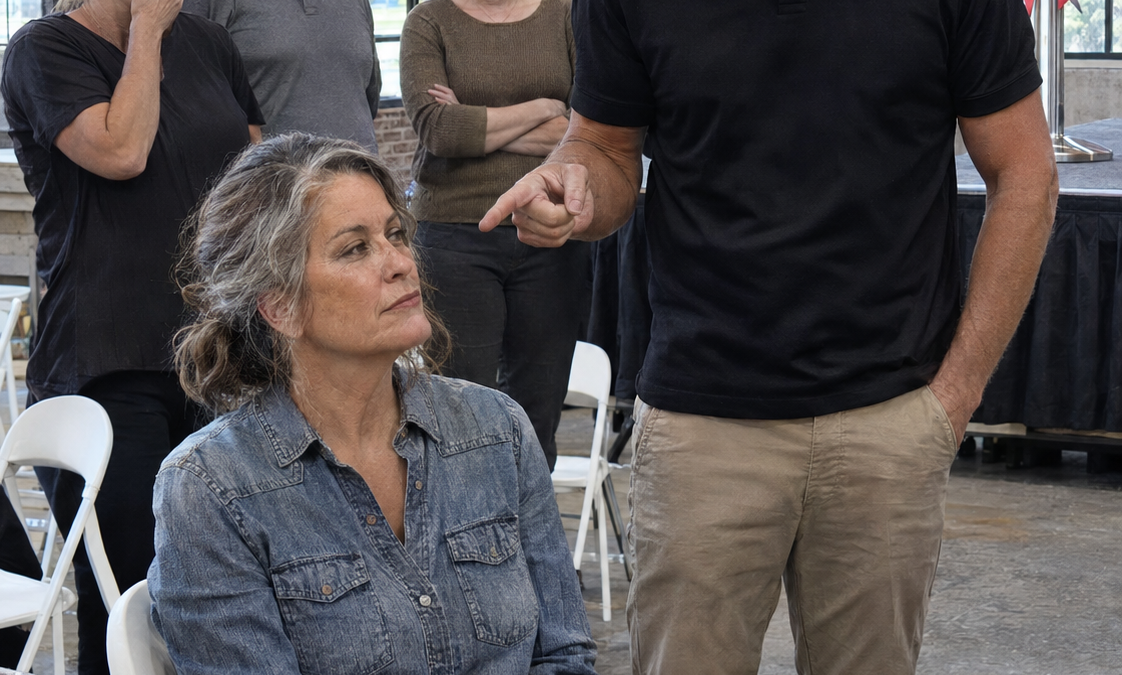
He stood over me in his new black company polo.
“You can attend as family,” he said. “From the back.”
“Did they inspect the trust schedule?”
A forklift operator stopped rubbing a stain on his sleeve.
Mitchell glanced toward the visitors beside the loading doors.
“They inspected everything that mattered.”
I rested my hands on my knees.
“Then we can wait.”
Nobody clapped.
My name was Janice Ralston. I drove long-haul for eighteen years.
I founded Prairie Lantern Supply from the cab of my own truck.
My first office had been the passenger seat of a truck.
Dad had helped me sort delivery slips at truck-stop counters.
He died before we opened our second warehouse.
Mitchell joined after the work stopped requiring overnight runs.
When he wanted an office, I gave up mine.
When he needed training, I paid his replacement during classes.
When he asked for responsibility, I handed him operations.
That appointment was nineteen days old.
Now this.
Mitchell turned back toward the microphone, still standing over my chair.
“For everyone’s benefit, we have some excellent news.”
He smiled at the same employees who had watched him dismiss me.
“Prairie Lantern is joining a national distribution family.”
A woman near the coffee urn lowered her paper cup.
“The purchase price is seven-point-eight million dollars.”
Someone started clapping, then stopped after two uncertain beats.
Mitchell looked down at me.
“This is what professional management brings to a business.”
“Which business?” I asked.
“Our business, Janice. Please don’t make this difficult.”
I looked toward the loading doors again.
Still closed.
He followed my eyes, then adjusted his collar.
“The buyers won’t tolerate interference from retired drivers.”
“I delivered to Muskogee on Tuesday.”
“That’s exactly my point.”
He returned to the table and lifted Dad’s bandana.
The red cotton hung from his fingers like a cleaning rag.
“Dad paid fourteen dollars for this at a roadside stand.”
He spread it across his palm.
“That’s your idea of a business credential.”
One corner remained folded beneath the rest.
I kept my eyes on that corner.
Mitchell put the bandana down beside the scissors.
“Sentiment doesn’t qualify somebody to run a distribution company.”
“Neither does a shirt,” somebody said near the coffee.
Mitchell’s smile tightened.
I did not turn to identify the voice.
There was no reason to give him another target.
“Let’s stay positive,” he said into the microphone.
The microphone squealed against his polo.
One guard stepped closer to my chair.
“Are you all right here, ma’am?”
“I’m fine. Please leave the aisle clear.”
He moved back.
A yellow envelope rested beneath the visitors’ sign-in book.
I had watched the receptionist place it there earlier.
Mitchell had never asked why.
He leaned close enough that only the front tables heard.
“You could have let me give you a graceful retirement.”
“I haven’t asked to retire.”
“You won’t have to.”
He straightened and addressed the room again.
“There will be changes. That includes legacy positions.”
Two warehouse workers looked toward their spouses.
The bandana stayed on the table between us.
Mitchell tapped the microphone against his thigh.
“Some people confuse starting something with owning its future.”
I checked the loading-door clock.
Four minutes past two.
A car had arrived outside the glass entrance.
I recognized the silver roof before the engine stopped.
Mitchell saw me looking and tried a small laugh.
“Your ride?”
“No.”
The entrance opened behind the last row of chairs.
A woman in a charcoal suit entered carrying a flat leather case.
I had asked her to come after Mitchell circulated his announcement.
Her name was not on Mitchell’s guest list.
She stopped beside the receptionist and accepted the yellow envelope.
Then Audrey Keene crossed the concrete floor toward my chair.
“Ms. Ralston, I’ll take it from here.”
Mitchell went pale beneath the warehouse lights.
Audrey was my Oklahoma attorney, and he recognized her immediately.
His microphone dropped an inch.
“What are you doing here?”
Audrey set her case on the display table.
I stood, but stayed below the platform.
“Mitchell invited us to a sale announcement,” I said.
“He didn’t invite outside counsel.”
“You used the company email list.”
A few people shifted in their seats.
Audrey opened her case without answering his question.
She took out a thin folder and laid it flat.
The scissors stayed where they were.
So did Dad’s bandana.
Mitchell looked from the folder to the visitors near the doors.
His eyes stopped on their matching visitor stickers.
“This is a private family matter.”
“You announced a sale to our employees,” I said.
“Now you can explain it to our employees.”
He swallowed.
For the first time that afternoon, he stepped away from my chair.
Audrey quietly slid her phone across the table toward me.
A message on its screen confirmed that our request had been received.
I nodded and pushed it back.
Mitchell watched that small movement.
“What request?”
“An accurate account,” I said.
I had no interest in another speech.
I wanted the people worrying about Monday to hear facts.
The visitors beside the loading doors finally came forward.
One carried the same glossy packet Mitchell had shown the bank.
The buyer had sent a closing representative.
Part 2 of 5
The representative wore a visitor sticker with a name too small to read.
I had never met him, and I wasn’t going to invent familiarity.
He introduced himself only as the buyer’s closing representative.
Audrey asked him to stand where the employees could hear.
Mitchell stepped between them.
“We’re not doing legal theater at a celebration.”
“You started this at a celebration,” I said.
A chair leg scraped concrete.
The woman with the coffee cup sat down again.
I could see people deciding whether they should leave.
“Please stay,” I said. “This concerns your jobs.”
That kept them.
The representative opened his packet, then stopped at Audrey’s folder.
He asked whether she had been retained by the seller.
“By me,” I said.
Mitchell gave a short, breathy laugh.
“That’s the problem. She thinks those are the same thing.”
For years, I had let him say things like that privately.
In front of vendors, I had corrected him gently.
At family dinners, I had changed the subject.
He had learned the wrong lesson from both.
My first truck cost $28,600 in 2002.
I put down $9,000 and signed for the rest.
The payment came due whether an engine started or not.
I carried tire chains, belts, fuses, and gloves for other drivers.
Eventually they began calling before I reached town.
That was the beginning of Prairie Lantern.
No grand opening.
No ribbon.
No microphone.
Just a woman answering a phone while her coffee went cold.
Mitchell had been working elsewhere then.
He used the surname of the stepfather who had adopted him.
We shared Dad, and I had never treated the different name as distance.
I paid for his first supplier conference in 2015.
The hotel cost $486 for three nights.
He came home with a plastic badge and a different way of speaking.
Customers became accounts. People became head count.
I kept the drivers’ phone numbers on paper.
He called that embarrassing.
Now he wanted those same drivers to watch me leave.
“You’re just an uneducated driver!”
He repeated it more softly, as though explaining a reasonable limitation.
Audrey’s pen stopped.
I looked at my brother’s shoes.
They were clean enough to show the warehouse lights.
“Which part of that makes the sale yours?” I asked.
He looked toward the representative.
“Tell her it’s signed.”
The man did not answer immediately.
That pause spread.
Mitchell pointed toward a framed photograph on the display table.
Dad stood beside our first truck in that picture.
The red bandana was tucked into his shirt pocket.
“She puts him on every wall,” Mitchell said.
“As if that makes every decision sacred.”
“He helped with deliveries,” I said.
“He helped both of us. You don’t own the memory.”
“No,” I said. “I don’t.”
Audrey moved the photograph away from the edge.
Mitchell watched her, then pulled his sleeve down over his watch.
The packet stayed closed.
That didn’t fit.
He had promised everyone a completed transaction.
Yet the buyer’s representative still carried a packet with loose tabs.
I had spent enough mornings at shipping counters to recognize unfinished work.
Completed loads did not need three people checking the same page.
“Were funds released?” I asked.
Mitchell smiled quickly.
“That’s not appropriate for this audience.”
“You announced the price to this audience.”
A worker near the front folded his event program in half.
Another set down the commemorative travel mug without drinking.
The representative said funds were being held pending final release conditions.
Mitchell cut in before anyone could ask what those were.
“A routine closing step.”
Audrey wrote down the phrase.
I did one practical thing.
I took the bottled water from beneath my chair and opened it.
My hands were steady enough that the plastic barely crackled.
Mitchell had wanted a fight he could call a scene.
I gave him the sound of a bottle cap.
“Look,” he said, facing the employees. “Your pay will continue.”
I screwed the cap back on.
“Under whose authorization?”
“Mine.”
He said it too fast.
The representative looked at Audrey’s folder again.
Several people noticed.
Mitchell picked up his glossy packet and opened to a marked page.
“My title is right here.”
“Operations chief,” I said.
“Executive authority.”
“Those aren’t the same words.”
He pressed his lips together and held the page higher.
A forklift operator leaned forward, then settled back without reading it.
The letters were too small from his chair.
Mitchell lowered the packet.
“I wasn’t going to mention your bonus,” I said.
His head snapped toward me.
That figure had appeared in the announcement attachment he emailed me.
I had printed the attachment that morning.
“You sent me the incentive schedule,” I added.
He glanced toward the nearest tables.
“It rewards successful transition.”
“Does it?”
Audrey laid a finger beside the date on his packet.
The closing representative read it, then turned to another page.
No one spoke while he looked.
The building’s ventilation fan clicked on overhead.
A paper ribbon tail lifted against the platform.
Mitchell shifted his attention to the security guards again.
“Could we clear the immediate area?”
Neither guard moved.
Their assignment was safety, and nobody was threatening anyone.
I had confirmed that with their supervisor before the event.
Audrey moved her case aside, uncovering the bandana.
Mitchell reached toward it, then stopped when I stood closer.
“You brought that to make me look foolish,” I said.
“I brought it because Dad would have wanted progress.”
“He liked things that could be checked.”
“He liked me, too.”
For a moment, the warehouse looked smaller around him.
“I know he did,” I said.
That answer left him nowhere useful to go.
He stared at the red cloth.
I remembered Dad ironing it flat for customer photographs.
He had bought it for fourteen dollars and complained about the price.
Then he had worn it until the cotton softened almost white along one fold.
Mitchell nudged that fold with a fingertip.
A few dark stitches showed underneath.
He stopped moving.
I stepped beside the display table, still below the ribbon platform.
Three employees at the nearest table leaned forward.
Audrey kept the folder closed.
“What did Dad sew into that corner?” Mitchell asked.
I unfolded the bandana, revealing the embroidered number of our first delivery route.
“Route 214,” I said.
The stitches were crooked where Dad had worked around the hem.
Mitchell stared down at them.
He had seen that cloth for years without opening it.
The number matched the route painted on the first truck.
Our retired dispatcher stood near the back wall.
I had invited him because he helped plan our original routes.
He had arrived early and watched every minute.
Now he came forward, leaving his untouched cake on a chair.
He stopped beside the photograph.
He was the man who had written Route 214 into our first dispatch ledger.
Part 3 of 5
Ernest Wilcox looked at Mitchell, then at the employees behind him.
“I dispatched that truck,” he said. “Your sister paid for it.”
Mitchell gave him the smile people use on a confused older relative.
“Dad started the business.”
“Your dad brought sandwiches,” Ernest said. “Janice brought the down payment.”
The smile disappeared.
Ernest had kept our original dispatch ledger after retiring.
I knew because he had asked whether we wanted it for the display.
He had brought it wrapped in a grocery bag that morning.
Now he removed the bag.
The ledger had a broken corner and coffee stains along the spine.
Nothing about it resembled Mitchell’s glossy packet.
Ernest opened to the first page.
“October 2002. First truck. First route. Her signature.”
He turned the ledger so Mitchell could see.
“My memory isn’t your evidence,” Ernest said. “The receipts are clipped inside.”
Mitchell did not touch them.
I did.
The first receipt had faded until the amount looked pale gray.
The name above it was still clear.
“Dad gave us his time,” I said. “I never claimed otherwise.”
“Then why does everyone think he owned it?”
“Because I didn’t stop every conversation to correct people.”
Ernest nodded toward the photograph.
“Your dad corrected them when he heard it.”
A woman at the nearest table looked from me to Mitchell.
Her husband had driven for us since our second year.
He was staring at his folded hands.
I set the receipt back beneath its clip.
I wasn’t going to turn Dad into a weapon because Mitchell had.
He had been useful in ways that never appeared on a balance sheet.
He remembered whose child had surgery.
He stocked the break room when snow kept drivers waiting.
He started a little program helping disabled veterans repair accessible equipment and get to appointments.
At first, it was folding tables in a borrowed garage.
Later, we paid for tools and a wheelchair-accessible van.
He never liked calling people recipients.
He called them neighbors.
After he died, I kept the program going.
Mitchell knew that much.
He had complained about the annual expense twice.
“Charity has its place,” he said now, watching Audrey open her folder.
“Sure does,” I said.
Audrey placed a schedule on the table.
The closing representative bent over it.
He read the first page without moving.
Then he turned to the second.
Mitchell tried to look over his shoulder.
“What is that?”
“The schedule I asked about,” I said.
He looked at me as if I had changed the subject.
Audrey set certified copies of recorded deeds beside it.
The representative checked the property descriptions against his own packet.
His thumbnail stopped beside one address.
Then another.
I recognized the turn of his mouth when he reached the Tulsa site.
Every warehouse was on that schedule.
The original yard.
The second warehouse.
The distribution center around us.
Years earlier, I had placed each property in an irrevocable charitable trust supporting Dad’s disabled veterans’ program.
The operating company rented the buildings under written leases.
Rental income maintained the properties and funded the program.
The arrangement had never appeared in a party speech.
It had appeared in every properly assembled financial packet.
Mitchell had received those packets when he took the operations job.
His acknowledgment sat beneath Audrey’s hand.
He had initialed without asking what he was reading.
“You can’t do that afterward,” he said.
“I didn’t.”
The representative checked the recording dates.
The earliest deed predated Mitchell’s arrival at the company.
The newest was recorded before construction started on the center.
Mitchell looked toward the ribbon.
“We built this for expansion.”
“We did,” I said. “The lease allows expansion.”
He picked up the schedule, then put it down.
“You hid the buildings?”
“I protected them.”
“From me?”
“From anyone who thought a sale price erased their purpose.”
Ernest stepped back beside the employees.
He had said what he came forward to say.
The bandana lay open now, its stitched number visible.
I left it that way.
The representative quietly asked Mitchell where he had disclosed the trust properties.
Mitchell pointed at a paragraph in his packet.
The man read it.
That paragraph described the facilities as part of the proposed business acquisition.
It did not disclose ownership by a separate trust.
A woman near the coffee table stood.
“My husband uses that van,” she said.
She meant Dad’s program van.
I knew her from the appointment calendar, but she had never spoken about it at work.
Mitchell looked toward her and then away.
“Nothing was going to change overnight.”
Her hands tightened around the back of her chair.
“That’s not an answer.”
I looked at the representative.
“Will the buyer honor the existing leases?”
He said he needed to speak with his counsel before making any commitment.
That was the first completely careful statement anyone on the buyer’s side had made.
Mitchell heard the distance in it.
He moved closer to Audrey’s folder.
“If the buildings aren’t included, we’ll adjust the price.”
The representative closed his packet halfway.
Audrey took out one final sheet and set it on top.
Mitchell read its heading.
The sale schedule excluded the controlling ownership units.
Part 4 of 5
Mitchell kept reading as though another sentence might cancel the heading.
I waited beside the table.
The employees were still in their chairs.
All seventy-two original guests had stayed, with Audrey added to the room.
The buyer’s representative had been among the invited visitors from the start.
Nobody could later pretend this had happened in a closed office.
“You own units,” Mitchell said finally. “So do I.”
“Yes.”
“Then this is a family disagreement.”
“No.”
He looked toward the representative for help.
The man had stepped far enough away that their shoulders no longer aligned.
Prairie Lantern was an Oklahoma limited liability company.
I had retained the controlling ownership units when Mitchell joined.
He had received a smaller, noncontrolling interest as part of his compensation.
His new operations title gave him authority over purchasing, staffing schedules, and distribution.
It did not give him my ownership.
It did not let him sell what the trust owned.
Those were separate facts, and he had tried to blur both.
Audrey put my signed ownership record beside the transfer schedule.
The representative compared the unit numbers.
His lips moved once as he counted.
I watched Mitchell see the gap.
The agreement he had signed described only the interest he could actually offer.
The buyer’s paperwork reserved approval until controlling ownership and property rights were verified.
Mitchell had treated that reservation like a formality.
It had been the entire lock on the door.
“You let me negotiate for months,” he said.
“You told me you were exploring supply partnerships.”
“You knew we needed scale.”
“I asked for the proposals.”
He looked down.
“You sent summaries,” I said. “You left out the sale terms.”
“They weren’t final.”
“Then why did you tell our employees they were?”
His jaw worked.
I could hear someone behind me opening a peppermint wrapper slowly.
Such a small sound, and nobody spoke over it.
The representative asked whether Mitchell had a signed authorization from me.
Mitchell pushed his packet forward.
Audrey separated two pages and turned them back toward him.
Neither bore my signature.
He looked at the doorway.
The guards stood clear of it.
For the first time, I wondered whether he might simply walk out.
Instead, he lowered his voice.
“We can discuss a settlement privately.”
“You told security to remove me publicly.”
“Janice.”
He had finally used my name without making it sound like an inconvenience.
I kept my hands on the edge of the table.
“People came here expecting to know where they worked Monday.”
“I was trying to secure their future.”
“Then let’s give them an accurate answer.”
He glanced toward the woman whose husband used the program van.
She did not look away.
The representative took a call by the loading doors.
Audrey had asked his office to arrange it before arriving.
That was why she had waited outside until the yellow envelope was delivered.
It contained the buyer’s written acknowledgment of our objection.
There had been no surprise rescue and no fortunate timing.
I had made arrangements while Mitchell ordered commemorative mugs.
He returned from the call with his phone against his palm.
The buyer would not release funds.
Its counsel had confirmed the missing controlling consent and separate property ownership.
The announcement did not make the proposed transaction complete.
Mitchell gripped the back of an empty chair.
“My bonus is in the agreement.”
The representative pointed to a condition beneath the figure.
The bonus depended on a completed, authorized sale.
There was no completed, authorized sale.
Mitchell sat down without pulling the chair out properly.
Its front legs bumped his shoes.
For several seconds, he stared at the platform he had built around himself.
I stayed standing beside the table.
Audrey placed a short written notice in front of me.
I read every line.
Mitchell watched my eyes move.
“What is that?”
“A correction.”
“Don’t do this over a misunderstanding.”
I took the pen from the table.
The same pen had been set out for ceremonial guest signatures.
My name went beneath a clear statement revoking his delegated management authority.
Another page reinstated me as managing member with sole operational control.
The documents reflected rights I had never sold.
They did not require us to invent a courtroom in a warehouse.
Audrey had confirmed the provisions and prepared the notices before she came.
Mitchell still owned his small economic interest.
He would receive whatever distributions it legitimately earned.
He would not receive a title, a microphone, or access to payroll.
“Are you firing me?” he asked.
“Yes.”
His fingers loosened on the chair.
“Today?”
“Yes.”
He looked around for a relative to interrupt.
Nobody did.
I signed the second page.
Audrey checked both signatures, then gave copies to the representative.
The guards remained near the aisle, watching quietly.
Mitchell’s phone buzzed on the table.
He glanced at its screen and tried to unlock the company app.
The access notice appeared before he could open it.
Audrey had already sent our signed instructions to the account administrator.
Mitchell’s company access ended before he could reopen the payroll screen.
Part 5 of 5
Mitchell pressed his thumb to the phone again.
The screen gave him the same answer.
He looked up at Audrey.
“You can’t erase me.”
She faced him with the signed notices resting flat on the table.
“You sold a company whose controlling owner is standing here.”
Nobody moved toward the coffee.
The microphone lay beside Dad’s bandana, still switched on.
Her sentence carried through the warehouse speakers.
Mitchell looked at me.
I did not give him a speech.
The buyer’s representative confirmed that the proposed acquisition would not proceed.
No purchase funds would be released.
No sale bonus would be paid.
Audrey delivered the revocation notice to Mitchell where he sat.
She placed the reinstatement notice beside my copy.
The company had not legally left my ownership.
What she transferred back was its management, its accounts, and the authority Mitchell had used as though they belonged to him.
The distinction took less time to explain than his announcement had.
The employees understood it.
One of the guards asked whether the ribbon cutting was canceled.
I looked at the scissors.
“No,” I said. “We still built a distribution center.”
A few shoulders lowered.
Mitchell pushed back his chair.
“This isn’t how family handles things.”
I looked at the chair he had sent me to.
He followed my glance.
His face changed, but he said nothing about the chair.
“What do you want me to do now?” he asked.
“Leave your company keys with the receptionist.”
“You’re having me escorted out?”
“No. You can walk.”
He took the keys from his pocket.
The ring carried the bright new tag he had ordered for operations.
He set it beside the unsigned ceremonial certificate.
Then he looked at the red bandana.
“Can I at least have Dad’s?”
My hand rested beside the cloth.
For once, there was no audience-ready answer available to him.
“That belongs in the truck,” I said.
He nodded once.
The receptionist collected the keys.
Mitchell walked toward the entrance without his packet.
The same seventy-two guests watched him cross the floor.
No one clapped.
I was grateful for that.
He had lost his position, his promised bonus, and his control in front of them.
He did not need a jeering aisle as well.
At the door, he paused and looked back.
I thought he might apologize.
Instead, he asked whether his personal things would be boxed.
“I’ll have them ready tomorrow,” I said.
He left.
The closing representative gathered his papers and apologized to the room for the premature announcement.
Then he left his contact information with Audrey and departed.
The ribbon still stretched between its stands.
A photographer who had been hired for the event lowered her camera.
I asked her to wait.
First, I stood where everyone could see me.
“Your next shift is unchanged,” I said.
Several people looked at each other.
“Your pay is unchanged. Your benefits are unchanged.”
The forklift operator rubbed his sleeve again.
“Who’s running operations?”
“I am, until we hire somebody qualified.”
“Do we need college for that?” he asked.
A small laugh moved through the front tables.
“We need someone who reads what they sign.”
This time, the laugh lasted.
I asked whether anyone had questions about Monday.
People did.
One wanted to know about an overdue parts order.
Another asked whether the new loading schedule still started at six.
A supervisor needed approval for temporary help.
Ordinary problems came back into the room one at a time.
I answered what I could and wrote down the rest.
Audrey closed her case.
Ernest brought the old ledger over and asked where I wanted it.
“In the office,” I said. “Somewhere people can open it.”
I picked up Dad’s bandana.
The cotton had kept the shape of the fold for so long that it resisted lying flat.
I smoothed the embroidered corner with my thumb.
Outside, our first truck waited beside the display entrance.
We had restored it for the launch, down to the cracked vinyl seat.
It no longer hauled freight, but its engine still turned over.
I asked the guests to come outside.
They gathered along the marked walkway while I opened the passenger door.
Nobody needed to crowd around.
The cab sat high enough for the front tables’ worth of witnesses to see.
I tied the bandana to the passenger-side grab handle, where Dad used to leave it between stops.
The number faced inward.
That was how he had liked it: useful to the people in the cab.
Ernest stood below the step.
“Still got the spare fuses?”
“Behind the seat.”
He nodded, satisfied.
Back inside, I asked the warehouse crew to stand with me at the ribbon.
There wasn’t room for everybody on the platform.
We stayed on the floor.
The photographer lifted her camera.
I handed the scissors to the employee who had managed the construction deliveries.
She cut the ribbon while I held the loose end away from her wrist.
Applause rose without anybody asking for it.
Afterward, the receptionist handed me the company key ring.
I separated the new operations tag from the keys and put it in a drawer.
Then I called the program coordinator and confirmed that the next van repair was still funded.
Before the last guests left, I posted the signed management notice beside Monday’s schedule.
My name stood above the opening shift.
THE END
More stories
I Was Serving Funeral Lunch When My Sister-in-Law Told Me to Pack My Husband’s Fishing Gear, Then Our Lawyer Found the Date That Undid Her Cabin ClaimMy Niece Called Me “Too Old” in Front of 21 Relatives and Tried to Take My Granddaughter at Thanksgiving, but When Six Women Walked In, She FROZEMy Niece Felicia Declared My Little Boat OUT at Our Marina Meeting, but When My Attorney Walked In, She FROZE Before the Same Owners Who Had Watched Her Humiliate MeCecily Said I Stole $600 From Our Church Pantry Before 38 People, but When the AUDIT Arrived, My Red LEDGER Held a Secret She Never Saw ComingI Paid for the Engagement Dinner Sylvia Draper Turned Into My Wine-Serving Shift, Until the Restaurant Owner Asked One Question and Her Plan to Take My House CollapsedFelicity Keene Made My Daughter Kneel to Clean Wine at Her Engagement Party, Then Her Fiancé Recognized a Bracelet and Ended the Night Without a Bride
You Might Also Enjoy

My Daughter-In-Law Told Me To Stay Elsewhere While Strangers Took My Condo — Then I Pushed Back







