My Daughter-in-Law Sabrina Handed Me a Bus Tub at My Retirement Dinner, but the Employee Votes I Carried Cost Her the $900,000 She Expected From Selling the Company
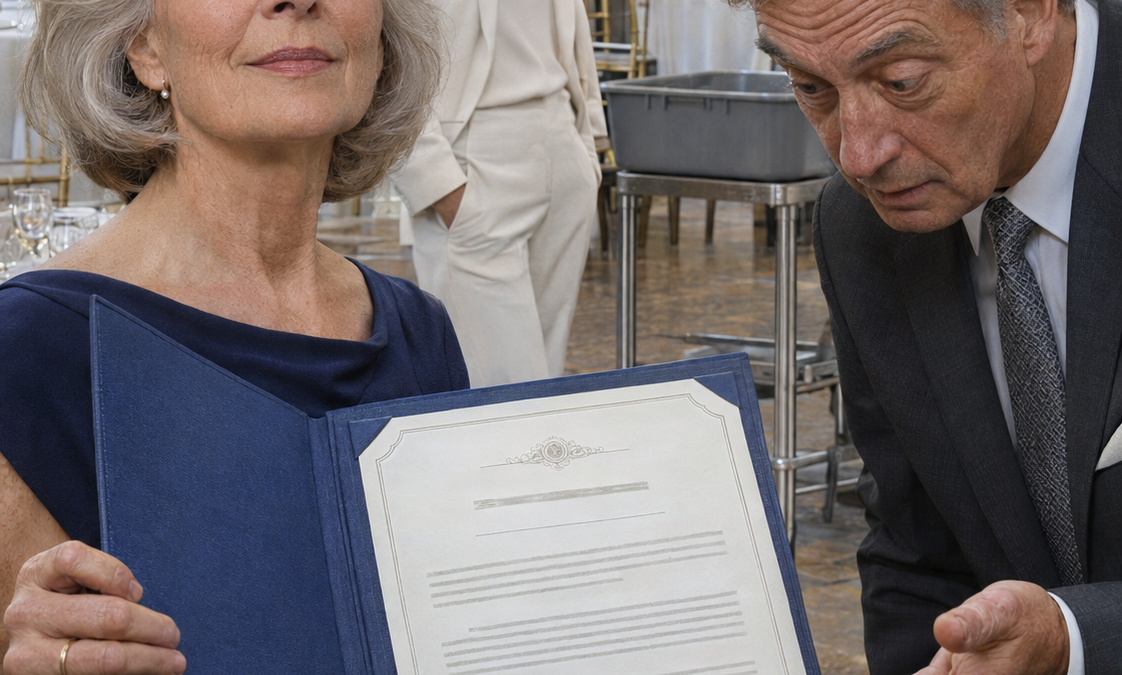
Part 1 of 5
“Let’s thank her for knowing where she belongs.”
My daughter-in-law pushed a gray bus tub into my hands before anyone finished clapping.
Sabrina Keaton, our CEO, wore a white pantsuit. I wore the navy dress I had bought for my retirement dinner.
Behind us, 120 employees and investors sat beneath the anniversary banner for Stillwater Component Works.
I was sixty-two. After twenty-eight years running its cafeteria, I knew exactly how much that empty tub weighed.
Sabrina held one edge against the podium until I had both handles.
“Just the head table first,” Sabrina said. “We’re running behind.”
A server stood ten feet away with a rolling cart. His hands stayed on its rail.
On the screen beside the podium, Sabrina’s presentation showed a box labeled executive transaction payment. It was hers, if the sale closed.
Inside the box was $900,000.
Under it sat the proposed sale price of the company.
My name was still on the retirement slide behind that window. Someone had forgotten to close it.
I looked at the tub, then at my daughter-in-law.
“Is my part of the program finished?”
“Your contribution speaks for itself,” Sabrina said.
The microphone caught every word.
At the nearest table, Etta Raines put down her fork without taking a bite.
Etta had worked first-shift inspection for nineteen years. I knew her by the soup she bought when her dentures bothered her.
Across the aisle, Leon Hobbs folded his napkin into a square.
He maintained the milling machines. His right thumbnail had been black since February.
Nobody reached for a plate.
Sabrina smiled toward the room.
“Dorothy has always been happiest taking care of the practical things.”
I had spent the afternoon making sure the practical things were in order.
My blue binder lay on the chair beside the podium.
A ribbon from the retirement gift basket had fallen across its cover.
I moved the ribbon with one finger.
“Leave that,” Sabrina said quietly. “We can take your things out afterward.”
The outside board chair, Wallace Denton, sat at the end of the head table.
At sixty-seven, he still wrote meeting notes with a sharpened pencil.
He turned his program over and looked toward the sound technician.
The technician lowered the background music.
Sabrina tapped the microphone.
“Before dessert, I’d like to finish our overview of the acquisition.”
No one had announced an acquisition was finished.
The shareholder meeting was scheduled for nine the next morning.
That time appeared on the printed program, below the anniversary dinner and above the breakfast buffet.
I had circled it before leaving home.
Sabrina pointed toward the screen.
“This is how we protect the next chapter.”
An investor lifted his glass. Nobody at the employee tables followed him.
I shifted the tub against my hip.
Its bottom pressed a crease into my dress.
Sabrina leaned close enough that only I should have heard.
“Please don’t make this awkward for Joel.”
My son was at a service call in Cincinnati. He repaired commercial refrigeration and had warned us he might miss dinner.
“Joel isn’t holding the tub,” I said.
Sabrina’s smile stayed fixed.
A woman at the back coughed into her napkin.
I could have carried the dishes. I had carried thousands.
What I would not do was help Sabrina turn that work into a warning for everybody watching.
The employee tables were arranged behind the investors.
From the podium, the people who made the parts looked like an audience for the people who financed them.
That had not been the arrangement on the seating chart I helped print.
I had seen Sabrina moving place cards at five.
Now Etta’s chair stood partly behind a support column.
Leon could see the screen only by leaning sideways.
I looked at the server beside the cart.
“Are these tables assigned to you?”
“Yes, ma’am.”
“Then I won’t get in your way.”
Sabrina tightened her hand on the other handle.
“It’s a small favor, Dorothy.”
“Then somebody whose shift hasn’t ended can handle it.”
A spoon struck a plate near the kitchen doors.
Sabrina’s fingers opened.
For a second, I held the whole thing.
Wallace set his pencil down.
I could hear the ventilation fan above the service entrance, the same uneven hum I had reported twice that spring.
The room waited for me to carry the tub away.
Sabrina tipped her chin toward the dirty plates.
I set the tub on the empty service stand beside the podium.
Carefully. Plastic makes a surprising amount of noise when someone wants you to drop it.
Then I put my hand on the blue binder.
Sabrina looked at the cover.
“We have a presentation to finish.”
“I know.”
“Could you take your seat?”
“In a minute.”
Wallace pushed his chair back an inch.
“Is there a problem?”
Sabrina answered before I could.
“Nothing that needs the board’s attention.”
He looked at me instead.
I had served Wallace coffee at six different board lunches.
He always brought his cup back to the counter and asked where the grounds belonged.
I had never mistaken that for friendship.
I did consider it useful evidence of how a man behaved when nobody important was watching.
“The program gave me three minutes,” I said.
Sabrina glanced at the clock over the kitchen doors.
“You’ve had considerably more than that.”
“Yes,” I said. “But I haven’t used mine yet.”
Wallace reached for the microphone resting beside his plate.
“Then let’s allow her to finish.”
Part 2 of 5
Sabrina took half a step away from the podium.
I kept the binder shut.
There were things to say before I opened it, and none required raising my voice.
“When I started here, we had forty-three people and one refrigerator that only shut with a wedge under the front.”
Leon nodded.
“Still got the wedge,” he said.
A few people laughed into their glasses.
“The refrigerator is gone,” I said. “Leon saves everything useful.”
“Costs less than buying it twice.”
That sounded like the factory I knew.
Our company made machine parts in Dayton, Ohio. Housings, couplings, pieces most people never noticed until something stopped working.
The cafeteria windows looked onto the employee parking lot.
For twenty-eight years, I had watched people sit in their cars before coming inside.
Some needed five minutes after a doctor’s appointment.
Others needed enough heat in the car to loosen their hands.
I learned to leave the coffee on.
Sabrina touched the remote.
“Those relationships are exactly what a larger organization can help preserve.”
The screen advanced.
A slide titled Operational Integration replaced the payment box.
Under staffing efficiencies sat a number: 38 positions.
Nobody clapped.
“Does that mean jobs?” Leon asked.
Sabrina held the remote against her palm.
“Those are preliminary projections.”
“Jobs,” he said again.
“The buyer will make its own operational decisions.”
I watched Etta reach into her purse.
She took out a folded sheet, smoothed it against the table, and stopped.
That morning, the same paper had been beside her lunch.
At eleven twenty, she had come through my line carrying a turkey sandwich from home.
“Can I sit before I buy anything?” Etta asked.
“You can sit without buying anything.”
“Good. I may need the sandwich money.”
She laid the sale summary next to her thermos.
The buyer, Ridgeway Industrial Partners, wanted our facility and customer contracts.
Its draft operating plan also listed duplicate functions, shift consolidation, and outsourced food service.
Etta put a finger on one paragraph.
“Does duplicate mean they get rid of one?”
“It means they believe two people or departments do the same work.”
“Which one goes?”
“The summary doesn’t say. The operating plan gives them room to choose.”
She unwrapped half her sandwich.
“Why don’t they just print that?”
“Long words fit smaller decisions around the hard ones.”
During the previous months, people had brought documents to my tables because the cafeteria stayed open between shifts.
I never charged for a chair.
When a sentence required a lawyer, I wrote down the question instead of pretending I knew the answer.
The company had provided independent counsel for employees reviewing the sale.
We sent questions together and posted the written answers beside the vending machines.
Sabrina had walked past those pages every morning.
Once, she stopped beside my cash register.
“Lunch is supposed to be a break.”
“It is.”
“Then perhaps stop giving people homework.”
“They bring it.”
Sabrina picked up a packet someone had left by the mustard.
“You’re not qualified to interpret a transaction.”
“I’m qualified to ask what a sentence means.”
She set it down upside down.
At dinner, the same sentence was on the screen in larger type.
Thirty-eight positions.
That did not include the cafeteria contract. I had checked.
My own retirement date had been set in January, before the buyer’s offer arrived.
I was leaving on Friday whether this sale happened or not.
The people sitting behind the column had no such choice.
Sabrina clicked past the staffing slide.
“We’ll have time for questions tomorrow.”
Wallace lifted his pencil.
“Leave that slide up, please.”
“The next one explains the transition resources.”
“Then we can return to it.”
Sabrina clicked backward.
A chair scraped near the rear wall.
One of the machinists leaned forward, elbows on his knees.
I looked down at my dress.
The hem was straight. I had checked it in the cafeteria restroom before coming upstairs.
My husband had died six years earlier. I was widowed, and buying a dress without his running commentary still took longer than it should.
Joel had offered to help.
Then Sabrina sent him a link to something beige and called it appropriate for a support employee.
I bought navy.
At four that afternoon, Joel called from beside a broken walk-in freezer.
“Save me a piece of cake, Mom.”
“I’ll ask the kitchen.”
“Sabrina says there’s a tribute.”
“That’s what the program says.”
“You’ll let them make a fuss for once?”
“I’ll stand where they tell me.”
That part, at least, had happened.
Now Sabrina lowered her voice.
“Family disagreements do not belong at a company event.”
“I’m talking about the company.”
“You’re holding up dinner.”
A server came through the swinging door with a tray of cake.
Wallace raised one hand, asking him to wait.
Then he looked at the binder beneath my palm.
“Dorothy,” he said, “what did you bring?”
Part 3 of 5
“The original,” I said.
Sabrina put the remote on the podium.
“An original what?”
I lifted the binder from the chair and laid it flat beside the microphone.
The cover was blue cloth, worn a little at the corners, with the employee trust’s embossed seal near the bottom.
I had kept it inside a grocery bag on the way from the parking lot because rain was coming across Dayton.
Now the bag sat folded beneath my chair.
Sabrina reached toward the binder.
“If this is a cafeteria invoice, payroll can handle it Monday.”
“It isn’t.”
I opened the cover.
The first page rested under a clear sleeve.
Wallace stood before I could turn it toward him.
He had served on the committee that approved that seal years earlier; he recognized it from the trust’s annual reports.
His chair struck the wall behind him.
Sabrina turned toward the sound technician, but Wallace already had his own microphone.
He looked from the seal to the document inside.
Then he asked, clearly enough for the back tables to hear:
“Are you here tonight as the employees’ voting trustee?”
“Yes,” I said.
Sabrina’s hand stopped above the podium.
Wallace held out his palm.
“May I examine the appointment?”
I turned the binder toward him.
“Hourly employees elected me last week,” I said. “After the lunch meetings.”
Etta stood, keeping one hand on the back of her chair.
“We needed someone who would stay until the questions were answered.”
Over the past three months, we had worked through the sale documents one section at a time.
Lunch breaks were twenty-five minutes. We kept a list so second shift could pick up where first shift stopped.
At first, people asked me to read aloud while they ate.
Then they asked me to keep the questions organized.
When the trust announced its scheduled trustee election, Etta put my name forward.
I asked whether a retiring employee could serve.
Independent trust counsel answered in writing: yes, under our trust agreement, for the remainder of the elected term.
That letter was behind the appointment.
“The election administrator certified the result yesterday,” I said.
Wallace checked the next page.
Sabrina leaned toward it.
“Why wasn’t I notified?”
“The certification went to the corporate secretary,” Wallace said. “The receipt is attached.”
He moved his finger down the page without covering the signature.
“Your signed acceptance?”
“Here.”
I lifted the clear sleeve.
“My appointment became effective at three this afternoon.”
Sabrina looked at the clock again.
It was eight fourteen.
“You should have disclosed this before tonight.”
“The secretary received my acceptance at three oh six,” I said. “I brought the original because tomorrow’s meeting requires it.”
Wallace nodded.
His name appeared on the agenda as presiding chair. That was why I had wanted the binder within reach.
Sabrina looked past us toward the investor tables.
“This does not change the strategic merits of the transaction.”
Wallace closed his program.
“It changes who is authorized to vote the trust’s shares.”
“How many?” someone asked from the back.
I waited while Wallace checked the share schedule attached to the appointment.
Then I answered.
“The employee trust controls fifty-four percent of the company’s voting shares.”
Leon stopped folding his napkin.
Etta sat down slowly.
They knew the percentage from our meetings. Hearing it through the microphone made several investors reach for their folders.
Sabrina stepped closer.
“The trust owns shares for employees’ retirement accounts. That isn’t permission to run the company from the lunchroom.”
“No,” I said. “It’s permission to cast the votes assigned to the trustee.”
Wallace turned to the tab marked Voting Direction.
“The proposed sale requires shareholder approval tomorrow,” he said.
“Yes.”
He read the certification, then compared its date with the appointment.
I kept my hands on the podium.
“The employees formally instructed me to vote against it,” I said.
An investor asked, “Is that an advisory poll?”
Wallace shook his head.
“Under this trust agreement, this transaction is subject to participant direction. These are certified instructions.”
He looked toward me.
“You have the counsel’s confirmation?”
“Behind the green tab.”
He found it.
Sabrina pressed the remote until the screen went black.
For a few seconds, all I could see on it was the reflection of our three figures.
Then I pointed to the presentation laptop.
“Please put the transaction payment page back up.”
“That’s an employment matter,” Sabrina said.
“It’s in the shareholder disclosure packet,” Wallace said. “You presented it tonight.”
The technician waited for Sabrina.
She gave one short nod.
The $900,000 box returned.
Wallace read the small print beneath it.
“Payable only upon closing,” he said.
I looked toward the employee tables.
“If the sale doesn’t close, that payment doesn’t exist.”
Sabrina picked up her water glass but did not drink.
Nobody cheered.
The servers remained by the kitchen doors, holding plates that had begun to tilt.
I looked at Wallace.
“Those are the documents I brought.”
He returned the binder.
“We will verify the originals before the meeting opens.”
“Eight thirty?”
“That will be sufficient.”
Sabrina moved toward me.
“We need to discuss this privately.”
“Tomorrow’s vote is at nine.”
“I said privately.”
Wallace put his pencil inside his program.
“Any discussion concerning the trust’s voting instructions should include its counsel.”
I closed the binder.
Then I stepped away so the waiting server could finally put down the cake.
Part 4 of 5
Sabrina followed me into the corridor outside the banquet room.
The service door swung behind us.
Through its round window, I could see Wallace speaking with the corporate secretary, who had brought the meeting records.
“Did you arrange that?” Sabrina asked.
“Arrange what?”
“The spectacle.”
“I brought the original documents.”
“You could have told me you were elected.”
“I told the office responsible for receiving it.”
Sabrina folded her arms.
“You understand what losing this buyer means.”
“I understand what the papers say.”
“Without investment, those jobs are not guaranteed either.”
“No one at lunch said they were.”
That was the part Sabrina kept skipping.
We had not promised one another that voting no would repair an aging press or bring back a lost customer.
The company needed equipment. Health insurance cost more every year.
People had asked about those things in the cafeteria, too.
They had asked whether there were alternatives to a buyer whose operating plan began by cutting their names off a roster.
Sabrina pointed through the banquet room window.
“Some of those investors have been waiting years for liquidity.”
“Then they can vote their shares.”
“You’re making this sound simple.”
“The vote is simple. The work afterward won’t be.”
Her phone lit up.
Joel’s name appeared on the screen.
Sabrina turned it face down.
“You’re putting me in an impossible position with your son.”
“Joel didn’t appoint me.”
“You could at least think about the family.”
“I did. I told the election administrator we were related.”
That disclosure was in the binder, too.
Trust counsel had reviewed it before my name went on the ballot.
I would vote under the employees’ certified direction, not make a personal choice about Sabrina’s proposal.
She looked at my hands.
I had a faint burn near my wrist from a steam pan.
“You spent your entire career serving lunch.”
“Yes.”
“This is outside your experience.”
“Then it’s good the instructions are written down.”
The corridor door opened.
Wallace came out with the corporate secretary, a woman carrying two document cases.
“Trust counsel is available by telephone,” Wallace said. “We can complete preliminary verification now.”
Sabrina lowered her arms.
“I want corporate counsel on that call.”
“They’re already joining.”
We used a small conference room beside the coat check.
I sat at one end with my binder open.
Sabrina took the other end.
Nobody asked me to surrender my appointment. The secretary copied it, compared the signatures, and placed the original back in its sleeve.
The lawyers discussed notice periods, the share register, and the voting threshold.
When somebody used a term I did not know, I asked.
At nine twelve, Wallace placed both palms on the table.
“The meeting will proceed as noticed. No vote will be taken tonight.”
Sabrina looked toward the speakerphone.
“Can the voting direction be reconsidered before morning?”
Trust counsel answered.
“Only through the procedures in the agreement. There is no authorized shortcut available tonight.”
I put the green tab back where it belonged.
Wallace gave me a copy of the verification checklist.
“Bring this at eight thirty.”
“I will.”
Outside, the dinner guests were collecting coats.
Etta waited near the elevator.
“Are we still meeting tomorrow?”
“Yes.”
“Should we come?”
“It’s a shareholder meeting. The attendance instructions are in your packet.”
“I know. I mean, do you want us there?”
“I want you where you choose to be.”
Etta adjusted the strap of her purse.
“Then I’ll be there.”
Leon came up carrying a covered plate.
“Kitchen saved you cake.”
Under the clear lid was a corner piece with blue icing.
“Did you have to ask?”
“Three times. They thought somebody else had it.”
I took it home.
Joel’s truck was in my driveway when I arrived at ten.
He stood when I came through the kitchen door.
“Sabrina called.”
“I saw your name on her phone.”
“She said you surprised her with a vote.”
“The vote is tomorrow.”
“What happened tonight?”
I put the cake on the counter and described the tub.
Then I gave him the exact words Sabrina had said into the microphone.
He looked at the bakery label on the lid.
“She said it was a joke.”
“Nobody laughed.”
Joel pulled out a chair.
“Do you want me to call her?”
“That is between you and your wife.”
“What can I do for you?”
“Check my alarm. I need to leave by seven forty-five.”
He picked up my phone, checked both alarms, and set it beside the binder.
Part 5 of 5
At eight twenty-eight the next morning, I signed the attendance register downstairs at the factory.
I wore gray slacks, a clean blouse, and the same low shoes.
The blue binder rested under my arm.
Outside the conference room, Sabrina stood beside a representative from the buyer.
Her white pantsuit had been replaced by a dark jacket.
She looked at the binder before looking at me.
“Good morning,” I said.
Sabrina nodded.
Wallace met me at the door.
The originals were checked against the copies made the night before.
At eight forty-one, the secretary placed a voting card in front of me.
The employee trust’s name appeared above the share total.
I checked it against the schedule.
“Correct?” Wallace asked.
“Yes.”
Employees filled the visitor seats along the wall.
Etta had taken the morning off. Leon came in wearing his work shirt, with permission to attend before returning to maintenance.
Neither spoke to me.
This was not a room for a victory speech.
On the table lay a proposal that would change the ownership of the place where they earned their living.
At nine, Wallace called the meeting to order.
The secretary confirmed the quorum.
Corporate counsel explained the approval requirement stated in the company’s governing documents.
More than half of all outstanding voting shares had to support the sale.
Sabrina presented the buyer’s offer.
This time, she stayed on the financial pages.
When the staffing plan came up, Wallace asked that it remain in the record.
“It is included in the materials,” Sabrina said.
“Then there should be no difficulty.”
The buyer’s representative spoke about equipment purchasing and access to larger contracts.
An investor asked about timing.
Another asked whether the offer could be extended.
The representative said the buyer would evaluate its position after the vote.
Wallace turned to me.
“Any question from the employee trust?”
“One.”
I looked at the buyer’s representative.
“Does your current plan still authorize eliminating the thirty-eight positions shown in the disclosure?”
“Yes,” he said. “Subject to operational review.”
“Has that provision been withdrawn?”
“No.”
I sat back.
Sabrina straightened the pages in front of her.
Wallace asked whether there were further questions.
No one raised a hand.
Then the voting began.
There was nothing theatrical about it.
No gavel striking at just the right second. No music leaking through a wall.
I marked the card according to the certified direction in my binder.
Against.
I signed beneath the employee trust’s name and handed it to the secretary.
She checked my authority one final time.
Wallace waited while the votes were counted.
Sabrina watched the secretary’s calculator.
At nine forty-three, Wallace read the result.
The employee trust’s fifty-four percent had been cast against the proposal.
The remaining voting shares had been cast in favor.
The sale failed.
Sabrina reached for her glass, then folded her hands instead.
“Is that final?” the buyer’s representative asked.
“For this proposal,” Wallace said. “The required shareholder approval has not been obtained.”
He asked the secretary to record the result.
I closed my binder.
An investor leaned toward corporate counsel.
“And the executive payment?”
“The closing condition was not satisfied,” counsel said. “No transaction payment is due.”
Exactly $900,000 disappeared from Sabrina’s expected proceeds.
No one took her salary.
Nobody ordered her out of her office.
She remained CEO, responsible for running the company whose employees had refused this particular sale.
Wallace scheduled a board work session to review equipment financing and other options.
The factory still needed a replacement press.
The insurance renewal still waited on somebody’s desk.
But the buyer would not be using this agreement to eliminate thirty-eight jobs.
At ten eleven, the meeting adjourned.
Sabrina caught up with me beside the elevator.
“Are you satisfied?”
“The instructions were carried out.”
“That’s all you have to say?”
“I’m going downstairs.”
She stayed beside the conference room.
On Friday, I finished my last cafeteria shift.
I counted the register, labeled the spare keys, and showed my replacement which breaker controlled the coffee urns.
Etta came through with exact change.
“Any regrets?”
“I should have bought these shoes sooner.”
She looked down, then slid her tray along.
At one thirty, the kitchen staff brought out another cake.
This one said simply, Thank you, Dorothy.
Joel arrived before we cut it.
He set a bunch of grocery-store flowers beside the register and asked where he could wash his hands.
Our marriage discussions, he had told me, were staying between him and Sabrina.
I had asked for nothing else.
The trust records went into a locked cabinet in the company office. My retirement did not end my elected term.
Before leaving, I gave the secretary my home number again.
Then I returned to the cafeteria for my coat.
The same server from the dinner was helping clear the cake plates.
He reached for a gray tub.
“Want me to get yours?”
“Please,” I said.
I handed him my empty plate, took the flowers from Joel, and walked out through the employee entrance.
THE END
More stories
My Daughter-in-Law Told Me to Serve Champagne at the Gala Where I Was a Guest, Then My Signature Cost Her the Head-Table Chair and Her Museum JobI Was Serving Funeral Lunch When My Sister-in-Law Told Me to Pack My Husband’s Fishing Gear, Then Our Lawyer Found the Date That Undid Her Cabin ClaimI Paid for the Engagement Dinner Sylvia Draper Turned Into My Wine-Serving Shift, Until the Restaurant Owner Asked One Question and Her Plan to Take My House CollapsedFelicity Keene Made My Daughter Kneel to Clean Wine at Her Engagement Party, Then Her Fiancé Recognized a Bracelet and Ended the Night Without a BrideI Was Brooke’s Unpaid Kitchen Helper at My Grandson’s Christening Until Her Father Recognized My Scar and Discovered the House Deed She Wanted Me to SignMy Sister Dropped My Daughter’s 42-Square Memory Quilt Into a Birthday Fire—Then a Teenager’s Phone Captured the Proof That Made Her Hand Back the Keys
You Might Also Enjoy

My Daughter-In-Law Told Me To Stay Elsewhere While Strangers Took My Condo — Then I Pushed Back







