My Ex Duncan Called Me a “Discount Parent” at Our Daughter’s Roller Party—but His Smile Disappeared When the Man Beside My Bench Announced My Usual TABLE Was Ready
Part 1 of 5
“You’re a discount parent!”
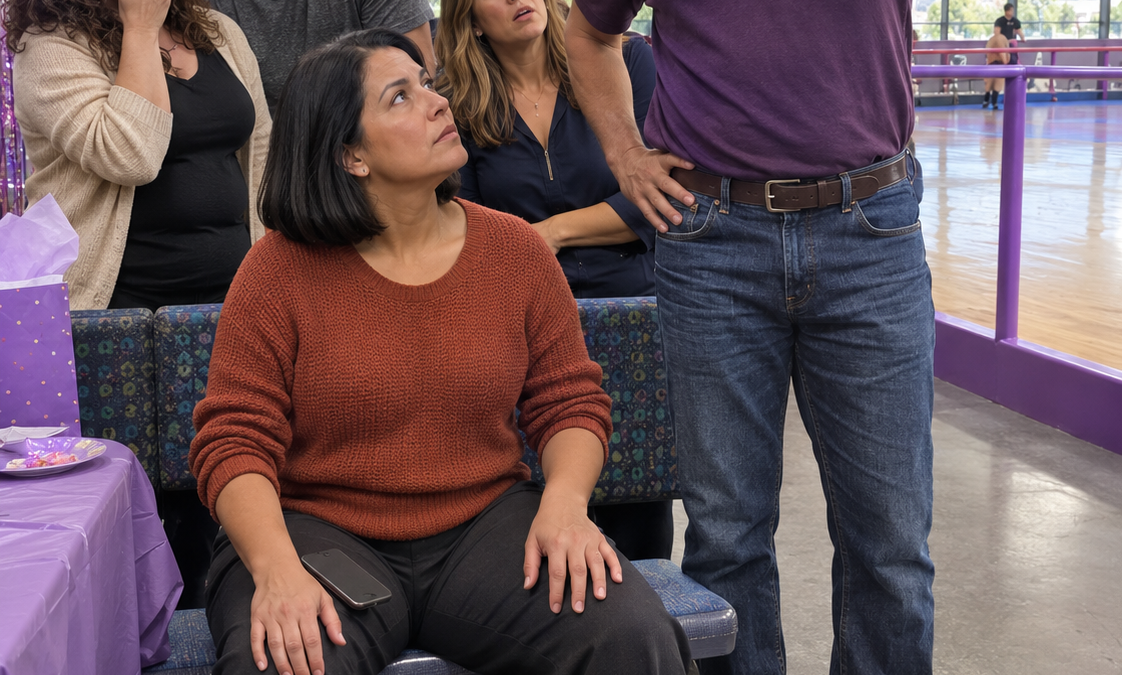
Duncan stood over my bench at the Albuquerque roller rink.
Twenty-seven parents and relatives watched him order me toward the exit.
My father’s scuffed rental skates sat beside my shoes.
“Get up,” Duncan said. “This seating is for invited guests.”
Behind him, our daughter’s birthday cake waited beneath purple streamers.
Aubrey had turned twelve that morning. Her candles remained in their box.
I stayed seated.
“Does your package include the building?”
One paper cup stopped halfway to a woman’s mouth.
Duncan looked around, expecting somebody to smile with him.
Nobody did.
“It includes the party,” he said. “Which I paid for.”
The wheels beneath a passing child whispered across the floor.
I moved my father’s skates away from the aisle.
Their leather tongues had curled inward over the years.
A faded twelve-dollar rental sticker clung to one heel.
“Those belong in the trash,” Duncan said.
I straightened a lace.
My father had taught neighborhood children here on Saturday mornings.
He had knelt beside loose wheels and tied unfamiliar shoes.
Parents paid twelve dollars for rentals; his lessons cost nothing.
After he died, I kept the skates he always borrowed.
Aubrey had asked me to bring them for her birthday photograph.
That was why they occupied the bench beside me.
That was why I had come early.
Duncan glanced toward the party counter, where his new wife stood.
She had recently become the rink’s events manager.
Her laminated name card still looked freshly printed.
“My wife handled everything,” he said. “You could at least respect that.”
“I brought the candles.”
“You were supposed to drop those off.”
“That wasn’t our agreement.”
His jaw moved once before he answered.
“Don’t do this here.”
I looked at the adults gathered around the bench.
He had chosen here.
Aubrey stood near the skate gate, holding her purple helmet.
I wanted her back with her friends, away from this conversation.
“Go finish your lap,” I told her.
“Are you leaving?”
“No.”
She watched my face before setting her helmet on.
Duncan stepped sideways, keeping himself between me and the party tables.
He had dressed for photographs: purple polo, pressed jeans, polished watch.
At forty-six, he still checked windows for his reflection.
“I bought the premium package,” he said. “Twenty-eight hundred dollars.”
A relative lowered her phone.
“That gives me control over the guest list.”
“Does the agreement say that?”
“My wife wrote the booking.”
“That wasn’t my question.”
A skate wheel clicked against the gate behind him.
His wife came closer, carrying the party folder against her chest.
She stopped outside our conversation, close enough to hear.
I recognized the blue folder from the events desk.
A white correction label covered part of its spine.
That label interested me.
Duncan followed my glance and mistook it for hesitation.
“You can have another birthday with her,” he said.
“She has one birthday.”
“You know what I mean.”
I did.
He wanted a clean photograph without me at its edge.
Aubrey rolled past with two friends, looking toward our bench.
I smiled until she looked ahead again.
“Don’t make her choose a side,” I said.
“Then stop creating a scene.”
A woman beside the gift table shifted her purse.
Duncan raised his voice enough to include her.
“You’re a discount parent!”
This time, nobody pretended not to hear.
I set both feet flat beneath the bench.
My phone rested inside my sweater pocket, its screen facing inward.
I didn’t reach for it yet.
“Please lower your voice.”
“Please leave.”
His wife looked toward the office hallway.
I had noticed that glance earlier, when I first arrived.
Someone back there already knew I was on the bench.
Someone had seen the skates.
Duncan tapped the face of his watch.
“We’re losing party time.”
“The children are skating.”
“The adults are waiting.”
“They can sit down.”
But he wanted witnesses standing, arranged around his purchase.
I knew that posture from quieter rooms.
In court, a raised voice often arrived before a missing fact.
I worked as an interpreter. I waited for complete sentences.
Across the rink, the office door opened.
A gray-haired man stepped into the hallway.
Duncan didn’t see him until several guests turned their heads.
The man wore a striped rink shirt and black trousers.
He approached without hurrying, his shoes quiet against the rubber floor.
I recognized the folded reservation slip tucked beneath his arm.
He stopped beside my bench.
“Your usual table is ready, ma’am.”
Duncan’s smile disappeared.
The gray-haired man waited for my answer, ignoring the space Duncan occupied.
“Thank you,” I said. “We’ll stay here for a minute.”
“Certainly.”
Duncan looked from him to me.
“Her usual table?”
The man’s gaze settled on the skates, then returned to my face.
He didn’t explain.
That restraint cost Duncan more than an argument would have.
A guest moved away from the exit.
Another pulled a chair toward the birthday table.
The little audience Duncan had arranged began choosing its own positions.
“Is there a problem with the booking?” the man asked.
Duncan straightened.
“No. Just somebody who isn’t on our list.”
“I’m her mother,” I said.
Nobody needed that explained.
Still, I wanted the words spoken where Aubrey could hear them.
She had stopped at the gate again.
The gray-haired man noticed her and softened his voice.
“Your cake table is all set.”
Aubrey nodded but didn’t move.
Duncan turned toward his wife.
“Would you show him our package?”
She opened the blue folder.
A loose sheet slid against its clear cover.
I could see a handwritten addition near the bottom.
My name stood beside a box nobody had checked.
Part 2 of 5
The woman holding the folder was Stella Benton, Duncan’s new wife.
I had met her twice before this party.
Both times, she had called me “the weekday parent.”
Until that afternoon, I had treated it as clumsy conversation.
Now I looked at the unchecked box.
“May I see that page?”
“It’s an internal worksheet,” Stella said.
“Then tell me what the box means.”
Duncan answered instead.
“It means we didn’t include you in the adult seating.”
“Who told Aubrey?”
“She doesn’t need every detail.”
I was April Salazar, forty-four, a court interpreter in Albuquerque.
Details were how I paid my bills.
Details were also how children learned which adults they could trust.
I didn’t move.
My father, Edmund Navarro, had worked maintenance for an apartment complex.
On weekends, he came here with a canvas bag of spare laces.
I had used my mother’s surname since childhood.
He never needed us to match on paper.
“People know whose kid you are,” he used to tell me.
He died nine years before that birthday.
Aubrey had been three.
She remembered his whistle more clearly than his face.
For years, Duncan said that made the skates unnecessary.
I kept them anyway.
When he bought a fishing boat, I paid the preschool balance.
When he missed conferences, I brought home the teacher’s notes.
When he called twice a month, I passed Aubrey the phone.
Those weren’t things I intended to recite beside her birthday cake.
I had kept receipts for taxes, not for applause.
But Duncan had built his speech around a false accounting.
According to him, payment made a parent.
According to him, my smaller visible purchases meant less.
Our divorce had become final four years earlier.
The parenting schedule said we shared birthdays by agreement.
His message about this one still sat in my phone.
Bring the candles. She wants you there.
I had answered with a purple heart for Aubrey.
That was all.
A woman near the gift table looked down at her own screen.
Perhaps she was checking a message.
Perhaps she was giving me somewhere private to look.
I appreciated either possibility.
Duncan wanted a different kind of audience.
“Tell her what I paid,” he said to Stella.
“You already did,” I said.
“The premium package has reserved seating,” Stella said.
“For how many?”
She glanced at the worksheet.
“Enough for the invited adults.”
“That isn’t a number.”
The gray-haired man waited beside the end of the bench.
He hadn’t introduced himself because I already knew him.
Stella knew him, too.
Her fingers tightened around the folder.
She wouldn’t meet his eyes.
That was the detail.
Not the price. Not the blank box. Her eyes.
Duncan noticed only that she wasn’t supporting him quickly enough.
“Show her the list.”
Stella turned the worksheet outward.
My name had been written in pencil under “special arrangements.”
Beside it were the words: candles only; no meal.
Aubrey could have read them from the gate.
I shifted my body to block her view.
Then I took out my phone.
One practical thing.
I opened my saved records and searched the rink’s street address.
Duncan watched my thumb move.
“Calling somebody won’t change the reservation.”
“I’m checking something.”
“Check it outside.”
“No.”
The word didn’t need a louder voice.
Across the floor, the music changed to another skating song.
The children kept moving in their loose, uneven circle.
One instructor stayed near them so the adults could remain here.
He had seen the cluster and quietly covered the gate.
There was nothing accidental about the way staff protected children here.
My father had taught that lesson long before I could afford much.
Stella closed the folder.
“We could add a chair,” she said.
Duncan turned sharply.
“We discussed this.”
“Duncan.”
“We discussed exactly who would be here.”
Aubrey rolled through the gate and stopped beside the bench.
She didn’t reach for either parent.
“Did you tell Mom she couldn’t eat?”
“No one said that,” Duncan answered.
I looked at the folder beneath Stella’s hand.
Aubrey followed my eyes.
“Please go wash up before cake,” I said.
“Are you still going to be here?”
“Yes.”
This time, she believed me enough to leave.
A relative followed her toward the restroom hallway.
That small kindness kept my voice steady.
The phone took longer to load than it usually did.
The building’s thick walls interfered with reception near the floor.
I connected to the guest network.
Duncan folded his arms.
“You’re making this bigger than it is.”
“You asked me to leave our daughter’s birthday.”
“I asked you to respect the person paying.”
“The person paying should read what he bought.”
His cheeks tightened.
Stella glanced at the gray-haired man again.
He remained still, giving me the choice to speak first.
The county page finally opened.
I enlarged the top section and turned the screen outward.
“Read the owner’s name.”
The property record on my phone listed me, April Salazar, as the rink’s owner.
Duncan leaned closer without taking the phone.
Stella’s folder lowered against her leg.
“Scroll down,” he said.
The purchase date appeared beneath my name: nine years earlier.
Part 3 of 5
Duncan stared at the date until the screen dimmed.
I tapped it awake.
“Nine years?” he said.
“Yes.”
“We were married nine years ago.”
“We were.”
His eyes moved toward the adults around us, checking how many had understood.
The same twenty-seven parents and relatives were still there.
Nobody had been asked to leave. Nobody was filming now.
A cake knife rested untouched on its plastic tray.
“Why didn’t you tell me?” he asked.
“I did.”
“No, you didn’t.”
“I told you I was buying the rink after Dad died.”
Duncan shook his head, but the movement slowed halfway through.
“You said you were helping keep it open.”
“I said I was buying it. You called it my expensive grief project.”
He looked at the skates.
I remembered the kitchen where we had that conversation.
There had been a broken dishwasher and preschool drawings taped to the refrigerator.
I had put the sales papers beside his dinner.
He had pushed them away to protect them from a water glass.
Then he had asked whether I was still paying my share of childcare.
At the rink, he swallowed.
“I thought you meant a fundraiser.”
“You didn’t ask.”
I hadn’t spent nine years planning a public correction.
For most of those years, Duncan simply hadn’t cared about my work beyond its deposits.
The purchase had appeared in our divorce disclosures.
He had signed the acknowledgment.
Our settlement left it with me, along with its mortgage and repair bills.
I wasn’t going to unpack our divorce beside a birthday cake.
But I wasn’t going to let him replace the facts again.
“The records were disclosed,” I said. “You received them.”
Stella turned toward him.
“You knew she had a business?”
“I knew she had some arrangement here.”
“I own the property and the operating business,” I said.
The distinction mattered only because he kept trying to shrink it.
The rink hadn’t been a gift from my father.
He had never owned it.
After his death, its former operator fell behind on payments and planned to close.
The price reflected a leaking roof, failing cooling equipment, and a floor needing repairs.
I had savings from years of court interpreting and a small inheritance from Dad.
It still wasn’t enough.
For months, I accepted additional assignments, weekend hearings, and overtime whenever it was offered.
I translated testimony until my throat scraped.
At home, I labeled freezer dinners with the date and Aubrey’s bedtime instructions.
Duncan had been there for some of those evenings.
Other nights, my mother stayed with our daughter.
I never pretended I had done every hard thing alone.
But the extra money came from my work.
The mortgage came with my signature.
The risk came home with me.
“Interpreter overtime saved this place,” I said. “That and a loan I’m still paying.”
The gray-haired man stepped forward.
“April, as the owner, would you like me to clarify the booking?”
“Yes, please.”
He faced Duncan.
“I’m Winston Keel, the general manager.”
Duncan looked at the striped shirt as though it should have warned him sooner.
“Your booking grants no authority to remove our owner.”
Winston didn’t raise his voice.
He didn’t need to.
Duncan’s folded arms came apart.
Behind him, Stella pressed the blue folder flat against her stomach.
For the first time that afternoon, she looked directly at me.
“I didn’t know,” she said.
“That may be true.”
“I started three weeks ago. I was told you worked at the courthouse.”
“I do.”
Winston looked at her.
“Your orientation packet names the owner. We also discussed April’s table during your first shift.”
Stella’s mouth opened, then closed.
Duncan took a step toward her.
“She doesn’t come around much,” he said.
Winston answered without looking away from the folder.
“She comes before opening when repairs are scheduled. She isn’t required to announce herself to guests.”
I put my phone back in my pocket.
The proof had done its work.
Now came the part that wouldn’t fit on a county website.
Aubrey emerged from the hallway with damp hands and no paper towel.
She stopped when she saw everyone looking at me.
“Is Mom staying?”
“Yes,” I said.
Duncan spoke at the same time.
“Of course.”
Aubrey studied him.
“You told her to leave.”
He glanced at the watching adults.
“I was frustrated.”
“With Mom sitting down?”
The question was twelve years old and impossible to decorate.
I held out the napkin from beside the skates.
Aubrey dried her hands.
“This is still your birthday,” I told her.
“Can everybody stop talking about the package?”
Winston nodded.
“We can do that.”
He signaled the employee at the music booth to lower the volume.
Then he looked toward me, waiting.
Stella finally opened the blue folder all the way.
“There’s another page,” she said.
Part 4 of 5
The second page was the guest list Aubrey had made.
Her handwriting tilted upward across the lines.
There were check marks beside friends, neighbors, and relatives.
My name appeared near the top, inside a crooked heart.
Under it, Aubrey had written: Mom sits by me.
Stella held the page where I could see it.
Duncan reached toward the folder, then stopped when Winston moved closer.
No one touched anyone.
“That was her draft,” Duncan said.
Aubrey looked at him.
“You said I could choose.”
“I meant your friends.”
“You said people.”
Duncan rubbed one thumb along his watchband.
Aubrey turned toward Stella.
“You helped me spell the last names.”
Stella nodded.
“Yes.”
“Then why did you take Mom off?”
The folder’s plastic cover crackled beneath Stella’s grip.
“I shouldn’t have changed your list.”
It was the first answer that didn’t arrive wrapped in an excuse.
Duncan stared at her.
“We agreed on adult seating.”
“I’m talking to Aubrey,” Stella said.
I hadn’t expected that from her.
I didn’t turn it into forgiveness.
A child’s birthday wasn’t the place to settle every account between adults.
But an honest sentence could stay.
Winston slid a chair toward the table without sitting.
“April, how would you like the celebration to continue?”
Duncan answered first.
“I’ll take it from here.”
“No,” I said.
He looked at me.
I kept my voice at the same level I used when interpreting a witness.
“The adults are going to hear this once. Then we’re cutting cake.”
Aubrey moved close enough that her sleeve touched mine.
I didn’t pull her into a speech.
I addressed the people who had watched her father try to send me away.
“Nobody is being removed because Duncan paid for a package.”
A relative nodded, her lips pressed together.
“Duncan stays. Stella stays. They’re both part of Aubrey’s life.”
Duncan’s shoulders lowered slightly.
He mistook welcome for surrender.
“But I will approve the guest list,” I said. “We’re using Aubrey’s original invitations.”
“I paid for a certain number,” he said.
“We aren’t adding anybody. We’re putting my name back where Aubrey wrote it.”
Winston took the original page from Stella after she offered it.
He compared it with the reservation sheet.
“Same party attendance,” he said. “One seating change. No additional charge.”
Duncan had lost even the usefulness of his price.
The money couldn’t turn my chair into an extra.
It couldn’t make the birthday girl’s handwriting disappear.
He looked toward the guests again.
A man by the gift table moved his chair to clear the space beside Aubrey’s seat.
That was all.
Nobody clapped.
The small scrape of chair legs sounded better than applause would have.
“Put the candles on,” Aubrey said.
“In a minute,” I told her. “There’s one more thing.”
I looked at Stella.
“Personal disagreements don’t belong on booking worksheets.”
“I understand.”
“Winston will handle the rest of this event.”
Her eyes lowered to the folder.
“Yes.”
Duncan’s head came up.
“You’re firing her over this?”
“No. I’m making sure our daughter gets a birthday.”
Winston extended his hand for the folder, palm open.
Stella passed it over.
“I’ll review the worksheet changes with you tomorrow,” he told her. “For today, you’re attending as family.”
His words left no room for Duncan to manage the celebration through her desk.
Stella removed her name card and put it in her pocket.
Aubrey watched that small action, then looked toward the cake.
The way back to her birthday was suddenly clear.
Duncan remained between the bench and the table.
“What am I supposed to do?” he asked.
“Be her dad.”
His mouth tightened.
I waited.
“Not the customer,” I added.
He looked at Aubrey.
For several seconds, neither of them spoke.
Then she held out the candle box.
“Can you open this? Mom always tears the little tabs.”
Duncan took it.
The gesture didn’t erase anything.
It gave him a task he could complete without controlling another person.
He bent the cardboard flap carefully and slid the candles free.
Aubrey carried them to the cake.
Stella followed, asking where the used skate bags should go.
I stayed by the bench long enough to collect my father’s skates.
The old leather gave beneath my fingers.
One lace had worked loose while Duncan was speaking.
I tied it slowly.
Winston remained beside me.
“I’m sorry this happened under our roof.”
“You came when you saw the problem.”
“I saw Stella head toward the office earlier. I thought she needed supplies.”
That explained his delay and the slip beneath his arm.
He had prepared my usual table because Aubrey’s original guest list named me.
He hadn’t known Duncan planned to exclude me.
“Keep the original list,” I said.
“I will.”
Across the room, Duncan placed the final candle upright.
He didn’t look toward the watching guests.
Stella stood beside the cake with nothing official left to hold.
Winston lowered his voice.
“Your father’s photograph is back from the frame shop.”
Part 5 of 5
I had sent the photograph out because its glass had cracked.
A stray puck from a school fundraiser had struck the wall beneath it.
Nobody had been hurt, and the child who hit it had cried harder than anyone needed.
I told him my father would have preferred a good shot to perfect glass.
Now Winston brought the repaired frame from the office.
The photograph showed Dad on one knee beside a little girl in oversized skates.
His own rentals were scuffed even then.
I had taken the picture before Aubrey was born.
The girl’s mother had given me permission to hang it after his death.
For years, it had watched birthday parties from beside the skate counter.
Duncan had walked past it that afternoon.
He had never stopped long enough to notice the shoes.
I carried the old skates beneath the photograph.
There was a low wooden shelf there, empty since we moved the lost-and-found basket.
I set them side by side, toes facing the rink.
The twelve-dollar sticker faced outward.
Aubrey came over before Winston had finished placing the frame on its hook.
“Can they stay there?”
“If that’s what you want.”
“I don’t want them in the garage anymore.”
“Then they stay.”
She touched one lace, gently enough not to move the boot.
“Grandpa taught kids in these?”
“Yes.”
“Even if they weren’t good?”
“Especially then.”
Duncan stood behind her, holding the empty candle box.
He could hear every word.
I looked at him, then at the skates.
He didn’t offer another opinion about trash.
The adults gathered around the cake table.
All twenty-seven parents and relatives who had watched the humiliation remained for the celebration.
They had seen my phone.
They had heard Winston identify me as the owner.
They had watched Duncan’s guest list replaced with Aubrey’s.
There would be no private version later in which I had misunderstood a polite request.
Winston stood at the end of the table with both booking pages.
He spoke briefly, directing his words to Duncan and Stella without turning them into another show.
“The original guest list is restored. April’s seat is beside Aubrey.”
Duncan looked down at the candle box.
“Future changes to this booking come through me,” Winston continued. “No guest gets removal authority with a party purchase.”
Stella nodded.
“Understood.”
Winston waited until Duncan looked up.
“Understood,” Duncan said.
The consequence was small enough to fit inside a birthday party and public enough to last.
He was still welcome.
He was no longer in charge of who belonged.
I sat beside Aubrey.
Duncan took the chair on her other side after she pulled it out with her foot.
Stella sat across from us.
The arrangement wasn’t neat. It wasn’t a family photograph anybody would have designed for a greeting card.
It was a table with enough places.
Winston lit the candles.
Everyone sang, including Duncan, though his voice barely rose above the children’s.
Aubrey closed her eyes before blowing them out.
I didn’t ask what she wished.
She had already asked plainly for the things adults should have given her without a wish.
When Winston started cutting slices, Duncan leaned forward.
“I shouldn’t have called you that.”
I kept my eyes on the cake plate being passed toward Aubrey.
“No, you shouldn’t.”
“I was trying to make the day special.”
Aubrey set down her fork.
“It was special when everybody was skating.”
Duncan nodded once.
“I know.”
I couldn’t tell whether he did.
I could see him listening without interrupting, and that was the only useful evidence available.
He looked at me again.
“I’m sorry I told you to leave.”
“Tell Aubrey what will be different.”
He turned toward her.
“I won’t make you choose who gets to come to your birthday.”
She studied him the way she had studied me at the gate.
“Even if you pay?”
“Even then.”
Stella pushed a napkin toward Aubrey’s plate.
“I won’t change your invitations again.”
Aubrey picked up her fork.
“Okay. Can we please eat now?”
We did.
Later, the children returned to the rink while the adults finished coffee.
Duncan helped gather paper plates without announcing it.
Stella asked Winston where to put the unused supplies instead of issuing instructions.
Neither action earned a speech from me.
Some repairs needed repetition before they deserved a name.
Aubrey called from the gate.
“Mom, picture!”
She wanted both parents beside her under her grandfather’s photograph.
I stood on one side. Duncan stood on the other.
Stella used Aubrey’s phone, at Aubrey’s request.
Beneath us, the skates rested on their shelf.
Before the picture, Duncan glanced down at them.
Then he moved his shoe back so the rental sticker wouldn’t be hidden.
I noticed.
I didn’t turn it into more than it was.
After the photograph, Aubrey put her helmet on and rolled toward the floor.
This time, she didn’t look back to check whether I was leaving.
Winston returned the original guest list to her purple birthday envelope.
“Take this home,” he told Aubrey when she passed the gate.
She brought it straight to me.
Across the top, she had added a final instruction in pencil.
“Next year, Mom books it.”
THE END
More stories
My Son Glen Tried to Move Me Into His Spare Room Before 43 Picnic Guests, but My PAID Residency Agreement Was Only the First Paper He RegrettedMy Sister Offered Me MOTEL Money Before 67 Lodge Guests—but When the Owner Said My Right to Stay Stood, She Went PALE and Lost Her Management ContractMy Uncle Shouted “Stop Asking for Charity!” at Dad’s Memorial Luncheon—but When a Man in a Black Jacket Ordered Him Away From the Microphone, He Went PALEMy Brother Alan Called Me the Daughter Who Contributed NOTHING at a Hospital Dedication, Then Went PALE When the President Put Me Back in the PhotographMy Ex Shouted “You Don’t Get the Mother’s Seat!” Before 62 Ceremony Guests—But When a Woman Said Our Daughter SAVED My Place, He Lost the Seat He TookMy Ex-Husband Told Me to Leave Hero Stories to the MEN Before 24 Radio Listeners—Then the County Official Arrived, and My RECORD Cost Him His Tribute.
You Might Also Enjoy

My Daughter-In-Law Told Me To Stay Elsewhere While Strangers Took My Condo — Then I Pushed Back







