My Ex Shouted “You Don’t Get the Mother’s Seat!” Before 62 Ceremony Guests—But When a Woman Said Our Daughter SAVED My Place, He Lost the Seat He Took
Part 1 of 5
“You don’t get the mother’s seat!”
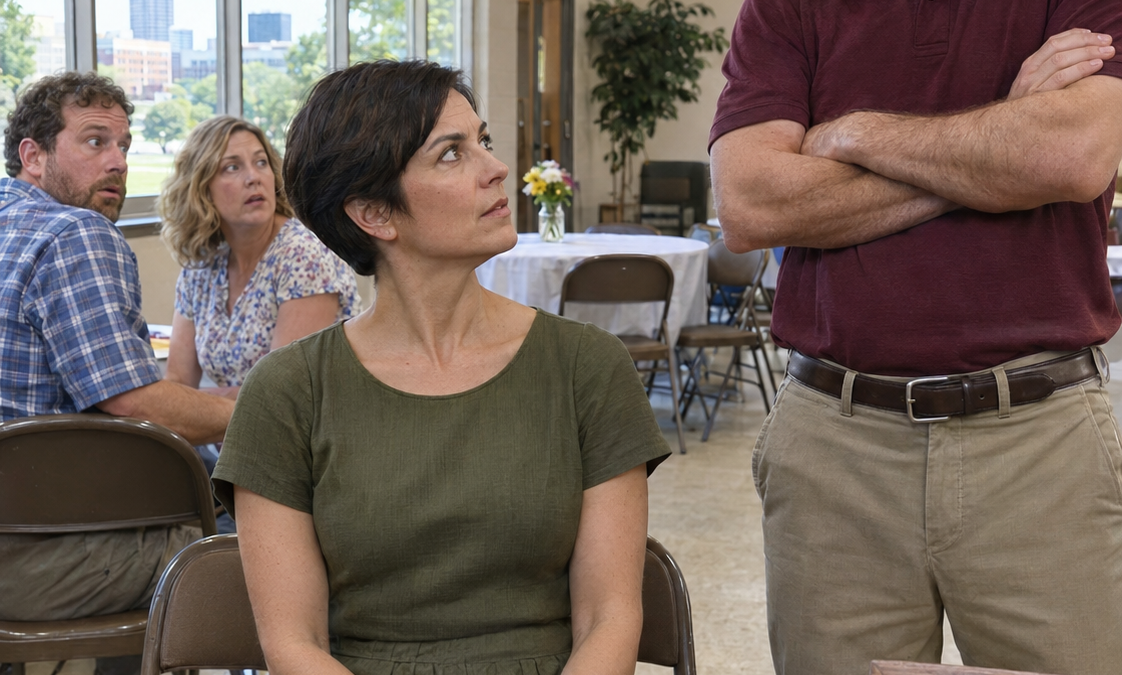
Neal pulled my chair backward inside the Dayton community center.
Sixty-two guests watched its metal feet scrape the tile.
An enamel airplane rested beside our daughter’s Eagle Scout display.
I remained seated until he stopped dragging the chair.
Then I stood, allowing the legs to settle squarely.
“Ask our daughter.”
A woman beside the punch bowl lowered her empty cup.
Two Scouts stopped straightening the programs on the front table.
Neal looked toward Lydia, then back at me.
“Our daughter knows who showed up,” he said.
His burgundy polo matched the napkins stacked beside the cake.
Mine was an olive dress with a repaired side seam.
I had driven from Oklahoma wearing flats and no jewelry.
The airplane pin had cost two dollars twelve years earlier.
Neal tapped the chair back with one clean fingernail.
“Mailing checks doesn’t make you a mother.”
Nobody moved.
“The parent pin is mine,” he added.
Lydia stood near the display, both palms against her trousers.
At seventeen, she had learned his warning signs too well.
I knew that stillness from our old kitchen.
“Let her finish setting up,” I said.
He gave the guests a small, apologetic smile.
“We’ve already arranged everything. You can sit near the back.”
The nearest empty chair faced the kitchen’s swinging door.
I sat there instead of making Lydia choose immediately.
Neal returned my former chair to the family row.
He placed his program on its seat.
A reservation.
When Lydia was five, I bought that airplane after payday.
We were waiting for pancakes at a roadside restaurant.
She liked its blue wings and crooked little silver propeller.
I told her inexpensive things could carry important promises.
She made one, solemnly, with syrup on her sleeve.
Later, distance turned ordinary parenting into scheduled calls and visits.
Neal and I divorced before she entered first grade.
He kept the school-week address; I kept crossing state lines.
I never stopped trying to shorten the space between us.
That was the whole history I allowed myself just then.
Lydia deserved an afternoon, not an argument about twelve years.
A guest pulled her purse off the chair beside me.
“Would you like this one closer?” she asked.
“Thank you. I’m fine here.”
Neal heard that and raised his voice slightly.
“This reception cost me forty-eight hundred dollars.”
He faced the room as though accepting reimbursement in applause.
“Some of us did more than send little trinkets.”
His chin indicated the airplane.
Lydia looked down at it without touching the display.
I could see the chipped paint on one wing.
The small wooden box underneath had unfamiliar brass hinges.
One corner held a folded strip of white paper.
A mailing label.
Neal noticed my attention and stepped between us.
“She wanted childhood things included,” he said.
“You know how sentimental girls get.”
“She can speak for herself,” I said.
“She’s busy.”
Lydia looked directly at him.
“I’m right here.”
A serving spoon clicked against the punch bowl’s glass rim.
The woman holding it set it down carefully.
Neal’s smile tightened.
“Then tell your mother where the guests sit.”
Lydia glanced toward the hall outside the open double doors.
“Someone’s coming to help with that.”
He checked the wall clock.
“The ceremony starts in eight minutes.”
“I know,” Lydia said.
Her voice did not rise.
I put my folded program beneath my chair.
There would be no paper shaking in my hands.
Neal bent toward me, keeping his smile for everyone else.
“Don’t turn her day into your homecoming.”
“I came for her.”
“Then act like it.”
Across the room, Lydia straightened the airplane’s blue ribbon.
The ribbon disappeared beneath the lid of the wooden box.
She had tied it there deliberately.
I recognized the knot before I understood the box.
Lydia used that square knot on every care package.
At least, she had when she was little.
The hallway door opened against its rubber stop.
A woman in a tan Scout shirt stepped inside.
She looked first at Lydia, then at my empty seat.
Neal straightened, ready to greet another witness.
The Scoutmaster stopped beside my chair.
“Your daughter saved your place.”
Neal’s mouth remained open around a greeting he never finished.
The Scoutmaster did not smile at him.
“I’m Doreen Bixby,” she told me. “We spoke by email.”
“Yes. Thank you for the directions.”
She moved the program off the family chair.
It went onto Neal’s seat, not onto the floor.
A small distinction.
I appreciated it.
“This one belongs to you,” Doreen said.
Neal gave a short laugh that nobody answered.
“I explained the arrangements.”
“Lydia explained hers to me.”
He glanced toward our daughter again.
Lydia did not rescue him.
Doreen waited while I crossed the narrow aisle.
I sat in the chair he had removed.
Its front leg caught in the same chipped floor tile.
That little click sounded louder than his laugh had.
Neal remained standing beside me.
“There are family matters you don’t understand,” he told Doreen.
“Then they can wait until after the ceremony.”
He lowered his voice.
“I paid for this room.”
“And Lydia earned the award.”
Doreen turned toward the display before he could answer.
Our daughter stepped closer to me, carrying nothing.
“Did you get here all right?” she asked.
“The interstate behaved.”
“You always say that when it didn’t.”
“Only one construction zone.”
Her mouth curved, briefly.
Then she looked at the airplane.
“Please don’t leave early,” she said.
“I booked a room for tonight.”
“Good.”
She bent beside my shoulder, close enough that Neal could not hear.
“The box is for you, too.”
Part 2 of 5
I kept my eyes on Lydia’s face.
“Do you want me to open it?”
“Not yet,” she said. “I need to do it.”
Neal cleared his throat behind her.
“People are waiting for pictures.”
“Then take pictures,” Lydia said.
He held out his phone. She did not step toward it.
That was new.
My name was Maren Guthrie. I was forty-three, living near Enid, Oklahoma, and practiced at arriving without making demands.
Dayton meant a hotel receipt, nine hundred miles of interstate, and the hope that this visit would not end with another locked porch door.
When Neal changed weekends, I changed flights.
When he shortened calls, I wrote.
When he called me unnecessary, I paid the orthodontist directly.
Those were not noble acts. They were ordinary parenting performed through a narrow opening.
A round trip sometimes cost $386 before the hotel.
The school pictures cost $24 each year.
I ordered my own copies after mine stopped arriving.
Small purchases. Long distances.
Neal had been forty-eight for three weeks. Lydia told me during one of our recent Sunday calls.
Those calls were new, too.
Before that, conversations came through his kitchen speakerphone, with him clattering dishes nearby.
At thirteen, Lydia once asked why I never sent anything for her birthday.
I had been standing beside the tracking receipt for her package.
“I did send something,” I told her.
“Dad says you forgot.”
I asked to speak privately. The call ended.
Afterward, Neal wrote that I was upsetting her.
I kept that message.
I kept other things.
Receipts. Returned parcels. Copies of requests to the family court.
A revised order eventually gave me direct calls and a dependable summer week.
By then Lydia had learned to answer questions cautiously.
I could enforce time. I could not order trust.
So I took the week.
We bought peaches outside Tulsa. We repaired a birdhouse. I listened when she spoke and stopped when she needed quiet.
The following year, she asked to bring her Scout handbook.
That was how I learned she wanted Eagle.
Not from Neal.
From Lydia.
Near the display now, he repositioned a silver tray until it covered the lower edge of the wooden box.
Lydia slid the tray back.
No argument.
Just a correction.
Doreen tested the microphone without speaking into it. A faint thump traveled through the speakers.
Neal leaned toward my chair.
“You’ve made your entrance. Now let us enjoy this.”
“I’m sitting down.”
“You know what I mean.”
I did.
He wanted the old arrangement: his explanation, my departure, Lydia left to interpret the empty space.
But she had asked me to stay.
That was enough.
A paper corner protruded from beneath the box lid again.
It bore a strip of red postal ink.
Wrong side out.
I had seen those strips on parcels that came back to Oklahoma.
There could have been a reasonable explanation.
I did not reach for it.
Neal followed my gaze and moved his body closer to the table.
“Those are just keepsakes.”
“I haven’t asked.”
“You keep looking.”
Lydia heard him that time.
“She’s allowed to look at my display.”
He took a slow breath through his nose.
“I’d prefer not to discuss this in front of everyone.”
“Then stop discussing it,” she said.
A man in the second row lowered his camera.
Neal noticed.
His next smile was wider and less convincing.
“Teenagers,” he told the man.
Lydia stepped away from him.
Doreen brought over the ceremony program and crouched beside my chair.
“Lydia asked for one addition before the parent presentation,” she said.
“Is that all right with you?”
“It’s her ceremony.”
“Yes,” Doreen said. “It is.”
Neal bent down from the other side.
“The program’s been printed.”
“A program can survive an addition.”
Doreen stood before he could reply.
I unfolded my reading glasses and set them on my knees.
One practical thing.
If Lydia needed me to read something, I would not make her wait while I searched my purse.
Neal watched the glasses.
“Planning a speech?”
“No.”
“Good. We’ve had enough complications.”
Across the aisle, a guest shifted her chair farther from his.
He pretended not to notice.
Doreen asked everyone to take their seats.
The sixty-two guests settled, programs rustling.
Two seats at the back remained empty, marked with folded cards.
Neal sat beside me, then immediately stood again.
He had spotted the parent recognition pins on the front table.
One lay beside a small card with Lydia’s handwriting.
He reached toward the card.
Doreen covered it with her program.
“We’ll get there,” she said.
“I should know what’s being presented.”
“Lydia knows.”
His cheeks darkened above his collar.
He turned toward me as though I had arranged every inch of the afternoon.
“Mailing checks doesn’t make you a mother.”
This time, the nearest guests heard him without any room noise between the words.
I put on my glasses.
“Did you open the airplane box?” I asked Lydia.
She came to the display and lifted the blue ribbon free.
Neal stepped forward.
“Leave that alone until afterward.”
Lydia rested her fingers beneath the brass latch.
“Mom, there’s something under your airplane.”
Part 3 of 5
Lydia opened the display box beneath the airplane pin.
Inside lay a folded piece of yellow construction paper.
She lifted it carefully, keeping the corners supported.
I recognized my own block printing before she began to read.
“When you earn Eagle, this airplane comes home to me.”
Beneath that was a crooked line in purple crayon.
Lydia traced the air just above it with one finger.
“I promise,” she read. “Love, Lydia.”
The microphone picked up the catch between those last two words.
Neal looked from the paper to me.
“That was a child’s game.”
Lydia unfolded the bottom edge.
“There’s a date.”
She read it aloud. Twelve years earlier. The spring before our divorce became final.
I remembered that afternoon clearly now.
A library had displayed photographs of Eagle projects. Lydia had stopped beneath one showing a footbridge.
Girls could not yet follow that path in the program then, but she had pointed at the bridge and announced she would build something useful.
I had told her we would find a way for her to do that.
Years later, when the opportunity opened, she remembered.
The pin was our little plane going ahead of her.
I had left it with her for the journey.
“I thought you lost that paper,” I said.
“So did I.”
Neal moved one foot closer to the table.
“Read the rest later. People came for an award.”
“They did,” Doreen said.
She positioned the microphone nearer Lydia, then stepped aside.
Lydia put the promise on the display and reached into the box again.
Underneath lay a stack of envelopes bound with kitchen string.
The top envelope carried my handwriting.
Its address was the house where Neal still lived.
Across the front, someone had written “Refused” in block capitals, but the envelope had never gone back to the post office.
The room became very quiet, apart from the ventilation fan above the kitchen.
Lydia held up the envelope.
“This one was for my seventh birthday.”
Neal rubbed the side of his neck.
“You don’t know what was inside.”
“I opened it.”
His hand stopped.
She slid out a letter and a small photograph of me beside a birthday cake.
Seven candles. An empty chair across the table.
“I was supposed to call while you opened your present,” I said.
Lydia nodded once.
“The letter says that.”
She did not read every private sentence aloud.
I was grateful for that.
Instead, she placed the envelope beneath the promise and lifted the next one.
Another date. Another returned label.
Then a flattened package wrapper with the address written in permanent ink.
“This one was a book,” she said. “You wrote notes in the margins so we could read together.”
“I kept the book when it came back.”
“I know. I found the letter you put inside.”
Neal turned toward the guests.
“There were rules about deliveries. She moved around. Addresses got confused.”
“The address is yours,” Lydia said.
He opened his mouth, but she had already lifted the next wrapper.
It showed the same street, the same house number, the same “Refused” in the same block capitals.
“These didn’t get lost.”
“No,” I said.
“Why didn’t you tell me?”
There was no accusation in her voice that I could hide behind.
I answered the question she had asked.
“I tried. Then I was told you didn’t want to hear it. I should have found better ways to keep asking.”
Neal seized on that.
“You hear her admitting it?”
“I hear my mother answering me,” Lydia said.
Doreen moved beside the display, close enough to protect it without blocking anyone’s view.
Lydia laid the remaining envelopes flat.
“They’re dated in different years,” she said. “It wasn’t one mistake.”
I could see my old return addresses changing down the stack.
Different assignments. Different apartments.
The same child’s name.
Neal looked toward the kitchen, then at the exit.
Nobody stood to follow him.
At the back of the room, the outside door opened.
Two people in blue Air Force service uniforms entered quietly.
I recognized Celina Rusk and Terrence Madsen, officers I had worked with before my Oklahoma assignment.
They paused beside the two reserved seats.
Lydia looked up from the letters.
“I asked them to come,” she said to me.
Celina approached only after Lydia nodded.
“Good afternoon, Colonel,” she said.
Terrence gave me the same respectful greeting.
Neal’s face lost the color his collar had seemed to push into it.
He looked at my plain dress as though it had concealed a weapon.
“Colonel?”
I stood because Celina and Terrence were guests, not because I needed the room to see me rise.
“Thank you for coming.”
“We wouldn’t miss her day,” Celina said.
Lydia touched the edge of my letter.
“I found their names in this one. It said they helped you mail my science kit.”
Terrence nodded.
“Your mother worried about those glass slides surviving the trip.”
Lydia looked toward her father.
“You said she was an overseas supply clerk.”
Neal made a small movement with his jaw.
I had served overseas. Logistics had been part of my career. Neither fact had ever been shameful.
The lie was the smallness he had wrapped around them.
“I’m an Air Force colonel,” I said. “I’m stationed in Oklahoma.”
Terrence remained beside the aisle.
“We’re assigned near Dayton now,” he explained. “Lydia contacted us through our public office.”
One ordinary explanation.
No rescue summoned by coincidence.
My daughter had done the asking herself.
Lydia looked down at the envelopes.
“I found them while clearing Dad’s garage.”
Part 4 of 5
Neal shook his head before Lydia could continue.
“That garage was full of things your mother abandoned.”
Lydia turned the box slightly so the guests could see its contents.
“Then why were these inside your locked camping cabinet?”
He looked toward Doreen.
“Are you really letting this happen at a youth event?”
Doreen kept her voice level.
“I’m letting Lydia explain the presentation she requested.”
Lydia rested both hands on the table.
“You told me to clear space for the reception tables. The cabinet key was hanging beside the freezer.”
That explained something I had not understood.
Now I understood. Neal had marked them refused himself, then mailed back only the gifts. The letters had never left his house. Some were still sealed.
Neal had kept both kinds.
Lydia pointed to a larger padded wrapper beneath the stack.
“This had another envelope inside. It was addressed back to Mom.”
I recognized the handwriting then.
My own address, written by Neal, on a parcel he had repacked.
He had sent the object back while keeping the letter.
I had received enough returned things that I had not understood the distinction at the time.
“You told me you stopped writing,” Lydia said to me.
“I said I stopped mailing things to the house.”
“When?”
“After the last package came back. I kept writing. I put the letters in a binder.”
She pressed her lips together.
“I want that binder.”
“You can have it tonight.”
Neal made an impatient sound.
“This is exactly why I tried to protect you. Every visit turns into a discussion of what she didn’t get.”
Lydia looked at the promise on yellow paper.
“She didn’t bring this up. I did.”
A woman in the second row removed her glasses and folded them.
The man beside her stared at his program without turning a page.
These were people who had heard Neal’s version at cookouts and fundraising dinners.
I could see them checking old conversations against the table in front of them.
I did not help them.
Lydia’s day was already carrying enough adults.
“May I say something?” I asked her.
She nodded.
I stayed beside my chair.
“Your father took you to meetings. He drove you to camps. I won’t pretend those things didn’t happen.”
Neal straightened slightly.
“But none of that required hiding letters from you.”
His shoulders went rigid again.
Lydia looked at him for a long time.
“Why did you keep them?”
He rubbed his palms against the sides of his trousers.
“You were little.”
“That isn’t why.”
“I didn’t want you getting attached to promises she couldn’t keep.”
“The promise is right here.”
She touched the yellow paper with one finger.
“You made me think she forgot.”
Neal glanced at the guests.
“This should be private.”
“You said it in front of them,” Lydia said.
He looked at me.
There had been years when that look would have sent me searching for a gentler explanation.
I had mistaken smoothing things over for protecting our daughter.
This time I stayed still.
Lydia reached into the box again and removed a folded copy of an old school calendar.
My visits were marked in blue.
Several had been crossed out in Neal’s handwriting.
“I remembered these differently,” she said.
“Your mother canceled,” he said.
“The emails were printed on the back.”
She turned the sheet over.
I had forgotten sending him that calendar.
Every requested visit had an accompanying message. His replies changed the weekend, shortened the hours, or said Lydia had other plans.
Some plans had been real.
Others, apparently, had not.
“I thought the museum trip was your idea,” Lydia told him. “I stayed home that Saturday.”
Neal did not answer.
The microphone gave a faint hiss.
Doreen switched it off, leaving Lydia’s next words to travel without amplification.
“I’m not reading anything else.”
My daughter began putting the private letters back into their envelopes.
She had supplied proof. She did not owe anyone a performance of every injury.
I stepped close enough to help if she asked.
She slid one envelope toward me.
“Will you keep this flat?”
“Yes.”
That was all.
Celina and Terrence took the reserved seats at the back.
They did not flank Neal. They did not threaten him with authority they did not possess over a family ceremony.
They had come because Lydia wanted someone present who knew an unedited part of her mother’s life.
I watched Neal register that there would be no person he could accuse of staging a military spectacle.
Only his daughter.
Only his own labels.
Only the chair.
Doreen returned to the front table and uncovered the parent recognition card.
Neal took one quick step toward her.
“I’m still her father.”
“Yes,” Doreen said.
“I paid for all of this.”
Lydia looked at the cake, the napkins, the rented silver trays.
“I earned Eagle before you ordered lunch.”
A chair creaked somewhere behind us.
Neal’s eyes shone, but his mouth stayed hard.
Doreen lifted the card.
“The parent presentation is next.”
Part 5 of 5
Neal held out his hand toward the recognition pin.
Doreen did not place it there.
“Her mother is the parent she selected.”
The words were quiet enough that everyone had to stop moving to hear them.
Neal’s hand remained suspended for a second.
Then he lowered it.
“That wasn’t the arrangement.”
“It was Lydia’s selection,” Doreen said.
He looked at our daughter.
“You’re doing this after everything I paid for?”
Lydia stood beside the display box, her uniform shirt smooth except where her fingers had creased the hem.
“I’m thanking someone. You’re making it a bill.”
The woman near the punch bowl covered her mouth.
Nobody applauded.
I was glad of that. Applause would have made another spectacle out of a girl setting one necessary boundary.
Neal turned toward the guests.
There was no friendly laugh waiting for him now.
The man with the camera lowered it again.
Doreen set the recognition pin beside the airplane.
“Neal, please take a guest seat. We’re continuing with the presentation Lydia requested.”
He glanced at his chair in the family row.
His program still lay there, moved by Doreen earlier.
He picked it up.
For a moment, I thought he might tear it.
Instead, he folded it hard enough to leave a white line through the cover.
“There won’t be any family photograph after this,” he said.
Lydia swallowed.
“There can still be a photograph of people who want to stand beside me.”
I watched her wait.
It was the last opening she offered him that afternoon.
He looked down at his folded program.
Then he walked to the chair beside the kitchen door.
The one he had chosen for me.
Nobody moved out of his way dramatically. Nobody blocked his exit.
He simply crossed the room in front of the same sixty-two guests who had watched him remove my chair.
Doreen waited until he sat.
Then she asked Lydia to bring me forward.
My knees felt stiff when I stood.
Lydia held out her hand, and I took it.
Up close, I could see a tiny blister at the base of her thumb, probably from the tools she had used finishing her project.
She had built accessible garden tables for a neighborhood food pantry.
I had followed the progress through photographs she sent herself, after direct calls became routine.
The finished tables had rounded corners and space underneath for wheelchairs.
Useful, just as she had promised beneath those library photographs.
Doreen spoke about the project, the volunteers, and the hours Lydia had spent correcting a measurement rather than hiding it.
The room listened.
For several minutes, the ceremony belonged to the person who had earned it.
I kept my eyes on Lydia.
When Doreen finished, my daughter picked up the small parent recognition pin.
“I chose my mom,” she said.
Her voice shook on the last word, then steadied.
“She kept making room for me, even when I didn’t understand what was happening.”
I started to answer, but Lydia shook her head.
“Please let me finish.”
So I did.
“I used to think showing up only counted if everybody could see it. I don’t think that anymore.”
She fastened the recognition pin to my dress.
Her first attempt missed the clasp.
We both looked down.
“Still terrible at these,” she murmured.
“You’re working upside down.”
That earned a little laugh from the front row.
It was the first sound all afternoon that did not ask someone to choose a side.
Then Lydia lifted the enamel airplane.
The blue ribbon trailed over her wrist.
She untied it from the display box and placed the pin in my palm.
Its crooked propeller pressed against my skin.
“I earned Eagle,” she said. “This comes home.”
I closed my fingers around it carefully.
“You remembered.”
“I found the paper. Then I remembered.”
That distinction stayed with me.
Memory could be covered. It could also be uncovered by a seventeen-year-old cleaning a garage for a party.
Across the room, Neal sat with his program folded between his knees.
Doreen announced the reception without naming him as a presenter or calling him forward.
The recognition he had tried to claim had gone to the person Lydia selected, in full view of everyone who had heard him demand it.
Guests rose slowly.
Several approached Lydia first. They asked about the garden tables. They congratulated her on Eagle.
That was the right order.
Celina and Terrence waited their turn, then thanked her for inviting them.
Neal remained near the kitchen door.
When Lydia passed him, he stood.
“Can we talk at home?”
“We can talk tomorrow,” she said. “Tonight I’m having dinner with Mom.”
She had not asked me yet.
I nodded when she looked over.
Neal glanced toward the room, perhaps measuring whether anyone had heard.
Doreen had.
“Your display will stay here until Lydia is ready to pack it,” she said.
The letters would not disappear into his car.
Lydia slipped her arm through mine.
“Bring the binder to dinner,” she said.
“I will.”
She guided me toward the cake table, past the chair he had dragged and the seat she had saved.
Behind us, Doreen opened the photographer’s space near the window.
“Lydia,” she called, “your mother’s place is ready.”
THE END
More stories
Byron Told Me to Sit Beside the Rental SHOES at My Husband’s Bowling Alley, but He Went PALE When the Deputy Arrived to Speak to MeMy Uncle Ordered Me Out of the Family Row at a Fire Station Tribute, but When a Man Gave Me the FLOOR, His Claim to My Father’s Rescue Began to UnravelMy Ex-Wife Called My Daughter’s Memorial a “Sad Little Tribute,” Then Went PALE When the Drive-In Manager Restored My EveningMy Niece Belinda Said I Didn’t Live There Anymore Before 32 Neighbors, but She Went PALE When a Biker Asked Who Changed My LocksMy Brother Ross Mocked My Cheap Key Before 34 Relatives, Then FROZE When a Uniformed Guest Walked In and Greeted MeMy Ex Blake Renshaw Mocked Our Daughter’s Purple Halter While Selling Her Mare, Until One Name on a Certificate Cost Him a $48,000 SALE in Public
You Might Also Enjoy

My Daughter-In-Law Told Me To Stay Elsewhere While Strangers Took My Condo — Then I Pushed Back







