My Ex-Wife Ordered Me Out of My Chair at Our Son’s Memorial, but When the Arriving Guest GREETED Me, She Went Pale
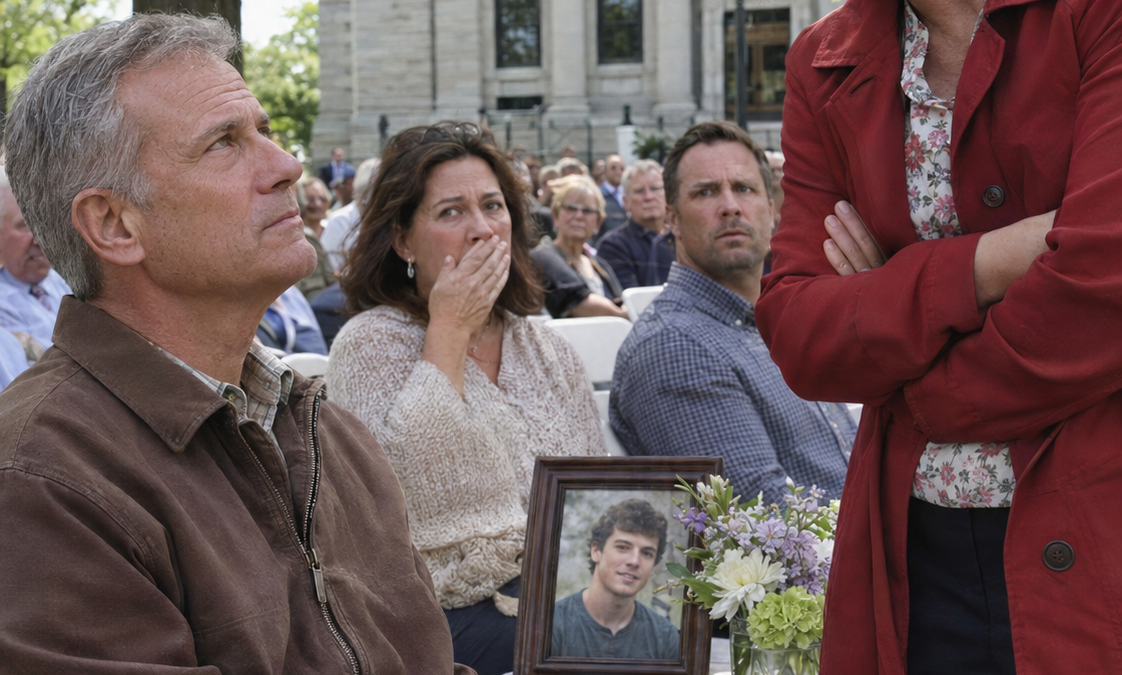
Part 1 of 5
“Get out of that chair!”
Daphne Sedgewick stood over me outside the courthouse in Carlisle, Pennsylvania.
The Memorial Day audience included 140 residents, and nobody missed it.
Our son’s battered harmonica lay on the memorial table.
My ex-wife’s red coat blocked the aisle beside my reserved chair.
Her silver-blond hair barely moved in the morning breeze.
“You don’t get to borrow his service after abandoning yours.”
A program crackled somewhere behind me.
I kept both feet flat on the grass.
“Please check the recipient.”
The ceremony officer stopped beside the table and looked down.
Several neighbors lowered their programs without quite lowering their eyes.
Daphne gave him the smile she used at church suppers.
“There’s nothing to check. My husband is receiving the flag.”
Her new husband stood behind the empty chair beside mine.
He studied the printed program instead of looking at me.
I stayed seated.
The officer’s folder rested against his leg, its corners softened.
“Let me get the ceremony packet,” he said.
Daphne moved half a step across his path.
“We already settled this through the family.”
“Then checking should be simple,” I said.
Nobody clapped.
Nobody coughed.
Nobody offered me another chair.
At fifty-five, I had learned not to fill every silence.
The little harmonica had cost fifteen dollars at a hardware counter.
Our boy had wanted a guitar, which we couldn’t afford.
I had offered that instead, wrapped in a paper lunch bag.
He had carried it through school and eventually overseas.
Nine years earlier, it came home without him.
When he wrote, I answered.
When he called, I stayed.
When he died, I drove through the night.
That was the whole history I needed at that table.
A brass plate stood behind the harmonica, polished beyond usefulness.
Daphne had ordered the tribute display around it for $2,400.
She had mentioned the price while volunteers carried it outside.
The harmonica looked almost disposable against the dark wood.
One corner was dented, and two holes sounded wrong.
I had placed it there before the audience arrived.
Daphne noticed it now.
“Could somebody move that old thing behind the flowers?”
“No,” I said.
Her eyes narrowed.
“It distracts from the presentation.”
“It belonged to him.”
“So did plenty of things you never saw.”
The officer looked toward the courthouse doors, then at his watch.
Daphne followed his glance and straightened her coat.
“We’re already late,” she said. “Please don’t encourage a scene.”
The scene had begun without any help from me.
I turned my program over and rested it on my knee.
The card on my chair read Miles Fenstermaker, beneath a reserved seating note.
A white envelope protruded from the officer’s folder.
Its flap carried a strip of blue tape.
I recognized that tape from the packet mailed to Virginia.
Daphne had seen me notice.
“That’s just office paperwork,” she said.
“I asked him to check it.”
“And I’m asking you to think about our son.”
“I am.”
A woman behind the rope pressed her lips together.
Beside her, a man stared down at his folded hat.
Both had known me before I owned a good winter coat.
Neither spoke.
Daphne bent closer without lowering her voice.
“Lester has been here for this family.”
Her husband’s shoulders tightened at his own name.
I looked at him for the first time.
“Then he understands why the right person should receive it.”
He closed his program.
“Daphne, maybe let them check.”
She turned away from him as though he hadn’t spoken.
I could hear the courthouse clock winding toward the hour.
The officer took his phone from his pocket, checked something, and nodded.
“Our presenting guest has arrived,” he said.
Daphne smoothed the front of her coat with both hands.
She expected another person to thank her for organizing everything.
A dark sedan had stopped beyond the courthouse steps.
The guest had been scheduled to arrive through the side entrance.
Volunteers had kept that path clear for him all morning.
He stepped around a planter and looked toward the memorial table.
Daphne lifted her chin, ready to welcome him.
The arriving guest stopped beside my chair.
“Captain, we’re ready for you.”
Daphne’s mouth stayed open, but no sound came out.
The guest offered me a small, familiar nod.
Her husband looked from his face to mine.
Around us, programs stopped moving.
“Thank you,” I said. “There’s a recipient question to settle.”
The guest’s eyes moved toward the officer’s folder.
“We’ll settle it before we begin.”
Daphne’s hand caught the edge of her coat.
“There must be some misunderstanding.”
The guest did not answer her immediately.
He looked at the chair card, then the harmonica.
I had not asked him to make an entrance for me.
He was there because he had accepted the ceremony invitation.
His greeting was ordinary.
The effect wasn’t.
For sixteen years, people here had heard another account of me.
I could see that account meeting the man beside my chair.
A neighbor lifted his head, studying me without pretending otherwise.
Daphne tried a short laugh.
“Miles likes people to use old titles.”
The guest’s expression stayed level.
“We need the family packet.”
The officer shifted the folder against his palm.
“I have the final seating list here.”
“Start with the recipient designation,” the guest said.
Daphne’s husband stepped away from the empty chair.
“I was told both parents agreed,” he said.
Daphne looked at him sharply.
He didn’t move back.
The officer turned the folder over.
An envelope had been clipped beneath the seating list.
Daphne recognized the blue tape.
Part 2 of 5
“That envelope isn’t necessary,” Daphne said.
The officer kept it beneath his hand.
“Then it won’t take long.”
I set my program on the empty chair beside me.
A small thing.
It kept my fingers from worrying the folded edge.
The guest remained near enough to hear, far enough to leave us room.
Daphne glanced toward the audience as though searching for a friendly face.
Several relatives looked away.
I knew those faces.
They had watched us exchange wedding vows in a church basement.
They had brought casseroles when our children were born.
After our divorce, they had heard what Daphne wanted them to hear.
I stopped defending myself sixteen years earlier.
That decision had seemed practical from Virginia.
On this lawn, I could see its cost.
An aunt had once returned a birthday card unopened.
A cousin had stopped inviting me to Thanksgiving.
Neither had asked where I worked or what happened.
“People have waited long enough,” Daphne said.
“Let them hear the music.”
The musicians stood beyond the folding chairs with their instruments lowered.
No one had given them a cue.
The ceremony officer’s name tag read Dylan Metcalf.
He introduced himself to the arriving guest in a low voice.
Then Dylan turned toward me.
“Did you receive the family invitation directly?”
“Yes.”
“Did you respond?”
“Yes.”
Daphne made a small impatient sound.
“Everyone responded. I handled the family arrangements.”
Dylan lifted the envelope slightly, checking its label.
“You handled the local arrangements?”
“I’m his mother.”
No one disputed that.
The harmonica lay between a vase and our son’s photograph.
I had carried it from Virginia wrapped in a clean dish towel.
Daphne had not seen the towel.
She had not seen me unfold it in the motel room.
There were things she no longer had any reason to see.
Our son, Joshua Talcott, had taken his wife’s surname when they married.
He had written to tell me before submitting the paperwork.
“Does it bother you?” he had asked.
I had told him a name wasn’t a receipt for ownership.
Daphne had disliked that answer then, too.
I remembered the letter’s creased corner more clearly than our argument.
My boy had pressed so hard that his pen marked the next page.
He had enclosed a photograph of his kitchen.
A pan sat on the stove behind him.
Nothing ceremonial.
Just proof he was building a life.
“Are you listening?” Daphne asked.
“Yes.”
“Then help us get on with this.”
“I’m waiting for the check.”
Dylan’s thumb paused beside the envelope flap.
The program listed one name.
The chair card listed another.
Two different names.
I had noticed the discrepancy before Daphne stepped into the aisle.
That was why I had remained in my seat.
The invitation had asked me to receive a commemorative flag for Joshua.
It was a town tribute, not a replacement for his burial flag.
His widow kept the flag from his funeral.
Nobody here had any claim to that.
This flag had flown over the courthouse before the ceremony.
The invitation included a place for my acceptance and signature.
I had returned it the same afternoon it arrived.
No argument.
No conditions.
No demand for a speech.
Daphne looked toward the display behind the table.
“I put months into this.”
“I know,” I said.
“I paid for the frame, the lettering, all of it.”
“I know that, too.”
Her voice rose just enough to reach the second row.
“He couldn’t even come to the planning meetings.”
“I wasn’t invited to them.”
“You were in Virginia.”
“That hasn’t changed.”
A man near the aisle glanced at the guest beside us.
Daphne saw the glance and lowered her voice.
“You’re making this about yourself.”
I looked at the photograph instead.
Joshua had been twenty-six when he died.
The photograph showed him squinting into sunlight, one shoulder slightly higher.
I remembered telling him to stand still for it.
He had laughed and refused.
That was the photograph Daphne chose.
For all our damage, we agreed on his face.
A chair scraped behind us.
Our daughter came through the side aisle carrying a plain canvas bag.
She stopped when she saw her mother blocking the row.
“Dad?”
I turned.
“Right here.”
Daphne moved toward her.
“Your father is having trouble with the seating.”
Our daughter looked at my chair card.
Then she looked at the empty chair beside it.
“That’s my seat,” she said.
Daphne’s lips pressed together.
“We discussed a different arrangement.”
“You discussed it.”
The guest stepped back, giving our daughter room to reach me.
She put her bag beneath her chair and sat.
Her knee touched mine.
I hadn’t seen her since Christmas.
She was thirty, with work shoes she had polished in her car.
There was a faint streak of dust along one heel.
“You drove this morning?” I asked.
“Before sunrise.”
“You should have called.”
“I wanted to be here before they started.”
Daphne turned toward Dylan.
“We have enough family discussion now.”
He looked down at the envelope again.
Our daughter saw the blue tape.
“Please open it,” she said.
Daphne took one quick step toward the table.
The guest moved beside Dylan without touching either of them.
“Let him finish.”
Dylan drew the signed family participation form from its envelope.
He read the recipient’s name aloud: Lester Goodwin.
“That isn’t the name I accepted under,” I said.
Our daughter leaned forward.
“I know who changed it.”
Part 3 of 5
“I saw Mom substitute Lester’s name after Dad accepted,” our daughter said.
Daphne turned so quickly that her coat brushed the tablecloth.
“Autumn, be careful.”
Autumn Ellsworth kept her eyes on Dylan.
“I am being careful. That’s why I kept the email.”
Dylan laid the form flat without handing it around.
“Tell me exactly what you saw.”
Autumn pulled her phone from her bag, then stopped.
“May I show you?”
He nodded.
The arriving guest stood quietly while Autumn found the message.
Nobody asked the musicians to begin. The residents remained in their chairs, close enough now to hear without leaning.
Autumn turned her phone toward Dylan.
“Mom forwarded the family packet to me because she wanted help printing the seating cards. Dad’s acceptance was attached.”
Daphne looked past us toward the courthouse doors.
“I corrected an arrangement that wasn’t suitable.”
Autumn shook her head.
“You covered Dad’s printed name with a white box. Then you typed Lester’s name over it.”
“That was a draft.”
“You sent it back.”
Dylan studied the phone, then the paper on his folder. He asked Autumn to scroll to the forwarding header.
She did.
“I was copied because Mom wanted me to collect the final programs from the printer,” Autumn said.
That explained the message. It also explained why she had arrived carrying a bag large enough for programs.
I looked beneath her chair. A stack of folded booklets pressed against the canvas.
“You knew before today?” I asked.
“Last night. I called you.”
“My phone was off during the drive.”
“I left a message.”
I had arrived late at the motel, put the harmonica on the dresser, and gone to sleep without checking.
Autumn’s thumb hovered above her screen.
“I thought I could get here early enough to fix it quietly.”
Daphne folded her arms.
“There was nothing to fix. Lester has supported this family for years.”
Lester stood where he had moved away from the chair.
“You told me Miles declined,” he said.
Daphne’s eyes flicked toward him.
“He was never involved in the planning.”
“That isn’t what I asked.”
A loose corner of the tablecloth lifted in the breeze. Nobody reached for it.
Dylan looked at me.
“Do you have your acceptance?”
“In my email.”
He waited while I found it. The date was there, along with my reply accepting the invitation and the attached form bearing my signature.
Dylan compared the two versions.
“The signature section wasn’t changed,” he said. “Only the recipient field.”
Daphne’s folded arms loosened.
“It was understood that I represented the family.”
“You represented yourself,” Autumn said.
I put my phone away. There was no use keeping it out once Dylan had what he needed.
The guest looked toward the ceremony microphone.
Before he went anywhere near it, he turned to me.
“May we explain the delay plainly?”
I nodded.
“No details about his death beyond the approved tribute.”
“Agreed.”
Daphne stepped between him and the microphone stand.
“You can’t make an announcement about private family matters.”
He stopped with enough space between them that she had to turn to keep facing him.
“The recipient designation affects the public presentation. We can correct it without discussing anything else.”
“You don’t know our history.”
“I know what was submitted for this ceremony.”
His name was Andrew Pennington. The printed program identified him as the rear admiral presenting the tribute.
Daphne had approved that program herself.
She had simply never imagined he would recognize me.
Andrew and I had served together years earlier. More recently, our work in Virginia had put us in the same briefings.
There was no mystery in his greeting.
The mystery was why it had frightened her.
For sixteen years, Daphne had told local relatives I had been discharged in disgrace.
She began saying it after our divorce, when I stopped answering calls that started with accusations and ended with demands.
I had mistaken distance for a boundary.
Joshua had never believed her. He knew where to write, which number reached my office, and why I sometimes answered after midnight.
Autumn had known less.
She had been fourteen when we divorced, caught between school nights and two people who could not speak kindly in the same kitchen.
I should have explained more to her.
That failure belonged to me.
“Dad,” she said quietly, “did you know what she told everybody?”
“Yes.”
“Why didn’t you tell me?”
“I thought answering your questions was enough.”
“You didn’t know which questions I was afraid to ask.”
I looked at her polished shoes, the dust on the heel, the bag full of programs she had brought anyway.
“You’re right.”
Daphne made a sharp sound through her nose.
“This is exactly what he does. He sits there and lets somebody else carry it.”
Lester looked toward the audience.
Then he faced his wife again.
“I need you to answer one thing.”
Daphne started to speak.
He kept his voice low.
“Did Miles ever decline?”
Autumn turned her phone toward Lester.
Part 4 of 5
Lester read my acceptance without touching Autumn’s phone.
His chin lowered a fraction.
“No,” he said. “He didn’t.”
Daphne looked toward the rows of residents, then back at him.
“Please don’t do this here.”
“You chose here.”
He moved behind the chairs and stood beside the rope marking the aisle. He did not leave the ceremony.
That was important. I wanted no one disappearing before the correction could be heard.
Dylan returned my acceptance email to me and placed the altered form beneath a clear cover in his folder.
“We have enough to correct the presentation,” he said.
Daphne’s gaze stayed on the folder.
“You’re keeping that?”
“It’s part of the ceremony record.”
“Then keep my explanation with it.”
“I’ll note what you said.”
Andrew walked to the microphone. He waited until the small speaker stopped humming.
“Thank you for your patience,” he said.
Chairs creaked as the residents straightened.
“We had a discrepancy in the family participation materials. It has now been checked.”
Daphne stood beside my chair, taller than either Autumn or me. Her coat had opened, exposing a blouse buttoned to the throat.
Andrew looked directly at the seated audience.
“The original invitation was accepted by Joshua’s father. A later version substituted another recipient without his consent.”
A woman in the front row lowered her hand from her mouth.
Daphne took a step toward the microphone.
“I was trying to honor my son.”
Andrew turned toward her.
“You may honor him. You may not change another participant’s acceptance.”
The words were plain enough to carry across the lawn.
No one applauded.
I was grateful for that.
This was still a memorial, and our boy was still dead.
Andrew looked toward Dylan.
“Please restore the accepted arrangement.”
Dylan lifted Lester’s name card from the recipient’s place at the table. He did not tear it or crumple it.
He carried it to the supply table and returned with the correct card.
My name faced the audience.
Autumn’s card stayed beside mine.
Daphne stared at that narrow strip of paper as though it had become heavier than the display behind it.
Andrew stepped away from the microphone.
“Captain, your son’s flag will be presented to you.”
Autumn’s knee pressed against mine again.
I nodded once.
“Thank you.”
Daphne’s face had gone almost the same color as her blouse.
“But I’m his mother.”
“Yes,” Andrew said. “You are.”
He let the statement stand without giving her what she wanted.
Dylan approached with a spare chair from the family row.
“Your reserved seat is here.”
He placed it beside the aisle, with a clear view of the table.
Daphne did not sit immediately.
For years, she had treated every correction as an invitation to argue. Now the chair waited, and the microphone belonged to someone else.
She looked at Lester.
He remained by the rope.
“Will you sit with me?” she asked.
“After you let them finish.”
Her hands moved to the edges of her coat. She drew the fabric together and sat.
Andrew returned to the microphone.
“One further correction is necessary.”
I looked up.
He had not promised me that, and I had not requested it.
“Miles Fenstermaker remains on active duty in the United States Navy. He serves as a captain in Virginia.”
A cough started somewhere behind us and stopped.
Daphne’s eyes fixed on the grass.
Andrew continued.
“Any statement that he was discharged in disgrace is false.”
That was all he said about my record.
He did not recite assignments or offer decorations as evidence of fatherhood. He did not turn my service into a contest with a grieving mother.
He corrected a fact.
The people who had heard the lie heard the correction from the same place.
Autumn looked at me.
“You’re still going every morning?”
“Most mornings.”
“Still terrible coffee?”
“Worse.”
Her mouth moved at one corner.
It was the first ordinary expression I had seen on her face all day.
Dylan brought the flag forward on a covered tray and placed it on the table. The blue field faced the audience.
The harmonica lay just below it.
I noticed that nobody had moved the instrument behind the flowers.
Daphne watched Dylan straighten the cloth.
“I paid for the display,” she said, not loudly enough for the microphone.
“I heard you,” Lester said from the aisle.
He came forward then and took the chair beside her.
“You bought a beautiful display. You didn’t buy the presentation.”
Daphne turned her face away from him.
The musicians raised their instruments when Dylan gave the cue.
A breeze lifted the loose pages in Autumn’s lap. I put my palm over the edge so she could listen without chasing them.
The music was brief.
During the final notes, Dylan leaned toward Andrew and spoke quietly.
Andrew checked his program, then looked at Autumn.
“Your brother requested that his sister stand with his father.”
Part 5 of 5
Autumn’s hand stopped over the program.
“He requested that?”
Andrew nodded toward Dylan’s folder.
“His widow included a copy of his letter with the family memorial materials. She asked that we follow it.”
Dylan opened a separate sleeve.
I had not known about that letter.
Joshua’s widow had chosen to remain in California for a private observance. She had explained that in the original family email, along with permission to use the photograph.
There was no hidden invitation, no last-minute messenger. Her contribution had been in the packet all along.
Dylan held the sleeve so Autumn and I could read.
Joshua had written the letter before his last deployment. It concerned the people to contact if he did not come home.
Most of it was practical.
His wife was to receive his personal effects first. His mother was to have a particular photograph. Autumn was to get the little box of ticket stubs he had kept from concerts they attended.
Then came the sentence Andrew had mentioned.
If his hometown ever held a tribute, he wanted his father and sister together.
I recognized the hard pressure of his handwriting.
The next page bore the faint impression of the words above it.
Autumn looked at me.
“He remembered the bandstand.”
“Yes.”
We had stood together beside the town bandstand when Joshua left for his first training assignment. Autumn had been small enough to tuck beneath his arm.
He had complained about taking a picture.
Then he had asked for a copy.
Dylan returned the letter to its sleeve.
Andrew did not read the private instructions into the microphone.
Instead, he invited Autumn and me to stand.
I rose slowly, making sure my knees would hold without giving the front row something else to discuss.
Autumn stood beside me.
The harmonica remained on the table between us.
From where we stood, I could see its worn metal beneath the flag. A small brown mark near one end had resisted every attempt I made to clean it.
Joshua once spilled root beer on it during a drive home.
He had apologized more for the sticky seat than the instrument.
For once, the memory came without a phone call attached to it.
For a few seconds, he was simply my boy in the passenger seat.
Andrew faced us with the folded flag resting across his forearms.
He spoke Joshua’s full name and identified him as a Navy corpsman killed while serving nine years earlier.
He thanked our family without pretending gratitude repaired anything.
Then he placed the flag in my hands.
Autumn supported the lower corner.
Neither of us had planned that. We both reached, and there was room.
Across the lawn, the same residents who had watched Daphne order me away watched us receive it.
A man in the second row removed his hat.
Behind him, a woman wiped beneath one eye with the edge of her sleeve.
Daphne sat with her shoulders rigid and her hands closed on her knees.
The flag did not pass through her hands.
There was no second presentation, no compromise photograph with Lester holding one corner, no announcement that the mix-up had been mutual.
The corrected ceremony was the ceremony.
Andrew stepped back.
Dylan asked everyone to remain standing for the closing remembrance.
I held the flag while Autumn stood beside me. The harmonica stayed between our places on the table until the final note faded.
Only then did the audience begin to move.
People approached slowly, leaving room around us.
One neighbor said, “I should have asked you.”
“Yes,” I said.
He accepted that without asking me to make him feel better.
Another offered her hand to Autumn and told her she remembered Joshua carrying his little instrument through the square.
Autumn looked down at it.
“I thought he’d lost it.”
“He mailed it to me for safekeeping,” I said. “Before the last deployment.”
I had kept the packing slip in the case at home.
There was nothing expensive about the case, either.
Daphne stood when the row ahead of her cleared.
For a moment, I thought she might walk straight to the parking lot.
Instead, she stopped at the table.
“I never said you didn’t love him,” she said.
Autumn looked at her mother.
“You told us he abandoned everything.”
Daphne glanced toward the remaining residents. Enough of them were close to hear.
“I was angry.”
I adjusted the flag against my chest.
“You had sixteen years to say something else.”
Lester stood beside her, leaving a small space between their sleeves.
Daphne looked at the harmonica.
“Are you taking that?”
“Yes.”
“The display was meant to stay here.”
“The display can stay.”
I let the distinction rest.
She had chosen the wood, paid the bill, and arranged the flowers. Those contributions did not need to disappear for the truth to remain.
Dylan came over before she could reach across the table.
“The courthouse will retain the display,” he said. “Personal family items go home with their owners.”
Daphne lowered her hand.
Autumn took the clean dish towel from my jacket pocket and spread it on the table.
I set the harmonica in the middle.
Together, we folded the cloth around it.
Behind us, Dylan removed the incorrect programs from the remaining stack. The corrected tribute sheet would go into the courthouse display.
My name would not be missing from it.
Autumn picked up her canvas bag and waited while I secured the flag for the walk to the car.
“I’d like to come down to Virginia,” she said.
“You have a key.”
“I know. I’d like to use it.”
Across the lawn, Daphne watched us leave together.
Autumn put our son’s harmonica into my open hand.
THE END
More stories
My Sister Charlotta Said Mom Owned Nothing Worth Keeping Before Eleven Neighbors, but Mom’s RECORDING Stopped Her Piano Sale and Put Her Stolen Money Beyond Her ReachMy Sister Veda Snapped, “We’re Not Opening a SHELTER,” and Blocked a Man’s Chair at Dad’s Memorial Setup—Then the Woman Who Controlled the Shed Keys Walked In.My Sister Ordered Me Away From the Piano Before 69 Guests, but She Went PALE When the Foundation Chairman Said, ‘Let the Little Girl Finish’My Ex-Wife Ordered Me Out of the Theater’s Reserved Row Before 63 Patrons—but When a Gray-Haired Man Promised to Follow My INSTRUCTIONS, She Went PALEMy Daughter-in-Law Gretchen Shouted That I Didn’t Make the Quilt Before 57 Spectators—but When the RIDER Walked In, Her Claim Unraveled and She Lost Her Shot at a $25,000 ContractMy Stepmother Called Me an ABSENTEE Father Before 68 Wedding Guests—but When Two Marines Walked In and Greeted Me, She FROZE Beside My Daughter’s Chair
You Might Also Enjoy

My Daughter-In-Law Told Me To Stay Elsewhere While Strangers Took My Condo — Then I Pushed Back







