My Fiancé’s Mother Raised My Bankruptcy Record Before 112 Yacht Club Guests—Then His 90-Year-Old Grandmother Turned Over Her Phone and Club Friends Left Before Birthday Cake
Complete story · 7 parts · about 29 minutes · ending included
Part 1 · Part 2 · Part 3 · Part 4 · Part 5 · Part 6 · Part 7
Part 1 of 7
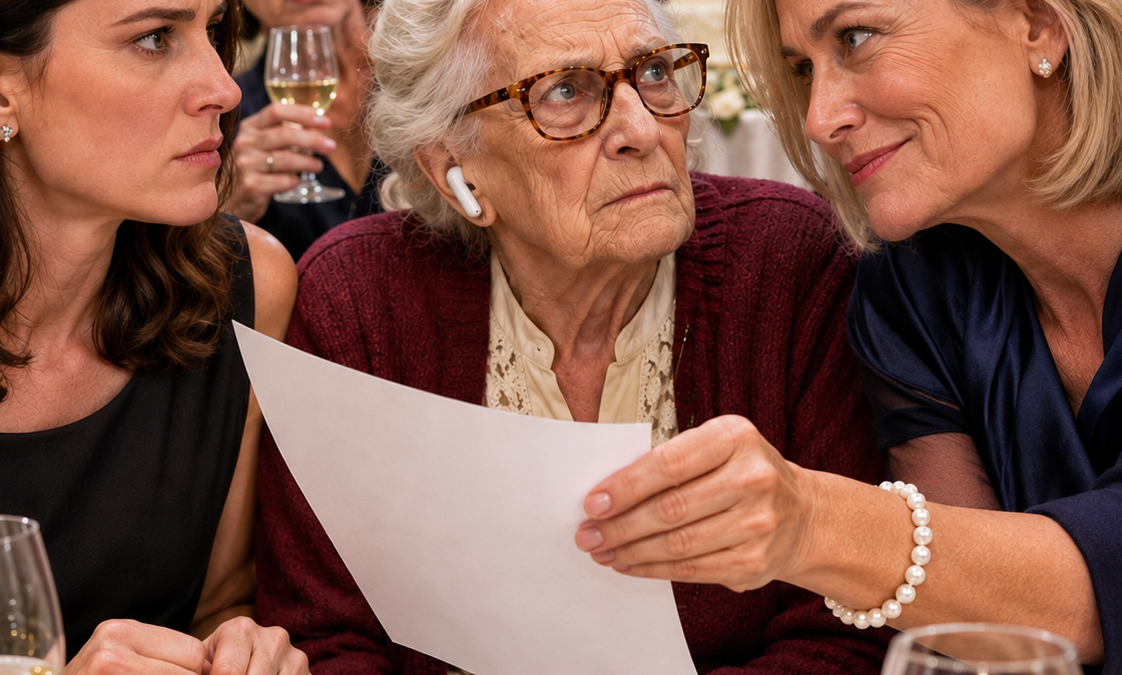
Merrin Thatcher held one sheet of my 2019 bankruptcy record above the cake marked 90. “Before we toast Mama, Callum should know who he’s marrying,” she said to 112 guests.
Her navy silk dress caught the ballroom light as she tapped a teaspoon against the wineglass on the head table.
Beyond the windows, Spa Creek was black and still.
At 7:40 p.m., every face in the yacht club ballroom turned toward me.
I stayed in my chair.
My plain black dress reached my knees, and my hands rested flat on the white tablecloth. Callum sat on my right, staring at the paper in his mother’s left hand.
Merrin extended the sheet toward me as if she had found it under my mattress.
“Chapter 7,” she said. “Filed by Joelle Pratt.”
“He knows,” I said.
Callum pushed his chair back an inch. “Mom, stop.”
On my left, Winnie Ashby removed the white earbud from her right ear and set it beside her dessert fork. Her phone lay face down near her plate, where she always kept it.
Winnie slid one hand beneath the phone and turned it face up.
Behind thick glasses, her eyes settled on Merrin.
Then Winnie smiled.
Only slightly.
Across the table, Whitley froze with her wineglass halfway to her mouth.
One year and five days earlier, I had entered Merrin’s house in Annapolis wearing a green wrap dress that cost sixty-eight dollars.
Merrin opened the door on Sunday, November 9, 2025, and looked from the hem to the V-neck.
“How practical,” she said.
Callum touched the small of my back. “You look beautiful.”
His mother stepped aside.
Merrin’s dining room had polished silver candlesticks, linen napkins, and a table long enough to make dinner feel like a hearing. A pot roast sat on a platter beside glazed carrots and a bowl of mashed potatoes.
Winnie waited across from my place, her white hair pinned neatly behind her ears. Thick lenses magnified her eyes, but she still leaned close when she wanted to see a face.
Whitley sat to my left.
Callum took the chair on my right, and Merrin settled at the head of the table with her phone in her lap.
We had barely passed the potatoes before Merrin began.
“Callum says you work with phones,” she said.
“I repair phones and tablets.”
“In Annapolis?”
“Glen Burnie.”
Merrin lifted one eyebrow. “A kiosk?”
“My own shop. It is in a strip of stores.”
Whitley covered a smile with her napkin.
I spooned carrots onto my plate.
“I teach a free class there on Tuesday mornings,” I said. “Phones for seniors.”
“How charitable,” Merrin said.
Winnie tilted her head toward my voice. “Useful.”
That single word earned Winnie a look from her daughter.
Merrin cut into the roast. “Callum spent eleven years building his practice. Orthodontics is so demanding.”
“It keeps me busy,” Callum said.
“Busy and established,” Merrin said. “There is a difference.”
Under the table, light flashed against Merrin’s wrist.
Her thumb moved over the phone in her lap.
A second later, Whitley’s phone vibrated against her dress. She lowered her chin, read the screen, and pressed her lips together.
Merrin watched her.
Whitley made a small choking sound.
“Are you all right?” Callum said.
“Pepper,” Whitley said.
There was no pepper near her plate.
Merrin’s shoulders shook once. She picked up her water glass to hide her mouth.
Callum looked between them. “Did I miss something?”
“Nothing you need to worry about,” Merrin said.
Whitley rested her phone beside her plate with the screen facing up. The message remained visible in a group thread called Thatcher Girls, under the name Mom.
Mall-kiosk girl wants an orthodontist’s money.
Picking up where the Facebook post left off
Whitley’s fingers closed around the phone, but she had left it there long enough.
She turned the device face down.
I cut one slice of pot roast into four pieces.
Across from me, Winnie had stopped eating.
“Joelle’s shop does well,” Callum said. “She built it herself.”
Merrin dabbed the corner of her mouth. “How enterprising.”
“Mom.”
“I gave her a compliment.”
“No,” Callum said. “You wrapped an insult in a napkin.”
Whitley leaned toward him. “You are being dramatic.”
I took a drink of water.
Merrin’s gaze moved to my dress again. “We tend to dress a little differently for Sunday dinner. You will learn.”
“Green suits her,” Winnie said.
Merrin set down her fork. “Mama, you can barely see the color.”
Winnie turned her face toward her daughter’s voice.
“I can see enough.”
Whitley reached for the serving bowl. “More potatoes, Joelle?”
“No, thank you.”
“Are you sure? You’ve hardly eaten.”
“I have eaten enough.”
Callum’s knee touched mine beneath the table. He left it there.
Merrin smiled at him. “You always did bring home strays.”
“Merrin,” Winnie said.
The name came out quiet and precise.
Merrin looked down at her plate. “It was a joke.”
Whitley laughed anyway.
After dinner, Callum carried dishes into the kitchen. Merrin followed him with the gravy boat, leaving Whitley and me at the table with Winnie.
Whitley picked up her phone.
“You shouldn’t take Mom personally,” she said. “She is protective of Callum.”
“From phone repair?”
“From people who see his lifestyle before they see him.”
Winnie placed her napkin beside her plate.
Whitley stood, phone in hand, and carried her dish toward the kitchen.
I remained seated across from Winnie.
Her gaze found the green fabric at my shoulder.
“It does suit you,” Winnie said.
“Thank you.”
Winnie gave one small nod.
From the kitchen came Merrin’s laugh, followed by Whitley’s.
The words on that screen stayed with me all the way back to Glen Burnie.
Mall-kiosk girl wants an orthodontist’s money.
Part 2 of 7
Winnie’s new phone had to become usable before Thanksgiving dinner at 4:00 p.m. Without spoken controls, it was little more than a six-inch sheet of glass she could barely see.
On Thursday, November 27, 2025, the phone sat on Merrin’s kitchen table beside a small white box.
Winnie occupied the chair nearest the window.
I pulled out the chair beside her and sat down. Callum stood at the island cutting dinner rolls, while Whitley arranged place cards near the dining room doorway.
Merrin paused beside the stove with an oven mitt in one hand.
“Mama can’t see a screen, don’t waste your time,” she said.
“It can read the screen to her,” I said.
Merrin opened the oven. “She managed before.”
Winnie placed her fingertips on the edge of the phone.
“Continue,” she said.
I opened the white box and removed the earbuds I had bought her for Thanksgiving. Then I set the empty box beside the phone.
Merrin shut the oven door.
“Those things will be lost by dessert,” she said.
“I put her name on the case,” I said.
Whitley glanced over. “In giant letters?”
Callum set the bread knife on the cutting board. “Can we have one holiday without this?”
“I was teasing,” Whitley said.
“You always are,” I said.
Whitley’s mouth tightened.
I increased the text size, raised the contrast, and turned on VoiceOver. The phone began reading each button as my finger moved across the screen.
Winnie leaned closer.
“When VoiceOver is on, one tap selects an item,” I said. “Two taps open it.”
Winnie practiced on the Settings icon.
The voice identified it.
She tapped twice, and the menu opened.
“Good,” I said.
Merrin removed the oven mitt and dropped it on the counter. “We are eating in less than two hours.”
“I will finish before then.”
“You work on phones all day,” Merrin said. “Surely you have other things to discuss.”
Winnie held out her hand.
I placed the left earbud in her palm. She fitted it into her left ear, then extended her hand again.
I gave her the right one.
After Winnie put it in place, I opened the notification settings. I turned on spoken announcements for incoming messages whenever she wore the earbuds.
Winnie watched the blur of my finger moving across the bright screen.
“Every message?” she said.
“Every incoming message from an app you allow,” I said. “You can turn it off whenever you want.”
Winnie nodded.
I set her phone on the table, picked up my own phone from beside my elbow, and sent her a test message.
A woman’s voice spoke into Winnie’s earbuds.
Joelle says, “Happy Thanksgiving, Winnie.”
Winnie’s lips curved.
She removed the right earbud and set it beside the phone.
“Useful,” she said.
Merrin turned back to the stove.
I showed Winnie how to pause the screen reader, adjust the volume, and answer a call by tapping twice. She practiced until each movement was clean and deliberate.
When we finished, I put my phone beside my elbow. Winnie placed the loose earbud in its charging case, removed the other from her ear, and added it.
She closed the case herself.
Then Winnie turned her phone face down on the table.
On February 14, 2026, Callum asked me to marry him.
Two weeks later, a cream envelope arrived at my apartment. Inside was the invitation to our engagement party.
The front read:
Please join us to celebrate Callum Thatcher & Guest
I placed the card on my kitchen counter when Callum came over that evening.
He stared at it.
“Whitley planned this,” he said.
“Yes.”
“She knows your name.”
“I have met her.”
Callum took out his phone.
I put my hand over it before he could call. “Ask her in person.”
At the engagement party, Whitley stood beside a tower of champagne glasses and examined the invitation as if she had never seen it.
“The template dropped your name,” she said.
“Templates are tricky,” I said.
“It was a printer problem.”
“You just said template.”
Whitley handed the card back to me. “You knew the invitation was for you.”
Merrin approached in a pale blue suit, carrying a glass by the stem.
“We knew who ‘guest’ meant,” she said. “There was no need to make a scene.”
“I have not raised my voice.”
“That can be its own kind of performance,” Merrin said.
Callum stepped beside me. “Whitley should apologize.”
Whitley picked up a champagne flute from the display. “For a printing error?”
Merrin took Callum’s arm.
“Before you book anything,” she said, “make her sign something.”
Callum pulled his arm free. “Joelle is standing right here.”
“Yes,” Merrin said. “That is why I lowered my voice.”
Winnie sat at a nearby table with her phone face down beside her plate.
I took the empty chair next to her.
Under the tablecloth, Winnie found my hand and held it. She did not say anything.
On Saturday, July 25, Whitley hosted an outdoor family party beside a rented pavilion. Blue folding chairs stood around long tables covered in brown paper, and bushels of steamed crabs waited near the coolers.
As Callum carried a bag of ice toward the drink station, Whitley led me to a table marked KIDS.
My place card sat between a plastic cup with a cartoon shark and a jar of crayons.
“The adults’ tables filled up,” Whitley said.
“There is an empty chair beside Winnie.”
“That is for Mom’s friend from the club.”
A boy with an Orioles cap looked up from his coloring page. “Are you our babysitter?”
“No,” I said. “Apparently I am a guest.”
Whitley walked away.
Callum returned without the ice and stopped when he saw my place card.
“Are you serious?” he called after his sister.
Whitley turned near the pavilion. “It is only a seating chart.”
Callum took a spare folding chair from beside the wall, carried it to the kids’ table, and opened it next to mine.
“If Joelle sits here, I sit here,” he said.
Merrin came over with her lips pressed thin.
“You two make everything adversarial,” she said.
I picked up a red crayon that had rolled near my plate and returned it to the jar.
“Your daughter put me at the kids’ table.”
“And now Callum has embarrassed her in front of everyone.”
Whitley folded her arms. “Thank you, Mom.”
Winnie remained at the adults’ table with her phone face down beside her iced tea.
Later, when I stood near the coolers, Winnie walked over and took my hand.
Her grip stayed firm while Whitley laughed beneath the pavilion.
By late October, the birthday party had become Merrin’s favorite subject.
One Sunday afternoon, we sat around her dining table while Whitley discussed flowers, cake, and the ballroom on Spa Creek. Winnie occupied the chair beside mine with a white earbud in her left ear.
Her phone rested face down near her hand.
“Mama won’t care about the centerpieces,” Merrin said.
“They are for the photographs,” Whitley replied.
The phone buzzed once against the polished wood.
Winnie did not reach for it.
She closed her fingers around mine and kept listening.
Part 3 of 7
Winnie’s 90th birthday party was thirteen days away when she told me to turn into a closed bank’s parking lot. We were on the way to church on Sunday, November 1, and she had the “Thatcher Girls” chat open on her phone.
I signaled, pulled beside the drive-through lane, and switched off the engine.
Winnie’s phone rested face up on her lap. She wore the white earbuds I had given her the previous Thanksgiving.
“Take one,” she said.
Winnie removed the right earbud and held it toward me.
I accepted it and fitted it into my left ear.
On the phone screen, the group name appeared in letters large enough for me to see from the driver’s seat.
Thatcher Girls.
Winnie held the phone in her left hand and moved one finger across the screen with practiced care.
A woman’s electronic voice spoke into my ear.
“Whitley says, Joelle spent forty minutes teaching Grandma to answer a call. Saint of the strip mall.”
Winnie swiped.
“Merrin says, She knows exactly what she is doing. Callum always did like a rescue project.”
My left hand settled on my knee. My right remained near the steering wheel.
The date above those messages was November 28, 2025.
One day after I had configured Winnie’s phone.
Another swipe.
“Whitley says, Did you see the ring? She got the orthodontist after all.”
“Merrin says, Make her sign something before he books a venue.”
Winnie kept going.
The dates moved through February, March, and April.
They discussed my shop’s location, my shoes, and whether I knew which fork to use at the yacht club. Whitley called my free Tuesday class “day care for people with flip phones.”
Merrin replied, “She likes an audience that can’t check her work.”
My mouth had gone dry.
Winnie’s finger crossed the screen again.
“Whitley says, I put Joelle at the kids’ table. Maybe crayons are more her speed.”
“Merrin says, Callum will move his chair. He always rewards a performance.”
That message had been sent on July 25.
The day Callum sat beside me under the rented pavilion.
Winnie paused with her fingertip above the glass.
“You heard this while we were there?” I asked.
“Yes.”
Her finger moved.
The next messages were from October, when Whitley had begun planning the birthday party.
“Merrin says, Mama is a blind checkbook.”
“Whitley says, Then let the checkbook pay for her own party.”
Winnie’s hand remained steady.
Mine did not.
The earbud shifted as I pressed it more firmly into place.
The next message played.
“Merrin says, Mama will sit wherever we put her. She won’t see the seating chart anyway.”
Winnie stopped swiping.
Cars passed on the road beyond the bank lot. A church bell rang somewhere closer to downtown Annapolis.
I looked at her.
Behind the thick lenses, Winnie’s gaze rested near my shoulder.
“How long?” I asked.
“I have heard every message since Thanksgiving.”
“The announcements.”
“You turned them on.”
I remembered Winnie sitting at Merrin’s kitchen table with one earbud in place.
Every message?
“Yes,” I said. “I did.”
Winnie tapped near the top of the screen. VoiceOver announced the group details.
Three participants.
Whitley Thatcher.
Merrin Thatcher.
Winifred Ashby.
“Whitley created this?” I asked.
“In 2021. She added me.”
“She knows you are in it.”
“She appears to have forgotten.”
Winnie returned to the conversation. The screen showed messages from the previous Thursday, October 29.
She swiped.
“Whitley says, I found Joelle Pratt’s Chapter 7 filing. Public record.”
My fingernails pressed into my palm.
The next message followed.
“Merrin says, Print it.”
Winnie moved her finger once more.
“Whitley says, You should read it before the toast. Maybe Callum will wake up.”
A final swipe.
“Merrin says, Leave it to me.”
Winnie lowered the phone to her lap.
The electronic voice stopped.
I watched a sedan use the bank lot as a shortcut, passing our parked car before turning back onto the road.
Callum had known about the bankruptcy since our third date.
I had filed Chapter 7 in 2019 after my father’s hospital bills buried me. The debts were discharged. I had never hidden any of it.
Merrin did not need the truth.
She needed a sheet of paper she could hold in front of a room.
“Does Callum know about this chat?” I asked.
“No.”
“Have you told anyone?”
“No.”
I removed the earbud and held it out. Winnie took it, but she did not put it back in her ear.
“Why did you keep listening?”
“I wanted to know when they would stop.”
Winnie placed the earbud in her coat pocket.
“They didn’t,” I said.
“No.”
Her phone remained face up.
The newest message waited at the bottom of the screen, sent that morning by Whitley.
“Mom, remember to pause before you say Chapter 7. Let everyone look at her.”
I reached for the ignition, then stopped with my fingers on the key.
“We can skip church,” I said.
“I would rather not.”
“You want to sit beside Merrin after hearing that?”
Winnie turned the phone face down on her lap.
“I have sat beside worse things than the truth.”
I started the engine and pulled out of the bank lot. Neither of us spoke during the remaining four blocks.
At the church entrance, I parked near the wheelchair ramp and got out. I walked around the front of the car, opened Winnie’s door, and offered my hand.
She placed her left hand in mine and stepped onto the pavement.
Before we reached the red doors, Winnie stopped.
“Do not tell them I heard,” she said.
I looked down at her.
“What are you going to do?”
Winnie tightened her grip on my hand.
“Listen a little longer.”
Part 4 of 7
On Thursday, November 5, I decided I would not attend a party where Merrin planned to display my bankruptcy to 112 guests. Winnie asked me to stay and gave me one job: connect her phone to the ballroom speakers.
We sat across from each other in a diner booth in Glen Burnie.
Winnie’s phone lay face down beside the sugar dispenser. A server had poured coffee for me and hot tea for Winnie, then left the check near my elbow.
“I can take you to the party and leave,” I said.
“No.”
“Callum can sit with you.”
“I asked you.”
I folded the paper check into a narrow strip, then flattened it against the table.
“They want me in that chair so they can watch my face,” I said.
“Yes.”
“I do not owe them that.”
“No.”
Winnie lifted her teacup with both hands and took a sip.
I waited.
She returned the cup to its saucer. “Stay anyway.”
“For Merrin?”
Winnie’s mouth drew into a straight line.
“For me.”
That ended the easy argument.
I pushed the check away from my hands.
“What do you want me to do?”
“Connect my phone to the ballroom sound system.”
I glanced at the device beside the sugar packets.
“You want to play the chat.”
“I want them to speak in their own voices.”
The phone’s screen reader would supply the sound, but Merrin and Whitley had supplied every word.
“Does the ballroom system have Bluetooth?” I asked.
“Whitley rented equipment.”
“I will need access to it.”
“You will find a way.”
Winnie picked up the phone and slipped it into her coat pocket.
I looked through the window at the parking lot. My car sat beneath a light pole, nine days away from a trip I had planned to avoid.
“Why wait for the party?” I asked.
Winnie reached for her tea.
“Saturday,” she said. “You will hear me then.”
She offered nothing else.
I paid the check at the register. Outside, Winnie took my hand before we crossed the parking lot.
By the time I opened the passenger door for her, I had agreed.
That evening, Callum came to my repair shop after closing.
The neighboring nail salon had turned off its sign, and the carryout two doors down was stacking chairs. I locked the front entrance behind him.
Callum placed a paper bag containing two turkey sandwiches on the counter.
“You said this could not wait,” he said.
“It cannot.”
I moved a repaired tablet aside and leaned against the counter. Callum remained on the customer side, still wearing the pale blue shirt he used beneath his white coat.
“I filed Chapter 7 in 2019,” I said. “My father’s hospital bills were part of it. The debts were discharged.”
Callum studied my face. “I know.”
“I told you on our third date.”
“You also told me you were afraid I would leave before dessert.”
“You ordered pie.”
“I was making a point.”
Despite myself, my mouth moved at one corner.
Callum’s expression tightened again. “Why are we discussing this tonight?”
“Your mother may bring it up at Winnie’s party.”
His fingers curled around the edge of the counter. “How would she know?”
“The filing is public.”
“That was not my question.”
I looked at the paper bag between us.
Callum waited.
“I cannot tell you everything yet,” I said.
“Is my mother planning something?”
“Sit next to me Saturday.”
“What is she planning, Joelle?”
I met his eyes. “Sit next to me Saturday.”
Callum stepped away from the counter and paced to the front window. He stopped beside the display of charging cables, then turned back toward me.
“I am tired of being asked to trust that Mom is only difficult,” I said. “I am also tired of leaving the room before anyone has to admit what she did.”
Callum rubbed one hand across his jaw.
“You should have told me sooner,” he said.
“I am telling you what I can.”
“That sounds like something my family would say.”
“Yes,” I said. “I noticed.”
He looked through the dark window, then returned to the counter.
“Saturday,” Callum said. “I will sit next to you.”
On November 14, I drove Winnie to the yacht club shortly after 3:00 p.m.
Florists moved white arrangements through the ballroom while servers covered round tables with pressed cloths. The cake marked 90 waited on a wheeled table near the head table.
Winnie sat in a chair near the ballroom entrance. Her coat was folded across her lap, and her phone rested face down on top of it.
Whitley hurried toward me carrying a wireless microphone.
She wore black pants and a headset, with a clipboard tucked beneath her left arm.
“The mic is dead,” she said. “Fix it.”
“I repair phones.”
“You understand buttons.”
Whitley thrust the microphone toward me.
I took it. “Where is the receiver?”
She pointed toward a sound table near the windows. “Over there. I have 112 people coming, and the club’s technician is stuck in traffic.”
I carried the microphone to the sound table and set it beside the mixer.
The wireless receiver had power, but its channel was muted. I switched the mute off and raised the channel fader.
“Test it now,” I said.
Whitley had followed me. She picked up the microphone.
“Welcome to Winnie Ashby’s 90th birthday,” Whitley said.
Her voice filled the ballroom through six ceiling speakers.
She lowered the microphone. “Good. Check the music connection too.”
A Bluetooth receiver sat beside the mixer with its blue light blinking.
“I need a phone,” I said.
Whitley pointed toward Winnie without looking at her. “Use Grandma’s. Use anything. Just make it work.”
She walked toward the florists.
Winnie had watched the exchange from her chair.
I crossed the ballroom and stopped beside her. “May I have your phone?”
Winnie picked it up from her coat, unlocked it, and placed it in my hand.
I returned to the sound table, opened the phone’s audio controls, and selected Ballroom Audio.
The receiver’s blue light stopped blinking.
Through the ceiling speakers, VoiceOver announced, “Connected.”
Whitley looked up from her clipboard.
“There,” she said. “Your little shop finally came in handy.”
I disconnected the audio test but left Ballroom Audio paired in Winnie’s settings. Then I carried the phone back to her.
Winnie accepted it and laid it face down on her folded coat.
At 3:18 p.m., her phone had a voice large enough to fill the ballroom.
Part 5 of 7
The sheet in Merrin’s hand showed my 2019 Chapter 7 filing. At 7:40 p.m., she held it toward me in front of 112 guests and waited for me to look ashamed.
“I filed in 2019,” I said. “Callum knew by our third date.”
Callum remained beside me, his chair pushed back an inch from the head table.
Merrin kept the paper raised. Her teaspoon was still in her right hand.
“You told him your version,” she said. “Public records tend to be less romantic.”
Whitley lowered her wineglass to the table.
Winnie pressed one palm against the tablecloth and rose from the chair on my left.
“My turn,” she said.
Merrin’s hand dropped slightly.
“Mama, this has nothing to do with you.”
“It has everything to do with me.”
Winnie’s right earbud rested beside her dessert fork. The other remained in her left ear, though her phone had disconnected from the earbuds when I selected Ballroom Audio at 7:37 p.m.
At Winnie’s request, I had opened the “Thatcher Girls” conversation before the dinner plates were cleared. Her phone was unlocked, face up, and connected to the ballroom sound system.
Merrin glanced toward the sound table.
“What are you doing?” she asked.
I lifted my right hand from the table and tapped the top of the phone’s screen.
VoiceOver came through the six ceiling speakers.
“Messages,” the electronic voice announced.
Conversation, Thatcher Girls.
A few guests turned toward the speakers.
Merrin set the teaspoon beside her wineglass.
I touched the first message Winnie had selected.
The machine voice filled the ballroom.
“November 9, 2025. Merrin says, ‘Mall-kiosk girl wants an orthodontist’s money.’”
Callum’s head turned toward his mother.
Merrin’s paper bent between her fingers.
“That could mean anyone,” she said.
“No,” Whitley whispered.
I moved to the next message.
“February 28, 2026. Whitley says, ‘I left her name off the invitation. Let her figure out who guest means.’”
The room had been full of silverware, conversation, and a piano recording moments earlier. Now I heard a server’s shoes stop on the hardwood floor behind me.
“July 25, 2026. Whitley says, ‘I put Joelle at the kids’ table. Maybe crayons are more her speed.’”
A man at the nearest table lowered his coffee cup.
The next message appeared on the phone.
“October 18, 2026. Merrin says, ‘Mama is a blind checkbook.’”
Winnie stood without moving.
Merrin looked past her mother toward the club members seated near the windows.
“This was a private family conversation,” she said.
Winnie turned her face toward Merrin’s voice. “I am family.”
Whitley rose, leaving her wineglass on the table.
“Turn that off, Joelle.”
I touched the next message.
“October 29, 2026. Whitley says, ‘I found Joelle Pratt’s Chapter 7 filing. Public record.’”
“Merrin says, ‘Print it.’”
“Whitley says, ‘You should read it before the toast. Maybe Callum will wake up.’”
“Merrin says, ‘Leave it to me.’”
Callum held out his hand.
“May I see the phone?” he asked Winnie.
Winnie nodded.
Callum reached across the corner of my place setting and lifted the phone from the table. I moved my hand back to my lap.
The current message showed Merrin’s name above the text.
Callum looked at the conversation header, then at the messages beneath it. His thumb moved carefully because VoiceOver was active.
“That is Mom’s number,” he said.
Merrin lowered the bankruptcy sheet.
“Callum, people joke in group messages.”
“You planned this,” he said. “You wrote it down.”
“I was trying to protect you.”
“From something I have known since my third date with Joelle?”
Merrin pressed the paper flat against her dress. “You knew whatever version she chose to give you.”
“My father got sick,” I said. “There was no secret version.”
Whitley stepped around the end of the table.
“Grandma was never supposed to hear those messages.”
Winnie looked toward her granddaughter.
“Thank you for confirming them.”
Whitley stopped.
Callum placed the phone face up in front of Winnie, then sat beside me again.
I selected the message sent that afternoon.
“November 14, 2026. Merrin says, ‘Mama won’t remember tonight. She can’t even see her cake.’”
Several guests turned toward the cake marked 90.
The machine voice continued.
“Whitley says, ‘Just keep her smiling for pictures.’”
Winnie reached down and touched the screen. VoiceOver stopped.
Merrin stared at her mother. “You have been listening to us?”
“Since Thanksgiving.”
“For a year?”
“Nearly.”
“You could have said something.”
Winnie’s chin lifted. “You could have.”
A woman at Merrin’s table pushed her chair away from the white linen.
Merrin looked toward her. “Evelyn, please. This is being presented without context.”
The woman remained standing. “What context improves ‘blind checkbook’?”
Merrin’s gaze snapped back to me.
“You arranged this.”
“No,” Winnie said. “I did.”
She placed her fingertips beside the face-up phone.
Merrin’s voice became softer, which was when it usually cut deepest.
“Mama, if you wanted to embarrass me, you could have done it privately.”
“I waited for tonight on purpose.”
Whitley glanced toward the tables filled with Merrin’s club friends, then toward the ballroom doors.
Winnie followed the faint movement with her eyes.
“You wanted these people to watch you expose Joelle,” Winnie said. “I wanted them to hear how you speak when you think they are not listening.”
Merrin stood beneath the ballroom lights with my bankruptcy paper against her navy dress.
Around her, the people she had spent years trying to impress began reaching for their coats.
Part 6 of 7
The $15,713.60 party bill was already charged to Merrin’s club member account. Before anyone cut the cake, Winnie told her daughter she would not pay one cent of it.
Chairs scraped across the ballroom floor.
Guests near the doors rose first. Others followed in small groups, leaving half-full coffee cups and folded napkins behind.
Evelyn stopped beside Merrin.
“I came to celebrate your mother,” she said. “I will wish her happy birthday away from this table.”
Evelyn crossed to Winnie, took her hand, and spoke quietly to her. Then Evelyn collected her coat from the back of a chair and walked out with another club member.
Merrin remained beside the cake.
“This is a family disagreement,” she called after them.
Nobody turned around.
A server approached Whitley and pointed discreetly toward the untouched cake.
“Should we begin serving?” the server asked.
“Wait,” Whitley said.
“The cake service was scheduled for 7:45.”
“I said wait.”
The server stepped away.
Whitley faced Winnie. “Grandma, you have made your point. Can we finish your party?”
“My point is not finished.”
Winnie looked toward Callum. He stood and moved her chair back far enough for her to sit. Once Winnie was settled, Callum returned to his chair beside me.
The phone stayed face up near Winnie’s plate.
Merrin placed my bankruptcy record on the table and smoothed the bent corner.
“What else could you possibly want?” she asked.
Winnie folded her hands.
“I began sending you $1,850 a month in March 2019.”
Merrin’s mouth opened.
Winnie continued before her daughter could speak.
“Through October, that was 92 payments. $170,200.”
A man at the next table looked down at his plate.
Merrin picked up the bankruptcy sheet again. “My finances are not party entertainment.”
“You made finances the entertainment,” Winnie said.
Whitley moved closer to her mother. “Grandma, Mom relies on that money.”
“I know.”
“She has club dues. Her house costs money. You cannot cut her off over a group chat.”
Winnie’s gaze stayed near Whitley’s face.
“The monthly support was scheduled to continue in December. It will not.”
Merrin took one step toward her mother.
“After everything I do for you?”
Winnie reached for her teacup but did not lift it.
“You called me a blind checkbook.”
“That was a joke.”
“It was accurate enough for me to close the account.”
Merrin’s face hardened.
“You are 90 years old,” she said. “Joelle has confused you with all this technology.”
Callum leaned forward. “Grandma repeated the dates and amounts without looking at anything.”
Merrin turned on him. “Stay out of this.”
“You put Joelle’s bankruptcy in front of the room because you wanted me involved.”
Whitley pressed her fingertips to her headset.
“The party still has to be paid for,” she said. “Grandma promised.”
Winnie turned toward Whitley’s voice.
“One hundred twelve dinners at $115 cost $12,880. The 22 percent service charge is $2,833.60. The total is $15,713.60.”
Merrin gripped the paper with both hands now.
Winnie continued.
“The charge is on Merrin’s member account. It will remain there.”
“You cannot do that,” Merrin said.
“I just did.”
Whitley looked at me. “This is what you wanted, isn’t it?”
I stayed seated. “I wanted dinner.”
“You turned her against us.”
Winnie picked up her phone and held it against the table with one hand.
“I heard you without Joelle’s help.”
“She installed those earbuds,” Whitley said.
“Yes. Joelle helped me hear you.”
Merrin’s voice sharpened. “You should be grateful we handle your life for you.”
Winnie’s fingers tightened around the phone.
“I am aware of what you handle,” she said. “Especially my money.”
Whitley glanced around the ballroom. Guests were leaving before the cake, including people who had greeted her earlier as clients.
“This stunt could damage my business,” she said.
“You planned the stunt,” Callum replied.
Merrin pointed the bankruptcy sheet toward me. “This woman entered our family and turned Mama into a weapon.”
“No,” Winnie said. “You mistook quiet for empty.”
Callum rose and offered Winnie his hand.
She placed the phone on the table, accepted his hand, and stood. Once steady, Winnie picked up the device with her right hand.
I rose from my chair and took Winnie’s right earbud from beside her dessert fork. She removed the left one and held it toward me.
I placed the two earbuds together in my palm.
Callum lifted Winnie’s coat from the back of her chair and held it open. Winnie slipped her arms into the sleeves while keeping the phone in her right hand.
I dropped the earbuds into her left coat pocket.
Behind us, the server asked Whitley once more whether to cut the cake.
“No,” Whitley said.
Callum looked at his mother.
“We’re leaving.”
Merrin did not apologize.
She stood beside the uncut birthday cake, holding my discharged debts in both hands as her club friends walked out.
Part 7 of 7
Thanksgiving was twelve days away, and Callum decided Merrin and Whitley would not be invited. At 9:05 p.m., he drove Winnie and me away from the yacht club while the $15,713.60 party bill remained on his mother’s account.
I sat in the front passenger seat.
Winnie sat behind me with her phone face down on her lap. Her white earbuds remained in her left coat pocket.
Callum drove along Spa Creek without turning on the radio.
His phone vibrated in the cup holder. The screen showed Mom.
Callum glanced down long enough to identify the caller, then returned his eyes to the road.
He let it ring.
“Why didn’t you tell me about the chat?” he asked.
“Winnie asked me not to.”
“For thirteen days.”
“Yes.”
Callum tightened his hands on the steering wheel. “I kept saying Mom was difficult.”
“You wanted her to be less than she was.”
“That does not excuse me.”
“No.”
The phone stopped ringing.
A message appeared on the screen. Callum left it untouched.
Winnie spoke from the back seat.
“Your mother will say Joelle planned it.”
“I know,” Callum said.
“Whitley will agree.”
“I know that too.”
Callum drove Winnie to her building in Annapolis. He parked near the entrance, got out, and opened her door.
I stepped onto the sidewalk and walked around the car.
Winnie put her phone into her right coat pocket. Then she accepted Callum’s hand and climbed out.
“Thanksgiving is at my apartment this year,” I said.
Winnie adjusted her coat. “What time?”
“Three.”
“Who is invited?”
“You and Callum.”
Winnie nodded once. “Sensible.”
Callum escorted her through the entrance. I waited beside the car until he returned.
During the drive to Glen Burnie, Whitley called.
Callum did not answer her either.
On Thursday, November 26, my apartment smelled like sage stuffing before noon.
Callum set three places at my small dining table. Winnie sat near the window, wearing the white earbuds while her phone rested face down beside her water glass.
Merrin had sent Callum six direct messages that morning.
Whitley had called him at 8:12.
Callum placed a bowl of mashed potatoes on a folded towel in the center of the table.
“Whitley says two clients canceled their spring events,” he said. “They were in the ballroom.”
I carried the green beans from the kitchen and set them beside the potatoes.
“Did she apologize?” Winnie asked.
“No. She said Joelle damaged her reputation.”
“She supplied the material,” I said.
Callum returned to the kitchen for the turkey.
Winnie removed the right earbud and placed it beside her phone.
“Your mother?” she asked when Callum came back.
Callum set the turkey platter on the table before answering.
“She says excluding her from Thanksgiving is cruel.”
Winnie looked toward his voice. “Did she mention the chat?”
“She said private remarks should stay private.”
“That would be no.”
Callum pulled out the chair across from Winnie and sat.
I took my place between them.
Winnie’s phone vibrated once against the wood. The remaining earbud announced a message into her left ear.
She touched the side of the earbud, silencing it, then turned the phone face up.
The message was from Merrin.
Winnie’s screen reader spoke through the earbud for several seconds. Her mouth settled into a thin line.
“What did she say?” Callum asked.
“That I will need her eventually.”
Winnie removed the left earbud and placed it beside the right one.
Her fingers stayed on the table.
“My eyesight will get worse,” she said. “That part is true.”
Callum reached across the table and offered his hand. Winnie placed her hand in his.
I looked at her thick glasses, the phone we had taught her to use, and the earbuds that had carried nearly a year of words no one expected her to hear.
“Needing help does not mean you have to pay for it with your dignity,” I said.
Winnie turned toward me.
“No,” she said. “It does not.”
Callum squeezed her hand before releasing it.
I lifted the handwritten menu I had placed beside my plate. The letters were large, but Winnie leaned back and waited for my voice.
“Turkey,” I read. “Sage stuffing, mashed potatoes, green beans, cranberry sauce, rolls, and pumpkin pie.”
Winnie put the earbuds back in, one at a time, while I repeated the dessert.
“Pumpkin pie,” she said. “Start there.”
Callum picked up the pie server.
“We have not eaten dinner.”
“I am 90,” Winnie replied. “I know how pie works.”
I cut her a small slice and placed it on the dessert plate above her fork.
Nobody asked Winnie to smile for a picture.
Nobody spoke around her as if she were furniture.
She took one bite of pie, then reached for my hand. Her phone stayed face up beside her plate.
Winnie smiled, the white earbuds bright against her hair.
THE END
More stories
My Husband Tapped the $1,067 Payment Line on My Paid-Off House—Then the Loan Officer Asked One Calm Question and Put Two Cancellation Notices in My HandsMy 72-Year-Old Former Mother-in-Law Mocked Me Over the Arena Speakers Before 412 People—Then the Manager Walked Past Her Son With the Pen, and the $200,000 He’d Collected Had to Go BackMy 71-year-old mother-in-law drove a moving truck onto my lawn and claimed my cottage—Then my late husband’s sealed envelope led me to the deed that ended her ownership story.My Landlord’s Son Ordered 43 Households Out by March 31—Then His 81-Year-Old Mother Refused to Sign, and All 43 Households Bought the Land Themselves Instead
You Might Also Enjoy

My Daughter-In-Law Told Me To Stay Elsewhere While Strangers Took My Condo — Then I Pushed Back







