My Food Services Director Mocked the 14 on My Spiral Notebook After 22 Years and Told Me to Take It Home—Then 14 Kids Cost Him His $15,000 Bonus
Complete story · 8 parts · about 33 minutes · ending included
Part 1 · Part 2 · Part 3 · Part 4 · Part 5 · Part 6 · Part 7 · Part 8
Part 1 of 8
I had just peeled off my food-service gloves when Kyle Tolan walked into my kitchen with my layoff letter under his arm and held out his hand.
“Kyle Tolan. Great to finally meet the team.”
It was 6:40 a.m. on Monday, October 5, at Lark Hollow Elementary in Tulsa. Rhonda Cobb stood at the stove with the long paddle in the oatmeal, and three other kitchen staff had stopped close enough to hear him. Kyle’s quarter-zip still had the sharp folds of something new.
I shook his hand.
He released mine, pulled one paper towel from the dispenser, and slowly wiped his palm, then each finger. His eyes stayed on my apron through the wiping.
“Sink’s on your left,” I said.
Rhonda’s paddle scraped the bottom of the pot.
Kyle dropped the used towel on the steel table and took the white envelope from under his arm.
“I appreciate efficiency,” he said. “So I’m going to be direct.”
He slid out a one-page letter addressed to Gwen Haskell, Head Cook, and laid it flat between us.
The superintendent’s signature was at the bottom. Above it were the words layoff for lack of work, effective immediately. My pay would continue through Friday, October 9. An earlier paragraph said the district expected to save over four hundred thousand a year by changing food service operations.
Kyle rested two fingers on the top margin.
“Twenty-two years is a great run. At the end of the day, a vendor does this cheaper.”
Rhonda looked down into the oatmeal.
Nobody else moved toward the stove. The burner kept ticking under the pot, and a bubble broke against the rim.
“Effective immediately means I leave now?”
“That’s the idea.”
“And this kitchen?”
“The remaining team maintains service.” He gave Rhonda a quick look. “You have experienced people.”
Rhonda kept the paddle moving.
I read to the last paragraph. One line said the layoff was recommended by the Food Services Director. Beside that line were two typed initials.
K.T.
I folded the page once and put it into my apron pocket.
His eyes went to where I had put the letter. “Human Resources can answer benefit questions.”
“I didn’t ask one.”
“No. That’s true.”
The oatmeal climbed again. Rhonda lowered the heat without taking her eyes off the pot.
I walked to the hook beside the stove.
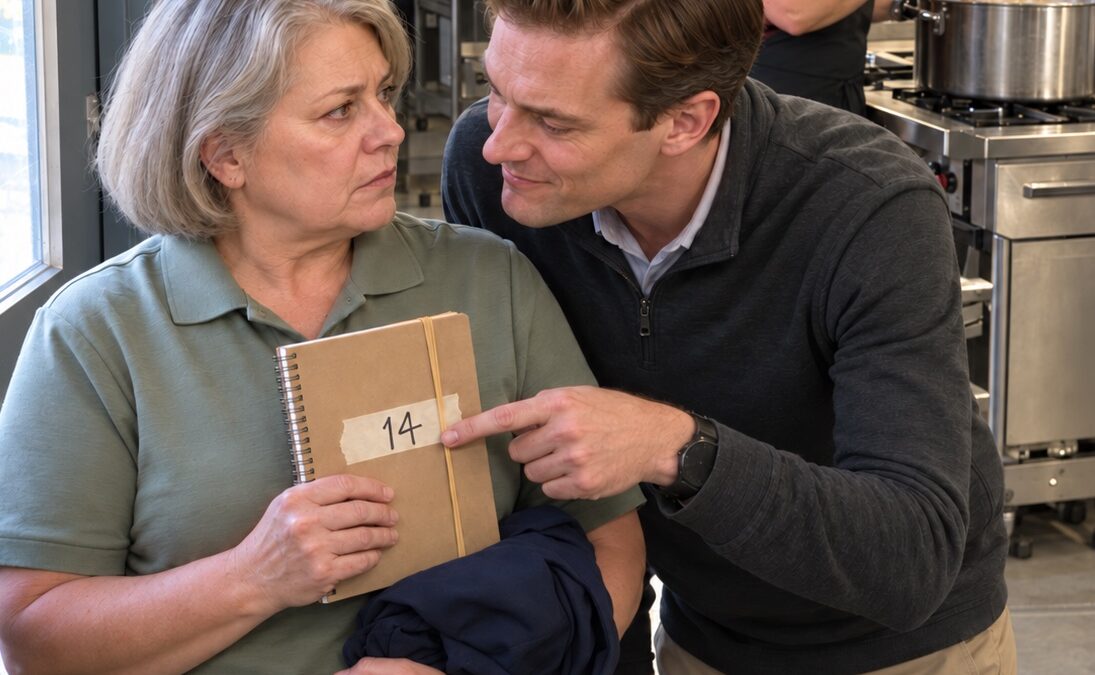
A spiral notebook hung there by its rubber band. A strip of masking tape crossed the cover, and 14 was written on it in black marker.
I knew by heart everything written behind that number.
I slipped the band off and held the notebook against my palm.
“Who do I give this to? Those kids eat in ninety minutes.”
Kyle looked at the cover the way people look at a receipt they do not plan to keep.
“What is that?”
“The kitchen book.”
“For recipes?”
“No.”
“What, then?”
“Something the next person needs.”
He glanced toward the three staff members, then back at the tape.
“Is this district paperwork?”
“It lives in this kitchen. We use it every day.”
“Who told you to keep it?”
“Nobody had to.”
His mouth tightened. “So it’s your personal notebook.”
“Some kids need someone here to know what’s inside.”
He shrugged. “The vendor has professionals.”
“They aren’t standing in this kitchen.”
“They don’t need to be here today.”
“Somebody does.”
Rhonda shifted her grip and looked once at the 14 on the tape. She had worked beside me long enough not to need the cover opened. One of the other women moved a stack of bowls an inch farther from the steam.
Then Kyle looked at the cover again.
“It’s a lunch line, apron lady, not an ICU. Take your little book home.”
Rhonda’s hand stopped on the paddle.
Kyle smiled toward the room as though he had settled a scheduling question.
I put the rubber band around the spiral again.
“Then I’m taking it.”
“That’s what I said.”
“You said home.”
His smile thinned. “Same destination.”
I walked past him to the rack of blue trays parked against the wall near the serving area.
The wheels squeaked on the first push. I rolled the rack across the kitchen until it sat beside Rhonda, close enough for her to reach without leaving the stove.
“Blue trays go out first. Same as always. Until somebody with a title tells you different.”
Rhonda nodded, her head still down over the pot.
His gaze moved from the rack to Rhonda, then to me.
He did not tell her to move it back.
The blue trays meant nothing to him. I could see that in the blank little pause before he looked away.
I went back to where he had shaken my hand, and I untied my apron.
Its pocket held the layoff letter and the old phone, the one I kept only for allergy messages from the parents’ group going back years.
I folded the apron around both and tucked the bundle under my arm.
One of the women near the prep sink opened her mouth.
Kyle turned his head toward her.
She picked up a pan instead.
I carried the notebook in my other hand and started for the back door.
Kyle followed me past the dry-storage shelves.
“You understand the district is paying you through Friday,” he said.
“I read the letter.”
“You’re not being escorted out.”
“I’m walking.”
“I’m trying to keep this professional.”
I stopped at the door and set my hand on the latch.
The kitchen sounded different from there. Metal bowls. The burner. Rhonda’s paddle moving again.
Kyle came up and stood at my shoulder.
His eyes dropped to the notebook.
He reached out and tapped one finger on the tape across the cover.
“What’s fourteen, anyway? Years till your pension?”
“Fourteen kids. Ask your vendor which ones.”
Part 2 of 8
I opened my spiral notebook in the school parking lot and counted fourteen children whose lunches could make them sick if somebody served the wrong food.
Six had tree-nut or peanut allergies. Three couldn’t eat eggs. Two milk-free meals were required, two were wheat-free, and one had to be sesame-free.
I sat behind the wheel of my old sedan on Monday morning, October 5. The rubber band already lay in the cup holder.
Each child had one line. The substitute dish, the product we could safely use, and how that child was met at the kitchen.
Some came through the regular serving line. Others stopped at the side window, where Rhonda or I could check the plate before it went onto a tray.
Wyatt’s entry had a cookie crossed out.
The supplier had changed ovens in March. Its ingredient sheet was the same, but I called anyway and asked whether the new equipment was shared with anything containing tree nuts.
The answer was yes.
I struck through the cookie and wrote down the replacement we had checked. Wyatt could still have dessert. He just couldn’t have that one.
A printed menu wouldn’t tell a new cook about that telephone call.
I turned back to the first page.
The ink was faded enough that I had to angle the paper toward the windshield.
“Drew M., gr. 2, egg. Grandma picks up the label Tues.”
That was from 2004, my first year in the kitchen. Drew was grown now.
I remembered his grandmother’s gardening hat, with a soft brim and a green ribbon worn pale with age. One afternoon, late enough that the counters were nearly cleared, I passed her a handwritten label through the serving window.
She thanked me and tucked the paper away.
Every Tuesday of Drew’s second-grade year, his grandmother came back for another one. After that, I never saw the woman again. I never learned her name.
At home, Phil was standing at the coffee maker when I brought the notebook inside.
His eyes went to the apron bundled under my arm, then to the tape on the cover.
“Your call, Gwennie.”
I put the book on the kitchen table.
At noon, I used my everyday cell to text Rhonda.
Did the blue trays go out?
There was no answer.
At 3:10 p.m., I emailed Kyle Tolan, the new Food Services Director.
Who should I give the kitchen notebook to? It contains the individual meal substitutions we used for students with food allergies. Please tell me who will receive it.
At 3:24 p.m., his reply arrived.
“Not needed. The vendor has everything. Do not contact kitchen staff.”
I printed the message on our home printer and clipped the sheet inside the front cover.
Phil poured coffee into my mug without asking whether I wanted any.
I left the mug by my chair and turned to the last used page. Recent lines carried Rhonda’s handwriting next to mine where we’d corrected products or serving arrangements.
The notebook had stayed in the Lark Hollow Elementary kitchen for twenty-two years. When a substitute came in, I showed that person the relevant entries before lunch.
Nobody had asked to copy those pages by the time I was sent home.
I closed the spiral book and put it on the table near the printer.
That evening, my cell lit up with Rhonda’s answer.
“Yes.”
I put the phone down without sending another message.
On Tuesday, October 6, I called the principal at Lark Hollow using my own cell.
“I only have the memo that says the vendor’s ready. Meals run through Kyle’s office.”
“Could I see the memo?”
“I can’t provide that over the phone, Gwen.”
“Then who can answer a question about the allergy meals?”
“Food Services.”
I thanked the principal and ended the call.
Next I drove to the school and waited for Anita Frey in the parking lot.
Anita came along the sidewalk on foot, carrying a canvas tote against her hip and a cardboard folder held flat across the top. She had worked as the school nurse long enough to know why I used a separate serving window.
“Morning, Gwen,” she said. “I heard about Monday.”
“I need somebody to take this.”
The spiral notebook stayed open to the current entries as I held it out, angled so the writing faced me.
Anita stopped beside my car. Her hands remained on the folder and tote.
“What are you asking me to do?”
“Get these meal instructions to whoever is taking over. I can’t walk back into the kitchen.”
“Have you contacted Kyle?”
“Yesterday. He says the vendor already has what it needs.”
Anita kept her eyes on my face.
“I can’t discuss a student. Anything about meals has to go up to Kyle’s office, same as my medical statements did in August.”
“You sent those yourself?”
“Through the district process, yes.”
“Can you check whether the kitchen received what it needs?”
“I can’t answer that.”
“Could you at least take the book?”
“I’m sorry, Gwen. I can’t accept student information outside the approved process.”
Anita adjusted the cardboard folder against her bag.
“I can tell you where your request has to go. I can’t tell you what another office has done with it.”
“Then that’s where it goes.”
I drew the notebook back and closed it. Anita hadn’t touched a page.
“Take care of yourself,” she said.
“You too.”
She went toward the front entrance. I returned the book to the passenger seat before making another call.
The employee association representative listened while I explained that I was out immediately, though the vendor contract still needed board approval.
“A layoff for lack of work isn’t a for-cause case, so the for-cause hearing doesn’t reach it. You could argue it’s premature, since the board hasn’t voted. Argue it to who? The board.”
I emailed Steve Ingram, the superintendent, and an automatic reply routed my message to the Food Services Director’s office.
That afternoon, I was home when someone knocked at the front door.
A district courier stood on the porch with a white envelope addressed to me. I signed for it and closed the door.
Inside was a letter bearing Kyle Tolan’s signature.
I held the paper against the narrow table at the entrance and read the final paragraph.
“Further contact with staff or families about district food operations will be treated as interference and may affect your final leave payout.”
Part 3 of 8
I held a black pen over Peg Ansley’s public-records form and wrote: Entire Sunfield contract, including attachments and exhibits.
On Wednesday, October 7, one day after Kyle’s letter threatened my leave payout, Peg stood behind the administration-center counter, the one district door he could not close on me. She read the page from top to bottom, then checked the date beside my signature.
I added anything filed with the contract packet. No reason belonged on the form, and Peg did not ask for one.
She slid the carbon copy toward me.
“Twenty-five cents a page. I’ll call you.”
“Bill me the whole file.”
Peg kept the original and returned my pen. Friendly would have been too much to expect from her, but so would hostility. She handled paper and people the same way: correctly.
I folded my duplicate once and put it in my purse.
Outside, I was halfway to my car when the door I had just left opened behind me.
Kyle came out beside a woman wearing a blue Sunfield lanyard. Her badge read TIFFANY ROWE, REGIONAL REPRESENTATIVE.
She laughed at something he had said, loud enough to carry across the lot. Kyle had his jacket open and was walking half a step ahead of her.
He saw me near the car and lifted his right hand like he might wave.
Then he dragged that same palm down the front of his pants.
Tiffany kept smiling.
“Tell your book I said hi,” Kyle called.
I unlocked the driver’s door and put my purse on the passenger seat.
Nothing in his face said he knew about my records request.
Later, at the grocery store, Amber Nesbitt stepped directly in front of my shopping cart near the canned vegetables.
I knew her from the Lark Hollow parents’ group, which she ran as its admin. She wore navy scrub pants under a gray sweatshirt, and there was a hospital badge clipped at her waist.
Kyle’s letter was folded in my purse. The last paragraph had stayed with me all day, especially the warning about contact with families.
Amber put one hand on the handle.
“Why does Wyatt come home saying he doesn’t see Miss Gwen at the serving window anymore?”
Then she waited.
Wyatt was eight and in third grade. I knew his face, his voice, and what he called me. That did not make his school information mine to hand across a grocery aisle.
I kept both hands where they were.
“Ask the district who has your son’s plan. Ask for it in writing.”
Amber’s mouth tightened.
“What plan?”
I steered around her. She did not follow me or ask again.
Thursday night, Phil had the baseball game on in the living room while I stood at the washing machine with the apron I had folded up on Monday.
The old phone was still in its pocket. Since Monday, I had plugged it in every night and put it back there, afraid a parent might message about an allergy.
I emptied the apron before starting the load.
The layoff letter came out first. I set it on the shelf above the machine.
Then I placed the phone beside the detergent bottle.
The apron went into the drum.
Before I could close the lid, the phone buzzed.
I picked it up.
The Lark Hollow parents’ group had 212 members. Kyle had been added in August to announce the vendor change.
A gray line on the screen read:
Kyle T. deleted a message.
A few parents had already posted, “what was that?”
Then Kyle wrote:
“Sorry folks, fishing video, wrong thread!”
The timestamps showed the post had been up under a minute, both entries still at 9:47 p.m.
A private message from Amber appeared.
“That wasn’t fishing. I saved it. Are you sitting down?”
A video attachment followed.
I lowered the volume until it barely rose over the game in the other room, then pressed play.
Kyle sat in the driver’s seat of a parked car. He looked into the camera and grinned.
“Trent, no bass this time. Get this. Vendor keeps asking me for some roster. Fourteen kids in a spiral notebook. We’re dropping the book, man. It’s a lunch line, apron lady, not an ICU. And that’s fifteen grand if this thing closes.”
The whole clip ran 19 seconds, and I let it play out.
I had never heard of a Trent. “No bass this time” and the fishing excuse told me only that the video was meant for a friend.
Fourteen kids.
That book.
He had known what the number meant.
My thumb left a damp print on the glass.
I looked toward the laundry-room doorway. Only the crowd noise carried on from the living room. Phil had not come in.
The number at the end was different.
Fifteen grand.
I had no idea what it referred to.
I did know the voice.
The same man who had stood in front of my kitchen staff on Monday and called me apron lady had said it again when he thought he was talking to a friend.
Amber had saved the video in time, and nobody else in the group had said they had.
The frame was still frozen at second 19, on Kyle’s smiling face behind the wheel, when Amber’s next message dropped over it.
“Fourteen. My son’s one of them, isn’t he?”
Part 4 of 8
Amber Nesbitt stood on my porch Friday morning in navy scrubs, holding her phone out between us.
“Fourteen,” she said. “Wyatt?”
I kept the notebook closed on the kitchen table behind me.
“I’m not giving you a child’s name.”
“He’s my child.”
“Your son has a right to a written plan. Kyle sent a letter to my house saying contact with families could cost me my leave payout. You ask the district.”
Amber lowered the phone, but only an inch. Kyle’s face was frozen on the screen from the video she had saved.
“I can post this right now.”
“Post that and he says sorry by breakfast. A rude video gets you an apology. I need the paper.”
“The Tulsa stations would take it.”
“A bigger screen gets you nothing more from Kyle. Put the paper on TV before the board votes, and he sees it coming.”
Amber glanced over my shoulder at the spiral notebook. A rubber band held the cover shut.
“Ask Kyle who has Wyatt’s plan,” I said. “Get his answer in writing.”
Then she locked her phone and slid it into her scrub pocket.
Later Friday, Amber forwarded me the email Kyle had sent to all parents: “Mrs. Haskell has chosen to retire… all special diets are fully covered.”
A second message carried a cafeteria photo of a sheet cake iced, “Happy Retirement, Gwen!”
That weekend at the grocery store, Rhonda saw me near produce and turned her cart into another aisle. A corner of a Sunfield envelope showed from her purse as she went.
Tuesday, October 13, the insurance company’s letter stayed open on our kitchen table: our family health coverage ends Saturday, October 31.
I turned the letter’s envelope over and did the math for Phil’s medicine on the back.
His prescriptions would cost $640 a month.
Phil opened the refrigerator and tucked the insulin behind the milk carton before I could add anything else.
I put down the pen.
Neither of us spoke of it.
The old apron had been washed since Thursday. I took it from the laundry basket, folded it once, and put it in my dresser drawer.
Its pocket was empty.
That afternoon, the old phone rang on the table, and I answered it.
Amber said, “The district wrote back. Every special diet covered. Maybe the video’s just a jerk being a jerk, Gwen. Maybe you’re…”
She stopped.
“It’s Wyatt. I keep pushing, he becomes the kid everybody watches.”
The notebook lay open in front of me now.
The first faded line read: “Drew M., gr. 2, egg. Grandma picks up the label Tues.”
I closed the cover.
Then I slid the book to the far end of the table.
Wednesday, October 14, Peg Ansley called.
At the administration-center counter, she handed me twenty-two pages.
I counted out $5.50 in cash.
Peg put the money beside her receipt pad without looking up.
“Agenda posts by Friday. Sign-in closes ten minutes before the gavel. Five minutes each, thirty total.”
“The meeting’s Monday?”
“October nineteenth.”
I carried the stack to my car.
The first useful page I found was a memo to the board dated September 30, signed by Kyle Tolan as Food Services Director.
“Vendor is ready for all special-diet meals at no added cost.”
I had not read the rest of the stack.
That evening, I photographed the memo and sent it to Amber.
Her reply came back: “I’m coming over.”
At my kitchen table, I set the memo first.
Then I unclipped Kyle’s printed 3:24 p.m. email from inside the notebook’s front cover and placed it underneath.
I went to the laundry room, took the layoff letter from the shelf above the washer, and brought it back.
Amber set her phone beside the three papers.
“Now I have something to sign,” she said.
She filled out a complaint to the state child nutrition office as Wyatt’s parent.
We both knew it would not come in time, since the state reviews contract terms before signing and does not settle a complaint in a few days.
If Sunfield landed on the consent agenda, the board could vote without separate discussion. If thirty minutes ran out before my name was called, nobody would hear me.
Amber capped her pen.
“What are you sending the board?”
“These three. I know what these three say.”
She took her phone and went home.
Thursday, October 15, I sent those same three papers to the board’s public address. Four days remained, and those were the documents I was sure of.
The automatic reply arrived a minute later:
“Board correspondence is routed through the Superintendent’s office.”
That night, with no one else at the table, I opened the full packet I had not finished reading.
I read it one sheet at a time.
There was no order by subject. Forms and signatures were mixed with pages that seemed to belong somewhere else.
Behind the pricing appendix sat page 17.
It was a Sunfield handoff sheet dated Friday, October 2, two days after Kyle’s memo.
Near the bottom were two sets of initials.
One line read:
“Special-diet roster: NOT RECEIVED. Standard menu only until received.”
Standard menu meant the cookie I had struck out for Wyatt could come back from the supplier’s shared equipment.
Beside that line were the initials K.T.
Part 5 of 8
“Add-on $1.85 per meal.”
Friday morning at my kitchen table, with a pencil in my hand, I found the line I had not reached the night before, at the very bottom of page 17.
I turned over the insurance letter’s envelope. Under the $640 for Phil’s medicine, I wrote:
14 × $1.85 × 180 = $4,662 a year.
Kyle’s video had given me another number.
Fifteen grand.
I had no bridge between $4,662 and $15,000. One was less than a third of the other, and I could not prove they had ever met. That was all I knew.
I photographed page 17 and sent the picture to Amber.
She answered before I set the phone down: “Keep that page with you.”
At 5:30 p.m., the district posted Monday’s agenda.
I printed a copy. The Sunfield contract had landed on the consent list as item 7(c), with no separate discussion.
Amber shared one sentence with everyone in the parents’ group:
“Your kids’ lunches are on the agenda.”
She added the time and place underneath, without the video.
Rhonda had sent me nothing since that one “Yes.”
Monday, October 19, I reached the board room at 5:15 p.m. with the notebook under my arm and the 22 pages, layoff letter, and Kyle’s email in my hands.
The sign-in sheet sat on a table by the door.
The first six lines were filled, and every name belonged to someone in a Sunfield polo.
Tiffany Rowe stood beside the sheet in her vendor lanyard, smiling.
“Per the agenda.”
I signed seventh.
Amber put her name down right after mine.
In 22 years, I had never attended a board meeting. I knew the president, Marilyn Dority, only from paperwork that came through my kitchen.
A worn gardening hat hung on a coat rack beside the board table. Its green ribbon had faded almost white.
I gave the hat a brief glance and checked the time on the wall clock.
At 6:00 p.m., Peg counted 90 people for the record from her clerk’s desk.
Marilyn brought down the gavel. Steve Ingram, the Superintendent, sat at her left, with the other four board members along the table. In the back row, Anita Frey, the school nurse, kept her purse on her knees.
Kyle took the microphone for the Food Services Director’s report. He said the new meal program had put him up for an innovation award from a Tulsa business club.
Then he said, “Sunfield is ready for every special-diet meal.”
My thumb rested on page 17.
“There is no private list. The kitchen never kept anything the vendor needs.”
Kyle’s printed email was in my stack.
“Mrs. Haskell chose to retire, and we’re honoring that.”
The layoff letter lay behind it.
I stayed in my chair.
Kyle kept his place at the microphone and took a glass frame from the table beside him.
Inside it was a new apron embroidered “22 Years.” The cloth was bright white, the kind that had never spent a lunch shift over steam pans. The stitched number sat where my own apron usually picked up gravy or tomato sauce before noon.
He called my name and raised the frame where the audience could see it.
“A retiree deserves a thank-you, whatever she may say tonight.”
The whole room applauded.
I went up because refusing would look like a disruption and could cost me my turn to speak.
My papers stayed on my chair next to Amber. The spiral notebook came with me under my arm, closed by its rubber band.
Kyle handed me the frame while a district employee raised both hands to take our photo. The glass caught the overhead lights and laid a white bar of glare across the embroidered “22 Years.”
Then Kyle offered his hand.
I shook it.
The camera clicked.
The instant it lowered, he wiped his hand down his pant leg.
“See? No hard feelings,” he said, his back to the microphone.
I gave him no reply.
He turned toward the head of the room with the little smile he used when a matter was finished.
I carried the framed apron to the front row and set it on the empty chair on my other side. Nobody touched it.
Amber looked at the frame, then away.
She held her phone in both hands, Kyle’s saved video still unplayed.
I sat down beside Amber and took my papers onto my lap. The notebook stayed tight against my side, its rubber band untouched.
At 6:08 p.m., Marilyn opened public comment.
The six Sunfield employees went to the podium one at a time in sign-in order.
“Seamless transition,” the first one said.
The red clock on the wall was already counting down from thirty minutes.
Another speaker praised “student-centered service.”
Time drained away while they read prepared remarks about staffing, menus, and readiness. One finished early. Someone else used nearly the full five-minute limit before leaving the podium. Amber never took her eyes off the numbers.
The sixth employee stepped away with eight showing.
Together, the six had eaten 22 of the 30.
Marilyn looked at the clock.
“Speaker seven, Gwen Haskell. Eight minutes remain in speakers’ time. You have the floor.”
I stood.
The framed gift stayed on its empty seat.
Holding the notebook and my papers against my chest, I walked toward the podium with a rubber band I could not take off and not one child’s name I was allowed to say.
Part 6 of 8
With eight minutes showing and five of them mine, I set my papers on the podium: the layoff letter, Kyle’s printed email, and the 22 pages. The spiral notebook stayed in my hand.
“My name is Gwen Haskell. I did not retire. Six children with nut allergies. Three with egg. Two with milk. Two with wheat. One with sesame. That’s fourteen, and they eat in that line five days a week.”
I raised the notebook without opening it. The rubber band stayed around the cover, and the taped “14” faced the room.
“This has their names, so it stays shut.”
I tucked it under my arm and picked up the dismissal letter.
“‘layoff for lack of work, effective immediately.’”
Below that, I read the line saying the Food Services Director had recommended the action against me.
Then I read the two typed initials beside it.
“K.T.”
I set the letter back on the podium.
Kyle broke in from his own microphone beside the board table.
“That’s an old personal notebook. Everything on file went to the vendor.”
The red clock stopped whenever someone interrupted or Marilyn asked a question.
I left Kyle’s words where he put them.
“On October 5, I emailed Mr. Tolan asking who should get the notebook.”
I lifted the printed reply.
“At 3:24 p.m., he answered: ‘Not needed. The vendor has everything. Do not contact kitchen staff.’”
The email went down. I took the September 30 memo from the 22 pages.
“‘Vendor is ready for all special-diet meals at no added cost.’”
I named the date and his signature, then turned to page 17.
“The Sunfield handoff sheet is dated Friday, October 2.”
I read the next lines word for word.
“‘Special-diet roster: NOT RECEIVED. Standard menu only until received. Add-on $1.85 per meal.’”
Beside the roster line were the same initials.
“K.T.”
Peg came over from the clerk’s desk for my copy of page 17 and carried it to Tiffany Rowe.
Marilyn looked at Tiffany.
“Is that your form?”
Tiffany studied the paper in front of her, with no smile left for it.
“Per the agreement… yes. We haven’t received a roster.”
Peg took the copy back for the meeting record.
Marilyn turned toward the back row.
“Mrs. Frey, what paperwork about the children’s dietary needs did you send forward this school year, without naming any student?”
Anita stood with her purse still on her chair.
“Fourteen medical statements left my office in August.”
She said nothing else and sat down.
My five minutes ended with three still showing on the clock above us.
Kyle had the September 30 memo from his report folder in one hand.
“She’s a disgruntled former employee.”
Marilyn gave him no answer. She looked down at the sign-in sheet Peg had handed her.
“Speaker eight, Amber Nesbitt.”
I stepped two paces aside to make room.
Amber came up from the front row with her phone in her hand and held it to the podium microphone.
“My son eats in that line. This came to our parents’ group by mistake.”
She touched the screen.
Kyle’s voice played for all 19 seconds.
“Trent, no bass this time. Get this. Vendor keeps asking me for some roster. Fourteen kids in a spiral notebook. We’re dropping the book, man. It’s a lunch line, apron lady, not an ICU. And that’s fifteen grand if this thing closes.”
At the last sentence, Steve Ingram lifted his head.
I could see that much from where I stood, and the third row leaning out to find Kyle.
Kyle went stiff, the memo still pinched in his fingers.
“That’s a private joke between friends.”
Amber lowered the phone, held on to it, and went back to her seat.
Marilyn ran a finger down the page in front of her and stopped at the final line.
“Speaker nine, Rhonda Cobb. Two minutes remain.”
I had not known Rhonda was in the room. The sheet, as I saw later in the record, showed she had signed last at 5:49 p.m., one minute before sign-in closed.
Rhonda stood from the middle row holding the Sunfield envelope with the vendor’s job offer.
She walked to the podium, took out the letter, and set it beside my papers. The empty sleeve went beneath it, and both stayed there on the wood.
Rhonda kept her voice low and did not look at Kyle.
“He told me to keep quiet about the book if I wanted a job in November. I’ve fed those kids for nineteen years. I’m done keeping quiet.”
When she finished, I carried the notebook to the board table and set it in the middle, rubber band still on and the taped “14” still showing.
“Mrs. Frey can have this. You can’t read it out loud, and neither can I.”
Anita came forward and lifted it from the table with the cover shut.
One board member made a motion to pull item 7(c) for separate consideration and table it. Another seconded.
Five arms rose at once.
Marilyn counted them.
“A motion, a second, every hand up. Item 7(c) is removed from the consent agenda and tabled.”
Steve Ingram stood, taking his time.
“Mr. Tolan, you’re on administrative leave as of now. Please step out.”
Nobody had yet said who would run the Lark Hollow kitchen in the morning or asked Kyle what fifteen grand meant.
Kyle’s way out took him past me where I still stood beside the board members.
He had wiped his hand down his pant leg once more by the time he stopped at my shoulder and met my eyes.
“You were a cook.”
Ninety people were still in the room.
“It’s a lunch line, Kyle. Fourteen kids eat in it.”
Part 7 of 8
“Sunfield Dining Partners withdraws its proposal,” Amber read on Wednesday, her voice coming from my cell on the kitchen table while she stood at Peg Ansley’s counter with the vendor’s letter in her hand.
She had also filed a written public-records request for Kyle’s pay addendum, because fifteen grand had to be on paper somewhere, and now she asked Peg to read the bonus line.
Peg’s answer came through flat.
“Savings bonus: $15,000 if documented cost cuts reach $410,000 for the year.”
Peg opened the cost-reduction report that was on file.
“Projected drop for the year: $412,000.”
Every other school’s roster was marked received with its add-on counted, and only Lark Hollow’s was missing.
“Copies are a quarter a page,” Peg said.
That was all she added.
Amber shifted to her copy from the Superintendent’s office.
“The savings bonus has no basis following the vendor’s withdrawal.”
The insurance letter’s envelope was still on my kitchen table, with my pencil math on the back.
I had written $640 for Phil’s medicine and, below it, 14 × $1.85 × 180 = $4,662.
Under those figures I wrote $412,000 − $4,662 = $407,338.
That left the number just short of $410,000, and short was all it took.
Those special-diet meals had been the last cost standing between Kyle and the $15,000.
Kyle had sold fourteen kids to keep the bonus, and now he had lost that too.
I read her the numbers off the envelope, and Amber asked, “So $4,662 was the difference?”
“To the penny,” I said.
By that night, the parents’ group was passing around exactly one number: $4,662.
On Thursday I drove Amber to the district office in my old sedan.
Before we went inside, she showed me the Tulsa business club’s lunch innovation award page on her phone.
Kyle’s name was gone.
At Peg’s counter, Amber set down the petition with 187 signatures.
“We want written plans for every kid, and we want her back.”
Peg stamped the bottom and logged it like any other paper.
The state’s answer to Amber’s complaint came only after all this was over.
That evening Rhonda stood on my porch and would not come in.
Her voice stayed low, and she kept her eyes on the floorboards.
“They pulled my offer. I’d do it again.”
“Who’s been setting the allergy trays since I left?” I asked.
“I kept the blue trays on the top rack. Separate tongs. Clean cutting board. I checked the cartons and wrappers before the line opened. Nobody switched a meal once I set it.”
“You still marking the lids?”
“With the grease pencil. Same place.”
“What about the side cooler?”
“Left bin stays separate. I check the label before anything goes out. The others know not to reach across it.”
Rhonda rubbed one thumb along the seam of her coat pocket.
“I kept your list in my head where I could. Anita handles the paperwork now.”
“That belongs with Anita.”
“I know.”
From inside, I brought out the foil-covered tray of baked chicken and potatoes meant for our supper and put it in Rhonda’s hands.
“Blue trays. You did that part right.”
Rhonda carried it down the steps without looking back.
That night Phil laid the insurance letter on top of the dresser.
He slid the drawer holding my old apron partway open, left it that way, and went off to make coffee without saying a word.
The apron’s folded edge showed behind the wood.
I pushed the drawer shut.
“They fired me with a paper towel, Phil.”
He did not answer it.
Friday brought board president Marilyn Dority up my porch steps in the worn gardening hat I had seen on the coat rack at the board meeting.
The green ribbon had faded almost white.
She carried the notebook in one hand and the invitation letter in the other.
“Anita copied it into fourteen written plans, so this comes home.”
She laid it on the porch rail between us, rubber band still around the cover and the taped “14” showing.
Marilyn held the folded letter out to me.
“This invites you back. It still needs the board’s vote.”
I held the page by one corner.
“So right now it’s a maybe on district letterhead?”
“Yes,” Marilyn said. “That’s exactly what it is.”
She did not ask me to decide on the porch.
Instead, she reached over and touched the closed cover.
“Every current entry in here has a plan behind it.”
“And nobody needs this for the medical file?”
“No. Anita has what she needs now.”
The letter stayed folded in my hand, and I gave her no answer about going back.
Marilyn slipped off the rubber band, opened the cover, and rested her hand beside the first line.
I knew the words before my eyes reached them.
“Drew M., gr. 2, egg. Grandma picks up the label Tues.”
Marilyn kept her palm there.
“Earlier in my career, I taught in another district. When I retired, I ran for this board because one child with an egg allergy at Lark Hollow had depended on a stranger’s handwriting. I assumed the woman who wrote it was long gone. Then a memo said ‘ready,’ and I let it go on consent. Anita needed a board officer to sign for this book. I saw the entry with Drew’s name on it.”
I looked at the hat, at the ribbon that had once been green, and kept the reason to myself.
Marilyn reached into her purse with the hat still on her head, opened her wallet, and drew out a yellowed label.
The ink had gone brown, but the writing was my own from 2004.
She held it up between her fingers.
“Egg-free. Safe for Drew. — G.”
She turned the label over.
On the back, in a different hand, I read:
“Never got her name.”
She raised her eyes and looked directly at me.
“One school year, 2004. That grandmother was me.”
Part 8 of 8
“The district’s statement that Mrs. Haskell retired was false and is withdrawn,” Peg Ansley read into the record.
I sat in the front row of the public seats beside Amber while Superintendent Steve Ingram took the next page from his folder. He read slowly enough that nobody could mistake a number.
“I signed the layoff letter, then accepted a report that Mrs. Haskell had chosen retirement instead. That report was wrong.
“The recommendation is to cancel Mrs. Haskell’s layoff, reinstate her for a November 2 return, pay $2,408 in lost wages for fourteen workdays at $172 per day, October 13 through October 30, and restore her health insurance with no gap in coverage. Her pay already ran through Friday, October 9, and Monday, October 12, was Columbus Day, when schools were closed and no kitchen hours were worked.”
Four board members voted yes.
Marilyn voted last.
“Yes.”
The label from 2004 rested between the board president’s fingers. She said nothing else.
Peg entered the vote.
The next item had been on the posted agenda since Thursday, and I had already read the wording at my kitchen table.
“Superintendent’s recommendation to terminate the Food Services Director, or accept his resignation.”
Steve turned one page.
“He signed it Friday, October 23, after the notice of recommendation reached him.”
Kyle Tolan’s letter sat in Peg’s file.
The board accepted it, 5 to 0.
Peg read his full name and district job title aloud, polled each member, and entered every vote into the public minutes.
That evening the invitation letter lay beside a pen on our kitchen table.
Phil poured coffee and looked at the page.
“Should you take it back, after what they let happen?”
“Fourteen kids didn’t let anything happen.”
“That isn’t an answer, Gwennie.”
“No.”
He set my mug down.
“Your call.”
I read the line about returning November 2, then signed my name at the bottom.
Directly beneath it, in my own handwriting, I added one condition: every plan had to carry that child’s parent’s signature in the nurse’s office, not live only in one person’s head in the kitchen.
Phil tapped the sentence.
“You’d walk if they won’t do this?”
“I’d carry my apron home.”
“Even after the vote?”
“Especially after the vote.”
He nodded toward my name.
“That sounds like an answer.”
“It is paperwork.”
Phil put his finger on the written line again. “At least this time the paper goes where people can find it.”
“That’s why I signed.”
Before the week was out, Amber Nesbitt had signed as the first parent, and Anita Frey for the nurse’s office.
The insurance card stayed active. When Phil picked up his medicine, the pharmacy did not ask us for $640.
At 5:50 Monday morning, Rhonda had the ovens lit and the rack of blue trays stacked by the line when I tied on my old apron from the dresser drawer.
Behind the refrigerator, Kyle’s glass frame hung from its hook.
The white apron embroidered “22 Years” was gone.
Rhonda wiped the stainless counter with it.
I nodded toward the rag.
“Retirement gift?”
“Absorbent.”
“Best use it’s had.”
“Want me to frame the rag?”
“Only if you wash it first.”
“I was hoping you’d say no.”
Rhonda folded the cloth once and set it beside the sanitizer bucket.
“I carried the frame back from the chair you left it on,” she said. “Hung it myself.”
“Good wall for it.”
She went back to work on the trays.
I checked the rack, the side cooler, and the file cabinet. Inside the top drawer sat the kitchen’s copy of fourteen written plans. The originals were in Anita’s office.
Nothing had to live only in my memory now.
Before lunch, Marilyn came to the far side of the serving window.
She put the old label directly into my hand.
“This belongs in the kitchen that earned it.”
The brown ink still said, “Egg-free. Safe for Drew. — G.”
Marilyn did not stay for a speech.
I slid the label under the glass top of the serving counter and pressed the corners flat.
Then I took the spiral notebook in both hands. The rubber band still circled the cover, and the masking tape still carried the black “14.”
I hung it on its old hook beside the stove, next to the file cabinet.
On Thursday, November 19, Rhonda reached up before the Thanksgiving lunch and brought the notebook down from the hook.
A new kindergartner with an egg allergy had started, and the paperwork was already in place.
Rhonda peeled the old tape from the cover and held the spiral steady on the prep table.
I wrote “15” on a fresh strip in black marker.
“Looks busier,” she said.
“It is.”
The dining room filled beyond the counter opening, and the blue trays moved down the line without anyone guessing from memory.
After twenty-two years, wanting somebody to say the work mattered did not make me vain.
Near the end of lunch, Wyatt came running up to the window.
“Can I have more mashed potatoes? My bread has to be Prairie Hearth White. That’s the one I can eat.”
He planted both feet, stood straight as a grown man, and held one gravy-covered hand across the opening.
“Mom says I should shake your hand, Miss Gwen.”
I peeled off my food-service gloves and shook it hard.
His hand was sticky with gravy. I didn’t wipe mine.
THE END
More stories
My husband hid my sister’s letters for 7 years — Then a mailman brought envelope “#29,” and he was served divorce papers at work with employees and customers present.My Sister Gave Mom’s Bedroom to Her In-Laws and Put Mom on a Cot in the Sewing Room, Then Threw Them a Party, Until Mom Showed Everyone the Credit Cards Opened in Her Name.My boss gave his daughter until Friday to leave her home after 16 years—then the folder he left on my counter helped stop his auctionMy brother-in-law used a $180 drill in Mom’s purse to push care-home papers—Until the store owner checked his cameras and my sister tore up the forms.My HOA president sent two men with shovels into my late husband’s memorial garden and fined me $2,400—Then her own financial records cost her the presidency.
You Might Also Enjoy

My Daughter-In-Law Told Me To Stay Elsewhere While Strangers Took My Condo — Then I Pushed Back







