My Niece Belinda Said I Didn’t Live There Anymore Before 32 Neighbors, but She Went PALE When a Biker Asked Who Changed My Locks
Part 1 of 5
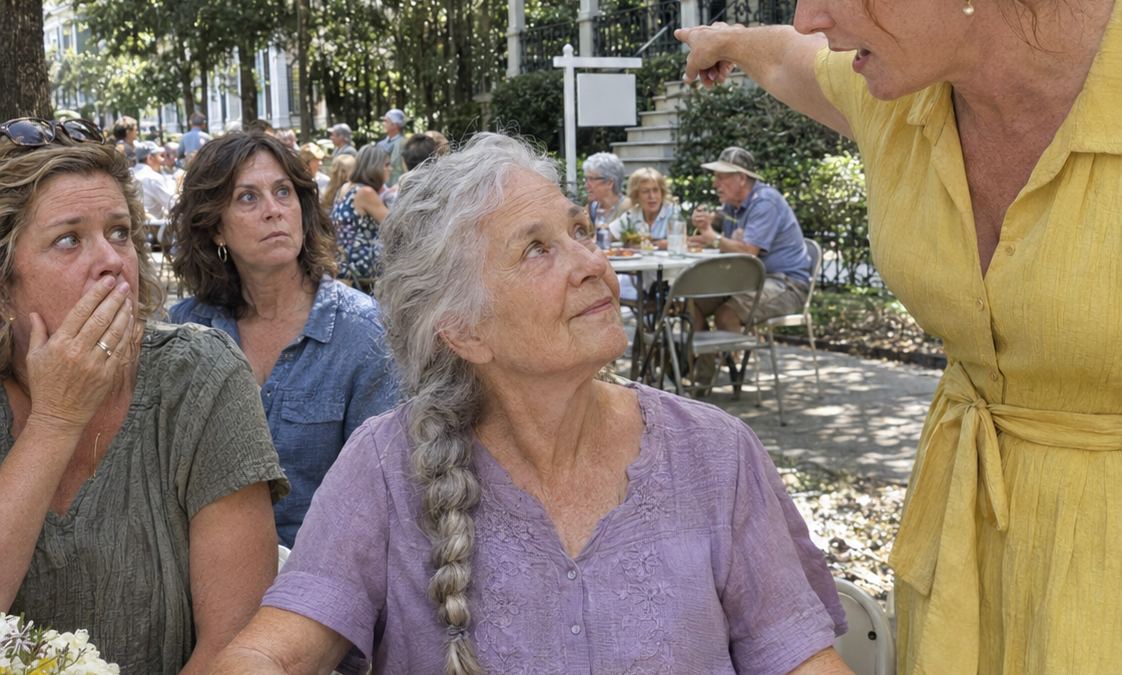
“You don’t live here anymore!”
Belinda Crowell shouted across our annual street breakfast in Savannah, Georgia.
All 32 neighbors stopped eating beside the folding tables.
My husband’s wooden house-number plaque lay beside my empty plate.
I had brought a cloth napkin to protect its corners.
Belinda stood beside the real-estate sign outside our front walk.
Her yellow dress had a belt with a square buckle.
She kept straightening it whenever somebody looked toward me.
“The court says otherwise,” I said.
A fork clicked against a plate halfway down the table.
Belinda smiled at the neighbors instead of answering me.
“Listen to her. She’s been watching courtroom television again.”
I folded my napkin.
That was all.
At seventy-five, I could still recognize a practiced performance.
I had spent forty-one years working as a court reporter.
People often mistook a quiet witness for an unreliable one.
My name was Harriet Winslow, and I knew better.
“Would you like breakfast?” Belinda asked, lifting a paper plate.
“I’ve already paid.”
“That was last year’s arrangement.”
She glanced toward the coffee urn, making sure everyone heard.
“I can spare a three-dollar plate.”
I looked at the eggs cooling beneath her plastic fork.
She leaned closer, lowering her voice without lowering its reach.
“Before somebody drives you to the county home.”
Nobody laughed.
One neighbor began gathering empty cups that were not empty.
Another stared at the sign as though reading it might help.
I stayed seated.
Silas Fenmore and I had bought that house together.
He had been my husband for forty-six years before I was widowed.
We had paid $126,000 and eaten sandwiches on the bare floor.
Belinda moved into the upstairs bedroom twenty-seven years before this breakfast.
She was twenty-one then, with unpaid tuition and a broken suitcase.
We gave her a room without rent or a deadline.
Silas repaired engines and taught young riders to repair their own.
I covered groceries while he helped people stretch another paycheck.
We thought shelter should make a person steadier, not smaller.
A breeze lifted the corner of my napkin.
Belinda pinned it beneath the plate she had offered.
“There. You can at least eat while we settle this.”
“Please move the plate.”
“You’re making the neighbors uncomfortable.”
“The grease will stain the wood.”
Belinda looked down at the plaque, then back at me.
“You brought decorations?”
I slid the plate aside without touching her hand.
Across the street, a garage door began its slow climb.
The ordinary sound helped me keep my shoulders loose.
I had slept three nights in a room above a bakery.
My prescription bottles were still inside the house.
So were my hearing-aid charger and my winter coat.
Belinda had put my overnight bag on the porch.
Then she had changed both locks while I bought groceries.
“I’m trying to make this easier,” she told the table.
“You could stop speaking for me.”
“You need somewhere with supervision.”
“I need my charger.”
Someone coughed into a napkin.
Belinda turned toward the house as if checking the windows.
A cream-colored envelope rested beneath my handbag.
She had noticed it when I sat down.
Now her eyes returned to its square, unsealed flap.
“What did you bring in that?”
“Something I intend to read.”
“You always did make a production out of paperwork.”
I adjusted my chair.
The plaque stayed where everybody could see it.
A neighbor offered to bring me coffee.
“Black, please,” I said.
Belinda interrupted before the woman reached the urn.
“Don’t encourage this. We’re dealing with a family matter.”
The woman brought my coffee anyway.
I thanked her and set it away from the wood.
From the corner came a low, steady engine sound.
Belinda looked irritated before she looked concerned.
“Now what?”
I knew that sound, though I had never ridden.
Silas had called it a conversation you felt through your shoes.
Motorcycles rolled into the parking spaces beyond the breakfast tables.
Their engines stopped together, leaving birdsong over the street.
The riders removed their helmets without approaching the food.
I had asked them to come, and they had promised.
Their leader crossed the sidewalk toward our table.
His gray beard moved in the breeze.
He stopped beside my chair.
“Which one of you changed her locks?”
Belinda’s smile disappeared before anybody answered.
The rider wore a plain black vest over a clean shirt.
He was sixty-three, with the careful walk of someone protecting an old knee.
“Ralph Cresswell,” I told the neighbors. “An old friend of my husband’s.”
“This is private,” Belinda said.
“You made it public,” Ralph said.
He did not move closer to her.
The other riders stayed beside their parked motorcycles.
Nobody blocked the sidewalk or touched the real-estate sign.
I had asked for witnesses, not a rescue.
Ralph looked at the plaque.
“You saved it.”
“It was loose on the porch when I collected my bag.”
I turned the wood so the table could see its face.
“Silas made this when we bought the house. He carved the numbers by hand.”
The edges were rounded from years of weather and my husband’s patient sanding.
A little nick crossed the bottom where his chisel had slipped.
“He said a house ought to know its own name,” I said.
Belinda crossed her arms.
“It’s an old board, Harriet.”
“It tells me where I belong.”
Ralph looked toward the doorway Silas had repaired so many times.
Then he stepped behind my chair and stood still.
The neighbors had begun looking at Belinda rather than at me.
She reached into the tote hanging from her elbow.
Belinda pulled out a folder bearing a photograph of my house.
Part 2 of 5
“That ought to clear up this confusion,” Belinda said.
She laid the folder beside the butter dish, covering a sticky ring of syrup.
The photograph showed our porch without my rocking chair.
I recognized the angle. Someone had stood in the street to take it.
“You had photographs taken?”
“People expect photographs.”
“People who?”
Belinda pressed her lips together.
“Harriet, please don’t start questioning every little thing.”
I waited.
A rider shifted beside his motorcycle, then settled back against the seat.
Ralph had told his friends what I needed before they came.
They were there to carry boxes if asked and witness whatever happened.
Silas had once taught Ralph how to replace a transmission without crushing his fingers.
Later, Ralph helped organize a riding club that raised money for tool classes.
That was how my husband’s garage had grown beyond our driveway.
When he taught, I made coffee.
When he lent tools, I wrote down where they went.
When he worked late, I left the porch light burning.
The men learned to return what they borrowed.
Belinda had watched all that from the upstairs window.
She had also watched me pay the property-tax bill every fall.
The first year she stayed, I paid $2,140.
The bills grew, but her monthly contribution stayed the same.
Nothing.
Silas said school was work enough.
After graduation, Belinda said she needed time to find her footing.
Then came a new car, a better job, a different explanation.
We never charged rent.
That was our choice, and I would not pretend otherwise.
But generosity had gradually become something she described as her right.
“Your aunt has it easy,” relatives told her at cookouts.
“She’s lucky you let her stay.”
Belinda never corrected them.
For twenty-seven years, my family repeated the same story about an inheritance.
At first I thought correcting it would embarrass her.
Later, I learned how comfortable a lie becomes when everyone supplies its furniture.
I had corrected individual relatives when the subject arose.
Belinda told them I got confused about arrangements.
Then she started intercepting invitations and calling them cancellations.
I learned about two Thanksgiving dinners afterward.
Still, I stayed.
My garden was there. My work records were there.
The kitchen doorway held pencil marks from children who were now parents.
I had mistaken staying quiet for keeping the peace.
Belinda tapped her folder.
“We don’t need a history lesson.”
“No,” I said. “We need accurate dates.”
“You’ve always liked making people sound guilty.”
“I wrote down what people said.”
“That’s the same thing.”
Several neighbors looked away from her.
Only the front door had new hardware.
That was what had first stopped me when I came back carrying my groceries.
Belinda claimed a locksmith had replaced the hardware for safety.
Yet the side-door lock was old, and my key no longer worked there either.
Someone had changed its cylinder, not repaired a broken latch.
I had photographed both doors before leaving.
Then I called my lawyer from the bakery stairwell.
I did not climb a window.
I did not break glass.
I did not beg.
The bakery owner let me charge my phone while I waited.
Now I took it from my handbag and turned off the ringer.
Belinda watched that small movement.
“Who are you calling?”
“Nobody. I’m listening.”
“Well, listen to this. You cannot move back upstairs.”
“I didn’t ask about upstairs.”
“You don’t live here anymore!”
The same words sounded thinner the second time.
A neighbor set down a biscuit.
Belinda turned toward the table, palms spread.
“You all know I’ve taken care of this place.”
I looked at the gutter Silas had replaced before his last winter.
A corner had come loose since I left.
“Have you?” I asked.
“Don’t twist my words.”
“I haven’t changed one.”
Ralph lowered himself into the empty chair beside me.
His knees cracked, and a neighbor quietly moved a cup out of his way.
Belinda studied the cream envelope again.
She had stopped pretending it was unimportant.
“What have you been telling these men?”
“Only what happened.”
“They don’t know our arrangements.”
“Then we can explain them.”
I drew the envelope out from beneath my handbag.
The flap opened easily because I had not sealed it.
Inside were copies arranged in the order my lawyer had requested.
I removed the first one and left the rest covered.
Belinda leaned forward.
A neighbor asked whether she should put away the breakfast trays.
“Please leave them,” I said. “This won’t require moving anybody.”
The plaque sat between my document and Belinda’s folder.
One had been made to welcome people.
The other showed my home emptied of everything that identified me.
Belinda reached toward my paper, then stopped when I put my palm beside it.
“What does that say?”
I turned the recorded trust toward Belinda.
“The recorded trust names me as owner, with exclusive occupancy,” I said.
Belinda bent over the page.
The county recording information ran across the top of the certified copy.
I showed her the paragraph beneath my name.
Silas and I had signed it twenty-seven years earlier, when Belinda moved in.
Her name appeared only in the provision allowing her temporary, rent-free residence with our permission.
The final clause reserved my exclusive right to occupy the house.
Part 3 of 5
“That can’t be the whole thing,” Belinda said.
Her finger hovered above the paragraph without touching it.
“It isn’t,” I said. “There are more pages. You may read every one.”
I laid the certified deed beside the trust.
The property had been placed in our family trust when Silas and I planned for illness and death. After his death, I became its sole trustee and sole beneficial owner. The recorded documents protected my right to remain there.
There was no inheritance to Belinda hidden in another paragraph.
There was permission to live under our roof.
Permission was what she had turned into a deed in everyone’s imagination.
“My mother said it was mine,” Belinda said.
“Your mother was told you would always have help getting started.”
“That’s not how she explained it.”
“I know.”
The neighbor nearest the coffee urn took off her glasses.
“You mean you’ve been paying everything all along?”
“The taxes, insurance, and repairs,” I said. “Belinda paid her own telephone bill.”
Belinda straightened.
“I bought things for the house.”
“You bought a television for your bedroom.”
“And a couch.”
“You took that couch to your apartment during the year you moved out.”
She looked toward the riders, as though they had caused this accounting.
Ralph examined the grain of the plaque.
He knew enough to leave the answer to me.
I had no interest in adding up every grocery bag. I wanted the house back, not an audience for twenty-seven years of receipts.
But the folder beside the butter dish needed explaining.
“May I see what you brought?” I asked.
“It’s nothing you need.”
“The cover is my front porch.”
Belinda pulled the folder toward her. A loose sheet slid out and landed against my coffee cup.
Across the top was the same photograph, printed above the address and an asking price of $850,000.
The neighbors closest to me could read it without standing.
“You listed it,” I said.
“I was exploring options.”
“At eight hundred fifty thousand dollars.”
“That’s what houses here are worth.”
“You didn’t ask me.”
“You wouldn’t have understood the timing.”
My coffee had cooled enough that I could drink it without waiting. I took one sip before answering.
“I understand a price.”
The listing described the house as available for immediate possession.
I traced that phrase with my eyes, not my finger.
My bedroom was still full of clothes. Silas’s workbench stood in the back room. A jar of pencils waited beside the kitchen telephone.
Immediate possession meant removing all of it.
“When were you planning to tell me?” I asked.
“We could have worked something out.”
“Before or after the sale?”
“There isn’t a sale.”
“Then we have time to correct this.”
Belinda’s mouth opened, but a woman approaching from the bakery end of the street spoke first.
“Harriet?”
I raised my hand.
Louise Merriweather came to the table carrying a leather document case. She was my lawyer, and she had represented Silas and me when we signed the trust.
I had told her the breakfast began at nine. Her office had confirmed she could meet me there after collecting the signed order.
She introduced herself to Belinda and placed her card on the table.
Belinda did not pick it up.
“Are you responsible for all this?”
“I represent your aunt,” Louise said. “May we sit?”
“You’re already making a spectacle.”
Louise waited until a neighbor offered her a chair.
Then she looked at the listing.
“Has this been distributed?”
Belinda said nothing.
“The sign is in the yard,” I said.
Louise took a photograph of the sheet with my permission.
“The listing agent needs notice immediately,” she said. “No one here has authorized you to convey this property.”
“I haven’t signed anything binding.”
“Then correcting the listing should be straightforward.”
Belinda’s buckle knocked against the table when she leaned forward.
“You people don’t understand what I’ve put into living here.”
For the first time that morning, I heard the words underneath her words.
Living there had become proof, in her mind, that she owned it.
Louise opened her document case.
“Your aunt provided the recording documents, photographs of the changed locks, and the messages you sent after the lockout.”
Belinda looked at me.
I had saved the message telling me not to return. I had also saved the one saying my remaining belongings would be packed “when convenient.”
“The court held the expedited hearing yesterday,” Louise said. “You were served. You chose not to attend.”
“I thought that was another threat.”
“It was notice of a hearing.”
A fly landed beside the untouched eggs. Nobody brushed it away.
Louise removed a document with a signed page clipped on top.
“This is the possession order,” she said.
Belinda stopped adjusting her belt.
Louise laid the signed possession order beside the listing.
Part 4 of 5
Belinda looked from the order to the open front door.
For three nights, she had treated that doorway like something she could grant or refuse.
Now she backed toward it.
Louise stayed seated.
“Please don’t go inside and lock the door,” she said. “The deputy is on the way.”
“You called the sheriff on me?”
“The court issued an order restoring possession. The sheriff’s office arranged execution for this morning.”
I had known the approximate time. I had not known which would arrive first: my lawyer or the deputy.
That was why I had asked Ralph to meet me at breakfast. I wanted company while I waited, and help carrying my bag home afterward.
Belinda glanced around the tables.
“You’re all just going to sit there?”
The neighbor with the glasses put them back on.
“What do you want us to do?”
“Tell her this is unnecessary.”
The woman looked at the order.
“Is it?”
Belinda had no answer that did not require someone else to surrender something.
I picked up the plaque and brushed a grain of salt from its edge.
Silas had rubbed the wood with oil every spring. The back still bore a faint pencil line where he had measured the bracket.
“You can’t expect me to leave today,” Belinda said.
Louise turned the signed page so she could see it.
“You were given notice of the relief requested. The court found you had no ownership interest and no right to exclude Harriet.”
“My clothes are inside.”
“So are mine,” I said.
“I have nowhere to go.”
“You have a job, a car, and money you didn’t spend on rent.”
It was more than I had intended to say.
I put the plaque down and kept my hands flat on the table.
Ralph spoke without rising.
“If the deputy permits, we can help carry her bags to her car.”
Belinda stared at him.
“You came here to throw me out?”
“We came because Harriet asked for witnesses and help with boxes.”
His answer left no room for the scene she wanted.
A marked vehicle turned onto the street and stopped beyond the motorcycles. The deputy who stepped out spoke briefly into his radio before walking toward us.
Louise stood and identified herself.
“This is Harriet Winslow,” she said, indicating me. “And this is Belinda Crowell.”
The deputy introduced himself as Lester Goodwin.
He checked our identification and compared the address on the order with the house. He had received his own copy through the sheriff’s office; Louise handed him the signed copy for comparison.
Belinda watched him read.
The 32 neighbors remained beside their breakfast tables. Some had stood, but nobody had left.
Lester returned my identification.
“This order restores her possession today.”
Belinda’s lower lip drew against her teeth.
“But she let me live here.”
“That does not authorize you to lock her out,” he said.
“I need time.”
“You may collect essential personal belongings now. Further collection will be arranged as the order provides.”
“Where am I supposed to go?”
“I can give you local lodging information. You cannot stay in this house against her wishes.”
The deputy’s voice never rose above the scrape of a chair.
Belinda looked at me instead.
“Harriet.”
For years, my name in that tone had meant an overdue bill, another favor, a problem that would become mine if I listened long enough.
I looked at the yellow belt.
“You may take your clothes and personal things,” I said. “Nothing from Silas’s workroom. Nothing of mine.”
“You’re really doing this in front of everyone.”
“You offered me breakfast in front of everyone.”
A neighbor lowered her head over her folded napkin.
Belinda turned away before I finished.
Lester accompanied her to the house. Louise remained with me, watching the doorway while I drank the last of my cold coffee.
Inside, a drawer shut hard.
Then another.
Ralph stood, but I shook my head.
“He’ll tell us if he needs help.”
A few minutes later, Belinda appeared carrying a suitcase and a canvas bag. The deputy followed with her coat over one arm.
Her car was parked two houses down. She had moved it there to leave the space beside the sign clear.
Nobody offered a farewell speech.
Ralph asked whether she wanted help with the suitcase.
“No.”
One wheel caught in a crack. She pulled until it came free.
At the car, Belinda opened the trunk and put the bags inside.
Lester waited until she returned to the table.
“Keys, please.”
Belinda dropped the new house keys beside my empty plate.
Part 5 of 5
The keys struck the paper plate and left two little dents.
I did not reach for them immediately.
For three days, I had imagined that sound. In my room above the bakery, I had listened to other people opening doors and wondered how something so ordinary could become a privilege.
Now the keys lay beside crumbs and a plastic fork.
Lester asked Belinda whether there were additional copies.
“One in my purse.”
“Please give that one to me, too.”
She unzipped an inside pocket and placed another key beside the first pair.
Louise made a note.
“I’ll arrange for the locks to be rekeyed,” she told me. “You should have the only new set until you choose otherwise.”
Belinda looked toward the sign.
“What about that?”
“The listing needs to be withdrawn,” Louise said. “I’ll contact the agent with the recorded documents and the order.”
“I can call.”
“You may. I’ll provide written notice as well.”
Belinda took out her telephone. Her thumb missed the screen once.
She stepped far enough away that I could not hear the other side of the call, but her own words carried.
“There’s a title problem. No, don’t send anybody over.”
Louise waited.
Belinda looked back at the table.
“It isn’t mine to sell,” she said into the phone.
That sentence did what the shouting had not.
The neighbors looked at one another. The woman who had brought my coffee put a hand over her mouth, then lowered it.
Belinda ended the call.
“The office will take it down.”
Louise asked for the agent’s contact information. Belinda handed over the listing sheet rather than answering.
There was nothing left on it that she could use against me.
Lester explained the arrangements for retrieving the rest of her belongings. Louise wrote down a time and the requirement that Belinda not return unannounced.
I would not have to stand in the kitchen negotiating while she packed.
The deputy would document that possession had been restored. My lawyer would handle the remaining arrangements.
For once, I would not be the person smoothing every rough edge.
Belinda picked up her tote.
“After everything, you could at least let me keep my room.”
I looked at the upstairs window.
The curtain was one I had hemmed when her first paycheck barely covered her car insurance.
“It was a room I lent you,” I said. “It wasn’t a house I gave you.”
She pressed the tote against her side.
Nobody filled the silence for her.
Lester walked with Belinda to her car. He remained at the curb until she drove away, then returned to confirm that she had surrendered the keys.
The same 32 neighbors watched her turn the corner.
I counted because counting had always been easier than wondering what people thought.
Louise slid the trust and the order back into their separate sleeves.
“Ready?” she asked.
“Almost.”
I turned to the woman beside the coffee urn.
“Would you mind saving me a biscuit?”
She covered a plate with a clean napkin.
“I’ll bring it over.”
The man at the end of the table stood.
“I should have said something.”
I recognized him from twenty breakfasts, from storm cleanup, from evenings when we hauled bins back from the curb.
“You can say it sooner next time,” I told him.
He nodded without asking me to make him feel better.
Ralph lifted my overnight bag only after I asked him to.
I carried the plaque.
Its corners pressed familiar shapes into my palms as we crossed the sidewalk.
Lester walked ahead to the door, checked inside, and stepped aside. The lock turned with a key that had never belonged to me before that morning.
Then he placed the keys in my hand.
The kitchen smelled of coffee grounds left too long in the basket.
My grocery list was still attached to the refrigerator. Three nights earlier, I had written “peaches” and underlined it.
Nothing about that small list had stopped belonging to me.
I went to the hall table and set down the plaque.
Through the open doorway, I could see all 32 neighbors beside the breakfast tables. Nobody was looking at the real-estate sign now.
I walked back outside long enough to thank the deputy.
Then I crossed my own threshold again, slowly enough that no one could mistake whose choice it was.
Ralph put my bag beside the stairs.
“Where would Silas have kept the mounting screws?”
“Left drawer of the workbench. In a tobacco tin.”
He waited while I fetched it.
A neighbor brought my biscuit on a real plate. I gave Louise the bakery receipt so she could add the lockout expenses to her file.
The deputy finished his paperwork on the porch.
I opened the tobacco tin and found the screws wrapped in the scrap of cloth Silas had used.
Ralph held the plaque against its old marks while I checked the height.
“Right there,” I said.
The first screw caught.
Outside, breakfast resumed with the scrape of chairs and the pour of coffee.
Louise’s phone sounded as Ralph tightened the second screw.
The listing agent’s written withdrawal arrived before the last screw was tight.
THE END
More stories
My Brother Ross Mocked My Cheap Key Before 34 Relatives, Then FROZE When a Uniformed Guest Walked In and Greeted MeMy Ex Blake Renshaw Mocked Our Daughter’s Purple Halter While Selling Her Mare, Until One Name on a Certificate Cost Him a $48,000 SALE in PublicMy Brother Raymond Said Someone “Respectable” Should Present My Father’s Flag at My Daughter’s Reception, but a Woman’s BUS STATION Remark Stopped His Smile Before Our Mother’s Instructions Cost Him the HonorMy Stepmother Veronica Told Me to Stay in My Place at Dad’s Grave, but Her Smile Vanished When the Cemetery Owner Asked to Let His DAUGHTER FinishMy Brother Mitchell Called Me an UNEDUCATED Driver in Front of 72 People, but He Went PALE When a Woman Walked In and Said, “Ms. Ralston, I’ll Take It From Here”I Was Serving Funeral Lunch When My Sister-in-Law Told Me to Pack My Husband’s Fishing Gear, Then Our Lawyer Found the Date That Undid Her Cabin Claim
You Might Also Enjoy

My Daughter-In-Law Told Me To Stay Elsewhere While Strangers Took My Condo — Then I Pushed Back







