My Son Glen Tried to Move Me Into His Spare Room Before 43 Picnic Guests, but My PAID Residency Agreement Was Only the First Paper He Regretted
Part 1 of 5
“Pack up—you’re coming with me!”
My son Glen shouted across our San Antonio retirement courtyard.
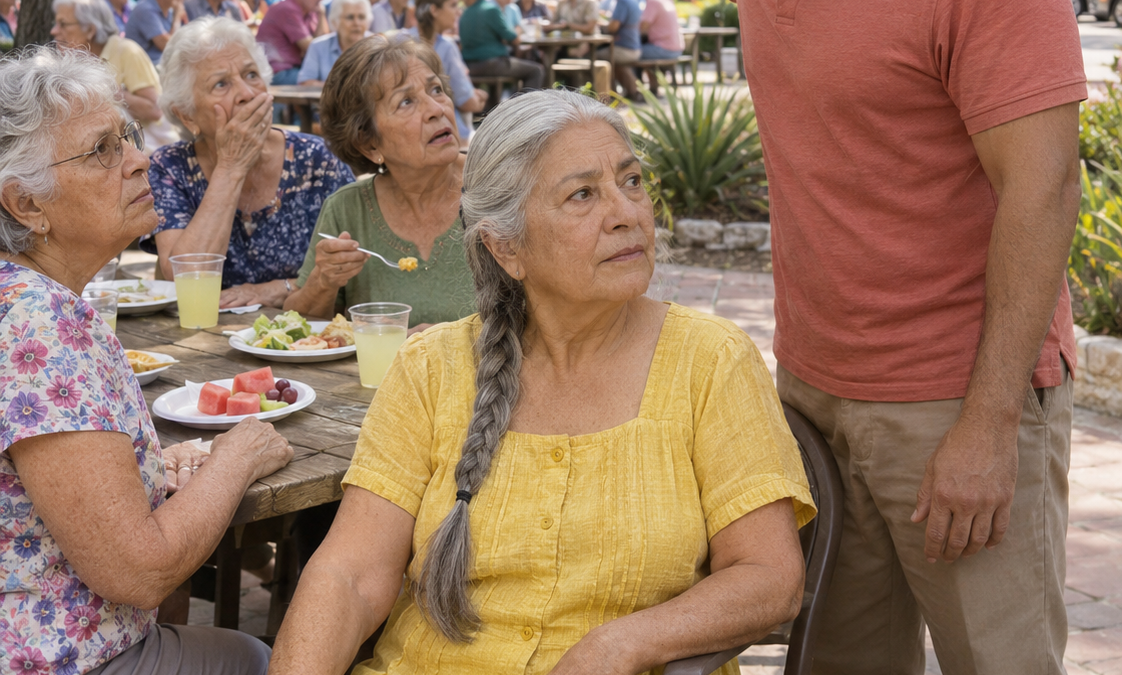
Forty-three residents and relatives watched him roll my sunflower suitcase past the picnic tables.
He parked it beside my chair like an eviction notice.
“Your expensive little vacation is over.”
I said nothing.
A plastic fork stopped halfway to somebody’s mouth.
Behind Glen, his SUV blocked the courtyard’s service gate.
He wore a salmon polo and his company’s newest expression: overdue.
I stayed seated in my yellow linen dress.
At seventy-three, I had learned that standing wasn’t always advancing.
“My room is already paid for,” I said.
A woman across the table lowered her lemonade.
Glen smiled toward her, inviting agreement without asking permission.
“That’s what she thinks.”
Nobody answered.
The suitcase leaned against my calf. One wheel had collected grass.
I recognized the crooked sunflower near its handle.
Twelve dollars.
That was what I had paid at a church sale.
Glen had mentioned the price before mentioning my health.
“You drag that embarrassing thing around beside a ninety-six-thousand-dollar vehicle.”
“Your vehicle,” I said.
“Which will take you somewhere sensible.”
His keys clicked against his belt.
I had not asked him for a ride.
My name was Vera Sikes. I was a widowed, retired civil engineer.
I had spent thirty-six years checking structures people assumed would hold.
After my husband died, I chose this apartment myself.
Glen promised he would visit without trying to manage me.
When he needed tuition, I paid the remaining balance.
When he needed business equipment, I helped buy the first trailer.
When he missed birthdays, I saved him cake anyway.
That history did not require another payment.
Across the courtyard, someone set down a serving spoon.
Glen reached for my chair’s empty neighbor.
I rested my palm on its seat.
“Someone’s sitting there.”
“Your little friends can find another spot.”
“He isn’t here yet.”
“Then he can stand.”
I moved my hand back to my lap.
No argument.
The suitcase’s front zipper had not been closed completely.
A pale blue folder showed through the narrow opening.
Glen noticed where I was looking.
“Don’t start sorting things. I already packed what you need.”
“Did you pack my measuring tape?”
“You’re not inspecting bridges anymore.”
“That wasn’t my question.”
A man at the nearest table coughed into his napkin.
Glen turned toward the others again.
“She gets attached to objects. You understand.”
Three residents looked down at the suitcase.
None looked at him.
He mistook their lowered eyes for permission.
“The spare room is ready. Meals together. No more bills.”
“I have meals here.”
“And too many people encouraging you.”
The woman with the lemonade pushed her chair back slightly.
Glen stepped between her table and my seat.
“Please stay out of family business.”
She had not spoken.
I looked toward the service gate.
His SUV occupied the striped space beside the accessible walkway.
My guests would have to use the longer entrance.
I checked the courtyard clock.
Three minutes late.
Glen followed my glance and misunderstood it.
“Yes, we’re leaving before dessert.”
“I ordered the lemon bars.”
“You can eat one in the car.”
That brought a sound from the next table.
Not laughter. A short scrape of metal against ceramic.
I kept my hands folded.
The folder remained where I could see it.
Glen bent closer, lowering his voice without lowering its reach.
“I’m handling the accounts from now on.”
A nearby resident stopped folding a napkin.
“No,” I said.
“We’re not doing this in public.”
“You started it here.”
He straightened so quickly his chair rocked backward.
Then the side gate opened.
A gray-bearded man entered in a black riding vest.
Behind him came a uniformed man and several adults walking carefully.
I recognized Deke Cutler before he saw me.
He stopped beside the sunflower suitcase.
“Which one of you packed her life without asking her?”
Glen froze with his keys pressed against his hip.
Deke didn’t raise his voice. He looked at my suitcase, then at my son.
The uniformed man stayed by the gate.
The other arrivals waited behind him, leaving the walkway open.
“Who are you?” Glen asked.
“Deke Cutler.”
“That doesn’t tell me anything.”
Deke looked at me instead.
“Would you like us to stay, Vera?”
“Yes, please.”
He moved beside the empty chair, but didn’t sit.
Glen’s mouth worked around an answer he apparently decided not to use.
I brushed a leaf from my skirt.
“Those are the guests I mentioned.”
“You invited strangers to interfere?”
“I invited people to a picnic.”
The lemon bars sat under plastic wrap, untouched.
One of the original witnesses pulled a chair away from the walkway.
Another moved a cooler so the new arrivals could pass.
Small adjustments.
Nobody announced which side they were on.
Deke nodded toward the suitcase.
“Did you ask him to bring that?”
“No.”
“Do you want it taken anywhere?”
“Back upstairs when we’re finished.”
Glen gave a quick, dry laugh.
“My mother has trouble accepting help.”
Deke looked at the suitcase again.
“It seems she’s having trouble refusing it.”
The uniformed man began walking toward us.
Glen saw him coming and tucked his keys into his pocket.
I noticed that small correction.
Deke noticed it, too.
The man stopped an arm’s length beyond my table.
“My name is Charles Rivas,” he said. “I’m the sheriff’s investigator you spoke with.”
Part 2 of 5
Glen stepped back from my chair.
“You called somebody about me?”
I lifted the suitcase upright so its wheels sat squarely on the paving.
“I made an appointment.”
“For what?”
Charles looked at me before answering.
“We can discuss that when you’re ready, Ms. Sikes.”
Glen stared at his uniform, then at the gate.
His SUV still blocked the short entrance.
“Move your vehicle out of the access lane,” Charles said.
“I’m picking up my mother.”
“Not through that gate.”
Deke stayed beside my empty chair. The late arrivals settled along the courtyard’s outside edge.
They had come together, but nobody crowded Glen.
He looked at the original guests for support.
Forty-three people had watched him arrive with my suitcase.
The same forty-three remained within hearing.
Some had worked beside me in the community garden. Others knew me only from breakfast or the library shelf.
None had been invited to pass judgment on my living arrangements.
Glen had given them that assignment himself.
The wrong zipper.
That was what bothered me about the suitcase.
He had opened the clothing section, but not the narrow compartment behind it.
A person packing for me would have asked about my pills.
A person packing me away had chosen blouses that looked tidy.
“Did you bring my glasses?” I asked.
“They’re on your face.”
“My reading glasses.”
He looked toward the building.
Deke lowered his eyes to hide the smallest movement of his mouth.
I did not help Glen answer.
My apartment key lay in his palm when he took his hand from his pocket.
He had used the spare I gave him for emergencies.
A burst pipe.
A missed call.
A real reason.
Not a spring afternoon when I was downstairs eating potato salad.
“Put that on the table,” I said.
“I need it to finish loading.”
“There will be no loading.”
“You don’t understand the arrangement.”
“Then explain it without speaking for me.”
He glanced at Charles again, then set the key on the table.
The courtyard fountain clicked through its watering cycle behind us.
Glen had always disliked questions with witnesses.
At home, he could change the subject. Over dinner, he could claim a call was urgent.
Here, every sentence stayed on the table.
“I’ve been covering things,” he said.
“Which things?”
“Expenses. Administrative stuff.”
“Give me one.”
“This isn’t a bookkeeping exercise.”
I had spent my working life hearing versions of that sentence.
Usually someone said it just before an estimate stopped making sense.
For years, I had kept household receipts in envelopes.
A furnace repair cost $640. My first used drafting table cost $85.
Glen once teased me for writing both amounts on the same ledger page.
“Big things and little things,” he had said.
“Both still have to add up,” I told him.
He remembered that habit now.
I could see it in the way he looked at the blue folder.
“Your expensive little vacation is over,” he repeated.
This time he said it more softly.
The words still reached the nearest tables.
Deke pulled out the empty chair and finally sat.
“Does she get a say in this vacation ending?”
“This is my mother.”
“Yes,” Deke said. “We heard you.”
I slid the suitcase closer with my shoe.
Its yellow petals had faded along one seam.
The fabric had traveled on buses, through hospital corridors, and into rooms where stairs were the problem nobody budgeted for.
Glen had never asked where I took it.
He only asked why I wouldn’t replace it.
“People will think you can’t afford better.”
“People may think whatever saves them time.”
I had said that months earlier.
Now he stared at the same bag as though it had embarrassed him deliberately.
Charles remained standing, angled so I could see the path to my apartment.
No one blocked it.
That detail steadied my hands more than anything he could have said.
Glen tried another voice.
“Mom, you’re making this ugly.”
“I’m sitting in my chair.”
“You know what I mean.”
“No. Be specific.”
He rubbed the back of his neck.
“I have a room. You don’t need all this.”
The geranium pots. The shaded tables. My upstairs window, with its small paper bird taped inside.
He dismissed the whole place with one sweep of his eyes.
“I didn’t ask what you think I need.”
“You’re acting like I’m stealing your house.”
I looked at Charles.
He didn’t move.
Deke watched my face rather than my son’s.
At the far table, someone quietly covered the potato salad against the flies.
The picnic had not ended. Life continued in small, ordinary tasks around us.
I bent forward and laid the suitcase flat.
One practical thing.
Glen took a step toward it.
Charles moved half a pace, enough to keep the space beside my chair clear.
“Let her handle her belongings.”
“I packed them.”
“That doesn’t make them yours.”
I found the pull tab behind the faded sunflower.
“What are you trying to prove?” Glen asked.
I kept my fingers on the zipper.
His gaze dropped to the blue edge showing through the fabric.
“What’s in that compartment?”
Part 3 of 5
I unzipped the document compartment and lifted out my blue folder.
Inside lay my prepaid lifetime-residency agreement, the first page marked with a yellow tab.
I put it on the table facing Glen.
“My apartment,” I said. “Paid in full.”
He didn’t touch it.
The agreement named me, my apartment, the services covered, and my lifetime right to remain under its terms.
No monthly payment from Glen appeared anywhere.
Charles leaned close enough to read without taking the page.
Deke kept his chair turned slightly away, giving me room.
“That’s old paperwork,” Glen said.
“It’s the current agreement.”
“There are always fees.”
“Not the fees you told people you were paying.”
A corner of the page lifted in the breeze. I secured it beneath the blue folder.
My hand did not shake until I took it away.
I left it resting on my knee.
The woman with the lemonade looked directly at Glen now.
He looked past her toward the parking lot.
“Who knows what you signed?”
“I do.”
“Mom.”
“I spent my career reading contracts before I approved work. Retirement didn’t erase that.”
Charles asked permission to look at the signature page.
I slid it toward him.
He checked the date, then returned it to the same place.
No ceremony. No speech.
Glen’s spare room had become what it had always been: a room I had not requested in a house I did not choose.
But he still had another claim to make.
“Fine. You paid ahead. That doesn’t mean you should be managing the rest.”
“The rest?”
“Your accounts.”
I opened the next section.
The bank records were clipped in date order, with copies of the disputed transfer instructions behind them.
I placed the first statement beside the residency agreement.
“Here is the account you helped me set up for online bill payments.”
“I know which account it is.”
“And here are the transfers to your business.”
His eyes moved down the page.
The courtyard sounds seemed to separate: a chair leg, the fountain motor, someone easing a lid onto a cooler.
“Those were reimbursements.”
“For what?”
“You said you wanted to help.”
“I helped buy your first trailer. That was a gift. These were not.”
The unauthorized transfers totaled $68,400.
They went to the business account identified on the bank’s tracing records.
I didn’t need to name his company aloud. The account holder appeared beside the destination number.
Glen bent over the sheet.
“You’re showing people private information.”
“I asked you three times in private.”
“You asked questions over text.”
“And you answered with pictures of that vehicle.”
His face turned toward the SUV beyond the gate.
I had not accused him of buying it with a particular transfer. I could prove where money went, not every dollar spent afterward.
I kept that distinction clear.
Years of engineering had taught me not to claim more than the evidence supported.
Deke looked at the statements only when I turned them toward him.
He had come to thank me, not audit me.
That was the part Glen had never bothered to discover.
“For eighteen years,” I said, “I’ve helped fund accessible apartments for injured veterans.”
Glen stopped scanning the page.
I nodded toward Deke and the people who had arrived with him.
“Several residents wanted to come today. Deke arranged their ride.”
Deke rested his forearms on the table.
“Our motorcycle association helps with the moves and grocery runs. Vera handled the parts that needed money and measurements.”
“Don’t turn this into a tribute,” I said.
“I’m explaining why we’re here.”
The work had begun with one bathroom door that a wheelchair couldn’t clear.
I had measured it on a Thursday and paid for the alteration the following week.
After that came lowered counters, roll-under sinks, better entries, and apartments where a person could reach the light switch without asking.
My name stayed off the signs.
I preferred invoices.
The sunflower suitcase had carried rolled plans and sample fixtures before it carried weekend clothes.
Glen looked at it, then at me.
“You never told me.”
“You never asked why I was busy on Tuesdays.”
“You said errands.”
“They were.”
One of the new arrivals nodded from the courtyard’s edge.
Nobody applauded. I was grateful for that.
Glen tapped the bank statement with one finger.
“So you can give strangers money, but you’re doing this to your own son?”
“People who ask receive an answer,” I said. “You stopped asking.”
Charles took a folded sheet from his jacket.
He kept it closed while he addressed me.
“Ms. Sikes, may I clarify the status of your account for everyone hearing these claims?”
“Yes.”
“The bank placed a fraud restriction on the disputed access before this afternoon.”
Glen pulled his phone out.
“Don’t,” I said.
He looked up.
“Don’t try to prove something with an app.”
His thumb moved anyway. He stared at the screen.
Charles waited until Glen lowered it.
“Your mother’s funds remain under the bank’s protective controls,” he said. “You cannot transfer them.”
Glen’s phone displayed an access-denied message.
Part 4 of 5
“You had no right,” Glen said.
He was looking at me, not the investigator.
“I had every right to call my bank.”
“You could have called me.”
“I did.”
His shoulders rose and stayed there.
Three calls. Two messages asking him to explain specific transfers. One invitation to meet with a bank officer.
He had answered none of those questions.
Instead, he had started telling acquaintances that I was confused about money.
He had told the community office he would soon be “bringing me home.”
The office had called me to check.
That was how I learned his plan had acquired an audience before the picnic.
“You told them I needed supervision,” I said.
“You were giving money away.”
“I was paying approved invoices.”
“You can make anything sound respectable with a folder.”
I looked at the papers between us.
“Yes,” I said. “That appears to be what you tried.”
Charles asked Glen to keep his hands visible.
The phone went onto the table.
Deke stood and moved his chair back, clearing the space without being asked.
He did not loom over Glen or touch him.
The other late arrivals remained near the outside tables.
Charles opened his folded sheet.
Before he read from it, I took the final packet from my folder.
This was the one I had put in the suitcase myself that morning.
Glen had packed over it.
I had planned to bring it downstairs to our scheduled appointment after the picnic. He had saved me a trip.
“You didn’t know these were here,” I said.
“You’re making that sound like something.”
“It explains why you brought them.”
Charles glanced at the packet and nodded.
I laid out a copy of the disputed authorization form.
It carried a signature that tried to be mine.
The capital V looked passable until you saw what followed.
My own hand had become slower with age. His imitation was hurried in different places.
I had noticed those differences.
I had not claimed expertise.
“The bank sent this for review,” I said.
Charles spoke before Glen could answer.
“A handwriting examiner compared the questioned signatures with known samples obtained independently.”
“From where?”
“Records your mother authorized us to obtain.”
Glen’s eyes searched mine.
“My pension forms,” I said. “Older bank paperwork. Documents that existed before this dispute.”
“You write differently every time.”
“The examiner accounted for normal variation,” Charles said.
There was no lecture after that.
He identified the report and let the plain conclusion stand: the examination supported the allegation that the authorization had been forged.
It was evidence, not a magic answer to every question.
The bank’s transfer records, access history, and the destination account supplied the rest.
Glen looked at Deke.
“You brought police to a picnic?”
Deke shook his head.
“I brought the people who wanted to thank her. The investigator met us at the front entrance.”
I supplied the ordinary explanation Glen wanted to turn into a conspiracy.
“Charles called this morning to confirm our appointment. I told him where I would be.”
Charles nodded.
“When the gate was blocked, we used the side entrance.”
That accounted for the delay.
No procession had been organized to humiliate my son.
He had built his own stage, then objected when other people arrived.
“I didn’t know you’d be here,” Glen said.
“You knew I’d be here,” I told him. “That should have been enough.”
His fingers curled against the table edge.
The woman with the lemonade moved her glass away from his elbow.
Such a small action.
I would remember it longer than anything shouted that afternoon.
Glen tried to make his voice gentle.
“Mom, tell him we can work this out.”
“I offered that before I called the bank.”
“Families don’t do this.”
“Families don’t sign each other’s names to take money.”
He lowered his head until I could see the thin patch near his crown.
For one second, I saw the boy who used to hide broken things behind his back.
Then he looked toward the gate again.
The boy had never driven away with my money.
Charles asked him to step back from the table.
“Am I being detained?”
“Yes.”
Deke moved beside me, leaving the investigator a clear approach.
“Would you like to go inside?” he asked.
“No.”
I would not leave while someone decided what happened to me.
The suitcase lay open at my feet.
Yellow petals framed the empty document sleeve.
Glen looked at Charles’s folded paper.
“That examiner can’t order anything.”
“The examiner didn’t,” Charles said.
His voice carried no triumph.
I gathered my residency agreement and bank copies, keeping their corners aligned.
Charles held the paper where Glen could see it.
“The judge signed the forgery warrant this morning.”
Part 5 of 5
Glen stared at the warrant.
His eyes moved across the page, then returned to its top.
The courtyard’s original forty-three witnesses were still there.
Nobody had fetched a crowd. Nobody had taken out a phone.
The people Deke brought stood apart from the picnic tables, leaving the scene its proper size.
A son.
His mother.
An investigator doing the work my son had insisted would never happen.
“You’re not taking her anywhere,” Glen said.
Charles lowered the warrant.
“Your mother stays; you’re under arrest for forgery.”
Glen’s mouth opened.
No words came.
Charles instructed him to turn and place his hands behind his back.
The metal closed with two small clicks.
Glen looked over his shoulder at me.
“Mom.”
I stayed seated.
For years, that single word had arrived with bills tucked behind it.
A missed payment. A promised repayment. A problem that became mine before I had agreed to carry it.
This time, I let it remain a word.
Charles checked the restraints and kept Glen beside the open walkway.
There was no shove, no shouting, no performance for the tables.
Glen’s salmon collar had folded under itself.
He tried to straighten it with his shoulder and stopped.
“My accounts,” he said. “I need to call somebody about my accounts.”
“Your phone and property will be handled through the usual process,” Charles said.
Glen looked at me again.
“You can tell the bank.”
“I already told the bank the truth.”
The restriction was in effect. His access to my funds was gone.
He could not restore it by taking me to a spare room.
He could not argue it open with a family title.
Charles asked me about the apartment key on the table.
“That one is mine,” I said.
He confirmed that Glen had set it down voluntarily, then allowed me to take it back.
I closed my fingers around its warm brass edge.
The community office would replace the lock before evening. I had arranged that after the office called about Glen’s announcement.
A spare key could be canceled.
A trusted person took longer.
Deke crouched near the suitcase, careful not to touch it.
“Would you like help with the zipper?”
“I can manage that.”
“Figured you could.”
He stood again.
I put the final packet behind the bank records and slid everything into the document sleeve.
The zipper caught at the same corner it always had.
I eased the fabric loose.
Glen watched as though this ordinary delay might offer him a way out.
It did not.
Charles asked whether any of Glen’s belongings remained in my apartment.
“No,” I said. “Only things he packed without permission.”
“We’ll document that separately if needed.”
He gave me a case card and explained where to call about restitution and the remaining investigation.
He did not promise a sentence that no court had imposed.
The arrest was real. So were the bank restriction and the papers on which both depended.
Glen’s business troubles would not be repaired by another transfer from me.
“What about my vehicle?” he asked.
Charles told him arrangements would be made to remove it from the access lane.
For once, the price of the SUV did not improve his options.
The investigator led him toward the side gate.
Glen stopped once.
“Are you really staying here?”
I looked up at my apartment window.
The paper bird was crooked. I had meant to fix it before the picnic.
“Yes.”
Charles waited until Glen moved again.
Nobody followed me.
Nobody escorted me away.
When the gate closed, the courtyard did not erupt into applause.
The woman with the lemonade pushed the covered plate of lemon bars toward my place.
“Still want one?”
“Yes, please.”
Deke sat down.
The adults who had come to thank me joined the picnic only after I waved them toward the tables.
Introductions happened in ordinary voices.
One guest explained that a lowered kitchen counter meant he could make pancakes for his daughter again.
Another described getting through her own front door in the rain without waiting for help.
Their thanks had nothing to do with Glen.
I wanted to keep it that way.
After a few minutes, I stood and extended the suitcase handle.
Deke rose with me.
“Company upstairs?”
“Walk beside me if you like.”
The distinction was small enough to fit inside a sentence.
He understood it.
Before the same witnesses who had watched Glen roll my life toward the parking lot, I wheeled my sunflower suitcase toward my own building.
Its bad wheel clicked at every paving seam.
At the doorway, I stopped to straighten the handle.
Twelve dollars had bought a bag with a stubborn zipper, faded flowers, and room for the papers I needed.
It still worked.
Behind us, someone uncovered the lemon bars for the rest of the tables.
The picnic resumed.
Upstairs, I used my own key and opened my own door.
At 4:18, the community office called: my replacement lock was ready.
THE END
More stories
My Sister Offered Me MOTEL Money Before 67 Lodge Guests—but When the Owner Said My Right to Stay Stood, She Went PALE and Lost Her Management ContractMy Uncle Shouted “Stop Asking for Charity!” at Dad’s Memorial Luncheon—but When a Man in a Black Jacket Ordered Him Away From the Microphone, He Went PALEMy Brother Alan Called Me the Daughter Who Contributed NOTHING at a Hospital Dedication, Then Went PALE When the President Put Me Back in the PhotographMy Ex Shouted “You Don’t Get the Mother’s Seat!” Before 62 Ceremony Guests—But When a Woman Said Our Daughter SAVED My Place, He Lost the Seat He TookMy Ex-Husband Told Me to Leave Hero Stories to the MEN Before 24 Radio Listeners—Then the County Official Arrived, and My RECORD Cost Him His Tribute.Byron Told Me to Sit Beside the Rental SHOES at My Husband’s Bowling Alley, but He Went PALE When the Deputy Arrived to Speak to Me
You Might Also Enjoy

My Daughter-In-Law Told Me To Stay Elsewhere While Strangers Took My Condo — Then I Pushed Back







