My Stepmother Called Me an ABSENTEE Father Before 68 Wedding Guests—but When Two Marines Walked In and Greeted Me, She FROZE Beside My Daughter’s Chair
Part 1 of 5
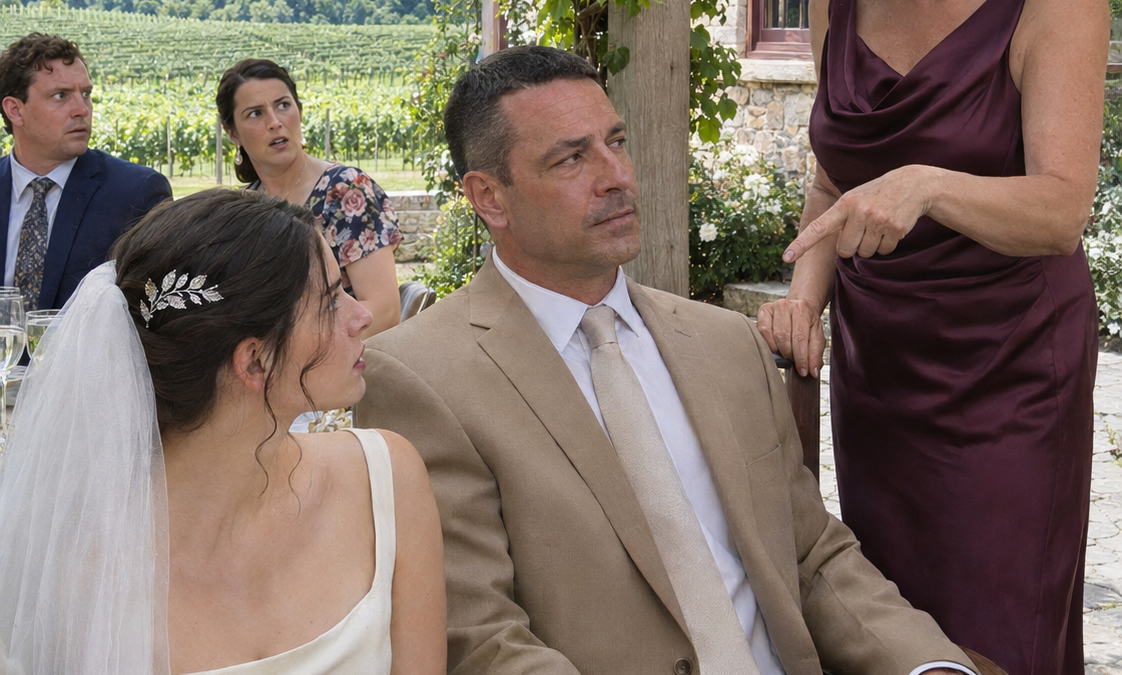
“Remove that comb, absentee father!”
Cynthia Ralston stood over my chair in the vineyard courtyard outside Charlottesville, Virginia.
All 68 wedding guests had heard her across the stone terrace.
My daughter’s silver comb caught the daylight beside her veil.
Isabel Ellison sat next to me beneath the arbor. Her fingers stopped smoothing her skirt.
Cynthia pointed directly at the comb.
“Your mother borrowed that. It belongs to my family now.”
I set my water glass on the table.
“Read the inventory.”
Nobody moved.
Then I looked toward the woman seated beside the aisle.
“Do you want the estate inventory read aloud, Cynthia?”
A fork clicked against a plate. Someone stopped adjusting a centerpiece.
Cynthia’s auburn curls barely moved when she shook her head.
“Don’t turn this into one of your little performances.”
I kept my voice level.
“You started this one.”
My name is Gabriel Stroud. I was forty-five, living in Jacksonville, North Carolina.
Cynthia hadn’t spoken to me in nineteen years.
Apparently, she had saved up.
Isabel moved her chair closer to mine without looking away.
“Dad, should I take it out?”
“No.”
One word.
The comb stayed where it was.
Cynthia’s plum satin dress brushed the empty chair behind her.
“Your father always has somebody else clean up his messes.”
Isabel’s chin lifted.
“You’re talking about my dad.”
“I know exactly who I’m talking about.”
A server stopped near the gate, then backed toward the kitchen.
The ceremony hadn’t started. We had gathered for lemonade before taking our seats.
Cynthia had chosen her audience carefully.
My mother bought the comb’s velvet box thirty years earlier.
The price sticker, four dollars, still clung underneath.
When my father missed a recital, I saved his seat.
When he forgot my birthday, I told Mom I hadn’t noticed.
When he remarried, I helped carry his boxes.
Mom died before Isabel could remember her voice.
I kept the little box through every move.
That morning, Isabel had opened it beside her wedding shoes.
She asked me to put the comb in her hair.
Now Cynthia wanted it removed in front of strangers.
“Look at me,” I told Isabel.
My daughter turned.
“You haven’t done anything wrong.”
Cynthia gave a small, polished laugh.
“Nobody said she did. This is about family property.”
“Then speak to me.”
“I am speaking to you.”
“Without reaching toward her hair.”
Cynthia lowered her arm, but remained beside Isabel’s chair.
The little box rested open on the table between us.
Empty now.
Its faded lining had kept the comb safe through years of packing.
Cynthia glanced at it as though I’d set out trash.
“You brought that shabby thing to a vineyard wedding?”
“Isabel asked for it.”
“Children ask for plenty of things.”
“My daughter is twenty-four.”
“She can still be misled.”
Isabel’s shoes scraped the stone.
I moved my chair enough to give her room.
She stayed seated.
Cynthia looked around, checking who was listening.
“You send checks, Gabriel. That doesn’t make you present.”
A woman near the aisle lowered her lemonade.
The sentence had been intended for her, too.
I folded my napkin once and laid it beside my plate.
One practical thing.
Cynthia waited for me to defend a lifetime in public.
Instead, I looked toward the guest beside the aisle.
A flat leather folder lay beneath that woman’s place card.
Cynthia noticed my glance.
“You can wave papers around all afternoon.”
“I haven’t waved anything.”
“You know what I mean.”
“I know what you said.”
Beyond the courtyard gate, two men paused beside the seating chart.
They had been helping move a guest’s wheelchair from the gravel parking area.
Their invitations were already checked.
Their chairs waited inside.
Cynthia couldn’t see them from where she stood.
Isabel could.
Her shoulders lowered a fraction.
I recognized the careful way the taller man waited for a server.
Neither hurried.
Neither interrupted.
Cynthia leaned closer, lowering her voice just enough to sharpen it.
“Don’t embarrass yourself in front of people with actual careers.”
The taller man entered the courtyard with his companion.
“Good afternoon, Sergeant Major,” the taller man said.
Cynthia’s mouth stayed open, but nothing came out.
Both men stopped beside my chair.
“Afternoon,” I said. “Glad you made it.”
The taller man smiled at Isabel.
“Wouldn’t miss it.”
Cynthia looked from his dress uniform to my tan suit.
The second man gave me the same small, respectful nod.
Someone near the back straightened.
Another guest stopped whispering.
Cynthia finally found her voice.
“Why do officers know you?”
The question carried farther than her lowered voice intended.
I stood, slowly, so Isabel didn’t have to look up at everyone.
“They’re wedding guests.”
“That isn’t what I asked.”
“It’s the answer you need right now.”
The taller man glanced at Isabel, then at the comb.
His expression changed when he saw her tight fingers.
“Everything all right?”
“We’re settling a property question,” I said.
Cynthia’s laugh came out thin.
“A misunderstanding. Family things.”
The guest beside the aisle pushed her chair back.
I had invited her because she had known my mother.
Isabel had insisted she sit near us.
She picked up the leather folder without opening it.
Cynthia watched the folder, then looked at me again.
“You brought somebody here to challenge me?”
“No,” I said. “We invited somebody who loved Mom.”
The woman stepped into the space beside our table.
“I’m Helen Baines,” she said. “Lenora’s estate attorney.”
Part 2 of 5
Cynthia’s fingers flattened against the seam of her dress.
“I know who you are.”
“Then you know I don’t bring guesses to family questions,” Helen said.
A chair scraped behind Cynthia.
No one stood to rescue her.
The two men remained near the gate, leaving the aisle clear.
I introduced them because Cynthia kept staring.
“Christopher Maddan. Andrew Colson. Friends of mine.”
Christopher nodded once.
Andrew looked toward the rows of chairs.
“Where would you like us?”
“Your seats are marked.”
They went without making anything larger of their arrival.
Cynthia watched them leave.
Then she looked at my jacket, my shoes, my bare lapel.
“You never said.”
“You never asked.”
“For nineteen years?”
“For nineteen years, you didn’t speak to me.”
Helen rested the folder on our table.
Still closed.
Cynthia looked at the velvet box again.
The price sticker had curled at one corner.
Her own hairpiece cost thirty-six hundred dollars.
She had announced the amount at the welcome dinner the night before.
Isabel had shown me the video from that dinner afterward.
Cynthia had wanted everyone to hear the price.
Now she wanted everyone to believe the comb was hers.
Two different claims.
Neither required her to touch my daughter.
“You could have called privately,” I said.
“I shouldn’t have to chase my own property.”
“Then why wait until she was wearing it?”
Cynthia glanced toward the photographer.
“Because I finally saw it.”
“You saw the photograph Isabel sent with her invitation.”
My daughter’s hand opened on her skirt.
“I did send that picture.”
Cynthia looked at her.
“I thought it was a copy.”
“You wrote that it looked lovely.”
“That doesn’t establish anything.”
“No,” Helen said. “It doesn’t.”
A breeze lifted the edge of the tablecloth.
Nobody reached for the lemonade.
Isabel had invited Cynthia herself, with my knowledge.
My father had died the previous winter, leaving Cynthia widowed.
My daughter thought a wedding might reopen a door.
I hadn’t promised it would.
I had only promised not to close it on her behalf.
That was why Cynthia was there.
There was no trap.
No staged arrival.
Just an invitation she had mistaken for permission.
For years, she had described my work as something temporary.
Odd jobs on bases.
A paycheck until I found something better.
The last letter she sent had used those exact words.
I kept it because my father had written on the back.
He had asked me to call.
I did.
He didn’t answer.
The old pattern had followed us into adulthood.
When he needed a roof repaired, I sent the money.
When he stopped returning calls, I kept leaving messages.
When he died, I paid the outstanding utility bill.
Cynthia had never mentioned those checks as evidence of responsibility.
Only as evidence I could be dismissed.
Isabel looked at Helen’s folder.
“Can we finish this before the ceremony?”
“Yes,” Helen said.
Cynthia stepped between Helen and the table.
“There’s no need to turn a wedding into a courthouse.”
“You demanded property in front of the guests,” Helen said.
“A simple request.”
“You called her father a name.”
Cynthia looked past Helen, toward the seated guests.
“Remove that comb, absentee father!”
She repeated it with a little shrug.
“As if that’s the worst thing anyone has ever said.”
The courtyard stayed quiet.
Isabel’s face changed then.
She stopped trying to make Cynthia comfortable.
“Don’t call him that again.”
“I was explaining.”
“You were humiliating him.”
I touched the edge of my chair, not my daughter.
She didn’t need holding in place.
She needed room.
Cynthia turned back toward me.
“Tell her how many birthdays you missed.”
“Tell her yourself,” Isabel said. “You seem to have counted.”
A bird landed on the arbor overhead.
The photographer lowered her camera.
I had missed birthdays.
I had missed school nights, broken appliances, ordinary Saturdays.
There were apologies that belonged to my daughter.
They did not belong to this courtyard.
“We’ve talked about those things,” I said.
“Have you?”
“Yes.”
Cynthia pressed her lips together.
I pulled my chair inward so Helen could reach the table.
That was all.
No raised voice.
No list of assignments.
No account of what I had endured.
Helen placed her palm on the folder.
A corner of old cream paper showed beneath the flap.
Cynthia stared at it.
“That could be anything.”
“It could,” Helen said.
“Copies get altered.”
“So do stories.”
The groom, Benjamin Faber, came from the arbor steps.
He had stayed back because Isabel had asked him to.
Now my daughter held out her hand.
Benjamin took it and stood beside her chair.
“Do you want everyone seated?” he asked.
“Not yet,” Isabel said.
Cynthia looked at him, searching for a new audience.
“You understand protecting family property.”
“I understand listening to Isabel.”
My daughter looked straight at Helen.
“Please tell them what Grandma actually left.”
Helen opened the folder to the signed inventory.
Helen’s finger settled beside the entry identifying the silver comb as my inheritance and my signed gift to Isabel.
“The comb belongs to the bride.”
Cynthia’s chin pulled back as if someone had opened a door too close.
Helen turned the page toward Isabel, not toward Cynthia.
“Your father inherited it. He transferred it to you in writing.”
Isabel read the line, then looked up at me.
“You did this before today?”
“Yes.”
Helen lifted a second sheet from beneath the inventory.
“The gift was signed on Tuesday.”
Part 3 of 5
Cynthia reached toward the folder, then stopped before touching it.
“That isn’t the whole history.”
Helen kept the page flat beneath her palm.
“It is the relevant history.”
A guest near the fountain leaned forward.
Someone farther back whispered, “The bride?”
Helen looked across the courtyard.
“Yes. The bride.”
No flourish.
No speech about consequences.
The answer traveled through the same rows that had heard the insult.
Cynthia had claimed an heirloom in front of people whose approval she wanted.
Now those people watched her search for another claim.
“My aunt had one exactly like that,” she said.
Helen waited.
“Silver, with those little leaves.”
“Many combs have leaves.”
“My aunt wore hers at her wedding.”
“Do you have a photograph?”
Cynthia glanced toward the tables.
“Not with me.”
“Or a receipt?”
“Who keeps a receipt that long?”
I looked at the velvet box.
“Mom did.”
Cynthia’s eyes dropped.
Helen slid a small protective sleeve from the folder.
Inside was a receipt, browned along the edges.
The comb had been purchased at an estate sale thirty years earlier.
My mother’s name appeared beside the payment.
The box had been a separate purchase from a craft store that afternoon.
Four dollars.
Mom had saved both receipts together because she saved everything that needed proving.
At sixteen, I had teased her about it.
At forty-five, I wished I could apologize for that.
Helen had brought copies because I’d asked her to witness the gift paperwork on Tuesday.
She was staying nearby for the wedding and had offered to keep the originals secure until afterward.
That was the entire explanation.
No ambush.
Just a careful woman keeping a promise.
Cynthia looked at the sleeve without bending closer.
“Your mother could have bought a replacement.”
Helen’s hand stayed still.
“Cynthia, do you have evidence that this comb belonged to you?”
“It belonged in the family.”
“Which family?”
“Ours.”
“My mother had a name,” I said.
Cynthia looked at me.
“Lenora Treadwell,” I said. “She kept it after the divorce.”
My parents had divorced when I was fourteen.
Cynthia married my father the following year.
For a while, I had tried calling both houses home.
Then every object became a loyalty test.
A photograph on my dresser.
A winter coat Mom bought.
A birthday card I forgot to hide.
The comb had never entered my father’s house.
I knew that now because Helen had found the letter stored with it.
For thirty years, I hadn’t known there was anything to find.
“Your mother made everything difficult,” Cynthia said.
I looked at Isabel.
My daughter had stood, but she hadn’t moved away from the table.
Benjamin’s hand rested loosely around hers.
“No,” I said. “We’re not doing that.”
“You don’t get to edit the past.”
“Neither do you.”
Christopher had taken his seat near the rear.
Andrew sat beside him.
Their uniforms were no longer what anyone was watching.
Cynthia could feel the change.
Her shoulders drew backward.
“Fine. Keep the thing.”
Helen closed the receipt sleeve.
“It isn’t yours to permit.”
A breath escaped from someone near the aisle.
Cynthia turned toward the sound.
Nobody looked down.
That seemed to bother her more than the papers.
She had expected nervous laughter.
She had expected me to take the comb out, put it in her palm, and make the courtyard comfortable again.
For years, that had been the arrangement.
I swallowed the remark.
I paid the bill.
I left before dinner.
My daughter would not inherit that arrangement.
Isabel touched the comb carefully, checking that it remained secure.
“Grandma wore this?”
“On ordinary Sundays,” I said.
“Not just special days?”
“She said Sunday counted.”
My daughter’s mouth curved for the first time since Cynthia stood up.
“She sounds like somebody I would’ve liked.”
“She would have liked you.”
Cynthia’s heels clicked once against the stone.
“You’re all being sentimental over a hair accessory.”
Benjamin looked at her.
“Then it shouldn’t be difficult to leave it alone.”
Cynthia turned toward me again.
“Are you going to let him speak to me like that?”
“He asked you to stop.”
“I came here out of respect for your father.”
I kept my hands beside my chair.
“My father isn’t here to answer for this.”
That ended the sentence she had been preparing.
Helen looked toward Isabel.
“There is something else in the file.”
Cynthia’s face tightened.
“What else?”
“A letter from Lenora.”
My daughter’s fingers moved away from the comb.
“About me?”
Helen shook her head.
“About what she wanted protected.”
I had never opened that letter.
Helen had told me it existed, but I had asked to wait until after the wedding.
I didn’t want my mother’s last instructions competing with my daughter’s first promises.
Cynthia made waiting impossible.
“Read it,” Isabel said.
Helen looked at me for permission.
I nodded.
Helen unfolded a letter dated nineteen years earlier.
Part 4 of 5
The paper made a dry, small sound between Helen’s fingers.
Cynthia stared at the date.
I watched her eyes move, then stop.
“That was when she was ill,” Cynthia said.
“Yes,” Helen said. “It was.”
“She wasn’t herself.”
“I met with her privately.”
“You can’t know what happened in a family.”
“I know what she told me, and I documented it.”
Helen looked at Isabel.
“May I read the paragraph about the comb?”
“Yes.”
My daughter stood beside Benjamin, her veil resting against his sleeve.
Helen began without changing her voice.
“Gabriel, this comb is yours. Give it to Isabel when she wants it.”
I looked at the little box.
All those moves, and I had kept her gift without knowing she had written down why.
Helen continued.
“Cynthia asked me to sign a statement saying I had borrowed it. I refused. I bought it with my own money.”
A chair leg dragged across the stone.
Cynthia’s mouth tightened.
“That’s an accusation.”
“It is a signed account,” Helen said.
“She misunderstood me.”
Helen lowered the page.
“Would you like me to read the next sentence?”
Cynthia didn’t answer.
The vineyard owner stood beside the kitchen door, waiting for some sign that lunch could continue.
No one was eating.
A server held a pitcher against her apron.
Helen read on.
“I am writing this because I do not want Gabriel spending his life proving that what I gave him was his.”
The paper blurred for a moment.
I looked down until the letters steadied.
Mom had watched me carry boxes out of one home and into another.
She had watched me learn to apologize before asking questions.
I had thought she missed it.
Helen folded the page along its original crease.
“That letter is attached to the property schedule Lenora signed with her will.”
Cynthia shook her head.
“She poisoned you against me.”
I looked up.
“She wrote something down.”
“That’s the same thing.”
“No.”
One guest set her glass down too hard.
Cynthia looked around again, but the faces offered nothing.
“Your father knew I should have it.”
“Did he put that in writing?” Helen asked.
“He didn’t need to.”
“Then you cannot use his name to reverse Lenora’s ownership.”
Cynthia turned away from Helen.
“Gabriel, we can discuss this somewhere private.”
“You chose this courtyard.”
“I’m trying to spare Isabel.”
My daughter stepped closer to the table.
“You could have spared me by staying in your chair.”
Cynthia blinked.
The plum satin shifted as she drew herself taller.
“I paid to come here.”
“And I invited you,” Isabel said. “I’m asking you to stop hurting my dad.”
Benjamin moved half a step aside, keeping the aisle clear.
Nobody blocked Cynthia.
She could sit down.
She could apologize.
She could leave the comb alone and remain part of the afternoon.
I watched her consider those choices.
Then her eyes moved to Christopher.
“So what exactly do you do?”
I could have let the question pass.
For Isabel’s sake, I answered plainly.
“I’m a Marine sergeant major stationed in North Carolina.”
Cynthia looked at my suit again.
“But you never went to college.”
“I went later.”
“Your father said you worked around the base.”
“I did. I still do.”
Andrew looked down at his program, giving me the courtesy of not smiling.
Cynthia noticed that, too.
“Everyone seems to know except me.”
“Everyone here has spoken to me,” I said.
That was the whole difference.
No announcement.
No demand that she admire a uniform I wasn’t wearing.
She had built a smaller version of me and spent nineteen years refusing corrections.
The real one had come to walk his daughter down an aisle.
Cynthia looked at Isabel.
“You could have warned me.”
My daughter’s hand closed around Benjamin’s.
“About what?”
“This.”
Isabel waited.
“Your father,” Cynthia said.
“My dad wasn’t a surprise.”
The vineyard owner approached slowly, stopping beside Helen.
“Is there anything you need before we begin seating?”
Helen looked at me.
I looked at Isabel.
My daughter straightened the edge of her veil.
“I need the aisle clear.”
The owner nodded and turned toward Cynthia.
“We can help you to your seat.”
Cynthia didn’t move.
“I won’t be treated like a thief.”
“No one has called you one,” Helen said.
“Then stop acting like I stole something.”
Helen put the letter inside its sleeve.
“You claimed property that belongs to someone else. That claim has been answered.”
Cynthia’s eyes shone, but her jaw remained set.
“You haven’t heard the last of this.”
Helen closed the folder and faced her.
“Then the next claim comes to my office, not to this bride.”
Part 5 of 5
Cynthia stared at the closed folder.
Helen didn’t offer it to her.
“The documents remain with Gabriel,” Helen said. “The comb remains with Isabel.”
Christopher and Andrew stayed seated.
Nobody needed to move closer.
Nobody needed to raise a voice.
The same people who had watched Cynthia point at my daughter now watched her lower her eyes.
Her hairpiece sat perfectly among the auburn curls.
The comb she had called hers remained untouched.
Cynthia looked toward the gate.
“Perhaps I should go.”
Isabel answered before I could.
“That’s your choice.”
“You don’t want me here.”
“I wanted you here when I invited you.”
Cynthia looked at me then.
There were several things she could have said.
My name without an accusation.
My mother’s name without contempt.
A simple apology.
Instead, she asked, “Will you at least walk me out?”
I looked at the arbor, where the officiant waited with a closed book.
“I’m walking my daughter.”
Cynthia’s fingers gathered a small fold of satin at her side.
Then she released it.
The vineyard owner stepped beside her.
“I’ll show you the path.”
Cynthia walked through the courtyard without looking at the guests.
No one clapped.
No one called after her.
The gate closed with the same ordinary click it had made when Christopher and Andrew arrived.
Helen waited until it settled.
Then she turned toward the guests.
“For clarity, the ownership question is resolved. There is no claim against the bride’s comb.”
A few people nodded.
The woman beside the fountain said, “Understood.”
That was enough.
The consequence wasn’t a spectacle.
Cynthia had lost the heirloom she had never owned, the audience she had counted on, and the chance to stay without apologizing.
Helen slipped the folder into her bag.
“Now,” she said to Isabel, “I believe you have somewhere to be.”
My daughter looked at me.
“Can we have a minute?”
Benjamin kissed her cheek and went to the arbor.
The guests began finding their places.
Chairs shifted.
Programs opened.
The afternoon resumed in small sounds.
I sat because Isabel sat.
For the first time, nobody stood over us.
She touched the comb again.
“Is it crooked?”
“Not that I can see.”
“You always say that.”
“Usually you’re asking about a picture frame.”
She laughed once, then looked at the empty velvet box.
“Were you really going to let her talk like that all day?”
“No.”
“You looked like you might.”
“I was deciding how much of our day she could have.”
Isabel ran a finger along the worn corner of the box.
“I know you missed things.”
“I know.”
“You don’t have to give me the list.”
“I wasn’t going to.”
“Good. I already have it.”
That pulled a smile from me.
She had her mother’s directness.
Isabel had used her mother’s surname since childhood, a decision we had made together after the divorce.
There had been hard conversations in that home, too.
But my daughter had never had to earn my answer when she called.
“I also have the other list,” she said.
“What other list?”
“The night you drove in because the furnace quit. The science project we rebuilt over video. Every Sunday call.”
“You fell asleep during some of those.”
“You talked about drainage.”
“It was a serious problem.”
“It was a gutter, Dad.”
From the arbor, Benjamin looked over.
Isabel lifted one finger.
One more minute.
I looked at my daughter’s face, then at the silver leaves beside her temple.
“I’m sorry she did that here.”
“You didn’t invite her mouth.”
“I agreed to the invitation.”
“So did I.”
We let that sit between us without assigning blame.
Helen returned to the table.
She placed the protective sleeve beside the little box.
“Keep the original inventory somewhere dry,” she said.
“Practical wedding advice,” Isabel said.
“I’ve billed for worse.”
My daughter laughed again.
Helen’s eyes creased at the corners.
Then she went to her seat.
I put the papers inside my jacket.
Isabel closed the velvet box and handed it to me.
“Will you keep this safe until we get back?”
“Always have.”
She looked toward the gate once.
“Do you think she’ll tell people a different story?”
“Probably.”
“What do we do?”
“Keep the papers. Tell the truth. Have dinner.”
My daughter nodded.
“That sounds manageable.”
The officiant opened the book beneath the arbor.
Everyone stood.
I offered Isabel my arm, and she took it.
We walked past the chairs where the same guests had watched the humiliation.
Christopher met my eyes and gave one quiet nod.
Andrew smiled at the bride.
Helen sat with her bag closed beneath her chair.
The comb stayed silver against my daughter’s dark hair, exactly where she had wanted it.
At the arbor, Benjamin stepped forward.
I placed Isabel’s hand in his.
Behind us, the vineyard gate remained closed.
The officiant turned the first page and began the ceremony.
THE END
More stories
My Ex Duncan Called Me a “Discount Parent” at Our Daughter’s Roller Party—but His Smile Disappeared When the Man Beside My Bench Announced My Usual TABLE Was ReadyMy Son Glen Tried to Move Me Into His Spare Room Before 43 Picnic Guests, but My PAID Residency Agreement Was Only the First Paper He RegrettedMy Sister Offered Me MOTEL Money Before 67 Lodge Guests—but When the Owner Said My Right to Stay Stood, She Went PALE and Lost Her Management ContractMy Uncle Shouted “Stop Asking for Charity!” at Dad’s Memorial Luncheon—but When a Man in a Black Jacket Ordered Him Away From the Microphone, He Went PALEMy Brother Alan Called Me the Daughter Who Contributed NOTHING at a Hospital Dedication, Then Went PALE When the President Put Me Back in the PhotographMy Ex Shouted “You Don’t Get the Mother’s Seat!” Before 62 Ceremony Guests—But When a Woman Said Our Daughter SAVED My Place, He Lost the Seat He Took
You Might Also Enjoy

My Daughter-In-Law Told Me To Stay Elsewhere While Strangers Took My Condo — Then I Pushed Back







