My Uncle Shouted “Stop Asking for Charity!” at Dad’s Memorial Luncheon—but When a Man in a Black Jacket Ordered Him Away From the Microphone, He Went PALE
Part 1 of 5
“Stop asking for charity!”
My uncle Harvey Ralston shouted across our Toledo union hall.
Seventy-four members and relatives watched him shove Dad’s dented lunchbox aside.
It scraped across the memorial table toward my elbow.
Dad’s photograph stayed between the flowers and a pipe wrench.
His lunchbox stopped beside a bowl of wrapped peppermints.
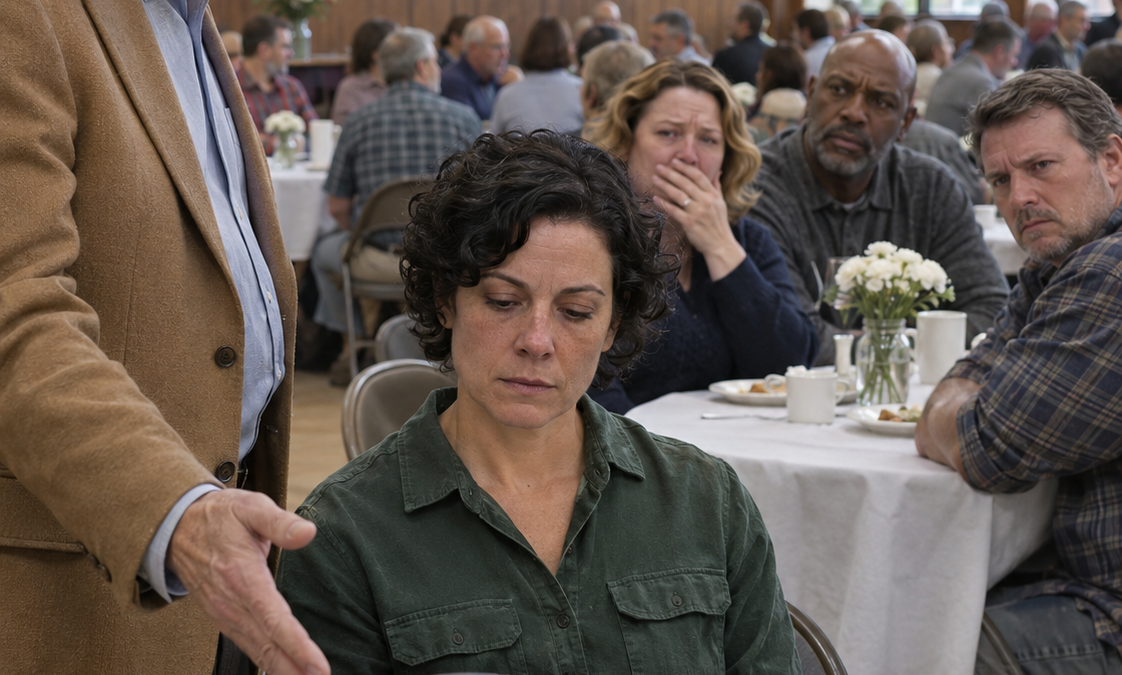
Harvey remained standing behind the microphone, wearing his camel sport coat.
I sat below him in my forest-green work shirt.
“Follow his deductions,” I said.
A fork stopped halfway between a plate and somebody’s mouth.
Harvey glanced toward the kitchen, then back at me.
“We’re here to honor your father, April.”
“Then leave his lunchbox where it was.”
He smiled without moving it.
A small request.
That was all I had made before his voice rose.
My name was April Winslow. I was forty-two, an elevator inspector.
I spent workdays checking brakes, door locks, and inspection records.
A pleasant explanation never made a missing safety test appear.
Neither did volume.
Harvey was fifty-seven, my mother’s younger brother.
He also administered benefits for the local’s pension plan.
Those were separate facts until he made them the same problem.
“You’ve misunderstood the purpose of this luncheon,” he said.
“I understood the invitation.”
“Your father’s service. Not your bills.”
The woman nearest me lowered her coffee cup.
Nobody reached for the basket of rolls anymore.
Dad had worked forty years as a pipefitter.
His name was Frederick Metcalf.
Six weeks earlier, I had buried him in his good jacket.
I had paid $3,840 after his burial allowance.
During his final winter, I bought groceries and drove him to appointments.
He promised to repay me when his pension problem got straightened out.
I told him to buy better oranges instead.
That was our bargain.
Harvey tapped the memorial program against his palm.
It listed Dad’s apprenticeship year beneath his photograph.
“Your father was proud,” he said. “Let’s preserve that.”
“By moving his things?”
“By keeping private difficulties private.”
He leaned toward the microphone again, though nobody needed amplification.
“He left debts, not a pension—stop asking for charity.”
A chair leg squealed against the tile.
I kept both feet flat beneath the table.
Dad had straightened that lunchbox handle with a vise.
One corner still bent inward where a fitting had struck it.
Harvey lifted the lid with two fingers.
He exposed the bills Dad had tucked under the tray.
“Seven dollars,” he said. “There’s your entire legacy.”
I watched the hinge.
It had always caught halfway open.
Harvey let it drop, producing the familiar metal click.
Then he straightened his jacket and addressed the room.
“I’ve earned a little comfort myself. Retirement cruise. Eight thousand five hundred dollars.”
A man near the aisle looked down at his paper napkin.
“Paid in full,” Harvey added.
I slid my water glass away from my envelope.
That was my only movement.
“You hear that, April? Planning makes a difference.”
“So does accounting.”
His jaw worked once.
The envelope lay beside my plate, its flap already loosened.
Harvey could see the white edge beneath my inspection notebook.
He had noticed it when I arrived.
He had asked whether it contained another request.
I had told him it contained records.
“Put that away,” he said now.
“It’s beside my plate.”
“This isn’t an office.”
“No.”
I let the word stand without helping him.
Beside the kitchen door, someone stopped stacking serving trays.
The room had narrowed to Harvey, the lunchbox, and my envelope.
He still had the microphone.
I still had my chair.
“Your father knew how these things worked,” Harvey said.
“That’s why I brought his paperwork.”
He gave a short laugh.
“Paperwork won’t change what he left.”
A latch clicked behind the last row of tables.
I recognized the man at the entrance.
He wore a black field jacket over a plain shirt.
His close-cropped brown hair caught the light from the open doorway.
He was fifty, and he had arrived when expected.
Harvey hadn’t noticed him yet.
“Stop asking for charity!” Harvey said again.
I looked past his shoulder instead of answering.
The man in the black jacket stepped into the aisle.
“Step away from the microphone,” he said.
Harvey’s mouth stayed open, but no sound came through.
Color drained from the skin above his collar.
The man did not raise his voice or approach my table.
He stood where everyone could see the open aisle.
Harvey lowered the microphone an inch.
“Who invited you?”
“I’m expected.”
I nodded once.
That was enough to make Harvey look at my envelope again.
Several people turned in their seats.
Nobody had left.
“You brought somebody to embarrass me?” Harvey asked.
“You were doing fine without help.”
A brief sound came from the back table.
It might have been a cough.
The man’s phone vibrated against his jacket.
He checked the screen, then looked toward me.
“One minute,” he said.
He stepped into the vestibule and pulled the door nearly closed.
Harvey watched until the latch caught.
Then he placed the microphone on its stand.
His thumb missed the switch, and he didn’t try again.
“What have you been saying about me?”
“I’ve asked questions about Dad.”
“To strangers?”
“To people who could answer.”
He looked toward the vestibule again.
The man had left the inside door unlatched.
Part 2 of 5
Harvey stayed behind his chair, one hand resting on its back.
For the first time that afternoon, he wasn’t addressing everyone.
“Who is that?”
“You can ask him when he comes back.”
“April, don’t make this worse.”
I moved my envelope away from a wet ring on the table.
One dry corner.
That was what I needed.
The luncheon program had promised roast chicken, coffee, and recollections.
Dad’s work boots sat beneath the memorial table.
I had cleaned the dried mud from their soles that morning.
Harvey had approved the display by email.
He had approved the lunchbox, too.
“You said I could bring his things,” I told him.
“Personal things.”
“These were personal.”
“You know what I mean.”
Across the room, a woman folded her napkin into quarters.
The man beside her stopped her from collecting their plates.
They stayed seated.
All seventy-four had heard what Harvey said about Dad.
I wasn’t asking any of them to choose a side.
I wanted them to hear a complete sentence for once.
When Dad lost work, I covered his heating bill.
When he needed rides, I changed my inspection route.
When he apologized, I asked what he wanted for supper.
That had started eighteen months before his death.
A damaged lung had finally made ladders impossible.
He could still identify a bad weld across a room.
He could no longer cross a parking lot without stopping.
His first pension application came back with a request for verification.
Then another letter arrived.
Then Harvey told us to be patient.
We were patient through Christmas.
Patient through January.
Patient through another hospital admission.
Dad kept every envelope.
He had paid $29 for a plastic file box at a discount store.
The receipt was still taped beneath its lid.
He called the box his office.
I called it one more thing to dust.
At first, that was all it seemed to be.
Folders. Rubber bands. An old calculator with a missing rubber foot.
Dad had kept pay statements long before anyone asked him to.
He saved them the way other men saved fishing photographs.
Proof he had been there.
Proof he had worked.
Proof he had paid.
Harvey looked at the envelope and shook his head.
“Your father’s filing system was a disaster.”
“You’ve said that.”
“I tried to help him.”
“I remember.”
Dad’s table had held three folders during Harvey’s last visit.
Harvey took none of them.
He told Dad that printed records could be misleading.
Afterward, Dad asked me to keep the originals at my house.
He never explained that request.
I hadn’t understood it then.
Harvey rubbed the back of his neck.
“You’re taking a family conversation and turning it into theater.”
“You used the microphone.”
“That was a mistake.”
“Which part?”
He looked toward the tables before answering.
“The tone.”
Not the claim.
A few feet away, the lunchbox rested against the peppermint bowl.
Its handle had left a dark crescent in the white tablecloth.
I wanted to move it back.
I left it where everyone could see it.
Harvey leaned closer without touching my chair.
“We can discuss whatever you think you found afterward.”
“You’ve had afterward for months.”
“Lower your voice.”
I hadn’t raised it.
He straightened again and offered the room a practiced smile.
“My niece has been under considerable strain.”
A woman near the coffee urn said, “She’s sitting quietly.”
Harvey pretended not to hear.
He glanced toward the vestibule, but the door stayed still.
The man outside had not come back.
I knew why he might need time.
Harvey did not.
“You paid some expenses,” my uncle said. “Nobody disputes that.”
“This isn’t about my receipts.”
“You expect the rest of us to reimburse you.”
“No.”
“Then what exactly do you want?”
I touched the edge of my envelope.
“An accurate account.”
He looked almost relieved by the ordinary words.
“You’ll need an appointment.”
“I tried that.”
“With the proper forms.”
“I submitted them.”
“Through the proper office.”
“Your office.”
Someone set a glass down too hard.
Harvey’s fingers tightened on the chair back.
He had asked us to wait until the month ended.
Then until the quarter closed.
Then until Dad felt better.
Dad had died before Harvey ran out of reasons.
The coffee had cooled beside my plate.
A kitchen worker switched off the warming unit.
Its little red light went dark.
Nothing else in the room moved much.
Harvey picked up the memorial program again.
“Your father wouldn’t want this.”
“He asked me to get an answer.”
“That was when he was sick.”
“He could still read.”
Harvey laid the program facedown.
He had never disputed Dad’s handwriting until that afternoon.
Now he seemed interested in whether I possessed anything bearing it.
“Did he sign something?”
I didn’t answer that question.
Instead, I opened the clasp on my inspection notebook.
My envelope had stayed beneath it during the meal.
The notebook cover was stained with machine oil.
Nobody could mistake it for a presentation folder.
Harvey watched my hands.
I removed the envelope and set the notebook aside.
“What’s in there?” he asked.
“The records you said couldn’t change anything.”
He stepped around the end of the table.
Three nearby guests drew their chairs back to leave me space.
Harvey reached toward the envelope, and I slid it beyond his reach.
Part 3 of 5
“Don’t touch my copies,” I said.
“Copies of what?”
“You’ll see.”
He withdrew his hand and folded his arms.
I sat centered beside the memorial table, with Dad’s lunchbox near my elbow.
Harvey stood to my right, taller than everyone seated nearby.
Under the American flag, three members watched his face.
One covered her mouth.
Another stared at the envelope instead.
The third looked from Harvey to the dented metal box.
I loosened the flap.
Harvey gave the lunchbox a dismissive flick of his fingers.
“There’s nothing in that envelope worth doing this to your family.”
I unfolded the first pay statement.
The pay statement showed a pension deduction, and the sheets beneath it documented eighteen years of the same payments.
I laid them across the cleared space beside my plate.
“These are grouped by year,” I said. “The full copies are indexed.”
Harvey looked at the top page without bending down.
“Payroll codes aren’t promises.”
“The code is explained on the back.”
I turned one sheet over.
A member at the nearest table put on his reading glasses.
I shifted the paper so he could read without leaving his chair.
Nobody had to take my word for it.
The deductions appeared beside hours worked, withholding, and take-home pay. There were ordinary weeks and overtime weeks. There were statements with coffee stains and others folded so often the creases had gone white.
Dad had earned every line on those pages.
Harvey said, “Contributions and benefits aren’t the same thing.”
“I know.”
“Then you’re misleading people.”
“I haven’t told them what happened to the contributions yet.”
He glanced at the vestibule.
For the first time, I saw him measure the distance to the side exit.
I placed another document above the pay statements.
“This came directly from the plan’s independent recordkeeper. Dad authorized the request while he was alive.”
That mattered more than my uncle’s opinion of Dad’s filing habits.
The document carried the account identifier that matched Dad’s old enrollment form. The attached transaction history covered the same eighteen years.
I let Harvey read the heading.
Then I read the explanation aloud.
“The employee payments shown on these pay statements never reached his account.”
A serving spoon slipped against a platter in the kitchen.
Nobody turned toward it.
Harvey put his hands in his pockets.
“You don’t understand reconciliation.”
“Then whose account received his deductions?”
He looked at me.
I waited.
“Answer her,” somebody said from the back.
I kept my eyes on Harvey, not the voice.
He drew one hand from his pocket and adjusted his cuff.
“There are pooled accounts. Transfers. Administrative corrections.”
“The recordkeeper accounted for the pooled transfers. These payments weren’t among them.”
“You can’t determine that from one statement.”
“I didn’t.”
His mouth pressed into a thin line.
I took out the cover letter, leaving the remaining pages inside the envelope. The letter explained how the search had been conducted and which records had been compared.
Dad had signed the request at his kitchen table.
I had steadied the paper because his hand shook.
Harvey had told him the request would only delay things.
The recordkeeper’s response had arrived after Dad’s final hospital admission.
I had read it beside a vending machine while Dad slept upstairs.
Now it lay beneath the luncheon’s paper centerpiece.
One of the members leaned forward.
“Are you saying the plan lost his money?”
“I’m showing you what the plan confirmed,” I said. “The next part belongs to the people who traced it.”
Harvey made a sharp movement toward his chair.
“You’ve made accusations you can’t take back.”
“I’m not trying to take them back.”
He looked around for someone to join him.
The woman who had defended my quiet voice moved her coffee cup away from the documents. Another guest pulled a clean napkin from beneath a bread plate and laid it beside my elbow.
Small things.
Nobody offered Harvey the microphone.
I kept one hand flat on the table.
“For six months, I’ve been assisting a federal pension-theft investigation,” I said.
Harvey stopped adjusting his cuff.
“I wasn’t begging you for help. I was answering requests for records.”
The member wearing reading glasses lowered them slowly.
“Six months?”
“Yes.”
I had brought Dad’s files to the people handling the investigation. I had identified handwriting, matched dates, and explained which letters Harvey delivered himself.
Dad had known I was getting outside help.
He had not lived long enough to hear what that help uncovered.
Harvey tried to speak twice before a sentence came out.
“You recorded family conversations?”
“I preserved records. I answered questions truthfully.”
“You set this up.”
“You arranged the luncheon.”
That was the plain explanation for the timing.
The investigators had asked where Harvey would be. I had supplied the invitation, the address, and the schedule. I hadn’t requested an audience or chosen the hour.
His own invitation had done that.
I put the cover letter down where everyone nearest me could see its heading.
Harvey stared at the signature block.
Then the vestibule door opened again.
The man in the black jacket returned carrying a folded warrant.
Part 4 of 5
“Harvey Ralston,” he said, “I’m Clayton Sweeney, a criminal investigator with the Department of Labor.”
He showed his credentials at chest level, then put them away.
A second investigator remained by the open doorway.
Clayton looked directly at Harvey.
“I have a federal arrest warrant.”
Harvey’s chair knocked against the table behind him.
I kept my hands beside the papers.
The seventy-four members and relatives who had watched him move Dad’s lunchbox were still there. Now they could see the folded warrant, the investigator, and Harvey’s place card beside the microphone.
“Wait,” Harvey said.
Clayton stopped a few feet away.
The second investigator stayed near the aisle, leaving the exit clear.
Harvey swallowed and tried a smaller voice.
“This is a benefits disagreement.”
“The warrant concerns diverted pension payments and forged records.”
“You’ve listened to her.”
“We examined financial records.”
Clayton did not look toward me when he said it.
That was important. This was no longer my word against my uncle’s, and it had never depended only on the papers beside my plate.
The investigators had obtained records I could not request.
They had followed transfers I could not see.
The documents I supplied had helped them know where to look.
Harvey glanced at his audience.
“Somebody needs to explain how this works.”
Clayton held the warrant where Harvey could see it.
“You’re under arrest for stealing pension funds.”
Nobody spoke over him.
Harvey’s lips parted.
The tiny microphone light remained green behind his shoulder.
He had left it on.
I heard his next breath through the speakers.
“This is my retirement,” he said.
Clayton instructed him to turn around.
Harvey looked at the side door.
The second investigator moved one step into the aisle.
That ended the looking.
No chair overturned. Nobody rushed forward. The cuffs closed with a sound much smaller than the lunchbox lid had made.
Harvey kept his eyes on the floor while Clayton checked them.
The camel jacket pulled tight across his shoulders.
He had worn that jacket to Dad’s funeral.
At the cemetery, he had told me there were things about money I would understand when I got older.
Now he was asking whether he could get his phone.
Clayton told him it would be handled with his property.
“April,” Harvey said.
I looked at him.
“Tell them we can settle this.”
“The money isn’t mine to settle.”
For years, he had used family as a room nobody else was allowed to enter.
Dad had worried about making trouble.
I had worried about hurting someone who had helped run the local for so long.
Harvey had counted on those worries doing his work.
Clayton turned him toward the aisle.
The second investigator opened the way.
Harvey passed the memorial display without lifting his head.
He passed the photograph, the pipe wrench, and the boots beneath the table.
At the last row, a member stood to move a chair out of their path.
No one stood to shake Harvey’s hand.
The outside door opened.
Daylight crossed the floor.
Then Harvey left his place of honor under escort.
Clayton returned to the threshold after his colleague took Harvey outside. He spoke quietly, but the room had become quiet enough to hear him without the microphone.
“The criminal case and the recovery of funds are separate processes,” he said. “Nobody should promise a payment date today.”
I nodded.
I had asked that question before.
There would be forfeiture proceedings, claims, records to correct, and decisions I could not make happen by wanting them.
An arrest did not put eighteen years of deductions back where they belonged.
It did establish that Dad’s missing pension was being treated as theft, not a character flaw.
Clayton asked whether I had someone to stay with me.
“I’m not alone,” I said.
He looked at the tables, then nodded.
Before leaving, he gave me the contact sheet for the victim specialist assigned to the case. I folded it once and placed it beneath my notebook.
The woman by the coffee urn began to cry without covering her face.
A man beside her held out a napkin.
I looked at the lunchbox.
It still rested beside the peppermints, exactly where Harvey had shoved it.
I had imagined picking it up during the whole meal.
Now my fingers wouldn’t quite close around the handle.
The man with the reading glasses came nearer.
“Would you like a minute?”
“Yes,” I said. “But don’t put the papers away.”
He withdrew his hand from the table.
Across the room, someone finally switched off the microphone.
The hum disappeared.
Clayton paused at the doorway one last time.
“The forged records used your father’s signature.”
Part 5 of 5
I looked up from the lunchbox.
“Can you say that again so everyone hears?”
Clayton stepped back inside.
“The records supporting the diversion included forged authorizations bearing Frederick Metcalf’s name,” he said. “The evidence does not show that he authorized those transfers.”
The man with the reading glasses closed his eyes.
A woman at the nearest table said, “Then he didn’t sign his pension away.”
“No,” Clayton said.
That answer belonged in the room where Harvey had called Dad irresponsible.
It belonged beside the photograph and the work boots.
I had spent months being careful about what I could say. Clayton had been careful, too. He did not promise a conviction or announce a recovered balance.
He stated what the evidence supported.
It was enough to remove the lie Harvey had laid on Dad’s name.
After Clayton left, the room remained facing the memorial table.
Seventy-four members and relatives had heard the accusation.
Seventy-four had heard the correction.
I took the lunchbox by its handle.
The metal felt cool despite the warm room.
A little pressure freed the hinge, and I opened the lid.
The seven dollars lay beneath the tray.
I smoothed the bills and left them there.
Dad had carried emergency cash because vending machines jammed and someone always forgot a wallet. More than once, he had come home without lunch money because a younger worker needed gas.
Those bills had never been a measure of him.
I shut the lid carefully.
Then I returned the lunchbox to its place beside his photograph.
The dent faced outward.
No one tried to turn it away.
The woman from the coffee urn approached with a fresh cup.
“I believed him,” she said.
She didn’t have to tell me which man.
“I thought your dad had borrowed against everything. Harvey said it so often.”
“He repeated it to me, too.”
“I should have asked your father.”
I accepted the coffee.
That was all I could manage for her.
Across the table, the man with the reading glasses touched the corner of a pay statement.
“My wife saves mine,” he said. “I give her a hard time about the boxes.”
“Keep the boxes.”
He nodded and took his hand away.
Nobody asked me to make a speech.
I gathered the documents in order, separating the pay statements from the plan correspondence. That small task steadied my fingers.
I counted each section against the index.
The originals remained somewhere safe.
These copies could go back into their envelope.
The local’s president, Cedric Bowers, came from the kitchen doorway. He had been helping serve the meal when Harvey started speaking.
He stopped on the opposite side of the memorial table.
“I let him keep talking,” Cedric said.
“You weren’t the only one.”
“I’m responsible for this hall.”
“Then make sure Dad’s correction reaches the people who heard the lie elsewhere.”
Cedric pulled a clean memorial program from the stack.
“Tell me exactly what you want said.”
I did.
Dad had worked forty years.
His pay statements documented eighteen years of pension deductions that had not reached his account.
He had not authorized the transfers described in the forged records.
Recovery was still underway, and nobody could promise what would come back.
Cedric wrote it down without adding an adjective.
Then he read it aloud to the same room.
He did not ask anyone to applaud.
That spared me something I couldn’t have stood.
Instead, people came to the display in twos and threes. A man described Dad teaching him to thread pipe without ruining the die. Another remembered him staying late to fix a leak that wasn’t on his assignment.
They spoke about work Dad had actually done.
No one mentioned Harvey’s cruise.
The place card beside the microphone stayed where he had left it.
I didn’t tear it up.
Someone would need to clean the tables eventually, and his name could go into the trash with the other paper.
For now, I wanted Dad’s things in their proper places.
Photograph.
Pipe wrench.
Lunchbox.
The investigator’s contact sheet stayed inside my notebook. Tomorrow I would call the victim specialist and ask what documentation the recovery process required.
I knew better than to call an arrest a refund.
Nothing that happened in the hall could give Dad back the winter he spent apologizing for needing help. No transfer could restore the evenings he sat beside his plastic file box, trying to discover what he had done wrong.
He had done nothing wrong.
I could finally say it without an asterisk.
When the guests began leaving, each passed the memorial table instead of slipping out through the kitchen. Several stopped to touch the edge of Dad’s program.
I waited until the room had emptied before packing his photograph.
The lunchbox went last.
Inside, beneath the seven dollars, I found his folded apprenticeship card.
THE END
More stories
My Brother Alan Called Me the Daughter Who Contributed NOTHING at a Hospital Dedication, Then Went PALE When the President Put Me Back in the PhotographMy Ex Shouted “You Don’t Get the Mother’s Seat!” Before 62 Ceremony Guests—But When a Woman Said Our Daughter SAVED My Place, He Lost the Seat He TookMy Ex-Husband Told Me to Leave Hero Stories to the MEN Before 24 Radio Listeners—Then the County Official Arrived, and My RECORD Cost Him His Tribute.Byron Told Me to Sit Beside the Rental SHOES at My Husband’s Bowling Alley, but He Went PALE When the Deputy Arrived to Speak to MeMy Uncle Ordered Me Out of the Family Row at a Fire Station Tribute, but When a Man Gave Me the FLOOR, His Claim to My Father’s Rescue Began to UnravelMy Ex-Wife Called My Daughter’s Memorial a “Sad Little Tribute,” Then Went PALE When the Drive-In Manager Restored My Evening
You Might Also Enjoy

My Daughter-In-Law Told Me To Stay Elsewhere While Strangers Took My Condo — Then I Pushed Back







