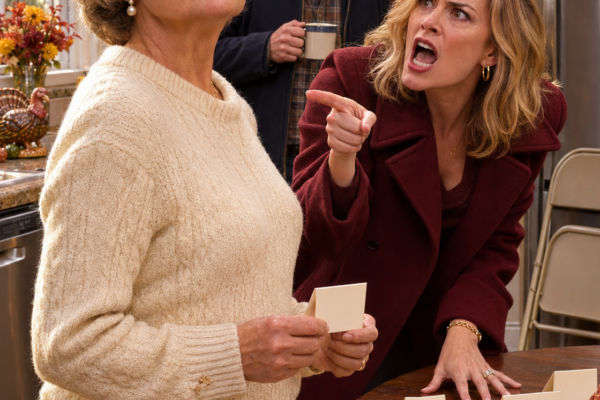
At the crowded finalists’ reception, my son claimed credit as the composer of my piano piece and told me to turn his pages.
This is an original work of fiction set in 2026. The characters, Lakeward New Music Competition, and its rules are invented.
Chapter 1 of 7
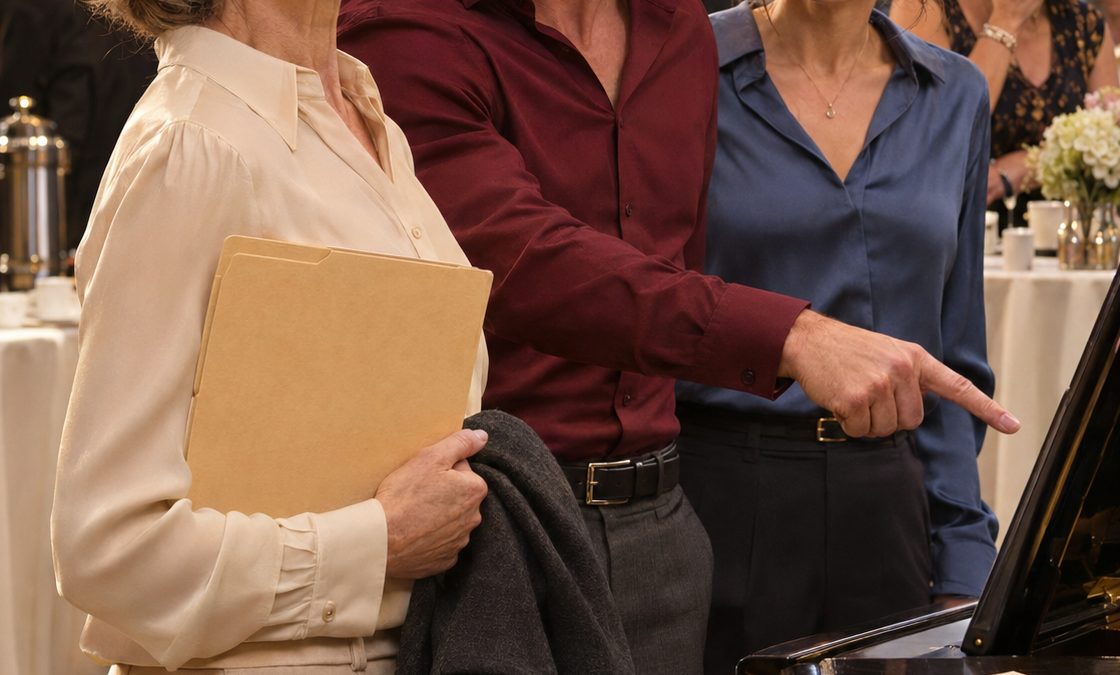
I had straightened Evan’s score on the piano and stood holding his coat. Beside his name, the program said “composer and pianist.”
“Evan, they left my name off. Can you have them fix it before the welcome?”
Rachel stood close enough to hear without leaning.
“Mom, you’re useless here. Just turn the pages.”
His voice carried past us. A woman beside the piano looked down at her program.
I still had his coat over my arm.
“The piece,” I said. “They’ve listed you as the composer.”
“I know what you’re asking.”
“Then why did you say that?”
He glanced toward the little microphone stand near the windows.
“Rachel, would you get Mom settled? There are seats up front.”
Rachel’s lips parted, but she said nothing. She had dressed carefully for him, in a blue blouse I had admired when they arrived. Now she kept looking toward the chairs.
“Please leave the programs alone until after introductions,” Evan said. “People are trying to get started.”
A man came up and congratulated him. Evan thanked him warmly. I waited through a conversation about the piano’s action, still holding the coat.
Then I gave it back.
“Being your mother did not make my work yours.”
“Mom. Come on.”
I had made helping him so automatic that neither of us asked anymore.
My worn yellow teaching pencil stuck out of my purse. A plain folder rested against my leg. I had brought both because he sometimes wanted a change marked before playing.
I had kept something he had never asked to see.
“Who handles corrections?” I asked.
“We can talk at home.”
“Who handles them here?”
He looked past me toward a desk near the entrance.
“Please don’t make this an announcement.”
“I’m asking for my name.”
Rachel finally spoke. “There’s somebody at the check-in table.”
“Rachel,” he said, softly.
“She asked.”
That was all she gave me. She did not follow when I crossed the room.
The reception had started at six. It was barely twenty past, and already the crowded room smelled of coffee and warm wool. Outside, Madison’s evening light caught the windows across the street.
At the desk, a woman was helping a guest find a missing name tag. I waited beside a plate of cheese cubes with toothpicks nobody wanted to touch.
I had cut Evan’s recital sandwiches into triangles for years. He insisted rectangles tasted different. Even at thirty-five, he sometimes said it while reaching for another.
I had nearly asked whether he had eaten tonight.
The woman at the desk finished with the guest.
“Can I help you?”
Her badge read Celia Grant.
“I need to ask about a composer credit.”
“Which piece?”
“The Kitchen Window at Six.”
She glanced toward Evan. “Are you with the pianist?”
“I’m his mother. I composed it.”
Her attention returned to me.
“Your name?”
“Marian Bell.”
She asked whether I meant the title was wrong or my name had been omitted.
“My name. He was supposed to play it with me credited.”
“Did you give permission for this performance?”
“Yes. For performance and competition use. With my name as composer.”
Evan reached us before she answered.
“There’s a family conversation happening at the wrong time,” he said. “I’m sorry.”
Celia did not turn away from me.
“Would you like to finish?”
“He told me it advanced,” I said. “I came expecting to see my name.”
“Mom, you haven’t seen everything I did with it.”
“I’ve heard you play it.”
“That’s different.”
He was right about that much. His playing could make people stop talking halfway through a sentence. Mine sometimes sent me back three measures to try again.
But the tune on that stand had come from my kitchen.
Celia brought up something on her tablet.
“Before we discuss the program, I need to check the entry.”
Evan’s shoulders shifted beneath the coat he now carried.
“Could this wait until after the welcome?”
She kept reading. He leaned closer to the desk.
Celia stopped scrolling and looked from the tablet to Evan.
“Was this your own confirmation?”
“Yes,” he said. “But there’s context.”
“The entrant personally confirms being the sole original composer. Permission to perform someone else’s work doesn’t satisfy that condition.”
A burst of laughter came from near the coffee urn. Someone called Evan’s name, then noticed he was occupied.
“I developed the version that’s here,” he said. “I’d like a chance to explain that properly.”
“You’ll have that,” Celia said. “This desk isn’t the place to decide it.”
“I’m not asking you to decide tonight,” I said. “Can the credit be corrected?”
“I need to understand the concern before changing the program.”
“I have my composition archive at home. Handwritten drafts, a rough home recording.”
“Please keep the originals,” she said. “Don’t leave anything here tonight.”
“I wasn’t planning to.”
I looked down at the folder beside my purse.
“There’s a grocery list in this one, anyway. Lesson receipts. The Thursday copy.”
She gave a small nod, without asking me to open it.
“Could you give me your contact information?”
Evan answered before I could.
“I can send whatever you need.”
“I’ll need to hear from each of you separately.”
Rachel approached from behind him. She had left her purse on a chair and seemed unsure whether to retrieve it.
“Celia?” she asked.
“Yes?”
Rachel leaned toward her and whispered. I caught only “application” before Evan moved nearer.
“Rachel, we should talk before—”
Celia lowered her pen.
“You were there on April 3?”
Rachel’s eyes stayed on the desk.
“When he submitted it. Yes.”
“Were you helping with the application?”
“Some of the typing. I was beside him.”
Evan spoke evenly. “She wasn’t handling the music.”
“I haven’t asked her about the music,” Celia said.
Rachel stepped back. She had answered the question, but she did not come stand beside me.
I had wanted her to say more. I disliked how badly I wanted it.
“How do I submit an authorship concern?” I asked.
Celia gave me an email address and asked for a short account of what I disputed.
“Send that first. I’ll tell you what material we need.”
“Will he get to read it?”
“Yes.”
“Good.”
Evan looked at me then.
“Could you withdraw the question for tonight? We can sit down tomorrow without everybody standing around.”
Nobody was standing around us, exactly. Guests passed within earshot, lowering their voices as they approached.
“I won’t discuss it with them,” I said.
“That’s not what I asked.”
“I know.”
“Mom, I’ve worked toward this for months.”
“I’m asking for the credit to be accurate.”
“Let me explain the score before you send anything.”
“You can explain it. I’m still going to write.”
He looked toward the piano, where his music waited open. I knew he could hear those pages without touching the keys. I could almost hear them too.
Celia asked for my email address. I spelled it, then checked it when she turned the tablet toward me.
“Could I have what he confirmed?” I asked.
“I can send you the acknowledgment tonight. The application material will follow.”
“Thank you.”
Rachel asked Evan whether he wanted some water. He shook his head.
From the windows, someone tested the microphone. The first sharp squeal made several guests laugh. Evan shut his eyes briefly, the same way he did when a student struck a wrong opening chord.
For a moment, I wanted to straighten his collar.
Instead, I checked the message arriving on my phone.
The acknowledgment identified Evan’s personal confirmation on April 3 at 11:42 p.m.
I had never seen that declaration.
Chapter 2 of 7
On Sunday, May 3, I read the acknowledgment at my kitchen table. Evan had personally confirmed that he had created the entered work as its sole original composer.
There was no place in that statement for me.
On March 22, he had stood beside my piano and asked to use the piece.
“For the competition too?” he had asked.
“Yes. You can perform it and enter it. Put me down as composer.”
“Of course.”
“I don’t want to find it online with no name.”
“Mom, I said of course.”
I had gone back to sorting lesson books. That had been the whole conversation.
Now I searched the acknowledgment for anything I might have approved. My permission to perform was nowhere on it. Neither was my name.
A student’s worksheet lay beneath my breakfast plate. I taught piano at home, and evidence of it migrated into every room. Sometimes I found rhythm exercises beside the washing machine.
At sixty-two, I still bought stickers for people who claimed they were too old for stickers. They usually chose one anyway.
My own music occupied the hours nobody booked. After my husband died, those hours had grown longer. I filled some with television, some with cleaning things that weren’t dirty, and some at the piano.
Evan had always been welcome there.
If he needed to practice between jobs, I moved my lunch. If he wanted quiet, I let calls go unanswered. When he played a phrase well, I could hear it from the kitchen and forget what I was reaching for.
I called him before I could turn that memory into another excuse.
“Have you had breakfast?” he asked.
“Yes.”
“Good. Last night got away from us.”
“I’m looking at what you confirmed.”
“The form?”
“Yes. I want you to ask for a corrected composer credit in writing. Copy me.”
He didn’t answer immediately.
“Mom, that credit was part of entering. It was an administrative necessity.”
“You put your name where mine belonged.”
“I put my name on the version I submitted.”
“I gave you permission with my name attached.”
“And I can explain your contribution at the final. Before I play. People will actually hear it.”
“My contribution?”
“You know what I mean.”
“I don’t think I do.”
He sounded tired, and I caught myself lowering my voice to make the call easier for him.
Then he said, “A printed line doesn’t explain how this happened.”
“It would be a start.”
“I could thank you properly. Tell them where it began.”
“Will you ask them to correct it?”
“Can we discuss what that does before you insist on it?”
A car passed his end of the call. He was outside somewhere, walking.
“I’m trying to keep the appearance intact,” he said. “That matters to me.”
“I know it does.”
“Then let me handle the acknowledgment from the stage.”
“You’ve already handled it once.”
He stopped walking. The street noise stayed, but his breathing came closer.
“That’s unfair.”
I looked at the worksheet beneath my plate. Someone had written a sharp sign backward. I had circled it without scolding them.
“I’m trying to say this carefully,” I told him. “I want my name on my music.”
“You make it sound like I took a finished piece and did nothing.”
“I’ve never said you did nothing.”
“Then there has to be room for that.”
“There is. Beside the word pianist.”
He went quiet for several seconds.
“What if I put a dedication in my own program?” he asked. “Something just for you.”
“A private dedication?”
“If that’s how you want to call it.”
“I don’t want a dedication instead of a credit.”
“You’d rather have this become a dispute.”
“I called you first.”
That ended the useful part of the conversation. He said he needed to think. I said he could send the correction when he was ready.
Afterward, I stood in the doorway of the room where I taught. The bench was too far from the keyboard for me. Evan had used it last.
I left it there while I read the competition rules.
Lakeward’s website had photographs of smiling performers above a link I had never opened. I had trusted Evan to understand the contest he entered. He was thirty-five, paid his own bills, taught his own students.
The rules required adult entrants, eighteen or older, to perform works they had created as sole original composers and personally confirm that statement.
I read that sentence twice. Then I emailed Celia.
Could the program credit be corrected without anything further happening to the entry?
Her reply came that afternoon.
“If he did not create the work as sole original composer, correcting the program would not make this entry eligible. I would need to review the concern.”
I called the number beneath her name.
“I wasn’t asking you to cancel him,” I said.
“I understand.”
“I thought somebody could fix the line.”
“We can’t leave the declaration unexamined once that question is raised.”
“Does asking mean you’ve decided?”
“No. He gets notice and a chance to answer. We review the material from both of you.”
Her voice had none of the careful warmth people used when they wanted me to calm down. I was grateful for that.
“What do you need from me today?”
“A short statement. What work, what credit you dispute, and what permission you gave.”
“Not everything?”
“Start there.”
I spent too long on the first sentence. Every version either sounded angry or apologized for existing.
Finally, I wrote that I had composed The Kitchen Window at Six and had permitted Evan to perform it and use it in the competition with me credited as composer. I had not approved a declaration naming him sole original composer.
I asked Lakeward to review the credit and the declaration.
I read the message aloud. There was nothing about money, and nothing asking them to punish my son.
At 4:30 p.m., I sent it.
For a while, I listened to a lawn mower beyond the kitchen window. I had meant to buy milk. The thought seemed so ordinary that I checked the refrigerator, as though being wrong about milk might let me start the day again.
There was enough for breakfast.
Rachel’s message arrived later. She had forwarded something Evan had sent in a family thread that did not include me.
Above it, she wrote, “I think you should see what he said.”
I waited for another line from her. None came.
His message began by saying I was upset about how the program described the piece. He said he had offered to recognize me and wanted to keep family matters out of the event.
Then he wrote, “Mom has now raised a formal issue with Lakeward. If she keeps the challenge in place, they can remove my May 23 appearance.”
Chapter 3 of 7
On Monday, May 4, Celia explained that withdrawing my complaint would not correct the record. It would leave Evan’s declaration where it was.
“I can review what you’ve raised,” she said. “I can’t make it accurate just because you and he stop discussing it.”
“I haven’t agreed to stop.”
“I’ll send the notice today. His response is due May 11.”
The message arrived while I was waiting for a student. It included access to the relevant application material and instructions for supplying my own records.
I closed it when the doorbell rang.
For the next half hour, I counted aloud beside a child who wanted every piece to go faster. When she left, she asked whether I was tired.
“A little,” I said.
“You counted five in a measure of four.”
“I owe you one.”
She seemed satisfied with that arrangement.
Evan called after my last lesson.
“I got the notice.”
“So did I.”
“You’re really sending them our emails?”
“The ones about the piece. Celia asked for the whole exchange.”
“That was between us.”
“Yes.”
“I could have talked differently if I’d known everything would become evidence.”
I looked at the place on the piano where his score usually sat.
“What would you have said differently?”
“That isn’t the point, Mom.”
“Then tell me.”
He let out a breath close to the phone.
“You’re taking things we did together, in your house, and handing them to strangers. It feels like a betrayal.”
I said nothing at all.
“I’ve worked with you on this,” he continued. “I wasn’t just some hired player.”
“I haven’t called you that.”
“No. You’ve filed a complaint instead.”
“I asked you to correct the credit first.”
“I know what you asked.”
There was another pause. I could hear a door close on his end.
“I’ll handle my rehearsals from here,” he said.
“Do you mean Saturday?”
“All of it. You don’t need to arrange around me.”
We had often met at my piano between his lessons and freelance jobs. Sometimes he played; sometimes we argued about a phrase until one of us needed lunch.
“Will you let me know when you want—”
“I’ll handle it.”
“All right.”
After the call, the rehearsal appointments disappeared from the calendar he shared with me. My own lessons remained, tidy blocks surrounding spaces I had kept open for him.
I nearly called him back.
I had an apology ready, though I couldn’t have said what I was apologizing for. It began with his name and would probably have ended with an offer of supper.
Instead, I called Nora Kim.
She had been my student long before she became a public-school science teacher. Now she came by occasionally to play something difficult badly and laugh about it.
“Do you remember visiting in March?” I asked.
“The Sunday with the bread?”
“You brought bread?”
“Banana bread. The middle was raw. We ate the ends.”
I remembered the foil parcel then, and her insistence that the middle was a pudding.
“I need to ask about the music you heard. But I don’t want to tell you what to remember.”
“What’s happened?”
I told her about the credit and the review. I kept it short.
“Oh, Marian.”
“Could you write down what you remember? For Celia. Your own account.”
“I can try. I can’t do a musical autopsy.”
“Neither can I.”
Nora checked her calendar while we talked. She had recorded the visit on March 8.
“You played something you were working on,” she said. “Then the kettle started carrying on. You said you’d forgotten you wanted tea.”
“What do you remember of the piece?”
“The melody, roughly. You tried the ending more than once. You weren’t happy with it.”
“Anything else?”
“You called it the unfinished version. Or said it wasn’t finished. Don’t make me swear to which.”
“I won’t.”
“And I couldn’t tell you every note.”
“Only write what you can.”
She said she would send it directly. I gave her Celia’s address.
Later, Nora sent me a copy of her account. One sentence read, “I could not remember every measure.”
She had distinguished what she recalled from the date she found in her calendar. I was glad she hadn’t tried to give me more.
That evening, I listened to the rough recording from March 12.
The file showed Thursday, approximately 6:20 p.m. I remembered making it on the device beside my piano. That didn’t make the little date on the screen an independent witness.
The sound was thin. A passing car nearly swallowed a quiet passage.
Then I heard myself miss an interval and stop.
“Oh, honestly,” my recorded voice said.
I had forgotten that part.
I started again, slower. The melody was there, but my left hand lumbered beneath it. A note I had meant to hold vanished early. I could hear my foot shifting on the pedal.
I wanted to send the recording with an explanation attached to every mistake.
The explanation would have been longer than the piece.
Evan could have made that passage sound inevitable. He could draw a clear line through notes I still had to negotiate separately. Listening, I missed him with an irritation that made me stop the file.
Then I played it through.
No one had ever been meant to hear that recording except me. Sending it required a different kind of nerve than asking for my name in a program.
On Thursday, May 7, I made readable copies of the drafts. Some pages had been folded beneath lesson books. Others carried crossed-out measures I would rather have recopied neatly.
I left the crossings visible.
The complete email thread took longer than I expected. I kept checking that the attachments opened and that the replies hadn’t separated from the messages they answered.
Celia had asked for the exchange, so I sent the exchange. I didn’t pull out the sentences that sounded kindest to me.
The originals stayed at home.
In the short message accompanying the copies, I began to write, “I’m sorry the playing is so poor.”
I deleted that sentence.
I told her which file was the home recording and which pages belonged together. Then I sent the packet.
Nora confirmed that she had submitted her account separately. She didn’t ask whether it had helped.
Instead, she asked whether I wanted the banana bread recipe.
“Only if it includes the missing ten minutes,” I wrote.
She sent back, “Twenty.”
On Friday, May 8, Celia confirmed that Evan had received the supporting packet. Both of us would have the material being considered.
I read her message before starting an afternoon lesson. For once, I was grateful to spend forty-five minutes discussing fingering with someone who accepted that a thumb could go under without anyone being betrayed.
Evan’s reply came later.
He did not dispute that the pages and recording were mine. He asked that the revised attachment be considered alongside his later working score, rather than treating the earlier material as the submitted work.
I read his request twice. He wanted a comparison with his March 24 score. His response would concern “a substantially different submitted version.”
Chapter 4 of 7
Evan’s March 24 score arrived with marks across nearly every system. He had moved notes between the hands, changed octaves, and written pedaling beneath passages I had left bare.
“I want you to hear it,” he said when he called Friday evening.
“I’ve heard you play.”
“With the pages in front of you. What I changed.”
We agreed on Saturday at two.
Before we hung up, he said, “You kept all those versions.”
“Yes.”
“Even the ones you crossed out.”
“They were still in the folder.”
“And the recordings. The whole email thread.”
“One recording,” I said.
“I didn’t know there was that much.”
“You never asked.”
He stayed on the line a moment longer. Then he said he would bring his working score.
At 2:00 p.m. on May 9, he came through my front door without Rachel. I had set out two bowls for the tomato soup I’d made that morning.
“Have you eaten?” I asked.
“Later, maybe. Can we play first?”
We had lost whole afternoons that way before. Music first, food when the pot threatened to burn.
He sat at my piano. His shoes looked too large beneath it, though he had played there as an adult for years.
“Start with the submitted version,” I said.
“That’s what I brought.”
He played without stopping.
I knew the melody, yet his playing made me listen for it. He let it emerge beneath the other notes, then brought it forward without making the accompaniment disappear.
In one passage, his right hand crossed over his left so smoothly I barely noticed. I had always stumbled there.
By the end, the soup had begun to smell scorched.
I went to turn off the burner. When I returned, he was still on the bench.
“Well?” he asked.
“It was beautiful.”
“But?”
“I didn’t put a but after it.”
He looked down at the keyboard.
“Okay.”
“I mean it, Evan.”
“I know. I just need that to count for something.”
“It counts. Play the crossing again.”
He played the passage, then separated the parts.
“Yours puts all this in the right hand. You lose the line trying to reach it.”
“I lose it trying to do several things.”
“This is redistribution between the hands. Same notes there, but a different way of carrying them.”
“Yes. That works better.”
“And here.”
He played two versions of the next phrase. In mine, the harmony blurred. In his, the lower notes cleared while the melody continued.
“The pedal,” I said.
“Half changes. And I release earlier than you do.”
“I heard it.”
“You didn’t write that.”
“No. You did.”
He showed me the voicing next, how he kept an inner part audible. Then he played the octave change that gave the return more weight.
“That was yours too,” I said.
He turned toward me.
“So you can hear how far it went.”
“I can hear your work.”
“Then why are we talking as though I just read the notes?”
“I’m not talking that way.”
“The complaint starts with you composing it.”
“Because I did.”
“I’m saying your piece was the source. This version took work beyond that.”
I sat in the chair beside the piano.
He continued before I could answer.
“You gave me permission to take it into the competition. I thought that included making it into the piece I could actually present there.”
“With my credit.”
“I thought we were working toward a performance. Together.”
“We were. That doesn’t make every part of it yours.”
“I’m not saying every part started with me.”
“But you’re asking them to accept you as the sole composer.”
“I’m asking them to consider what the submitted version is.”
For a few seconds, we listened to the refrigerator running in the kitchen.
“You can tell them what you changed,” I said. “I’ll agree where I agree. I won’t tell them you originated everything.”
“Everything is your word.”
“The declaration is theirs.”
He leaned back from the keyboard.
“I spent years learning how to do what you just heard.”
“I know. I was there for some of them.”
“That’s not—” He stopped. “I know you were. I’m not taking that away.”
“I didn’t say you were.”
“You can write something and leave it in a drawer. I have to get up and make people listen.”
The words hurt, partly because I had left so much in drawers.
“I teach too,” I said.
“I know you do.”
“You said that as though I don’t work.”
“I said I need this to lead somewhere.”
He looked toward the window, where afternoon light showed the dust on the piano lid.
“Twelve thousand dollars would give me some room. If I won. And one serious regional appearance, with people there who book things.”
“I know it’s a chance. I haven’t called it anything else.”
“Every introduction is the same. I’m a teacher who also plays. I’d like the playing to come first once.”
He still had freelance work. He still had students waiting on Monday. I knew that didn’t make this opportunity small.
“I want people to hear you,” I said.
“Then you see why I did the work.”
“Yes.”
“But you won’t stand behind the result.”
“I’ll stand behind what I can honestly say.”
He faced the keys again and played a few quiet measures. Even now, I wanted him to keep going.
“I have another rehearsal next week,” he said. “Assuming we’re still proceeding while they review it. I could use you for the page turns.”
There it was, offered almost casually. A familiar place for me to sit.
“No.”
“You wouldn’t have to say anything.”
“I’m not coming to do that.”
“Because you think helping means you approve?”
“Because I don’t want to sit beside you turning those pages.”
He nodded once. Neither of us spoke about soup.
I had expected him to stay through the afternoon. There were crackers on the counter and a second bowl waiting. Instead, he left before we ate.
Celia’s confirmation arrived later. The review was scheduled for May 15 at 10:00 a.m., in a rented rehearsal room in Madison. The address and room number followed.
Evan, Rachel, Nora, and I would attend with Celia and the two panel members. We would have an opportunity to answer questions and respond to the material.
I read the list of names twice. Then my phone rang.
“Is Evan still there?” Rachel asked.
“No. He left.”
“Are you alone?”
“Yes.”
“I didn’t want to call while you were together.”
Her voice sounded tired. Usually she called with something settled: a time, a ride, a dish she was bringing.
“Have you seen Celia’s message?” I asked.
“Yes. That’s why I’m calling.”
“Is something wrong with the time?”
“No. Marian, I haven’t told her everything I remember.”
“About the submission?”
“Yes.”
I waited.
“I asked him about that condition before he submitted it.”
Chapter 5 of 7
When Rachel came over on Tuesday, May 12, she told me what she had asked.
“The screen said sole original composer. I asked whether that was right, since it was your piece.”
“What did he say?”
“That you’d given him permission to use it. He said you’d talked about the competition.”
“We had.”
“I know that now. I mean, I knew you’d talked. I didn’t know what you’d agreed to.”
“And then?”
“He confirmed it himself. I was beside him.”
She could tell me what she had seen on April 3. She couldn’t tell me what Evan and I had said when she wasn’t there.
We sat in the kitchen. Rachel had arrived during the gap between my lessons, still wearing her medical-office badge.
“Did you ask him anything else?”
“No.”
“Were you satisfied with the answer?”
“I let him go on.”
“That wasn’t what I asked.”
“I know.”
A delivery truck stopped outside. We listened to its engine while the driver searched for a package.
Then Rachel said, “I thought you would let it go. You usually do.”
My kitchen clock ticked above the stove. I had been meaning to replace its battery for weeks. It lost time, but I kept allowing for it.
“Yes,” I said. “I usually do.”
“I’m sorry. That sounded awful.”
“It sounded familiar.”
She looked toward the doorway, where Evan’s height marks were still faintly visible beneath the paint.
“I didn’t think it would come to this.”
“What did you think would happen?”
“You’d be hurt. He’d say something. You’d talk.”
“And then I’d help him get ready.”
She didn’t answer.
There had been plenty of practice for that expectation. I had accepted apologies that arrived as requests for favors. Sometimes I had offered the favor first.
“Have you written to Celia?” I asked.
“I started something.”
“Send it to her yourself.”
“Would you read it?”
“I don’t want to help you make it say what I need.”
“I wasn’t asking you to—”
“I know. But send what you remember. Leave out what you don’t.”
Rachel’s lunch bag sat beside her chair. She had come straight from work and still hadn’t eaten.
“I can’t say he meant to take it,” she said.
“Then don’t.”
“And I don’t know who wrote which notes.”
“I’m not asking you to say that either.”
“I just saw the question. I asked him. He answered, and he clicked it.”
“That’s what you can tell her.”
For a moment, she looked relieved. Then she began, “Things at home have been—”
I wanted to hear. That was the trouble. I wanted details that might put somebody beside me.
“You don’t have to tell me about home,” I said.
“I wasn’t trying to make you choose.”
“I can listen to what happened that night. The rest should stay between you two.”
She nodded, though her face closed a little.
Before leaving, she asked whether I wanted a copy of her statement.
“Yes. Through Celia, with everything else.”
That afternoon, Celia confirmed that Rachel had submitted her account directly. It stayed within what she had told me.
Evan called that evening.
“Rachel said she came by.”
“Yes.”
“I’m not calling to argue about her statement.”
“All right.”
“I sent my response yesterday. I’ve been thinking about whether we can settle this before Friday.”
I stood beside the kitchen window. Across the street, a neighbor was trying to fold a fitted sheet alone.
“What are you proposing?”
“A shared public credit. Both names, wherever the piece is listed.”
“As composers?”
“Yes. We could agree on the wording.”
“What would you ask me to do?”
“Withdraw the complaint. Tell Celia we’ve resolved the credit between us.”
He spoke carefully, leaving room after each sentence.
“I don’t want this to keep spreading through the family,” he said. “Rachel’s in the middle. You and I aren’t talking except about documents.”
“We’re talking now.”
“I’m trying to keep us talking after this.”
“Would the entry stay as it is?”
“We’d ask them to accept the correction. I can’t promise what they’d do.”
“And what would my withdrawal say?”
“That we’d reached an agreement.”
I watched the neighbor abandon the sheet in a loose bundle.
“We haven’t reached one.”
“Mom, I’m offering to put your name beside mine.”
“I asked for my name before any of this.”
“I’m offering something now.”
“Yes. You are.”
He waited.
“I’m not going to write that we’ve resolved it,” I said.
“Could you at least think about it?”
“I have been.”
“For more than a minute.”
“I’ve been thinking about it since the reception.”
His voice stayed level.
“This would recognize both of us. It would give Rachel some breathing room. We could stop turning every conversation into a record.”
“I don’t want her hurt either.”
“Then there’s something here worth considering.”
“A new credit wouldn’t change what you confirmed when you entered.”
“You don’t have to endorse that statement.”
“If I withdraw by saying we’ve settled it, that’s what you’ll be asking them to leave alone.”
“We’d be asking for a way forward.”
“I can’t write it, Evan.”
I kept the phone to my ear and waited for my son to answer.
“All right,” he said finally. “Then we’ll go ahead.”
“I’ll be there.”
“I know.”
By noon on Wednesday, May 13, Celia had sent both of us the supplemental packet. Rachel’s statement was there, along with our proposed musical comparisons and the material we would use to explain them.
I opened every file. I wanted to know what I would be asked about, even when reading it made me postpone lunch.
Celia’s message asked whether either of us needed additional response time.
On Thursday, Evan answered Rachel’s account. He did not deny that she had asked about the condition. He said his answer reflected his understanding of the permission I had given.
He also confirmed he could proceed on Friday.
I had no more material to send. That afternoon, I bought a box of tissues for the teaching room and forgot the milk again.
His final response waited in my inbox when I got home.
He acknowledged that I had composed the earlier work. I read that sentence several times without feeling the relief I had expected.
The next pages explained why he still claimed the submitted version as his own. He listed work I had heard him demonstrate at my piano, then went further.
I read his final sentence aloud in the empty kitchen: “The structural character of the submitted piece arose from my later revisions.”
Chapter 6 of 7
On Friday, May 15, at 10:00 a.m., the authorship review began in a rented Madison rehearsal room. The piano bench had a split seam patched with black tape.
Celia sat with the two panel members. Nora and I faced Evan and Rachel.
“What makes you the sole original composer of the submitted version?” Celia asked.
Evan answered without looking at me.
“My mother supplied the earlier piece. I’m not disputing that. My claim concerns the structure of the finished version.”
“Which structural change?”
“The altered return near the ending. The melody appears ready to settle, but the arrival is held back. That changes the balance of everything before it.”
One panel member followed the submitted score.
“You’re saying more than a change in emphasis.”
“Yes. The listener has to wait. The earlier returns become preparation for that wait.”
I knew how well he could make that happen. Even hearing him describe it, I could hear his playing.
The panel member turned to me.
“Could you be hearing his interpretation as part of your original conception? Those can become difficult to separate after rehearsing together.”
“Yes,” I said. “They can.”
Evan looked at me then.
“But I’d like to show you where this one came from.”
I asked for the disclosed March 19 attachment.
“The Thursday copy,” I said. “That’s what I called it at the reception.”
Celia identified it in the shared packet. I placed it beside the submitted score on the piano.
First, I played the earlier ending. The last melody note came down with the harmony beneath it. I caught a neighboring key and started again.
“That’s the early arrival,” I said.
Then I played the revised passage. My left hand kept its pulse while the melody’s final note waited across the bar line.
I nearly lost the pulse myself.
“Once more,” I said.
Nobody objected.
The second time, the gap was clear. The accompaniment continued before the melody finally came home.
“That delay is in this attachment,” I said. “And here, earlier, the phrase teaches you to expect it.”
With my worn yellow teaching pencil, I pointed to the earlier passage, then its return.
“It happens again here. It isn’t just a late note at the end.”
The panel member compared the pages.
“Both preparations are in the March 19 attachment?”
“Yes.”
Evan leaned forward.
“A date on a domestic draft isn’t infallible. Neither is remembering when something became settled. My expressive conception still shaped what you hear.”
Celia asked, “Do you dispute that this attachment accompanied the exchange in your mailbox?”
“No. I’m questioning how much weight that gives it.”
“Your March 24 score makes which changes to these passages?”
“The distribution, voicing, pedal, octave placement. Those aren’t incidental.”
“They aren’t,” I said.
Celia looked at the two versions.
“But the delayed arrival and its preparation are already written in the attachment?”
Evan studied the pages.
“They’re written there. The performance makes their function clear.”
One panel member asked him to play the passage. He did, and the battered room seemed briefly worth renting.
“That is clearer than mine,” I said. “It’s still the passage I sent him.”
Celia returned to the complete email thread.
“You replied at 8:16 p.m. on March 19 about ‘the piece you composed.’ Was that referring to this piece?”
“Yes,” Evan said. “Before the later work.”
“And both copies of the exchange contain this attachment.”
“Yes.”
She asked Nora what she could establish.
“I heard the unfinished piece on March 8,” Nora said. “I remember an ending that settled sooner. But I couldn’t reconstruct every measure. Marian stopped because the kettle was going.”
“And the date?”
“My calendar. I wouldn’t have remembered the Sunday otherwise.”
The rough March 12 recording played next. My recorded complaint about my own fingers came out louder than the piano.
“Unfortunately, that is also my interpretation,” I said.
Nora gave a small, unwilling laugh.
The recording supported the earlier stage. It couldn’t supply the later one. Celia asked about that distinction, then returned to the attached score.
Finally, she asked Rachel about April 3.
“I saw the sole-composer condition,” Rachel said. “I asked Evan because I knew it was Marian’s piece. He said she’d given permission.”
“Did you hear that permission given?”
“No.”
“Who confirmed the declaration?”
“Evan.”
“I believed the permission covered the version I’d prepared,” he said.
“I can only say what I saw,” Rachel answered.
When Celia called a short break, Rachel moved her chair beside mine. She stayed there when we resumed.
There were more questions, including ones I couldn’t answer without checking my drafts. No one announced a finding that morning.
I went home with the sound of Evan’s passage still in my ears.
On Monday, May 18, at 4:00 p.m., the same seven people returned. Rachel sat beside me again.
Celia had copies of the written decision for Evan and me.
“The panel has made its recommendation,” she said. “The eligibility decision is mine.”
She asked Evan one final question.
“Your position remains that the later performance work supports your declaration as sole original composer?”
“Of the submitted version, yes. It isn’t simply her draft played better.”
“The record supports valuable changes,” Celia said. “It does not support that declaration. The structure you identified as decisive is already present in Marian’s March 19 attachment, before your March 24 edits.”
She read the finding aloud. The submitted version retained my documented original structural work. His entry therefore failed Lakeward’s sole-original-composer condition.
“Your entry is disqualified. You lose one conditional finalist place, eligibility to compete for the unpaid $12,000 first prize, and the May 23 competition performance slot.”
Evan stared at the decision in front of him.
“This finding concerns competition eligibility,” Celia said. “It is not a ruling on copyright ownership.”
He stood and closed his score.
“So the playing counted for nothing?”
“It counted as playing,” Celia said. “We have not dismissed it.”
“I spent weeks on this.”
“Yes,” she said. “The decision acknowledges that work.”
He looked toward the panel members. Neither offered a different answer.
The chair beside him remained empty.
Rachel’s knee was close to mine, though we weren’t touching.
“She asked for the right name,” she said.
Evan looked at Nora.
“You heard what I did with it.”
“I did,” Nora said. “I also heard Marian working on it before that.”
“I’m not denying she worked on it.”
Nora waited. She didn’t make the finding smaller for him.
I could see the edge of the program beneath his score. At the reception, “composer and pianist” had looked like one ordinary description. Now he had folded the page so only his name showed.
“You could play my music; you could not erase me,” I said.
He looked tired enough that I almost softened it.
Then he asked, “Can you stay a few minutes? We need to figure out what to tell people.”
“You can write your explanation.”
“It involves both of us.”
“I’m not staying to write it.”
I left with my folder and my copy of the decision. Nobody asked me to carry Evan’s score.
That evening, a message from him arrived while I was warming supper.
“For the family, could we agree to describe this as a misunderstanding between us?”
Chapter 7 of 7
I answered Evan before I ate.
“I won’t call it a misunderstanding between us. You can say the competition found your entry ineligible. I won’t write or sign anything saying we both misunderstood.”
He replied, “That sounds pretty bare.”
I left it bare.
I didn’t send the packet to relatives or post the decision anywhere. The people who had needed the evidence had it. I had students coming in the morning, and supper was cooling beside the stove.
On Tuesday, May 19, at 9:00 a.m., Lakeward corrected its website. Evan’s name disappeared from the six-person finalist listing. His single May 23 performance slot disappeared from the running order too.
The participant notice said his entry had been found ineligible. It did not publish our emails or describe my rough recording.
I read the notice once, then checked the schedule.
There was no place with my name added. I hadn’t entered the competition, and I hadn’t asked to.
Celia confirmed that the changes were complete. I thanked her and closed the message.
That afternoon, a student asked whether I had ever won a music prize.
“A small one, years ago.”
“What did you get?”
“A certificate.”
She considered this.
“I’d rather have a trophy.”
“Let’s get through the second line first.”
On Saturday, May 23, the final event went ahead without Evan. I stayed home.
Nobody needed me to turn pages there. I didn’t need to sit in the audience proving that I could bear it, either.
I made baked potatoes and practiced until their skins were crisp. At the hour I might have been listening to applause across Madison, I was trying to make two inner notes sound separately.
Evan’s teaching continued. So did his outside playing. Later, he told me about a job where the piano was badly out of tune.
“Only above middle C?” I asked.
“Everywhere. Ambitious instrument.”
I laughed before remembering how carefully we had been speaking.
He laughed too, briefly.
Then neither of us knew what came next.
On Thursday, June 4, he called about a joint statement.
“I don’t mean the competition notice,” he said. “Just something from us. People ask.”
“What do you tell them?”
“That there was a disagreement over the version.”
“Then tell them how it ended.”
“Could we call it a misunderstanding without assigning—”
“No, Evan.”
“I’m not asking you to approve the entry.”
“You’re asking me to sign a different account of what happened.”
He was quiet.
“I’d like to stop answering questions.”
“I would too.”
I wouldn’t sign it. He didn’t send me another draft.
On Sunday, June 7, we talked at my kitchen table. There was no score between us.
“If I want to play something of yours again,” he said, “what do you need?”
“Written credit terms. Before you use it. Where you’re playing, what it’s for, and how my name will appear.”
“Even for something small?”
“Yes. And I agree first.”
“All right.”
“That doesn’t mean you have access to whatever I’m working on.”
“I wasn’t asking for your drafts.”
“I’m saying it now.”
He looked toward the teaching room.
“I can bring my own copies.”
“You’ll need to prepare them too.”
“I usually do.”
“Sometimes you arrive with loose pages and ask me to fix them.”
He almost smiled.
“Sometimes.”
“I’m not keeping the afternoon open for that anymore.”
“All right,” he said again, more quietly.
We wrote down what we had agreed. It didn’t settle who we would be to each other next month. It settled what would happen before he used my music.
Before leaving, he asked whether he could hear the new piece.
“Not yet.”
He accepted that. I was grateful, and still annoyed that acceptance felt like a gift.
Rachel called a few days later.
“I keep thinking about the reception,” she said. “I could have said something when he spoke to you.”
“Yes.”
“I let you stand there alone.”
I didn’t make that easier for her.
“I’m sorry,” she said.
“Thank you.”
She told me she and Evan were still arguing about the review.
“You don’t have to report those conversations to me.”
“I know. I just don’t want you thinking everything’s fine because we’re still—”
“You’re married, Rachel. I’m not asking you to leave your home.”
“I’m not leaving.”
“I didn’t ask.”
After a pause, she asked how my lessons were going. I told her about a student who had learned an entire piece without noticing the repeat.
We talked for a few more minutes. I was glad to hear her voice. We didn’t arrange a weekly call.
On Sunday, June 14, at 6:00 p.m., I played at a neighborhood music evening. About twenty-four people came, including Nora and several people whose dogs I knew better than their names.
The program listed “Marian Bell, composer” beneath the title.
A listener asked whether I was also the pianist.
“Unfortunately for the composer,” I said.
Nora laughed from the second row.
Evan wasn’t there. He had told me he wouldn’t come, and I hadn’t saved him a chair.
The upright piano had a brighter sound than mine. Before beginning, I tested the pedal and found it needed less pressure than I expected.
Then I played The Kitchen Window at Six.
Partway through, I missed a note I almost never missed at home. My next finger hovered over the wrong place.
I kept the left hand moving. The melody found its way back.
Near the ending, I let the final note wait. I didn’t manage Evan’s evenness or his lovely balance. The little delay was there, though, and I finished.
I looked at the keyboard until my foot came off the pedal. Then I turned toward the listeners.
They applauded. A woman near the front asked whether I would play another piece.
“Yes,” I said. “A shorter one.”
Afterward, Nora told me she liked the middle passage.
“The one where I got lost?”
“I thought you’d taken the scenic route.”
I went home with leftover cookies wrapped in a napkin.
On Monday, June 15, the house returned to lesson-day noise. A backpack struck the wall. Someone asked for water halfway through a scale.
After my last student left, I checked the week ahead. I had been leaving early evenings unclaimed in case Evan needed the piano.
No rehearsal was coming.
I had a new passage to work on, only a few measures, with an awkward leap I wanted to keep. My worn teaching pencil still reached the bottom of my palm. I marked a fingering above the leap, then opened my appointment book.
I penciled in six o’clock for myself.