During our son’s birthday lunch, my ex-husband had our only accessible ride home towed.
This is an original work of fiction set in 2026–2027. The people, businesses, officials, and proceedings depicted are fictional.
Chapter 1 of 7
Owen stood beside my wheelchair outside the diner, looking at the empty parking bays. He still held the worn pencil he’d brought to mark his birthday breakfast-for-lunch order.
“Your service doesn’t make every parking space yours.”
Mark said it in front of our son and Daniel, the diner’s owner. Behind him, two ordinary guest spaces sat empty. My van had occupied one. Its side ramp needed the other.
It was our only accessible transportation.
“Bring it back,” I said.
“Rachel, let’s keep this reasonable.”
“Where is it?”
“At the storage lot. It’s safe.”
Owen looked toward the road. “Did somebody steal it?”
“No, buddy,” Mark said. “Dad’s company moved it.”
“You moved Mom’s van?”
Mark glanced through the glass door, where customers were watching. “There was a parking issue.”
Daniel stood beneath the lunch-special board. He’d written permission for us to use both spaces. Now he watched a pickup circle the lot instead of answering our son.
I reached toward Owen’s crooked coat collar.
“I’m sorry, I should have—”
The old sentence came easily. I’d spent years smoothing things over before Owen could ask why they needed smoothing.
My hand stopped at his collar.
“Bring our van back, Mark.”
“The sheriff knows how this lot has to run,” he said. “He and I have talked about the complaints.”
“Did he order this?”
“This is private property. Daniel has an agreement with us.”
Neither the sheriff nor any police officer had ordered the tow. Mark had directed it himself.
Daniel finally spoke. “I didn’t ask you to take her van.”
“You asked us to keep the lot available,” Mark said. “That’s what the agreement is for.”
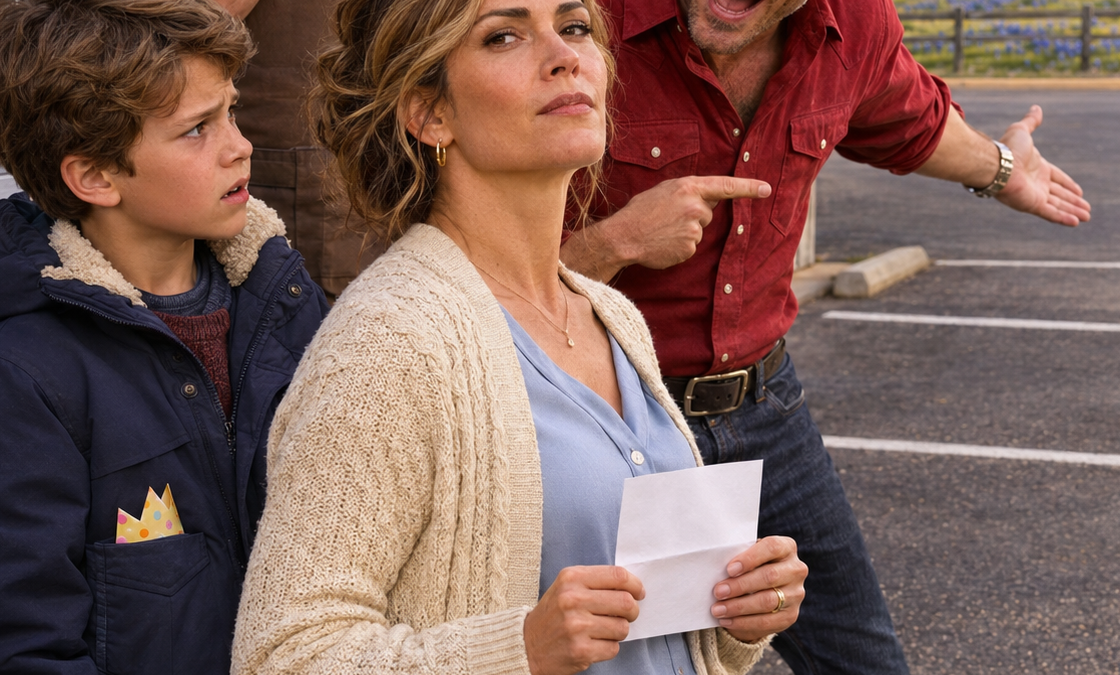
Owen moved closer to my chair. His birthday crown, folded inside his coat pocket, stuck out at one corner.
“Can we go home now?”
“Soon,” I told him.
Mark looked at me. “You could ride with me. We’ll get him settled, then work this out.”
“I can’t get into your truck.”
“I meant Owen.”
Our son looked down.
I could transfer independently with my usual setup. An ordinary truck or sedan wasn’t that setup, and Mark knew it.
“He stays with me,” I said.
“You don’t have to turn down help.”
“Taking our son home doesn’t get me home.”
The visiting manager came to the doorway. Her phone was against her apron. Beside her, taped inside the glass, hung the company-issued extension notice. A strip of tape crossed one corner; along the lower edge, beside bay 7, were the small handwritten words “ramp down” and a pair of initials.
My folded copy of Daniel’s original permission was in my coat pocket.
“Could everyone come inside?” she asked. “It’s cold out here.”
“One minute,” Mark said.
He held up his phone.
“I can send you a simple acknowledgment. Going forward, you won’t reserve two spaces. We can avoid all this.”
“I didn’t reserve them. Daniel gave me permission.”
“It’s one parking space per customer vehicle. That’s the issue.”
“My ramp needed somewhere to go.”
“And we can discuss a different arrangement. There’s no reason this needs to happen again.”
“Then bring the van back.”
“The truck’s already finished the job.”
Through the window, I could see our booth. Owen’s pancake plate still sat there, one triangle left beneath a puddle of syrup. He’d ordered the bacon separately because he didn’t believe birthday bacon should get sticky.
“Dad,” he said, “we weren’t done eating.”
Mark’s face changed when he looked at him.
“I know, buddy. Go finish. I’ll talk to your mom.”
“You already did.”
Daniel coughed into his fist. Nobody went inside.
Mark lowered his voice. “I’m trying to keep this from becoming a bigger problem.”
“Then stop asking me to agree to it.”
“You haven’t even read what I’m offering.”
“I’m not signing away room for my ramp.”
“That isn’t what it says.”
“Send it, then. I’m still not signing out here.”
I looked at Owen, who had begun rubbing one sneaker against the pavement.
“He shouldn’t have to earn a ride home.”
Mark checked the time on his phone.
“I have another call. Daniel, we’ll speak Monday.”
He told Owen he loved him. Owen answered, but didn’t move toward him.
Mark left in his truck. Our van stayed gone, and his company still had the diner’s towing agreement.
The visiting manager held the door open. Before Daniel could follow us, his phone sounded.
She looked straight at him.
“Read that before you tell her to pay.”
Daniel read the message twice. “Mark told me she’d already left.”
“She was eating lunch,” the visiting manager said. “I wrote that in the message. She had permission.”
Daniel looked from her to me.
“You saw him take it?”
“I saw enough to send you that. And I photographed the notice.”
Inside, she introduced herself as Helen Foster, the relief manager visiting from Temple. She’d stayed behind after the lunch rush to finish the shift paperwork.
“I’m an out-of-town witness,” she told me. “I don’t know your husband.”
“Ex-husband.”
“All right. I don’t know him.”
She had photographed the posted extension with my van and the diner frontage visible. Her original picture was still on her phone.
“Will you keep it?” I asked.
“Yes.”
Owen slid into our booth. His pancakes were cold now.
We were near Brenham, Texas, far enough from home that calling somebody meant asking them to give up their afternoon. I had sixty-four dollars in checking after the household payments.
The storage lot wanted $272.
Daniel offered to call Mark.
“Ask where they took it,” I said. “I need the address.”
“I ought to have checked before—”
“Yes.”
He went behind the counter. When he returned, he had the lot address and a contractor folder.
“The original permission is in here somewhere. Yours is a copy.”
“Please keep the extension, too,” Helen said.
Daniel opened the folder. An envelope slipped against the inside cover.
“That came with the renewal paperwork,” he said. “I thought it was insurance.”
Helen leaned closer. Daniel pulled out a folded sheet.
Daniel unfolded the contractor letter and stopped. “They warned him about unauthorized removals last October.”
He read farther, his lips moving.
It was a copy of an earlier final state order against Mark’s company, dated October 17, 2025. I asked Daniel to keep it with the parking papers. I couldn’t read anything else while Owen sat waiting for a ride.
I called Beth Lawson.
“Are you home?”
“Dryer’s broken. I’m negotiating with a fitted sheet. What happened?”
“My van got towed.”
“Where are you?”
I told her.
“Can you bring yours? Owen’s with me.”
“I’ll come. You staying inside?”
“Yes.”
“Good. Don’t let anybody invent a way to lift you into something.”
Beth had known me since rehabilitation after my service-related spinal injury. She used a rollator herself and owned a ramp-equipped minivan.
When she arrived, she didn’t ask me to explain in front of Owen.
“Birthday boy gets music,” she said. “Birthday boy does not get volume control.”
For the first time since we’d come outside, he smiled.
We used her ramp and my established transfer setup. Nobody carried me. Nobody told me an unsafe ride was better than waiting.
At the storage lot, I showed my identification and the van registration. The employee confirmed the amount.
“No storage?” Beth asked.
“Zero. Same-day pickup.”
“And nothing else?”
“Just the tow.”
“I can pay you back,” I told her.
“I know. Card first, conversation later.”
She paid the $272 directly by card as a loan. I asked for the itemized receipt, not just the card slip.
At 4:10 p.m., they released my van.
I checked the receipt against the amount Beth had paid: $272 for the tow, zero storage, zero additional charges. I kept both slips with my parking permission.
Owen waited with Beth while I reached my familiar driver’s seat.
My phone lit up with Mark’s proposed acknowledgment. His message said any future use of two bays would trigger another tow unless I signed.
The deadline was Monday at noon.
Chapter 2 of 7
On Tuesday, January 20, I took Mark’s acknowledgment to the kitchen table and answered it.
“I won’t sign this. Your Monday deadline doesn’t change that.”
The deadline had passed while the courthouse was closed for the holiday. It was Mark’s demand, not a court order. Still, refusing it hadn’t changed who could send a truck into that lot.
I emailed Daniel next. I asked for a written parking arrangement that didn’t depend on my ex-husband’s approval.
Then I got Owen ready for school.
He stood by the refrigerator with his backpack on, studying the lunch calendar.
“Was it because I asked him?”
“Asked who?”
“Dad. To come Saturday.”
The refrigerator motor clicked off. From the laundry closet came the uneven thump of a sweatshirt zipper.
“No, honey.”
“You said I could invite him.”
“And you could. Adults arrange parking. You didn’t do anything wrong.”
He kept looking at the calendar.
“I could’ve just seen him later.”
“You don’t need to fix this.”
“Are you still mad?”
“Yes. At what happened. Not at you.”
He wanted Thursday’s school lunch circled, though it was only Tuesday. Pizza mattered enough to plan ahead. I circled it, and we left.
After drop-off, I went to request the tow hearing. The clerk gave me a receipt for the $20 filing fee.
That left another small gap in money already assigned to groceries and gas.
My appointment with Karen Ellis was by phone. I had paid for limited help, and she kept us inside that limit.
“What do you want this hearing to do?” she asked.
“Get the tow charge back. Stop him doing it again.”
“The first part belongs here. The second doesn’t.”
“So he could lose and keep towing?”
“This judge decides whether there was cause for this tow and what fees you recover. The judge won’t take away the company’s license.”
I looked at the receipt beside my keyboard.
“I filed the state complaint online yesterday.”
“Good. Keep copies separately. These are two different proceedings.”
“I don’t have money for two lawsuits.”
“The state handles its investigation. I’m helping you with the fee hearing. If someone asks you for something you don’t understand, call before you answer.”
She asked whether I still had the permission papers and release receipt.
“Yes.”
“Keep the originals. Work from copies.”
At work, I spent the next few hours finding appointment openings for people who had already waited too long. One woman apologized three times because she needed wheelchair transportation.
“You don’t need to apologize,” I told her.
Then I checked the next available morning.
Daniel called during my break.
“I can give you permission for a particular visit,” he said. “You call ahead, and I’ll put it in writing.”
“What happens when Mark says your writing doesn’t cover something?”
“I’d send it to dispatch too.”
“Will you stop using his company?”
“I’m not ready to do that.”
Behind him, somebody called for more coffee.
“Rachel, I have a contract. I have deliveries getting blocked. There’s more to the lot than what happened Saturday.”
“I know there is.”
“I’m trying to offer you something.”
“I need to know I can leave after lunch.”
He didn’t answer right away.
“I can promise you written permission,” he said.
That was as far as he would go. I thanked him for calling, but I didn’t make another reservation.
Helen emailed that afternoon from Temple. Her message included the original phone file, rather than a screenshot copied from a message. She offered to keep the phone and leave the picture untouched.
We spoke while I was logged out for lunch.
“I was only there to cover shifts,” she said. “I wasn’t expecting homework.”
“I’m sorry.”
“Oh, don’t start that. Tell me where you need it sent.”
She confirmed the original permission covered bays 6 and 7 from 11:30 a.m. to 12:30 p.m. Daniel had approved staying longer, and the company-issued extension ran through 2:00 p.m.
“Was dispatch allowed to issue that?” I asked.
“Yes. That’s how the diner handles an owner-approved extension. I checked before I posted it.”
“Would you write down what you remember?”
“I already started. I’ll stick to what I saw.”
I gave her Karen’s email address. Helen said Daniel was keeping the diner’s originals in his office.
Before we hung up, she asked about Owen.
“He went to school.”
“That’s something.”
“Yes,” I said. “It is.”
At pickup, my van was in its usual place along the school’s pickup route. Owen came out with one sleeve pushed above his elbow and a library book too large for his backpack.
“Did you eat?” he asked when he got in.
“Yes.”
“Actual lunch?”
“A sandwich.”
“With the bread?”
I laughed. Once, during a rushed workday, he’d caught me eating turkey straight from the package.
“With both pieces.”
He buckled in. I waited for the car ahead to move, then drove us home.
The state complaint acknowledgment arrived the next day. It listed Laura Hayes as the investigator assigned to towing enforcement. The message said company records would be requested and asked me to preserve what I had.
I read it twice, looking for anything that promised a result. There wasn’t anything.
I sent Karen a copy and asked about the October order Daniel had found.
“Does that settle any of this?”
“No,” she said. “They still need to establish what happened to your van.”
“Then why keep it?”
“The agency can obtain its certified order. Daniel’s contractor copy tells them where to look.”
“So I shouldn’t send it around?”
“Send it where it’s requested. Don’t turn it into an argument with your relatives.”
I hadn’t mentioned relatives.
“Divorce cases,” she said. “People forward things.”
By Thursday, January 22, Mark had done exactly that.
His message went to a family group I’d muted months earlier. An aunt called before I saw it.
“He says you’re trying to claim two spaces permanently.”
“I asked for room to use my ramp.”
“Well, he says the extension isn’t the issue. It’s how long you expect everyone to keep making exceptions.”
I was still wearing my work headset, though my shift had ended.
“Did he tell you we were eating lunch when he took it?”
“He said Owen was upset by the disagreement.”
“He was upset because our van was gone.”
“She’s not accusing you,” my aunt said, although I hadn’t asked who else was with her.
“I need to read what he sent.”
The message began with concern for Owen. Mark acknowledged that an extension had been issued. He described a broader parking problem and said I wanted permanent control over two guest spaces.
He wrote that he hoped I would stop making our son’s birthday about my grievances with him.
Several relatives had responded with hearts. One said we both needed to compromise.
At the bottom was an offer addressed to me.
“I’ll return the $272 if you withdraw the state complaint and sign the parking acknowledgment.”
Chapter 3 of 7
“I’ll take repayment,” I told Karen. “I won’t trade the complaint for it.”
I had sent her Mark’s family message before our call. The tow-hearing request was already filed, and Friday, January 30, was on my calendar.
“Those are different things,” she said. “You can say so.”
“Will refusing his offer look bad?”
“You’re refusing conditions. You’re still asking for the fees.”
I wanted Beth’s money out of this. She hadn’t budgeted for my van any more than I had.
Karen helped me write a short answer. I would accept repayment without the acknowledgment or withdrawal. Otherwise, I would attend the scheduled hearing.
Mark didn’t answer me. In the family group, he wrote that his offer remained open.
I left the group muted.
On Friday morning, I took my folder to justice court. Owen was at school. He knew I had an appointment about the van, and that was enough.
Karen met me outside the hearing room.
“Answer what he asks,” she said.
“I schedule medical appointments. I can answer questions.”
“Then don’t schedule three answers into one.”
That got a laugh out of me, though it came out thin.
Judge Michael Grant examined the parking permission, the extension, and the release receipt. Daniel had come with the diner’s originals. Mark sat beside his attorney.
The judge asked Daniel whether he had authorized my use of the two bays.
“Yes.”
“And the additional time?”
“Yes. I approved that.”
Mark’s attorney described a disagreement about how the spaces were being used. The judge asked him to point to the restriction he relied on, then returned to the papers.
I waited through questions I wanted to interrupt.
When my turn came, Judge Grant asked what I had paid.
“My friend paid the lot directly. I owe her $272.”
“Any storage or other charge?”
“No, sir.”
“And your filing expense?”
“Twenty dollars.”
He checked the court receipt.
His ruling was short. He found no probable cause for the tow and awarded $292: the release charge and my actual filing fee.
I heard the number clearly. Everything after it took more effort.
Outside, I asked Karen, “Does he have to leave my van alone now?”
“This judgment returns these fees.”
“I know. I just—”
“Keep getting permission in writing.”
Mark passed us on his way out. He didn’t stop, and neither did I.
On Tuesday, February 3, his attorney sent the $292 payment on Dalton Recovery’s behalf. The accompanying note said payment did not admit liability in the state licensing matter.
I read that sentence once and checked the amount twice.
I paid Beth back that afternoon. The transfer was $272, with “van release loan” in the memo. The remaining twenty dollars restored what I had spent filing.
Beth called before I had closed the banking screen.
“You could’ve waited until payday.”
“I have it now.”
“Then we’re even.”
“Yes.”
“Good. My dryer has developed a second opinion.”
“What does that cost?”
“Apparently, another visit from a man who says ‘huh’ for ninety dollars.”
I laughed harder than the joke deserved. For the first time since the birthday, I didn’t owe someone for getting us home.
Helen called that evening to ask whether the payment had arrived.
“It did. Thank you for checking.”
“Daniel told me about court.”
“He came.”
“He needed to.”
There was a turn signal clicking on her end. She had pulled over outside a grocery store in Temple.
“Did the picture come through all right?” she asked. “The original file, I mean.”
“Yes. I kept your email too.”
“That paper kept curling away from the glass. I was afraid the corner would cover something.”
I opened the saved image. The diner window reflected a pickup and part of Helen’s sleeve. The notice sat crooked against the glass, tape across one corner. Near bay 7, the small handwritten words “ramp down” and a pair of initials were visible.
“I can see it,” I said.
“I took another picture of the lunch board by mistake. Nearly sent you that.”
“What was the special?”
“Meatloaf. You don’t need that one.”
“No.”
She said she was keeping the phone file. I thanked her again, and she told me to let her buy her groceries.
By Wednesday, the money was settled. Going back to breakfast wasn’t.
Daniel called while I was between work appointments.
“Mark wants individual advance written approval for the spaces,” he said.
“From you?”
“Yes.”
“What if you’re not there?”
“You’d need to arrange it before coming.”
“I used to ask whoever was running the diner.”
“I know.”
“And now?”
“He wants to take the uncertainty out of it.”
I looked at the work queue on my screen. Three patients needed callbacks before lunch.
“Can you give me permission for Saturday?”
“I expect to be there. Let me confirm.”
“Daniel, I can’t drive over and wait to find out.”
“I said I’d confirm.”
He sounded tired. I was tired too, but only one of us would be stranded if the arrangement failed.
That evening, I told Owen we would try another breakfast place.
“Is Bluebonnet closed?”
“No.”
“Are we banned?”
“No, honey. I’m choosing somewhere else this week.”
He considered that.
“Do they have waffles?”
“I’ll find out.”
The other restaurant was farther away. I called about parking and the entrance, then called back when the first person couldn’t answer about room beside the van.
Our usual Saturday breakfast fit before my late-morning work block. The extra driving didn’t. I asked my supervisor to move that block into the afternoon and lost the open stretch I usually used for groceries.
Nothing fell apart. We ate waffles, bought milk afterward, and got home with enough time for me to log in.
But Owen had to bring a book while I worked. At Bluebonnet, we would have been home earlier.
On Monday, Daniel called back.
“I could’ve made Saturday work,” he said.
“I needed to know before Saturday.”
“Yes.”
For a while, I heard dishes through his phone.
“Are you keeping him because replacing him costs money?” I asked.
“That’s part of running a business.”
“I’m asking about yours.”
He let out a breath.
“If I change towing companies now, people will ask why.”
“They’re already asking.”
“Most customers don’t know what happened.”
“My son does.”
“I know, Rachel.”
“Then what are you protecting?”
He didn’t answer quickly.
“I’d have to tell people I let the wrong thing happen in my lot. People who’ve been coming here for years.”
“You could tell them you’re fixing it.”
“I’m not ready to make that call.”
I had no answer that would make him ready.
A few minutes after we hung up, he forwarded the instruction Mark had circulated through their contractor arrangement after the birthday.
“Owner approval only. No manager extensions,” it said.
Chapter 4 of 7
“That instruction came afterward,” Laura Hayes said. “I need the agreement they were using on your birthday visit.”
It was Thursday, February 12. I had forwarded Daniel’s message before our call.
“Will you ask him for it?”
“Yes. Directly.”
“He keeps saying he has a contract.”
“Then I need to read it.”
Laura’s record request included the diner’s permission papers and Dalton Recovery’s dispatch records. She asked who had seen the extension issued and posted.
I gave her Helen’s number in Temple.
“She kept the photograph?”
“The original file. She sent me a copy.”
“I’ll ask her for it herself.”
That afternoon, Mark called.
“I heard from an investigator,” he said.
“I gave her what she requested.”
“You gave her the visiting manager’s name.”
“Yes.”
He paused long enough that I checked whether the call had dropped.
“I didn’t know she’d photographed anything.”
“She was working.”
“I’m not questioning that, Rachel. I’m saying there are details here that weren’t part of our conversation.”
“Our conversation outside the diner?”
“The permission. How it was being used.”
I watched the minutes on my work-break timer.
“Daniel extended it,” I said.
“I know an extension went out. The question is what he extended.”
“We stayed for lunch.”
“Your van stayed. Your ramp stayed down in another customer space. Those aren’t necessarily the same permission.”
I said nothing at all.
“Daniel needs parking available,” Mark continued. “He can’t have people thinking every arrangement lasts as long as somebody decides.”
“I used the arrangement he gave me.”
“We’ll have to let the records sort that out.”
For once, we ended a call without discussing Owen. I still had six minutes before work.
I spent them staring at the next patient’s appointment request.
The sheriff called the following week.
“This is Paul Mercer. Have you got a minute, Rachel?”
I knew his voice from years of cookouts. He and Mark used to argue about whether catching one large fish counted as beating three small ones.
“What do you need?”
“I hate hearing this has gotten so far from everybody.”
“My van was towed.”
“And you got the money back. That’s good.”
“Yes.”
“I wondered whether there’s a way to keep the rest local. You and Mark still have a boy to raise.”
Owen was at the kitchen table, trying to erase a math answer without tearing the page.
“Are you calling as sheriff?”
“I’m calling because I know the family.”
“Did you order my van towed?”
“I didn’t order that tow.”
“Did anyone from your office?”
“Not that I’m aware of. This was a private-property matter.”
“Then I’ll leave the complaint with the investigator.”
“Rachel, I’m not trying to tell you—”
“I need to help Owen with his homework. Goodbye.”
I wrote down the call while I could still remember the wording. I separated what Mercer had said from what I had asked.
Then I sent the account to Laura.
I didn’t write that he had threatened me. He hadn’t. I wrote that he had suggested keeping the matter local and denied ordering the tow.
Owen looked up when I returned.
“Is seven times eight fifty-four?”
“Fifty-six.”
“Then this whole row is bad.”
“We can fix a row.”
He sighed as though I had suggested rebuilding the school.
Laura called again after interviewing Daniel. She had the earlier towing agreement and had requested the company’s dispatch authorization log.
“Did he tell you what happened?” I asked.
“I can’t discuss his interview.”
“Can you make Mark stop towing while you look?”
“No. I gather the facts. I don’t suspend licenses.”
“So what can I do?”
“Write your account of lunch. What you saw, what you heard. If someone told you something, say who.”
“Even Mark?”
“Yes. Just don’t describe it as something you witnessed.”
After Owen went to bed, I wrote where we had sat and how we had found the empty bays. At the tow itself, I stopped. I hadn’t seen it happen. I left that part blank except for what Mark had told me.
By Thursday, March 12, Laura had most of the requested material. She asked me to confirm a few details about my copies and the release receipt.
“Dalton Recovery has counsel responding now,” she said.
“Is he saying the extension never happened?”
“He’s disputing its scope.”
“Still?”
“That’s part of what we’re investigating.”
I called Karen afterward.
“Does having a lawyer mean he can drag this out?”
“It means someone will answer for him. Don’t guess beyond that.”
“Are you still my lawyer for this?”
“For the limited work we agreed on. I can help you understand requests. I’m not prosecuting the state’s case.”
I checked my calendar after we hung up. Owen had a school project due. My supervisor wanted next month’s availability. The complaint had to fit between those things.
On Tuesday, May 5, the department issued its Notice of Alleged Violation, shortened to NOAV in the email. It named Dalton Recovery’s towing company license and proposed discipline.
I called Karen with the notice open.
“Is this an order?”
“No. It’s the department’s allegation and proposed action. The company can contest it.”
“So nothing changes today.”
“Not from this notice.”
Mark’s attorney requested a hearing on Monday, May 18, within the response period. I learned about it through the case correspondence, not from Mark.
His messages to me stayed about Owen: pickup times, a missing sweatshirt, whether the school needed another permission slip.
I answered those messages. When one ended with “We should discuss the bigger situation,” I replied only to the pickup question.
Department counsel Eric Nolan contacted me about scheduling and testimony. He would present the agency’s case. I would be a witness, not the person arguing for a penalty.
“I haven’t testified in anything like this,” I told him.
“Answer from what you remember. Tell me if you don’t remember.”
“What if I need a break?”
“Say so.”
The hearing notice set the appointment in Austin before Administrative Law Judge Susan Reed. It was Tuesday, July 14 at 9:00 a.m.
I arranged time away from work and began planning the drive. Owen would not be going. He needed a summer morning that had nothing to do with where we had parked in January.
Then Mark’s filed defense arrived.
I expected another argument about customer turnover. His attorney’s language was narrower than that. It accepted Daniel’s authority to extend the lunch visit and disputed what that permission covered.
According to the filing, Daniel had authorized extra lunch time. He had never authorized the ramp to remain in bay 7.
Chapter 5 of 7
On Tuesday, June 30, I read Mark’s defense again with Karen on the phone.
“He says the van could stay,” I said. “Just not the ramp.”
“That’s the distinction he’s asking the judge to accept.”
“I couldn’t use the van without space beside it.”
“Tell them what you were given permission to do. Don’t guess what he knew.”
Every exhibit had been exchanged. The full photograph, the original notice, the dispatch log, and the prior order were in the materials available to both sides.
The witness subjects were listed, too. Nobody was arriving in Austin with a surprise tucked inside a coat.
“What if he gets careful?”
“You can’t answer for Daniel.”
I had spent too much of the winter trying to make him less afraid of his own answers.
Karen practiced questions with me.
“Did you see Mark attach the van to the tow truck?”
“No.”
“Do you know what he read before directing the tow?”
“No.”
“What did you see?”
I started with the lunch, then drifted into what Daniel had said afterward.
“Rachel.”
“I know. Too much.”
“Try again.”
“I will answer what I saw.”
“Good. You’re allowed to stop there.”
From the kitchen, Owen called, “Does bowling count as a birthday thing in July?”
Karen said she could wait.
“Who’s asking?” I called back.
“Beth. She says we didn’t get a proper redo.”
Beth was on his tablet, helping him plan the day he would spend with her during the hearing. He wanted bowling, pizza, and a visit to a used-game store.
“That’s a long birthday,” I said.
“I’m still eleven.”
“Fair point.”
He returned to his negotiations. Beth apparently had a pizza budget.
Karen asked whether I was ready for another question.
“Yes,” I said.
This time, I answered only that question.
Helen called from Temple the following week.
“I found a motel that says its coffee starts at six.”
“You’re coming the night before?”
“I’m not trusting the drive on hearing morning.”
“I’m sorry you have to spend—”
“I already booked it, Rachel.”
She had traded an opening shift and would work Saturday instead. Her sister would feed her cat, who apparently refused food from anyone wearing outdoor shoes.
“You could ask about appearing another way,” I said.
“I’ve made the arrangements.”
“I just hate that a few shifts at the diner turned into all this.”
“So do I. They asked who was there. I was there.”
She asked about parking at the hearing building. Neither of us knew, so we checked the arrival information together.
Before hanging up, she said, “I don’t want ‘temporary manager’ to turn into ‘she probably didn’t know what was happening.’”
“Has somebody said that?”
“Not to me. I’d rather answer the questions myself.”
Daniel called two days later.
“I’ll be there Tuesday,” he said.
“Thank you.”
“I need you to hear me out before you thank me.”
I waited.
“I’m going to answer honestly. I’m not promising to fix everything for either of you.”
“I didn’t ask you to fix Mark’s problem.”
“You’ve asked me to end the contract.”
“Yes. I have.”
He sounded as though he was somewhere quiet for once.
“That account matters to him,” he said. “About eighteen thousand a year in gross business.”
“I know why he wants to keep it.”
“And replacing him would be work for me.”
“So you’ve said.”
“I should’ve spoken sooner.”
I looked toward the hallway, where Owen’s swim towel had been hanging for two days.
“Which time?”
Daniel didn’t answer.
“Outside, when Owen asked where our van was? Afterward, when people said I’d claimed the lot?”
“Yes,” he said. “Those times.”
“Then answer the questions Tuesday.”
“I will. But I won’t promise what either lawyer will make of it.”
That was the first promise from him I could use.
Mark called that evening. His next visit with Owen was already arranged, and I almost let it go to voicemail.
“Rachel, I think there’s a practical way to narrow this.”
“What are you asking?”
“I’ll accept that the van could stay until two. We don’t need to spend the hearing arguing about extra lunch time.”
“We weren’t arguing about that.”
“The adjacent space was for loading only. If we agree on that, there’s much less to fight over.”
“I’m not agreeing to that.”
“You needed it to get out. Nobody disputes that.”
“You’re asking me to describe an arrangement I wasn’t given.”
“I’m asking you to separate access from holding a second customer bay.”
“No.”
“This isn’t an apology you have to make.”
“I know what it is. My answer’s no.”
He paused.
“All right. Then the hearing will address it.”
He ended the call politely. I recorded the substance of his proposal for Eric Nolan, then went to ask Owen about his day.
On Tuesday, July 14, I reached the Austin hearing building early enough to check the entrance and find the restroom without rushing.
Helen was already in the lobby.
“How was the coffee?” I asked.
“Available. That was its best quality.”
She had brought a sweater despite the heat outside. The lobby air-conditioning made that look sensible.
Mark arrived with his attorney. Sheriff Mercer came with them in civilian clothes and took the seat beside Mark.
They spoke quietly about the drive.
Daniel arrived next. He greeted me, then sat in the row behind them. His knees nearly touched the back of Mercer’s chair.
I sent Beth one last message.
“Owen stays with you until I call. Please don’t bring him here, even if this runs late.”
Her reply came quickly.
“He’s arguing that pizza should precede bowling. We’re fine.”
I put my phone away.
Eric came over before nine and asked whether I needed anything.
“Water eventually. Otherwise, no.”
“We’ll make time.”
Mark’s attorney joined him near the hearing-room door. Their opening exchange was low, but we were close enough to hear.
“Our position is narrow,” his attorney said. “The company accepts the owner-approved time extension. The disputed point is continued occupation of the adjacent bay.”
Eric answered, “We’ll present the authorization and the witnesses.”
“We’re not challenging the dates on the notice.”
“I know.”
There was no raised voice to make it easier. Mark looked rested. His attorney had a clear question for the judge to decide, and Daniel was still sitting behind him.
Helen stood when the clerk came to the doorway.
Before we went inside, Mark turned toward us. He spoke evenly, to the witnesses gathered there.
“Daniel approved the van. He never approved leaving the ramp down through lunch.”
Chapter 6 of 7
On the public record, I gave my name and answered Eric Nolan’s questions about our lunch.
Then he directed me to the company extension already admitted into evidence.
“Is this the notice you saw posted?”
“Yes. May I point out the handwriting beside bay seven?”
Judge Reed allowed it.
“It says ‘ramp down,’” I said. “Those are Daniel’s initials beside it.”
Mark’s attorney stood.
“We don’t dispute what’s written. The question is who had authority to approve that use.”
Judge Reed looked toward him. “Explain the distinction you’re drawing.”
“A dispatcher could issue additional time. A temporary manager could post it. Neither could independently authorize prolonged occupation of another customer bay. Loading access and leaving equipment deployed through lunch are different permissions.”
She returned to me.
“Who specifically authorized the ramp to remain there?”
“Daniel. Helen was there when he gave the instruction.”
“What did he tell you?”
“That I could leave it down while we finished lunch. It was secured inside the second bay, away from traffic.”
Mark’s attorney asked whether I knew what dispatch had told Mark.
“No.”
“Whether he personally read this handwriting?”
“No.”
He sat down.
Helen testified next. She identified her original photograph and the posted notice visible behind my van.
“Did you write the instruction?” Eric asked.
“No. Daniel did.”
“What did you hear him authorize?”
“The ramp staying down for the rest of their lunch. He didn’t tell her to raise it between trips.”
“Why did you photograph it?”
“I was covering the shift. I wanted a record of what we’d posted.”
The original notice and the dispatch log supplied the timing her photograph alone couldn’t. Daniel’s approval had gone through dispatch at 12:18 p.m., before Mark directed the tow at 12:46.
The handwriting wasn’t a manager’s reminder about helping me unload. It described the use Mark now said nobody had approved.
When Daniel was called, he rose from the seat behind Mark.
Eric showed him the notice.
“Whose initials?”
“Mine.”
“What did you authorize?”
“Both spaces through two. The van in six, the ramp down in seven while they ate.”
“Only while she was entering or leaving?”
“No.”
Mark’s attorney approached the same point another way.
“Your standing agreement required us to keep customer parking available?”
“Yes.”
“And you understood that two occupied bays affected other customers?”
“I did. I gave permission anyway.”
“Did you personally telephone Mr. Dalton?”
“No. Dispatch handled owner-approved extensions under our agreement.”
Daniel’s voice had gone rough. He asked for water before Eric questioned him again.
“Did you correct Mr. Dalton outside the diner?”
“I said I hadn’t asked for the tow.”
“Did you explain the full permission?”
“No.”
“Why not?”
Daniel looked toward Mark, then back at Eric.
“I wanted them to work it out without putting me in the middle.”
“And what happened?”
“My silence let his account stand.”
After he was excused, Daniel took the empty chair beside mine.
Mark took the witness seat. His attorney asked why he had ordered the removal.
“The agreement required us to keep parking available,” he said. “I understood the extension to cover lunch time, not leaving the ramp in another bay throughout it.”
“Are you saying there was no extension?”
“No. I’m saying there were operating limits.”
Eric stood for cross-examination.
“You personally directed this tow?”
“Yes.”
“At 12:46?”
“Yes.”
“The owner-approved extension had gone through dispatch at 12:18. Before your direction?”
“Yes.”
“Do you dispute that Daniel approved it?”
“No. I dispute what that approval allowed under our agreement.”
“Did you read every word on the posted notice?”
“I’m not saying I did. I acted on my understanding of how the lot was supposed to operate.”
“Did you call Daniel before directing the tow?”
“No.”
“Was your decision based on a conversation with him about this extension?”
“No. It was based on the operating limits I understood.” His attorney returned to that distinction in closing.
“This was not hostility toward disability. Mr. Dalton believed continued occupation of the adjacent bay exceeded the arrangement.”
Judge Reed addressed counsel.
“Your client personally directed and participated in this removal?”
“Yes.”
“The owner-approved notice preceded it. What inquiry did he make about the second bay?”
Counsel referred to Mark’s understanding of the standing agreement.
“I’m asking about verification of this permission,” she said.
There was no record of a call to Daniel before the tow.
Only after addressing the current removal did she turn to the certified October order and its warning about recurrence.
Eric argued that the prior discipline, combined with Mark’s personal role, warranted stronger action.
Judge Reed closed the hearing without announcing a suspension.
“I’ll issue a proposal for decision after reviewing the record.”
Outside, Helen asked where she could find coffee that had actually met a coffee bean.
I laughed once, then had to stop.
On Friday, July 31, the proposal arrived. Judge Reed recommended six months’ full suspension of Dalton Recovery’s company license; the Commission still had to decide.
My lawyer kept me posted as the parties submitted their exceptions on August 14, 2026, and their replies on August 28, both on time. On September 4, Judge Reed informed everyone that, after reviewing the filings, her recommendation remained unchanged. I reread my lawyer’s message, relieved it still stood but uneasy about what the Commission might decide.
On Tuesday, September 15, we returned to Austin for the public Commission meeting.
Mercer sat near Mark again. Daniel sat with me.
Mark’s attorney argued that suspending the whole company would affect employees who hadn’t ordered the tow. Mark sat beside him.
Eric answered that the department sought discipline against the company license, based on an independently proved removal and prior final discipline.
Chair Linda Brooks questioned Mark’s attorney.
“Why does scope remain disputed after the owner authenticated his instruction?”
“Our position remains that the operating agreement distinguished temporary access from continued occupation. We preserve that authority argument.”
“Even where the owner expressly approved the continued use?”
“We believe the company reasonably relied on its understanding of the agreement.”
“The owner authorized both bays for that lunch,” she said. “The record establishes that dispatch issued his extension under the agreement. The company’s contrary understanding did not withdraw his permission.”
She called for a motion to adopt the proposed findings and sanction. A commissioner moved; another seconded.
The votes were called individually. Each commissioner voting supported the motion.
“The motion carries,” Chair Brooks said.
After the order was signed, she announced a “six-month company-license suspension,” with November 1 as the stated delayed effective date, subject to the applicable finality requirements.
Mark shut his binder.
“What about rehearing?” he asked his attorney.
“We’ll discuss the filing.”
He turned toward Mercer, who remained seated.
“I can’t change this, Mark,” Mercer said.
In the hallway, Daniel waited until counsel finished speaking.
“Our diner arrangement has to change,” he told Mark.
“We have a contract.”
“I know. I’ll deal with it under the contract.”
Mark looked at me.
“I hope we can keep this separate from Owen.”
“You don’t get to make our son watch me beg.”
His attorney glanced toward us. I kept my voice low.
“Pickup arrangements stay as agreed. Changes involving transportation or money come in writing. I’ll answer about Owen. I won’t negotiate parking with you again.”
“I wasn’t asking you to.”
“Then we’re clear.”
At Beth’s home, Owen was stretched across the rug with a puzzle book. His worn birthday pencil rested behind his ear.
“Did you have to talk again?” he asked.
“Mostly listen today.”
“Sounds worse.”
“Some of it.”
Beth had made grilled cheese and cut mine diagonally. Owen insisted rectangles tasted different.
I stayed for dinner. Nobody asked me to explain the vote over his plate.
On Friday, September 25, an email arrived while I was finishing work. Mark’s lawyer had filed a motion for rehearing.
November was still ahead. I forwarded the notice to Karen.
I added a question to Karen: “Does this motion change the November 1 start date?”
Chapter 7 of 7
“Not automatically,” Karen told me. “November 1 is still the stated start date, but we need the rehearing decision and finality information before I can confirm it.”
“Do I need to answer it?”
“Not yourself. Department counsel handles the agency’s response.”
I left the notice in its folder and went back to work. A patient needed to move an appointment because her ride couldn’t come Thursday. I found her a Tuesday opening and waited while she checked.
On October 13, Mark’s motion for rehearing was denied.
Karen reviewed the denial and the later service and finality information before calling me. I had asked her to check the start date, not tell me what usually happened.
“The order’s November 1 start remains in place,” she said. “There’s no judicial stay preventing it.”
“So that’s when they stop?”
“Yes. Under this order.”
I wrote the date on my calendar. Owen’s school picture reminder occupied the square above it.
On November 1, Dalton Recovery stopped licensed towing under the six-month suspension of its company license. The suspension was temporary, with employees’ separate licensing rights unchanged.
Mark sent a message that afternoon confirming his weekend pickup.
I answered, “Five works.”
Then I helped Owen find a shirt without a stretched collar for picture day.
On Thursday, November 5, Daniel called.
“I’ve ended the towing agreement,” he said. “The termination clause lets me do it with the notice I’ve given.”
“Did the Commission require that?”
“No. This is my decision.”
I waited.
“I should have made it earlier,” he said.
He was ending an account that had brought Mark’s company about eighteen thousand dollars a year in gross revenue. Replacing the contractor would be Daniel’s work now.
“You’re welcome back,” he added. “Both of you.”
“Thank you.”
“I can send you the new parking arrangements.”
“Please do.”
He sent them that evening. I saved them without making a reservation.
The sheriff called once more that fall.
“I owe you a short acknowledgment,” Mercer said. “My name shouldn’t have been used to pressure you over that tow. And I shouldn’t have asked you to keep the complaint local.”
“No, you shouldn’t have.”
“I wanted to say that directly.”
“All right.”
He didn’t offer to fix anything. I didn’t ask him to. We ended the call, and I returned to the grocery list I had been making.
Mark and I kept the parenting arrangement we already had.
He picked Owen up at the agreed times. Owen brought home stories about a movie, a fishing trip, and a hamburger too tall to eat. I listened to those stories without asking what his father had said about work.
Once, Mark called to ask whether I could meet somewhere different for a handoff.
“Send me the location,” I said.
“I’m telling you now.”
“And I need it written.”
“Rachel, it’s just a change of parking lot.”
“Then it won’t take long to send.”
He sent it. I checked that I could use the location safely before agreeing.
Money requests went the same way. So did transportation changes. I answered what needed answering and stopped there.
There were no new parking waivers with my signature on them. I didn’t agree to anything over the phone because he said it would be easier.
One Sunday, Owen came home unusually quiet.
“Dad says people don’t get what running a business is like,” he said.
I waited while he unzipped his backpack.
“Do they?”
“Some people do.”
“Did you?”
“I knew he had a business. I also needed my van.”
“He says there were rules.”
“He can explain what he meant. You don’t have to explain it for him.”
Owen looked relieved, then annoyed.
“I wasn’t trying to.”
“Okay.”
“I need a poster board.”
“For when?”
“Tomorrow.”
We went out for poster board.
Winter passed in work shifts and school mornings. I still worked roughly twenty-four hours a week, fitting appointments into spaces that never seemed wide enough. My pay hadn’t changed because the Commission had voted.
The van needed ordinary attention. I kept gas in it, checked the ramp, and called ahead when we tried somewhere unfamiliar.
Beth remained my backup, not my transportation plan.
When a cold morning made the van reluctant to start, I called her before it became an emergency. She stayed on the phone until the engine caught, then reminded me that friendship did not include listening to me argue with a battery.
Owen learned to make scrambled eggs that winter. He put too much pepper in the first batch and insisted the gray patches were “restaurant seasoning.”
I ate them with extra toast.
Sometimes Mark’s messages still began with an explanation I hadn’t requested. I read through to the actual question and answered that.
He got better at putting the question first.
In March, Karen confirmed that the suspension ran through April 30. Its scheduled end didn’t change our boundaries or restore the diner account. I thanked her for the limited help she’d given me and put away the last correspondence.
I had no reason to watch Mark’s lot when the six months ended.
On Saturday, May 1, 2027, Owen asked for breakfast somewhere we hadn’t tried.
“Real plates,” he said. “Not drive-through.”
“I can manage real plates.”
We chose a small café near Brenham. I had called the day before about the entrance and parking. That morning, I picked a level space with room to deploy the ramp safely.
Owen waited until I was ready, then walked beside me toward the door.
Inside, a waitress asked whether we preferred a table or booth.
“Table,” I said.
She moved a chair away without turning it into a conversation.
Owen studied the menu. I checked my phone once for anything urgent, then left it in my bag.
“What time do we have to go?” he asked.
“Nothing scheduled until this afternoon.”
“So we could get breakfast and then just sit?”
“If you want.”
“Maybe. Depends how good breakfast is.”
Outside the window, a man was trying to persuade a small dog to leave a patch of sunshine. Owen watched for a while before returning to his menu.
“Pancakes,” he decided.
He found the worn birthday pencil in the little pocket of his backpack. The painted barrel had almost no lettering left.
“Still writes,” he said.
He circled pancakes, pressing hard enough to leave a faint mark underneath. Then he looked at my unopened menu.
“Your turn.”
I hadn’t checked the clock.
He slid the birthday pencil across the menu.