My older cousin presented Dad’s final recording as her wedding blessing while I sat beside his empty chair—and she didn’t know what I had kept.
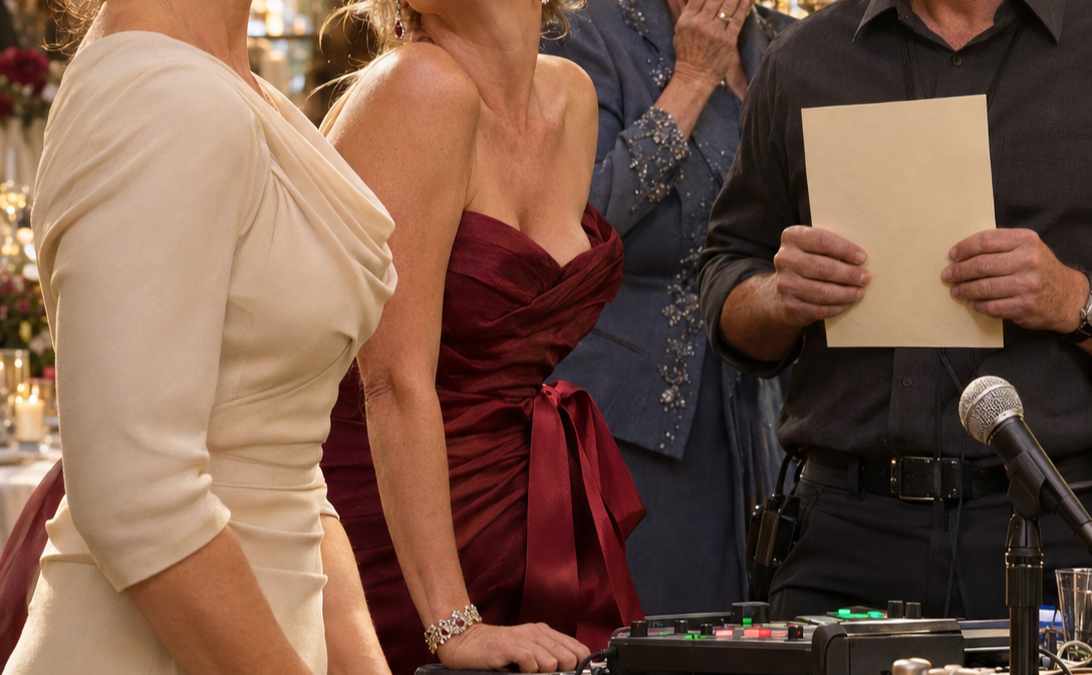
Original fictional family drama set in 2026. The people, wedding venue and event-company contract are fictional. AI-generated illustration.
Chapter 1 of 7
Celia stood beside the microphone, her trailing ribbon caught against my shoe. I freed it and straightened it automatically.
“That recording wasn’t made for this,” I said.
Her mother, Diane, stood close enough to hear.
“He would rather celebrate me than watch you cry.”
Diane looked toward the windows. Celia turned back to the guests.
“We’ll have his voice with us later. Now, can we get everyone together for a photograph?”
It was 2:30 on Saturday afternoon at the wedding venue in Granville, Ohio. Beyond the windows, guests crossed the lawn carrying jackets they didn’t need yet.
Celia bent toward me, smiling for someone across the room.
“Please don’t sit there looking injured, Ellen. Come stand beside Mom.”
“What recording are you planning to play?”
“The one with his message.”
“Which message?”
She glanced at the microphone, still live on its stand.
“Let’s keep our voices down.”
Mine had barely carried past her shoulder. Behind her, a guest asked whether the family should gather by the fireplace.
“Just a minute,” Celia called. Then, to me, “We’ve got people waiting.”
My knees pressed against the chair in front of me. I couldn’t stand without making her move, and she seemed content to keep me there.
“Did you take the recording from the restoration shop?”
“Take? Really?”
“Did you collect it?”
“Everything was arranged. You don’t need to worry about the technical part.”
Dad had died in February. I still sometimes reached for my phone when a radio made a noise he would have recognized.
Celia touched the back of Diane’s arm.
“Mom, tell her we discussed including him.”
Diane’s lipstick had settled into the lines above her mouth. She looked at me, then at the people gathering by the fireplace.
“We did talk about a memorial.”
“A memorial,” I said. “That’s what we talked about.”
“Oh, honey.” Celia lowered her voice further. “You can’t expect everyone to know there’s a difference.”
A woman near the fireplace beckoned us over. Celia nodded, promising us with her smile.
“Come on. We’ll put you on the end if that’s easier.”
“I’m not doing the photograph.”
“Then we’ll have to explain why.”
“Being family didn’t make my grief available for borrowing.”
Her smile stayed in place, but she stopped beckoning.
“That’s an ugly way to describe people loving your father.”
Diane said my name softly.
I waited for the rest. She checked whether her jacket was buttoned.
Across the room, the producer stood behind a small control table. His headset covered one ear. A printed reception rundown lay beside the controls.
“Excuse me,” I said.
Celia moved enough for me to get past, then followed.
At our family photographs, someone always shouted “pickles” instead of “cheese.” I heard it behind me, followed by a burst of laughter, and nearly answered out of habit.
The producer looked up.
“Can I help?”
“Are you Graham?”
“Yes.”
“I’m Ellen. Has the original recording for tonight been delivered?”
Celia reached us before he answered.
“She’s worried about her dad’s things. This has been a difficult year.”
“I asked whether you have the original.”
“Let me check what came in,” he said. “Are you asking about the audio or a physical item?”
“A quarter-inch reel. Scratched gray tin.”
“We have a supplied audio file listed.”
“And the reel?”
Celia leaned closer to his table.
“We’re about to lose the light for the family picture. Could you reassure her that everything’s being handled?”
“I need to know what came in first.”
He looked toward a doorway behind the table. Nobody came through it.
I could still hear chairs moving near the fireplace. Diane had followed us halfway across the room and stopped beside a tall flower arrangement.
“Please don’t start the recording,” I said.
Celia’s voice stayed pleasant.
“There’s no reason to change the afternoon over this.”
Graham looked down at a delivery entry beneath his rundown.
Graham began reading the line again, his hand above the cue button.
“Celia, whose recording did you bring me?”
“Her father’s. The family recording I told you about.”
“This lists Ellen as the restoration customer.”
“That’s right. She handled getting it cleaned up.”
His finger remained on the entry.
“Were you expecting delivery here?” he asked me.
“No.”
Celia looked toward Diane.
“Mom, could you come over? We seem to be getting tangled up.”
My phone was in my pocket. With Celia facing her mother, I opened the shop’s last message and typed a question about collection.
Graham asked Celia when she had arranged delivery. I stepped far enough away to hear my phone.
Susan answered almost immediately. She said the recording had been released Thursday and asked whether I wanted the handoff record.
“Yes, please,” I typed.
The scan arrived at 2:47. At the top were the words “release slip.” Susan’s message said the shop retained the original form.
At the bottom was my name, written as a signature.
I had not written it.
Dad had given me the tin at his house in January, its pale leader tucked among the coils. I usually labeled everything carefully for my volunteer oral-history work, but that afternoon I had carried it home against my coat.
I enlarged the form enough to read the collection details, then returned to Susan’s message.
“Please send my intake and paid invoice too.”
Celia was explaining the family memorial to Graham. Neither of them looked toward me.
I asked Susan who had supplied the pickup reference.
Before she answered, a voice crackled through Graham’s headset. He raised a finger toward Celia, asking her to wait.
Graham answered his headset and turned toward the equipment door.
“The original is already in our booth?”
I stepped back beside the table.
“Yes,” he said to whoever was speaking. “Leave it where it is for now.”
Celia’s eyes followed him.
“Is something missing?”
“I’m checking the delivery.”
She looked at me then, properly, without the smile she had been holding for the photograph.
“Ellen, nobody’s going to damage it.”
“I’m not endorsing this segment.”
“You don’t have to introduce it.”
“I’m telling him I didn’t agree to it.”
Graham spoke before she could answer.
“Our custody rider covers borrowed recordings. I need to check what we received and whose permission came with it.”
Celia nodded.
“Fine. Mom can clear that up.”
Diane had reached us, though she stayed on Celia’s side of the table.
“I told her she could remember him,” she said.
I waited.
“She wanted him included.”
“Did you tell her she could use my recording?”
“Ellen,” Celia said, “Mom has had a hard year too.”
Diane’s eyes watered. I hated that I noticed Celia watching me notice.
For months, people had asked whether I was keeping busy. There had been quiet days when even answering that question felt like work.
“I’m asking about the recording,” I said.
“And I’m trying to get married,” Celia answered. “With the people who helped us still part of it.”
Graham looked between us but said nothing.
My phone vibrated against my palm. Susan had answered.
“Celia gave me the pickup reference. She said Diane got it from you.”
Chapter 2 of 7
At three o’clock, I asked Diane where she had gotten my pickup reference.
“From that notice on your kitchen counter,” she said. “When I came over. You were putting groceries away.”
“You read it?”
“It was right there, Ellen.”
“Did I tell you to give it to Celia?”
Diane glanced toward the guests drifting out to the terrace.
“I was helping with the tribute.”
“What did you tell her she could do?”
“Include your father. I told you that.”
“That doesn’t answer what I asked.”
Celia stood close to her mother, her skirt spreading into the space between us.
“Mom, could you and Ellen find somewhere to talk? Somewhere you can actually hear each other.”
“I can hear her.”
“I know, honey. But people are coming over asking where I’m supposed to be, and I can’t keep—”
She stopped as a guest approached. She accepted a compliment about her dress, asked about the drive, and waited until the woman left.
Then she spoke to Diane again.
“Would you help me with this? Please? I shouldn’t have to choose who’s upset with me today.”
Diane nodded before Celia finished.
“We’ll sort it out.”
Celia thanked her and went toward the terrace. She paused twice to greet people. From where I stood, she looked like a bride checking that everyone had arrived safely.
Diane waited until she was out of hearing.
“You know how much she did for him.”
“Yes.”
“The appointments. Driving over after work.”
“I know what she did.”
“Then why are we doing this here?”
“Because the recording is here.”
Her mouth worked around an answer she didn’t give.
A server passed with glasses of lemonade. Diane declined, then watched the tray disappear.
At family cookouts, she used to insist lemonade needed a pinch of salt. Dad called hers soup. She would drink his anyway, then complain it was too sweet.
I wanted her to ask whether I needed water. I wanted that small, ordinary thing badly enough to look away.
“Tell me the permission you gave,” I said.
“I said Walter ought to be remembered.”
“Did you say she could collect the recording?”
“I gave her the number so she could arrange things.”
“Did you tell her she could sign for me?”
“I didn’t discuss signatures.”
“Did you tell her I’d said yes?”
“I said you wanted him included.”
“On May ninth, I agreed she could honor him. That was the conversation.”
“I remember.”
“Then please say that.”
Diane looked tired now, and older than she had beside the flowers.
“I’m not going to stand here and make my daughter sound dishonest.”
“I asked what you authorized. I didn’t ask you to describe her.”
“I’ve told you what happened.”
She hadn’t, quite. But she had reached the end of what she would say.
Graham approached from the control table.
“Ellen. Can we speak away from the entrance?”
Diane started to follow.
“Just Ellen for now,” he said.
We stopped near a window overlooking the lawn. He kept his voice low.
“Have you got anything showing how you came to have the original?”
“Dad gave it to me.”
“Anything from that time?”
I found the January tenth conversation on my phone. There were messages about groceries above it and a question about his furnace below.
Between them was Dad’s message confirming he had given me the reel to keep.
Graham read it on my screen.
“Saturday, January tenth?”
“Yes. At his house. Diane was there.”
“May I have a copy of that message?”
I sent it while he waited. Then I opened Susan’s intake and the invoice she had just forwarded.
“I brought it in August twenty-eighth. That’s my payment.”
“One hundred eighty-five,” he said. “And you’re listed as the customer claiming ownership.”
“Yes.”
“This tells me what the shop received from you. I’ll need to check their delivery side too.”
“I have that.”
He looked up.
“Can you send it rather than show me here?”
I forwarded Susan’s scan. He read without commenting on the name at the bottom.
“I didn’t sign it,” I said.
“All right. I’ll ask her what she relied on.”
“Can I get my recording?”
“Not this minute.”
“It’s in your booth.”
“Yes. My operator’s working in there.”
“I could go with you.”
“Please stay out of the booth. I need to finish checking the handoff.”
From behind the door came a short burst of music, then a man counting into a microphone. It was an ordinary workroom sound. I hated being on the wrong side of it.
“So what happens while you check?”
“Our playback is on hold. It won’t run while this is disputed.”
“Celia can’t just tell you to start?”
“No.”
“And you’ll keep it there?”
“While I check the authorization, yes. My company accepted custody. I can’t skip the return check either.”
I looked toward the terrace. Celia was standing with Andrew, listening to something he said.
“I’m not asking you to take anything out of her hands.”
“I know. We already have it.”
That helped more than another promise would have.
Nathan arrived through the main entrance a few minutes later. He had changed out of his work clothes, but one cuff of his shirt was folded higher than the other.
“I missed a turn,” he said. “Then I found a very nice driveway belonging to somebody who wasn’t getting married.”
Usually I would have laughed.
He stopped beside me.
“What happened?”
“Celia collected Dad’s recording.”
“The one you took in?”
“Yes.”
He looked toward Graham, then back at me.
“Does he know?”
“He’s checking. He stopped the playback.”
“Okay.”
He didn’t ask why I hadn’t stopped Celia sooner. I had already supplied that question myself.
“I kept making things easy until they mistook easy for yes.”
Nathan stood beside me without answering right away.
“Do you want to leave?”
“I don’t want to leave it here.”
“Then we’ll stay.”
“You don’t have to spend the afternoon standing around.”
“I’ve got both shoes on. Might as well use them.”
I laughed once, badly. He let it count.
“If you want air, we can go outside,” he said. “If you want the car, I’ll get it.”
“Just stay here a minute.”
He did.
My phone lit up with a message to the family group. Celia’s name appeared above a photograph of the terrace.
She thanked everyone for being flexible. After talking with me, she wrote, she understood I preferred a smaller, private remembrance of Dad. They would adjust the reception tribute accordingly.
Nathan read it beside me.
“Did you ask for that?”
“No.”
There was already a reply thanking Celia for being thoughtful. Another relative sent a heart.
Beneath the message was an attachment labeled Updated Seating.
I opened it and found my name moved from the family table to Table 14, beside the service doors.
Chapter 3 of 7
At 3:30, Table 14 was on the seating board beside the reception doors. My name and Nathan’s appeared beneath it, moved together as if we had requested it.
Graham stood a few feet away, checking something with a server.
“Is this the same instruction you received?” I asked him.
I showed him Celia’s attachment.
“Yes. That came from the client.”
“So it wasn’t a mistake.”
“No.”
Through the open doors, I could see the table. Servers passed behind it carrying water pitchers. Beyond those doors, something metal struck the kitchen floor.
“Can she move people around this late?”
“I handle production. I don’t set guest seating.”
“I’m not asking you to move us back.”
He waited.
“I just wanted to know.”
Nathan studied the board beside me.
“We’re near the coffee,” he said.
“You don’t drink coffee after dinner.”
“I could develop.”
I almost smiled. Then a woman behind us leaned forward to find her own name, and we moved aside.
Celia approached with Andrew. He wore his boutonniere slightly crooked. She looked at the board, then at me, without appearing surprised.
“I hope that works better,” she said. “It’s farther from the speakers.”
“Better than what?”
“The family table is right near the sound. After what you said earlier, I thought some distance might help.”
Andrew looked at me.
“Is the music going to be a problem?”
“The music isn’t the problem.”
Celia answered before he could ask more.
“It’s been an emotional afternoon. I didn’t want Ellen feeling trapped in the middle of everything.”
“I didn’t ask to move.”
“No, honey. I was trying to spare you another decision.”
Graham excused himself to answer his headset. Celia watched him go, then turned back toward Andrew.
“We still need to check where your jacket went.”
“It’s upstairs,” he said. “What’s going on?”
“The recording is disputed,” I said. “Graham has put playback on hold while he checks.”
Andrew’s eyes moved between us.
“I thought that was settled.”
“We’re working through it,” Celia said. “There’s confusion about what Ellen wanted.”
“I didn’t agree to use that recording.”
“But you agreed we could remember him.”
“Yes.”
Celia paused. I could hear a server behind me asking whether the water glasses were finished.
“I’m not going to argue about the table,” I said. “We’ll sit there. I came for your wedding, and I’m staying for it.”
Andrew nodded, though he still looked uncertain.
“Then can we leave this until afterward?” Celia asked. “We’re about to walk down the aisle.”
“The ceremony can go ahead. I haven’t asked anyone to stop it.”
“I didn’t say you had.”
She said it gently. Andrew glanced toward the lawn, where guests were beginning to take their seats.
“We should get ready,” he said.
Celia thanked me for being flexible. She said it within hearing of two people reading the board.
I let her go.
Diane had been waiting near the hallway. She approached once Celia and Andrew were out of earshot.
“Please just accept the seat until after the ceremony.”
“I already said I would.”
“You sounded angry.”
“I was angry.”
“She’s trying to get through the next half hour.”
“So am I.”
Diane looked toward Nathan. He stood far enough away to give us privacy, though there was nowhere for either of us to hide.
“Andrew doesn’t need all this today,” she said.
“Then tell him whose gift it was.”
“What?”
“Dad gave me the recording. You were there. Tell Andrew that.”
“He’s gone upstairs.”
“When he comes back.”
Diane looked past me toward the lawn.
“Ellen, people are sitting down.”
“You saw Dad give it to me.”
She watched a guest struggle with the door until Nathan went over to help. When she spoke again, her voice was barely audible.
“I need to find my seat.”
She left me beside the board.
At the cookouts Dad used to host, he kept a pencil behind his ear to write names on paper cups. Celia always got a fresh one. Mine usually said “Elbow,” a mistake he insisted had become official.
I could have stood another minute remembering that. A venue employee was already asking us to head outside.
Nathan came back.
“Ready?”
“No. Let’s go.”
We chose seats near the end of a row. The ceremony chairs stood on grass dry enough to scratch my ankles. Somewhere beyond the grounds, a mower started, ran briefly, then stopped.
At four o’clock, the music changed.
Everyone rose for Celia. I rose with them.
Her dress caught briefly on the edge of the aisle runner. Diane leaned over and freed it. Then Celia looked ahead at Andrew, and her face changed.
He was smiling with his whole mouth. She laughed once before she reached him.
I watched them take each other’s hands.
The officiant’s pages fluttered in the breeze. A child behind us whispered that a bee was on somebody’s shoe. Nathan shifted his knee away from mine when the chairs settled unevenly into the grass.
I heard the vows. When Andrew’s voice caught, Celia waited for him.
For those few minutes, nobody asked me to make her version of Dad true.
When they kissed, I clapped. My palms felt hot afterward.
By the time we reached the terrace, people were discussing drinks and the weather. A server offered me a small square of something topped with a slippery tomato. I declined before remembering I hadn’t eaten since breakfast.
Nathan went to find us something less likely to land on my dress.
Andrew approached while I waited near the railing.
“Could I ask you something?”
“Yes.”
“Celia said you approved the tribute back in May.”
“I did.”
His shoulders eased.
“Okay. Because I thought maybe I’d missed—”
“I agreed she could honor Dad at the wedding. May ninth. We talked about it as a family.”
“That’s what she told me.”
“That part’s true.”
He looked toward the terrace doors.
“So what changed?”
“I found out today which recording she planned to use.”
“You hadn’t talked about that?”
“No.”
He rubbed the spot above his lip, careful of his tie.
“She did spend a lot of time with him.”
“She did. I’m not disputing that.”
“She talks about those drives to his appointments.”
“I know. I was grateful for them.”
He waited, apparently expecting a qualification.
I had none to give him. Celia had driven Dad. She had sat through appointments and brought back instructions he sometimes pretended not to hear.
Andrew looked down at the terrace boards.
“I wish I’d known there was a question about it.”
“So do I.”
Someone called him for another photograph. He hesitated, then went.
Nathan returned with crackers and cheese on two small plates.
At 4:18, my phone sounded. The production update said Celia wanted to supply a different file and keep the disagreement over the physical recording separate.
A second message followed.
Graham’s message said, “Celia has offered a replacement file. I need to speak to both of you.”
Chapter 4 of 7
At 4:35, Graham met us beside the sound table. Celia had come directly from photographs. A small leaf clung to the bottom of her dress.
“The replacement file doesn’t solve this,” he said.
“It would leave the original out of it,” she answered. “That seemed like a reasonable compromise.”
“It’s still the same disputed recording.”
“A copy.”
“The supplied-material clause covers what we play, regardless of format. It stays on hold.”
Celia glanced toward the terrace doors. People were gathering around a server carrying fresh drinks.
“So you haven’t canceled it.”
“No. I’m checking it.”
“Good. Because Andrew and I have paid for a program, and there are other people involved besides Ellen.”
“I know who my clients are.”
He said it without irritation. Celia nodded, accepting the correction before it became one.
“I’m trying to help you keep the evening moving.”
“Then I need a few minutes without photographs or guests interrupting.”
Celia looked at me.
“Can you manage that?”
“I’ve been here.”
“I meant all of us, honey.”
Graham asked whether Diane could join us. Celia sent her a message, then checked the doorway again.
From the lawn came a loud laugh followed by Andrew calling for someone to move closer. Celia’s eyes stayed there.
“I need to call the restoration shop,” Graham said.
That brought her attention back.
“Why?”
“To verify the handoff.”
“They delivered it to your company.”
“Yes. Ellen contacted Susan and received the form the shop retained.”
Celia looked at me for several seconds.
“You called the shop?”
“Yes.”
“When?”
“This afternoon.”
“And you’ve sent him paperwork.”
“The handoff form.”
Her voice dropped, though nobody stood close enough to hear.
“You could have asked me about collection.”
“I asked whether you collected it. You told me everything was arranged.”
“It was arranged.”
“There’s a signature on that form. I didn’t write it.”
Celia’s gaze shifted to Graham.
“I’m not going to argue over a scan while people are waiting for us. That document concerns collection logistics. Mom gave me the reference because she knew what we were doing.”
“I need to speak with Susan,” he said.
“Of course. I’m only asking you to keep the whole conversation in mind.”
Diane arrived from the hallway, breathing through her mouth.
“Did I miss something?”
“Graham is checking delivery,” Celia told her. “Ellen has involved the shop.”
Diane looked at me.
“I asked for their record,” I said.
Celia spoke before Diane could answer.
“Mom told me I could include Walter. Ellen agreed in May. Nobody invented a tribute this afternoon.”
“I agreed you could honor him,” I said.
“Yes. That’s what I just said.”
“I didn’t agree to lend this recording.”
“You never said there was a recording nobody could use.”
“You didn’t ask.”
She turned toward Graham.
“Can you see why I thought the family had settled this? We talked about remembering him. Mom helped. Ellen knew there would be a tribute.”
Graham waited until she finished.
“I heard you. Now I need the shop’s account.”
I was grateful he didn’t ask us to settle it by staring at the signature.
“Please call Susan,” I said. “I don’t want a handwriting argument.”
He called from his phone and told Susan who was listening. She agreed to speak with all of us there.
Her voice came through thin but clear.
“I have the records open.”
“Start with intake,” Graham said.
“Ellen brought the reel in on August twenty-eighth. She was the customer. She paid for restoration and left the original in my care.”
Diane’s eyes stayed on the phone.
“Was anyone else listed for collection?” he asked.
“No. Thursday’s release was based on the pickup reference and the submitted form.”
“Could you send the intake photograph and our signed custody acknowledgment?”
“Sending both now.”
Celia waited until Susan finished.
“Just so we’re clear, Susan, the reference was correct.”
“Yes.”
“Thank you.”
“The reference was correct,” Susan repeated. “Ellen is disputing the authorization.”
“I know. I’m not asking you to decide a family disagreement.”
“Neither am I,” Graham said. “I’m checking what my company accepted.”
A dishwasher rattled somewhere beyond the service corridor. Diane looked toward it as though someone had called her.
Graham’s screen showed the intake photograph: the open reel, a pale strip among the coils, the shop’s padded work surface. Beside it lay a ruler and a little brush with bent bristles.
Another image showed the custody acknowledgment. Graham checked his operator’s name and the delivery entry.
“Those are our records,” he said.
Susan confirmed the time of release. Graham asked two short questions about the reference transfer, then thanked her.
“Ellen,” Susan added, “I’ll send the rush verification invoice separately. Forty-five dollars.”
“All right.”
After the call ended, Diane spoke.
“I didn’t tell you to send it anywhere.”
Celia turned to her.
“Mom, you gave me the collection number.”
“I know I did.”
“You knew why I needed it.”
“I knew you wanted Walter included.”
“That’s what we’re doing.”
Diane looked at the photograph still visible on Graham’s screen.
“I didn’t know Ellen had left it there herself.”
“You knew I was having it restored,” I said.
“I knew that. I didn’t think about them holding it for you.”
Celia’s voice softened.
“Mom, please. You don’t have to remember every detail right now.”
Diane said nothing more. She had started worrying the inside of her cheek, a habit she used to scold me for.
A server came through carrying a tray of butter pats. One had escaped its dish and stuck to his sleeve.
Dad would have asked whether that cost extra. I almost heard the question, and for a second I had to look toward the kitchen.
Graham checked the reception schedule.
“We’re not finishing this here between photographs,” he said. “Six-fifty. At this sound table. Ellen, Celia, Diane, and me.”
“Dinner starts at six,” Celia said.
“Yes. This gives everyone time to eat.”
“And until then?”
“The recording stays on hold. The rest of the program continues.”
“I don’t want guests hearing that there’s some crisis.”
“I’m not making an announcement.”
Celia looked at her mother, then at me.
“I’ll be here.”
“So will I,” I said.
Diane nodded without looking up.
Graham sent the appointment to our phones. It read 6:50 p.m., with the sound table named beneath it.
Before I could close the message, another notification appeared. Andrew had forwarded a photograph of a printed introduction.
“A special message Walter recorded for Celia’s marriage.”
Chapter 5 of 7
“When did Celia give you those words?” I asked Andrew.
It was 5:15. He had found me near the terrace doors, still looking at his forwarded introduction.
“This morning,” he said. “Before we came here.”
“Before I said anything about the recording.”
“Yes.”
I read it once more: recorded for Celia’s marriage.
“Did she tell you she’d heard it?”
He looked toward the hallway.
“I didn’t ask.”
“Please ask her.”
“Ellen, I’m not trying to get between—”
“I know. Just ask.”
He found Celia coming out of the room where the wedding party had left their bags. He waited until two guests passed, then drew her into the alcove beside us.
“Have you heard the whole recording?”
She looked at me first.
“Why?”
“I’m asking.”
“Susan sent a little level-check excerpt. So we knew the voice was clear.”
“But the whole thing?”
“No. I wanted to hear it with everyone.”
Andrew’s mouth stayed slightly open.
“I thought you’d listened.”
“I knew it was Walter. I wasn’t going to sit through it alone and spoil that.”
He looked down the hallway toward the reception room.
Celia lowered her voice.
“Listen. We can still make this work.”
“The review is at six-fifty,” I said.
“I know when it is, honey. I’m talking about giving Graham something we can agree on.”
She waited, looking from Andrew to me.
“We don’t display the original. Nothing gets passed around. We play the tribute, and we return everything afterward.”
“No.”
“Please hear the rest.”
“I heard it.”
“Andrew’s family has been told there’s a special remembrance. They’ve asked him about it. Canceling it now makes them part of a disagreement they didn’t cause.”
Andrew glanced toward the reception room again.
“They’ll be all right,” he said.
“They’ll be embarrassed for us. There’s a difference.”
“They came to see you get married,” I said. “They can celebrate without hearing Dad’s private words.”
Celia’s eyes settled on mine.
“You don’t know that it’s private. You haven’t heard the restored version either.”
“I didn’t lend it to you.”
“We have one chance to do this with everyone here.”
“That doesn’t change my answer.”
Andrew let out a breath through his nose.
“Could we just let Graham finish checking?”
“That’s what I’m trying to avoid,” she said. “Another discussion at a table while our guests wonder where we’ve gone.”
She looked at me, waiting. In other years, I would have offered to write something, or find a photograph, or say a few words myself.
I offered nothing.
Celia nodded once.
“All right. Six-fifty.”
She walked back toward the reception room. Andrew stayed a moment, then followed.
Diane found me near the ladies’ room at 5:40. She had powdered over the shine on her nose and missed a little patch.
“Can we talk without Nathan?”
“He’s outside.”
“I don’t mean anything by that.”
“Then talk.”
She watched a woman disappear through the restroom door.
“I told her, ‘Your uncle would want to be included.’ Those were my words.”
“And the pickup reference?”
“I gave her that too.”
“But you never asked me.”
“No.”
A cart squeaked past the end of the hall. Diane waited until it was gone.
“Celia kept saying she didn’t want him forgotten. She did go over there, Ellen. Sometimes when nobody else could.”
“I know.”
“She’d come home with food he wouldn’t eat. Complain about him hiding the appointment cards.”
“I know those stories.”
“She wanted that part of her life to count.”
I looked at the powder on Diane’s collar.
“It counted before she took my recording.”
Diane’s eyes filled.
“I didn’t think she would put your name on anything.”
“Then you need to say what you did think.”
“I’m saying it now.”
“To me.”
She glanced toward the reception doors.
“You want me to stand there and contradict my daughter?”
“I want you to tell them you never asked me.”
“Couldn’t you explain that I—”
“No. I’m not repeating it for you.”
She stared at me.
“I’ll stand there,” I said. “But you have to say it.”
Someone came out of the restroom, and Diane stepped aside too quickly. When the door closed, she was still looking at the floor.
At six, guests began sitting down for dinner. Nathan and I went to Table 14, where the service doors opened often enough to stir the edge of the tablecloth.
Our table had a short leg. Each time someone cut into the chicken, the water in every glass leaned.
“I’ve got a spare washer in the car,” Nathan murmured.
“Please don’t repair the wedding.”
“I was going to bill them.”
I laughed, then lost track of what anyone said.
When the buffet line reached our table, I stayed seated. Diane was across the room. She looked toward me, looked away, then did it again.
Nathan brought back my meal.
“Chicken. Potatoes. I skipped the beans.”
“Thanks.”
“They looked tired.”
Before I picked up my fork, Andrew appeared beside us.
“Graham asked me to make sure you’re still coming over at six-fifty. Promptly, if you can. He has Susan arranged.”
“I’ll be there.”
“He doesn’t want to spend half the appointment finding people.”
“Does Diane know?”
“I’m telling her next.”
He stood there another second.
“Eat something,” he said, and went.
I ate enough chicken to stop feeling lightheaded. Across the room, Celia laughed at something one of Andrew’s relatives said. She looked rested now. When she caught me watching, she lifted her glass a little.
At 6:50, I reached the sound table with Nathan beside me. He stopped a few feet back, leaving space for the others.
Graham had the company’s custody record in front of him. My customer documents were open on my phone.
“Susan?” he said into his telephone.
“I’m here.”
Celia arrived with Andrew. Diane followed but stopped on the opposite side of the table from both of us. A server needed to pass behind her. She moved, then found herself beside me and moved again.
“Diane,” Graham said. “You’ll need to be close enough for Susan to hear.”
“I can hear,” Susan said.
Celia gave a small, patient smile.
“Before we start, I’ve offered a way through this. No display, no handling by guests. Everything goes back afterward.”
“Permission is still the question,” Graham said.
“And Mom can explain the family conversation.”
Diane looked toward the dinner tables.
Graham turned to her.
“What did you authorize?”
“I told Celia—”
A burst of applause came from a nearby table. Someone raised a glass toward the bride.
Celia turned and smiled. Then she left the table.
“Celia,” Graham said. “We’re not finished.”
“Just a moment. They’re waiting.”
She reached the microphone before Diane spoke again. Conversations tapered as guests turned toward her.
“I’d like to bring someone we loved into the evening,” she said.
Graham faced his operator. The operator looked back at him, waiting.
Celia told the 110 guests, “Walter left something for this marriage,” and gave the operator a visible cue.
Chapter 6 of 7
“Before you press play,” I said.
Graham signaled his operator to hold. The man lifted his eyes from the controls.
Celia kept the microphone near her mouth.
“Ellen, we haven’t started.”
“I know.”
At the nearest table, a guest lowered her phone. Farther back, someone was still trying to get a server’s attention.
Celia looked across the room.
“Walter intended this as a wedding blessing. My mother helped arrange it, and Ellen agreed we could honor him.”
“I agreed you could honor him. You told Andrew you haven’t heard the complete recording.”
“I haven’t.”
“Then how can you tell everyone he recorded it for your marriage?”
Her eyes went toward Diane, who had retreated to the family table. Diane sat on the edge of her chair.
“Graham,” I said, “please bring the original here. Let me identify it without playing it.”
He looked at Celia.
“I need to check the supplied original.”
She lowered the microphone. Andrew came to stand beside her.
“I’m not objecting to checking it,” she said. “But please don’t let this become something it isn’t.”
Graham spoke into his headset. The operator went through the equipment door.
Celia’s voice carried without the microphone.
“I drove Walter to appointments. I sat with him when he was sick of everyone asking how he felt. Sometimes he wanted to complain about Ellen. Sometimes he complained about me.”
A few people looked down at their plates.
“He was my uncle. That relationship didn’t disappear because he had daughters.”
“No one said it did,” I answered.
“Then let it count for something. Your aunt told me we should include him. You agreed in May. I relied on that.”
Andrew stayed close enough that their sleeves touched.
“The collection form may need sorting out,” Celia continued. “But that’s not the same as saying I invented my place in his life.”
Graham waited before answering.
“Diane, did Ellen authorize you to lend this reel or sign for its collection?”
Diane looked at her daughter.
Celia said, “Mom, just tell him what we discussed.”
The operator returned carrying the scratched gray tin. He set it on the sound table, beside Graham’s telephone.
Susan’s voice came through.
“Graham? I’m still here.”
“We have the original now.”
I opened the lid. The familiar scrape of metal carried farther than I expected.
The reel lay inside with its pale leader wound around the outside. I eased the loose end free. Its inward face turned upward.
Dad’s writing slanted across the strip.
“For Ellen, my youngest. A little company for the quiet days.”
I read it aloud once.
Celia looked at the strip, then at the microphone in her hand.
“Whose goodbye were you introducing?” I asked.
“I didn’t see that.”
“You told them it was for your marriage.”
“I knew he’d left a message. Mom said—”
“Celia.”
Diane had risen. She crossed the space between the family table and the sound equipment, carrying her place card.
She stopped beside me.
“I saw him give it to Ellen,” she said. “At his house. In January.”
Celia watched her mother.
“He put it in her hands. He said it was hers.”
“Mom, I’m talking about including him tonight.”
“I know what you’re talking about.”
Diane’s voice shook enough that she paused.
“I gave you the pickup reference. I told you your uncle would want to be included. That was me talking. I hadn’t asked Ellen.”
“You knew what I was arranging.”
“I knew you wanted a memorial. I had no permission to lend this.”
A server stood waiting with an empty tray. Nobody at the nearest table seemed willing to pass him a plate.
Celia turned toward Graham.
“I believed she was speaking for the family.”
He looked at Diane.
“Did Ellen ask you to arrange collection?”
“No.”
“Or authorize anyone to sign her name?”
“No.”
Susan spoke from the phone.
“The retained form bears Ellen’s name. That was part of what I relied on when I released it.”
“I didn’t sign it,” I said.
Graham faced Celia.
“Did Ellen authorize you to sign for her?”
Celia’s eyes stayed on the open tin.
“No.”
“Who signed her name?”
“I did. I had the reference. Mom had said we could include him. I thought that covered collecting it.”
Andrew looked at her, but he didn’t move away.
“I treated it as pickup paperwork,” she added. “I wasn’t trying to claim I was Ellen.”
Graham waited.
“And the message?” he asked.
Celia looked at the exposed leader again.
“It was addressed to Ellen.”
The microphone gave a small squeak against her dress. She moved it away.
Graham spoke plainly.
“Diane’s permission was not Ellen’s, and our agreement does not let us play disputed material.”
“Could we leave out the introduction?” Celia asked. “Just his voice?”
“No. We don’t have Ellen’s permission for this supplied recording.”
He brought the rundown where his operator could see it.
“I’m canceling the twelve-minute tribute.”
Celia stared at the page.
“All of it?”
“Yes.”
He crossed out the segment, then pointed out its cue to the operator.
“Remove that from the playback queue. Disconnect it from the next cue.”
The operator worked at the controls.
“It’s out,” he said.
“And no use of our working reference copy,” Graham added.
He checked the custody record, then slid the open tin toward me.
“Under our custody rider, I’m returning the entrusted original to you.”
I settled the leader inside and closed the lid.
Celia looked past me at the tables. Someone had started whispering near the windows.
“You can celebrate your marriage without borrowing my goodbye,” I said.
She swallowed.
“Could we have a minute, please?”
Graham nodded. He was already speaking quietly to his operator about the next part of the evening.
Celia raised the microphone.
“We’re going to make a small change to the program. Please enjoy your dinner. We’ll have music shortly.”
Her voice held through the first sentence. On the second, Andrew stepped closer.
“Can we have ordinary music?” he asked Graham. “Whatever you had planned for dinner.”
“Yes.”
A familiar instrumental started too loudly, then dropped to a level where people could speak. One of the servers resumed collecting plates. A fork slipped from his tray and struck the floor.
Dad would have called that a dinner bell.
I nearly laughed, then felt the laugh catch painfully behind my nose.
Diane carried a vacant chair from the edge of the family table. She put it beside the place where I had been standing.
“Don’t stay for me,” she said.
“I wasn’t going to.”
She nodded and sat down, her place card on her knee.
Celia was talking to Andrew now. He listened with his head bent toward hers. When she looked over at me, I couldn’t tell what she wanted.
I didn’t go back to ask.
Nathan met me beyond the sound table.
“Ready?”
“Yes.”
He walked beside me while I carried the tin. We passed Table 14, where my unfinished potatoes had gone dull beneath the lights. Someone had fixed the wobble with a folded drinks napkin.
Near the door, Nathan asked whether I wanted my coat.
“It’s in the car.”
“Right. Mine too.”
We both knew that. I was grateful he had asked anyway.
Diane followed us only as far as the doorway.
“May I come Sunday—not to explain her?”
Chapter 7 of 7
“Sunday at two,” I told Diane. “Come alone. We won’t play the recording.”
“All right.”
“And don’t bring me a message from her.”
Diane looked back toward the reception, then at me.
“I won’t.”
She arrived Sunday with nothing in her hands. I had expected a casserole, something requiring thanks before either of us could speak.
We sat at the kitchen table. Nathan had gone out to get groceries.
“I gave her the reference without asking you,” Diane said. “Then I stood there while she spoke to you that way.”
I watched a fly struggle against the window screen.
“I kept waiting for you to say something.”
“I know.”
“You asked me to be patient with her.”
“Yes.”
Diane’s shoes stayed together beneath her chair, toes pointed toward the door.
“I’m sorry, Ellen. For both things.”
She didn’t mention appointments or the strain of planning a wedding.
After a while, she asked whether she should go.
“Yes. I think so.”
She stayed seventeen minutes. At the door, she asked if she could call the next weekend.
“Call first,” I said. “Don’t just come.”
On Monday, Susan asked me to bring the returned reel by the shop. She checked it with me present, corrected the customer authorization record, and gave me a fresh receipt.
“I should have called you directly,” she said.
“Yes.”
“I will next time. A reference won’t be enough.”
She sent my customer transfer that afternoon. I saved it without opening the audio.
I had waited through the repair because I couldn’t hear Dad properly on the damaged reel. Afterward, I had kept waiting because I was afraid to hear him alone.
Now the file sat where I could choose it.
Graham’s email arrived Tuesday. His company would not use its working reference copy. He confirmed the original had been returned and attached the completed custody receipt.
I thanked him. Neither of us needed another meeting.
On Friday, October 2, Graham copied me on a short closing email. Celia had received an itemized invoice: $140 for the additional operator hour actually worked. There was no charge for canceling the recording.
I read it at lunch beside a cart of returned library books. A child had used a flattened cereal box as a bookmark.
The world had kept producing small jobs.
On October 16, two notices arrived. Graham confirmed Celia had paid the $140. A separate payment notification showed her $45 reimbursement for Susan’s verification work.
Her text followed.
“I paid the shop expense. I signed your name, and I shouldn’t have used the recording.”
I read it twice before answering.
“Thank you for paying it.”
Then I added what I had been practicing without sending.
“You can text me. You can’t collect or borrow my things. Don’t send requests through Diane.”
“I won’t,” she wrote.
I didn’t ask her to explain herself again.
She and Andrew stayed married. In November, she texted that they had painted their kitchen. I answered that the color looked nice. We left it there.
Diane called before visiting.
The first time, we talked about a loose button on her coat. The next time, she helped me sort a drawer full of takeout menus from places that had closed.
She found three identical vegetable peelers.
“Were you expecting company?”
“Apparently I was expecting carrots.”
She laughed, then looked at me carefully. I kept sorting.
Sometimes she said Celia’s name in an ordinary sentence. She never arrived carrying an argument for her. When she asked to stay for lunch, she accepted it when I said I had other plans.
By December, I stopped checking my phone before answering her knock.
On Saturday, December 19, I took the gray tin from my shelf.
Nathan was in the living room. Diane had called that morning, asking whether four o’clock still suited me.
When she arrived, I told them what I wanted.
“I’d like you both to hear it with me.”
Diane’s eyes went toward the tin.
“Are you sure?”
“Yes. Today.”
Nathan asked where I wanted to sit.
“Here.”
He brought another chair close enough that our knees almost touched.
The customer file showed eleven minutes and forty-two seconds. I started it before I could invent another task.
There was a rustle, followed by Dad clearing his throat.
“Well, Ellen. Apparently this thing still works. That puts it ahead of the kitchen clock.”
I laughed so abruptly I missed his next few words. Nathan laughed too, though he had never seen Dad slap that clock twice before changing its battery.
Dad tested his distance from the microphone. His breath sounded close, then farther away.
“If I sound important, don’t be fooled. I’m wearing the trousers with the missing button.”
Diane covered her mouth.
For a while, he talked about the radio on his workbench. He had meant to finish it. Then he described a bird stealing the string he had used to tie up his tomatoes.
His voice grew tired.
“I wanted to thank you without you interrupting me about the laundry.”
I pressed my lips together.
“I saw what you were doing. The clean sheets. Calling those people back. Sitting through the same story because I forgot I’d told it.”
A radiator clicked behind his voice. Three knocks, a pause, then one more. His house had made that sound all winter.
“I wasn’t always pleasant company.”
Diane looked down. Nathan stayed beside me.
Dad thanked me for making room in my life. He stumbled over that sentence and began it again.
Then he said, “But don’t keep the room empty now. Go somewhere. Have a good meal. Let Nathan drive if you’re tired. He seems capable, despite that truck.”
Nathan wiped his nose on his sleeve.
Near the end, Dad paused long enough that I checked the screen.
“This is for the quiet days,” he said. “You don’t have to make an occasion of it.”
His voice softened.
“All right, El. I love you. I’m going to turn this off before I start telling you how.”
We heard him search for the switch. The radiator knocked again.
I let the file finish.
For several minutes, nobody spoke. Then Diane asked if she could have a tissue, and I pointed toward the box behind her.
“I’d forgotten that clock,” she said.
“He never fixed his own things,” I said.
Nathan laughed through his nose.
“Professional courtesy. Gives the rest of us work.”
I wanted supper. The wanting surprised me.
“Grilled cheese?” I asked.
“And soup?” Nathan said.
“Tomato.”
Diane stayed while we cooked. The kitchen grew warm, so I opened the window a few inches. Cold air reached the table while Nathan scraped a burnt edge over the sink.
We ate before the sandwiches cooled. Diane took the smaller half without asking, then accepted another when I offered it.
After supper, Nathan washed the pan. I carried our cups into the living room.
I set Dad’s gray tin beside my own chair.