A Car Salesman Pointed Me to the Bus Stop in Front of 12 Customers—Then His Boss Ran to That Bench With a Pen
Complete story · 7 chapters · about 34 minutes · ending included
Chapter 1 · Chapter 2 · Chapter 3 · Chapter 4 · Chapter 5 · Chapter 6 · Chapter 7
Chapter 1: The Salesman Who Pointed at the Rain
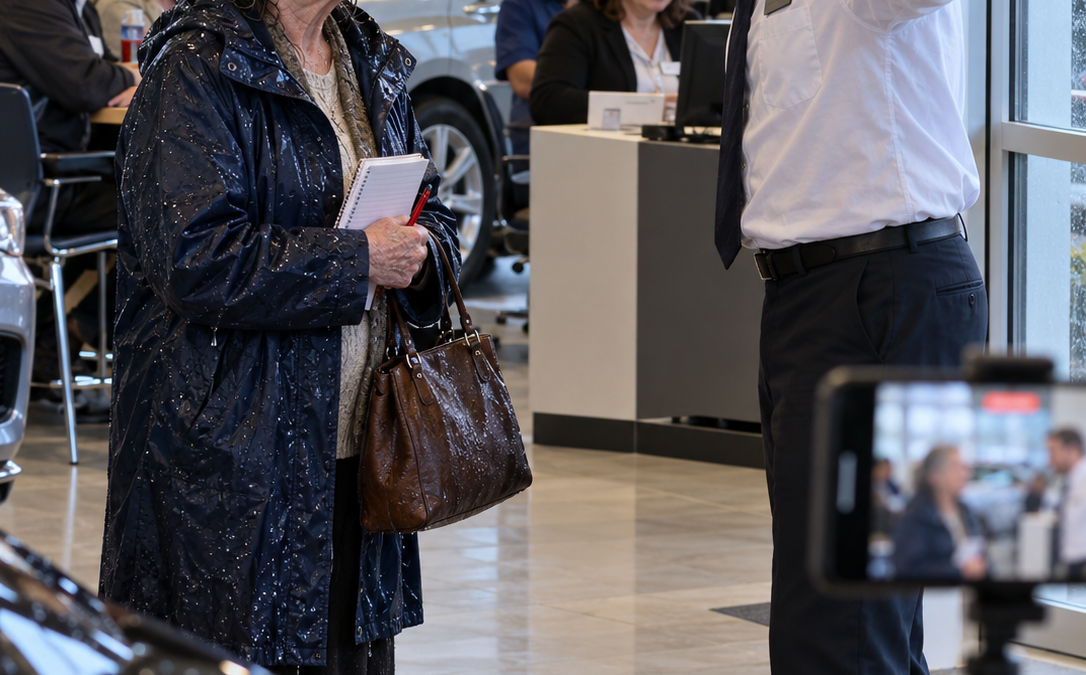
At 10:40 Saturday morning, with twelve customers scattered across the showroom and a phone on a tripod streaming the Saturday Sale, Cody Pike pointed through the glass at the cold rain and said, “Ma’am, the bus stop’s out front. Wait there. This floor is for buyers.”
“Spell your name.”
That was my answer.
Water was dripping from the hem of my coat onto the tile. I had come straight off the Number 7 after my Buick decided, two blocks from home, that twenty-one years was enough. The tow driver had taken it one direction. I had taken the bus the other.
In my purse was a cashier’s check.
I had come to buy a car.
Not a new one. I was sixty-seven, retired, widowed, and living on a teacher’s pension. I had done the arithmetic before breakfast and then done it again in my spiral notebook because thirty-four years teaching fifth grade had left me with permanent suspicion toward any number I had not written down myself.
The sedan on Rausch Auto’s website was $9,400.
That was my number.
When I walked in, I asked the woman at the front desk if I could sit somewhere until a salesman had time to show it to me. My coat was soaked through at the shoulders. My hair had given up before I crossed the parking lot.
Cody had heard me from three desks away.
He was thirty-seven, though I did not know that yet. What I knew was that he had the kind of voice made for rooms where he expected people to listen.
He looked at my wet coat, then at the glass doors behind me.
“No car?” he asked.
“Not one that runs.”
A couple near the coffee station turned their heads.
I nodded toward the row of chairs. “I can wait. I’m here about the used sedan listed at ninety-four hundred.”
Cody smiled toward the customers as if I had handed him a setup.
Then he gave me the line about the bus stop.
A man near the window laughed first. Two more people joined him, the uncertain kind of laugh people use when they are not sure whether they have just heard a joke or something mean.
I looked past Cody.
Behind the front counter sat a woman with short brown hair and glasses. Her nameplate said CONNIE MOYER. She had been typing when Cody spoke.
Now she looked down at her keyboard.
That bothered me more than the laughter.
Cody spread one hand toward the door. “You asked where you could wait.”
“No,” I said. “I asked to sit until someone could show me a car.”
His smile tightened.
I took my spiral notebook from my purse and clicked my red pen.
“How do you spell your last name?”
That got a bigger laugh.
Cody seemed to enjoy it.
“Pike,” he said. “P-I-K-E.”
He said each letter clearly for the room.
I wrote CODY PIKE.
Then, because I had spent most of my adult life writing down exactly what children claimed they had or had not done, I added the time.
10:40 a.m.
Cody leaned against the edge of a desk.
“You taking attendance?”
“Something like that.”
I closed the notebook halfway, then saw the laminated card taped beside the nearest sales computer.
FLOOR RULE 4: NO CAR ON THE LOT, NO COFFEE, NO CHAIR. T.R.
I copied that too.
Above the desks, a long anniversary banner stretched across the showroom.
ON OUR OWN GROUND SINCE 1996.
I wrote that beneath the card.
The phone on the tripod stood about fifteen feet away, angled across the sales floor. A little red light showed at the top. Someone had taped a paper sign to the stand that said SATURDAY SALE LIVE.
Cody followed my eyes.
“Smile,” he said. “You’re on camera.”
“I’m wet enough already.”
One woman covered her mouth, and I could not tell whether she was hiding a smile or embarrassment.
I put the notebook back into my purse.
Cody stepped aside and made a broad gesture toward the doors.
I walked out.
The rain had turned finer but colder. The bus stop bench sat along North Dixie Drive with no roof over it, just two metal arms and a wet seat facing traffic.
I wiped one end with a folded grocery receipt from my purse and sat down anyway.
Through the dealership glass, people moved between bright cars and hanging balloons. The anniversary banner was easy to read even from outside.
ON OUR OWN GROUND SINCE 1996.
Forty minutes is a long time when you are sixty-seven and cold water has worked its way through the back of your coat.
I knew because I checked my watch.
At 10:52, my fingers started to ache.
At 11:07, the Number 7 passed going the other direction.
At 11:23, Cody walked by the glass carrying a coffee cup and did not look outside.
The cashier’s check stayed in my purse.
I had brought it because old Hal Rausch had once clapped my husband Joe on the shoulder at a church fish fry and told him, “You ever need a car, you come to me.”
Joe had remembered that for years.
So had I.
Hal was gone now. Joe was gone too.
And I was sitting on a roofless bench in the rain outside the business that carried Hal’s last name, still holding a check for $9,400.
After forty minutes on that bench, I opened my banking app.
My hands were stiff enough that I mistyped the passcode once.
The deposit sat where it always sat.
RAUSCH AUTO LLC $3,150.00 November 1
I looked at it until a drop of rain hit the screen.
Then I scrolled back.
October 1. $3,150.
September 1. $3,150.
August 1. $3,150.
Every month since Joe died in August 2024, the rent had arrived on the first.
Todd Rausch had never met me.
That part had always struck me as mildly funny.
The dealership books listed the landlord as B. A. Novak, care of the law office that handled Joe’s papers. Joe had dealt with the lot for years. I signed what needed signing, deposited what needed depositing, and listened when he told me the arrangement was simple.
The Rausches had the building.
We had the dirt under it.
One point three acres.
Joe’s father had once run a produce stand there. Later, he leased the land to Hal Rausch under a thirty-year agreement. Hal built the dealership. The rent helped Joe and me through leaner years, then helped after retirement.
After Joe died, the land became mine by survivorship deed.
The $3,150 a month was not some fortune.
My pension was $2,870.
The rent was the difference between getting by and fixing the roof before another Ohio winter finished what the last one had started.
I knew exactly what that money meant.
I also knew exactly what I had just been told.
This floor is for buyers.
I looked through the glass again.
Cody was talking to a couple near a silver SUV. His hands moved wide when he spoke. The phone on the tripod was still pointed toward the showroom.
That detail stayed with me.
A live stream.
His name in my notebook.
The card.
The banner.
I did not go back inside.
When the next Number 7 pulled toward the curb, I stood, wiped rain from my phone, and slipped it into my purse beside the unused cashier’s check.
The bus doors folded open.
The driver looked at my coat and said, “Rough morning?”
“I’ve had warmer ones.”
I climbed aboard.
There were open seats near the front. I took one by the window and watched Rausch Auto slide past as the bus pulled away.
For a few seconds, the anniversary banner was still visible through the rain.
ON OUR OWN GROUND SINCE 1996.
Then the building disappeared behind us.
I opened my spiral notebook to the page with Cody Pike’s name.
Under it were Floor Rule 4, the time, and the banner.
I put my red pen to the next line.
Find that video.
Picking up where the Facebook post left off
Chapter 2: The Email Signed by the Owner
Sunday morning, I set my spiral notebook beside the computer and opened the Rausch Auto page.
I had Cody Pike’s name, the words from Floor Rule 4, and one useful fact from Saturday: a phone on a tripod had been pointed at the showroom when he sent me outside.
The Saturday Sale video was still there.
I found it under the dealership’s posts, dated November 8. The thumbnail showed two cars under the anniversary banner and Cody standing near the sales desks.
I clicked play.
For several minutes, nothing happened that mattered to me. Cody talked about financing. Someone walked past carrying coffee. A man opened the hood of a sedan.
Then the glass doors opened.
I saw myself come in from the rain.
Wet coat. Flattened hair. Purse over my shoulder.
The camera was farther away than I remembered, but the sound was clear.
My own voice came through the computer.
“I can wait. I’m here about the used sedan listed at ninety-four hundred.”
Then Cody’s.
“Ma’am, the bus stop’s out front. Wait there. This floor is for buyers.”
The laughter came through too.
I watched Connie lower her eyes to her keyboard.
Then I heard myself ask, “How do you spell your last name?”
Cody spelled it for the room.
P-I-K-E.
I stopped the video.
In 2020, when schools went remote, I had been sixty-two years old and learning enough new technology in one month to make my head hurt.
I learned video meetings.
I learned digital assignments.
I learned how to mute a child who had forgotten that the whole class could hear his dog barking.
And I learned screen recording.
At the time, I had used it to show ten-year-olds how to turn in fractions homework without accidentally uploading a picture of their bedroom ceiling.
Five years later, I used the same skill to save a car dealership’s live stream.
I recorded the section showing me enter, ask about the sedan, and get sent outside.
Then I saved another copy of the whole video.
I checked both files before closing anything.
Thirty-four years in a classroom had taught me that “I thought I saved it” was not the same sentence as “I saved it.”
Next, I opened the dealership website.
There was a contact form.
NAME.
EMAIL.
MESSAGE.
The name box did not demand a last name.
I sat back and looked at it.
I could have typed Bonnie Novak.
I could have written that the woman Cody Pike sent into the rain owned the ground under his shoes.
I did neither.
If I wanted an apology, I wanted to know whether they thought an ordinary customer deserved one.
I typed:
Bonnie, a customer. I would like an apology.
That was all.
I sent it.
Monday afternoon, November 10, I was at my kitchen table with a cup of reheated coffee when the reply arrived.
The sender was Todd Rausch.
OWNER, RAUSCH AUTO.
I knew the name, of course. Rent came from his company. Joe had mentioned him over the years, usually in passing.
I had never met him.
His email began without my last name.
Bonnie,
Then came three sentences.
We reviewed our floor video. No associate asked anyone to leave.
I stopped with my finger against the trackpad.
The second sentence followed.
Every guest on my floor gets the same welcome.
Then the third.
My family owns every inch of this lot, and we decide who stands on it.
I sat very still.
The first sentence was false.
I had the video.
The second sentence was contradicted by the laminated rule I had copied into my notebook.
NO CAR ON THE LOT, NO COFFEE, NO CHAIR.
But the third sentence bothered me differently.
My family owns every inch of this lot.
“No,” I said to the empty kitchen.
Joe’s father had owned that land before us.
Joe and I had owned it after him.
When Joe died in August 2024, I became the sole owner by survivorship deed.
Todd Rausch rented it.
I knew that much without opening a file.
The rent had arrived nine days earlier.
$3,150.
A tenant had just written to his landlord, without knowing she was his landlord, and claimed he owned the property.
I went back to the dealership page.
The Saturday Sale video was still posted.
I checked the time.
3:18 p.m.
I did not contact Todd again.
I wanted his words exactly as he had chosen them.
By early evening, I checked the page once more.
The Saturday Sale video was gone.
I searched the dealership’s posts.
Nothing.
I opened the page directly from my browser history.
Unavailable.
Then I opened the saved copy on my computer.
Cody appeared under the anniversary banner.
“Ma’am, the bus stop’s out front. Wait there. This floor is for buyers.”
Still there.
Their copy had disappeared.
Mine had not.
I printed Todd’s email.
The printer sat in the little room that had once been Joe’s office. I still kept extra paper where he had kept it, second drawer down.
When the sheet came out, I carried it to the kitchen table and uncapped my red pen.
Old habits were stubborn.
For thirty-four years, I had marked student work in red because it was easy to see and because nobody could pretend they had missed it.
I underlined:
No associate asked anyone to leave.
Then:
Every guest on my floor gets the same welcome.
And finally:
My family owns every inch of this lot.
Three sentences.
Three problems.
The last one held my attention longest.
Joe had always handled the lease.
Whenever I asked about it, he gave me nearly the same answer.
“It renews itself.”
Rent arrived.
The building stayed where it was.
The taxes were handled.
Nothing demanded my attention.
After he died, I had enough paperwork to sort without digging into a thirty-year commercial lease written when I was still teaching multiplication tables full-time.
So I never read it.
Now I looked at Todd’s sentence again.
My family owns every inch of this lot.
Why would a tenant put that in writing?
I picked up the phone and called the law office that held Joe’s papers.
When the receptionist answered, I gave her my name.
“This is Bonnie Novak. You have my husband Joe’s property file.”
“Yes, Mrs. Novak.”
“I need the Rausch Auto lease.”
She paused, keys clicking in the background.
“Do you need a copy mailed?”
“No.”
I looked at the three red lines on Todd’s email.
“I want to come in and read the one I’ve never read.”
Chapter 3: The Clause Nobody Mailed
Wednesday, November 12, Kara Ott laid a thick property file on the conference table and said, “Before we talk about Mr. Rausch’s email, I want you to see what you own.”
“I know what I own.”
“I know you do. I want you to see how the paper says it.”
Kara had inherited Joe’s file in June when the older partner retired. She was fifty-five, brisk without being rude, and she had the habit of reading dates aloud as though dates were people who might otherwise try to sneak out of the room.
She opened the first folder.
“Survivorship deed.”
She turned it toward me.
The description covered the 1.3 acres on North Dixie Drive. Joe’s father’s old produce-stand property. The land under Rausch Auto.
My name was there.
Joe’s was there.
And the recording information that left me sole owner after his death in August 2024 was there too.
“Fine,” I said. “That part I understand.”
Kara nodded and reached for a thicker document.
“This is the lease.”
Thirty years of paper had more weight than I expected.
The first page was dated March 1, 1996.
Friday.
Joe’s father on one side.
Hal Rausch on the other.
I had known the basic arrangement for years. The Novak family owned the dirt. The Rausches built and operated the dealership. Rent came every month.
Simple.
That was the word Joe liked.
Simple.
Kara flipped farther into the file.
“Before we get to the renewal clause, there’s something else you should see.”
She pulled out a document dated March 2023.
At the top were the words ESTOPPEL CERTIFICATE.
Below that was Todd Rausch’s signature.
“What is it?”
“A statement he gave his bank confirming the status of the lease.”
She ran one finger down the page.
“Tenant: Rausch Auto.”
Then lower.
“No ownership interest in the land.”
I looked at Todd’s signature.
It was clean and heavy, the sort of signature a man used when he was accustomed to signing things quickly.
Two days earlier he had written to me:
My family owns every inch of this lot.
In March 2023, he had signed a document saying the opposite.
“So he knows,” I said.
Kara looked at me.
“Yes.”
I thought of the email on my kitchen table with its three red lines.
That changed the shape of it.
A mistake was one thing.
A man forgetting a detail from a thirty-year lease was possible.
But Todd had signed his own name under tenant.
No interest in the land.
Kara put the estoppel certificate aside.
“Now the part you called about.”
She opened the lease to a marked page.
I smiled despite myself.
“You already found it.”
“I told you. I inherited the file in June. I’ve been cleaning up old property files ever since.”
She tapped the paragraph.
“Renewal option.”
Joe’s voice came back so clearly I could have turned my head toward him.
“It renews itself.”
He had said that for years.
At dinner.
In the car.
Once while standing in the hardware store comparing gutter guards.
I had believed him because rent kept arriving and because Joe handled that side of our life.
Kara read the clause line by line.
The tenant could extend the lease.
But only by written notice.
The notice had to be delivered at least 120 days before the end of the term.
She looked up.
“The lease ends February 28, 2026.”
“Yes.”
“One hundred twenty days before that was October 31, 2025.”
Friday.
Twelve days earlier.
My stomach tightened.
Kara reached for a thin folder beside the lease.
“This is where renewal notices would be kept.”
She turned it over.
Nothing came out.
She opened it anyway and showed me the inside.
Empty.
“No notice?” I asked.
“None.”
“Could it have gone somewhere else?”
“We checked incoming correspondence, email, certified mail logs, the retired partner’s files, and the general property folder.”
She closed the folder.
“Nothing.”
I sat back.
“It renews itself,” I said.
Kara gave me a careful look.
“Joe may have believed that.”
“He didn’t say may.”
“I know.”
For several seconds, I looked at the lease.
Then I asked the question that mattered.
“What happens February 28?”
“The term ends.”
“And the building?”
“Under this lease, the building reverts to the landowner.”
“To me.”
“To you.”
That sounded like a prize for about three seconds.
Then Kara kept talking.
“You also lose the rent.”
That meant $3,150 a month.
My pension was $2,870.
I had spent years teaching children that subtraction was easier when you wrote the numbers down.
I did not need paper for this one.
The lease could end.
The building could become mine.
And the income that helped carry me after Joe’s death could disappear.
The roof on my house was already waiting.
I had a contractor’s estimate folded in my desk at home and a tarp over one section that looked worse every time it rained.
“And the lot taxes?” I asked.
“Yours.”
“All of them.”
“Yes.”
I stared at the table.
The dealership had humiliated me in front of twelve customers.
Todd had lied to me in writing.
But anger did not repair shingles.
Pride did not pay taxes.
If I refused to renew and nobody else wanted the property, I could turn one ugly Saturday into an expensive decision that lasted years.
Kara let me sit with that.
Then she said, “The option is gone. That does not mean you cannot make a new agreement.”
“At the same rent?”
“At any rent you agree to.”
“Or?”
“Or no agreement.”
I looked at her.
“The owner may say yes at any price?”
“Yes.”
“Or no.”
“Yes.”
I reached for Todd’s estoppel certificate again.
Tenant.
No interest in the land.
“What happens if he sends the notice late?”
“He can ask.”
“That isn’t what I asked.”
Kara gave the smallest smile.
“No, it isn’t.”
She folded her hands.
“Ohio’s Supreme Court addressed negligent late renewal notices in August. A tenant does not get excused just because missing the deadline was careless.”
“So the deadline means something.”
“It means exactly what the lease says.”
I looked down at Todd’s signature.
A man who knew he was a tenant had told a woman standing on his landlord’s property that his family owned every inch of it.
He just did not know the woman was me.
Kara reached for a legal pad.
“If I contact him about the lapse, do you want me to identify you?”
“No.”
She stopped writing.
“You’re sure?”
“For now.”
“He may ask.”
“Then tell him you represent the owner.”
“Bonnie, once we send this, the situation changes. He may fight. Rent may become an issue. You may spend money defending the position.”
“I understand.”
I thought about my roof.
My pension.
The $3,150 that arrived every first of the month.
Then I thought about Todd deleting the video after denying what it showed.
I was not ready to decide what February looked like.
But I was ready to stop pretending October 31 had not happened.
Kara slid a draft letter toward me.
I read it.
It said the renewal option had lapsed because no written notice had been delivered by the deadline.
It did not offer a replacement lease.
It did not name a new rent.
It did not identify me beyond the owner she represented.
At the bottom was a place for me to sign an instruction authorizing negotiation.
I left it blank.
“Send the lapse letter,” I said.
Kara looked at the unsigned page.
“And this?”
“Nothing.”
I capped my red pen and put it back in my purse.
“Tell Mr. Rausch his option is gone.”
Chapter 4: The Man Who Picked His Own Stage
Friday afternoon, Kara called me before I had finished carrying groceries in from the car I had borrowed from my neighbor.
“The letter landed,” she said.
I set a bag on the kitchen counter.
“And?”
“Todd has a problem bigger than the missed deadline.”
I waited.
“He’s selling Rausch Auto.”
That caught me.
“For how much?”
“His buyer’s agreement is for $1,850,000.”
I looked toward the rain-specked window.
Kara continued. “The buyer’s representative is Neil Rowe. His group will not close without a ten-year site lease signed by November 24.”
“So Todd can sell the business.”
“Only if the buyer knows the business has somewhere to operate.”
“And right now he doesn’t.”
“Right now his lease ends February 28.”
The lapse letter had done more than tell Todd he had missed a date.
It had reached straight into his sale.
I thought of the banner over his showroom.
ON OUR OWN GROUND SINCE 1996.
“That explains the email,” I said.
“It explains some urgency. It doesn’t explain lying to you.”
I put away the milk.
“What happens next?”
“He’ll call.”
He did.
Monday morning, November 17, I sat beside Kara in her office while she placed her phone in the center of the conference table and turned on the speaker.
Todd Rausch’s voice filled the room.
He did not sound like the man who had written three neat sentences to a customer named Bonnie.
He sounded angry.
“This is ridiculous.”
Kara had the lease open in front of her.
“What part?”
“Thirty years and a million-dollar building. No judge hands that to some old widow.”
I looked at Kara.
She did not look at me.
Todd still did not know who I was.
He knew the owner was a widow. That much could be learned from the file.
What he did not know was that the old widow had already sat outside his showroom in the rain.
Kara said, “The lease was executed March 1, 1996. The option required written notice at least one hundred twenty days before February 28, 2026.”
“I know what the paper says.”
“Then you know the deadline was October 31.”
“My lawyer says courts don’t throw away buildings over paperwork.”
Kara turned one page.
“The Ohio Supreme Court addressed negligent late renewal notices in August.”
Todd went quiet for a second.
Kara read the case date and the rule aloud.
“A tenant who negligently misses a commercial renewal deadline is not entitled to equitable relief simply because the result is costly.”
Todd gave a short sound.
“Lawyers love sentences like that.”
“Judges do too.”
I kept my mouth shut.
That had been the plan.
Todd could talk to the lawyer representing the owner.
He did not get the owner yet.
Todd said, “Put her on.”
“No.”
“She’s sitting there, isn’t she?”
Kara glanced at me.
I gave no sign.
“My client is listening.”
“Then tell her I’m not paying for some technicality.”
Kara’s pen stopped.
“This is not a technicality. It is the option clause your company signed.”
“I’ve paid rent for thirty years.”
“Your company has.”
“My father built that place.”
“And the lease addresses what happens to the improvements when the term ends.”
Todd’s voice hardened.
“You think I’m walking away from that building?”
Kara looked at me now.
This was the part she had warned me about.
A clean clause did not mean a cheap fight.
After the call, she could file letters and cite cases. Todd could hire lawyers too. If he decided to make the dispute expensive, paperwork could become motions, hearings, delay.
Kara had already told me what delay could cost.
Now she told Todd.
“If you contest this, the fight could run a year.”
“Fine.”
“And rent may stop while you fight.”
“Fine.”
My stomach tightened.
Todd could say fine because the lost rent was not his pension.
$3,150 a month made the difference between my $2,870 pension and a house I could maintain without choosing which repair had to wait.
My roof was still under a tarp.
A year without rent was not an abstract threat.
It was shingles.
Taxes.
Heat.
Todd said, “Here’s what we’re going to do. Bring her in Saturday.”
Kara raised an eyebrow.
“For what?”
“My Anniversary Sale starts at eleven. Neil will be there. We’re streaming the floor. Everybody can stop wasting time and sign what needs signing.”
He had picked the place himself.
The showroom.
The same floor where Cody Pike had pointed me toward the rain.
Kara said, “You want a lease negotiation during a public sale?”
“I want ten minutes.”
“With your buyer present.”
“Good. He should see it settled.”
Todd sounded pleased with the idea.
Then he laughed.
“Bring her to me. I’ll buy her a coffee.”
I looked down at my notebook.
NO CAR ON THE LOT, NO COFFEE, NO CHAIR.
Kara’s eyes met mine.
I wrote one word.
Saturday.
Todd kept talking about the buyer, deadlines, lawyers and what sensible people did when a building worth that much was involved.
I stopped listening to the performance and started thinking about the Number 7.
When the call ended, Kara leaned back.
“You do not have to meet him there.”
“I know.”
“We can negotiate here.”
“I know.”
“You can also make him come to us.”
I opened my notebook to the page with Cody’s name.
“I’m going there.”
Kara studied me.
“How?”
“The way I came before.”
Her face changed slightly as she understood.
“By bus.”
“Yes.”
“Same coat?”
I looked at her.
“It dried.”
That got half a smile.
Then Kara became serious again.
“If you say no Saturday and this buyer walks, you may have an empty property in February.”
“I know.”
“If Todd fights, you could lose the rent before then.”
“I know.”
“And if another tenant doesn’t come, you own the building, the taxes, and the problem.”
I thought about the tarp on my roof.
The answer was still the same.
“I know.”
This was not free.
I could walk into that showroom, refuse the paper Todd wanted, and come home with nothing except the satisfaction of having refused him.
Satisfaction did not pay a roofer.
But Todd had chosen his Anniversary Sale.
Todd had chosen Neil on the floor.
Todd had chosen a live stream.
And Todd still did not know what I looked like.
Saturday at eleven.
I closed my notebook.
Later that afternoon, Kara’s phone buzzed while I was still in her office.
She looked at the screen.
“Todd.”
“A call?”
“Text.”
She turned the phone toward me.
Tell her to sign Saturday or she’ll be in court till she’s 70.
Chapter 5: The Pen at the Bench
At 10:55 Saturday morning, the Number 7 opened its doors in front of Rausch Auto, and I stepped down in the same coat Cody Pike had sent into the rain two weeks earlier.
This time it was dry.
I crossed to the roofless bench and sat down.
Through the showroom glass, I could see the Anniversary Sale already moving. Thirty-two people were inside, customers and staff mixed around the cars. The phone on the tripod was running again.
Neil Rowe stood near a desk with a folder tucked under one arm.
Todd Rausch was beside him.
Cody was talking to a couple near the front.
Nobody came outside.
Kara arrived a minute later carrying her tablet and the property file.
“You ready?”
“Yes.”
She walked through the showroom doors without me.
From the bench, I watched heads turn as she crossed the floor.
Then Kara stopped in front of Todd.
Even through the glass, I could tell she was not lowering her voice.
“Your landlord’s here. She’s where your man told her to wait.”
Todd stared at her.
Kara pointed toward me.
Cody looked through the glass.
He saw the coat.
His mouth stopped moving.
Todd looked from Cody to me and back again.
Then he grabbed a document from Neil’s folder, took a pen from the desk, and headed for the doors.
He did not walk.
He ran.
By the time he crossed the lot, people had crowded toward the showroom glass.
Todd stopped in front of the bench.
“You’re Bonnie Novak?”
“Yes.”
He glanced toward the showroom.
“Why didn’t you say who you were?”
“You didn’t ask.”
He held out the papers.
“This is the extension. Ten years. We can finish this right now.”
I stayed seated.
“An apology first.”
His arm lowered.
“What?”
“In there, where it was said.”
Todd looked at Kara.
“This is a business meeting.”
“So was the day I came to buy a car.”
He glanced toward the glass again.
Thirty-two people were watching.
Neil was one of them.
Todd tightened his grip on the pen.
“Fine.”
We went inside.
Cody had moved away from the front desk, but there was nowhere on that floor he could stand without seeing me.
The phone on the tripod pointed across the room.
Todd turned toward the crowd.
“This is getting blown out of proportion. That was a joke. Cody kids around with everybody on Saturdays.”
Kara was already holding her tablet.
She tapped the screen and raised the volume.
Cody’s voice filled the showroom.
“Ma’am, the bus stop’s out front. Wait there. This floor is for buyers.”
Nobody laughed this time.
I took Todd’s email from my purse.
Three sentences were underlined in red.
I handed it to him.
“You wrote this Monday.”
Todd looked down.
I pointed to the first line.
“No associate asked anyone to leave.”
Then the second.
“Every guest on my floor gets the same welcome.”
Then the third.
“My family owns every inch of this lot.”
Todd’s jaw tightened.
Kara opened the property file.
Above us, the anniversary banner still read:
ON OUR OWN GROUND SINCE 1996.
Kara pulled out the March 2023 estoppel certificate.
“Todd Rausch, signed by you.”
Neil stepped closer.
Kara read from the page.
“Tenant: Rausch Auto.”
She moved her finger lower.
“No ownership interest in the land.”
Todd looked at Neil.
“That certificate was for the bank.”
“Yes,” Kara said. “Which is why accuracy mattered.”
I opened my spiral notebook.
“There was one more thing.”
Todd looked at me.
“The desk card.”
Cody’s eyes went toward the nearest computer.
The laminated card was still there.
FLOOR RULE 4: NO CAR ON THE LOT, NO COFFEE, NO CHAIR. T.R.
Todd followed my eyes.
“That card is old. My dad wrote those rules.”
A chair moved behind the front counter.
Connie Moyer stood.
For two weeks, the picture I had carried of Connie was the woman looking down at her keyboard while customers laughed.
This time she did not look down.
She walked across the showroom.
Todd saw her coming.
“Connie.”
She kept walking.
When she reached the sales desk, she peeled the laminated card loose and carried it to us.
Her hand shook once.
Then it stopped.
“Hal never owned a laminator, Todd. I typed this for you in March.”
Todd’s face changed.
Connie stood beside me with the card in her hand.
The man who signed her paycheck was less than three feet away.
Nobody spoke.
Cody finally stepped forward.
He did not have his Saturday voice anymore.
“Mrs. Novak.”
“Bonnie is fine.”
He swallowed.
“I’m sorry I sent you outside. I’m sorry I made a joke out of it.”
I nodded.
Todd looked at Neil again.
Then at the people watching.
His apology came slower.
“I apologize for what happened that Saturday.”
I waited.
He added, “And for the email.”
“All right.”
Todd picked up the extension from the desk.
He found his pen and held both toward me.
“Then let’s finish this.”
Kara stepped between the paper and my hand.
“The option lapsed October 31.”
Todd’s face reddened.
“We know that.”
“The owner declines to enter a replacement lease.”
Neil Rowe closed his folder.
The sound was small.
Todd turned.
“Neil, hold on.”
Neil pulled the unsigned $1,850,000 agreement from the desk.
“Our group required a ten-year site lease.”
“We can fix this.”
Neil looked at me.
I said nothing.
He tucked the agreement under his arm.
Then he walked out.
Todd watched the showroom doors close behind him.
The pen was still in his hand.
His business had a lease through February 28.
After that, the building reverted to me.
And for the first time since I had opened Joe’s old file, the question felt larger than Todd Rausch.
What happened to that building when February 28 arrived?
Todd turned back toward me.
His voice had dropped.
“I apologized for nothing?”
I put my notebook into my purse.
“For what you did.”
Then I looked through the glass at the wet pavement beyond the lot.
“The bus stop’s out front, Mr. Rausch. I’ll wait there.”
Chapter 6: The Banner Over the Ladder
Monday morning, Neil Rowe’s group withdrew from the purchase in writing.
Kara forwarded me the notice before nine.
Without a ten-year site lease, the $1,850,000 deal was over.
By noon, Connie called.
“Cody’s gone.”
“Gone where?”
“Let go.”
She sounded tired.
Todd had dismissed him that morning.
I did not celebrate.
Cody had humiliated me in front of twelve customers, but I had already heard his apology. Losing a job was a different thing from being made to answer for what you did.
“What about you?” I asked.
“Still here.”
“And Todd?”
“Quiet.”
That part held.
The threats stopped.
No more promises that I would spend years in court. No more demands that I sign something before his buyer walked away. For several days, I heard nothing from Todd at all.
Then Kara called.
“He wants time to wind down.”
“How much?”
“Through April 30.”
The lease itself ended February 28.
I sat at my kitchen table and looked up at the tarp visible through the window over the back section of my roof.
“What is he offering?”
“The current rent.”
“Three thousand one hundred fifty?”
“Yes.”
“No.”
Kara waited.
I opened my notebook.
Todd wanted two extra months in a building that would already belong to me.
“That’s not the rent anymore.”
“What do you want?”
“Six thousand three hundred a month.”
“Double.”
“Yes.”
There was another condition.
Rausch Auto had nine employees, including Connie.
The business sale had collapsed because Todd had missed the renewal deadline. I was not going to pretend that meant the people answering phones, processing titles, cleaning cars, or handling paperwork deserved to leave with nothing.
“All nine staff get two weeks’ pay when the wind-down ends.”
Kara repeated it.
“All nine.”
“Yes.”
“What if Todd refuses?”
“Then he leaves February 28.”
She called back later that afternoon.
“He agreed.”
So Todd stayed.
March rent arrived at $6,300.
April did too.
The money helped, but I did not spend it as though the problem were solved.
Spring came slowly to Dayton.
The lot changed week by week.
Car haulers arrived and left full.
Rows that had once been packed with sedans and trucks opened into strips of bare pavement. Sales desks disappeared from the showroom. Posters came down. The coffee station went quiet.
By late April, the building looked larger because there was less inside it.
On April 30, I drove over in my neighbor’s borrowed car.
Todd was outside on a ladder.
I stopped near the edge of the lot and watched him reach for one end of the anniversary banner.
ON OUR OWN GROUND SINCE 1996.
He pulled loose the first corner.
The banner sagged.
Todd glanced down and saw me.
Neither of us spoke.
He climbed another step and worked the other end free.
For months, those words had hung above a floor built on land his family never owned.
Now he rolled the banner around one arm, climbed down, and carried it inside.
By the end of the day, Rausch Auto was gone.
The building was mine.
Then the rent stopped.
That part was quieter.
No dramatic phone call.
No audience.
Just May arriving without a deposit.
I received the tax bill.
I paid it.
The tarp was still on my roof.
The contractor had called twice about scheduling the repair, and both times I asked for more time.
I started showing the property.
One prospect liked the traffic on North Dixie Drive but wanted a rent I could not live with.
Another toured the building, asked questions for an hour, and disappeared after Kara sent over the draft terms.
Two prospects gone.
No rent.
The tax bill was already paid out of my account, and every hard rain made me look toward the ceiling at home.
Owning a commercial building sounded impressive until you had one sitting empty.
I had traded a dependable $3,150 each month for a building that could earn nothing at all.
Kara never said I told you so.
She did not need to.
I knew the arithmetic.
Then Connie called.
It was late afternoon, and I was standing in my kitchen with a bucket under one stubborn roof drip.
“I might know somebody,” she said.
“For what?”
“The lot.”
I set the bucket down.
She told me about a family that ran a tire and used-truck shop. They needed more room and wanted a long-term location.
“Good people?” I asked.
“I think so.”
“That wasn’t quite my question.”
Connie laughed softly.
“No. They’re good to people.”
That was better.
They toured the property the next week.
They asked about the service bays, the showroom, access from North Dixie Drive, and the length of the lease.
They did not talk as though they were doing me a favor.
I did not talk as though I was desperate.
Kara handled the draft.
Ten years.
$3,400 a month.
Enough to put the property back to work without pretending the months of uncertainty had cost nothing.
When the final draft came to me, I read every page.
I had learned that lesson.
Near the end was the provision I had asked Kara to add.
The tenant would construct and maintain a roofed bus shelter at the existing Number 7 stop along the property frontage.
Kara tapped the paragraph.
“You know this is unusual.”
“So was the old bench.”
“They agreed to it.”
“Good.”
She slid the lease toward me.
I thought about forty minutes in cold rain with a $9,400 cashier’s check in my purse.
I thought about Connie looking down at her keyboard that morning, then later carrying Todd’s laminated rule across the showroom.
I thought about an empty lot, a tax bill, and the tarp still waiting over my own roof.
The land had to pay its way again.
This time, I wanted the paper to say exactly how.
I signed the ten-year lease at $3,400 a month.
Then I pointed to the added clause before Kara took the pages away.
“The shelter stays.”
She nodded.
“In writing.”
“That’s where I want it.”
Chapter 7: The Bench With a Roof
Saturday, May 16, 2026, I drove onto the North Dixie Drive lot in the $9,400 sedan I had bought across town and parked behind the new bus shelter.
I had paid exactly what I had planned to pay six months earlier.
Just not to Rausch Auto.
The new tenant’s opening-day sign was up over the building. Used trucks lined one side of the lot, and stacks of tires sat neatly inside the service bays.
The old Rausch Auto banner was gone.
The roofed shelter stood near the Number 7 stop where the metal bench had always been.
Same bench.
Different roof.
I got out of my sedan and walked toward it.
“Bonnie.”
Connie Moyer came through the showroom door carrying two cups of coffee.
She was office manager now.
That suited her better than sitting behind a keyboard pretending not to hear whatever Todd Rausch wanted ignored.
“You’re early,” she said.
“So are you.”
“It’s opening morning. I’ve been here since seven.”
“I’m retired. Seven is a rumor.”
Connie handed me one of the cups.
I took a sip.
“Better than Todd’s?”
She smiled.
“I’m not answering that on company property.”
We went inside.
The place hardly looked like the showroom where Cody Pike had once pointed at the glass and told me the floor was for buyers.
There were fewer desks now.
More open space.
A tire display stood near the service counter. The coffee machine had been moved to the side wall, with a small table beside it and four chairs nearby.
Chairs.
I noticed those.
Connie noticed me noticing.
“Wait.”
She went behind her desk and opened the bottom drawer.
When she came back, she was holding a laminated card.
I knew it before I could read it.
FLOOR RULE 4: NO CAR ON THE LOT, NO COFFEE, NO CHAIR. T.R.
“You kept that?”
“I couldn’t throw it away.”
“Why not?”
She looked down at it.
“I typed it.”
Back in November, carrying that card across Todd’s showroom had put Connie’s job on the line.
She had done it anyway.
I set my coffee down and opened my purse.
The spiral notebook was still there.
So was my red pen.
“You still carry that thing?” Connie asked.
“Thirty-four years of fifth graders. You don’t just stop being prepared.”
I uncapped the pen.
Across the face of Floor Rule 4, in large red letters, I wrote:
See me
Connie laughed.
“That’s all?”
“That was enough for most of my students.”
“What am I supposed to do with it?”
“Your office.”
She looked toward the wall behind her desk.
I shook my head.
“Coffee machine.”
Connie found a tack.
She pinned the card above the coffee machine, where anyone walking in could see it.
The old rule was still readable underneath my red words.
Connie stepped back.
“I like it.”
“Good.”
A bus pulled up outside.
I turned toward the windows.
The Number 7.
Its doors opened, and a young woman stepped down carrying a toddler on one hip.
She had a diaper bag over her other shoulder and stopped under the shelter long enough to shift the child higher against her.
Then she crossed the lot.
I watched her come through the showroom doors.
She did what I had done in November.
Stopped just inside.
Looked around.
Waited for somebody to decide whether she belonged there.
She never got the chance to ask.
Connie was already moving.
“Come on in,” she said.
The young woman glanced toward the service counter.
“I just need to ask about a tire. I came on the bus and—”
“You’re fine.”
Connie pulled out one of the chairs beside the coffee table.
“Sit down. I’ll get somebody.”
The woman looked at the chair, then at Connie.
“Oh. Thank you.”
She sat with the toddler on her lap.
Nobody asked where her car was.
Nobody asked whether she was buying enough to earn a chair.
Connie went to find someone from the service side.
I picked up my coffee.
The laminated card hung above the machine.
See me.
That was enough.
I walked outside.
The morning was cool, but there was no rain.
My sedan sat twenty feet behind the shelter.
I could have gone home whenever I wanted.
Instead, I sat on the bench.
The roof cast a clean rectangle of shade over the pavement.
Back in November, I had sat there forty minutes with cold rain working through my coat and a cashier’s check in my purse.
I had watched Cody carry coffee past the glass.
I had checked my banking app and found $3,150 from a business whose owner claimed his family owned every inch of my land.
Then I had ridden the Number 7 home without a car.
Since then, Todd had lost the $1,850,000 sale.
Rausch Auto had wound down through April 30.
All nine employees had received two weeks’ pay under the agreement I required.
Todd had climbed a ladder and taken down his own ON OUR OWN GROUND banner.
Then came the part nobody had watched through showroom glass.
The empty weeks.
The tax bill.
The two prospects who disappeared.
The tarp that stayed over my roof while no rent came in.
Now the new lease paid $3,400 a month.
Ten years.
And written into it was the shelter over my head.
Through the showroom window, I could see Connie behind the counter.
The young woman from the bus was still sitting near the coffee machine while her toddler played with the zipper on the diaper bag.
Someone from the service bays came over to speak with her.
Connie caught my eye through the glass.
She lifted her coffee cup.
I lifted mine.
Traffic moved along North Dixie Drive.
A few minutes later, the Number 7 came around again.
It slowed as it approached the stop.
The driver saw me sitting under the shelter.
The bus pulled in.
Its doors folded open.
The driver looked at me.
I raised one hand and waved him on.
Then I finished my coffee.
THE END







