A week after my husband’s funeral, my son brought buyers into my $814,000 house; he didn’t know I alone owned it.
Chapter 1 of 7
“Move. They need to see the room.”
Mark said it while I stood in my mourning clothes. It was Thanksgiving, and strangers were looking past me into my living room.
“Don’t make a scene,” Jessica said.
Beth watched from beside the living-room doorway. My daughter looked at me, then down, without saying anything. I waited for her to tell her brother this was wrong.
She stayed where she was.
I was humiliated. The strangers looked embarrassed, which somehow made it worse. My son had brought them inside as if I were already gone.
My name is Elaine Parker. I’m sixty-seven. I had spent three years caring for my husband through an illness that gradually took over our days.
Before that, I had run an alterations shop in Columbus, Ohio. After selling it, I kept sewing privately until caring for him left little room for work.
I had paid for this house for twenty years. Over the past four years, I had also given Mark and Jessica $28,800. Some covered their mortgage payments; some kept their utilities on when they fell behind.
I never called that money a loan. They needed help, and I could help.
The house was in my name alone.
Neither child had ever asked who actually paid for it. They knew their father had worked for the city. Apparently, that had been enough to settle the question.
It hurt that Mark could remember every room he wanted to sell, but none of my work.
I had mistaken being needed for being loved.
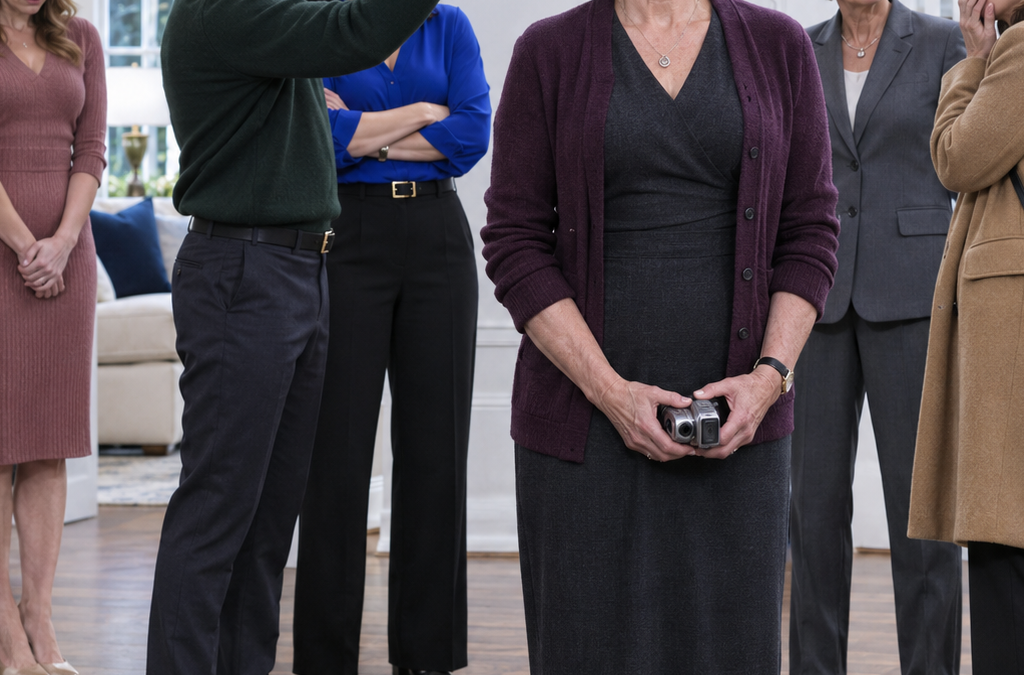
When they arrived, I had been holding my husband’s camcorder. I had taken it from the cabinet containing things I couldn’t yet sort. I hadn’t even decided whether to keep holding it when Mark waved the strangers through.
“Take that upstairs.”
He looked at the camcorder, then toward the hallway. His voice was the same one he used when telling a delivery driver where to park.
That camera had filmed our first tour of the house. Beth had been eighteen, walking behind her father while he pointed out rooms we hadn’t finished painting. She kept some of his old family recordings at her home now.
I felt small standing there with it. I hated that feeling, especially in a house where I had never needed permission to stand.
Mark stepped farther into the living room.
“You can wait upstairs while they look.”
Jessica moved beside him, making the hallway seem narrower.
“You don’t need all this space.”
She said a smaller rental would be easier for me. Less cleaning. Fewer stairs. She had already decided that losing my husband meant losing the right to choose where I lived.
I was angry with myself for almost agreeing about the stairs.
Our family usually spent Thanksgiving arguing over whether “pecan” had one acceptable pronunciation. My husband always changed sides halfway through, just to keep it going. This year, nobody had asked what I wanted for dinner.
“Just let them look,” Jessica said.
One of the visitors glanced toward the agent. Mark turned to them with a different voice, pleasant and brisk.
“This is my inheritance. We’re getting things moving.”
I looked at my son. He was forty-one, old enough to know what that sounded like.
“Mark—”
“We’re not doing this now.”
Beth’s eyes came up. For a second, I thought she would speak.
I felt ashamed of being ashamed. I hadn’t done anything wrong, yet I wanted the strangers to stop looking at me.
The agent hadn’t moved farther into the house. Earlier, Mark had sent me her number, saying someone might come by to discuss what the place was worth. I had said I wasn’t ready. He had brought buyers anyway.
I didn’t explain my marriage to them. I didn’t list payments.
“I’m not selling.”
I used my phone to call the number Mark had sent. The agent’s phone rang within hearing distance.
“This is the owner,” I said. “I don’t give permission for this showing. Please leave.”
The agent ended the call and faced the visitors.
“We need to leave. There won’t be a showing today.”
Mark moved toward the entrance before anyone could pass him.
The buyer stepped backward; Mark grabbed the doorframe.
“Wait. She’s grieving.”
He said it to the agent, with a strained little laugh. He hadn’t looked at me.
“This is temporary. We buried Dad last week. She gets confused about what we’ve agreed.”
We had agreed to nothing. Hearing him turn my grief into confusion frightened me more than his first command.
The agent stayed beside the visitors.
“I’m not continuing without her permission.”
She didn’t tell him whose house it was. She didn’t need to. She had asked whether she could show it, and I had answered.
Jessica tried to move the visit along anyway.
“The kitchen’s right through here. You haven’t seen the back.”
Neither visitor followed her. They waited for Mark to get out of the way.
“Mom, tell them they can look,” he said.
I said nothing at all.
His face reddened. Jessica looked at Beth, expecting help, but my daughter remained beside the living-room doorway.
The agent repeated that they were leaving. Mark finally stepped aside, and the visitors went out with her. He watched them go as though I had cost him money already sitting in his account.
Then he turned on me.
“You could’ve handled that privately.”
I was furious now, though my voice stayed low.
“You brought them here.”
He said he had tried to make this easy. Selling would have settled everything. I could have moved somewhere manageable, and the family could have stopped worrying about me.
Jessica stood close behind him.
“Now we have to do it the hard way.”
Mark brought up something newly prepared on his phone. He said there was another way to get what Dad was owed, whether I sold the house or kept it.
He stepped close enough that I could read the amount.
Mark turned his phone toward me: “Pay Dad back. $96,000.”
For a moment, I heard only the furnace running.
“Back for what?”
“The money he put into this place.”
Jessica answered before I could.
“You don’t get to keep everybody’s money.”
Mark said the demand was going into his father’s estate business. His father had named him to handle things, and he intended to collect. He spoke as though being named meant he could start giving orders immediately.
I looked toward Beth. She seemed miserable, but she didn’t challenge him.
That hurt almost as much as the demand.
I went upstairs, still carrying the camcorder. In my bedroom, I put it away and retrieved the purchase file I had kept since buying the house. The recorded deed was there with the old purchase records.
I didn’t take it downstairs to give Mark a lesson. I brought it because I suddenly wanted the things I knew within reach.
Mark was waiting at the bottom.
“You found what you need?”
“I found my records.”
“Then you know.”
I didn’t explain the file. My first impulse was still the old one: find out how bad their problem was, work out what I could spare, make the day bearable again.
I hated how quickly that impulse came back.
“I’m not promising you any money,” I said.
Jessica’s expression changed. She looked at Mark, then at me.
“This can’t drag on. Our lender needs $28,400 to keep the mortgage workout.”
“Transfer it to us,” Mark said. “Today.”
Chapter 2 of 7
“No. I’m not transferring $28,400.”
Mark looked past me toward Beth, as if I had stopped being useful.
“Talk to her. She’ll listen to you.”
My daughter didn’t answer. He kept looking at her.
“We’ve already lost Dad. We don’t need another family losing its home.”
He was trying to turn his mortgage shortage into money I supposedly owed Robert. If I paid to spare them trouble, he could call it repayment. I understood that much, even while part of me wanted to ask how close they were to losing the house.
I didn’t ask.
They left without my money that Thanksgiving. Two weeks later, the demand was still hanging over every conversation.
By Friday’s lunch, Jessica had decided Beth could settle it.
She had brought sandwiches to my house. I made tomato soup because Beth still liked dipping grilled cheese into it. When she was little, she had insisted triangles tasted different from rectangles. I nearly cut her sandwich that way before remembering why everyone was there.
Mark hadn’t taken off his jacket.
“Let’s get this handled.”
I had agreed to lunch because Beth asked. I regretted it before anybody ate.
Jessica turned toward her.
“Tell her what Dad wanted.”
Beth stared at her soup.
“He wanted us to get along.”
“He wanted things fair,” Mark said.
I felt lonely sitting with all three of them. Robert’s place at the table was empty, and they were using him to fill every gap in their argument.
“My house isn’t up for a family vote,” I said.
“Nobody’s voting,” Jessica said. “We’re asking you to stop making this harder.”
Beth finally looked at me.
“Could a smaller payment settle it? Just enough that everybody could—”
She stopped. I knew what she meant. Everybody could stop calling her. Everybody could have lunch without this.
“Settle what, Beth?”
“I don’t know. I’m asking.”
That answer hurt, though it was more honest than anything Mark had said.
He leaned toward her.
“It’s family money. Dad didn’t work all those years for nothing.”
I told them I had an appointment with my own lawyer. Mark said I was wasting money. Jessica asked whether a stranger’s advice mattered more than my children’s.
Beth said she needed to get back to work. Lunch ended with most of the sandwiches still there.
Dana Brooks had an office in Columbus with a waiting room warm enough to make me sleepy. I had been sleeping badly, then feeling guilty whenever I wanted sleep during daylight.
She was fifty-two, direct, and willing to let me finish a sentence.
She had checked the county record before our meeting.
“The deed names Elaine Parker alone,” she said. “It has since you bought the house. Mark cannot sell it for you.”
I had expected relief to feel better. Instead, I felt foolish for needing someone else to confirm what I already knew.
“Then his demand goes away?”
“No. Ownership and a separate debt are different questions.”
She explained that someone could own a house and still owe money used to buy it. Mark would have to support his claim that Robert had lent me money. The deed alone wouldn’t answer that claim.
“So I can keep them from selling it, but I still have to answer him.”
“Yes.”
I was tired of answering my son. I had spent years answering whether he needed help, whether he could wait until payday, whether I minded covering one more bill.
Now he wanted an answer to an accusation.
Mark had received his court papers the day before. Dana called them letters testamentary: they allowed him to handle Robert’s estate.
Robert had left $132,400 in a checking account in his name alone. Mark now controlled that account for the estate. Hearing the amount spoken aloud made me miss Robert in a plain, painful way. We had discussed that money while he was sick, usually when neither of us could bear discussing his illness anymore.
“Can I have Mark replaced?” I asked.
“Being cruel to you isn’t enough. I need facts about how he handles the estate.”
Dana explained the will’s shares briefly. I would receive half of what remained after the estate’s bills and expenses; Mark and Beth would each receive a quarter.
I couldn’t order my portion paid immediately, either.
It upset me that he could be so wrong at my kitchen table and still have a job the court allowed him to do.
I had brought a short family-video copy on my phone. It showed Robert walking through the house after we bought it.
“Elaine’s house,” he said, with an exaggerated sweep toward the living room. “I’m allowed to live here if I behave.”
I laughed once, then cried before the clip ended. He looked healthy. I hadn’t prepared myself for that.
Dana waited.
The copy stopped after a view down the hallway. There was no ending, just the abrupt stop familiar from old family clips. It wasn’t the whole afternoon’s filming, and I didn’t know what else had been recorded.
“It shows how he spoke about the house,” Dana said. “We’ll keep it with your records. It doesn’t settle whether there was a loan.”
Before I left, she asked me to send everything Mark put in writing.
His written position arrived that evening. He no longer asked me to agree to a sale. He wanted payment to Robert’s estate, claiming Robert had advanced purchase money that I had promised to repay when the house sold.
I forwarded it to Dana without answering him.
Attached was a transfer record bearing Robert’s name. Mark identified the alleged debt as $96,000.
Chapter 3 of 7
The transfer record started halfway through the story.
The money had passed through our household account after I sold my alterations business. Robert’s name was on that account, too. Mark’s attachment showed money leaving it, but nothing about where the money came from.
I knew where to find that part. Dana needed the matching bank records, not just my memory.
By the following Friday, Mark had sent his version to the family.
Beth forwarded it while I was eating breakfast. Above the attachment, he had written that Dad had expected to recover his contribution when the house sold. Now, he said, I was keeping money that belonged to everyone.
Jessica had added her own message.
“She knows what we’re facing. She’s making it worse.”
I felt humiliated reading it in my kitchen. They had turned a private accusation into something other people would discuss without me.
Beth called before I finished reading.
“Did you see what I sent?”
“Yes.”
“I didn’t know he was sending it around.”
“Did you tell him it was true?”
“No. Mom, no. I just—there’s something I should tell you.”
She had given Mark the short home-tour copy before Thanksgiving. He had asked whether she had anything from when we bought the house. She thought he wanted to see their father.
“I sent you the same one afterward,” she said. “I wasn’t hiding it.”
“I didn’t say you were.”
“You sound like you think I was.”
I was hurt, and I couldn’t make my voice sound otherwise. Robert had been dead only weeks. Even a video of him had become something we had to explain.
Beth said Mark had started a group conversation. She wanted me to join it and tell everyone where the money came from.
“Maybe if they heard it from you.”
“They could have asked me.”
“I know, but now it’s—”
“I’m not going to keep explaining myself in a conversation where I’m already guilty.”
She went quiet. I heard ordinary office noise behind her and remembered she was at work, trying to fit us between other people’s needs.
“I have to go,” she said.
Afterward, I forwarded everything to Dana.
Mark called that afternoon. He didn’t ask whether I had seen the messages.
“I have a job to do.”
“Then do it.”
“An executor has to collect what the estate is owed. You don’t get to stop that because you’re upset.”
I wanted to tell him how carefully I had kept those shop records. Instead, I asked for the estate account records.
“What went in, what went out,” I said. “Send them to Dana.”
“You think I’m hiding money?”
“I asked for the records.”
He told me his lawyer would handle it. That was the first useful thing he said.
I spent the rest of the afternoon trying to finish ordinary chores. Robert had always put the spare pillowcases inside the matching fitted sheet. I could never get them out without unfolding everything. That day, I laughed at the heap on the bed, then felt miserable because there was nobody to blame for it anymore.
Beth was supposed to come over that evening.
She sent a message saying she needed to postpone.
No new day. No suggestion that we talk over the weekend.
I typed that I had already started dinner, then erased it. I didn’t want her coming because she felt cornered, but I wanted her there badly.
The statement arrived through the lawyers before I ate. Dana called it a partial response. It showed the estate account and a recent $6,000 payment described as “house preservation.”
Beside it was the mortgage-servicer name.
I recognized the mortgage company immediately. I had seen that name when helping Mark make payments on his house.
For several seconds, I kept reading the same line.
Robert’s money was actually gone from the account. While Mark demanded $96,000 from me, he had sent $6,000 somewhere under a description that explained almost nothing.
I called Dana.
“That’s their mortgage company.”
“Have you seen an account number?”
“Not here. But I’ve paid them before.”
“That helps. It doesn’t tell us which loan received this payment.”
“Robert didn’t have a house loan.”
“I understand. I’m requesting the recipient detail.”
I wanted her to sound as angry as I felt. Instead, she stayed with what we could prove. I was grateful for that later. At the time, I hated waiting.
“What do I do with this?” I asked.
“Keep it. Don’t accuse him in the family messages. Let me get the destination.”
After we hung up, I ate alone. Beth’s portion went into the refrigerator beside mine.
I hadn’t lost my daughter altogether. I knew that. Still, her postponed visit felt like a loss I could count, right there with the empty place.
Mark sent another notice that evening. He intended to continue collecting the alleged debt for the estate. Any dispute, he wrote, should go through the lawyers.
I sent it to Dana. Beneath it, I wrote that I wanted the demand challenged, and I wanted answers about the payment.
I didn’t call Mark to ask whether this was another emergency. That was what I would have done before.
Dana sent the recipient detail once it came through. She asked me to check the names against what I remembered.
Both names were there, along with the loan identification.
The $6,000 estate payment had gone to Mark and Jessica’s mortgage.
Chapter 4 of 7
“His mortgage,” I told Dana. “I want him removed.”
I had the recipient detail open in front of me. Mark had used $6,000 of Robert’s money to pay his own lender, then kept demanding money from me.
Dana didn’t ask whether I was sure.
“We’ll file the petition and challenge the claimed debt,” she said. “Those are separate requests.”
I felt guilty almost immediately. I hated that I could still feel guilty for protecting myself from something my son had done.
By the time we met at her office after the holidays, both requests were before the court. Dana had arranged the meeting so we could review the records with Mark and his lawyer.
Colin Reed came in with Mark. Jessica wasn’t with them.
Mark looked at me before he sat down.
“You really filed to throw me out?”
“I asked the court to replace you.”
“Same thing.”
Colin introduced himself to me politely. Then he turned to Dana and asked whether the bank’s matching records had arrived.
“They’re included,” she said. “Along with the lender’s payment history.”
Copies of the complete purchase file were already in front of him. Mark had his own set. I had spent years keeping those records because that was what I did with paid bills. I never expected to need them across a table from my son.
Colin read without speaking. Mark skipped ahead, then went back when his lawyer pointed out the deposit from the sale of my shop.
“That’s the whole amount?” Mark asked.
“The sale proceeds were $96,000,” I said. “That was my down payment.”
“It went through their joint account,” he told Colin.
I was sitting directly across from him. Being called “their” made me feel as though I had already been dismissed from the conversation.
Colin kept reading.
“The deposit matches the business-sale record. The outgoing transfer matches the purchase.”
Mark looked at the next page. The house had cost $214,000. My mortgage had covered the remaining $118,000.
He had known we lived there. He had never known what buying it had required.
“The deed names your mother alone,” Colin said. “The loan was hers, too.”
I watched Mark reach the payment history. Twenty years of payments were there, followed by the payoff before Robert died.
“Dad had an income,” he said.
“Yes,” I answered. “And I had one.”
I had owned a business. I had worked evenings when customers needed dresses by Saturday. Even after selling the shop, I had sewn privately until Robert needed more care.
I was angry that my work still seemed harder for Mark to believe than his own assumption.
Colin asked whether he disputed the source of the down payment.
Mark didn’t answer right away.
“I’m saying Dad talked about getting it back.”
Dana looked at him.
“Getting what back?”
“The contribution. Whatever they called it between themselves.”
He no longer said he could sell the house. Now he said the household account mattered, that Robert might have considered money in it his to advance.
I knew how quickly I could be pulled into arguing about every year of my marriage. I had already spent too many nights rehearsing answers to claims Mark hadn’t made yet.
“I’m not bargaining over a promise I never made,” I said.
“Then let the judge hear it.”
“That’s what we’re doing.”
Colin spoke before Mark could continue.
“I’ll need whatever supports the repayment agreement.”
For the first time that morning, Mark looked uncertain. It passed quickly.
“Beth heard Dad talk about the house.”
He said it casually. I noticed, but he moved straight to the removal request.
“You’re trying to take my job away over one payment.”
After they left, I asked Dana whether the purchase records were enough.
“They establish where the money came from,” she said. “We still have to answer his claim about a spoken agreement.”
“And the mortgage payment?”
“The court can remove an executor for using estate money for himself. We have the transfer and the destination. That’s what the petition rests on.”
She hadn’t built it around Thanksgiving, or Jessica’s remarks, or how frightened I had felt in my hallway. I understood why. Those things had hurt me, but the payment showed what Mark had done with authority he actually held.
When I got home, I made a baked potato for dinner. Robert and I had always split one because he insisted the oversized ones at our grocery store were “sold by the acreage.”
I ate the whole thing. Then I cried because I had almost called to tell him about the meeting.
The hearing notice arrived through Dana: Friday, January 22, at 9:30 a.m., Franklin County Probate Court, Columbus.
I read the appointment twice. Dana and I would be there, along with Mark and Colin. Jessica planned to come, and Beth had been told to attend. I dreaded seeing us all gathered where we couldn’t simply leave when the conversation became painful.
Mark’s message came afterward.
“Pay the $28,400 and I’ll drop the loan claim. Otherwise we go ahead.”
There it was again: his mortgage amount offered as the price of peace.
I forwarded it to Dana. I didn’t ask him whether Jessica agreed or whether the lender might give them longer. I wanted to ask both questions. That was the part I still had to fight.
Beth called that evening.
“Mark’s lawyer called me.”
“Colin?”
“He asked what I remembered Dad saying when we first walked through the house.”
I felt uneasy hearing how carefully she spoke.
“What did Mark tell him?”
“That I was there. That I heard the money conversation.”
She paused.
“Mom, Mark gave him my name as someone who heard Dad explain the purchase money.”
Chapter 5 of 7
“I told him I wasn’t sure,” Beth said. “That’s all I told him.”
She remembered Robert discussing money during the home tour. She couldn’t remember enough to support Mark’s claim that it was a loan.
“Then why does he think you can?”
“Because I didn’t tell him he was wrong.”
She sounded embarrassed. I knew how easily my son could turn an unanswered question into permission.
“I’m going to look through the recordings Dad left at my house,” she said. “I should’ve done that already.”
I wanted to ask why she had waited. Instead, I told her we could talk outside Dana’s office before my appointment the next afternoon.
By then, the hearing was the following morning.
Beth waited near the entrance, wearing her work coat. She looked tired, and I nearly asked whether she had eaten. Mothering her was easier than telling her how much she had hurt me.
We stood under the overhang, out of the wind.
“What am I supposed to say tomorrow?” she asked.
“Tell the truth.”
“I know that.”
“If you don’t remember, say you don’t remember. I’m not going to give you words.”
She looked toward the parking lot.
“Mark says I’m changing sides.”
I felt angry hearing it. She wasn’t choosing which child got the larger piece of cake. She was being asked what her father had said.
“You don’t need his permission to answer a question.”
“He says Jessica’s barely sleeping.”
“Neither am I.”
That came out sharper than I intended. Beth looked back at me, and I let it stand.
She said Mark had told her they could still have family dinners. Jessica wouldn’t hold a grudge if Beth stayed with what she had “already told” him.
“What did you already tell him?”
“That Dad talked about the money. That’s it.”
I had spent years trying to make their disagreements smaller. Now I wanted my daughter to hear how large this one had become.
“I won’t tell you what to testify,” I said. “But I won’t pay him so nobody gets upset.”
Dana opened the office door before Beth could answer. My daughter said she needed to get home and continue looking.
Inside, Dana said the deed, purchase records, payment history, accounting, and short video copy had all been exchanged. There wasn’t another stack for me to assemble that afternoon.
I was relieved. I wanted an hour when I wasn’t searching for proof of my own life.
Colin called while I was there. Dana put him on speaker with my permission. Mark was with him.
Colin asked about tomorrow’s arrangements. Mark waited until that was settled, then spoke in a voice I hardly recognized.
“I appreciate everyone making time. I’m trying to be careful here. Dad trusted me to handle this correctly.”
Dana answered that the court would address both requests.
“Of course,” Mark said. “I understand.”
Then he asked to speak with me. I agreed, though Dana stayed beside me.
“Keep her out of this.”
“Beth?”
“She’s upset enough.”
“You gave Colin her name.”
“She knows what Dad said. She doesn’t need you working on her.”
I felt sick with anger. Minutes earlier, Beth had been asking me what she was allowed to remember.
“I told her to answer honestly.”
“Then stop calling her.”
The conversation ended without anything settled. I was grateful Dana had heard him, though I hated needing a witness to my son’s voice.
At home, I made scrambled eggs for supper. Robert always put ketchup on his, then called it a vegetable serving. I almost reached for the bottle before remembering that I didn’t like ketchup on eggs.
I ate without it.
Beth called while I was washing up.
“I’m still going through the batch Dad left here.”
“The family recordings?”
“Yes. There’s something Dana needs to see.”
Her voice sounded different, but I couldn’t tell whether she was relieved or frightened.
“Call her now,” I said.
“I will. Mom, I need to finish checking this.”
I didn’t ask her to tell me what she had found. I wanted to know badly, but I was afraid of making her feel she had to bring me an answer I wanted.
Before hanging up, she told me Mark had called with Jessica beside him.
“He kept saying the $96,000 was a loan,” she said. “Jessica said you knew what would happen to their house.”
“What did you say?”
“That I couldn’t say that from memory.”
Beth sounded close to tears. I was proud of her for answering, and still hurt that it had taken this much.
Later, Mark called me with another offer.
“We can settle privately. No hearing over the money.”
“What are you asking me to sign?”
“An agreement. You pay the $28,400 now. We work out the rest.”
I sat at my kitchen table. He was still offering me a larger debt in exchange for paying his immediate bill.
“No.”
“You’d rather do this to Beth?”
“I’m not asking Beth to pay anything.”
“You know what I mean.”
I did know. He wanted me to feel cruel enough to become useful again.
“I won’t make a private payment agreement.”
He hung up before I finished telling him to contact Dana.
Her email arrived afterward, forwarding Colin’s updated communication. I opened it expecting another request about where to meet or what to bring.
Instead, I found my daughter’s full name.
Beth Miller was listed as Mark’s proposed witness to confirm Robert’s alleged loan.
Chapter 6 of 7
“Say it here,” I told Mark.
He had called me obstructive outside the courtroom. Now Beth and Jessica sat behind us, close enough to hear.
Judge Foster looked toward him.
“Mr. Grant, what is the basis of your demand?”
“A loan from my father. Ask my sister.”
Beth rose when the judge addressed her.
“I can’t confirm a loan. I told him I wasn’t sure. Last night I found the complete home-tour disc.”
Dana explained that she had supplied Colin with the recording that morning. The original was available; the playback copy came directly from it.
Judge Foster allowed time for inspection before deciding whether we could play it.
When we returned, Colin said he had reviewed the recording and underlying records.
“We’re prepared to proceed.”
I felt frightened despite everything we had brought. Mark still looked certain someone would make me pay.
Once we were sworn, he described the household-account transfer. He said Robert had discussed recovering the money later.
“The estate is owed $96,000,” he said. “The house is hers. That doesn’t cancel a debt.”
Jessica nodded behind him. Beth watched the judge.
When it was my turn, I identified the matching deposit and outgoing transfer.
“That money came from selling my shop,” I said. “It wasn’t Robert’s savings.”
Mark waited until the judge let him respond.
“Fine. But she could still have promised to repay him. That little video proves nothing about a loan.”
I had brought the camcorder at Dana’s request, along with the original disc Beth had delivered. Seeing it beside our records hurt. Robert used to film whole birthday dinners before remembering nobody wanted footage of chewing.
“I brought the camera Beth used,” I said. “May we play the complete recording?”
Dana handled the questions about the copy. Then Beth identified the original disc and explained that Robert had left a batch of family recordings at her home.
“I filmed this when I was eighteen,” she said. “I kept recording after the part in the short copy. I remember this conversation now that I’ve watched it.”
Colin asked whether she had changed anything.
“No. I found it among the discs. That’s all.”
Judge Foster permitted playback.
Robert appeared in our unfinished living room, healthy enough to complain about painting the ceiling. I heard my younger laugh before I saw myself.
Then my recorded voice mentioned the down payment.
Robert answered, “Your $96,000 from selling the shop. You finally bought somewhere with enough windows.”
I remembered choosing those windows. For years, I had sewn under fluorescent lights.
On the recording, I joked that he was making it sound as though I had bought him a retirement present.
“I didn’t lend you that money,” Robert said. “It was yours.”
“And I’m not paying you back for my own money,” my recorded voice answered.
“No loan, no payments to me. Just let me have the garage.”
Beth laughed behind the camera. The picture continued down the hallway.
I was crying by then. Hearing him settle an ordinary household joke hurt more than I had expected.
Judge Foster asked Beth whether she had been present throughout that conversation.
“Yes. That was me laughing.”
“Did you hear your mother promise repayment?”
“No.”
The judge turned to Mark.
“Can you identify separate funds your father supplied, or a separate repayment promise?”
“He talked about what he put into the family.”
“Can you identify either?”
“No separate transfer. No.”
Judge Foster looked at the purchase records again.
“The documented source was Mrs. Parker’s business sale. The recording and testimony corroborate that evidence. The estate’s $96,000 claim is rejected.”
Mark started to speak, but Colin stopped him.
The judge moved to the mortgage payment.
“It was a temporary advance,” Mark said. “Against my eventual share. I wasn’t taking more than I’d inherit.”
“An expected inheritance did not authorize you to pay your personal mortgage with estate funds.”
He looked toward Jessica.
Judge Foster continued.
“The accounting identifies the payment and its destination. I’m granting the removal petition. Your control of $126,400 ends today. You must turn over the estate funds and records to the replacement administrator and provide a complete accounting.”
Mark rose so abruptly his chair struck the bench behind him. Jessica reached for him.
“Sit down,” Colin said.
“My lender’s deadline is Monday.”
“That does not change this ruling,” Judge Foster said.
I felt relief, but it came with a terrible sadness. My son was standing before a judge, still talking about his mortgage.
After we were excused, Beth crossed to the empty seat beside me. She sat without asking Mark anything.
He watched her do it.
“Seriously? You couldn’t have talked to me first?”
“I tried,” she said. “You kept telling me what I remembered.”
Jessica leaned toward her.
“We have enough going on.”
Beth stayed beside me. I had wanted her there for weeks, and I couldn’t speak yet.
Mark lowered his voice as the judge left.
“Mom. Five minutes. Without everybody.”
“No private payment agreement.”
“I’m asking to talk.”
Dana remained nearby. Colin was telling him they needed to discuss turnover of the account.
Mark ignored him.
“Who’s paying my lender now?”
I was ashamed of the old answer that nearly came: I could move money, cover the shortage, get everyone home.
“You don’t get to spend my grief,” I said.
Jessica stared at me. Mark asked whether I understood what could happen to their house.
“I won’t fund the mortgage rescue.”
Beth left beside me. I didn’t stop in the hallway when Mark called again.
Before we reached the exit, my phone lit up with his message.
“Send me the $28,400 for the lender. I still need it.”
Chapter 7 of 7
“No. I won’t send the money.”
I answered Mark before Beth and I reached the parking lot. He called twice while she drove me home. I let both calls go.
The lender’s deadline passed without my money. There was no reversal from the court, no relative stepping in with a check. Mark and Jessica had to work with their lender themselves.
I felt guilty that evening. I also slept through most of the night, which hadn’t happened in weeks.
The replacement administrator obtained the estate account and the complete accounting. Dana kept me informed, but there was less for me to do. I stopped checking my phone whenever it made a sound.
After a later order requiring repayment, the administrator confirmed on March 5 that Mark had returned the $6,000.
I read the confirmation at my kitchen table.
“All of it?” I asked Dana.
“All of it.”
“Then what happens?”
“We finish the administration. Bills, expenses, then distribution.”
Mark’s lawful share hadn’t been taken away. Neither had Beth’s. Mine wasn’t available for immediate withdrawal, either. There was still work to finish, but Mark no longer controlled it.
I felt relieved knowing the money was back. I didn’t call him to ask what returning it had cost him.
Beth began visiting on Sundays when she could. At first, she asked whether I needed anything picked up.
“Just come,” I told her. “You don’t have to bring groceries.”
Her first visit lasted less than an hour. We talked about her work and a leak under my bathroom sink. Neither of us mentioned the hearing until she was leaving.
“Mom, I’m sorry.”
I waited.
“For standing there when Mark brought those people in. I saw what he was doing. I should’ve said something.”
“Yes,” I said. “You should have.”
She looked hurt, and I nearly softened it for her. Then she nodded.
“I know.”
The next time, we walked around the neighborhood. I had been taking the shorter route since Robert’s illness, mostly from habit. That afternoon, I wanted to go farther.
Beth kept pace beside me.
“I’m sorry about the short video, too,” she said. “I passed it to Mark without asking what he wanted it for.”
“You thought he wanted to see Dad.”
“I did. But once I knew what he was saying, I should’ve spoken up.”
It hurt hearing how clearly she understood it now. I had needed her to understand while I was standing in that doorway.
“I’m glad you told the truth,” I said. “I’m still hurt.”
“I’m not asking you to be done with that.”
We kept walking. She didn’t ask me to comfort her, and I was grateful.
Some visits were awkward. Some were ordinary enough that I forgot to measure them. We went to the grocery store together once and disagreed over which checkout line would move faster. She won by one customer and mentioned it all the way home.
I began looking forward to seeing her again.
About five months after the hearing, Mark and Jessica arranged to sell their house. It was their decision, made after trying to manage the mortgage problem. The probate judge hadn’t ordered their home sold.
Before the closing, Mark called me.
“We found a rental. We need $2,800 for the deposit.”
I was in my living room, reading. I stayed in my chair.
“The closing money isn’t available yet,” he added. “This would just cover the gap.”
“No. I won’t pay your new deposit.”
“Mom, we’re selling the house. What else do you want?”
“I’m not asking you to sell anything.”
“You know what I mean.”
I did. He wanted the conversation to end with an amount I could afford.
I felt sad hearing him ask again. I had hoped he might call once without needing money.
“You’ll have to arrange the deposit yourselves,” I said.
There was a pause.
“Jessica and I can come explain it.”
“Visits need an invitation, Mark. Don’t come over to ask me for money.”
“So we’re not welcome now?”
“That’s not what I said.”
He ended the call soon afterward. I finished the page I had been reading, then went back because I hadn’t understood a word.
The sale eventually left them $18,700 after their mortgage payoff and sale costs. The closing statement made that plain. It wasn’t enough to restore the life they had expected, but it was theirs to manage.
I didn’t know every compromise they made. For once, I didn’t ask.
Mark and I still spoke occasionally. Some calls were short. I didn’t demand an apology before answering, but I didn’t offer money to keep him talking. Jessica hadn’t apologized. I stopped rehearsing what I would say if she ever did.
Seven months after the hearing, Beth came for supper.
I chose meatloaf, baked beans, and sliced tomatoes because that was what I wanted. I used crushed saltines in the meatloaf, the way I always had. Robert used to claim the end piece before it came out of the oven.
Beth arrived early and found me in the living room.
“Do you want me to get things started?”
“No. Sit with me a minute.”
She sat across from me. I didn’t get up to make myself useful. We talked until I was ready to check dinner.
At the table, Beth told me about a lost lunch bag at school. The office had spent half a day looking for its owner before discovering it belonged to a teacher.
I laughed with my mouth full. She laughed harder because I couldn’t answer her.
I missed Robert. I wanted him there, reaching for the end piece. That sadness stayed with me, but it didn’t take away the pleasure of feeding my daughter.
After supper, I brought out the camcorder.
“Are you filming me eating?” Beth asked.
“Only a little.”
“Dad never stopped at a little.”
“I can learn.”
I lifted the camcorder toward the ordinary table, with Beth still laughing beside her unfinished plate.
Love did not require another rescue.
I pressed Record.







