After heart surgery, I found my daughter-in-law changing my house locks; she didn’t know what I had kept.
Chapter 1 of 7
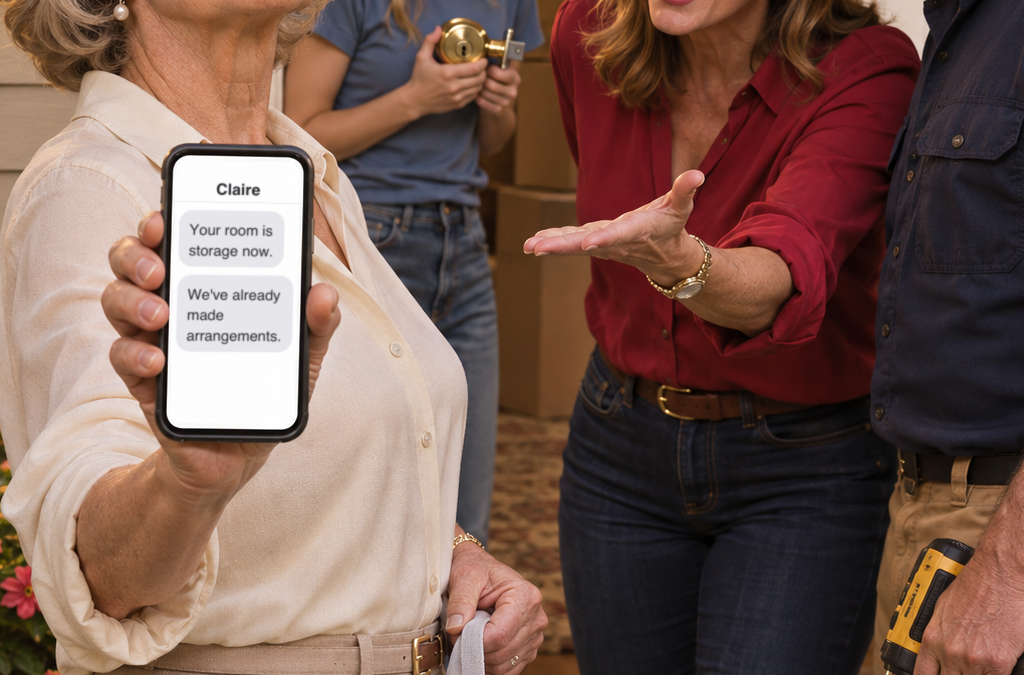
It was 10:20 Friday morning. I stood on the porch with my discharge bag against my sore chest. My late husband’s worn armchair sat beside the railing, its cushion exposed to the sun.
A locksmith knelt at the open door. Emma stood behind him, holding the discarded lock.
Claire looked at my bag.
“Your room is storage now; we’ve already made arrangements.”
“What arrangements?”
“Please step back from the work area, honey. He needs room.”
I was seventy. Getting up those steps had taken most of what I had.
Behind Claire, cardboard boxes filled the hallway. One had my bedroom lamp sticking out, its shade tilted against the wall.
“Why is my lamp in there?”
“We needed somewhere to put things. You weren’t supposed to come straight here.”
“My discharge was this morning.”
“Yes. Discharge doesn’t mean you’re ready to manage a household.”
For three years, my son, his wife, and their daughter had lived here without paying rent.
Now Claire stood between me and my front door, speaking as though I had arrived early for an appointment.
The locksmith glanced up.
“Ma’am, are you coming through?”
“She’s just getting home from the hospital,” Claire said. “We have a family plan.”
“I’m coming inside.”
“Could you wait by the car? Just until we get this sorted.”
There was no shade by the driveway. Sweat had already dampened the collar of my blouse.
I started reaching into my purse for my wallet.
“How much do I owe you?” I asked him.
The words came out before I caught them. I stopped with my fingers against the zipper.
Claire had hired him. Claire had put my lamp in a box.
“I didn’t order this,” I said.
“No one’s asking you to pay for the lock, honey.”
“What are you asking me to pay for?”
She glanced toward Emma.
“The apartment. Just a recovery place. Quiet, no stairs, nobody coming through while you’re resting.”
“Whose apartment?”
“There’s one available. We checked.”
“And I’m supposed to go there now?”
“We can get you settled today.”
Emma stared at the brass lock in her hands. There was a black smudge across one thumb.
“Did you know about this?” I asked her.
“She helped me clear things,” Claire said.
“I asked Emma.”
My granddaughter’s lips parted. Then she looked at her mother.
“She doesn’t need to be in the middle,” Claire said. “She’s been worried enough.”
The locksmith remained on one knee. His drill hung loose beside his leg.
“Is somebody expecting another resident here?” he asked.
“We all live here,” Claire said. “This isn’t a stranger situation.”
“Then let me through,” I said.
“You need a proper place to recover. We can’t make everything revolve around your medical schedule.”
A delivery truck passed behind me. Somewhere down the street, a mower started. My own front door stayed blocked.
“Being family didn’t make me a guest.”
Claire’s voice softened.
“Nobody said guest. You’re hearing things in the hardest possible way.”
“I’m hearing apartment.”
“A temporary one.”
“And my room?”
She looked past me toward the driveway.
“Let your son get here. He can explain the household arrangement without everybody getting upset.”
“He isn’t the person standing outside.”
“He has a say in how his family lives.”
“So do I.”
She pressed her lips together, then turned toward the locksmith.
“Can you finish what you’re doing? We’ll handle the family discussion.”
I had paid for peace until everyone expected me to disappear for it.
“Please don’t finish yet,” I told him.
He stayed where he was.
Claire looked at my discharge bag again. “You shouldn’t be doing this on your first day home.”
“Then move.”
“I’m trying to keep you from overdoing it.”
Emma shifted toward the doorway. Her mother said her name, quietly, and she stopped.
“Before surgery, I had saved one thing where I could reach it.”
I found the image on my phone and held it where only the locksmith could see. Claire stepped closer, but his shoulder blocked her view.
“What are you showing him?”
The locksmith read my screen twice. Then he lowered the drill.
“Who told you she couldn’t come inside?”
Claire’s eyes moved from him to me.
“I told you we were changing the locks. I didn’t ask you to settle anything between us.”
“Does she live here?”
“Yes,” I said.
“She’s been away recovering,” Claire said.
“I live here,” I repeated.
He asked for identification. I showed him that too.
On my screen was a saved image of the recorded deed. Nora Bennett was the only name listed as owner; the house belonged to me alone.
Claire knew that. She had never needed my phone to tell her whose house it was.
The locksmith stood, slowly enough that I could read his shirt: Joe Reed.
“I can finish installing working hardware,” he said. “I won’t help keep an owner who lives here outside.”
“Fine,” Claire said. “Give her a key. We’ll discuss the rest when my husband gets home.”
By approximately eleven, Joe had handed me a working key with Claire’s agreement. I went inside, but the boxes remained, and so did everyone who had put them there.
I spent the next hours at the kitchen table. My bedroom doorway was packed with plastic bins.
At two, my son’s truck pulled into the driveway. The garage door was open, exposing the headboard and bed rails stacked behind the lawn mower.
My son stopped halfway up the steps.
“Claire, why is Mom’s bed in the garage?”
“It wouldn’t fit with the storage,” she said.
Adam looked through the doorway at me.
“Mom? I thought you were going to the recovery place.”
“Who told you I agreed?”
“I thought—Claire said you needed somewhere quieter.”
“She needed the option,” Claire said. “Nobody was trying to upset her.”
“My bed is taken apart,” I said.
Adam came into the kitchen. He still wore his warehouse shirt.
“Okay. We can fix that.”
“Today.”
“Mom, can we just get through this without upsetting Claire? She’s been handling everything.”
My discharge instructions lay beside an empty mug. I had asked for water; nobody had remembered it.
“She handled me right out of my room.”
“That’s not fair,” Claire said from the doorway. “You came home needing care. We tried to make a plan.”
“A plan I didn’t agree to.”
Adam sat across from me.
“What if we go look at the apartment first?”
“I’m not paying for an apartment.”
“It would only be until you’re stronger.”
“I’m staying here. Put my bed back together.”
He looked toward Claire before answering.
“I’ll get the tools.”
Claire went down the hall. Emma followed her, still without looking at me.
I went to the kitchen cabinet for a glass. Behind the folded towels, my household ledger remained where I had left it. The cabinet also held the chipped measuring cup Adam insisted was exactly one serving of cereal, though it held nearly half a box.
He was forty-five and still used it.
I drank my water standing there, listening to him move the bed rails.
Nobody left the house that afternoon. Claire spoke to Adam behind their bedroom door. Emma stayed in her room. I sat at the kitchen table, too tired to follow the progress down the hall.
At 4:18 p.m., my phone sounded.
Claire had posted a photograph to the family chat. Across the top were the words FAMILY OCCUPANCY AGREEMENT. Signatures were visible below.
Near the middle, I could read “permanent family home.”
Chapter 2 of 7
On Monday, August 17, Adam brought his phone to the breakfast table. Claire’s photograph showed the front of the family agreement we had signed in 2023.
My signature was genuine. So were theirs.
“You remember what we talked about, Mom. A stable place. Somewhere we could stop starting over.”
“I remember.”
“Then can you honor that? Because Claire thinks you’re backing out.”
“Stability never meant putting me out of my room.”
He glanced toward the hallway. Claire was close enough to hear without joining us.
“Nobody’s putting you out now,” he said.
I had slept in my reassembled bed for three nights. The lamp still sat on a box because nobody had found its table.
Claire came into the kitchen wearing her dental-office scrubs.
“Adam knows how much we’ve put into being here,” she said. “I need him to help us keep this fair.”
“He wasn’t here when I came home.”
“No. But he lives here, too. We’ve made decisions together.”
“About me.”
“About the household, Nora. There’s a difference.”
Adam’s phone stayed between us, the photograph still bright.
“We’ve been trying to save toward a place,” Claire said. “Twelve thousand was the goal. Paying rent somewhere would eat that up before we got close.”
I knew that arithmetic. For years, I had supplied the missing money.
“You can’t ask Adam to pretend none of that matters,” she added.
Adam looked at me. He waited as if I were supposed to make this easier for him.
“I have an appointment this morning,” I said.
“With who?”
“An attorney.”
He looked down at his phone.
Claire said, “Then please tell him about the agreement.”
“I will.”
By the time I reached the Montgomery County Clerk’s office in Conroe, Texas, my blouse had stuck to my back.
The walk from the parking area was longer than it had looked. Halfway there, I stopped beside a concrete planter and pretended to check my purse.
Ben Ortiz stopped with me.
“We have time,” he said.
“I’m looking for my identification.”
“You showed it to me at the office.”
I left my purse alone.
“I need a minute.”
“Okay.”
He didn’t offer a speech or tell me how well I was doing. When we started again, he matched my pace.
I had spent years walking invoices across a plumbing contractor’s yard. Now a curb made me check where my feet were going.
Inside, Ben found me a place to sit while his office’s request was completed. At 11:30 a.m., we received the certified copy of my deed.
The clerk checked the request and handed it over. My name stood alone where it had stood before.
I looked at the county certification, then at Ben.
“So what happens when they say they won’t go?”
“They’ve lived there long enough that we need notice and, if they stay, a court order. The deed establishes that you own it; it doesn’t let you throw them out today.”
I watched a woman at the next counter search through a grocery sack of papers.
“How long for the notice?”
“Thirty days to end the arrangement. We’ll take the next step after that, if we need to.”
“And I stay there with them.”
“Yes.”
“They’re going to be angry.”
“Probably.”
He said it without making anger sound like a reason to stop.
Back at his office, the engagement agreement listed a $1,500 initial retainer. I had spent more than that keeping other people from being uncomfortable.
This time the expense was mine to choose.
“Do you want to proceed?” Ben asked.
“Yes.”
He waited.
“I want them to move out,” I said. “Even if they won’t agree.”
I paid the retainer. Then I asked whether I had to eat dinner with them.
“No,” he said.
It was the first answer that day that almost made me laugh.
That afternoon, written thirty-day termination notices went to all three adult occupants. Ben’s office kept the delivery records and sent copies by certified mail.
I handed Adam his copy myself.
He was in the kitchen, reading the refrigerator’s magnetic grocery list. Someone had written “good mustard” beneath “mustard,” an argument our house had been having for years.
“What’s this?”
“Your notice.”
He read the first lines.
“You hired somebody to do this to us?”
“I hired somebody to help me do it correctly.”
“Emma got one?”
“She’s nineteen. She lives here.”
“She’s your granddaughter.”
“I know who she is.”
His face changed at that. I nearly apologized for my voice.
Instead, I waited while he finished reading.
“Thirty days,” he said. “You’re really giving us thirty days.”
“Yes.”
“Where are we supposed to go?”
“You and Claire will have to work that out.”
He left the grocery list unfinished.
At 6:12 p.m., Claire found me at the kitchen table. She had changed out of her scrubs but still wore her work shoes.
“Before this gets any further, you need to account for what we paid.”
“I haven’t said you paid nothing.”
“Adam keeps telling me we’ll work it out. Well, this was us working it out. We paid for the air-conditioning system because this was supposed to be our secure home.”
She put an HVAC invoice and its payment record in front of me.
“June 2024,” she said. “You remember how hot it was.”
I did.
“We wouldn’t have spent that if we thought we’d be packing up whenever things got difficult.”
The contractor’s name was familiar. So was the house address.
Across the paid invoice was the amount: $6,400.
Chapter 3 of 7
On Friday, August 21, I told Claire I remembered the air-conditioning bill.
“You paid it. I haven’t forgotten.”
She stood by the refrigerator, dressed for work.
“Then you know why getting that notice felt the way it did.”
“I know you spent real money. That didn’t give you my bedroom.”
“We weren’t buying your bedroom, Nora.”
“You took it anyway.”
She checked the clock above the stove.
“I can’t keep having this conversation before work.”
Neither could I. I still needed to get dressed for my cardiac follow-up.
I had asked Ben about the bill by phone. He had answered in his usual short way.
“She can raise a money dispute separately. That doesn’t settle who gets to stay.”
He hadn’t told me the expense was imaginary or unimportant. I hadn’t needed him to.
By midmorning, my ride had fallen through.
The relative who had offered called while I was waiting near the front window.
“I thought Adam was taking you.”
“He’s working.”
“Oh. Claire said they were handling your recovery.”
“I still need to get to the appointment.”
There was a pause, then an apology. She had already agreed to take someone else somewhere.
“Can you call Adam?”
“I’ll get there.”
After we hung up, I stayed beside the window. I had my discharge folder tucked under one arm, ready to leave.
My phone held a message Claire had sent to several relatives. Someone had forwarded it with a question: Was I doing okay?
Nora came straight home instead of following the recovery plan. We’re trying to keep things calm, but the disruption is making the housing situation unsafe for everyone.
Below that, she had written that they were doing their best.
I ordered a ride and paid for it myself.
The driver asked whether I wanted the air turned down. That small question nearly undid me. Somebody had asked what would make me comfortable, then waited for my answer.
At the clinic, I gave the receptionist my name without explaining why I had arrived alone.
When I got home, a woman I knew from two houses down was leaving our driveway. She stopped when she saw me.
“Feeling better?”
“Getting there.”
“Claire said you came back before everything was ready. You let them help you now.”
“My appointment went fine.”
“Well, good. We’ve all been worried.”
She meant it kindly. That made correcting her harder.
“I came home on my discharge day,” I said. “Nobody asked me about another place before they arranged it.”
Her eyes went toward the house.
“Oh. Well.”
She left without asking anything else.
Inside, Adam was home from his shift. Claire must have called him, because he followed me into the kitchen before I could heat my lunch.
“Can we stop taking this outside the family?”
“I went to the doctor.”
“You know what I mean. Talking to people about Claire.”
“Somebody sent me what Claire wrote.”
“She’s worried.”
“She told people I ignored a recovery plan.”
“She thought there was one.”
“Did I agree to it?”
He leaned against the doorway.
“Mom, everybody doesn’t need every detail.”
“Then ask her to stop sending them details.”
“I’m asking you.”
I looked at the bowl waiting beside the microwave. There was dried soup along its rim from yesterday.
“I’ll correct things people say about me. I’m not calling around about your wife.”
“She feels like you’re making her look bad.”
“I needed a ride today. I lost it because somebody thought you were handling everything.”
His expression changed.
“Why didn’t you call me?”
“Would you have left work?”
He didn’t answer.
For lunch, I ate tomato soup with broken saltines. Our family called it fancy soup when there were enough whole crackers left to float on top. I had crumbs that day.
At 7:05 p.m., Emma appeared at my bedroom door.
“Can I come in?”
“Yes.”
She sat on the edge of the bed, leaving a careful space between us.
“Dad said you had to pay for a car.”
“I did.”
“I could’ve taken you.”
“You weren’t here.”
“I know.”
She had grocery-store flour on one sleeve. She worked near the baking aisle often enough that I recognized it.
“Grandma, I told Mom when you went to the attorney.”
I waited.
“And when you called him. If I heard you.”
“What did you tell her?”
“Just when you left. How long. Stuff like that.”
“Why?”
“She kept asking. And I thought if she knew what was happening, maybe she could fix it.”
“Fix what?”
Emma looked toward the hallway.
“I don’t have money for another room. Mom keeps talking about rent, and Dad barely says anything. I thought I was helping.”
“You could have asked me.”
“I didn’t want you mad at me.”
“I’m upset with you now.”
“I know.”
She stayed, although she looked ready to run.
“I used to help you with stuff,” she said. “The printer. Those folders before that college visit. Remember how it kept taking two pages?”
“I remember the printer.”
“You said it ate better than we did. I copied that household sheet twice because both sides had writing. Then all those tax things. Mom wanted everything in piles.”
“You were good at keeping the piles straight.”
“I wasn’t trying to—” She stopped. “I shouldn’t have told her where you went.”
“No. You shouldn’t have.”
For a while, we heard the television through the wall.
Then Emma said, “Mom doesn’t think you have those papers anymore.”
“Why would she think that?”
“After the laundry-room leak. She said your old paperwork got ruined. The originals. She thinks all that’s left is the picture on her phone.”
Chapter 4 of 7
On Wednesday, September 9, I took the original agreement out of the ledger pocket. The paper was dry, its corners still square.
Years of bookkeeping had taught me to keep signed papers tucked away from everyday spills.
I had carried the ledger to my bedroom before opening it. Outside my door, Adam was asking whether anyone had seen his work badge.
Nobody answered him. A moment later, he found it himself.
I put the agreement back in its pocket and called Ben’s office.
“I have something to bring you.”
That afternoon, he read it while I sat across from his desk. I had brought the whole ledger in a grocery bag because it fit, and because I didn’t own a briefcase.
“Can you leave this with me?” he asked.
“The ledger, too?”
“For now.”
“There are grocery totals in there.”
“I won’t grade them.”
I almost laughed. Then I looked at the paper again.
At 5:40 p.m., Ben called Claire with me sitting beside him. She answered on speakerphone.
“Adam should be part of this,” she said.
“You can bring him onto the call,” Ben said.
“He’s right here.”
I heard a television lower.
“What is it, Mom?” Adam asked.
“I have the original agreement. It wasn’t ruined in the leak.”
Claire didn’t answer immediately.
“And I have a certified deed copy,” I said. “I’m not offering to transfer the house.”
“Nora, I know you own it. Nobody has asked you to sign it over.”
“I wanted that clear.”
“Where was this original?”
“In my ledger.”
“You told us papers got wet.”
“Some papers did.”
Another pause followed. I could hear Adam ask her something I couldn’t make out.
Then Claire said, “Please send us the whole thing.”
“Both faces will be scanned,” Ben said.
“Good. Because the page we signed promised a permanent family home. That’s what we relied on.”
“I remember signing it,” I said.
“Then you can see why this is upsetting. We made decisions around that promise.”
Ben let her finish.
“I’ll send the scans,” he said. “You’ll have time to review them.”
“I’m not agreeing that every word on whatever Nora kept was part of what we signed.”
“The original will be available for inspection.”
“I want to see it. A sheet can be kept for years without everything on it being there from the beginning.”
Adam spoke then.
“Can we just get the copies first?”
“Yes,” Ben said.
Claire’s voice softened when she spoke to me again.
“We’re trying to keep a home together, Nora. That’s all.”
“I’m trying to live in mine.”
After the call, Ben asked whether I needed a few minutes before leaving.
“No. I need to get home before they do.”
Then I remembered they were already there.
His office sent complete scans of both faces. I went home with the grocery bag folded flat inside my purse.
The thirty-day period ended Wednesday, September 16, at 11:59 p.m.
I was awake for it. Down the hall, their television was still playing. Nobody had packed.
On Thursday morning, I called Ben.
“They’re still here.”
“Do you want the separate three-day notice delivered?”
“Yes.”
He didn’t ask me to explain the answer again.
The notice went out September 17, delivered and mailed. That evening, Claire passed me in the hallway.
“We got another one.”
“I know.”
“We haven’t even finished talking about the agreement.”
“You’ve had the scans.”
“That isn’t the same as resolving it.”
She continued toward the kitchen. I stayed where I was until she cleared the doorway.
For three more evenings, I waited for space in my own house.
Thursday, Adam had dinner spread across the counter when I needed to sort my medication. Friday, Claire took a call at the kitchen table, and I ate with my plate on my knees.
Saturday, Emma asked whether I wanted anything from the store.
“Plain yogurt.”
“The kind that tastes like sour cream?”
“Yes.”
She brought the right one. I thanked her. We didn’t discuss the notices.
Sunday night, their shoes still lined the hallway. The additional deadline passed at 11:59 p.m.
On Monday, September 21, Ben filed the eviction action against the adult occupants.
When he later called with the hearing setting, I wrote it on the calendar beside the refrigerator.
Thursday, October 8. Nine in the morning. Justice Court in Conroe, Texas.
“Who goes where?” I asked.
“You’ll sit with me. Claire and Adam will be on the other side.”
“And Emma?”
“We’ve identified her as a potential witness.”
I stared at the square I had filled.
“She hasn’t told me she’ll say anything.”
“I know.”
When Adam came into the kitchen, he read the calendar.
“So we’re really going.”
“Yes.”
He stood there a moment, then opened the refrigerator.
Tuesday, September 22, at 6:03 p.m., Ben’s office forwarded a proposal from Claire.
She offered to settle the case if I agreed not to end their residence before June 30, 2027. It would give them time to plan, she wrote, without spending their savings on a rushed move.
I read it at the kitchen table while dinner cooked behind me. Claire had said nothing about it when I came in.
The proposal left a space for my acceptance beneath the new date: June 30, 2027.
An answer was required by 5:00 p.m. the next day.
Chapter 5 of 7
Wednesday morning, I sent Ben a short response to Claire’s proposal.
“I won’t agree to the extension. Please proceed with the case.”
I didn’t offer another date.
Claire found me in the living room after dinner. Adam stood behind her. Emma had been on the couch with a textbook open, but she closed it when they came in.
“Your attorney answered,” Claire said.
“Yes.”
“I wish you’d talked to us first.”
“You sent it to his office.”
“Because that’s how you want things handled now.”
Adam stayed near the doorway.
Claire sat beside Emma. “I don’t think you’re considering what happens afterward, Nora.”
“I’ve considered it.”
“Where does Emma come for holidays? Where does she keep her things? She can’t just separate her parents from her grandmother because a court says somebody has to move.”
Emma stared at the closed textbook.
“She can visit me,” I said.
“That sounds simple when you say it.”
“It doesn’t sound simple to me.”
Claire turned toward her daughter.
“Em, tell Grandma what we all understood. When we moved here. We thought this would stay our home, didn’t we?”
“Mom.”
“I’m not asking you to take sides. Just say what we talked about.”
Emma’s mouth opened, then closed.
Adam said, “Maybe leave her out of this.”
“She lives here, Adam. This affects her.”
“She doesn’t have to answer,” I said.
Claire looked back at me. “You keep saying she can visit. What if she doesn’t feel comfortable coming?”
“Then she and I will talk.”
“You can’t guarantee she’ll want to.”
“No,” I said. “I can’t.”
Emma looked up then.
I wanted to ask whether she would still come. The question was right there, ready to make her reassure me.
Instead, I said, “She isn’t part of an offer. Don’t ask her to buy us more time together.”
Claire stood.
“I’m trying to keep this family from splitting apart.”
Adam followed her out. Emma stayed on the couch, her textbook still closed.
“You can finish studying,” I told her.
“I wasn’t getting much done.”
“Neither was I.”
By Wednesday, September 30, both sides had complete scans of the agreement, the deed, the notices, and the delivery records.
Ben told me at his office doorway. I had arrived early and caught him returning from lunch.
“They have everything?” I asked.
“Everything we’ll use. We have their records, too.”
“So nobody gets surprised by a paper.”
“Correct.”
He offered to go inside. I said I only had one question.
“Do I still talk first?”
“You’ll be our first witness.”
“Good.”
“Nora, ownership isn’t what they’re disputing. The judge has to decide what agreement was actually signed.”
“I know she says the back wasn’t part of it.”
“That’s the issue we need to be ready for.”
“What about Emma?”
“She’s on the witness list. If she testifies, she tells what she remembers.”
He didn’t ask me to get her to agree with anything.
“Will you be all right answering questions?” he asked.
“I used to explain payroll deductions to angry plumbers.”
“That may help.”
“Some of them brought their wives.”
He almost smiled.
I left without asking him whether we would win.
At home, October came with the air-conditioning still running. I started doing the newspaper crossword at breakfast again. Adam filled in one answer while waiting for his coffee, then apologized because he’d used pen.
“It’s ‘okra,’” he said.
“I can see that.”
“You had ‘oats.’”
“I was hoping for a different vegetable.”
He laughed once. Then Claire came in, and he went to find his work shoes.
On Wednesday, October 7, my phone rang at 8:16 p.m.
Emma’s name filled the screen.
“Where are you?” I asked.
“Outside. Down the street a little.”
“Are you all right?”
“Yeah. I just can’t talk in there.”
Through my bedroom wall, I could hear her parents’ television.
“Grandma, about tomorrow.”
“You don’t have to call me from the street.”
“I know more about the signing than I said.”
I sat against the pillows. My bedside clock clicked over another minute.
“Do you remember it yourself?”
“Yes.”
“Then tell what happened. Don’t tell it for me.”
“What if Mom says I’m remembering wrong?”
“She may.”
“And Dad?”
“I don’t know.”
Emma breathed into the phone.
“I should’ve said things earlier.”
“Yes.”
“I’m scared.”
“I know, honey.”
We stayed on the call until she reached the driveway.
The next morning, October 8, I arrived at Justice Court in Conroe before nine. Ben waited near the courtroom doors.
Claire and Adam stood across the hallway. Emma was beside a drinking fountain, wearing the dark pants she used for grocery-store shifts.
Claire came toward us.
“I want one thing clear before we go in,” she said. “I signed the permanent family home terms. That’s my signature. I’m not pretending otherwise.”
Ben said, “You’ll have a chance to explain.”
“I intend to. A signature on the front doesn’t establish when separate wording appeared on the reverse.”
Adam looked at Ben, then at me.
Claire continued, “We made real decisions based on what we signed. I’m going to ask the judge to consider that.”
“I heard you,” I said.
She returned to Adam.
Emma waited until her mother was farther down the hallway. Then she came to stand beside me.
“I told her where you kept papers,” she whispered. “Before the leak. I thought if everybody knew where everything was, they’d stop arguing.”
I looked at her.
“What did you want to tell me about signing?”
Her eyes went toward her mother.
“I watched Mom read the back before she signed.”
Chapter 6 of 7
Our possession hearing began at nine. Judge Ellen Shaw called our names, and Claire stood to be sworn.
“The front signature is mine,” Claire said. “Nora owns the house. We’ve never disputed that. But we signed a promise that this would be our permanent home.”
Judge Shaw looked at her. “You dispute the terms on the reverse?”
“I dispute whether they were there when I signed.”
Beside me, Ben waited while I leaned toward him.
“Ask if Emma can be heard,” I whispered.
He did. The judge said she would hear from me first, then Emma.
I identified the agreement I had kept in my household ledger. With the judge’s permission, I placed the original on the evidence table.
“Claire is relying on the front,” I said. “The back came with it.”
Claire looked at the sheet.
“I’m not saying Nora didn’t keep a paper,” she said. “But scans can put two unrelated faces together. Even with an original, writing could have been printed on the back afterward.”
Judge Shaw examined it.
“Mrs. Bennett, keeping this sheet establishes where it’s been. What establishes that the termination language existed when they signed?”
My mouth was dry. Ben had told me the paper wouldn’t answer every question.
“My granddaughter was there.”
Emma was sworn. She gave her name so quietly that the judge asked her to speak louder.
Ben asked her about copying household papers. She remembered the kitchen table, the printer feeding crookedly, and having to run one sheet through twice.
“Is this that sheet?” he asked.
“Yes.”
With permission to ask her myself, I faced her.
“Emma, did your mother turn this over before she signed?”
“Yes.”
Claire’s chair scraped behind her.
“Emma, you were sixteen. We copied a lot of things.”
Judge Shaw looked toward Claire. “You’ll have an opportunity to ask questions.”
Emma’s eyes stayed on the paper.
“Tell me what you saw,” the judge said.
“Mom read the front. Then she turned it over and read the back. Grandma was waiting for her to finish.”
“Did your mother sign before or after that?”
“After. She turned it back over and signed the front.”
Claire asked, “Do you actually remember reading it with me?”
“I didn’t read it with you.”
“Then you don’t know what I read.”
“I watched you. You stopped on the back. You weren’t just flipping it.”
“Why haven’t you said any of this before?”
Emma looked toward Adam. His face had gone red.
“Because I wanted us to stay,” she said. “I didn’t want to make it harder for you.”
The judge asked whether anyone had told her what to say.
“No.”
“Did you see anyone print anything on it after your mother signed?”
“No. I copied it afterward. Both sides.”
I looked at Judge Shaw.
“Would you read the final paragraph?”
She read from the original.
“Either party may end this permission by giving thirty days’ written notice. Describing the property as a permanent family home does not make this permission irrevocable.”
Claire leaned forward.
“We spent money because we thought we had security. We paid for the HVAC. That wasn’t a small repair.”
“I have those records,” Judge Shaw said. “Today I’m deciding possession, not a separate reimbursement claim.”
She looked at Claire again.
“Do you have evidence that a different reverse accompanied the front you signed?”
“I have my photograph of the front. And my recollection of what we agreed.”
“Anything else?”
“No.”
Judge Shaw turned back to the original.
“The sheet alone would not establish when the reverse was printed. But Mrs. Bennett’s identification of the original, together with Emma’s firsthand account, establishes that these were the terms signed.”
Claire looked down at her photograph.
“The signature on the front adopted this two-sided agreement,” the judge continued. “The notice records establish that the permission was properly terminated. The agreement no longer provides rent-free occupancy.”
Adam’s mouth opened, but he said nothing.
“Possession is granted to Nora Bennett.”
Claire stood and gathered her papers against her chest.
“How much time do we have to move?”
“Enforcement follows the writ process,” Judge Shaw said. “Mrs. Bennett does not set a private removal deadline.”
“So we’re not being put out today?”
“No.”
Adam nodded, once, without looking at me.
In the hallway, Claire stayed beside the courtroom door. Emma crossed from her parents’ side and sat beside me on the bench.
“Grandma didn’t add it. I was there.”
“I heard you,” Adam said.
Claire watched her daughter for a moment. Then she looked away.
“We need boxes,” Adam said. “I can get some from work.”
“Not the ones that smell like machine oil,” Claire said.
“Okay. I’ll find clean ones.”
He looked tired enough to sit down, but he stayed standing.
“Mom, I’ll start packing tonight.”
I offered Claire a conversation when we got home.
“About what?” she asked.
“How we get through the next part.”
“I can’t do that with you right now.”
“All right.”
She didn’t argue with the order. She asked Adam whether he could take time off when they found a truck.
Then he asked me, “What happens after we move?”
Emma’s knee was pressed against mine. I could feel her shaking.
“You can visit me. You cannot decide where I live.”
Adam looked toward Claire, then back at me.
“We’ll call first.”
Emma stayed beside me until Ben was ready to leave.
That afternoon, I ate peanut butter toast over the kitchen sink. I had burned one edge and scraped it into the drain.
Robert’s chair was sheltered inside, crowded against the living-room wall. There wasn’t room yet to put it where I wanted.
My phone sounded with a message from Ben.
Claire had requested a moving truck for October 23.
Chapter 7 of 7
The truck reservation didn’t decide when they had to leave. The sheriff did.
No appeal was filed. On Monday, October 19, after the waiting period, the clerk issued the writ of possession. A deputy posted notice on October 22 for execution the following morning, more than twenty-four hours later.
I read the notice outside, then went back in. Adam was packing dishes. Claire was on the phone with the truck company.
Nobody asked me to cancel anything.
At 10:00 a.m. on Friday, October 23, moving boxes crowded the hall. The deputy introduced himself at the door and explained what would happen.
I sat in the kitchen, out of their way. Nobody had come to watch with me.
Claire moved between the bedrooms and the truck with her work shoes squeaking on the floor. She checked each box before Adam carried it outside.
“That one stays upright,” she told him.
“I’ve got it.”
“It’s got the coffee maker.”
“I know what’s in it, Claire.”
Their voices sounded ordinary enough that I nearly asked whether they wanted coffee. Then I remembered mine was already cold.
Emma came through carrying a laundry basket with a desk lamp balanced across the top.
“Is there anything of yours in my room?” she asked.
“I don’t think so.”
“Can you check? Before we finish?”
I went with her. There were pale rectangles where her posters had been. A pencil lay beneath the bed frame, and she left it until I pointed it out.
“Oh. Thanks.”
She tucked it into the basket.
I didn’t carry their boxes or sort what they should keep. When Claire found another bag behind the laundry-room door, she took it outside herself.
The deputy waited while Adam checked the garage. Then he asked for all working house keys.
Adam looked at me.
“Could we keep one? For emergencies?”
“No.”
“If you fell, or couldn’t get to the door—”
“You can call. You have my number.”
“Mom.”
“If I need emergency help, I’ll call for it. Before a visit, call me.”
He rubbed his jaw.
“Okay.”
The deputy collected the returned keys and confirmed that the rooms had been cleared. Claire stood near the doorway with her purse over her shoulder.
Her dental-office lunch bag hung from one finger. She had carried it through this kitchen for three years.
“I think that’s everything,” she said.
Adam went back once for a phone charger.
Emma waited beside me.
“Can I come without everybody?” she asked quietly.
“Yes.”
“Should I text?”
“Text me. We’ll pick a time.”
She nodded, then followed her parents outside.
The deputy finished his check and left. I closed the door after him.
There was a strip of dust where their shoe rack had stood. I left it until the afternoon.
For several days, I kept listening for someone to come down the hall while I was in the bathroom. I still dressed behind a locked bedroom door.
One morning, I left it open.
On Sunday, November 1, Adam called about mail. Their apartment lease started that day, and he was nearby after getting the utilities set up.
“Can I come by?”
“After two.”
He arrived at two-ten. I had the final batch of their forwarded mail ready in a grocery sack.
“Anything important?” he asked.
“I didn’t open it.”
“Right. Sorry.”
He looked worn out. There was a white scrape of paint on his shirt from moving furniture.
“The rent’s eighteen-fifty,” he said. “Deposit was another eighteen-fifty. So we paid $3,700 just getting started.”
I waited while he checked the envelopes.
“Truck cost more than I expected, too.”
“That sounds like a hard week.”
“Yeah.”
He didn’t ask me for money. I didn’t offer.
Before he left, I told him he needed to check that every sender had the new address.
“I thought forwarding handled it.”
“Some of these still came here. I won’t keep collecting it indefinitely.”
“Okay. I’ll do it tonight.”
“And you can visit, Adam. We just need to arrange it first.”
He looked toward the kitchen.
“Could we have lunch sometime?”
“Yes. Call me.”
He did, later that month. We ate sandwiches, and he stayed an hour. He asked before opening the refrigerator.
Claire didn’t come. I didn’t ask Adam to bring her or carry messages between us. The apartment bills stayed theirs.
Over the next several weeks, I finished my follow-up appointments. I arranged my own rides when I needed them, with the time written clearly on my calendar.
I could walk from the parking lot without pretending to search my purse.
At home, I moved the dishes to shelves I could reach. I stopped saving the dishwasher for a full family load. When I wanted scrambled eggs for supper, I made them without asking what everyone else planned to eat.
December brought an invitation from Emma by text: could she come Sunday afternoon?
We settled on December 20 at three.
She arrived on time with a little bag of grocery-store cookies.
“They’re the good ones,” she said. “The bakery lady picked them.”
“You didn’t have to bring anything.”
“I know. Can I put them in the kitchen?”
“Yes.”
She paused at the living-room doorway.
“Are you still wanting to move Grandpa’s chair?”
It had stayed against the wall since October. I had waited until I could help without somebody worrying over every movement.
“Beside the window,” I said.
“Which side?”
“The one facing the front walk.”
We shifted it together, a little at a time. Emma took most of the weight. I told her when to stop.
“Here?”
“Almost. Leave room for the lamp.”
She stepped back. Afternoon light reached across the worn cushion.
“I can bring your tea,” she said.
“Please.”
While she was in the kitchen, I stood beside Robert’s chair. From there, I could see the gate and the place where visitors would turn toward my porch.
Emma returned with my cup and waited.
“A little more toward the glass,” I said.
“Want help?”
“Just stay there a minute.”
I turned his chair toward the window and sat down.







