After visiting my sister, my son left my suitcase outside my $436,000 home; he didn’t know I still owned it and paid every bill.
Chapter 1 of 7
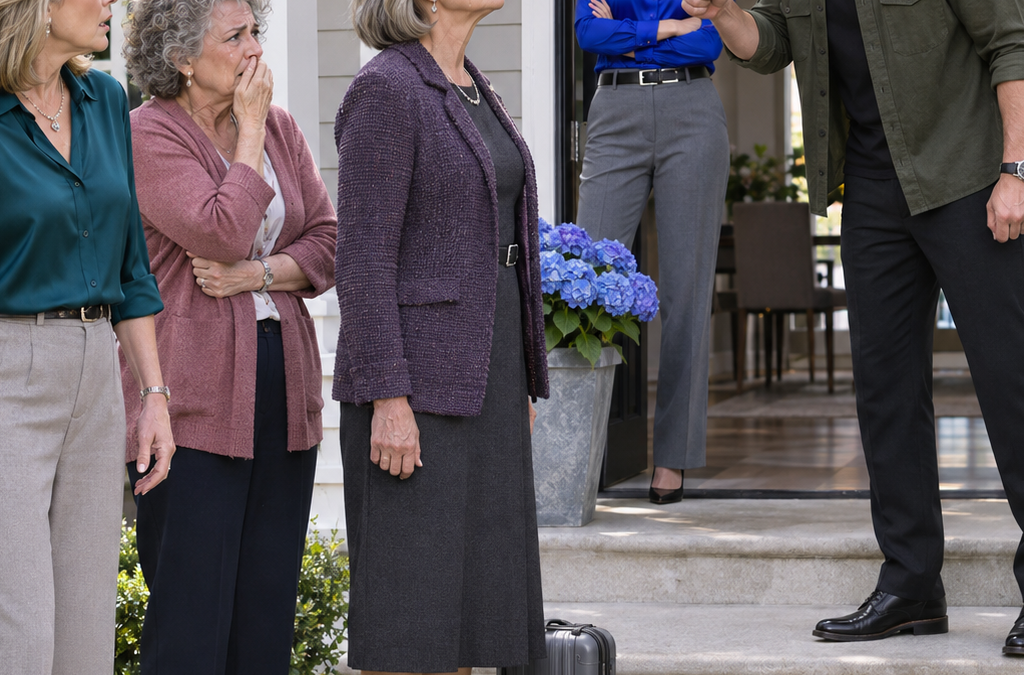
Daniel pushed it across the porch and stood in the doorway. Our next-door neighbor watched from his walkway. The woman across the street stopped near the curb.
“She can’t manage this place anymore,” Daniel told them.
“Stop embarrassing yourself. Go away.”
My sister, Linda, stood beside me. She had driven me home, and she said nothing. Ashley, my daughter-in-law, stayed behind Daniel, looking past him as though I had come to sell something.
I felt humiliated. These people had watched me bring groceries home for years.
My name is Helen Brooks. I’m sixty-four. My second husband died three years before this happened. I kept his surname; Daniel kept his father’s name from my first marriage.
For four months, I had given Daniel and Ashley free shelter while they arranged an apartment. Two years earlier, I paid $2,400 directly to the shop fixing his truck. I still paid the $1,240 mortgage each month from my own account.
I owned the house alone, and I still paid every house bill.
Daniel had never asked whose name was recorded or who kept paying. He called it the family home. That seemed to settle everything for him.
He was thirty-nine, with steady work dispatching heating and air-conditioning calls. Ashley worked at a dental office. They wanted to avoid roughly $1,800 in monthly rent while he worked down $12,600 in credit-card debt. He had told me that balance himself.
I had believed I was helping them get started again. It hurt to discover that helping had made me disposable.
Their apartment was supposed to be ready before my twelve-day visit with Linda. When that fell through, I expected a conversation after I got home.
Instead, my son had packed for me.
I opened the suitcase enough to lift out my familiar video camera. I had packed it for the visit myself. At least he hadn’t thrown that loose among whatever else he had moved.
Before retiring, I had been a public-school audiovisual aide. I kept complete recordings, even the dull stretches other people deleted. There was a family lunch on that camera from before my visit, along with ordinary things nobody else thought worth saving.
I returned it safely to the suitcase.
“Leave the bag,” Daniel said. “Linda can take you back.”
I felt betrayed. He knew how hard it had been for me to spend my first nights alone after my husband died. Now he was using my sister’s home as a place to put me.
Ashley leaned into the doorway.
“You should have called.”
“I told you when we were coming.”
“We already moved your things.”
She said it without embarrassment. I looked toward Linda, hoping she would say she had heard our plans herself. My sister stared at Daniel.
“Don’t make a scene,” Ashley added.
The woman across the street gave an awkward little smile. Ashley caught it immediately.
“See? Everybody understands.”
I was furious. They had made my return into a neighborhood announcement, and I was the last person allowed to speak.
Daniel told the neighbors that the family had everything handled. His voice changed when he addressed them. He sounded patient, almost cheerful.
“You’re tired, Mom. Go with Linda.”
I felt terribly lonely standing beside my own sister.
Linda had been wonderful during my visit. We had laughed about her habit of calling canned peaches “dessert preparation.” Here, with Daniel watching her, she couldn’t seem to find a sentence.
I had confused keeping the peace with keeping my place.
“I heard you,” I said.
I stopped asking to come inside. Using my phone, I called the lawyer who had helped after my husband died.
“I need a written move-out notice for Daniel and Ashley.”
She asked whether I was safe. I said yes, although I hated how uncertain I sounded. She told me not to force my way in or try to put them out myself. She would arrange delivery.
By morning, I stood beside Linda below the same porch. A professional server asked Daniel to identify himself. Ashley laughed behind him until the stranger said the notice required them to leave in thirty days.
Daniel stopped smiling when the stranger handed him my notice.
He read the first part, then looked over the stranger’s shoulder at me.
“You called somebody on us?”
The server explained that he was only delivering it. Daniel wanted him to take it back. When that didn’t work, he turned toward Ashley.
“Get my phone.”
I was frightened by how quickly he stopped pretending to be concerned about me. In front of those same neighbors, he called the police and said his mother wouldn’t leave him alone.
“She’s outside causing trouble,” he said. “I need her removed.”
Linda murmured that perhaps we should go. I said I would wait. I didn’t want an officer arriving to hear only Daniel’s account.
When the patrol officer came, Daniel stepped down from the doorway to greet him. He called him “sir” and described me as confused after a trip. Ashley said they were trying to keep things calm.
The officer asked me whether I lived there.
“Yes. I came home yesterday. He wouldn’t let me in.”
I didn’t ask the officer to drag Daniel outside. I wanted him to hear that I hadn’t arrived at a stranger’s house and refused to leave.
Daniel interrupted before I finished.
“She’s staying with her sister. Tell her to go.”
The officer told him to let me answer. Then he explained that he wasn’t deciding who owned the house or who could keep living there. That dispute would have to go to court.
Daniel moved back into the doorway, still expecting the officer to send me away. He pointed toward Linda and repeated that she could take me.
The officer shook his head. “I’m not removing her just because you say so.”
Daniel grabbed the doorframe when the officer refused to remove me.
Ashley started talking over him, but the officer repeated that he wasn’t settling their housing dispute on the porch. Nobody was being put out on his say-so, either.
I felt relieved, though I still couldn’t imagine sleeping under that roof with Daniel standing guard. Being heard wasn’t the same as being home.
After the officer left, I told Linda I would stay at a motel in Georgetown, Texas. I had already spent one night away from my own bedroom. I could manage a little longer while my lawyer helped me work out what came next.
“You can come back with me,” Linda said. “You don’t need to spend money.”
“I need to be close enough to handle this.”
She offered to stay nearby and eat with me. I accepted the company. I couldn’t bear another argument, especially one with the person who had driven all that way to bring me home.
But she still hadn’t told Daniel he was wrong.
Daniel heard us discussing the motel and came down one step.
“You’re wasting money to prove a point.”
I didn’t answer. He looked at Linda instead, expecting her to finish the job.
Ashley said I could have avoided all this if I had called first. I remembered calling before we left my sister’s house. I remembered Daniel saying, “Okay.” There was no use repeating it to someone determined not to remember.
My lawyer, Rachel Morgan, had told me the notice was a beginning, not permission to take the house back myself. I would leave their belongings alone. The household services would stay on.
Daniel seemed to take my restraint for uncertainty. His voice grew easier.
“Tell her, Linda. We talked about this.”
My sister looked at me, then at him. I waited for her to speak, but Daniel supplied the words himself.
“Linda heard you promise I could stay for life.”
Chapter 2 of 7
“What did you actually hear?” I asked Linda.
Daniel stayed in the doorway while my sister looked down the walk.
“You said he’d always have somewhere safe,” she said. “While they got settled. That was what I understood.”
“Did I say he could stay for life?”
“No. But, Helen, he may have heard it differently.”
She lowered her voice on that last part. I wished she had raised it instead.
“I offered him somewhere to land,” I said. “I didn’t give him my home.”
Daniel made a disgusted sound and went inside. Linda followed me to her car without saying whether she agreed. I felt hurt by how carefully she had protected him from hearing her answer.
Two days later, she drove me to the Williamson County Clerk’s office. I obtained a certified copy of the recorded deed, then took it to Rachel’s office.
There was my name, exactly where I expected it.
I had bought the house before my second marriage. I had never transferred it to Daniel or anyone else. Looking at the copy brought relief, followed by an embarrassment I hadn’t expected.
My son had sent me away without asking a single question.
He hadn’t asked what I still owed, what I paid, or what plans I had. He had simply decided that my bedroom could be emptied because he wanted the rest of the house.
The deed proved ownership.
“But it doesn’t settle what you agreed about him living there,” Rachel said.
“So he gets to say I promised, and I stay outside?”
“He’s lived there long enough to have tenant protections, even without paying rent. We follow the notice, then go to court if he stays.”
I hated that answer. I was also grateful she gave it plainly.
She asked me to gather the mortgage history and records for taxes, insurance, and utilities. I could download most of them. For years, paying those bills had been an ordinary chore. Now I needed to show that I had never stopped.
I left her office tired and angry. I wanted my bedroom back, and she had given me a list.
At the motel, Linda brought takeout chicken and insisted we eat before talking. She had ordered enough mashed potatoes for four people. That was her answer to most troubles: nobody should have to face them hungry.
For a few minutes, we argued about whether gravy counted as a vegetable. Then her phone rang.
She saw Daniel’s name and hesitated.
“Answer it,” I said.
She didn’t put him on speaker, but his voice carried. He wanted to know whether I was still “doing all this.” Then he began talking about the evenings he had spent with me.
Linda said, “I know you kept her company.”
I stared at the untouched food. He had kept me company sometimes. I had been glad when he came home from work. It hurt to hear that tenderness turned into something I owed him for.
When she hung up, Linda explained his proposal.
“He wants everybody to calm down. He says you could tell the neighbors there was a misunderstanding.”
“What misunderstanding?”
“About him putting you out.”
“He put me out.”
Linda rubbed her forehead. She looked tired, but I couldn’t make this easier for her.
“He says if you apologize for making it public, he can start bringing you home.”
That phrase made me feel small again. I was sitting on a motel bed while my sister described my return as a favor he might arrange.
I would not apologize for coming home.
“Tell him no,” I said.
“You could tell him yourself.”
“I already told him I wanted to come inside.”
My phone rang before we finished eating. Daniel didn’t ask about the motel or whether I had enough clothes.
“Stop making calls. Let Linda handle you.”
“Your aunt doesn’t handle me.”
“You’re making her drive everywhere. Think about somebody else.”
Then he ended the call.
I looked at Linda. She had heard enough to know what he had said. Still, she started explaining that he was under pressure at work.
“Please don’t carry our private conversations back to him,” I said.
“He asks me things.”
“You don’t have to answer.”
“He’s my nephew, Helen.”
She said it as though I needed reminding. I asked whether she could promise to keep what I told her between us.
“I don’t want to get trapped between you two.”
I stopped asking. I felt lonely sitting that close to her. I needed somewhere to sleep, and I hated knowing that need would follow me into her house.
After three nights, I paid the motel’s $336 total. At $112 a night, staying there while the notice ran would have eaten through money I needed for everything else.
Linda offered her spare room in San Antonio again. This time, I accepted.
I thanked her for coming back for me. She said I didn’t have to thank her, then asked whether I wanted to stop for lunch on the drive.
I wasn’t hungry.
Going back with her felt different from my visit. I wasn’t choosing a few days with my sister. I was leaving Georgetown because staying near my own house cost too much.
In her spare room, I logged into my accounts and began collecting what Rachel had requested. Linda knocked to ask about supper. Before I could answer, my phone lit up.
Daniel had sent a text. There was no mention of keeping me company or bringing me home.
“Pay $7,200 and we’ll move without a fight.”
Chapter 3 of 7
I read Daniel’s $7,200 demand twice before answering.
“No. I’m not paying you to move.”
He called instead of writing back. I could hear Ashley talking nearby, though I couldn’t make out her words.
“That’s four months of rent,” he said. “You changed the plan. That’s the least you owe us.”
“What plan?”
“We built everything around staying there. Now you want us starting over.”
He sounded annoyed that I needed this explained. He and Ashley had jobs, but in his version, their next rent payment belonged to me.
I was not buying permission to enter my own home.
“If you have an agreement I made, send it,” I said.
“You know what you said.”
He hung up before I could answer.
I forwarded the message to Rachel. Then I asked her to help arrange a pickup of clothing. The weather would change before this ended, and I had packed for a visit, not for losing access to my closet.
Daniel agreed to a short visit with Linda present. He would bring what I requested to the entry. Rachel told me to leave if it turned into another confrontation.
I hated needing instructions for collecting my own clothes.
Linda drove me back to Georgetown. She tried talking about road construction, then gave up. We had never struggled for conversation before.
Daniel opened the door only after she called from outside.
“Entry only,” he said. “We’ve got your stuff ready.”
Linda came in beside me. For a moment, I looked past him toward the hallway.
His work schedule covered the kitchen calendar. The dining table had been pushed against the wall. From where I stood, I could see Ashley’s exercise machine where my reading chair used to be.
I couldn’t see what they had done with the chair.
It hurt more than I expected. Those changes were ordinary enough, but they had made them while planning for me not to return.
Ashley came out of the hall.
“We couldn’t keep everything frozen. You left us to run everything.”
“I went to visit my sister.”
“Well, somebody had to be here.”
I wanted to ask what exactly they had run. Instead, I repeated my request to Daniel.
“Send me anything that supports what you’re claiming I agreed to.”
“You don’t put family promises in writing.”
“Then tell my lawyer what you say the promise was.”
Ashley looked at Linda.
“See what we’re dealing with?”
My sister said we had come for clothes. It wasn’t much, but at least she said it to Ashley.
Daniel had brought out summer things and two sweaters. He had missed my heavier shoes. I asked to get them from my bedroom.
“I’ll get them.”
He disappeared down the hall while I stayed by the entrance. I felt humiliated waiting for my son to decide which parts of my life he would hand back.
Linda asked whether he had included my house shoes.
“The ugly blue ones,” she added. “She won’t wear the good pair.”
I nearly laughed. She had bought me the good pair herself. They pinched, and she still refused to believe it.
Daniel returned with the shoes. Then he opened the front door wider, making it clear we were finished.
I left without reaching my bedroom.
Back in San Antonio, I put the clothes in Linda’s spare-room closet. She had moved her winter coats to make space. I thanked her, then cried after she went downstairs.
I was grateful for the room. I was also angry that gratitude had become part of getting dressed.
On October 15, the thirty days ended.
I called Daniel to ask whether he and Ashley had arranged to leave. I already knew they hadn’t, but I needed to hear his answer.
“We’re staying,” he said. “Let a judge hear what you promised.”
“So you won’t leave?”
“I just told you.”
He sounded certain that court would make me reconsider. I worried about the expense, the drive, and hearing him describe me to strangers. I told Rachel to keep going anyway.
I left the locks, their belongings, and the utility accounts alone. The house stayed lit while I slept in my sister’s spare room.
Rachel arranged a separate three-day notice to vacate.
“This gives them the final notice before we can file,” she said. “It’s separate from the thirty days.”
The following morning, the server delivered it personally. Rachel also arranged certified-mail backup and kept the delivery records. I wasn’t there to watch Daniel receive it.
His response reached me through the family group.
“Mom is upset and making an impulsive decision. Ashley and I are protecting the settled home she asked us to build. We’re trying to keep this calm.”
He had included Linda. I read it while sitting across from her at breakfast.
Then a private message arrived.
“You wanted a fight. Pay for it.”
I showed Linda both messages. She read them without defending him, but she didn’t answer him either.
I felt afraid then. The cost was no longer just what Rachel would charge. Daniel was asking people who loved me to accept that I couldn’t be trusted.
Linda’s phone rang later. She took the call upstairs.
When she came back, she stood at the spare-room door.
“He has named me as the person who heard the lifetime promise.”
Chapter 4 of 7
“Are you going to repeat something you didn’t hear?” I asked.
Linda stayed in the doorway of the spare room.
“I told him you’d probably give in,” she said. “Before the notice. I thought you would.”
“You told him that?”
“I thought if he stopped pushing, you’d come home and work it out.”
I felt betrayed, though she looked ashamed. While I had been trying to explain myself, she had been telling him to wait me out.
“What else did you tell him?”
“Some things you said here. About being tired. About the motel money.”
I had trusted her with those things because she was my sister. Now Daniel knew which parts were wearing me down.
“I need an honest sister, Linda. I don’t need somebody negotiating for me.”
“I was afraid you’d stop speaking to each other. For good.”
She said it quietly, as though naming that fear might make me understand. I understood it. I was afraid of that, too.
“You can’t keep us together by helping him keep me out.”
She went downstairs. I heard her start supper, then turn off the kitchen exhaust fan. Neither of us was hungry yet.
After the separate notice expired, Rachel filed the eviction. There was no announcement to the family group. She called me, told me it was filed, and asked about getting the household papers I still needed.
Daniel agreed to another access appointment. This time, Rachel came with me.
Before we left, I told her I wanted to give him the records myself.
“You don’t have to persuade him,” she said.
“I know. I want him to see them.”
He met us in the entry again. Ashley had gathered my household files from the small office. She told me she had checked them for anything belonging to her and Daniel.
I hated hearing that she had gone through them. I checked that the files I needed were there before saying anything else.
Then I handed Daniel the packet.
“The county copy is first. The payments are behind it.”
He looked toward Rachel.
She said, “Those copies are for you to keep.”
His expression changed as he read. He lingered over the certified deed, then turned to the lender statement.
“You still owe ninety-one thousand?”
“$91,800.”
“I thought most of that was taken care of.”
He had never asked. That was what hurt. He had filled in the parts he didn’t know with whatever made staying there seem reasonable.
The next pages showed the $1,240 payments leaving my personal account each month. Behind them were the annual tax payment of $3,960 and the $1,440 insurance premium.
Daniel checked the names on more than one page.
Those payments had not come from money somebody else managed for the family. They had come from my account, including while I was sleeping at Linda’s.
Ashley came closer.
“Why are we getting all this?”
“Because he told people I left you to run everything.”
“We did run the house.”
“You lived in it.”
Daniel interrupted before she answered. He had reached the utility records, the bills that averaged $310 each month.
“So all of this still comes out of yours?”
“Yes.”
For the first time, he seemed to understand what free shelter had actually meant. He looked back at the deed. My name was the only owner’s name he would find.
I felt relieved to have the facts in front of him. Then I felt foolish for expecting the facts to change how he treated me.
“Keep your name on it. You said we could live here.”
His voice was firm again.
“While you arranged an apartment,” I said.
“That’s your version now.”
Ashley stood beside him. “Bills don’t erase what you told us.”
Daniel agreed. He said a family could make an arrangement without writing it down, and he intended to tell the judge about ours.
I didn’t argue through the lunch again. I took my files and left with Rachel.
Outside, I asked her whether anything we had shown him mattered.
“Yes. The judge needs the ownership records, the notices, and reliable evidence of what was agreed. Paying the bills supports your account. It doesn’t answer his claim by itself.”
I was tired of answers that didn’t let me go home. Still, I trusted her more because she didn’t offer one.
I reminded her about the family-lunch recording I had preserved. She said she would review it privately before the hearing. I left that with her and went back to Linda’s.
The hearing notice gave us a place we would all have to face this: Thursday, November 5, at 9 a.m., in the assigned Williamson County Justice Court courtroom in Georgetown.
Rachel would be there with me. Daniel had hired an attorney. Linda was expected, along with Paul from next door and Grace from across the street.
Seeing those names together embarrassed me. They had known me as someone who waved from the driveway. Now they would hear my son explain why I should stay out of my house.
At Linda’s, I had begun eating breakfast standing up. Her toaster burned one side of every slice, and she insisted the bread was at fault. One morning she found me scraping toast and said she would buy another toaster.
“Don’t,” I said. “I’ve almost learned this one.”
We both laughed. It helped more than her assurances had.
Later, Daniel called her. I heard her say, “Send it, then,” but nothing else.
She came into the spare room after supper. I was sitting on the bed, still wearing my shoes.
“He wants my signature,” she said.
I waited.
Linda laid Daniel’s unsigned witness statement across my lap.
Chapter 5 of 7
“After the camera was put away,” Linda read, “Helen told Daniel and Ashley they could make the house their permanent home.”
She stopped there. I read the next line myself. According to Daniel, she had heard me say they would never need to rent again.
“I didn’t hear that,” she said. “I’m not signing it.”
“Have you told him?”
“No.”
The paper rested across my knees. I felt relieved, but I still needed to know what she would say when Daniel stood in front of her.
“He’ll say I’m choosing you,” she said.
“Tell him what you heard.”
Linda looked toward the door. For years, she had been the aunt who remembered his favorite cake. She had never expected him to ask her for this.
“He keeps calling,” she said. “I let the last one ring.”
I wanted to comfort her. That bothered me almost as much as the statement. I was still trying to make this easier for everyone except myself.
“Send Rachel a copy,” I said. “Tell her you haven’t signed it.”
Linda agreed. She left the paper with me.
On hearing morning, we drove to Georgetown without discussing Daniel. Linda asked whether I had eaten. I said yes, although I had only managed half an English muffin.
She had always eaten hers with peanut butter and dill pickle slices. I used to call it grounds for divorce. That morning, I wished I could care about something that ordinary.
Paul was waiting outside the courtroom. Grace stood a few feet away, reading the posted instructions.
Seeing them embarrassed me. I remembered standing below my porch while they watched my son explain me away.
Paul came toward us.
“I didn’t like what I saw that day,” he said. “Should’ve said so.”
“Thank you for coming.”
Grace joined him, looking at me rather than Linda.
“I need to tell you about that smile.”
I knew which one she meant.
“Daniel said the family had everything handled. I smiled because I didn’t know what else to do. I wasn’t agreeing that you couldn’t manage.”
“You didn’t know whether I could.”
“No. I didn’t. I should have asked you.”
It hurt to hear how little it had taken for my neighbors to accept his account. Still, Grace had come to tell me herself. I thanked her without saying it was all right.
Rachel arrived and spoke with me away from the courtroom entrance.
“The certified deed, payment records, and both notices with delivery proof are ready. The recording is identified as an exhibit. Their attorney has the exhibit information.”
“I want to identify it myself,” I said. “And ask for it to be played.”
“I’ll ask you the questions. Answer in your own words.”
“Please don’t explain it for me.”
She looked at me, then nodded. “You’ll speak.”
That helped. I was frightened of being questioned, but more frightened of sitting through another conversation about me without getting to finish.
Daniel and Ashley arrived with his attorney. Daniel went straight to the clerk and asked where they should wait.
“Yes, ma’am. Thank you. We appreciate your help.”
He sounded like the son I used to hear on work calls. Patient, useful, willing to sort things out.
Then he saw me standing nearby.
“Sit down. Let the adults finish.”
Ashley glanced toward the clerk before adding, “Just let him get us checked in.”
I felt my face burn. I had spent years excusing his sharpness as fatigue. Here, he had changed voices within a few steps.
The clerk called his attorney over. Daniel followed, polite again.
Linda drifted toward the chairs beside Ashley. She sat before looking back at me. There was an empty chair next to her, but I stayed with Rachel.
I didn’t ask my sister to move. I was tired of asking her to show where she stood.
Paul remained near me. Grace sat across the aisle.
When Daniel returned, he addressed all of us.
“I know this looks bad,” he said. “But Mom offered us a permanent home. We didn’t just decide to take over.”
Linda looked down.
He kept going, encouraged by nobody interrupting him. He said I had been lonely, that having them there had helped, that he had believed we were building a household together.
Some of that had been true. I had liked hearing another person come through the door. It hurt that he could use a happy memory without seeming to remember me in it.
“The family video was just lunch,” he said. “People say things for a camera. The actual conversation happened afterward.”
Paul shifted toward me, but said nothing.
Daniel looked at Linda. “You were there.”
She lifted her head. “I was at lunch.”
“And afterward.”
“Yes.”
That was all she gave him. He seemed satisfied anyway.
I wanted to ask why his permanent home had required putting me outside. Rachel was beside me, and the courtroom door was only a few feet away. I could wait to answer where somebody would have to listen.
Ashley leaned forward.
Now they were claiming a specific sacrifice. I had heard about an apartment falling through. I had never heard that they had canceled it for me.
Ashley looked from Grace to Paul.
“We canceled our apartment because she promised us this house.”
Chapter 6 of 7
“Play the whole recording.”
That was what I asked when Judge Karen Ellis reached the recording on Rachel’s exhibit list. My voice sounded thin, but I finished without looking toward Daniel.
The judge said she would hear his account first.
Daniel stood beside his attorney. He said I had privately offered him and Ashley permanent residence, and they had canceled their apartment because of it. His attorney confirmed they weren’t disputing my ownership or receipt of either notice.
“We relied on what she told us,” Daniel said. “Then she changed her mind.”
I felt angry hearing him say it so calmly. Behind him, Linda sat with her knees pressed together. Paul and Grace were farther down the row.
Rachel asked me to identify my familiar camera and its original memory card. I explained that I had recorded our family lunch in May, before the September apartment was supposed to begin.
The camera rested beside the courtroom playback equipment. Seeing it there hurt. I had used it to save birthdays and school concerts, never expecting to explain it to a judge.
“Is this the complete recording?” Rachel asked.
“Yes. I haven’t cut or changed it.”
I described my years working with school audiovisual equipment and my habit of keeping original files. Then Judge Ellis asked whether Daniel’s attorney had reviewed the exhibit.
He requested a short recess to review it with Daniel. She allowed it.
While they were gone, I stayed beside Rachel. Linda remained across the aisle. I wanted her near me, but I couldn’t ask again.
When they returned, Daniel avoided looking at me. His attorney said they were ready to proceed.
I asked for playback.
Our dining room appeared on the screen. There was my son, relaxed in his chair, thanking me for “temporary shelter” until the lease began in September.
His voice was warm. That nearly undid me. I remembered being happy they had somewhere safe to stay.
Rachel asked why that part mattered.
“He says that lunch was when I offered a permanent home,” I said. “But he thanked me for somewhere temporary.”
Daniel’s attorney asked him to explain.
“Mom didn’t want people thinking she needed us there,” Daniel said. “I was being polite. The real conversation was afterward, when she lowered the camera.”
He wasn’t denying his voice. He was giving the judge a reason to disregard what it said.
I felt frightened then. He knew how lonely I had been, and he could make that sound like an agreement.
The playback had paused near the end of the clear picture.
“Please play the rest,” I said. “It kept recording.”
The image tilted toward the tabletop. My voice remained audible, asking what they would do if the apartment didn’t work out. Then Daniel answered.
“Even if the lease falls through, we’ll find someplace else.”
I heard a chair scrape in the recording. Someone asked whether anybody wanted more potato salad. I had made too much again; Daniel used to say I cooked for people who might arrive hungry from another county.
That ordinary question made me ache. We had still been having lunch.
Judge Ellis asked Linda to testify about the conversation. My sister identified the voices and the occasion. She confirmed she had stayed through the end.
“Did Helen offer them the house permanently?” the judge asked.
“No.”
Linda looked at Daniel before continuing.
“She said they were safe there while they got settled. He said they’d find another place if the apartment fell through. I heard him.”
Daniel leaned toward his attorney, speaking urgently. Linda kept facing the judge.
Judge Ellis turned back to him.
“Why would you promise to find another place after receiving permanent permission to stay?”
Daniel said he had meant he wouldn’t burden me. Then he stopped and tried again.
“She was alone. We’re family. She wanted us there, and we arranged our lives around that.”
I had never felt so exposed. He was telling strangers how much I had wanted company, as though wanting him nearby meant I couldn’t ask him to leave.
Judge Ellis let him finish.
“Wanting family nearby does not establish the permanent agreement you’ve described,” she said. “Your later statement supports a temporary arrangement. Ms. Price’s testimony supports that too.”
She reviewed the notices briefly, then looked toward both attorneys.
“The tenancy was properly ended. I award Helen Brooks possession of the four-bedroom house.”
Linda rose from Daniel’s side.
He stood sharply and reached toward her sleeve. His fingers never touched her. She kept walking and sat beside me.
Daniel looked toward Grace, starting to speak. She turned away from him and toward Paul.
I felt relieved, but I was still shaking when the judge explained that enforcement would require further steps. I wasn’t going home with keys that morning.
In the hallway, Daniel caught up with us.
“Give us some time. You can come back while we figure it out.”
Ashley stood behind him. Neither mentioned the bedroom I had been kept from.
“You can visit only when I invite you,” I said.
“I’m talking about us living there.”
“I know.”
He offered to discuss a moving payment smaller than his original demand. I refused. I was tired, and I wanted to leave without buying another promise.
I told Rachel that if he remained after the required waiting period, I wanted her to request the writ.
The clerk came out with the appeal-information sheet from Daniel’s case file. She handed it to him and explained where an appeal would need to be filed. No appeal had been filed yet. He studied the page while Ashley whispered beside him.
Linda asked whether I wanted her to drive.
“Yes,” I said.
Daniel stepped closer before we reached the exit.
“I’m still not handing you the house keys.”
Chapter 7 of 7
Daniel filed no appeal. After the required waiting period, the court issued the writ, and the constable enforced it on November 16.
I hadn’t tried to take the keys from my son. I waited until the constable told me possession had been restored before arranging to have the locks changed.
By then, Daniel’s movers were carrying out the last of his furniture.
I stood at my own front door while Ashley checked that they had everything. Nobody from the neighborhood had gathered to watch. I was glad. I wanted to come home, not give them an audience.
Daniel stopped beside me.
“You really went through with it.”
“Yes.”
Ashley walked past us carrying her work bag. She didn’t look at me.
I felt relieved, and I hated how sad I was. I had wanted my house back. I had never wanted to watch my son leave it like this.
He asked whether he could leave some boxes in the garage.
“You’ll need to take everything.”
“It’s just until we get settled.”
“No, Daniel.”
He looked toward the constable, then back at me. The boxes went with him.
I didn’t inspect their furniture or ask for an apology before they left. Nothing of theirs stayed behind as something I could hold over them. I also didn’t tell them we were fine.
When the truck pulled away, Linda remained beside her car.
“Do you want me to stay?”
“Not tonight. Thank you.”
She nodded without asking whether I was sure.
Inside, the place smelled unfamiliar. Their rooms were empty, but the dining table still stood against the wall. My reading chair had been pushed into the small office. I was grateful they hadn’t thrown it away.
I walked through every room before going to my bedroom.
I felt safe there, though I still listened for Daniel’s voice in the hall. The new lock didn’t make that habit disappear.
That night, I slept in my own bed.
Four days later, Daniel sent me an apartment application. The rent was $1,800 a month. He wanted my signature because, he said, it would make approval easier.
A second message included the mover’s invoice for $1,480.
“Forward this amount today. We had to move because of you.”
I felt angry, but I didn’t call him. I wrote one reply.
“I won’t co-sign, supply the deposit, or pay the moving bill.”
He called twice. I let both calls go unanswered.
Later, he told me he and Ashley had signed the lease themselves. He had paid the movers, too. There was no thank-you, and I hadn’t expected one. I was simply glad neither bill required anything further from me.
Over the following weeks, our calls became less frequent. I stopped answering while I was paying bills or getting ready for bed. If he needed to ask me something, he could leave a message.
Linda stopped passing along my private conversations.
Once, she told me Daniel had asked whether I was having trouble keeping up with the house.
“What did you say?”
“That he could ask you.”
She sounded uncomfortable. Then she added, “I told him I wasn’t reporting on you anymore.”
I felt grateful. I still chose carefully what I shared with her, but I no longer worried that every tired remark would reach my son.
She apologized without asking me to reassure her.
“I should have said something on the porch.”
“Yes,” I said. “You should have.”
She stayed on the phone. So did I.
Daniel eventually asked for a spare key, supposedly for emergencies. I refused. He wouldn’t have storage space, access to my accounts, or permission to arrive whenever he wanted.
He could ask to visit. I would decide whether to invite him.
“That’s a lot of rules for your own kid,” he said.
I was sad after that call, but I didn’t change my answer.
Another evening, he called without asking for money.
For a while, he talked about work. Their apartment’s air conditioner was loud, he said, and the parking spaces were narrow. I listened. I could still listen to ordinary complaints without offering to solve them.
Then he stopped.
“I honestly didn’t think you’d make me leave.”
I sat down when he said it. That hurt more than another demand would have.
“You had already made me leave, Daniel.”
“I thought you’d go to Linda’s and then we’d—”
He didn’t finish.
I waited, but no apology came. Maybe he wasn’t ready to give one. I wasn’t ready to help him around it.
“I’m glad you have an apartment,” I said. “I’m going to go now.”
I ended the call before we could argue through the hearing again.
Six weeks after the constable came, I invited Linda, Paul, and Grace for supper.
I had moved the dining table back where I liked it. My chair was beside the window again. Nobody had needed to agree with either decision.
Linda arrived first and asked where I wanted everyone to sit.
“Anywhere. You take the end.”
She had always deferred to Daniel about that seat. This time, she sat down.
I served chicken potpie with biscuit topping. In our family, everyone wanted a corner piece, even though I made it in a round dish. Linda announced that retirement hadn’t improved my understanding of corners.
Paul offered to draw some on the plate.
I laughed hard enough to lose the first thing Grace said. She repeated it, smiling at me this time, and I didn’t have to wonder what she meant.
I felt happy. It was a small supper, and I had spent part of the afternoon worrying it would be awkward. Instead, people asked for seconds.
Before dessert, I brought out my familiar camera.
Linda looked toward it, then at me.
“Another family movie?”
“Just supper.”
I wanted the sound of Paul laughing and Grace asking for the recipe. I wanted Linda here because I had invited her, in a house where I could ask anyone to leave.
The camera didn’t have to prove anything tonight.
Being his mother did not mean giving him my home.
I turned the camera toward our supper.







