At Christmas dinner, my son demanded $925 rent in my own house; he didn’t know I still paid its mortgage, taxes, and insurance.
Chapter 1 of 7
“Pay up or clear your room.”
Mark said it while I still held my sewing-machine case. My grandson and granddaughter were sitting beside him. Neither child knew where to look.
“Grandma’s lucky I let her stay,” he told them.
His wife, Jenna, looked straight at me. “Just pay him.”
My sister, Linda, had come inside behind me. She said nothing. We had barely returned from her place, and everyone was waiting to eat.
I felt humiliated before I even got my coat off. Mark was thirty-nine years old, and he had just threatened me in front of his children.
My name is Ellen Brooks. I’m sixty-six. I’m a retired alterations seamstress, and I’ve buried two husbands.
Mark’s father died nineteen years earlier. I remarried, took the name Brooks, and lost my second husband two years ago. Mark kept his father’s surname, Davis.
I had bought this three-bedroom house in Round Rock, Texas, seventeen years earlier. Eight months before that dinner, I had opened it to Mark’s family while they got back on their feet.
I paid $2,400 for their moving and storage costs. During the preceding school term, I spent another $680 on the children’s clothes. I had collected no housing payment from either parent.
I owned the house and still paid every house bill: the mortgage, taxes, and insurance.
They had never asked what I still carried. Mark knew I had bought the house. He assumed my second husband’s insurance money had paid it off.
We had postponed Christmas dinner until I returned from visiting Linda. I had expected a late celebration, with our usual argument over whether sweet potatoes needed marshmallows. Linda called them dessert wearing a vegetable’s name.
Instead, my son was charging me admission to my own home.
“You can have the little back den,” Mark said. “We’ve worked it out.”
That hurt. He had worked out where I belonged without asking me.
The machine in my case had been mine for nearly thirty years. I had hemmed strangers’ trousers, altered wedding dresses, and let out my own children’s clothes on it. I had taken it to Linda’s, expecting to bring it home to my sewing space.
Mark had displaced that space. Now he was assigning me a place to sleep, too.
“Use the back room,” Jenna said.
She was thirty-six, old enough to know what she was helping him do. I was disappointed in her. She had brought the children to me for help so many times.
“Put your things away,” Mark said.
“Where am I supposed to—”
“Don’t start in front of them.”
His children had heard every word he said. Somehow, my asking where to put my belongings was the embarrassing part.
“You’re making the children uncomfortable,” Jenna said.
I felt angry then. My face was hot, and I hated that they could see it.
Mark told me I would need to ask before spreading sewing work through the house. He wanted the $925 every month. He talked about taking out trash and handling repairs as though I had become somebody he supported.
He stepped toward the hallway.
“If you won’t pay, I’ll move you out.”
I was afraid he meant to start carrying my belongings outside. Linda looked at him, then at me, but still said nothing.
For one foolish second, my hand started toward the money I had brought home. Paying had become a habit. A school expense, a moving expense, something needed before payday.
I had paid for peace until they began charging me for it.
“I’m staying,” I said.
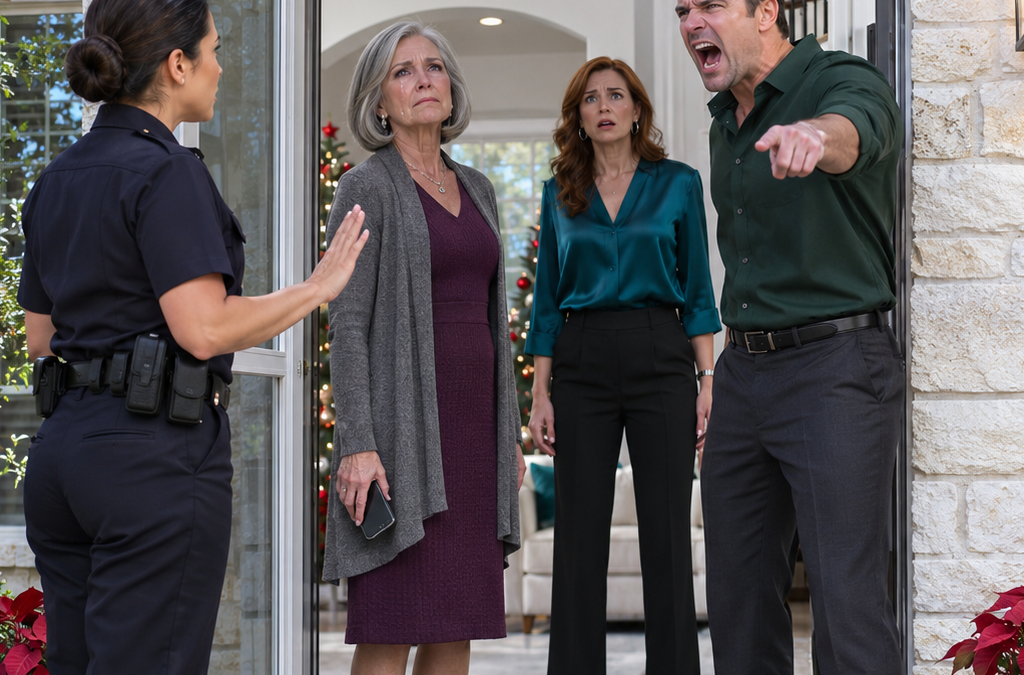
I used my phone to call the police nonemergency line. I gave my address and said my adult son was threatening to put me out of the home where we both lived. I wanted someone to keep the peace.
Mark began shouting that I was making a fool of myself. Then a woman outside announced she was a police officer.
My son opened the door and stopped shouting.
He changed his voice so quickly that Jenna looked up.
“Thanks for coming, Officer. My mother’s upset. We’re trying to have a family dinner.”
The officer stayed near the entrance. She asked who had called, and I told her I had.
Mark interrupted before I finished explaining.
“I take care of this place. She’s refusing to cooperate.”
“What are you asking me to do?” the officer asked.
“Get her out for tonight. Her sister can take her.”
I stood where he could see me. I was embarrassed that a stranger had to hear this, but I no longer wanted to soften it for him.
“This is my home,” I said. “I came back from visiting my sister. He says I have to pay him or leave.”
The officer asked how long each of us had lived there. I told her seventeen years for me, eight months for his family. She asked whether anyone had been hurt or threatened with physical harm. I described what Mark had said about moving me out.
He kept calling it a disagreement about respect.
The officer told us she was there to prevent trouble. She would not settle our housing dispute at the door.
Mark’s polite voice began to crack.
“She can go with Linda. That solves it.”
“Neither of you is being removed by me tonight,” she said.
He pointed toward the entrance. “Just have her leave.”
The officer refused his order to put me outside.
She asked Mark to give us some room. With him still near the dining area, she spoke to me by the entrance.
I told her quietly that I paid the mortgage, property taxes, and homeowners insurance. Mark thought those costs had gone away. I had never stopped paying them.
She didn’t announce who owned anything. She told me that if we couldn’t resolve the living arrangement, I needed advice about the proper next steps.
“I’m not putting his things outside,” I said. “I just don’t want him putting mine out.”
She repeated that to both of us before she left. Mark agreed to leave my belongings alone. He sounded offended that anyone had asked.
Afterward, Linda sat beside me. She didn’t challenge him. She only asked whether I wanted her to stay a little longer.
“Yes,” I said.
I was grateful, but I was still hurt by her silence. I couldn’t discuss that while Mark was close enough to answer for her.
Once I was back in my bedroom, I retrieved my copy of our temporary agreement. We had signed it on January 1, before I left for Linda’s.
It restated that their stay was temporary and required thirty days’ written notice to end it. It also preserved my bedroom and sewing space. Jenna had watched both of us sign and added her name as the witness.
I read those lines twice. The paper would not move anyone out that night. Refusing his demand would not give me back the space he had taken.
I needed help, and I hated admitting how far this had gone.
Linda stayed until the children had eaten. I heard my granddaughter ask whether I was coming back to dinner. Jenna answered too quietly for me to understand.
Then my phone showed a message from Mark. He had sent it from the other end of my house.
“No $925, no visits with the kids.”
Chapter 2 of 7
My grandson was ready for our library outing when Mark told him to take his shoes off.
“Grandma’s not taking you.”
We had planned it before my visit to Linda. My granddaughter wanted books about horses. My grandson had promised to help her find them.
“You said we could,” he told his father.
“Plans changed. Go get your sister.”
I waited until both children were down the hall.
“Don’t do this to them, Mark.”
“Quit making them choose.”
It hurt to hear him call it a choice. I hadn’t asked either child to take my side. I had only promised them an afternoon.
I didn’t offer the $925. Instead, I called an attorney. I wanted my home back, even if Mark made me miss the children to get it.
Linda came over while he was getting them ready to leave. His voice changed when she asked about the library.
“I’m protecting them from family tension,” he said. “They don’t need to be around all this.”
Linda looked at me. This time, she didn’t look away immediately.
After they left, she offered to drive me to my appointment.
“I can drive,” I said.
“I know. I meant company.”
I was relieved she offered. I didn’t want to explain this to a stranger alone.
Carol Hayes met with me in a small office in Round Rock. I brought the agreement, Mark’s message, and an urge to explain that he hadn’t always been this way.
She asked what I wanted.
“My bedroom. My work space. To stop being ordered around.”
“Do you want his family to move out?”
“Yes.”
Saying it made me feel disloyal. I was still sleeping in my bedroom, but I listened for Mark before entering the hallway.
Carol read our signed arrangement.
“They’ve lived there for months,” she said. “We can’t treat them as weekend visitors.”
“So I have to keep living like this?”
“For now. Don’t change locks or shut anything off. Call for help again if you feel unsafe.”
I hadn’t planned to touch the locks. Still, I was glad she said it plainly. I needed to know what I could do before another argument started.
At her request, I obtained a certified copy of my recorded deed from the Williamson County Clerk. My name appeared alone. The clerk supplied the copy, and I went home with it; nothing in the house changed.
I also brought Carol my current lender statement and bank payment record. She matched the $1,460 leaving my account to the payment received by the lender.
“That’s the mortgage,” I said. “Taxes and insurance are separate.”
“Keep those records too.”
I felt ashamed of how relieved I was. I had been paying all along, yet I needed someone outside my family to look at the numbers.
Carol returned to the agreement.
“You promised thirty days’ written notice. We honor that. If he stays afterward, we use the court.”
“Even though he wants rent from me?”
“Yes. His demand doesn’t erase the notice requirement.”
On January 8, I authorized the written notice ending their temporary stay. Carol arranged for it to be served and retained the proof. I kept a copy with my papers.
When Mark received it, he came to my bedroom doorway.
“You went outside the family.”
“I asked for help.”
“We moved in because you were alone.”
They had needed somewhere to live. I had been lonely too. Both things were true, and I had never pretended otherwise.
“I took over the heavy stuff,” he said. “You needed a man here.”
“I needed my son to be decent.”
“Then act like my mother.”
I was furious, but too tired to argue about who carried the trash. He spoke as though helping a widow had made him head of her household.
After that, he began announcing decisions before I could speak. Dinner would be earlier. Linda should call him before coming. I could use the dining area when the children finished homework.
I told Linda she could arrange visits with me. I ate when I was hungry. When Mark ordered me to wait outside my bedroom while he finished sorting things, I went in.
“Leave those where they are,” I told him.
He complained, but he stopped.
None of it felt brave. I hated having to insist on ordinary things.
He had piled some of the children’s belongings near my doorway. I carried them back to the room where the children slept, keeping their schoolwork together.
I wanted their things to be safe. Whatever happened next, they were not being punished by me.
Our uneasy truce settled into separate meals and short sentences. One evening, Jenna brought back a drawing my granddaughter had made for me.
Mark had removed it from my room while “clearing clutter.” It showed our family with enormous heads and almost no bodies. My granddaughter had given me purple hair.
“She said that was your fancy color,” Jenna said.
“I’ve never had purple hair.”
“She thinks you should.”
I almost laughed. Jenna left the drawing in my room and went back down the hall. She didn’t apologize.
I was grateful for that small kindness. I still remembered her telling me to pay him.
Mark noticed the drawing had returned. He said nothing about it.
Instead, he came to me with receipts.
“Six hundred forty dollars,” he said. “You think I spent that for a visit?”
He called the work his “permanent bedroom conversion.” He said moving his family now would mean pretending none of it counted.
I felt worn down already. I had expected anger about the notice. Now he was claiming the changes to my rooms gave him a reason to stay.
Mark laid the $640 in conversion receipts before me.
“You agreed this was permanent.”
Chapter 3 of 7
The receipts covered a bunk bed, a curtain, and paint. They totaled $640, and I didn’t question that he had spent it.
“I didn’t give you permission to take over my rooms,” I said.
“You think I bought all this for nothing?”
“You bought furniture. That doesn’t mean you can move me.”
Mark stared at me as though I had changed the price after he paid.
He had two children sharing space, a wife wanting somewhere settled, and receipts he thought made his position reasonable. I understood wanting a home that lasted. I had offered him time to find one, not permission to push me into the den.
I was angry that he kept making those sound like the same thing.
By the next afternoon, he had sent his account to the family group.
“I rebuilt a bedroom for my kids,” he wrote. “Now Mom wants them homeless.”
He included pictures of the purchases. There was nothing about the $925 he had demanded from me.
Linda called after reading it.
“What exactly did he change?”
I wanted her to say she knew better. Instead, she asked whether I had agreed to the work.
“You were there when he told me to pay him.”
“I know. I’m asking about before that.”
It hurt, though I knew she needed to ask. Mark had given her a story with pictures. I had been hoping she would understand without making me explain again.
I told her what the purchases were. Then I told her I had not agreed to surrender my bedroom or sewing space.
“He’s saying you’re putting the children out,” she said.
“They have parents, Linda. Those parents can find a place.”
She was quiet for a while.
“Does he know you mean it?”
“He has the notice.”
“That isn’t what I asked.”
I didn’t have a good answer. Mark acted as though every step I took was another complaint he could outlast.
Inside the house, even ordinary errands became negotiations. One morning, I needed measurements I had left near the space where my work table stood. Mark was sorting the children’s things there.
“I need to get through.”
“Wait till I’m done.”
“I’m not asking you to stop. Just let me past.”
He moved enough for me to squeeze by, then complained that I was disrupting his system.
I felt small arguing for a few feet of floor. I had spent years working around customers’ schedules. Retirement was supposed to mean I could use my own space without an appointment.
My granddaughter found me afterward.
“Are you going to rent somewhere, Grandma?”
“No, honey.”
“Daddy said somebody has to.”
I wanted to tell her exactly what her father had done. She was seven. She was already studying our faces before she asked ordinary questions.
“The grown-ups are working out where everybody will live,” I said.
“Can I still come here?”
“I want you to.”
That was all I could promise without pretending I controlled her father.
She stayed beside me while I matched clean socks. Our house always produced three singles for every pair. She decided the missing ones had gone to live together, which made more sense than anything the adults were saying.
For a few minutes, I enjoyed being her grandmother.
The thirty days ended without any sign of packing. Mark still left for work and came home expecting dinner to happen around him. I had stopped asking whether he had looked at apartments. Each question became an accusation that I wanted his children gone.
I was tired of defending myself against that.
On February 9, Carol arranged service of a separate three-day notice to vacate and kept proof of delivery. She explained that this was the next required step before asking the court for possession.
I left the locks, utilities, and everyone’s belongings alone. We continued sharing the house while the notice ran.
Mark found me in the kitchen after receiving it.
“That paper doesn’t change what you said.”
“What are you talking about?”
“At Linda’s. When you called.”
He said I had promised his family could stay permanently during my visit. According to him, that conversation replaced what we had signed before I left.
I remembered calling home. I did not remember giving away the right to live in my rooms.
“I didn’t promise you that.”
“You needed us. Own it.”
I was furious. He had asked for help when he moved in. Now my loneliness was being offered as proof that I had agreed to anything he wanted.
Jenna had come into the doorway. Earlier, she would have told me to stop arguing or reminded me about the children. This time she stayed quiet.
“Tell her,” Mark said.
She looked at him, then toward the hall.
“Not with the kids right there.”
She left without adding anything. I couldn’t tell whether she was angry with him or simply tired of us both.
Later, Linda told me Mark had called her. He said I must have forgotten the conversation because I had been upset about living alone.
I felt frightened by that version. It made my denial sound like another reason not to believe me.
I called Carol and repeated his claim. She asked me to write down what he was saying, as closely as I could. We would have to answer it, not just show that he had stayed beyond the notice.
That evening, Mark brought it up again with Jenna nearby.
“You can keep denying it,” he told me. “I wasn’t the only one listening.”
“Then whoever heard it can speak for themselves.”
“Jenna heard it. Ask her.”
Chapter 4 of 7
“Jenna, did you hear me promise that?” I asked.
She stayed near the doorway. Mark started answering before she could.
“She was standing right there. I already told you.”
“I asked her.”
Jenna looked at him. “Let me answer.”
“Then answer.”
“I’m not discussing that conversation with you listening like this.” She turned toward me. “If I’m called, I’ll answer the questions myself.”
I wanted to follow her down the hall. I wanted reassurance that I hadn’t imagined my own life. Instead, I let her go.
Whatever she remembered, I wasn’t going to beg her to choose me.
A few days later, Mark told me to clear the dining table. I had been reviewing my house records there because I couldn’t use my old work space.
“The kids need room for homework,” he said.
“They’re at school. I’ll be finished before they come home.”
“Just use the den.”
I was tired of hearing that room offered as the solution to everything I needed. My bedroom was still mine, but he treated the rest of the house as space he could lend me.
“No. These are staying here until I’m done.”
He looked at the papers.
“More stuff for your lawyer?”
“Yes. You should see some of it.”
I put the certified deed copy and the bills where he could read them. The deed had only my name. He barely glanced at it, but he stopped at the lender statement.
“The balance is $86,400,” I said.
He read it again.
“That’s current?”
“Yes.”
“I thought the insurance paid this off.”
“It didn’t. I used part of that money for expenses. I still have a mortgage.”
He stood beside the table instead of taking the chair across from me. For once, he had no instruction ready.
“The monthly payment is $1,460,” I said. “That comes out of my account. The property taxes are another $4,080 a year. Insurance is $1,560.”
He checked the payment record against the statement, just as Carol had.
I felt hurt watching him finally study what I had been carrying. He had been willing to call me dependent without ever asking how the house stayed ours to live in.
“You never said you still owed that much.”
“You never asked before you demanded money from me.”
“I wasn’t demanding—”
“Pay up or clear your room. That’s what you said.”
He looked toward the hall. Neither child was home to hear him answer.
For a moment, I thought he might apologize. I hated how badly I still wanted that.
Instead, he said, “Fine. You pay it. That doesn’t change what you told us.”
“What I told you?”
“On the phone. You said we could make this permanent.”
He no longer claimed he was carrying me. Now the bills supposedly had nothing to do with whether he could stay.
“I’ve looked at apartments,” he said. “One place wants $1,475 a month. That’s before everything else.”
“Then you and Jenna need to work out what you can afford.”
“With what? I’d have to cut everything and take more overtime. Jenna can’t keep changing her schedule around mine.”
I understood why he was afraid. Working more meant arranging more child care. Paying rent meant giving up things he had grown used to buying.
But he was asking me to absorb that cost by surrendering my rooms.
I was angry, and I didn’t try to hide it.
“We disagree about one thing,” I said. “Whether I told you during that call that you could stay permanently. I didn’t.”
“You can’t take it back because we had a fight.”
“I’m not taking back a promise I never made.”
He left the table without another word. My papers stayed until I finished.
At Carol’s office, I told her to proceed with the case. I felt guilty saying it, even after everything.
She checked the signed arrangement against the notice records already in her file. The thirty days had ended, and the separate three-day notice had run too.
“We filed after that interval,” she said. “Formal service is being handled. Keep living normally. No moving his belongings.”
“What about his receipts?”
“They show what he bought. They don’t tell us what you agreed to.”
She said the judge would decide who could occupy the house. A story about being a good son wouldn’t answer the question about permission, and neither would my list of disappointments.
That helped. I could talk about what happened without proving Mark had always been a bad person. He hadn’t.
When the hearing was set, Carol gave me the appointment: Monday, March 9, at 9 a.m., Williamson County Justice Court, before Judge Daniel Foster. She would be there with me. Mark and Jenna were expected, and Linda said she would come.
Linda offered to drive again. Then she asked whether I wanted company for dinner.
“Only if we don’t discuss Mark the whole time.”
We ate baked potatoes at her house. She had bought sour cream marked “light” by mistake and blamed the grocery store’s lighting. I laughed harder than the joke deserved. I needed an evening when nobody told me where I could sit.
The relief didn’t last long.
Carol called after Mark answered the case. She sent me a copy of his response so I could read his account myself.
He said our conversation during my visit had changed the temporary arrangement. He claimed I had approved permanent use of the rooms before he changed them.
I felt sick seeing it written down. He wasn’t merely threatening to tell that story anymore.
Mark’s filed response named Jenna as his firsthand witness to my alleged permission for permanent residence.
Chapter 5 of 7
“He put my name in his answer,” Jenna said. “He expects me to back him up.”
We were alone in the kitchen. She had waited until Mark left for work.
“I saw it,” I said.
“What do you want me to say?”
“Tell what happened.”
She looked toward the hallway, though neither child was there.
“That’s all?”
“That’s all I’m asking.”
I wanted to ask a dozen questions. Instead, I let her leave without answering any of them. I was frightened she would repeat his story, but I couldn’t give her mine to memorize.
After that, she avoided being alone with me. Mark seemed pleased with her quiet.
Linda came over before the hearing. She found me trying to decide what to wear.
“The blue one,” she said.
“I wasn’t asking yet.”
“You’ve been looking at those two blouses since I got here.”
She was right. I had dressed women for weddings and funerals. Somehow, choosing clothes to face my own son in court defeated me.
Linda sat on the edge of my bed.
“I should have spoken up at dinner.”
I kept looking at the blouses.
“Yes.”
“I thought if I challenged him, everybody would start shouting. I was afraid we’d break the family.”
I was hurt all over again. She had watched him threaten me, and keeping dinner intact had seemed more urgent.
“The children heard him say I was lucky he let me stay,” I said. “Then they heard Jenna agree. They didn’t hear anyone say he was wrong.”
“I know.”
“They only had his version, Linda.”
She looked down before answering.
“I thought being quiet was staying out of it.”
I didn’t make that easier for her. For once, I needed her to sit with what had happened.
“I’ll be there,” she said. “And I won’t pretend I didn’t hear him.”
I chose the blue blouse. Linda didn’t congratulate me on either decision.
Carol called before the hearing to confirm that Linda and Jenna would attend. She had exchanged the documents and witness information with Mark. There would be no paper he had never seen suddenly deciding our lives.
At her office, she checked the copies already prepared for court: our signed arrangement, the notice records, and the house records we had discussed.
“Answer what you’re asked,” she said. “If you don’t remember, say so.”
“What if he says I’ve forgotten again?”
“Let me handle the questions. You don’t need to answer him from your seat.”
I felt embarrassed that she needed to tell me. At home, I had gotten used to defending myself before Mark finished speaking.
The morning of the hearing, Linda drove. I had eaten half a piece of toast because chewing anything more seemed like work.
She had brought the children’s breakfast mistake with her: a banana they had rejected because it had “too many freckles.”
“I told them it was mature,” she said.
“Did that help?”
“They asked for cereal.”
I laughed, then cried a little. Linda kept driving without asking me which feeling I meant.
At the courthouse, Mark stood beside Jenna near the courtroom entrance. He thanked a staff member for directions and asked pleasantly where they should wait.
Then he saw me.
“Drop it before you embarrass us.”
Linda stayed beside me. Jenna looked away.
“We’re here now,” I said.
“You can still stop.”
His voice was low enough to escape the staff member’s attention. I hated how familiar that was, his public manners and his private orders.
He began talking about apartment costs. Rent, a deposit, the work schedules they would have to rearrange. He said a second household would leave nothing extra for the children.
“You know what that does to us.”
“I know moving costs money.”
“Then why are you doing this?”
Carol was speaking with the clerk nearby. I wanted her to come back, but I also resented needing someone to stand between my son and me.
Mark looked at Linda.
“She agreed to it. After we signed that paper, she called and said the rooms could be ours permanently. Then I did the work.”
Jenna stared at him.
“Don’t make that face,” he told her. “You were there.”
“Mark,” Linda said.
“What? She was.”
“I heard what you said at dinner.”
“This isn’t about dinner.”
He turned back to me. “Tell them you changed your mind. At least be honest about that.”
I was furious. He was asking me to accept his lie so he could forgive me for breaking it.
“I’m not arguing in this hallway,” I said.
“That’s convenient.”
I stayed beside Linda until Carol returned.
Mark pointed Jenna toward the seats nearest him.
“Sit here. We need to keep it simple.”
She didn’t move.
He lowered his voice, but I could still hear.
“She said yes. You heard her. That’s what they need to know.”
“Stop telling me what I heard,” Jenna said.
He glanced toward the staff desk.
“Just sit down.”
Jenna remained standing. I watched her look from him to the courtroom door. I felt sorry for her, and angry that feeling sorry still came so easily.
Carol told us they were ready. Linda went ahead with her. Mark followed, expecting Jenna behind him.
She came toward me instead.
“Ellen.”
I stopped at the doorway. Her voice was quiet enough that I had to lean closer.
“He asked me to lie about that call.”
Chapter 6 of 7
The judge looked up as Mark said I had approved permanent use of the house.
“She said we could stay,” he told Judge Foster. “And make the room work for the kids. That was during her trip.”
Linda sat beside me. Jenna sat behind Mark. The children were with someone Linda trusted, away from anything said here.
I was frightened by how ordinary he made it sound.
“Ask Jenna what I said about my room,” I said.
Carol glanced at me, then toward the judge.
“He says she heard that call,” I added. “Ask her.”
Judge Foster called Jenna forward. After she was sworn in, he asked what she had heard.
Mark leaned toward him.
“She was pleased the children would have a proper room. The call came after we signed. It changed the temporary agreement.”
The judge told him Jenna would answer first.
I had imagined this moment all night. Now I wanted to look away. Jenna had helped humiliate me, and I still needed her to tell the truth.
“The call was on speaker,” she said. “I was beside him.”
“What did Mrs. Brooks say about her room?”
“She said, ‘Leave my room the way it is. We can figure out the children’s things when I get home.’”
“And his answer?”
“He said, ‘Okay, Mom. We’ll leave it.’”
Mark shook his head. Jenna kept looking at the judge.
“Did she give you permanent permission to stay?” he asked.
“No.”
The word hurt in a way I hadn’t expected. One plain answer, after weeks of being told I had forgotten.
The judge asked about the changes. Jenna said she had witnessed our signatures before I left. Mark hadn’t directed the conversion until after I was gone, after that call.
“What did he tell you to do?”
“Move her work things. Get the room ready for the kids. He said she’d get used to it.”
I felt angry hearing how little my wishes had counted. I remembered coming home, still expecting a place to work.
When Jenna finished, Mark turned toward her.
“That isn’t how you put it at home.”
“I’m saying what I heard.”
She passed the seat beside him and sat on my side instead. I didn’t touch her. I wasn’t ready for that, but I was relieved she was there.
Linda answered questions next. She said she hadn’t heard the call. She described our return and Mark’s demand that I pay him.
“Ellen didn’t come home expecting to rent a room,” she said. “I was there. I should have said something then.”
Her voice shook, but she finished. I had needed those words at dinner. Hearing them now still mattered.
Judge Foster checked the papers before him. Carol pointed out the notice records when he asked. He had already reviewed the house records and the payments I continued making.
Then he turned to Mark.
“Do you have another basis to remain after the notice?”
“I spent money fixing that room. I help her. Trash, repairs, all the things she can’t handle.”
I stayed in my seat. There were things I couldn’t handle alone. That had never meant he could take over.
“Your purchases show what you bought,” the judge said. “They don’t establish permission to stay permanently. Neither does helping around the house.”
Mark started to answer, but the judge continued.
“Your witness contradicted the later permission you described. The notice requirements were met. I award Mrs. Brooks possession of the entire three-bedroom house. Your rent-free occupancy ends under this judgment.”
Mark looked at Jenna, then at Linda. Neither answered the look.
I felt relief, but I couldn’t make myself move. Carol quietly told me we would receive a copy of the judgment.
Mark stood so abruptly that his chair scraped.
“Come on, Jenna.”
She rose, but when he put his arm against her back to steer her, she stepped aside.
“I can walk.”
Linda stayed with me while Carol gathered what we needed. In the hallway, Mark asked whether I was satisfied.
I was exhausted. I didn’t want another argument, or an apology he would take back at home.
“You can visit me. You cannot run my home.”
Carol waited until he had moved away before speaking.
“Nobody is removed today. The court intervals still apply. No changing locks or moving his things.”
I nodded. I wanted him gone, but I wanted to finish this without giving him another reason to fight.
A fortnight later, he voluntarily moved under the judgment. Officer Maria Reed came for the scheduled civil standby. She kept the peace; she wasn’t there to put anyone out.
Linda helped me stay out of the moving path. Jenna packed the children’s things while Mark carried loads outside. They both checked the hallway twice for missing school shoes.
From the kitchen, I heard Jenna ask whether anyone had eaten. Linda said moving counted as exercise, not breakfast. Nobody laughed much, but Jenna found food for everyone.
I felt sad watching their household leave mine. I had wanted them settled when I welcomed them eight months earlier. I still did.
Jenna brought my sewing-machine case back inside after Mark had carried out the things stored around it. She set it in the space I chose.
“Here?”
“Yes. Thank you.”
She stayed a moment, then went back to packing.
Linda stood beside me as the last load went out. Jenna waited near the car. The same people who had heard Mark order me to pay were there when he left.
He came back to the doorway before driving away. He wanted me to guarantee the apartment deposit. When I didn’t answer immediately, he changed the request.
“Will you at least cover the $1,200 deposit?”
Chapter 7 of 7
“No, Mark. I won’t pay the deposit.”
He looked past me toward Linda, as though she might correct my answer.
“Then just sign. I’ll make the payments.”
“I won’t guarantee the lease either.”
Jenna called to him from the car. He waited another moment, then left without saying goodbye.
I felt guilty after they drove away. I stood in the doorway wanting to call him back, but I didn’t. Mark and Jenna arranged the rental themselves. Both signed the lease, and both were responsible for paying it.
The first evening alone, I kept expecting someone to tell me the television was too loud. I turned it off because I couldn’t follow the program anyway.
I missed the children. I didn’t miss listening for Mark before leaving my bedroom.
Those feelings stayed together longer than I expected.
By June 15, they were established in an apartment costing $1,475 a month. They had paid the $1,200 deposit from their own funds. Jenna told me when she called about bringing the children over.
“We had to cut back,” she said. “We’re working it out.”
“Are the children settling in?”
“They like the stairs. Ask me again after groceries.”
I laughed. She sounded tired, but she wasn’t asking me to fix it.
The rent and deposit were expenses of their new household. Nobody at court had ordered them to pay those amounts. They had found a place, signed for it, and begun paying for it.
I paid Carol’s final bill of $1,850. Seeing that money leave hurt. I had saved it for things I wanted, including replacing the worn flooring in my bedroom.
The flooring could wait. I also postponed replacing my dishwasher and washed more dishes by hand.
Carol confirmed that her work was finished. I thanked her, then sat at my kitchen table for a while. I was relieved the case was over, though I wished my son and I had never needed it.
Linda began coming for supper again. She called me first, and I answered for myself.
Once, she stopped in the doorway before entering the kitchen.
“You don’t have to ask him anymore,” I said.
“I know. Apparently my feet haven’t caught up.”
We were still careful with each other. Her apology hadn’t erased dinner, but she kept showing up without explaining away what Mark had done. That helped more than another apology would have.
Jenna and I worked out visits for every other Saturday. She asked directly, and I confirmed directly. If I had plans, we chose another day.
At first, she waited outside while the children came in. Then one afternoon she asked whether she could stay a few minutes.
“I owe you an apology,” she said.
“You do.”
“I told you to pay him. I knew he was treating you badly, and I helped.”
It hurt hearing her say it, even though I had wanted her to acknowledge it.
“I’m glad you told the truth in court,” I said. “I’m still upset about what happened here.”
“I know.”
I didn’t offer to make her feel better. We talked about the children’s schoolwork afterward, and that was enough for one afternoon.
My grandson, Ben, arrived for the next visit carrying a game he insisted I would understand this time. My granddaughter, Lucy, wanted to know whether she could still use the back den for building things.
“Yes,” I told her. “You’ll need to put them away before you leave.”
“Daddy said—”
“Your mom and I will work out the visits. You don’t have to carry messages.”
I said it gently. Later, I told Jenna the same thing. Questions about money, visits, or Mark coming over needed to come from an adult.
She agreed. Mark could visit if I invited him, but the children coming did not automatically mean he was coming too.
I was nervous the first time I did invite him. We had barely spoken beyond greetings at the car.
He arrived with Jenna and the children. For a while, he asked Ben about the game and drank coffee. Then he noticed the small table I had put beside the window.
“That needs to go against the other wall,” he said. “You’re crowding the room.”
“I’ve already chosen where it goes.”
He looked at the empty place he preferred.
“I’m just saying it would fit better.”
“It’s staying there. Would you like more coffee?”
He said no, then sat down.
I was relieved, though my neck stayed stiff until they left. He hadn’t apologized. I wasn’t going to invent an apology from the fact that he had stayed in his chair.
Afterward, the visits became easier. Some were noisy, some ended with tired children arguing over whose turn it was to sit in front. Mark came only when we had arranged it. He didn’t ask me for rent again.
One Saturday, Lucy brought a pair of shorts with a loose hem. She held them up before saying hello.
“Mom said maybe you could fix these.”
“Good morning to you too.”
She grinned and hugged me around the waist.
Ben went outside with Linda to inspect a tomato plant that had produced exactly one tomato. Linda had already told him they would need to share it fairly. He suggested six slices, which seemed optimistic.
Lucy stayed with me in the work space I had chosen. I opened my sewing-machine case and lifted out the machine I knew so well.
I had put the table where the daylight reached it. There was room for my chair and another beside it.
“Can I sit there?” Lucy asked.
“That one’s for company.”
She climbed up and watched me check the loose stitching. I was happy in a plain, almost unfamiliar way. Her shorts needed fixing, and I had somewhere to fix them.
The radio was tuned to a talk show. I changed it to an oldies station without asking whether anybody minded.
Lucy asked if I knew the song.
“Most of it.”
“Are you going to sing?”
“Possibly.”
She looked concerned, then laughed when I did.
I lined up the hem while she sat beside me, her bare feet swinging above the floor. From outside came Ben’s voice, disputing Linda’s estimate of the tomato harvest.
Being their mother did not make my home theirs.
I lowered the needle and started sewing.







