At lunch after my wife’s funeral, my eldest son demanded my house keys so he could sell the home where I still slept.
Chapter 1 of 7
Daniel reached across the table, his cuff dragging through a spot of mustard.
“Dad, nobody needs this much space to be alone.”
Rachel looked down at her paper plate. Lynn held a serving spoon above the potato salad.
The microwave clock said 12:40 p.m. It was Friday, May 22, and rain had followed us home through Columbus, Ohio. My overnight bag stood beside my bedroom door.
I put my palm over the keys.
“I’m using the space.”
“Come on, Dad.”
“I sleep here.”
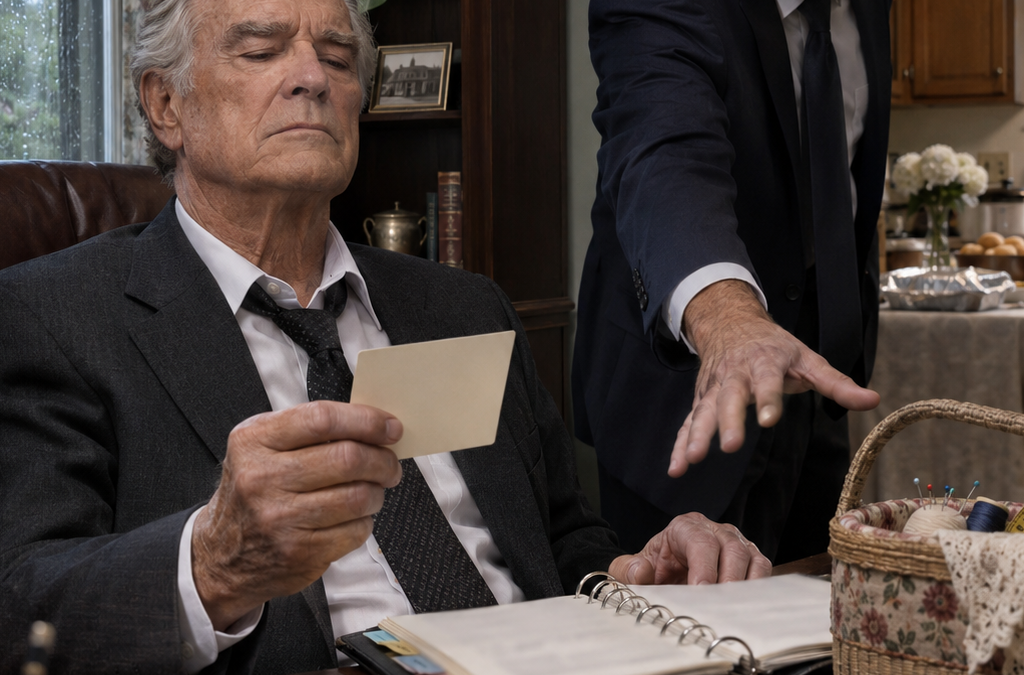
Through the study doorway, I could see Ellen’s tabbed binder beside her sewing basket. Someone had set a funeral program on top of it.
Lynn lowered the spoon.
“The gutters alone, George. And then there’s snow. Ellen used to worry about you on that ladder.”
“It’s May.”
“I know what month it is.”
Daniel pushed a sheet of paper past my plate.
“This just says we can arrange the relocation. We don’t have to do every little thing today.”
“Then leave it.”
“We need to get started.”
Rachel moved a pickle from one side of her plate to the other. She had always hated them. Ellen had always put one on her sandwich anyway.
I picked up my keyring. The worn brass front-door key hung beside the mailbox key.
“Rachel, hold these until lunch is over.”
Her eyes came up.
“Please,” I said. “Before he takes them.”
“Jesus, Dad. I wasn’t going to snatch them.”
His hand was still between our plates.
Rachel took the ring and put it in her cardigan pocket. I had a working spare in my pants pocket, where I’d carried it during Ellen’s hospice care.
I pushed the paper back unsigned.
By approximately 2:15, the food had been covered and Lynn was washing serving spoons. I went into the study and opened Ellen’s binder.
A blue planning sheet was clipped inside. May 10 was written across the top, with my signature below. I left it where it was.
Along another edge, Ellen had written a tab in her small, crowded handwriting: “George stays—4.2.”
She had drawn a crooked line beneath my name. It looked like one of the labels she used on Christmas leftovers.
Daniel stopped in the doorway.
“What are you looking for?”
“Whatever your mother left for me to read.”
“I’ve got the arrangements handled.”
I rubbed a crumb off the binder’s cover.
I had installed the kitchen cabinets he was leaning against earlier. One door still sat slightly low because Ellen wouldn’t let me take it down during Thanksgiving dinner.
For weeks, I had stood under those cabinets crushing ice for her. I had rinsed her cups, logged her medicine, and held the basin when she couldn’t get out of bed.
Now my son wanted my keys before the ham was cold.
Daniel had been six when I adopted him. He kept Price because it was already his name, printed inside his school coat. I had been his father for forty-two years.
“Dad?”
I found a cream-colored card inside the front pocket.
Helen Brooks. Beneath her name were the words “independent trustee.”
A short summary behind it said Ellen’s trust owned the house. Helen would administer the property, and I had a rent-free lifetime right to live here.
Ellen had established the trust four years earlier. We had signed papers, filed copies, then gone back to ordinary things. I remembered lunch afterward better than the appointment.
I read the summary again. Daniel couldn’t decide to sell this house just because he had brought a form.
“Do you know Helen Brooks?” I asked.
“Mom’s paperwork person? I know the name.”
“She’s listed here.”
“Fine. We’ll call whoever we need to call.”
He said it easily, already looking toward the hallway.
“I’m going to call her,” I said.
“Before you get everybody involved, can we talk?”
“We’ve been talking.”
“No. You’ve been making me sound like I’m throwing you out.”
Rachel appeared behind him with a stack of folded dish towels. She had folded them into squares. Ellen folded them in thirds.
“I spent one night at your sister’s,” I said. “I came home this morning.”
“I know where you were.”
“Then why are you acting like I moved?”
Daniel rubbed the back of his neck.
“Because that night happened for a reason. You shouldn’t have been alone.”
“Rachel asked me.”
“And you said yes. Which was good.”
“I wanted company.”
“Right. That’s what I’m saying.”
He looked at Rachel, waiting for her to help. She pressed the towels against her waist.
At seventy-two, I still knew when someone was changing my answer for me.
“I want company,” I said. “I don’t want to leave.”
“You’ve got a room at my place.”
“I’ve got a room here.”
“You’ve got a whole house here. Every noise at night, every step—”
“I can hear a furnace come on without calling an ambulance.”
“That’s not fair.”
His voice cracked on the last word. He glanced away, toward our bedroom.
“I was here when the hospice nurse couldn’t get your phone to ring,” he said. “You were asleep in the chair. Mom needed help, and you were just worn out.”
“I remember.”
“What happens next time? You fall, or you get sick. Who’s here?”
Lynn had come down the hallway drying her hands.
“He’s frightened, George,” she said.
“So am I.”
Daniel’s mouth opened, then closed.
I looked past him at the bedroom door. My bag had tipped against the frame. Inside were yesterday’s socks and the toothbrush Rachel had found for me.
“I’m still sleeping in our bed tonight,” I said.
Rachel set the towels on the desk.
“Dad, do you want me to unpack that?”
“No. I’ll do it.”
She nodded, but her hand stayed on the towels.
I dialed the number on Helen’s card. Daniel stepped out of the doorway, though he didn’t go far.
Helen answered after several rings.
“Mrs. Brooks? This is George Miller. Ellen’s husband.”
“I’m sorry for your loss, Mr. Miller.”
“Thank you. I found your card.”
She waited while I cleared my throat.
“My son wants me to move. He’s talking about selling the house. I need help getting Ellen’s plan handled.”
“Do you have the binder?”
“In front of me.”
“Keep it with you. I’m obtaining the documents I need to accept the trusteeship. We can speak Tuesday.”
“Will you tell me what I need to bring?”
“Yes.”
Her voice was plain and unhurried. I wrote Tuesday on the back of an envelope.
Daniel left while I was still on the phone. Lynn followed after putting the leftover rolls in the freezer.
Rachel stayed to wipe the table. She asked whether I wanted her to stay for dinner.
“Not tonight,” I said.
She kissed my cheek and left. I forgot to ask for the keys in her cardigan.
Afterward, I unpacked my bag. I put my toothbrush beside Ellen’s, then moved it to the other side of the sink.
At 4:18 p.m., my phone lit up on the dresser. An unfamiliar number had sent a text introducing its sender as a real estate agent.
The message proposed a house visit the next morning at 9:30 a.m., “arranged with Daniel Price.”
Chapter 2 of 7
I called the number before I could put it off.
“This is George Miller. You sent me a message about tomorrow.”
“Yes, Mr. Miller. Your son said nine-thirty would work.”
“It won’t. I haven’t authorized a visit or a listing.”
“Oh. I’m sorry. I was told the family had discussed it.”
“We discussed it. I said no.”
I picked at a loose thread on my shirt cuff. This stranger knew my son had gone around me.
“I’ll cancel the appointment,” the agent said. “We won’t come.”
“Thank you.”
“Again, I’m sorry for the misunderstanding.”
I thanked the agent twice more before hanging up.
Saturday came without a knock at nine-thirty. I watched from the front window anyway, holding coffee I had forgotten to drink.
Over the weekend, I found reasons to leave the television on. Weather reports, baseball, a man explaining how to restore a deck. I went to bed when the advertisements started repeating.
Ellen’s pillow still had a hollow in it. I slept facing the dresser.
On Tuesday, May 26, I brought the binder to Helen’s Columbus office. At 10:20 a.m., she set down her pen.
“I’ve checked the death certificate and the trust documents. I’ve accepted the trusteeship.”
She had the recorded deed beside her.
“The house was transferred into Ellen’s trust. Daniel can’t authorize a sale by making arrangements with the family.”
“He seems to think being the oldest settles things.”
“That doesn’t give him authority over trust property.”
I kept my hands on the binder. Helen wore reading glasses on a cord, and one earpiece had caught under her collar.
“So if something needs paying, I call you?”
“For the house expenses covered here, yes. Send me the bills.”
“And if I wanted money sent to one of the kids?”
“You can ask. I can only make payments the trust allows.”
“I wasn’t asking for one.”
“I know. You asked how it works.”
She freed her glasses from her collar.
“I administer the property, Mr. Miller. I don’t decide where you have dinner or who you visit.”
It was the first conversation in days where nobody offered me a bedroom.
Before I left, we went over the house bills. The current budget was $620 monthly for taxes, insurance, and routine maintenance, paid from the trust reserve. My retirement income, $3,100 after deductions, would still arrive in my own checking account.
I folded my list of personal expenses back into my pocket. I could buy groceries and keep the lights on without asking Daniel.
That afternoon, I was sweeping maple seeds out of the driveway when Rachel pulled in. Her dashboard clock showed 3:00 p.m.
“Don’t park on my pile,” I said.
She looked down through her windshield.
“Your pile is most of the driveway.”
“Then you’ve got a difficult decision.”
She parked at the curb.
For a moment, she sounded like herself when she laughed. Then she came toward me carrying a glossy brochure.
“Daniel asked me to bring this.”
I leaned the broom against the garage.
“Of course he did.”
“Dad, please look before you get mad.”
The photograph showed a small cottage with a porch and two matching chairs. No leaves on the walkway. No hose left unwound.
“They have a place open for a tour,” she said.
I found the price inside.
“$3,250 a month?”
“There are services included.”
“That’s more than my retirement check.”
“I’m just bringing it. Nobody signed anything.”
“Did you tell him I wanted to see it?”
“No.”
“Then why make an appointment?”
“It’s a tour time. We don’t have to go.”
I handed the brochure back. She kept both hands behind her, so I laid it on the car’s hood.
A maple seed slid down the windshield between us.
“You could come back to my house,” she said. “Your room’s still there.”
“It was one night, Rachel.”
“I know. I haven’t put anything back in it. The clean towels are still on the chair.”
I looked toward my front door.
“You don’t have to keep a room ready.”
“I like having you there.”
“I liked being there.”
“Then why does everything have to be a fight?”
A car passed slowly behind her. She waited until it was gone.
“I call at night and you sound so far away.”
“The phone’s old.”
“Dad.”
I rubbed the broom handle where the varnish had worn away.
“Nights are hard,” I said. “I keep thinking I hear her ask for water.”
Rachel’s mouth pulled sideways. She looked at the garage floor.
“Come over, then.”
“Sometimes. When I want to.”
“And the tour?”
“No.”
She picked up the brochure. Its corner had curled against the warm hood.
“Daniel worries about everything you’ll have to do.”
“Helen’s handling the house bills. I can hire somebody for work I can’t do.”
“He worries about more than bills.”
“Then he can call me and say that.”
Rachel left without asking me to change my answer. I swept the seeds into a dustpan, including the ones her tires had scattered.
That evening, I ate toast and an egg over the sink. I had set out one of Ellen’s flowered plates, then decided I didn’t want to wash it.
At 7:12 p.m., Rachel forwarded a message from Daniel.
He had asked whether she could help cover a loan. Underneath, she wrote, “He sent me this himself. I thought you should know before agreeing to anything.”
I opened the attached statement and enlarged it with two fingers.
Daniel owed $52,000, due June 19. He had never told me about the deadline.
Chapter 3 of 7
I called Daniel with the loan statement still open on my phone.
“Is moving me connected to what you owe?”
“Rachel sent you that?”
“She did. I’m asking you.”
“Yes, Dad. Some of it is.”
I sat on the edge of the bed.
“How much of it?”
“Mom provided a transition payment. Sixty thousand, if you move. I expected to use it for the loan.”
“Expected before you asked me?”
“We had talked about you coming here.”
“You could have told me about the debt.”
“And then everything I said would sound like money.”
I looked at Ellen’s slippers beneath the dresser.
“It sounds like money now.”
“That doesn’t mean I’m not worried about you. Both things can be true.”
“Then stop arranging things after I say no.”
“I have a room ready. You’re eating by yourself over there.”
“I ate by myself before you borrowed anything.”
He went quiet for a few seconds.
“That was cheap, Dad.”
I rubbed my eyes with my free hand.
“Yes. It was.”
Neither of us apologized for the rest of it.
On Thursday, May 28, his message came while I was making a grocery list.
“I can’t keep doing the $400 a month for groceries and rides. I can help here, but I can’t support two households while you refuse to combine them.”
He had started helping during Ellen’s illness. Sometimes he brought bags himself. Other times, he drove me and carried everything inside.
I typed, “Are you still taking me today?”
His answer came quickly.
“No. You’ll need to arrange that.”
I put the list down. For several minutes, I watched a fly work along the window screen.
The refrigerator still held foil trays from the funeral. I wanted a peach. I wanted bread that hadn’t been bought for people coming to tell me they were sorry.
I booked a $36 ride.
Waiting on the porch, I checked the car description three times. Daniel would have honked twice, then complained about the maple branches scraping his truck.
The street stayed quiet.
I had my own money. My regular expenses left room for this. Still, I kept thinking about paying someone to make a trip my son used to make with me.
When the car arrived, I started down the steps too early.
“Take your time,” the driver called.
“I am.”
I wasn’t. I had forgotten to lock the door.
I went back, used my spare, and checked the knob.
The driver asked which entrance I wanted at the grocery store.
“The one by the produce.”
“Sure.”
I watched houses pass through the window. A man was washing lawn chairs in his driveway. At the next corner, a woman wrestled a folded stroller into a trunk.
For months, my trips outside had been for prescriptions or medical supplies. Before that, I had stopped going anywhere that took me far from Ellen.
I had let everything get smaller. Even my grocery list had become things she could swallow.
At the store, I bought peaches, chicken thighs, and a small bag of potatoes. I stood too long in front of the cereal.
Ellen used to buy raisin bran and shake extra raisins into it. She called that cooking breakfast.
I bought cornflakes.
Near the checkout, Rachel called.
“Did Daniel take you?”
“I got a ride.”
“Oh, Dad.”
“Don’t do that. I got here fine.”
“I’m finishing at school. Do you want me to bring you home?”
“Yes,” I said. “That would help.”
She arrived while I was sitting on the bench beside the carts. She took the bags I handed her, without reaching for the receipt.
“Do you need to tell Daniel you’ve got me?” I asked.
“No.”
“Or what I bought?”
She stopped with the trunk open.
“Have I been doing that?”
“You tell him things. Then he calls about them.”
She moved a bag so the peaches wouldn’t roll.
“I won’t.”
On the way home, she kept both hands on the wheel.
“At lunch, I thought if I didn’t argue, you two might settle down.”
“You looked at your plate.”
“I know.”
“I was waiting for you.”
She missed the turn and went around the block.
“I thought agreeing with him was helping you both,” she said. “He sounded like he had a plan. I didn’t have one.”
“I didn’t need you to have a plan.”
She nodded, watching the intersection.
At home, she carried in the groceries and asked where I wanted them. I told her to leave them on the counter.
“I can put my own cornflakes away.”
“I wasn’t questioning your cereal abilities.”
“That’s good. I’ve had years of training.”
She laughed, then wiped under one eye with her knuckle.
After she left, I cooked a chicken thigh and potatoes. I ate at the table. The other chicken went into the freezer in portions I could use.
At 6:05 p.m., Rachel came back.
She stood on the porch holding her phone, her work bag still over her shoulder.
“Daniel sent something,” she said.
“What now?”
“He asked me to remind you of your own decision.”
“No gutters this time?”
“No. He sent a picture he took.”
She handed me the phone.
The paper in the photograph was blue. I recognized the crease across its middle before I enlarged the writing.
May 10 was written at the top.
Below it were the words, “After Ellen dies, I plan to move into Daniel’s downstairs room.”
The signature underneath was mine.
Chapter 4 of 7
“I signed it,” I told Rachel. “Nobody pushed my hand.”
She stayed beside me on the porch while I studied the photograph.
“Did you want to go when you signed?”
“Yes. Your mother was in the bedroom. I couldn’t picture being here without her.”
“Should I help arrange it, then?”
“No. I want to stay.”
Rachel shifted her bag higher on her shoulder.
“What do I tell Daniel?”
“What I just told you.”
I handed back her phone. Through the screen door, I could see Ellen’s sweater hanging over a dining chair.
“I meant it that Sunday,” I said. “I’m not pretending I didn’t.”
“I know.”
“But this week I bought groceries. I slept here. It’s different from sitting beside her bed, trying to imagine afterward.”
Rachel put her phone away.
“Okay,” she said. “I’ll tell him you’re staying.”
On Tuesday, June 2, Helen’s email arrived at 11:00 a.m. She had sent the complete signed trust and an administrative notice to all three of us.
I printed my copy in the study. The machine pulled two sheets together, then complained until I opened its back panel. Ellen had taped a note there years before: USE BOTH HANDS, GEORGE.
I used both hands.
Daniel called while I was straightening the pages.
“I got the packet,” he said. “Helen’s going to call us at two-thirty.”
“All right.”
“We should be able to get the payment scheduled.”
“Daniel, I told Rachel—”
“I know what you told Rachel. Let’s talk with Helen.”
At 2:30 p.m., I sat at the study desk with the phone on speaker. Daniel joined the call already talking.
“I can get the house cleared once Dad’s settled. I know people who can handle the work before it goes up.”
“Mr. Price,” Helen said, “you can’t arrange a listing.”
“I’m not saying tomorrow. I mean after—”
“I administer the house. I also control payments from the trust accounts.”
There was a click on his end, followed by paper sliding.
“Then I send the agent to you?”
“No agent has been authorized.”
“I’m the one coordinating this for the family.”
“That doesn’t authorize you to act for the trust.”
I moved my coffee away from Ellen’s binder.
Daniel stopped shuffling his papers.
“All right,” he said. “Then let’s deal with what Dad signed.”
Helen asked whether we both had the materials she had sent.
“Yes,” I said.
“I have them,” Daniel said. “And I have his agreement.”
“George has a protected right to live in the house,” Helen said.
“That’s why we wrote down his choice. Nobody wanted confusion later.”
I ran my thumb over Ellen’s handwritten tab.
“She marked this,” I said. “‘George stays—4.2.’ It’s right here in her binder.”
“I have the executed section,” Helen said.
“I’d like to sit down with you. About what I want now.”
Daniel let out a sharp breath.
“Dad, I put a bathroom door in. I moved my tools out of that room. You picked where the bed would go.”
“I remember.”
“You said you didn’t want to climb stairs at night. I changed the room because you asked.”
“You showed me where things could fit. I said it looked good.”
“You did more than that.”
“Yes. I signed the sheet.”
My desk chair creaked when I leaned forward.
“I’m not denying what you did.”
“Then why am I the one left holding everything?”
“You’ve still got a room you can use.”
“A downstairs room with grab bars where I used to keep my equipment.”
His voice had risen. I heard him set something down hard.
“Sorry,” he said, though I didn’t know which of us he meant. “Look, I spent money. I made plans. You can’t keep saying I dreamed this up.”
“I haven’t said that.”
“You’re acting like I came over after the funeral with some scheme.”
I looked toward the kitchen. From the desk, I could see the cabinet door Ellen had refused to let me straighten.
“You came over and reached for my keys,” I said.
“I was trying to get things moving.”
“I know.”
Helen waited until neither of us spoke.
“We can meet in person,” she said. “Attendance is voluntary. I’ll address the pending administration questions.”
“Can Rachel come?” I asked.
“Yes.”
“And Lynn. She heard us at lunch.”
Daniel answered before Helen could.
“Fine. Let them hear what we actually agreed to.”
At 4:00 p.m., Helen confirmed the appointment: Friday, June 5, at 10:00 a.m., in her Columbus office. Rachel and Lynn both agreed to attend.
I wrote it on the kitchen calendar. Ellen had already filled in the trash pickup changes for the summer. My handwriting crowded the square beneath hers.
Rachel called afterward.
“Do you want me to drive you Friday?”
“Yes. But I’ll carry my binder.”
“I figured you would.”
“And I’ll talk.”
“I figured that, too.”
I went outside and watered the two pots by the steps. One had drained onto the porch, leaving a dirty crescent. I scrubbed it with my shoe until I only made it wider.
Daniel had done work for me before. He was good with doors. He could make an old frame close without scraping the floor.
I had thanked him for that downstairs room. I could thank him again.
I still wanted to sleep here.
At 6:42 p.m., my phone sounded while I was rinsing the watering can.
Daniel had sent Rachel and me a receipt. The $450 moving reservation was marked paid and nonrefundable.
Pickup at my house was scheduled for Saturday, June 6, at 8:00 a.m.
Chapter 5 of 7
I called Daniel with the moving receipt open.
“You haven’t got permission to send anyone into this house.”
“It’s a reservation, Dad. It protects an available slot.”
“Then tell them that. They aren’t taking my things.”
“I heard you.”
I called the mover next, using the number on the receipt.
“My son booked this. I live at the pickup address. I haven’t agreed to move.”
The woman asked for the reservation number, then waited while I found it.
“We can’t collect anything without access authorized by the resident,” she said.
“Please put that down.”
“I will.”
I wrote her answer on the receipt’s blank reverse side. Then I put it beneath the binder.
On Thursday, June 4, Rachel came after work. She asked before setting her bag on Ellen’s sewing chair.
“The desk is better,” I said. “There might still be pins.”
She moved it.
We opened the binder where the blue sheet had been clipped. Its edge had slipped beneath a folded household checklist.
“There,” Rachel said.
She lifted the checklist and opened the clip. She put the original sheet in my hands.
The paper had a dent where I had pressed too hard signing it. I remembered balancing it on a magazine outside our bedroom.
“Do you want a sleeve for it?” she asked.
“No. Clip it back where it was.”
“You’re bringing it?”
“It’s mine. So is the signature.”
She watched me smooth the crease.
“I’m not going to sit there and say he made it up.”
“Nobody’s asking you to.”
“I know. I’m saying it out loud.”
From the kitchen came the refrigerator’s uneven rattle. Ellen used to stop it by pushing a folded takeout menu beneath one foot. I had replaced the menu with a proper shim, and somehow the rattle had returned.
Rachel glanced toward it.
“Don’t,” I said. “It’s winning today.”
She let out a small laugh and pulled the desk chair closer.
I waited until she sat.
“Why have you still got my keys?”
Her hand went toward her bag, then stopped.
“I should have brought them back.”
“You’ve been here.”
“I know.”
“Did you think I’d lose them?”
“No, Dad.”
She looked at the clip in my hand.
“At first, you asked me to hold them. Then bringing them back felt like—I knew Daniel would ask about it.”
“They open my front door, Rachel.”
“I know that.”
I laid my working spare on the desk between us.
“I’ve been using this. But I shouldn’t have to ask.”
“You shouldn’t.”
She rubbed a spot on her skirt.
“I kept putting it off. Giving them back where he could see would be choosing. I kept hoping you two would settle it first.”
I picked up the spare and slipped it into my pocket.
“I can’t settle it by disappearing.”
She nodded without looking up.
Later that Thursday, Helen copied us on Daniel’s written request. He asked for a $60,000 distribution after the proposed move, with $52,000 sent directly to his lender.
Below the request, he had listed the downstairs work and attached the moving receipt.
I read it at the desk while Rachel stood by the window.
“He’s put it all together,” she said.
“Yes.”
“Do you want to answer?”
“I’ll answer tomorrow. In person.”
I put the request behind my copy of the trust. The clip barely closed.
Friday morning, June 5, I shaved twice over the same patch beneath my chin. Rachel arrived while I was changing shirts.
“Take your time,” she called through the screen.
“I’m ready.”
I wasn’t. I had put the binder beside the wrong shoes.
On the drive to Helen’s Columbus office, Rachel asked whether I wanted the radio.
“Leave it off.”
She did.
Lynn was already in the waiting area when we arrived. Daniel stood beside her, holding a folder against his leg.
“There he is,” Lynn said. “Daniel’s been keeping everything moving.”
He gave her a tired nod.
“I’ve been trying.”
She reached for my elbow.
“We’ll get you comfortable, George. Daniel can explain what’s been arranged.”
“I’ll speak for myself.”
Her hand dropped.
“Well, of course.”
I sat with the binder across my knees. Rachel took the chair beside me.
Daniel stayed standing.
“I’m not trying to speak over anybody,” he said. “But we keep starting from scratch.”
Lynn folded her purse strap into her lap.
“What do you need settled today?”
“The schedule,” Daniel said. “Dad made his permanent choice on May 10. The room’s ready. Helen handles the house and the payment. I’m not arguing with that.”
I kept my fingers around the binder’s edge.
“She needs to carry out what we agreed,” he continued. “We can’t keep making arrangements and unmaking them.”
Rachel looked at him.
“He’s told you he wants to stay.”
“And I heard him. But I heard him in May, too.”
Lynn turned toward me, then back toward Daniel. Her purse strap sprang loose.
Rachel’s phone vibrated.
She glanced down, frowned, and turned the screen toward me.
It was 9:58 a.m. The mover had sent her a revised confirmation. Daniel had supplied her name as the contact.
The pickup had been advanced from Saturday.
The new confirmation named an 11:00 a.m. pickup at my house that morning.
Chapter 6 of 7
“Put the keys here,” I told Rachel.
I pointed to the conference table, then slid her phone toward Helen. The revised pickup time filled the screen.
“Nobody has permission to enter my house. Daniel, cancel it.”
He pulled out a chair.
“The movers can wait while we settle the paperwork.”
“They’re coming at eleven. You changed it without asking.”
“I thought we could finish this today.”
Helen glanced at the message, then returned the phone to Rachel.
We had barely sat down. Her desk clock read 10:00 a.m.
Daniel laid his folder beside the water pitcher. Lynn reached to straighten the papers sticking out.
“Dad signed freely,” he said. “The room’s finished. He chose the paint, for God’s sake.”
“I chose from two cans you already had.”
“You said the lighter one. You talked about putting your reading chair by the window.”
“Yes.”
“This isn’t me asking for an early inheritance. Mom provided a payment when he moved. We planned around that.”
Rachel kept her bag in her lap. I could hear my keyring against its zipper.
Daniel looked at Helen.
“I’ve spent money because he said he was coming. Now everyone’s treating that like it never happened.”
I opened my binder. The clip caught the blue sheet, and I had to work it loose.
“It happened,” I said.
I placed the original beside the executed trust, open to Section 4.2. My finger rested below my signature.
“May 10. That’s when I signed.”
Daniel leaned forward.
“Exactly.”
“Ellen died May 17.”
I moved my finger to the trust page.
“Can that earlier signature give up my right to stay? These dates aren’t the same.”
Helen drew both pages closer without lifting them.
Daniel pressed his palms against the table.
“People make plans before somebody dies. They have to. Grief can’t undo every agreement afterward.”
“I’m asking about this one.”
“And I’m saying you were clear-headed. You knew what you wanted. You weren’t confused.”
“I’m not confused today, either.”
He looked toward Rachel.
“You’ve been over there. His bag was still packed.”
“One night,” I said. “I stayed with her one night. I brought the bag home.”
“You had the room ready here,” Lynn added, looking at Daniel.
“And I still slept at home,” I said. “I’ve got my spare key in my pocket. My clothes are there. I haven’t left.”
Helen turned to me.
“Have you made a written election to leave since Ellen died?”
“No.”
“Only a voluntary written election made after Ellen’s death, followed by permanent departure that I confirm, activates the payment. A plan signed before her death or a temporary stay elsewhere doesn’t qualify.”
Daniel stared at the blue paper.
“So that week makes everything I did worthless?”
Helen waited while he pulled his folder closer.
“He could sign now,” he said. “If we stopped making this harder.”
“I’m not signing,” I said.
The water pitcher had left a damp circle beside my binder. I moved the blue sheet away from it.
Ellen’s handwritten tab stuck out between us. She had pointed me to the section; the signed pages held the terms.
Daniel tapped his request.
“The money goes after the move. That’s what I asked for. I didn’t ask you to pay it this morning.”
“You’re asking me to approve it based on a move George hasn’t elected to make,” Helen said.
“I have a deadline.”
“I have your request.”
She set it squarely in front of her.
“I will not authorize the proposed sale. There will be no $60,000 distribution.”
Daniel’s hand stayed on the edge of his folder.
“But there’s money in the account.”
“That does not make this request payable.”
He looked at me, then at Lynn. His chair scraped backward.
Lynn started gathering the moving papers near her elbow. Then she stopped and left them where they lay.
“Dad being quiet didn’t mean he agreed,” Rachel said.
She opened her bag. In front of Daniel and Lynn, she returned my keys, laying the ring where I had pointed.
I picked it up. The brass key settled against my thumb.
“I’m staying. Any visit starts with asking me.”
Daniel stood with one hand on his chair.
“Lynn, would you talk to him? Just without everybody—”
“No, Daniel.”
“You said this made sense.”
“I thought he wanted it.”
“He signed.”
“I heard him today.”
Rachel stayed beside me. She didn’t reach for my binder or suggest we leave.
Daniel gathered his papers himself. One slid beneath the chair, and he bent to retrieve it.
“Cancel the pickup,” I said.
He took out his phone and called.
“This is Daniel Price. I need to cancel today’s pickup.”
He listened, staring at the carpet.
“No. Don’t send the truck. There’s no authorized access.”
His jaw shifted.
“Yes, I know about the deposit. Send me confirmation.”
After he hung up, Helen told us we would receive her decisions in writing. I closed the binder and checked that the original sheet was clipped inside.
By 10:45, we were outside her office. Lynn went ahead toward the elevator. Rachel waited a few steps away.
Daniel stopped beside me, his folder tucked under his arm.
“Separate from the trust,” he said.
I waited.
“Can you lend me $22,000 by June 19?”
Chapter 7 of 7
“No, Daniel. I won’t lend you the money.”
He shifted the folder under his arm.
“I’m not asking you to pay the whole thing.”
“I heard what you asked.”
“I could pay you back.”
“I’m keeping my retirement money.”
Rachel stood near the elevator, studying the buttons without pressing one. Daniel glanced toward her, then back at me.
“So what do we do now?”
“You handle the loan. If you want to come over, call and ask first.”
He rubbed the corner of his folder against his pants.
“I need to make some calls.”
“All right.”
He walked past Rachel. She moved aside, and neither of them spoke.
On the ride home, I held my binder on my knees. My keys were in my pocket. Every turn brought them against my leg.
Rachel pulled into my driveway.
“Do you want company?”
“For a little while.”
She stayed until I had made a sandwich. Then she asked whether I wanted her to leave.
“Yes,” I said. “I’m going to lie down.”
She rinsed her glass and went home.
On Monday, June 8, Helen sent the written confirmation. She would not authorize the proposed sale, and Daniel’s pending distribution request was denied.
I filed it behind the trust pages. The notice concerned those decisions. It didn’t erase Daniel from Ellen’s plan.
Later, Daniel forwarded the mover’s cancellation confirmation. The $450 reservation deposit was nonrefundable under the booking terms.
He added nothing.
I started to type a reply, then closed the message. There wasn’t anything useful I could say about that money.
The house took longer to settle than the paperwork.
Some mornings, I still reached for two bowls. Once, I called toward the bedroom because I couldn’t find the scissors. I found them before I finished saying Ellen’s name.
I left her sweater on the dining chair.
On Friday, June 12, Daniel emailed again.
“Sold the pickup for $28,000. Paid the $6,000 lien. That leaves $22,000 for the loan.”
The sale and payoff receipts were attached.
I read his message at the kitchen table. He had kept straps behind that truck’s seat, along with pencils and gloves he never matched.
I typed, “I got your email. Thank you for telling me.”
I didn’t tell him he should have sold it sooner.
On June 19, his next message arrived.
“Paid the $22,000 today. The lender agreed in writing to twelve months on the remaining $30,000.”
He attached the signed extension. There was no request beneath it.
I wrote, “Glad you worked something out.”
His answer came that evening.
“Still a lot to pay.”
“Yes,” I wrote back.
I sat awhile before sending it. I wanted to add something that would make us sound like we used to sound. Nothing came that I could honestly put there.
Rachel called the following week while I was sorting laundry.
“Would Saturday be good for a visit?”
“Afternoon. I’ve got things to do in the morning.”
“Two?”
“Two works.”
She came at two. When I said I didn’t want to go out for dinner, she put her car keys back in her bag.
“Want me to pick something up?”
“I’ve got pork chops.”
“Enough for me?”
“If you don’t eat both.”
She stayed at the table while I cooked. She asked about the grocery store and a neighbor’s tomato plants. My afternoon didn’t become a report for her brother.
Later, when I dropped a dish towel, she started to get up.
“I’ve got it,” I said.
She sat back down.
I let her dry the plates.
By July, I had returned to the hardware store without needing a reason beyond looking around. I bought furnace filters and spent too long comparing two identical garden nozzles.
The stairs still needed a better handhold at the turn. I had noticed it while carrying clean sheets upstairs, then put the sheets down and measured.
On Monday, July 6, I paid $180 for the rail I had chosen. The installer asked where I wanted it.
I showed him my pencil marks.
“Right there?”
“Let me try it once.”
He held it while I put my hand around it. We moved it slightly higher.
Rachel came by after asking first. She watched me carry the folded sheets upstairs.
“How’s it feel?”
“Like a rail.”
“Excellent review.”
“Put it on the receipt.”
She laughed. I left the receipt on the counter until I finished making dinner.
Daniel’s downstairs room stayed at his house. My reading chair stayed by my window.
We spoke occasionally. Once he called about a rattle in a work tool, and we spent several minutes arguing over which part was worn.
Then he said he had to go.
“Call sometime,” I told him.
“I just did, Dad.”
“Yes. You did.”
That was as far as we got that day.
On Sunday, August 9, Rachel arrived for coffee at 8:30 a.m. I had picked the time because the porch would still be shaded.
She brought nothing. I had told her I had everything we needed.
Our porch table had one short leg. Ellen had marked that leg underneath with red nail polish, so we’d know where to put the folded cardboard.
Rachel touched the table as she sat.
“Still got the red dot?”
“Underneath.”
“You could fix it.”
“Then what would hold that cardboard?”
She shook her head and took her coffee.
We talked about her school starting up again. I told her I planned to get a haircut Tuesday and buy peaches afterward.
“Want a ride?”
“No, thanks. I’ve got it arranged.”
“Okay.”
A squirrel dug in the flowerpot beside the steps. I tapped my shoe against the boards, and it fled with a mouthful of dirt.
Rachel stayed until her coffee was gone. When she stood, I stood too.
“I can find my car,” she said.
“I’m walking you out.”
At the curb, she kissed my cheek.
“Next Sunday?”
“Call me during the week.”
“I will.”
I watched her pull away, then went back inside. The worn brass key rested against the mailbox key in my palm.
I hung my keys beside the door.







