At my husband’s funeral lunch, his brother demanded our $240,000 retirement fund before dessert; he didn’t know what my husband had put in my hands.
Chapter 1 of 7
Frank placed a prepared disclaimer beside my empty dessert plate. Behind it was another page headed “Payment Instructions.”
“Sign here, Ellen. We can finish before everybody leaves.”
“I buried him this morning.”
“You were his nurse, not his real family.”
Luke sat across from me, still wearing his funeral tie. He looked toward the private room’s closed door.
The restaurant’s air-conditioning blew against my ankles. I still wore the shoes I’d bought for hospice visits, black flats with rubber soles. One heel had rubbed through my stocking.
“The account was our retirement money,” I said.
“David and I made arrangements years ago. Before you two married.”
“Then why do you need me to sign?”
“To keep this from becoming a problem. Please, honey. Today’s hard enough.”
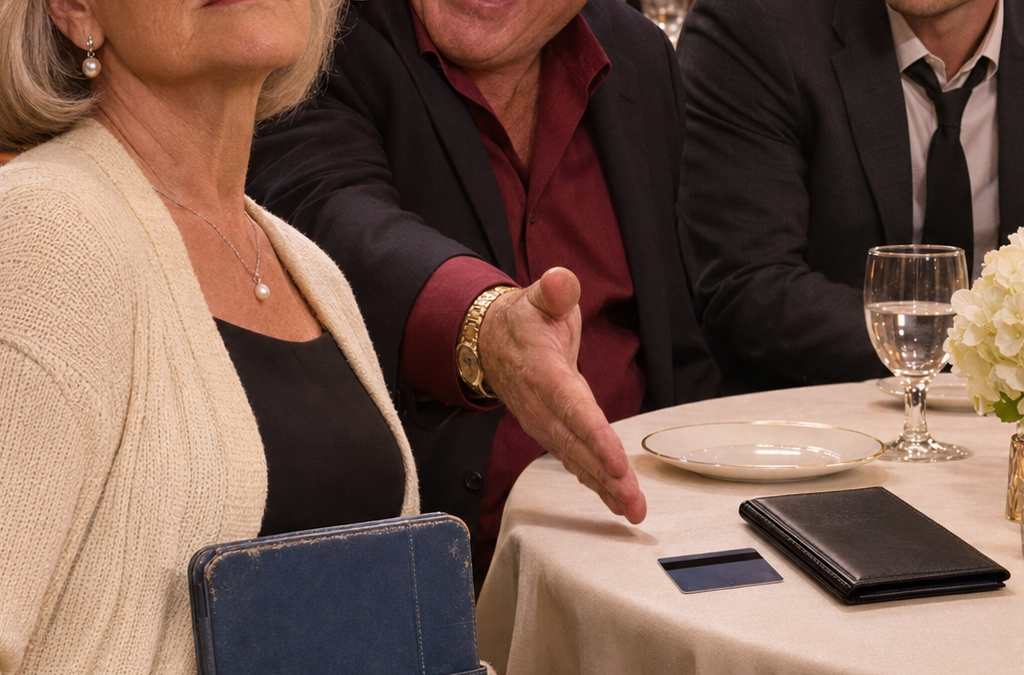
I drew David’s tablet from my handbag. Its worn blue cover caught on the lining. I rested it against my knees, under the table’s edge.
The lunch had started at 12:30. Someone had ordered coffee nobody seemed to want.
Beside the check, I had already put my credit card. Nobody had asked me to pay. I had seen the little black folder and done what I always did.
Frank glanced at it.
“We appreciate you taking care of lunch.”
I looked at the disclaimer again. My name was typed beneath the signature line.
“You had this ready.”
“I wanted to save you running around.”
“Before the funeral.”
“The bank needs paperwork, Ellen. Grief doesn’t stop that.”
Luke’s plate held a square of lasagna with its browned cheese peeled off. David used to call that taking the roof off dinner. I almost said it, then couldn’t get the words out.
Frank continued.
“You keep your house. You have your monthly money. This account was something between brothers.”
“I’m his wife.”
“I know what you were to him. I’m talking about what he arranged.”
The waitress opened the door a few inches.
“Anybody ready for cake?”
“Give us a minute,” Frank said.
She looked at me before withdrawing. I wished I had said yes.
Frank turned toward Luke.
“You can witness her signature. You don’t have to get involved in the money.”
Luke’s mouth opened.
“Uncle Frank, I don’t—”
“Just that she signed in front of you. That’s all.”
“I haven’t agreed to sign,” I said.
“Of course. Read it first.”
“There’s another page attached.”
“Where the payment would go. So there’s no confusion afterward.”
“Into your account?”
“It would come to me under our arrangement. I’d handle what needed handling.”
The tablecloth had a cigarette burn near my plate, although nobody could smoke there anymore. I kept looking at that little brown ring.
“Which things?” I asked.
“David’s wishes. Family obligations. We don’t need to make a list here.”
“You brought a place for my signature. Bring a list.”
Frank leaned back.
“All right. We can discuss details later. For now, let me deal with the correspondence. Forward anything the bank sends you.”
“No.”
“You shouldn’t have to sit home answering questions about forms David handled.”
“I can answer my own mail.”
“You’ve barely slept. Luke, tell her there’s nothing wrong with letting somebody help.”
Luke looked at me then. His eyes were red, too.
“She’s tired,” he said.
That was all he offered.
Frank’s voice softened.
“Exactly. Let me carry this part. You can get through the next few weeks without another burden.”
“The letters would still be mine.”
“Yes, but—”
“And the signature.”
“Nobody’s taking anything from you.”
I could see the indentation where the pages had been stapled. He had assembled them somewhere quiet, with a desk and enough time.
“Being family didn’t make my signature yours,” I said.
Frank glanced toward the door. Beyond it, people were laughing over something near the register. He waited until they passed.
“Let’s keep our voices down.”
“Mine wasn’t raised.”
“I’m trying to keep this private. David wouldn’t want his business discussed in a restaurant.”
“Then you could have waited until we left it.”
His phone vibrated beside his plate.
He glanced down, then bent closer. Whatever he saw held him there.
Frank started reading the new message a second time.
His fork stayed above the plate.
“They won’t extend it?”
Luke frowned. “What?”
Frank turned the phone toward him.
“The payoff. They’re keeping June 30.”
On the screen, below the lender’s notification, I could see $48,000.
“The renovation loan?” Luke asked.
“I asked for more time. They’ve had all the information for weeks.”
“Can you call them?”
“I have called them.”
Frank looked at my unsigned pages.
“This is why delays create trouble. Money sitting somewhere while people need decisions.”
“Your loan,” I said.
“It’s an obligation I planned around. That doesn’t change what David wanted.”
While he explained it to Luke again, I woke the tablet against my knees.
The saved message was still there, below an appointment reminder and an unread weather alert.
The header read “May 12, 2026, 2:31 PM.” Riverbend’s confirmation named me as David’s updated IRA beneficiary.
I read the acknowledgment once. Then again.
Frank was saying, “They’re treating it like I haven’t been making payments.”
I found the bank’s listed number on its website and called from my phone. When someone answered, I said I needed help with my late husband’s account.
Frank stopped talking.
“Who are you calling?”
“The bank.”
“They won’t settle this over lunch.”
I gave the representative my information and stayed on the line. She sent a secure upload link and said the beneficiary officer would call me back. I photographed the unsigned pages where they lay.
“You could have asked me,” Frank said.
“I did.”
At about 1:15, my phone rang. The woman introduced herself as Rachel Grant, Riverbend’s beneficiary officer in downtown Dayton, Ohio.
“Mrs. Miller, I have your image open. Are you somewhere you can talk?”
“Yes.”
Frank’s chair scraped closer.
“Put her on speaker.”
I kept the phone against my ear.
The bank officer stopped halfway through the image I’d sent.
Her voice changed. “A competing claim arrived at 10:14.”
“This morning?”
“Yes. From Frank Bennett.”
I looked at him. He watched my face without asking what she had said.
“He brought this paper to lunch,” I told her.
“Have you signed it?”
“No.”
“Don’t upload a signed copy unless you’ve decided to give up your claim. We’ll record that you haven’t done that.”
“I want you to review the account. I’m not agreeing to any payment to him.”
“Understood. We’ll need to follow up with both of you.”
After the call, Frank said, “A hold is routine when there are questions.”
“You filed before the funeral lunch.”
“I submitted what I had. You were occupied.”
“With burying your brother.”
“Yes, Ellen. I know. That’s why I didn’t bring it to you yesterday.”
Luke stared at the coffee stain beside his saucer.
“Did you know?” I asked him.
“About the claim? No.”
“About these papers?”
“He said there was something to straighten out.”
Frank cut in gently. “There is. Nobody needs to turn this into sides.”
Luke said nothing more. His phone lit up, but he let it go dark. I waited for him to look at me again. He didn’t.
“I need that money to help me live,” I said. “When I need care, there won’t be a wife doing it for free.”
“I’m not suggesting you go without.”
“You haven’t asked what I need.”
“We can discuss that when you’re feeling better.”
“I’m not going to apologize for needing retirement money.”
Frank studied me across the remains of lunch. Then he opened the folder he had brought.
He pushed forward a designation dated September 16, 2014. His own name appeared beneath David’s.
“Ask them whether that’s real.”
Chapter 2 of 7
The older form was real.
Rachel confirmed it when she called Monday, June 15. I was standing in my kitchen, beside a sink full of rinsed cups.
“The copy Mr. Bennett brought matches our retained record,” she said.
“So he didn’t make it up.”
“No.”
“I have something from the bank, too.”
“We’ll review both claims. I can’t release the money because you ask me to.”
“I wasn’t asking you to skip anything.”
“I know, Mrs. Miller. I’m telling you what happens next.”
The refrigerator motor started behind me. I had expected a fake signature, some corner he had cut. Instead, Frank had brought something David really signed.
“Please don’t send my answers through him,” I said.
“We’ll contact you directly.”
That afternoon, I paid Beth Collins $225 for forty-five minutes in her Dayton office. She was an Ohio estate-planning attorney, and her appointment reminder had told me to bring copies.
I brought the unsigned disclaimer, the proposed payment instructions, and the bank correspondence.
“Did you sign anything?” she asked.
“No.”
“Good. Don’t sign this without advice.”
She read both pages. I watched the clock above her bookcase, spending minutes I had paid for.
“Tell me what you need this money to do.”
“I don’t know how to answer that.”
“Start with next year.”
“Keep me in my house. Help with bills.”
“What else?”
“If I need somebody to come in. Help me bathe, maybe. Drive me.”
My voice caught on the last word. David had hated asking for rides.
“I needed care, too.”
Beth waited while I cleared my throat.
“Frank has a loan,” I said. “There’s always something somebody needs paid. I can’t have this become another rescue.”
“This IRA follows the beneficiary instructions accepted by the bank,” she said. “An executor’s preference wouldn’t decide it.”
“Does the bank’s message settle it?”
“I haven’t seen their full record. I won’t promise you that.”
She said it without softening it. I liked her better for that, although I had wanted a different answer.
“Then what am I paying you for?”
The question came out sharper than I intended.
“To help you avoid signing away a claim while it’s being reviewed.”
“I’m sorry.”
“You can ask what you’re paying for.”
When our time ended, she gave me a receipt. There was no promise about getting the fee back.
Frank was on my porch when I got home. He stood beside the chair David had always said sat too low.
“I tried calling,” he said.
“I had an appointment.”
“With somebody about the account?”
“Yes.”
He waited for more. I unlocked the door but stayed outside.
“Ellen, you don’t need more fees. Let me be the family’s point of contact.”
“The bank has my number.”
“They can keep it. I’m talking about coordinating things so you’re not paying someone every time a letter comes.”
“I’ll read my own letters.”
“You can still read them. Just send them to me first, and we can decide what needs an answer.”
“No, Frank.”
He looked past me into the front hall.
“I’m trying to keep this manageable.”
“Then stop bringing me things to sign.”
“I haven’t brought anything today.”
“All right. But I’m not agreeing to anything today, either.”
A lawn mower started two houses down. He waited for it to pass before speaking again.
“About July. The six-fifty I said I could help with.”
I stayed beside the door.
“I can’t commit to that now,” he said. “Not with my loan coming due and all this unresolved.”
“You said it would help me get through the first month.”
“And I meant it. But I can’t support two households while money gets spent on a dispute.”
“I paid for advice.”
“That’s your choice, honey. I have to make choices, too.”
For a moment, I nearly told him I would find a cheaper lawyer. The words were ready, the way thank-you had been ready when he first offered the money.
“I won’t count on it,” I said.
“I’m not withdrawing from the family.”
“I said I won’t count on the money.”
He left without coming inside.
At the kitchen table, I opened my checking account on my phone. It showed $2,100, before the attorney’s payment cleared.
My monthly income was $1,740. The house and utilities took $1,860. The missing $650 had been groceries, breathing room, a bill paid without checking twice.
David used to put a question mark beside the grocery total when I bought decent peaches. Then he ate three over the sink.
I had bought two that morning. They were still in the bag.
I wrote Rachel that Frank had no permission to receive my claim updates or speak for me. Her reply confirmed that and mentioned a request for the archived source record behind the newer submission. It would take more time.
I ate one peach with toast for supper. I left the other on the counter.
For the next two days, I answered ordinary messages about flowers and leftover food. When someone asked whether Frank was handling the money, I said the bank was reviewing it.
By Thursday morning, my phone had become something I checked before touching my coffee.
A new message appeared in the family thread under Frank’s name.
“Luke has been asked to change what he remembers.”
Chapter 3 of 7
I called Luke before I finished reading the replies.
“Have I ever asked you to change what you remember?”
“No.”
“Then why is that in the family thread?”
“I didn’t write it, Ellen.”
“I know who wrote it.”
He went quiet. Behind him, something metal struck concrete.
It was Thursday, June 18. His uncle’s message had already collected replies about keeping peace and respecting David. Nobody had asked me what happened.
“Did you tell Frank I was calling the bank?”
“Yes. I thought we were getting things settled.”
“What else?”
“Just that you’d talked to somebody. And you weren’t signing yet.”
I hadn’t asked him to change anything. I had barely asked him for anything.
“Can I see you?” I said.
“I’ve got another job this afternoon.”
“Before that.”
He told me where to meet him.
The HVAC depot sat behind a chain-link fence in Dayton, Ohio. I parked beside two service vans. A crushed paper cup rolled along the curb without getting anywhere.
Luke came out wearing work boots and a shirt darkened under the arms. He had a sandwich wrapped in wax paper.
“You haven’t eaten?” he asked.
“I didn’t come for lunch.”
“I know. I just—there’s a vending machine.”
“I’m fine.”
He stood beside my car instead of getting in. The sun caught the pale line where his wedding-size glove cuff usually covered his wrist.
“Frank said you were worried about paperwork,” he said. “I thought if he knew what the bank needed, he could help.”
“He wanted me to sign the money away.”
“He said you two were still discussing it.”
“You were at the table.”
Luke looked toward the open depot door.
“You heard him.”
“Yeah.”
“And afterward, you told him about my calls.”
“I didn’t give him account numbers.”
“That wasn’t what I asked.”
His sandwich sagged in its wrapper. David used to complain that Luke ate standing up, like somebody might repossess his lunch chair.
“I thought it would stop everybody arguing,” Luke said.
“Did it?”
“No.”
His phone buzzed with a job reminder. The calendar was open to May, crowded with service calls, a dentist appointment, and “Afternoon off” on May 12. He went to today’s schedule.
“I’ve got a compressor call after two,” he said.
“I won’t keep you.”
“That’s not what I meant.”
A car pulled in behind mine. Luke glanced over before I did.
“Frank’s taking me to pick up a used mower,” he said. “We arranged it last week.”
Frank got out carrying a folded store advertisement.
“Ellen. Good. Saves me calling you.”
“I came to talk to Luke.”
“Of course, honey. I’m glad you’re both talking.”
“Your message says I asked him to change his memory.”
“I said he’d been asked. I didn’t name you.”
“Who else would they think you meant?”
Frank looked at Luke, then back at me.
“If that’s how it came across, I’ll clarify it.”
“Please do.”
“I will. But we need to be careful about how much gets put on you right now.”
“Put on me?”
“You’ve buried your husband. You’re looking at a whole retirement account while you’re grieving. Then somebody starts charging you to explain every page.”
“I went to one appointment.”
“And I’d hate to see one turn into ten. People hear there’s money involved.”
Luke stared at the sandwich he still hadn’t eaten.
“David handled this kind of thing,” Frank continued. “There’s no shame in having family check what you’re being told.”
I wanted to list every scheduling desk I had staffed, every mistake I had caught. Instead, I spoke to Luke.
“You can come to my house.”
He looked up.
“But my appointments aren’t updates for your uncle. Neither are my balances or anything I tell you.”
“Okay.”
“If you don’t want to keep a conversation private, tell me before we have it.”
“I can do that.”
Frank’s voice stayed pleasant.
“Nobody’s asking him to spy.”
“Then we agree.”
A van backed out of the depot, its warning beeps filling the space between us.
Frank said, “I’ll clear up the message now.”
His correction arrived while I was still beside my car.
“To clarify, Ellen tells me she has not asked Luke to alter his recollections. We’re all under strain. My concern is that he be allowed to remember David’s condition without pressure from any direction.”
I read it twice.
“Ellen tells me,” I said.
“That’s what you told me.”
“He told you, too.”
Luke’s face went red.
Frank said, “I’m not going to argue over wording in a parking lot.”
“Luke, will you answer it?”
He rubbed his jaw against his shoulder.
“He corrected it.”
“You could say I never asked you.”
“I don’t want another thread.”
There was already another thread. I was standing inside it.
“All right,” I said.
I drove home without waiting for them to leave.
On my porch, I checked the family messages once more. Someone had thanked Frank for looking after everyone. Luke’s name wasn’t there.
Late that afternoon, Rachel sent a secure message. Frank had submitted a written objection. It included information about David’s May 8 prescription for pain medication.
I called her, but she was unavailable. I left my number, then returned to the message.
The bank would review the underlying transaction record before acting. Below that was the allegation Frank wanted considered.
According to his objection, David’s medication had left him unable to understand a beneficiary change.
Chapter 4 of 7
“Was there a doctor’s statement?” I asked Rachel.
“No. Prescription information and Mr. Bennett’s account of what he observed.”
She had returned my call Monday, June 22. I stood in the kitchen with a bowl of cereal going soft beside me.
“So he can just say David didn’t know what he was doing?”
“He can raise a concern. We have to examine what supports it.”
“He was sick. I’m not saying he wasn’t.”
“We’re not asking you to prove he was never sick.”
I looked at the space beside the refrigerator where I had kept the visiting nurse’s number. The tape was still there.
“What do you need from me?”
“For now, I’d like you on a call with Mr. Bennett. I need to give you both the same information.”
“Together?”
“By phone. You don’t have to speak to him separately.”
That sounded manageable until she connected him.
“Morning, Ellen,” Frank said. “Did you get some breakfast?”
Rachel began before I answered.
“We have a more recent beneficiary designation naming Mrs. Miller. Your earlier form is authentic, Mr. Bennett, but it isn’t the most recent instruction in our records.”
Frank didn’t answer immediately. I heard traffic behind him, then a car door closing.
“All right,” he said. “Then we need to look at whether David could make that instruction.”
“We’re reviewing your objection.”
“I’m not questioning whether her name appears. I’m questioning how it got there.”
My cereal spoon was still upright against the bowl.
“He was very ill,” Frank continued. “Ellen was helping with appointments, messages, all the things he couldn’t keep up with.”
“I helped him keep track,” I said.
“Of course you did, honey. Nobody’s criticizing that.”
“You just said he couldn’t—”
“I said you helped. That’s what you’ve told all of us.”
Rachel interrupted.
“Please distinguish what you saw from what you’re assuming.”
“I saw him lose track of conversations. I knew about the medication. If somebody helped him through a financial change during that period, I think it’s reasonable to ask whose decision it was.”
I could hear him speaking more carefully now. Each sentence left me a little room, but only enough to agree with him.
“David usually handled his financial forms,” I said.
“Usually,” Frank answered. “Before he got sick.”
Rachel said she was still obtaining the underlying bank record. She gave us no description of its contents.
“I’ll contact you about a meeting,” she said. “I want to ask the remaining questions with everyone present.”
Frank agreed. I did, too.
The call ended, and my phone rang again before I reached the sink.
“Just us now,” Frank said.
“I know.”
“I don’t want that to become unpleasant.”
“It already is.”
“Well. More unpleasant.”
He waited. I could hear his turn signal clicking.
“There’s a way to stop this,” he said. “I can withdraw my objection.”
“What do you want me to sign?”
“Let’s talk before we get to signatures.”
I said nothing.
“You’d have money for the house. For your care. Nobody would question ordinary expenses.”
“Who decides what’s ordinary?”
“We could work that out. You, me, Luke. Keep everybody informed.”
“About every bill?”
“Only the larger decisions. You shouldn’t have to carry those alone.”
“And if I wanted something you didn’t approve of?”
“Ellen, you’re making this sound like an allowance.”
“You’re offering to stop if I let you supervise it.”
“I’m offering a family arrangement instead of a fight.”
David and I had kept frozen waffles for supper emergencies. He called a broken corner a serving suggestion. There were still three in the freezer, and I had been saving them for no reason I could name.
I hadn’t asked Frank’s permission to buy them. I pictured asking him about a home aide.
“I’m not having a family vote on my care.”
“That’s not what I proposed.”
“Then we don’t agree on what you proposed.”
His turn signal stopped.
“You could at least think about it before more time gets wasted.”
“I want the bank to finish its review.”
“All right, honey. But finishing isn’t always quick.”
I wanted the bank to finish. I could wait longer than I could live with asking Frank.
Rachel called that afternoon with an appointment.
“Friday, June 26, at ten,” she said. “Our downtown Dayton office.”
“Who’s coming?”
“You, Mr. Bennett, and Luke Harris, if he agrees. I’ll conduct the meeting.”
“Does Luke have a claim now?”
“No. He’s being invited to answer questions about what he observed. Attendance doesn’t give anyone a claim.”
I wrote the time on my kitchen calendar. There was nothing else in that square.
That evening, Luke called.
“Frank talked to me.”
“About Friday?”
“Yeah. He wants me there.”
“Are you going?”
“I can take the time.”
Neither of us said anything for a while.
“Did he tell you what to say?” I asked.
“He’s sending something. Says it’ll help me get the order straight.”
“You don’t have to get anything straight for him.”
“I know.”
I waited for more, but he said he needed to go.
Later, he forwarded an attachment without a message. It was written in the first person, ready for his signature. It described David as confused throughout the weeks in question, unable to follow conversations or manage important decisions without Ellen’s help.
I called Luke. He didn’t answer.
A second forwarded message arrived beneath the attachment.
“Sign the statement by noon Thursday.”
Chapter 5 of 7
“I told him I’m not signing it,” Luke said.
He called Thursday morning, June 25, before the noon deadline.
“What did you tell him?”
“That it says more than I can say. All those weeks. I wasn’t there all those weeks.”
“What did he say?”
“He said to come tomorrow and answer in my own words.”
“And you’re going?”
“Yeah. He thinks once she asks me questions, she’ll see why he’s worried.”
Luke sounded worn out. I wanted to ask what his own words would be.
“Was he angry?”
“No. He said I shouldn’t sign anything I wasn’t comfortable with.”
By late morning, Frank had invited us both to a video call. His message called it one last try before tomorrow.
I answered from my kitchen on my phone. Luke appeared from his parked work van. Frank sat with a blank wall behind him.
“Thank you, Ellen,” he said. “I know you don’t want another conversation.”
“I have a few minutes.”
“That’s all we need. Luke’s not comfortable signing the statement. Fair enough. He can speak for himself.”
Luke’s picture froze with his mouth half open.
“Can you hear us?” Frank asked.
“I can hear.”
“Good. Ellen, I’ve been thinking about what you said. About needing money for yourself.”
I waited.
“My offer is $24,000 for you immediately, if we settle this voluntarily. The rest stays under family control, with an arrangement for your needs.”
“Immediately from where?”
“As part of the settlement, once the bank can release it. I’d ask them to make your payment first.”
“So not today.”
“No, honey. I can’t make the bank move today. I’m trying to give you something definite.”
Behind him, a television was loud enough to hear a weather forecast. He paused until it grew quieter.
“You wouldn’t have to come tomorrow and go through all this.”
“I’d still be giving up my claim.”
“You’d be settling it. There’s a difference.”
“Who controls the rest?”
“We’d put that in writing. Nobody would have to rely on a conversation.”
“Would I have to ask you for money?”
“We could set up regular payments.”
“That wasn’t what I asked.”
Frank’s face stayed level on the screen.
“I’m trying to find terms we can both live with.”
Luke said, “She asked who decides.”
“We would agree before anybody signed,” Frank answered. “I’m not asking for a signature on this call.”
I could see the refrigerator behind my own little picture. On top sat the cake carrier I used for taking deviled eggs anywhere. David had insisted that made it an egg carrier. He’d been pleased with that joke every time.
Frank continued.
“I’m not disputing that her name appears in a newer record. I’ve heard that from the bank. What I don’t know is whether a very sick man personally gave an instruction he understood.”
“He had a name,” I said.
“David. Whether David understood it. You’re right.”
Luke looked down.
“Ellen helped him with messages and appointments,” Frank said. “That was necessary. But it leaves a question when something important changes. We ought to be able to ask it without accusing each other.”
“The bank is asking it.”
“And tomorrow we’ll have to answer in front of someone who didn’t know him.”
“I’m going tomorrow.”
“You won’t consider the offer?”
“No. I’m not agreeing to have the rest controlled by you.”
“I said family.”
“I heard you.”
He glanced away from the camera.
“All right. I wanted Luke to hear what I offered.”
“I heard,” Luke said.
Frank ended the call soon after that.
That afternoon, I stopped outside Beth’s consultation office in Dayton. She was leaving when I arrived, with my copies of the bank correspondence in an envelope.
“I thought you might want these before tomorrow,” she said.
“Frank offered a settlement.”
“Did you accept?”
“No.”
“Then answer the questions tomorrow. Only what you know.”
“What if he says something wrong?”
“Correct what you know is wrong. Don’t guess about the rest.”
“I keep wanting to explain everything.”
“You don’t have to fill every pause.”
She had another appointment. I had my envelope. There was no extra meeting, no promise that she would be waiting by the phone.
At home, I called Rachel.
“You may discuss the relevant account record with Frank and Luke tomorrow,” I told her. “I don’t want you stopping because I haven’t said that clearly.”
“I’ll note your permission for the meeting.”
“Do you have everything now?”
“The source-record retrieval is being completed. I’ll review the final material before we meet.”
“So you haven’t decided.”
“No, Mrs. Miller.”
I slept in pieces that night. By morning, I had checked my meeting time so often the numbers looked unfamiliar.
At 9:57 a.m. Friday, I sat in Riverbend’s downtown Dayton waiting area. Frank was near the windows, speaking quietly into his phone.
Luke sat beside me.
“He sent me the objection,” he said.
“Today?”
“Last night.”
He showed me a paragraph on his phone. I saw David’s name, then a sentence about a family member who could confirm his confusion.
“Is that what you intend to say?” I asked.
Luke’s eyes stayed on the screen.
“I’ll tell her what I saw.”
I read the line again.
Frank had named Luke Harris as his corroborating family witness.
Chapter 6 of 7
The beneficiary claims review began with Frank’s hands folded beside his old form.
It was ten o’clock Friday morning. Through Rachel’s office window, I could see traffic moving through downtown Dayton.
“I accept that there’s a newer record,” Frank said. “But David was dying. Ellen handled his messages. An instruction made that way shouldn’t replace one he made when he was well.”
Rachel looked at Luke.
“What did you personally observe?”
“Toward the end, he’d lose track. Sometimes he’d fall asleep while you were talking.”
“That’s what concerned me,” Frank said.
Luke kept looking at Rachel.
“But there was an afternoon before that. He wanted to get out and do things himself. That wasn’t the same.”
David’s tablet rested on my lap. I opened the original bank message in its worn blue cover.
“Please read your acceptance entry,” I said.
Rachel leaned forward far enough to see the screen.
“May 12, 2026, at 2:31 p.m.”
“That’s not when he was in hospice. He went into hospice June first.”
Frank started to speak.
“And I didn’t enter this at home,” I said. “Wasn’t he there? At the bank?”
Rachel checked the source record open on her computer.
“Yes. The confirmation matches our retained acceptance record. The instruction was given in person.”
Frank looked at the tablet, then at Rachel.
“I didn’t have that record. But the prescription was May eighth. Before this. Being out of hospice doesn’t tell us whether he understood a financial decision.”
Rachel stopped reading.
“That’s a fair distinction.”
My knees pressed together beneath the table.
“He could have made it into a bank,” Frank continued, “and still been confused. Nobody here is saying he wasn’t trying.”
Rachel looked from him to me.
“What shows he understood the instruction that afternoon?”
“Please read the note from the visit,” I said. “What did he tell your people?”
She read from the retrieved service record.
“His identity was checked. He attended personally and asked to change his beneficiary.”
“Does it say why?”
“Yes. He said his wife needed to keep her housing and have money for future care.”
I looked down at the blue cover. There was a worn patch where David’s thumb used to rest.
Rachel continued.
“The new beneficiary information was read back to him. He confirmed Ellen Miller, his wife, as the person he wanted named.”
“Staff can record what someone says,” Frank answered. “That doesn’t make it a medical assessment.”
“No,” Rachel said. “It doesn’t.”
“I drove him,” Luke said.
Frank turned toward him.
“To the bank?”
“Yes. That afternoon.”
“Was Ellen with you?” Rachel asked.
“No. Just me and Uncle David.”
Luke’s voice cracked on David’s name. He waited, then continued.
“He had a list. Bank, hardware store, then home. He asked whether I could stay while he went inside.”
“Did you hear his instruction?” Rachel asked.
“No. I waited. I’m not saying I did.”
“Tell me about the time you were together.”
“He knew I’d taken off work. Asked if I’d lose a whole day’s pay. We talked about my van needing tires. Then he told me which turn I’d missed.”
A laugh escaped me, barely more than air. David gave directions as if every wrong turn cost him personally.
Luke looked at me briefly.
“He complained about how I parked, too.”
“Are you certain about the date?” Rachel asked.
“It’s in my work calendar. Afternoon off, May twelfth.”
He showed her the ordinary entry among his service calls.
Frank said, “You also saw him confused, Luke.”
“Later. I told you that. I can’t make those days all the same.”
Luke moved his chair beside mine. Its legs caught the carpet, and he had to lift it.
Rachel faced Frank.
“Do you have evidence he took medication that afternoon or was confused during this visit?”
“I have the prescription and what I saw during his illness. I think that warrants caution.”
“It warranted review,” Rachel said. “A prescription doesn’t establish incapacity during this transaction. The bank’s record documents his own instruction and confirmation. Mr. Harris’s account supports his attendance and his conversation that afternoon.”
Frank watched her read the decision before signing it.
She handed it directly to him.
“Mr. Bennett, you are denied the $240,000 distribution.”
He read the first page without answering.
Rachel turned to me.
“Mrs. Miller, your beneficiary claim can proceed.”
She gave me my processing acknowledgment. My name was on that page, too. This time, nobody pushed it toward me with a finger on the signature line.
Frank stood.
“Luke. Let’s go.”
“I’m staying a minute.”
“We came together.”
“I can get back.”
Frank looked toward the office door. Then he looked at me.
“I wasn’t trying to leave you without anything, Ellen.”
“I won’t sign away the care David left for me.”
“I heard what the note said. I wish he’d talked to me.”
I had no answer for that. David was gone, and Frank’s paper was still in his hand.
“At least let me help with what comes next,” he said. “Forward the correspondence. There’ll be choices you don’t want to make alone.”
“I’ll read it myself. I can ask for help if I need it.”
“I’m offering, honey.”
“I know. Don’t have anything sent to you.”
Luke stayed beside me. Frank waited another moment, as though his nephew might change his mind once he reached the door.
“Call me when you’re finished,” he told Luke.
Luke didn’t promise.
After Frank left, I remained seated long enough to read my acknowledgment. Rachel waited while I finished. I didn’t apologize for taking the time.
Outside, the sidewalk was bright. I carried the tablet against my side, with Luke walking a few steps behind me.
My phone sounded before we reached the corner.
Frank’s text read, “Could you lend me $6,000 by Tuesday?”
Chapter 7 of 7
I answered Frank on the sidewalk outside Riverbend.
“No. I won’t lend you money.”
Luke stood a few steps away, watching the traffic light. I didn’t show him my phone.
Frank replied before we crossed.
“I meant temporary help, Ellen. Just until I get things arranged. I would pay you back.”
“I’ve answered you,” I wrote.
I put my phone away. We crossed when the light changed.
“Do you need a ride home?” Luke asked.
“I have my car.”
“Okay.”
He walked with me to the parking lot anyway. I let him.
That Friday, June 26, I went home and left the bank papers on the kitchen table. I didn’t call anyone to explain why Frank wouldn’t be getting a loan.
By Tuesday, June 30, his deadline arrived and passed without a call from a lender. Nobody needed my signature. I knew nothing about his arrangements that day, and I left it that way.
On Thursday, July 2, Rachel called.
“Your beneficiary processing is complete, Mrs. Miller. The confirmation is available through your secure account.”
“So there’s nothing else waiting on Frank?”
“No.”
I stood in the hallway where I could hear her clearly.
“And future correspondence comes to me.”
“Yes. Directly to you.”
“Thank you for calling.”
“You’re welcome.”
Afterward, I read the confirmation myself. The IRA was still an account with decisions ahead, not a pile of money on my kitchen table. But I could include it when planning for my own care.
I called my doctor’s office that afternoon about my knee.
The scheduler asked how long it had bothered me.
“Since before my husband got sick.”
“How long before?”
“A while,” I said. Then I gave her the less convenient answer.
At the appointment, I didn’t say it was probably nothing. When physical therapy came up, I agreed to consider it instead of explaining why I couldn’t leave the house.
Thursday, July 9, Luke came over after work.
He stayed near the kitchen doorway until I told him to sit.
“Frank said I could tell you how the loan worked out.”
“Did he ask you to?”
“No. I asked if I could. Figured you might still be wondering.”
“I was. A little.”
“He paid six thousand out of his savings on Tuesday. June thirtieth. The lender signed off on a repayment agreement for the other forty-two thousand.”
“So he got more time.”
“Yeah. Twelve monthly principal payments of thirty-five hundred. Interest on top.”
“That’s a lot.”
“It is.”
I waited for the part where I could make it easier.
Luke looked at the floor.
“I’m not asking you for anything.”
“All right.”
“And I told him I’m done taking messages back and forth. He can talk to you himself, if you want to talk.”
“I don’t want reports about his bills.”
“I won’t bring them again.”
He had more to say. I could tell by how he kept starting, then looking toward the window.
“I told him about your bank calls,” he said. “You asked me something private, and I took it straight to him.”
“Yes.”
“I thought if he knew, he’d calm down. That’s what I told myself.”
“You could have asked me.”
“I should have.”
The refrigerator clicked off. From the street came the rattle of somebody’s empty trash cart.
“And at lunch,” he said, “when he said you weren’t real family. I heard him. I sat right there.”
I waited.
“I’m sorry I let you sit there by yourself.”
“I kept looking at you.”
“I know.”
“No. You didn’t look back.”
His eyes stayed on mine then.
“You’re right.”
I wanted to tell him it was all right. He looked so miserable, and those words would have gotten us out of the kitchen faster.
“I’m glad you told the truth at the bank,” I said.
“I should’ve done it sooner.”
“Yes.”
He nodded.
“Can I still come by?”
“You can visit. But I don’t want every visit to be about your uncle.”
“Okay.”
“And I may not tell you everything.”
“You don’t have to.”
“I’m going to need some time.”
He stayed another few minutes. We talked about the road construction near his depot. It wasn’t a comfortable conversation, but neither of us tried to repair it with promises.
Over the following months, his visits got easier. Once he mentioned Frank, caught himself, and asked whether I wanted to hear it.
I said no. He changed the subject.
Frank never received a password or another bank letter from me. There was no loan, and no further claim arrived. His repayment stayed his business.
On Saturday, December 12, Luke stopped by my house in Dayton. Six months had passed since the funeral lunch.
The living room looked much as it always had. I still hadn’t moved David’s chair.
Luke stayed for tea. I served store-bought ginger snaps on a dinner plate because the small plates were in the dishwasher.
“Fancy,” he said.
“They taste better with elbow room.”
He laughed with a mouthful and had to wait before answering. For once, I hadn’t been trying to make anybody feel better.
He asked about my knee when I stood.
“I’ve got a referral. I still need to book.”
“Want me to—”
“I’ll do it.”
“Okay.”
He left before dark. I watched him reach his car, then went back to the kitchen.
David’s tablet was charging on the counter, its blue cover worn at the corners. I opened the physical-therapy practice’s appointment page.
The knee had hurt while I helped him dress, while I waited through visits, while I told myself I would make my appointment afterward.
I found an opening I could get to without rushing.
At the emergency-contact field, I stopped. My fingers rested above the screen where I would once have typed David’s name.
I entered Luke’s number. He had said I could use it at my doctor’s appointment.
Then I checked the appointment once more.
I tapped Confirm, then set the tablet beside my tea.







