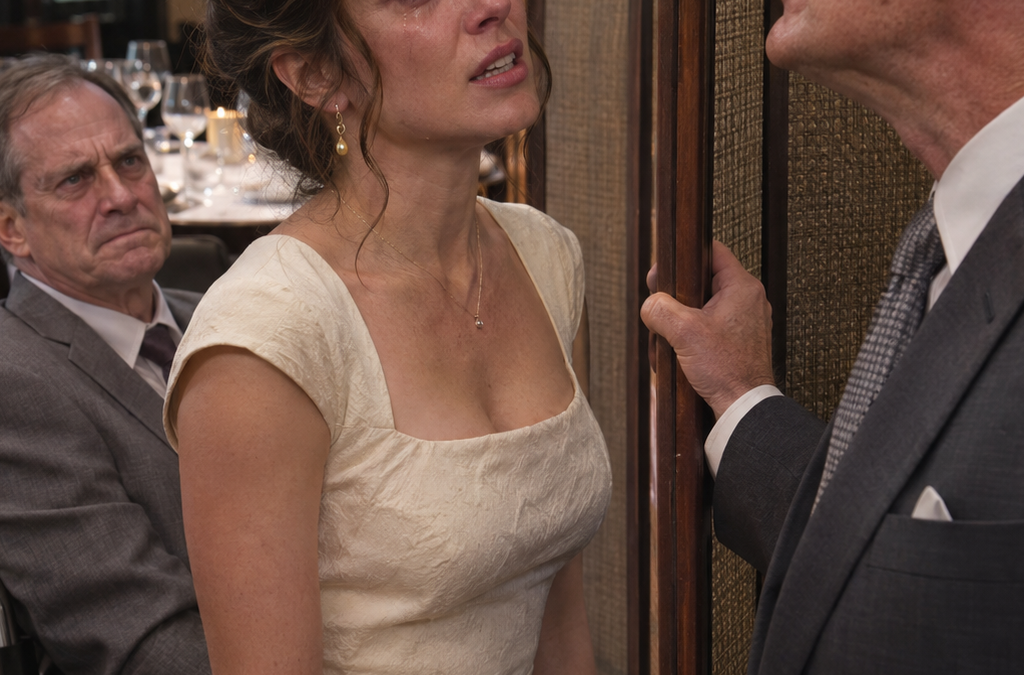
At our engagement party, my fiancé’s father rolled Dad’s wheelchair behind a folding screen: “You’re spoiling the photographs.”
Chapter 1 of 7
“Richard, he was sitting beside me.”
“He can wait here until we finish.”
Dad’s wheels stopped against the carpet at Hawthorne Table in Raleigh, North Carolina. His hip surgery had been three weeks earlier. Richard hadn’t asked before taking the handles.
“Daniel, are you going to let him do this?”
Daniel looked down at the place settings. My handmade cards stood beside the plates, their blue lettering matching our invitations.
“Let your father finish arranging the room,” Linda said to him.
“Dad belongs in the pictures,” I said.
Richard’s school folder lay beside the photograph place cards. A corner of a house photograph stuck out. This was supposed to be our engagement dinner, with Thanksgiving still ahead of us, and relatives already gathered around the long table.
At thirty-four, I hadn’t expected to ask permission for my father to sit beside me. Claire Bennett, residential kitchen designer, apparently still needed that explained.
Dad owned Bennett Plumbing, and he had paid the loan Richard was taking credit for.
The amount had been $112,700. Richard had borrowed it for Maple Hill Academy during a cash emergency; at my request, Dad had later paid the lender directly.
Dad was sixty-four and had run his business for twenty-eight years. Tonight he wore the gray suit he’d asked me to collect from his house.
I’d made every table card after work. Earlier that year, I’d drawn the school’s kitchen renovation plans without charging, fitting them around projects for my employer. Daniel’s card even had a tiny dishwasher sketched beneath his name. He called loading one his contribution to kitchen design.
Then Richard’s folder shifted beneath the photograph cards.
Richard’s school folder had my name beneath a photograph of our future house.
It wasn’t a house we owned. Daniel and I had saved the listing picture as an example of what we wanted. Seeing it there made my face burn.
“We can take your pictures afterward,” Linda said.
“With my father, you mean?”
“Claire, don’t make this difficult for everybody.”
Dad stayed seated, his jaw set. One footrest had slipped lower during the move. He brought his compact socket wrench from his jacket and silently put it in my hand.
There was one worn notch along its edge. I remembered rubbing that notch with my thumb during childhood afternoons at his shop, waiting for him to finish an estimate.
I crouched and tightened the footrest, then slipped the wrench into my pocket. Dad settled his shoe back into place.
Then Richard dragged the screen another few inches across the carpet. Linda straightened its outer panel, closing the gap beside Dad’s shoulder.
“MOVE HIM OUT OF SIGHT!”
His shout carried across the tables. My knees shook as I stood, and for a moment I hated that anyone could see it.
“You want my father hidden at my engagement?”
“Yes, until we finish the family photographs.”
Daniel finally looked at me.
“Please cooperate. We’ll sort it out afterward.”
Those words hurt more than Richard’s order. Daniel had watched the whole thing and still expected me to help finish it.
I had made peace so often that they expected silence.
My hand had started toward a wrinkle in the tablecloth. But I stopped before smoothing it. There were relatives waiting for dinner, a photographer’s space cleared against the wall, and my father behind restaurant furniture.
“Go ahead without me,” I said.
Then I stepped beside Dad.
From there, I could see the doorway and Richard’s folder. Ellen Shaw, Maple Hill’s principal, hadn’t arrived yet. We knew each other through those kitchen drawings, and she’d accepted our dinner invitation weeks earlier.
I called her.
“Claire, I’m just outside,” Ellen said.
“Can you come straight to our room?”
“Yes. I brought something we need to discuss.”
Her voice changed before I could answer.
“Richard listed your home money as a school pledge.”
“I didn’t promise the school anything.”
“That’s what I need to hear from you.”
The call ended. Dad had his phone open across his lap. On its screen was the lender’s receipt, with Bennett Plumbing named beside the completed payment. Beneath it sat a saved-message icon labeled with the lender’s name.
He looked from the screen to me. I nodded toward the doorway as Ellen appeared, still wearing her coat.
Dad wheeled past the screen. “Ellen, please listen to my daughter.”
Richard turned toward her with the welcoming expression he used at school events. His voice softened immediately.
“Ellen, wonderful. We’ve kept a place for you.”
“Thank you. Claire, may we talk here?”
“Yes,” I said. “Here is fine.”
Dad positioned his chair beside me. Nobody needed to move him. There was enough space once Richard stepped away from the screen.
Ellen carried a slim folder. Richard glanced at it, then at the one beside his place cards.
“I called about the donor information you sent,” she told him. “Claire says she hasn’t agreed to it.”
“We’ve been discussing family plans,” Richard said. “The couple agreed in principle.”
But Daniel watched me instead of answering. Linda stood close enough to Richard that their sleeves touched.
I tried to remember every conversation about the school. There had been dinners, invitations, Richard explaining which families gave generously and which ones needed encouragement. And he’d asked about our house search, too. I’d mistaken that for interest in us.
But I had never offered my savings.
“What exactly did you tell her, Richard?”
“Nothing we can’t clear up after dinner.”
Ellen opened the folder where we all could see. My name appeared beneath the school’s heading, followed by a proposed gift.
Richard reached toward the page, then stopped when Ellen kept it in front of her. My mouth had gone dry. I recognized the photograph printed below my name.
Ellen turned the folder. “He promised the school your house deposit.”
For a moment, all I could look at was the picture. The little brick house had a narrow breakfast corner, the part I’d liked most. Daniel had said we could find something similar when we were ready.
The figure beside my name was $86,000.
It was the money in my own savings account. No money had moved, Ellen explained. Richard’s list couldn’t give the school access to it.
That helped, but seeing my future printed as his promised gift still made me feel sick.
Carol Evans, Richard’s sister, pushed an empty chair toward me. She’d come to celebrate her nephew’s engagement. Now she looked at the paper instead of the decorations.
I sat beside Dad.
Richard leaned close enough that his next words were meant for me alone.
“Stop embarrassing me and let me handle this.”
“You put my name on it.”
“Daniel knew we were discussing a contribution.”
Daniel rubbed his forehead. “We talked about helping eventually. That’s all.”
“We talked about volunteering,” I said. “I made no pledge.”
Ellen looked directly at Richard. “I’ll need the email you sent with this.”
“You have it already,” he said, still trying for pleasant. “You know how committed I am to that school.”
Linda started to speak, then looked down at the proposed gift again. Dad remained beside me, his phone resting on his lap.
I’d wanted Daniel to say something simple. That the savings were mine. That Dad should never have been moved. Even now, he could have said either one.
Instead, he asked Ellen whether this could wait until after dinner.
“There’s another submission we need to discuss,” she said.
Richard’s expression changed.
Then Ellen drew a second page from her folder. It carried Richard’s signature beneath a statement he’d submitted when applying for his school job.
She opened it in front of us.
“He wrote that no one helped repay the loan.”
Chapter 2 of 7
“Richard borrowed the money and gave it to the school,” Ellen said. “That part isn’t in question. This says he repaid it without outside help. We relied on that when we hired him.”
Richard stayed beside her chair. “You’re leaving out what the school was facing.”
“I’ll hear your explanation. But not over dinner.”
I looked at the page again. “And my supposed donation?”
“You can say no to that now. His employment is the school’s decision.”
That distinction frustrated me, though I understood it. My father had been hidden behind a screen, and now we were supposed to separate each wrong into its proper pile.
“I never agreed to give anything,” I said.
Ellen nodded. She took both pages with her when she left.
Dad and I didn’t stay for dinner. Daniel followed us as far as the doorway, explaining that his father had been under pressure. He never asked Dad whether the move had hurt his hip.
By the next morning, Richard had found a gentler audience.
His message arrived in the family group while I was getting ready for work. He thanked everyone for their patience during “an awkward interruption to a happy occasion.”
Then came his account of me.
“Claire understandably mistook an informal discussion about the couple’s future charitable interests for a request for immediate funds. We regret the confusion and look forward to putting it behind us.”
There was nothing about Dad.
My face grew hot reading it. Richard had made me sound anxious and confused, someone the family needed to reassure.
Daniel called twice. When I didn’t answer, he asked if he could come over that evening.
I said yes. I wanted to hear what he would say without his parents beside him.
He arrived at my apartment still wearing his work clothes. This had never been our place. The lease was mine, and his overnight bag usually lived in his car.
“Dad’s trying to calm everybody down,” he said.
“He could start by telling them what happened.”
“That’ll just start another argument.”
My kitchen table held a stack of cabinet samples for work. Daniel sat beside them, in the chair where he usually ate the browned corner of my baked ziti before I’d served dinner.
That small familiarity hurt. I still wanted him to sit there and be the person I’d expected to marry.
He showed me a message he’d drafted.
“We both regret the misunderstanding,” it began.
“Send it from your phone,” he said. “Then I’ll agree underneath.”
“There wasn’t a misunderstanding.”
“Claire, you don’t have to like the wording.”
“I’m not sending it.”
He looked toward the kitchen, then back at me. “You know he didn’t take your money.”
My name wasn’t permission.
Richard had used it anyway, attaching my savings to a promise that would make refusing look selfish. Daniel wanted me to repair that with another statement I didn’t mean.
“He offered money I’ve spent years saving,” I said.
“So tell Ellen no. Leave the rest alone.”
For several seconds, I couldn’t answer him. My ring caught the light against the dark cabinet sample between us. I kept it on.
Daniel left without supper.
Later, Ellen confirmed that my name and the proposed $86,000 pledge had been removed from the school’s materials. She asked for the existing payment record, with Dad’s permission.
I went to his house after work. He was in his usual chair, with his wheelchair within reach and a plate of toast balanced on his knee. Dad put peanut butter on toast so thickly it left teeth marks. He’d always called that a serving suggestion.
He agreed to share the receipt. He didn’t ask me to smooth anything over.
“It cleared the remaining principal on Richard’s school-rescue loan.”
That nearly made me cry.
The next conversation included Laura Price, a loan servicing officer at Piedmont Community Lending. Dad gave permission for her to discuss his payment with Ellen and me.
Laura had a plain, steady voice. She verified the receipt against the lender’s records while Dad listened beside me.
“The $112,700 payment came from Bennett Plumbing,” she said. “It cleared the remaining principal on Richard’s school-rescue loan.”
There was no unpaid balance waiting behind it. Richard had covered the scheduled interest separately.
Ellen had also received a signed release from Richard. It allowed the lender to share the loan’s history and payment information with the school.
“He wants the original borrowing included,” Ellen told us.
It made sense. Richard really had taken the risk when the school needed money. He expected the record to support him, and part of it did.
I hated that a true part could give his version so much cover.
“But this proves somebody else paid it off,” I said.
“Yes,” Laura answered. “It doesn’t tell us what he knew.”
Ellen didn’t let that distinction slide.
“I need to consider his explanation before deciding what the statement means for his job.”
She wasn’t defending him. Still, I’d wanted the receipt to do more. Dad’s money had gone out, Richard’s debt had disappeared, and I was learning how much remained between those facts and an answer.
Richard’s explanation came through Ellen later that evening. He said outside help had arrived anonymously. He also said the school had always known his original contribution came from personal borrowing.
Ellen said she would check that account against the records. She wouldn’t treat my anger as proof, even when the anger was justified.
I sat at my kitchen table after the call, beside Daniel’s empty chair.
In Richard’s written response, one sentence stood apart:
“I did not learn the payer’s identity until the engagement dinner.”
Chapter 3 of 7
“I’ll let the school check what the lender told Richard,” Dad said.
“Is what he wrote true?”
“The lender spoke to him directly. Ellen can ask about that.”
We were at Dad’s kitchen table, with his wheelchair angled away from a loose floor tile. He had kept the original message on his phone. He gave me permission to share it with the school, but neither of us played it.
I wanted him to say Richard couldn’t get away with this. Dad had never been much good at promises he couldn’t keep.
“Eat before you go,” he said.
“I’m not hungry.”
“Neither was I. Then I smelled the eggs.”
He’d put salsa on scrambled eggs straight from the jar. Cooking for one had loosened his definition of a recipe. I ate standing beside the counter, grateful he didn’t ask me about the wedding.
Daniel did that afternoon.
He asked me to come to his apartment after work. Our wedding drawings were there, tucked in the project bag he’d bought when planning still seemed like something we did together.
His dining table held a few envelopes and the floor plan for our reception. I’d drawn each table to scale. At work, clients paid me to make rooms function; at home, I’d treated everybody’s comfort as my assignment.
Daniel didn’t ask me to sit.
“We need to settle the house money,” he said.
“That’s what you want to talk about?”
“We can’t plan a life if you’re treating us like enemies.”
He meant his parents, too. I could hear it in the way he said us.
“For our house. We didn’t agree to give anybody else control.”
The hurt surprised me, even after dinner. I’d spent years imagining a house where we would choose things together, down to which wall could take open shelves.
“My savings aren’t your father’s donation,” I said.
“Fine. But after we’re married, the eighty-six thousand goes into our joint account. We agreed it was for a house.”
“For our house. We didn’t agree to give anybody else control.”
“Nobody’s taking control. You’re making everything sound ugly.”
There had been no joint account yet. No house under contract. Just my savings and a future Daniel now spoke about as if it came with conditions I’d missed.
He leaned against the table.
“There won’t be a shared home if you humiliate my father.”
For a moment, I looked at the reception plan instead of him. His parents’ table had the easiest path to the doors. Dad’s place was beside mine.
“You don’t get my savings and my silence.”
“Then what are we doing, Claire?”
I didn’t have an answer I could say yet.
The project bag stood beside his couch. I took out my drawings, including the breakfast-corner sketch I’d made for a house we hadn’t found. Daniel watched without helping.
“Those are for the wedding.”
“I know what they’re for.”
I took them home.
That evening, Richard sent another message to the family group. This one had photographs from Maple Hill Academy: classroom doors, children’s artwork, the front steps.
He described the emergency that had threatened the school’s bills and the personal borrowing he’d arranged to help. He wrote about being unable to walk away when families were counting on him.
Much of it was true.
That made it harder to read than an outright lie. Relatives thanked him for explaining. A few had children connected to the school. They remembered the worry and were relieved to have a version that restored Richard to his familiar place.
Nobody asked about Dad.
I felt ashamed of wanting someone to ask. My phone stayed beside the drawings, and I checked it more often than I wanted to admit.
Linda called before I’d put them away.
“Keep your father out of the next school conversation,” she said.
“He paid the debt.”
“School families don’t need to see us struggling.”
I could hear Richard somewhere behind her, though I couldn’t make out his words.
“Frank being there makes this look like a family fight,” she continued. “You’ve already done enough with that.”
She hadn’t called to ask how he was recovering. She wanted him absent again, only this time without moving any furniture.
“I’m ending this call, Linda.”
“Claire, don’t you hang—”
I ended it.
Ellen’s email arrived the next morning. She had given Richard the school’s written concerns and asked for his explanation and supporting material. He had nine calendar days from the dinner report, with the holiday included in the response period.
“He’ll have time to answer,” she told me when we spoke. “Then we finish the review.”
She made no promise about his job.
I understood, but I hated waiting while Richard kept telling people what had happened. Refusing his pledge hadn’t stopped him from using our family as part of his defense.
Later, Ellen forwarded a section of the response he’d submitted so far. She wanted Dad to check the payment details.
Richard’s email described “Frank” as a business donor Claire had approached, someone previously unknown to the Cole family. Beneath it were the company details from the payment record.
Bennett Plumbing.
I read those two words, then went back to his description of the donor. He had my father’s first name in one place and his business in another. He was still treating them as separate pieces.
He still didn’t know Dad.
At the bottom, Richard asked Ellen to obtain a statement from “the owner of Bennett Plumbing.”
Chapter 4 of 7
“Frank Bennett, owner of Bennett Plumbing,” Ellen said.
Dad’s wheelchair fit beside the low table in Maple Hill Academy’s small reception area. Richard stood across from us, still holding the ownership information Ellen had given him.
He looked at the page again.
“Your company?”
“Yes,” Dad said.
For a few seconds, Richard seemed unable to decide where to look. His attention moved from Dad to me, then back to the company name. The man he’d pushed behind restaurant furniture owned the business that had paid his debt.
Ellen opened the door to her office.
“Come in. There’s room beside the desk.”
Richard stepped back to let Dad through. He’d been smiling at Ellen, asking about her holiday, when we arrived. Now he directed that same careful courtesy toward Dad.
“Frank, let me get the door wider.”
Dad wheeled through without answering. I followed him, carrying the factual statement Richard had requested.
It hurt to watch respect arrive only after Richard recognized the money.
Ellen went around her desk to find the school’s copy of the payment record. Richard leaned toward us, his pleasant voice gone.
“You should have told me who you were.”
“He introduced himself at dinner,” I said.
Richard ignored me.
Dad looked up at him. “You didn’t ask.”
There was no satisfaction in his voice. He sounded tired, and I knew the drive had been uncomfortable. He’d insisted we stop for a biscuit anyway. Dad considered any appointment before lunch a breakfast opportunity.
Ellen came back with the folder already used for the review. Dad gave her his statement, confirming that he owned the company and had authorized its payment.
Richard remained standing until Ellen pointed to a chair.
“I never disputed that somebody helped,” he said.
Ellen glanced at the signed statement in her folder.
“Then why did you write that you repaid it without outside help?”
“Because the money the school received came from me.”
“Yes. We’ve confirmed your original borrowing.”
He started explaining the emergency anyway. Bills had been waiting. Families had needed reassurance. He’d put his own name on the loan when nobody else had stepped forward.
I believed that part. I could even imagine how frightened he’d been.
But Dad sat beside me with his foot carefully supported, listening to Richard describe a sacrifice he’d quietly helped bring to an end.
“The help was real. Your account of it wasn’t.”
Richard turned toward me. “You weren’t there when the school needed saving.”
“I was there when you asked for help paying it back.”
Ellen let that sit, then asked Richard whether he wanted to add anything to his written explanation.
He opened his own folder. His new response was typed, with a few corrections along one edge.
“I knew Claire had approached a business owner called Frank,” he said. “That isn’t the same as knowing who paid.”
I looked at Dad. He kept his eyes on Richard.
Richard continued, choosing his words more carefully now.
“I didn’t know his surname. I hadn’t met him. I didn’t connect him with Bennett Plumbing until this came up at dinner.”
“You’re narrowing what you said,” Ellen told him.
“I’m explaining what I meant.”
“He gets the concerns, time to answer, and a review before I decide.”
She wrote that down beside his response. I was frustrated by how calmly she did it. Richard could change his explanation, and she would still give him room to finish.
Then I noticed the papers beneath her notes: his offer, the school’s hiring authority, the handbook page marked for review.
“Will somebody else decide this?” I asked.
“I have the school’s written authority to hire and dismiss development staff,” Ellen said. “He gets the concerns, time to answer, and a review before I decide.”
She closed the handbook. That was all she said about it.
Richard shifted forward.
“There’s another part Claire keeps leaving out. This was connected to the wedding.”
My face grew hot.
“Your father helped because we were becoming family,” he said. “I reasonably saw it as family support.”
“A minute ago, you didn’t know he was my father.”
“I knew you’d arranged it. Don’t twist this.”
He turned to Ellen, softening his voice again. He said he’d understood it as a wedding favor, not an outside donor stepping in to replace his contribution.
Then he looked straight at me.
“Tell her why you asked him, Claire.”
“Because you needed help.”
“For Daniel’s family.”
“Because you needed help,” I repeated. “I never agreed you could call Dad’s payment your own.”
I hated being asked to turn my request into permission. Daniel had done it with my savings. Now Richard wanted the same thing from an act I’d once felt good about.
Ellen accepted his response and asked whether he wanted the final discussion at school.
Richard wanted Hawthorne Table instead.
“The family should hear the answer,” he said.
“You may hear it privately,” Ellen told him. “You don’t need relatives there.”
“No. They heard the accusations.”
He named Daniel, Linda, and Carol. Ellen confirmed that Dad and I would attend too, then limited the discussion to the claims already under review.
She wrote the arrangement in her notes: Wednesday, December 2, at 6:30, Hawthorne Table.
Richard agreed before she finished asking.
By the time Dad had turned his chair toward the office door, Richard was typing on his phone. I waited while Ellen copied Dad’s statement.
My phone began vibrating before we reached reception.
Richard had sent the restaurant invitation to the family group. He’d titled it “Bennett family apology” and tagged my name beneath it.
Another notification brought it back across my screen.
There was my name, announcing an apology I had never agreed to make.
Chapter 5 of 7
“I’m attending to answer for myself, not to apologize. I will speak for myself.”
That was my entire reply to Richard’s invitation. I sent it to the family group before I could spend another hour making it gentler.
Carol answered beneath it.
“I intend to hear Claire finish this time.”
Nobody else replied. Seeing her words helped, though I wished someone had said them at the engagement dinner.
Daniel called while I was leaving work the following afternoon. I stayed in my parked car, with a kitchen layout rolled across the passenger seat.
“Come alone tomorrow,” he said.
“Dad’s coming with me.”
“He makes my father defensive. You saw what happened at school.”
“Your father asked him for a statement.”
“And now he has it. Frank doesn’t need to sit through more of this.”
I could hear traffic through Daniel’s phone. He sounded impatient, as if we were arguing about which exit to take.
“Dad is my family. He’ll sit beside me.”
“You’re supposed to be joining mine.”
That hurt. I looked at the ring on my hand and remembered how happy I’d been to tell Dad about it. He’d asked whether Daniel made me happy, then listened to my long answer without interrupting.
“I’m not leaving him home for your father’s comfort.”
Daniel said he would see me at the restaurant. He ended the call before I answered.
Ellen’s email came that evening. It was short, asking Dad to confirm permission for the school to use his own payment information in the review.
I read it beside him at his kitchen table. He gave his permission, and I sent his answer. There was nothing about what Ellen expected to decide.
By the next afternoon, she confirmed that the review interviews were complete. I wanted to ask whether Richard had said anything different. Instead, I thanked her for letting us know.
Waiting made me feel helpless. I could refuse a pledge and correct an invitation, but I couldn’t make everyone stop believing the version that suited them.
When I arrived to take Dad to the restaurant, his company jacket hung by the door. He wore a plain navy sweater instead.
“Want me to bring that?” I asked.
“No. This is warm enough.”
“The restaurant might be cold.”
“Then I’ll complain about it. I’m getting pretty good at that.”
He checked that his phone was in his pocket. Then he looked toward the jacket.
“I’m not wearing the business name so he’ll treat me decently.”
I felt ashamed that I’d thought, even briefly, the jacket might help.
Dad had already eaten half a banana because he didn’t trust a family meeting to produce dinner. He offered me the other half. It was such an ordinary precaution that I laughed, then ate it standing in his kitchen.
Before we left, I considered taking off my ring.
Daniel hadn’t apologized for the screen. He hadn’t challenged the pledge or the invitation. Still, I wanted to make my decision looking at him, not leave him to read it in another message.
I kept it on.
At Hawthorne Table, the private dining room had been arranged around the same long table. The folding screen stood beside the cleared photograph area, its outer panel angled toward the wall.
Seeing it again made me feel sick. Someone had decided it could simply remain part of the room.
Richard stood near the head of the table. Linda and Daniel were on one side, Carol on the other. Ellen had arrived before us and was taking off her coat.
“Ellen, thank you for making time,” Richard said. “I hope we can finally put this unpleasantness behind us.”
Then he turned to me.
“Your seat is down there. Frank can stay near the door.”
There was room for Dad farther in. Richard had left a chair beside Daniel for me, several places away from where he expected Dad to sit.
“We’re sitting together,” I said.
“Don’t start rearranging everything. I’ve already worked this out.”
Dad moved his wheelchair along the open side of the table. I waited beside him while Richard began speaking, apparently unwilling to lose another moment.
He described the school’s emergency and the personal loan he’d taken. He explained that the money had gone to Maple Hill Academy, not into his household.
Ellen nodded. “The school has confirmed that.”
Richard looked around the table, making sure everyone had heard her.
“Claire got upset about the photographs. Now she’s making this about my honesty.”
“The later favor has been confused with my commitment,” he continued. “I didn’t know who was behind that payment. A business contact helping anonymously doesn’t erase what I did.”
Nobody had asked him to erase it. That was what made listening so frustrating. He kept defending the part nobody disputed.
Then he turned toward me.
“Claire got upset about the photographs. Now she’s making this about my honesty.”
Daniel stared at the table. I had wanted him to object without being asked.
I sat beside Dad.
Richard’s mouth pressed flat. He waited a moment, then came around the table carrying a single page.
Ellen watched him. Carol leaned forward enough to read the heading.
The page was written in my voice. It described a misunderstanding, praised Richard’s support of the school, and ended with a sentence I had never said.
“I accept that I unfairly questioned Richard’s honesty.”
Reading it was humiliating. He’d even left space beneath it for my signature.
Richard offered me a pen.
“This will let everybody move on,” he said.
Then he pushed the apology across the table.
“Sign it, Claire.”
Chapter 6 of 7
I pushed the apology back across the table. “Before our families, tell Ellen when you learned who paid.”
Richard left the pen where he’d offered it.
“I retired that debt as my contribution to the school. I didn’t know who was behind the help until dinner.”
His voice had the patience he used when he wanted an audience to notice how difficult I was being. Daniel watched him, waiting for me to accept the answer.
“Your statement says no outside help,” I said. “The receipt shows an outside payment. Those aren’t the same thing.”
“I knew you’d approached someone called Frank. That doesn’t mean I knew whose company paid.”
He looked toward Ellen.
“I didn’t knowingly mislead the school. I took out that loan.”
Nobody disputed that. Still, he kept returning to it, and I understood why. It was the part that let him look around the table without shame.
Ellen kept his signed statement in front of her.
“Before you signed, did you know someone else had covered your balance?”
“No.”
Richard stood, his chair catching against the carpet.
“Is a business name supposed to prove what I knew?”
Dad offered me his phone. He didn’t look at Richard or ask me to explain anything further.
My fingers felt clumsy taking it. I hated that I was frightened of upsetting people who had watched Dad disappear behind a screen.
The compact socket wrench was still in my coat pocket. I used it to prop Dad’s phone upright, with the speaker facing the table.
Then I opened the saved voicemail and started it myself.
Laura’s recorded voice filled the space between us. She identified herself from Piedmont Community Lending, then spoke the words Dad had kept.
“Richard asked me to thank you himself. He knows you covered the balance.”
“Yes. I left it on Frank’s phone. I checked the original against our record.”
Richard’s mouth opened, but he waited until the message ended.
Ellen’s phone lay beside her folder. Laura was already on the authorized call, waiting to answer questions.
“Laura, was that your message?” Ellen asked.
“Yes. I left it on Frank’s phone. I checked the original against our record.”
“And you spoke directly with Richard?”
“I did. He knew the balance had been paid for him. He asked me to pass along his thanks.”
I looked at the message information, then at Richard’s statement. Four days separated them. He had known about the help four days before signing that he’d repaid the debt without it.
For months, I’d thought asking Dad to help had brought our families closer. Remembering that embarrassed me now.
“You knew before you signed,” I said.
Richard ignored me. His attention stayed on Ellen.
“The school still received my borrowed funds. You can’t pretend that didn’t happen.”
“I’m not,” Ellen said. “That contribution was real.”
She waited until he looked down at the statement.
“You knew someone else had paid when you signed that no one had.”
Richard’s collar had shifted as he stood. He tugged at it, then stopped when he noticed Linda watching.
Ellen offered to pause and speak privately. He could hear her final response away from the family.
“No. They’ve heard everything else. Finish it here.”
Carol sat back from the table. Daniel finally looked at me, but there was no apology in his face. He looked afraid.
I was afraid too. Hearing the truth hadn’t made the people around me easier to recognize.
Ellen closed the folder.
“I am ending your development director position, effective now.”
Richard stared at her.
The $68,300 annual job he had held for nearly seven months was gone. He looked toward Daniel, then Linda, as if one of them could correct what Ellen had said.
“You’re dismissing me over wording?”
“Over the false statement you made for the job.”
He snatched the apology from the table. The page bent in his fist.
“Daniel, say something. Don’t just sit there watching this.”
Daniel rose halfway, then stood fully beside his chair. He looked at Ellen first, searching for somewhere to begin.
Linda got up before he spoke.
She went toward the photograph area. For a moment, I thought she was leaving us to manage Richard ourselves.
Then Linda moved the screen aside.
“Frank sits with us,” she said.
Dad was already beside me, exactly where he had chosen to sit. Linda cleared the space anyway. It didn’t undo her hands straightening that panel at our engagement dinner, but she no longer stood beside Richard.
Carol came around to our side of the table. Richard called her name. She stayed where she was.
Daniel leaned toward me.
“Ask her to reconsider. You can still help him.”
That hurt more than I wanted it to. Even now, he had found another task for me.
His mother had moved. His aunt had moved. Daniel was still asking me to make his father comfortable.
I slipped off the ring. The pale mark beneath it looked strange, though it had only been a few months.
“I won’t marry someone who asks me to hide my father.”
“Claire, don’t do this here.”
I held it out until he accepted it.
Dad turned his chair toward the doorway. I walked beside him, leaving the unsigned apology with Richard. Behind us, Daniel said my name once.
Outside, the air was cold enough to sting my face. Dad waited beside me while I checked a new message from the wedding venue.
The refundable part of my deposit still depended on canceling before the deadline. I read the reminder twice.
Cancel by Friday, or forfeit the remaining $4,400.
Chapter 7 of 7
I canceled the venue myself the next morning, before the Friday deadline. The contract was mine; there was no space where Daniel needed to sign.
The written confirmation arrived while I was at my kitchen table. Of the $6,200 I had paid, the venue would keep $1,800 and return $4,400.
Losing that money hurt. I read the confirmation once more, saved it, and closed the wedding folder.
Dad called after breakfast.
“Did they give you trouble?”
“No. They just canceled it.”
“Well. That’s one thing done.”
I cried after we hung up. I’d expected an argument, and the simple confirmation left me alone with what I had ended.
Daniel arranged to collect his things that weekend. I asked him to come while I was home and bring back my spare key. He agreed.
There wasn’t much: clothes, a charger, running shoes, the mug he preferred. I had folded the clean clothes before realizing I didn’t need to pack for him.
He arrived carrying an empty grocery bag.
“Are you sure you want everything gone?”
“Yes.”
He stood beside the kitchen table, looking at the cleared space where our drawings had been.
“Dad’s leaving the school. He’s got enough going on without this.”
“Your things are in the bedroom.”
“I’m trying to talk to you.”
“I know. I’m not discussing the engagement again.”
That was harder to say than I’d expected. Part of me still wanted him to understand, though understanding now wouldn’t change what he had chosen.
He packed his bag. Before leaving, he returned the key as we’d agreed.
“Can I call you sometime?”
“Not about getting back together.”
He nodded without looking at me. After he left, I washed his mug and put it with the others. It was just a mug, and I needed one for coffee.
Over the following weeks, Richard finished leaving Maple Hill Academy. Ellen confirmed that he no longer worked there. I didn’t hear about his next job, and I stopped checking the family group before leaving it.
On January 15, the $4,400 appeared in my account.
I was at work between kitchen appointments when I saw the credit. For a moment, I felt relieved enough to laugh. Then I remembered what I’d originally paid for and sat quietly until my next client arrived.
The school’s correction came that afternoon. Ellen sent me the copy that went to the 24 households previously contacted.
It withdrew the supposed pledge under my name and stated that I had never authorized it. It also distinguished Richard’s original borrowed contribution from the later payoff made by Frank Bennett’s business.
There was no account of the restaurant or the broken engagement. Just the facts those families should have received.
I forwarded it to Dad.
“Got it,” he replied. “Thanks.”
Linda’s apology arrived in a written message a few days later.
“I helped Richard hide Frank’s wheelchair behind the screen. I saw what he was doing and helped him. I’m sorry I treated your father that way, and I’m sorry I expected you to accept it.”
I read it twice. She hadn’t mentioned Richard’s stress or the school families watching.
Her next message asked whether Dad and I would come to dinner.
“Thank you for acknowledging what happened,” I wrote. “We won’t be coming.”
“If he has something to say, he can manage his own phone.”
I was sad afterward, but I didn’t send another paragraph to make the refusal easier.
Carol stayed in touch. At first, seeing her name on my phone made me brace for a message from Daniel.
She settled that herself.
“I’m calling because I like you,” she said. “If he has something to say, he can manage his own phone.”
Mostly, we talked about work. She told me about travelers who wanted adjoining hotel rooms but insisted they didn’t want to travel together. I told her about a client who wanted an island larger than her kitchen.
We laughed. It helped to have one relationship from that family that didn’t require an explanation.
One evening, Dad asked whether I was still planning to buy a home.
“Eventually. I’m nervous about doing it alone.”
“That’s reasonable.”
“I don’t need you paying for it.”
“Good. I’m not paying for another attempt to make that family comfortable.”
He wasn’t angry with me. Still, I felt ashamed.
“I thought I was helping.”
“I know you did.”
I remembered the seating charts, the softened messages, the meals arranged around everybody else. I’d volunteered for so much before anyone asked. Even after leaving Daniel, I caught myself drafting explanations nobody needed.
Dad let me sit with that. Then he asked whether I wanted the last baked potato.
Months later, I bought a modest house in Raleigh with my own savings. It had two bedrooms, a small yard, and kitchen cabinets I could live with until I could afford better ones.
The purchase involved ordinary appointments and a stack of papers. Nothing happened that needed telling at a family dinner.
I had once labeled a folder “our first home.” This house was mine, and I felt happy saying so.
Six months after the engagement dinner, Dad spent an afternoon with me there. He sat comfortably in the breakfast corner while I sorted through photographs for the wall.
His work pictures were mixed in with family ones: Dad beside a finished job, Dad outside the shop, Dad much younger beneath the Bennett Plumbing sign.
Linda had once suggested those belonged in a garage. Daniel had agreed they wouldn’t suit a breakfast room.
I held one against the wall.
“Too much sunlight here?”
“Probably fade it eventually,” Dad said.
“I can get another print.”
“Then put it where you want it.”
I hung it beside the others. Seeing him look up at them made me happy enough that I had to look away.
A cabinet pull near the breakfast corner sat crooked. Dad had brought his socket wrench for the small jobs we’d planned, and he told me which fitting to use.
“You could leave that till next weekend,” he said.
“It’ll bother me every morning.”
“That does sound like you.”
I crouched beside the cabinet. His worn wrench fit comfortably in my hand.
Family shouldn’t require anyone to disappear.
Behind me, Dad asked which cupboard held the coffee. I pointed him toward the one I was fixing.
I tightened the handle and opened the door.







