At Thanksgiving, Dad pulled my handmade quilt off the guest bed and spread it beneath his dog: “You can make do without it.”
Chapter 1 of 7
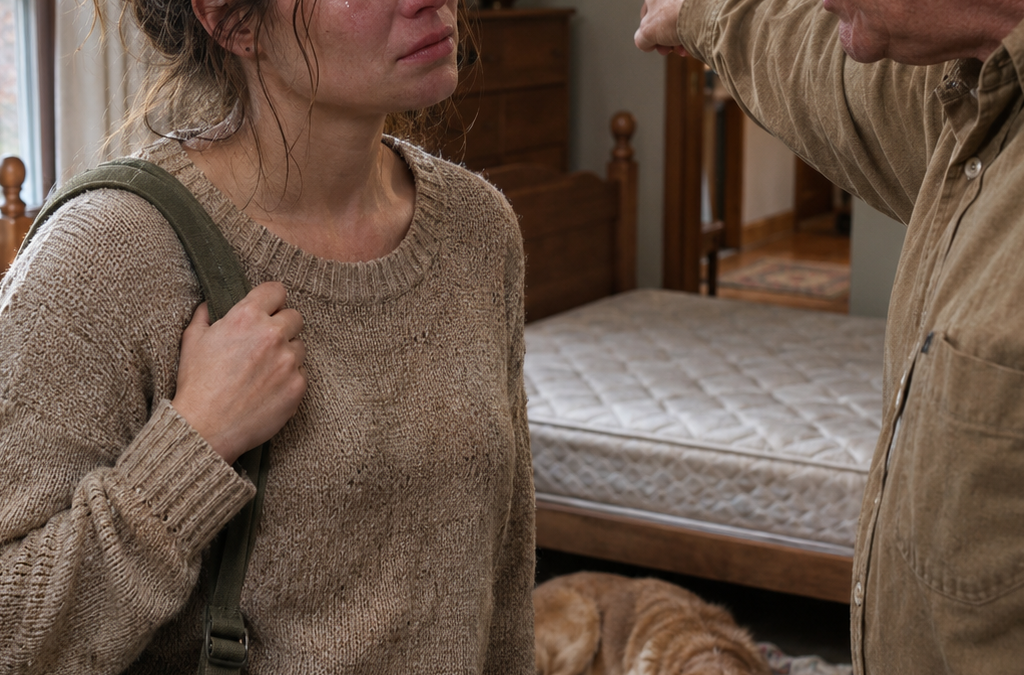
My military duffel still hung from my shoulder. A moment earlier, my fingers had rested on the hem I’d sewn.
“You promised me this bed, didn’t you?”
Mom looked past me toward the hallway. Linda Carter had confirmed the room twice before I left Norfolk.
“Your father has already worked this out.”
“Worked out where I’m supposed to sleep?”
Dad straightened beside the bed. Tom Carter still wore his good dinner shirt.
“You’ve got a car with reclining seats.”
Aunt Beth stood in the doorway without meeting my eyes. Then my phone lit up with a thank-you message from Daniel Reed, a veteran who’d stayed at Stillwater Lodge. The unopened video preview showed its porch and the edge of Dad’s orange hunting sleeve.
But nobody asked about the long drive.
At thirty-five, I was still coming home hoping they’d be glad to see me. Claire Bennett was the name on my bag; I’d kept Bennett after an amicable divorce.
I was a Navy lieutenant commander.
Thirteen years had passed since I joined after college. This visit followed a seven-month deployment, and I’d arranged three nights here during approved leave. My jeans were creased from driving.
I own the lodge, and every veteran’s stay is supposed to be free.
Stillwater Lodge sat outside Sandusky, Ohio, near the lake. Officer-salary savings and financing had bought it six years earlier; a manager handled daily operations.
But here I was, looking at the guest towels I’d bought Mom. The apple pie I’d carried in for her sat on the kitchen counter beneath its foil.
Beyond it, the dining table was set for eighteen adult relatives. Ruth Morgan’s place card stood beside the extra setting.
Beside Mom’s plate lay an envelope marked “Carter family gift.”
Dad followed my glance and moved into the hallway, expecting me to follow. Ruth chaired Harbor Welcome, the charity that employed both my parents to arrange veterans’ weekends. Apparently she was coming to dinner.
I had made being easy my contribution to every visit. Usually that meant washing the roasting pan while everyone else had dessert.
This time, it apparently meant sleeping in a parking space.
“Your brother might come later,” Dad said. “He’ll need somewhere to stretch out.”
“He hasn’t even said he’s coming.”
“Your brother needs a proper welcome,” Mom said.
Those words hurt more than the comment about my car. She’d saved him a bed without knowing whether he’d use it. And I’d driven hundreds of miles to a room she’d promised.
Mom glanced toward the dining room.
“Please stop making dinner about yourself.”
The dog settled onto my quilt. Its blue corner stuck out beneath one paw. I remembered sewing that crooked square after work, years before I’d bought the lodge.
Then Dad pointed toward the front door.
“Take the bag out. It’s blocking everything.”
There was room to walk around me. Beth had just done it. She stood beside Mom now, studying the floor.
“Mom, are you really letting this happen?”
“You’re used to roughing it, Claire. You do desk work anyway.”
“TAKE YOUR BAG OUTSIDE!”
My face burned. Several relatives could see us from the table, and none spoke. The guest bed stood bare behind him, ready for sheets and a son who wasn’t there.
“You’re saving an empty bed while I sleep outside?”
“Yes, and I expect you to cooperate.”
“Then I won’t stay.”
And that was all I could manage without crying in front of him.
Outside, the cold reached through my sweater. I stood beside my car with the duffel against my leg. All six lodge suites were occupied that night; nearby lodging had been unavailable over the holiday.
Owning the place didn’t create another bed.
I called Ruth.
“Claire? I’m almost at your parents’ house.”
“Could we talk before dinner, please?”
“Yes. There’s something I need to ask you.”
Her voice changed. She said a guest had questioned a charge connected with his donated weekend. Daniel had contacted her after sending me his thank-you clip.
“Your parents described the weekends as their family’s gift,” she said. “Did you know guests were paying?”
“No. I didn’t know about any charge.”
The cold had made my fingers stiff, but I could still feel heat in my face. Then Dad opened the front door before I could ask anything else. His welcoming voice carried out toward Ruth’s arriving car.
Ruth stepped inside. “Lieutenant Commander Bennett, may I speak with you?”
Dad’s greeting stopped halfway through her name. I followed her into the entryway, still carrying my bag.
“Lieutenant commander?” Mom said.
“Claire’s service biography came with her award nomination,” Ruth said. “She’s had a substantial career.”
Dad looked at me as though I’d changed clothes on the porch. My parents knew I served in the Navy. But they’d stopped asking what I actually did years ago.
Ruth moved close enough to speak quietly.
“The winter gathering will honor you. I meant to discuss it somewhere nicer than your parents’ doorway.”
For a second, I couldn’t answer. She hadn’t lowered her voice out of embarrassment about me. She was trying to give me a private moment.
Then Dad stepped forward.
“Ruth, come get warm. Linda’s got dinner ready.”
“Tom, why did a guest pay for a donated stay?”
She asked it plainly, within hearing of the table. Dad’s pleasant expression held, but the rest of his face went rigid.
“What guest are we talking about?”
“Daniel Reed. He says he transferred three hundred dollars.”
Mom made a small sound beside him. Ruth explained that Daniel had offered to send his bank record. She hadn’t yet checked it, but his message named the account holder.
And Dad no longer looked at me.
Daniel Reed’s payment went to Dad, not the lodge.
“That was a personal thank-you,” Dad said. “People appreciate somebody doing the work.”
“Was he told he could say no?” Ruth asked.
“Of course he could. Don’t make this ugly.”
He’d softened his voice for her. With me, he hadn’t bothered.
Mom turned toward the dining room.
“Everything’s getting cold. We can talk about one person’s confusion after we eat.”
But I stayed beside Ruth. The smell of turkey reached the entryway, and I realized I hadn’t eaten since the drive. Hunger seemed embarrassing now, another need I didn’t want to mention.
“Claire knows how much we do,” Mom added. “Tell Ruth.”
“I don’t know what Daniel was told.”
Dad stared at me. He’d expected the familiar quick agreement, the one that let dinner keep moving.
Then Beth came out of the hallway.
“You can sleep on my sofa tonight, Claire.”
Her voice was quiet, but she didn’t look away this time.
“Thank you. I’ll need all three nights covered.”
“I can do tonight. We’ll figure out tomorrow.”
It wasn’t an apology, and I couldn’t make it one. Still, there was a place indoors where I could lie down. My shoulders began to ache from holding the bag.
My older brother, Mark, still hadn’t arrived. His empty bed remained behind us, and nobody suggested changing the arrangement now.
Dad lowered his voice.
“You could have handled this without an audience.”
“You told me to leave in front of them.”
He looked toward Beth, waiting for support. But she said nothing, and she stayed beside me.
Ruth’s phone sounded while we were still standing together in the entryway. She read the new message, then turned the screen so I could see it.
Daniel had written, “Linda told me the payment was necessary to keep my reservation.”
Chapter 2 of 7
“Linda told me to arrange payment with Tom,” Daniel said over Ruth’s speakerphone. “I thought we’d lose the room if I didn’t.”
We were outside my parents’ house. Through the front window, I could see Dad taking his seat.
“Did you send him the money?” Ruth asked.
“Three hundred dollars. I can send the bank record.”
“Please send it directly to me.”
Daniel sounded embarrassed, as though he’d failed to understand something obvious. That hurt almost as much as what he was telling us.
“You haven’t done anything wrong by asking,” I said.
“I just wanted to know before we tried booking again.”
Ruth promised to check. Beth drove me to her house, and I slept on her sofa with my duffel beside it.
By morning, Daniel had sent the record. Ruth called while Beth was getting ready for work. Grace Turner, Harbor Welcome’s treasurer, was on the call too.
“The recipient is Tom Carter,” Grace said. “The amount is three hundred dollars. This confirms the transfer, not whether he was told he had to pay.”
There it was, verified without settling everything. Dad had received money from a guest whose room I’d donated. We still needed his answer about why.
I thanked Grace. After the call, I sat on Beth’s sofa for another minute. I hated knowing that Daniel was wondering whether he could afford to come back.
Aaron Brooks called after the lodge’s scheduled departures.
“I’ve got a suite ready,” he said. “You can come over.”
He met me inside Stillwater Lodge, outside Sandusky, with a room key and a question about whether I’d eaten. Aaron managed the place without treating every small problem as an emergency. Usually, that made our calls short.
That morning, I nearly cried when he said the room was ready.
Upstairs, the bed had clean white sheets. There were fresh towels in the bathroom, and the heat was on. Nobody’s possible arrival mattered more than mine.
“Two nights?” Aaron asked.
“Yes. Thank you.”
“Those are free respite weekends. Has anyone here been collecting money?”
“You don’t need to thank me for a room.”
I did, apparently. That realization made me feel small all over again.
In the office afterward, he pulled up the program calendar. I wanted to know whether anything in our arrangements could have confused a guest.
“Six suites, twelve weekends a year,” I said. “Those are free respite weekends. Has anyone here been collecting money?”
“No. We don’t charge those households.”
“Harbor Welcome handles the bookings and arrivals.”
“And employs your parents,” he said. “They don’t work for the lodge.”
I knew that distinction. Saying it aloud mattered now. I owned the building and the business, but that didn’t make me their employer.
Aaron had saved some vegetable soup from the staff lunch. He warned me that the noodles had absorbed most of it. I ate it with a fork, sitting in his office, and managed my first laugh since arriving in Ohio.
Then Beth called.
“Your father sent a family message,” she said. “I’m guessing you weren’t included.”
“What did he say?”
“That you’re ungrateful. That they do all the organizing while you come home and find fault.”
She sounded reluctant, but she kept going. Dad had asked relatives to remind me how much my parents had done for me. He said Mom had barely slept.
My lunch sat unfinished. I was humiliated that he’d made me a subject for the family to discuss without me.
“Did you answer him?” I asked.
“No. I wanted to speak to you first.”
“Then please don’t tell him I’m confused. I know what I’m asking.”
“I won’t.”
I didn’t write a message for her to forward. I couldn’t spend the afternoon persuading relatives that a guest’s question deserved an answer.
Dad called before I left the office.
“You’ve had your fun. Call your mother.”
“This isn’t fun.”
“We’ve put two years into this program. Two years, Claire. A little acknowledgment wouldn’t kill you.”
His voice had the same impatient edge I remembered from childhood. He wasn’t asking what Daniel had understood.
“You’re doing well for yourself,” he continued. “You could think about helping this household instead of picking us apart.”
For a moment, I wanted to list everything I’d done. I hated how quickly he could put me back in that position.
Then he said, “Stop embarrassing your mother over a guest’s misunderstanding.”
“Guests need to know whether a stay is free.”
“You always have to have the last word.”
He ended the call before I answered.
Later, Ruth called with the employment information Grace had checked. Dad’s annual salary was $32,400. Mom’s was $32,400 too.
They were paid for coordinating the program. I hadn’t known the amounts, and I was ashamed of how readily I’d accepted their complaints about doing everything for everyone.
“Can you ask them about Daniel directly?” I asked.
“We will. The three directors supervise their employment, not a donor, and we have to hear their answer.”
She didn’t promise me an outcome. I was grateful she didn’t ask me to smooth it over either.
Back in my suite, I finally unpacked. My phone sounded before I’d finished.
Mom’s message included the arrival list for the coming weekend: six veteran households, each already assigned a suite.
“Unless you publicly withdraw your complaint, I won’t handle the six veteran households on this list.”
Chapter 3 of 7
Aaron read Mom’s message in the lodge office, then checked the arrival list against our reservations.
“Three still need arrival calls,” he said. “The other three need confirmation that nothing’s changed. I’ll start with those.”
“I can call the others.”
“Tell them to come to the front desk. We’ll handle the welcome here.”
Within an hour, every household had heard from one of us. Nobody lost a room because Mom wanted an apology.
One guest stayed on the phone after I explained where to park.
“Is the lodge closing?” she asked.
“No. Your room is ready for your weekend.”
“Linda sounded like there was a problem.”
“The arrangements have changed. Your stay hasn’t.”
She asked me to repeat that before we hung up. I hated that she needed reassurance about a gift she’d already been offered.
Aaron and I worked through the rest of the information that afternoon. I had planned to spend part of my leave walking by the lake. Instead, I was checking arrival instructions my parents were paid to provide.
When I stopped for coffee, Aaron warned me about the cream.
“That’s mine. It tastes like a birthday cake.”
I used it anyway. He was right, and the coffee was terrible enough to make us both laugh.
By Monday, Dad had found an audience beyond the family.
Beth forwarded his message. It had paragraphs, a polite opening, and none of the impatience he used with me. He’d sent it to relatives and local supporters of Harbor Welcome.
He described late arrivals, bad weather, and the hours he and Mom spent making strangers comfortable. Sometimes, he wrote, grateful guests offered personal tips. Now his own daughter was attacking the people who had made the program possible.
There was no mention of the empty guest bed. That hurt, though I hadn’t expected him to include it.
Beth called after I read it.
“I remember him standing outside in sleet,” she said. “Waiting because somebody had missed the turn. He did do that.”
“I believe you.”
“I’m not saying the money was right.”
“Then don’t let the weather answer the question.”
She went quiet for a moment. I knew she wanted a version in which everybody had meant well.
“I just don’t understand why he’d risk this,” she said.
“Neither do I.”
Mark’s message arrived while Beth and I were talking.
“Please stop upsetting Mom and Dad. They’ve done enough.”
My older brother hadn’t asked where I’d slept or whether I was still in Sandusky. His instruction came without a greeting.
I typed half a reply about his reserved bed, then erased it. I wasn’t going to spend my leave arguing about which child deserved more.
“What did Mark say?” Beth asked.
“Nothing I need to answer.”
Putting the phone down didn’t make it hurt less. I had wanted one person in my family to ask what had happened before deciding I should fix it.
Daniel called later to ask whether Ruth needed anything else from him. He sounded careful, worried about becoming a nuisance.
“She has your transfer record,” I said. “She’ll contact you if she needs more.”
“I should explain that clip I sent you.”
“The thank-you?”
“Yeah. I only sent the beginning of the video. The cheerful part. I figured you didn’t need all the check-in business afterward.”
He’d recorded himself on the porch to show his wife where they were staying. At the time, the rest had seemed like ordinary arrival business, not something he needed to send with his thanks.
“You still have the original?” I asked.
“On my phone.”
“Keep it, please.”
Afterward, I replayed the short clip. Daniel stood in front of the lodge, looking pleased and a little awkward about recording himself. Dad’s orange hunting sleeve appeared at the edge.
Then it ended, exactly where it had ended before.
I watched it twice. It told me nothing new about what had happened, but Daniel’s happiness at arriving made me sad.
Ruth called after speaking with both my parents.
“They each have the complaint, the transfer record, and the terms saying the rooms are provided at no charge,” she said. “I’ve asked them to answer in writing.”
“Have they?”
“Tom says he’s preparing something.”
She’d also sent notice that their employment would be reviewed. She said it plainly, without making it sound like a verdict. They would have a chance to explain what they’d told guests.
I was relieved there would be an answer on paper. I was also afraid of another week of family messages.
Dad called before dinner.
“Your mother won’t keep doing arrivals under this cloud.”
“Aaron has the calls covered.”
“I never said nobody gave us money. People wanted to thank us personally.”
“So you’ve replaced us already.”
“The guests needed someone to call them.”
He skipped past that.
“I never said nobody gave us money. People wanted to thank us personally.”
“Did you tell them they could refuse?”
“You weren’t there doing the work.”
“That’s what I’m asking, Dad. Did they know they could say no?”
He called it appreciation again, louder this time. I didn’t argue about whether he’d worked hard. He ended the call without answering.
His written response reached me through Ruth that evening. She forwarded it without comment.
Dad had called the money “personal appreciation,” separate from the rooms. Near the bottom, he claimed Harbor Welcome’s directors knew about the arrangement and had approved it.
The last line named the person he said had given permission.
“Ruth Morgan approved it herself.”
Chapter 4 of 7
“I approved the arrival schedule,” Ruth told me. “Volunteer help before they were hired, then the paid arrangements. Never personal charges to guests.”
She sounded tired rather than offended. Dad had put her name under an explanation she hadn’t given.
“Will you tell him that?” I asked.
“Yes. But my saying it doesn’t settle what Daniel was told.”
That distinction frustrated me, even though she was right. I wanted Dad’s claim to unravel as easily as he’d written it.
By Thursday, Ruth had arranged a meeting in the lodge office. Only my parents, Aaron, Ruth, and I attended. Outside, bare branches scraped the window whenever the wind came off the lake.
Dad kept his coat on.
“Let’s get this done. We’ve already lost enough time.”
Aaron laid copies of the business records beside the program agreement. Mom looked at him instead of me.
“Does Claire’s boss know we’re using his office?”
“This is Claire’s business,” Aaron said. “I manage it for her.”
Dad glanced at the papers without moving closer. He’d called it my boss’s place twice on the way down the hall.
“Managing isn’t owning,” he said.
“I’m the sole owner,” I told him.
Ruth explained that the lodge belonged to my company and that I owned that company. The records in front of her confirmed it. Aaron handled daily operations; he wasn’t my employer.
Mom finally looked at me.
“Who signed when it was bought?”
“I did.”
She studied my face, then the papers. For six years, she’d asked whether work was busy without waiting for much of an answer.
It hurt to watch her discover how little she knew. I’d once sent her pictures of the porch after we repaired it. She’d replied that my hair looked better longer.
Dad unbuttoned his coat but didn’t take it off.
“Fine. You own it. That doesn’t get people checked in.”
Aaron stayed beside the desk. He didn’t argue for me or offer Dad a way around what he’d heard.
The heater clicked on beneath the window. Usually, Aaron complained that this office could roast a chicken while the hallway stayed cold. That afternoon, I wished I’d worn a lighter sweater.
Dad pointed toward the agreement.
“You gave them rooms. We gave them our weekends.”
“You’re paid to coordinate those weekends,” I said.
“People wanted to give us something extra. Your father didn’t invent being grateful.”
“Not for everything people ask us to do.”
He described late calls, luggage, directions repeated to people who missed the driveway. Some of it was work I knew he’d done well. That made listening harder, not easier.
Mom leaned forward.
“People wanted to give us something extra. Your father didn’t invent being grateful.”
“Then we need to know what they understood,” Ruth said.
Dad’s voice rose before he caught it.
“We have a fourteen-eighty mortgage every month. That doesn’t stop because somebody wants another favor.”
There was the household expense he’d never mentioned when telling relatives how much he gave. I understood being afraid of a bill. I still couldn’t make Daniel responsible for paying it.
My face grew hot when Dad turned back to me.
“You can afford to be generous.”
“The question is what guests were required to pay.”
He looked away first, toward Aaron. Nobody offered him another subject.
Mom asked whether this meant they could lose the house. Ruth answered without dressing it up.
“The board can end its employees’ appointments if the review establishes misconduct. It cannot take your house or Claire’s lodge.”
“I’m not asking for your house,” I said.
Mom gave me an irritated look, as if I’d deliberately missed what she meant. I was tired of being asked to answer a threat I hadn’t made.
Ruth brought us back to Daniel’s transfer and the no-charge terms. Dad acknowledged receiving the money. He said again that the room was free and the payment thanked them for personal help.
His explanation fit the bank record. The agreement didn’t tell us what he’d said on the porch. I hated that there was still space between those two things.
Before we left, Ruth confirmed the gathering that had been scheduled before any complaint.
“Saturday, December 12, at two in the afternoon. Here, in the common room.”
The winter appreciation event would include the regular board segment. Ruth, Grace, and Paul would attend, along with both my parents, Daniel, invited supporters, and me. Daniel was already scheduled to speak about his stay.
Ruth offered my parents a private opportunity to answer the employment questions. They could also choose to discuss their own roles openly.
Dad answered before Mom did.
“People have heard plenty about us. They can hear our side.”
Ruth asked Mom separately. She agreed.
No one looked pleased when the meeting ended. Dad left without calling the office anybody’s place at all.
I stayed behind after Aaron went to check a delivery. Ruth had another appointment, and for a few minutes I had the office to myself.
I was sad enough that I couldn’t concentrate on the records. My parents had learned I owned the lodge, and neither had asked whether I liked owning it.
That evening, Beth sent me a photograph. My parents had prepared a printed statement for relatives coming to the event. She said they were passing copies around and asking people to bring them.
Their names appeared together at the bottom. Dad hadn’t put Ruth’s name on this version.
Beth’s photograph showed the new claim: “Every $300 payment was entirely optional.”
Chapter 5 of 7
Beth held my parents’ statement beside her chair in the lodge common room.
“They’re saying nobody had to pay,” she said. “Is that what they’re going to tell everybody?”
Before I answered, a relative near her nodded toward the page.
“Optional tips. That’s what your father explained to us.”
“He’ll have a chance to explain it here,” I said.
Copies rested on several laps. Seeing them hurt more than seeing Beth’s photograph had. My parents had made sure their explanation reached the room before Daniel did.
Aaron had arranged chairs for thirty-six attendees, leaving a clear path from the entrance to the refreshments. Relatives mingled with Harbor Welcome supporters beneath the common room’s exposed beams. Beyond the windows, the lake looked gray and rough.
I was still on approved leave. There was no reason I needed to feel as though I’d been summoned to answer for myself.
But I did.
Aaron checked the microphone near the front. It gave a brief squeal, and he moved away from the speaker.
“That’s the musical portion finished,” he said.
A few people laughed. I was grateful for the small, ordinary interruption.
Grace sat beside Ruth with the payment records and my parents’ employment letters. Paul had the meeting agenda open in front of him. He asked Ruth a quiet question, then checked the order of speakers.
Daniel arrived before everyone had settled. I recognized him immediately from the porch clip, though he looked less comfortable now.
“Claire?” he asked. “Daniel Reed.”
“I’m glad you came.”
“I was coming anyway. Ruth asked me to speak before all this.”
“I know.”
He carried his phone and a folded page of notes. His thumb rested against the phone’s dark screen.
I still hadn’t seen the full recording. I knew only the cheerful beginning and what he’d told us about paying.
“I wrote down the good parts too,” he said. “My wife and I really needed that weekend.”
“You can talk about those.”
He nodded, visibly relieved. I hated that he’d wondered whether gratitude and a complaint could belong in the same account.
Dad entered with Mom close behind him. He greeted Paul first, asking after the hardware store, then turned his attention to Grace.
“Thank you for giving us the time,” he said. “Linda and I appreciate being heard.”
His voice was warm and easy. I remembered hearing that voice through the front door on Thanksgiving, just after he’d ordered me outside.
When he reached me, he leaned close enough that nobody else needed to hear.
“Keep your accusations out of my presentation.”
“You asked to answer in public.”
“Then let us finish without making a scene.”
Mom waited until he moved toward the front.
“We saved you from dealing with strangers every weekend,” she said. “You could show a little gratitude.”
“They were guests, Mom.”
“And who answered when they called?”
I had no answer that would satisfy her. Their work had become, in her telling, a favor I could never finish repaying.
Beth sat with an ordinary tote beneath her chair. She watched Mom walk away, then looked up at me.
“I could have said something at Thanksgiving.”
“Yes.”
“I kept waiting for your mother to fix it.”
“She didn’t.”
Beth looked down at the statement still in her lap.
“I know. And I chose to keep quiet.”
It mattered that she said chose. Still, I wasn’t ready to tell her we were fine. I sat beside her without offering that reassurance.
Ruth called the gathering to order using the ordinary microphone Aaron had tested. She welcomed the guests, thanked the people who supported the program, and explained where the regular board-review segment fit into the afternoon.
“We’ve answered calls when most people were done for the day.”
“Tom and Linda chose to give their response openly,” she said. “We’ll discuss their work and the payment complaint. No private guest medical information will be discussed.”
Dad nodded as though she’d just introduced a presentation he’d given many times.
He stood where everyone could see him. Mom remained beside his chair.
“We’ve welcomed people in snow, rain, whatever showed up,” he began. “We’ve answered calls when most people were done for the day.”
Some relatives nodded. I knew those details were true. That made his next words harder to hear.
“We never charged for Claire’s rooms. The money people gave us was optional, for the extra help Linda and I provided.”
He acknowledged Daniel’s transfer without hesitation. He said the amount had been appreciated, but it hadn’t bought access to anything.
My face grew hot. He sounded so reasonable that I understood why relatives had accepted the printed statement.
Grace asked whether guests had been told they could decline.
“Of course,” Dad said. “Nobody needed to pay us to stay.”
Ruth let him finish, then invited Mom to speak.
“I handled the booking calls,” Mom said. “Sometimes people asked how they could thank us. I passed along their wishes to Tom. That’s all.”
Daniel sat two rows ahead of me. Nobody turned on him or asked why he hadn’t understood. Ruth thanked my parents and checked the agenda with Paul.
“We’ll move to the recognition portion now,” she said.
Daniel stood before she could continue.
“Please, there’s one thing I need to answer.”
Ruth kept the microphone raised and waited.
“Linda held my room key until the payment appeared. I have the complete porch recording.”
Chapter 6 of 7
“Lieutenant Commander Bennett is our guest of honor,” Ruth said. “But we need to finish this first. Daniel, does your recording contain the actual check-in exchange?”
“Yes. I made it myself. It runs straight through.”
Dad looked toward the relatives seated behind him.
“He could have declined. Every guest could.”
“Then why did his key depend on three hundred dollars?” I asked.
“It didn’t, Claire. He confused two separate things.”
Dad sounded patient now, almost sorry for Daniel. He acknowledged receiving the transfer. The room was free, he said; the money thanked them for personal help.
For a moment, I could still hear how believable he sounded. It hurt to know how often I’d accepted that voice instead of trusting my own memory.
Daniel offered me his phone.
“This is the original. Nothing’s cut out.”
Ruth brought the microphone over. I held the phone beside it and started the video.
There was Daniel on the porch, pleased with the lake behind him. The familiar orange sleeve entered the picture. Then Dad stepped fully into view.
On the small screen, Daniel asked about getting settled.
“The three hundred is required. No money, no room.”
Dad’s recorded voice carried through the common room. Across the aisle, Beth stopped looking at her copy of his statement.
Mom stood behind him in the video, holding the key.
“We don’t hand over keys before payment.”
Daniel asked whether that was the lodge’s rule.
“Yes,” Dad answered. “Send it to me. Linda will check.”
The recording continued through the transfer and the release of the key. I let it finish. My fingers felt clumsy when I stopped the playback.
Daniel looked at Ruth.
“What choice did he have before you gave him the key?”
“That’s why I paid.”
Mom stared at his phone. Dad watched Paul, waiting for something I couldn’t read.
Ruth faced them both.
“What choice did he have before you gave him the key?”
Dad shifted forward in his chair.
“We expected a contribution for the extra work. Somebody has to do it.”
“You made it a required payment,” Ruth said. “An optional gift cannot be the price of receiving a donated room.”
Mom said Daniel could have called somebody if he’d objected.
“He’d already driven here,” I said.
I was ashamed for her when she looked annoyed instead of answering.
Ruth gave them another chance to respond. Dad repeated that the extra work deserved compensation. Neither denied the words we’d heard.
Grace moved to end their appointments. Paul seconded. Ruth called each director’s name; all three voted yes. Paul recorded the vote.
“The board ends both paid positions, effective now,” Ruth said.
Their combined annual salaries had been $64,800. That employment was over. Grace added that their earned wages would still be paid.
Dad stood so abruptly that his chair struck the one behind it.
“Linda, get your coat. We’re leaving this nonsense.”
Mom stayed seated. She looked toward Beth, then toward the relatives who’d nodded through Dad’s presentation. Nobody got up with him.
I hadn’t expected to feel sad. For weeks, I’d wanted somebody to make him answer. Now he stood in front of people who knew him, and I still wished he’d given them a different answer.
Beth rose from the other side of the aisle. She pulled my cleaned quilt from her tote and carried it toward me.
I recognized the crooked blue square before she reached my chair.
“She had a bed. We chose not to give it.”
She said it to the people around us, then sat beside me with the quilt across our knees. It smelled faintly of her laundry soap.
Mom’s face reddened.
“Beth, that has nothing to do with this.”
“It has to do with why I kept quiet,” Beth said. “I’m done doing that.”
Dad turned on me.
“Come outside. We’ll settle this as a family.”
There it was again: somewhere private, where he could tell me what I owed. I was tired enough to want the argument over. Beth’s knee rested against mine, and I stayed seated.
“You don’t get to charge people for the rest I gave them.”
“Don’t talk to me like I’m a stranger.”
“I’m not withdrawing the complaint. I’m not asking them to change the vote.”
His mouth stayed open a moment before he looked away.
Aaron remained near the doorway. He wasn’t blocking it or watching Dad like a guard. He was answering a supporter’s question about the next arrivals, quietly keeping the lodge running.
One of my cousins folded the printed statement and put it beneath her chair. Another asked Daniel whether he and his wife would come back.
“I hope so,” he said.
That answer nearly made me cry. He’d spent the afternoon proving why he’d paid for something I’d meant him to receive freely.
Mom finally stood. Dad waited by the entrance, but she came to me first.
“You know what our bills are.”
“Yes.”
“And you’re just going to sit there.”
“I can’t fix this for you.”
She looked at the quilt across my knees. For once, she didn’t tell me to stop making things difficult. She followed Dad out.
Ruth waited until the door closed, then confirmed that the respite weekends would continue. Aaron would coordinate arrivals temporarily with Harbor Welcome. Existing reservations would stand.
Near the refreshments, he warned someone that the decaf pot was the one with the broken lid. The ordinary problem made me grateful beyond reason.
Grace’s phone sounded while Ruth was thanking Daniel. She read the message twice, then asked him to stay a little longer.
“Another guest has contacted me about a payment,” she said.
She turned the screen toward Ruth.
“We paid the same three hundred.”
Chapter 7 of 7
The other guest told Grace that Dad had waited for the transfer before Mom released the key.
That account began a review of the previous six months. Grace contacted the households on the program list, checked their records, and asked my parents to account for what they’d received. The review confirmed twelve payments of $300, totaling $3,600.
It was the same charge each time. There wasn’t another scheme beneath it, just more people who’d believed they needed to pay before they could rest.
Some guests had kept their bank records. Others needed help finding the transfer. My parents’ accounting eventually matched the twelve payments.
I hated imagining those arrival conversations repeated. People had driven to the lake expecting a break and found Dad waiting with a price.
Daniel called after Grace confirmed his refund was being arranged.
“Will this make it harder for somebody else to get a weekend?” he asked.
“No. The rooms are still donated.”
“Good. My wife keeps talking about coming back.”
I told him Aaron would be glad to hear from them. After we hung up, I sat at my kitchen table in Norfolk until the tea beside me had gone cold.
I was back at work, back in my own home. Still, every call from Ohio made me brace for another demand.
By February 12, my parents had completed the signed repayment agreement, and Grace had confirmed all twelve refunds. They funded the money; Harbor Welcome handled its return to the guests.
Grace’s final email included the total, $3,600, and confirmation that my parents had received their earned final wages. Nothing they’d already earned had been withheld.
I read it twice. Then I closed it without forwarding it to the family.
For once, I didn’t need every relative to agree before I could leave a matter alone. That felt unfamiliar enough that I almost reopened the message.
Harbor Welcome also changed how the weekends worked. Booking and guest arrival became separate jobs, handled by different people. Guests received written confirmation that their donated stay cost nothing.
My parents’ access to the guest schedule ended with their employment. They no longer received names, arrival details, or contact information.
Aaron called after the new arrangement had been used for a full weekend.
“Everybody found us,” he said. “Everybody got a room.”
“Any confusion about money?”
“None.”
I was relieved, though I wished such an ordinary report hadn’t meant so much. We spent the rest of the call talking about a leaking bathroom faucet.
Mom called a few days later.
“Grace says everything’s finished.”
“The refunds are finished.”
“We’ve paid everybody back. There’s no reason to keep humiliating us.”
“Then we need to put it behind us.”
I knew that phrasing. Usually, it meant I was about to be assigned something.
She wanted me to tell relatives that she and Dad had retired from Harbor Welcome. Two years of service, she said, deserved a decent ending.
“We’ve paid everybody back. There’s no reason to keep humiliating us.”
“I’m not contacting people about you.”
“Just say we decided to retire.”
“But you didn’t.”
She went quiet long enough that I checked whether the call had ended.
“Your father can’t go anywhere without wondering what people think.”
I was sorry he felt ashamed. Saying that to myself was easier than saying it to Mom, who would have heard an offer to repair things.
“I won’t call it retirement,” I said.
“You’d rather make us sound like thieves?”
“I’m not writing another version.”
My voice shook. I resented that, even alone in my kitchen.
Before she could return to Dad’s embarrassment, I told her what contact I could manage. She and Dad could send me direct, civil messages. I wouldn’t discuss family complaints forwarded through other people.
They would have no access to lodge guests, business records, or keys. Any personal visit would need an invitation.
“You’re making us ask permission to see you?”
“Yes.”
She ended the call soon afterward. I cried while rinsing my dinner plate, then finished cleaning the kitchen. Being firm hadn’t made me stop wanting a different mother.
Dad sent one message telling me I’d chosen strangers over family. I didn’t answer it. Neither parent apologized, and I stopped leaving room in every conversation for an apology to arrive.
Beth didn’t ask me to call them.
She phoned about her own week, asked about mine, and accepted it when I said I didn’t want family news. Once, she started to mention how lonely Mom sounded, then stopped herself.
“You don’t need to do anything with that,” she said.
I appreciated the correction more than a long explanation.
When she wanted to visit the lodge, she asked. When I said I wasn’t available that weekend, she chose another without asking why. Those small exchanges made it possible to look forward to seeing her.
Four months later, she came for an afternoon I’d invited her to share.
I was resting in my own lodge suite, with the quilt over my knees. The window was open to the lake breeze. Beth sat nearby, trying to divide a cherry turnover she’d brought without losing all the filling.
“They sell these as something you can eat in a car,” she said.
Red fruit slid onto her plate.
“That seems optimistic.”
We ate them with forks.
Outside, a veteran and his wife sat in the porch chairs, their shoes drying beside the steps after a walk. Aaron had welcomed them himself. Their room was free, and nobody was waiting for them to offer anything in return.
I could hear their conversation without making out the words.
Beth glanced toward the window, then back at me.
“Do you need to go downstairs?”
“No. Aaron has everything.”
“All right.”
She settled into her chair. She didn’t praise me for resting or ask whether we should help with supper.
For a moment, I considered checking the office anyway. There was always a call I could return, always something I could straighten before anyone noticed it needed doing.
I stayed where I was. I was tired, and I wanted the afternoon I’d planned.
Beth asked whether I wanted the last piece of turnover.
“Yes,” I said.
Being family did not entitle them to make me smaller.
I pulled my quilt over my feet.







