At the Diner, the HOA President Said My Daughter’s Ramp Would Hurt Property Values After Taking My $4,800; She Had No Idea Who Had Stayed Behind.
Chapter 1 of 7
“I already paid you forty-eight hundred dollars,” I said.
Carol turned toward the neighboring homeowners, leaving me looking at her cheek.
“Your daughter’s needs don’t outrank everyone else’s investment.”
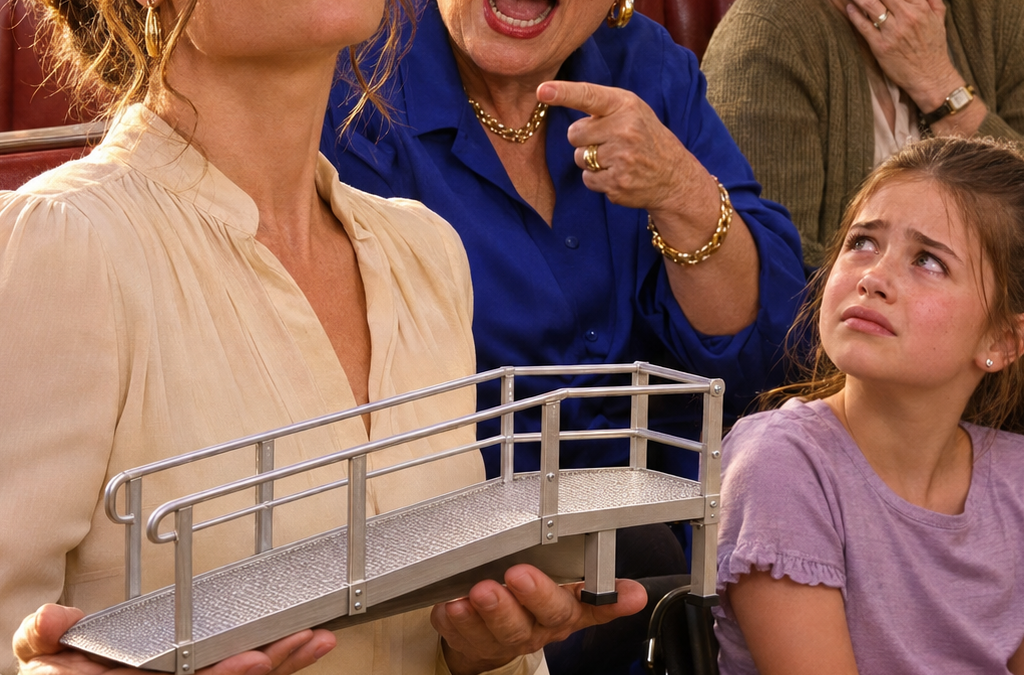
Beside me, Lily stopped rolling the little model ramp between her palms. Ruth looked down at her lunch.
The clock above the counter read 12:10 p.m. It was Monday, August 3, and our sandwiches hadn’t come.
“A permanent structure changes the appearance of a property,” Carol told the others. “That affects everybody.”
“It would let her use our front door.”
“We all want that, honey.”
The vice president leaned forward from the next table.
“Then let the board handle it. Calling installers yourself just confuses things.”
“I called one.”
“And we’re asking you to stop,” Carol said. “Until we’ve settled on something suitable.”
Lily looked past her toward the parking lot.
“Will somebody be home to help when we get back?”
I couldn’t get her wheelchair over our entrance steps by myself. Every trip home depended on finding another adult.
“I’ll call before we leave,” I told her.
“What if nobody answers?”
“We’ll wait here a little longer.”
Carol’s expression softened for the homeowners watching us.
“That’s exactly why we should discuss something you can use immediately.”
A server approached with plates and hesitated beside Lily’s chair.
“Sorry, we’re taking up—” I stopped. There was room beside us. “The sandwiches are ours.”
Lily offered me the little ramp without looking up. I took it from her hands.
She had ordered grilled cheese with pickles inside, something she called a secret menu item. Now she peeled back the bread to count them.
Carol waited until the server left.
“A removable option wouldn’t change the house. You could put it away afterward.”
“Who puts it out?”
“You would work out a routine.”
“While she waits outside?”
“There are families who manage with portable equipment.”
Lily pressed the bread down.
“Would I have to wait outside when it rains?”
“Your mother would help you, sweetheart.”
“She already does.”
The vice president cleared his throat. “Nobody’s suggesting leaving a child in the rain.”
“Then tell me how this works,” I said.
Carol spoke more quietly. The people beside her leaned closer.
“Let’s not rule out an affordable solution before we’ve discussed it.”
“I paid for someone to come look.”
“And we’re still discussing your request. In the meantime, we need your cooperation.”
Ruth’s untouched soup had developed a skin. She kept looking at it.
“Did anyone call the man I gave you?” I asked her.
Carol answered. “We don’t need to conduct board business over lunch.”
“You started talking about our house.”
“Because people have questions. They’ve seen you showing contractors around.”
“One contractor. And he wasn’t there to build anything.”
“Then stopping those visits shouldn’t be difficult.”
Across the aisle, a homeowner who had smiled at Lily turned back to Carol.
“A temporary one sounds reasonable,” she said.
Carol nodded toward her. “Thank you. That’s what we’re trying to offer.”
My sandwich sat under its toothpick flag. Lily had eaten one pickle.
“What exactly are you asking me to accept?” I asked.
“We’ll send you an acknowledgment.”
“Of what?”
“That the board offered sufficient access. Then we can stop having these misunderstandings.”
“You want me to sign that?”
“It would help us close this out.”
“And someone still has to lift her chair.”
“You haven’t even tried the alternative.”
“Has anyone measured for it?”
The vice president answered this time. “That can be addressed once you accept the direction.”
I felt heat behind my ears. Lily was watching me instead of her lunch.
“No,” I said.
Carol waited, as though I had more to say.
“I’m not signing that.”
“We’re trying to work with you, Emma.”
“My child should not have to apologize for coming home.”
My phone lit beside the napkin dispenser. Earlier, I had asked the contractor one plain question about the charge. His reply appeared while Carol was still looking at me.
I placed the screen between us.
Carol’s spoon stopped as she began reading my screen again.
“Why is he contacting you?”
“He’s answering me.”
The message said, “My business never performed the assessment you were billed for. That visit was free.”
Carol looked toward Ruth.
“That doesn’t tell us anything about another provider.”
“Then give me that person’s name.”
“Bring your questions to the board meeting. We’ll check the records rather than speculate.”
I read the reply again. Until then, I had kept imagining a report sitting somewhere, waiting for someone to email it.
His name was Peter Lawson, an independent contractor from Albany. His next message said he had personally attended the board’s approval of a comparable ramp elsewhere in the neighborhood and kept dated installation photographs.
I had an outside witness, someone who didn’t need Carol’s permission to answer me.
During his free product visit, Peter had given Lily the sample I was holding. After I left for school enrollment, rain kept his van behind Ruth’s garage while he had coffee on her screened porch.
“Who approved the other ramp?” I asked.
“Different properties have different conditions,” Carol said. “I’m happy to explain that when we have the relevant materials.”
Ruth finally looked up.
“Maybe we should finish this at the meeting.”
“Finish what?” Lily asked.
Nobody answered her.
By the time my phone rang, the clock showed 12:55. I recognized neither the number nor the voice, but I’d requested a callback the previous Monday.
“Rachel Kim, New York attorney general’s Civil Rights Bureau,” the caller said.
Carol began lowering her cup before the caller finished introducing herself.
“Is this a good time to discuss your intake?” Rachel asked.
“Yes. Please.”
I stepped a few feet toward the counter, where Lily remained in sight.
“I’m an assistant attorney general,” Rachel said. “I need to hear what happened. Start with what you paid for.”
A server squeezed past me carrying three plates. Behind me, Carol asked whether I was discussing association business on the phone.
“Yes,” I told her, then turned back toward the counter.
Around us, Millstone Diner continued serving lunch. Through its window, traffic moved along the street in New Paltz, New York.
I had expected to spend the afternoon buying supplies for my new middle-school science classroom. Instead, I described the invoice’s promised independent site measurements, grade and drainage review, and written access recommendation.
“I paid on July twentieth,” I said. “Nobody has come to do that work.”
“Have they identified anyone they hired?”
“No. I’ve asked.”
“And the contractor you mentioned?”
“He says his visit was free. He didn’t do the assessment.”
“Send us the invoice, your payment record, and the messages.”
“Can you make them let us build?”
“We’ll review what you send. This call isn’t a finding.”
I gave her the board’s contact information. My voice sounded embarrassingly polite, like I was explaining a missed delivery.
When I returned, Carol had stopped addressing the neighboring tables.
“Please send any concerns in writing,” she said. “We want an accurate record.”
The vice president, Scott Pike, spoke before I could answer.
“We can arrange a time tomorrow,” he said. “Before the deadline.”
“What deadline?”
“You’ll receive the information.”
Ruth asked Lily whether her sandwich was all right.
“It got cold,” Lily said.
“I can ask them to warm it.”
“No, thank you.”
I sat beside my daughter. I had paid to keep things easy, and made it easy to ignore us.
“We’ll go home after you eat,” I told her. “I’ll find someone to help.”
Carol said, “We’ll expect to hear from you tomorrow.”
While we were still at the table, Scott’s board message arrived.
“Portable-access acceptance form due Tuesday, August 4, 5:00 p.m.”
Chapter 2 of 7
At 4:30 p.m. on Tuesday, August 4, I sat across from Carol with the acceptance form between us. It called a removable ramp a sufficient access solution. Nobody had measured our entrance.
“This gives you something now,” Carol said. “We can keep discussing a permanent design afterward.”
“Then why does it say sufficient?”
“It’s an acknowledgment, Emma. We need to know we’re moving forward together.”
Lily sat beside me in the meeting room. She still wore the paper visitor sticker from our school enrollment appointment. One corner had collected enough sweater fuzz to look furry.
“Can I take this off now?” she whispered.
“Yes.”
“Yesterday they said to keep it on.”
“That was for yesterday.”
She laughed once, then looked toward the folded metal ramp beside Scott.
He had brought two homeowners into the meeting. One stood near the door; the other had taken the chair nearest Carol.
“We thought hearing from neighbors might help,” Scott said.
“My brother uses one of those,” the woman by the door told me. “We keep it in the garage.”
“Who gets it out?” I asked.
“Well, I do. Usually.”
The other homeowner leaned forward. “They fold right up. You don’t have to leave them outside.”
“Could we see?” I asked.
Scott looked at Carol, then unfolded the ramp across the meeting-room floor.
“There,” he said. “Simple enough.”
It lay flat between the chairs. Our entrance had steps.
“Lily, suppose we’ve just gotten home,” I said. “Where would you be?”
“In my chair.”
“And where would this be?”
“In the house?”
“Stored wherever you find convenient,” Carol said.
I went to the doorway, leaving Lily beside the ramp.
“So I go inside to get it,” I said. “She stays outside. Then I bring it out and set it against the steps.”
“You’d get used to it,” the seated homeowner said.
“And when I’m at work?”
“You wouldn’t leave a ten-year-old home alone, surely,” Carol said gently.
“I’m talking about another adult bringing her home. Or her going outside while I’m making dinner.”
Lily looked at Scott. “Can I put it down from my chair?”
“Your mother would help with that.”
“I know. Can I?”
He glanced toward Carol again.
“We haven’t selected a particular product,” Carol said. “This is just an example.”
I returned to my chair.
“Then I’m not signing that.”
“You’re treating a temporary compromise as a final rejection.”
“The form says it meets her needs. You just said this isn’t even the one.”
Carol’s eyes moved toward the clock.
“We have until five to settle the temporary option.”
My classroom training kept coming back to me: what had we observed, and what were we guessing? I had been treating an invoice as proof that someone was working.
“Who actually came to the house?”
“Your contractor was there,” Scott said.
“For a free visit.”
“That’s your description.”
“Let’s ask him.”
Peter answered on the third ring. I told him who was present before putting him on speaker.
“Was July twenty-third the accessibility assessment I paid the association for?” I asked.
“No. That was a free product visit.”
“Did anyone hire you to measure the site or write a recommendation?”
“No.”
Carol leaned toward the phone.
“We haven’t claimed your company was retained, Mr. Lawson. We’re checking the status of the request.”
“All right,” he said.
“Did you bill anyone for that visit?” I asked.
“No charge to anybody.”
I thanked him and ended the call. Ruth had been sitting beside Carol with the association’s ledger open in front of her.
“Was there someone else?” I asked.
“I don’t have a vendor listed for it,” Ruth said.
“Any payment to an assessor?”
“No.”
“A work order?”
“Nothing here.”
Carol turned slightly toward her. “The funds were received. That’s in there.”
“Yes,” Ruth said. “The forty-eight hundred is recorded.”
I had brought the invoice and my bank record. The debit matched the association’s credit. That part, at least, had happened exactly as promised.
“The invoice says independent measurements, grade and drainage review, and a written access recommendation,” I said. “Before a design decision. Where’s the recommendation?”
Ruth looked at Carol.
“Ruth?”
“There isn’t one in the file.”
“Has anyone been hired?”
“No,” she said.
The homeowner nearest Carol stopped nodding.
Carol’s voice stayed pleasant. “The money was being held while we worked toward a workable design. We didn’t want you paying for work that would need to be repeated.”
“I already paid.”
“And it remains accounted for.”
“Then give it back.”
“That requires a board vote. We can’t arrange an immediate repayment across a table.”
“All three of you are here.”
“We haven’t put a refund on the agenda,” Scott said.
I looked at the form again. Its deadline was half an hour after the meeting began. Apparently that had required less preparation than returning my money.
“Send me the date you’ll vote,” I said.
“We’ll review your request,” Carol answered. “Meanwhile, exterior work still needs approval. Owning the house doesn’t remove that requirement.”
“I know I own a house with steps my daughter can’t use.”
“We’re trying to resolve that.”
I left the form unsigned.
Outside, Lily asked whether we could go straight home. I still had to arrange help at the entrance.
Before I finished that call, Peter forwarded a warning Scott had just sent him. The board had told him not to begin.
Unapproved work could trigger “$250 per day.”
Chapter 3 of 7
“I released the August slot.”
Peter told me over the phone Friday morning, August 7. I was standing beside our entrance steps, looking at the space where the ramp should have gone.
“Am I already being fined?” I asked.
“No. Nothing’s been built. There’s no fine running.”
“But you can’t come.”
“I can’t keep a crew waiting without approval, Emma. I gave those days to another job.”
“How much longer?”
“I don’t have a date I can promise.”
I had wanted him to say September. I would have settled for a week circled in pencil.
“You haven’t lost any construction money,” he added. “You haven’t paid me for a build.”
“I know.”
But Lily would still need help getting inside when school started.
After we hung up, the board’s formal warning arrived in my email. The phrase “$250 per day” appeared beneath a paragraph about unauthorized exterior alterations.
Carol called before I finished reading.
“I wanted to make sure you weren’t alarmed by the notice.”
“Peter gave our days away.”
“That’s unfortunate. But proceeding without approval could become very expensive. We’re trying to protect you from that.”
“By warning him not to come?”
“By making the requirements clear before you incur more expense.”
“I’ve already incurred an expense.”
“And your request about that payment is under review.”
There was typing on her end.
“Going forward, please direct installer communications through the board,” she said. “Separate conversations create confusion about what’s been authorized.”
“I can still talk to someone I might hire.”
“Of course, honey. We’re asking that anything involving this project come through us.”
I said nothing at all.
“We need cooperation if we’re going to resolve this.”
“Then send me a date for the refund vote.”
“We’ll notify you.”
That afternoon, a neighbor helped us get Lily and her chair inside after a school-supply trip. I thanked him twice. He told me it was no trouble, but he had left his car running.
Lily waited until he was gone.
“Should I stop asking people over until winter?”
I stood beside the door with the shopping bag against my leg.
“Why winter?”
“Maybe it’ll be done then.”
“You can have friends here.”
“What if they want to go outside?”
“We’ll figure it out.”
She looked at the steps through the open door.
“I don’t want everybody waiting while somebody gets me.”
A package of pencils had split in the bag. One poked through the plastic against my knee.
“I don’t want that either,” I said.
She went down the hall without asking about the ramp again.
Later, a colleague called about classroom setup. We were both preparing rooms at the middle school where I had just been hired.
“Also, this might be none of my business,” she said. “I live in Cedar Hollow. Was that update about you?”
“What update?”
“The board email. About a homeowner declining temporary access.”
I found it while she waited. The message said a practical temporary arrangement had been offered and declined. It asked residents to allow the board time to work toward a permanent solution.
“They wanted me to sign that it met Lily’s needs,” I said. “Nobody had measured our entrance.”
“Oh. That’s different.”
“Yes.”
“Do you want me to reply?”
“No. Thanks for asking me.”
We went back to talking about classrooms. Mine had a faucet that squealed when it was turned on. She said every science teacher eventually learned which taps to avoid.
After the call, I started a reply to the neighborhood list.
I got as far as “For anyone who would like the actual facts.”
Then I deleted it.
Instead, I sent Rachel the invoice, my bank payment record, Peter’s contact information, and the warning. I named each attachment so she wouldn’t have to guess what it was.
Ruth came over before dinner. She stayed outside the doorway.
“I saw the neighborhood message,” she said.
“So did I.”
“I didn’t write it.”
“Did you object?”
Her gaze moved past me toward the hallway.
“No.”
I waited.
“I voted for the charge,” she said. “I thought somebody had arranged the work. That’s what I thought the money was for.”
“You could have asked.”
“Yes.”
“Will you tell the neighbors that?”
“Oh, Emma.”
“You just told me.”
“I’ve lived beside these people for years.”
“So have they lived beside you.”
“They trust me to keep association matters private.”
“They got an email about my daughter’s access.”
Ruth’s face colored.
“I can’t get into a neighborhood fight,” she said.
I stayed in the doorway until she left.
On Monday, August 10, Rachel called while Lily was reading on the couch.
“I have your attachments,” she said. “We’re requesting the association’s records and accounts from the people involved.”
“Can they spend the money while you’re looking?”
“This investigation doesn’t freeze their account.”
“And the ramp?”
“You still need approval before construction.”
I watched Lily turn a page. We were still arranging every trip around our steps.
“Please ask each of us separately.”
“We’ll request individual accounts.”
“Ruth said she thought somebody had arranged the work.”
“Did you hear that from Ruth directly?”
“Yes. Friday. At my door.”
“Include that in your response to me. What she said, as closely as you remember.”
The written request reached me afterward. It asked for records, dates, and names.
One line specifically named “Carol Mercer” and asked who had instructed the board not to commission the promised assessment.
Chapter 4 of 7
“The association says it was a committee decision,” Rachel told me. “Their lawyer sent that answer.”
“Which committee?”
“They haven’t identified who decided to hold the work.”
It was Thursday, September 17. I had come after school, while Lily stayed at her regular after-school program. There was dried whiteboard marker along the side of my little finger.
“So nobody’s responsible?”
“That’s not what I said.”
Rachel waited until I looked at her.
“We can follow your payment into their account. We can establish that nobody was hired. Those records don’t tell us who gave an instruction.”
I had spent weeks wanting a name beneath every empty space. Rachel wouldn’t fill one in just because I could.
Peter had sent his dated installation photographs. Rachel had also obtained the earlier ramp approval from the association’s records.
One picture showed the modular sections before the handrails went on. Another showed Carol standing beside the installation, close enough to speak with the workers.
“That’s her,” I said.
“Yes. July fourteenth.”
“She was there. All that talk about how a ramp would look, and she’d already watched one go in.”
Rachel let me finish.
“The board approved that design,” she said. “We still need to address your property.”
She asked whether Peter could join us by phone. When he answered, he sounded as though he was outside.
“Same system I showed Emma,” he said. “Different layout, obviously. You build to the entrance.”
“Have you completed a site assessment at her home?” Rachel asked.
“No. Product visit only. I’ve been clear about that.”
“I know. I need the distinction kept clear.”
Afterward, I went to collect Lily. Her program had made paper helicopters, and hers kept landing upside down.
“It’s a rescue helicopter,” she told me. “It needs rescuing.”
For the drive home, we argued about whether that counted as a successful science project. At our entrance, we waited for the adult I had arranged to help.
The next week, Carol called.
“I’ve seen the photographs Mr. Lawson provided,” she said. “Nobody disputes that installation happened.”
“Then you knew this equipment could be approved.”
“At that property, yes. Honey, there are slopes, water runoff, the length of time a structure remains in place. You can’t compare houses from a picture.”
“Did somebody compare them any other way?”
“That’s what we’re trying to work through.”
“You charged me to have someone do that.”
“And our attorney is discussing the payment with Ms. Kim.”
Her voice stayed soft. Mine had gotten loud enough that Lily looked up from the kitchen table.
Carol continued, “We need to avoid turning a difference over process into an accusation against individual officers.”
I ended the call before I said anything Lily would have to hear twice.
When I told Rachel, she didn’t dismiss Carol’s point.
“A photograph cannot measure drainage.”
“I know that.”
“She’s entitled to raise site differences. We’ve asked for the assessment supporting those concerns.”
“But there isn’t one.”
“No. That’s part of what they need to resolve.”
Rachel asked me to describe the entrance I needed. I began talking about the money, then stopped.
“I need Lily to get from the driveway to our door,” I said. “In her chair. Without me finding another adult first.”
“Anything else about the proposed design?”
“She needs to be able to come back inside if she goes out. I don’t want a setup where I have to put something down for her every time.”
“That’s what I’ll take into the discussions.”
The weeks that followed were mostly ordinary school days interrupted by calls. I taught lab safety, answered parents’ emails, and checked my phone during lunch.
Once, Rachel called while I was eating a baked potato beside a stack of quizzes. By the time we finished, the butter had hardened again.
The association’s lawyer and Rachel worked toward an agreement. I answered questions about delays, arrangements for getting Lily inside, and what I had paid. Nobody asked me to pretend those weeks had been convenient.
On Thursday, October 15, Rachel called with something definite.
“The board authorized Carol to sign a settlement up to sixteen thousand eight hundred dollars, with approval for your ramp.”
I leaned against the classroom counter.
“Does that mean it’s done?”
“No. Everyone still has to agree and sign.”
She explained that the agreement wouldn’t require an admission of legal liability. I could hear students passing in the hallway.
“And they can’t charge me again for the assessment?”
“That requirement comes out. You’ll have the terms to review.”
She offered an optional public signing at Millstone Diner in New Paltz.
“Thursday, October 22, at six,” she said.
I asked who would be there.
“You, me, the three officers, their lawyer, and Peter. Affected homeowners may observe.”
“Lily won’t be there.”
“That’s fine.”
I arranged for her to stay elsewhere that evening. She asked whether the meeting would take as long as the one with the folding ramp.
“I hope not.”
“Don’t bring me cold fries.”
“I wasn’t planning to.”
“You always think they’ll still be good.”
Before the signing, Carol called to confirm she would attend.
“If the photographs are what people will be shown, we can explain the different sites,” she said. “I won’t accept an inaccurate account of an officer deliberately refusing access.”
I told her to discuss that with Rachel.
Later, Ruth called. She sounded breathless, though she said she was sitting down.
“There’s something I should have told you.”
I stayed beside the kitchen doorway.
“I forwarded your message.”
“What message?”
“Your private one. To Carol. September eighteenth, at six-forty.”
“What did you send her?”
“The whole thing, Emma. Including where you said you were going to ask each board member separately who stopped the assessment.”
Chapter 5 of 7
“Carol asked me to keep the contacts in the board’s shared account,” Ruth said. “So everyone would have the same information.”
“Mine wasn’t sent to the board.”
“I know.”
It was Monday, October 19. Through the kitchen doorway, I could hear Lily practicing spelling words. She pronounced each one like a weather forecaster warning us about hail.
“What else have you sent her?” I asked.
“Questions you asked me. About the meeting, mostly.”
I had stood at Ruth’s door and told her things I hadn’t put in emails.
“You can tell Rachel what you did,” I said. “Your own account.”
“Of course. But if you hear anything before Thursday—”
“I’m not giving you updates anymore.”
“Emma, I wasn’t trying to hurt you.”
“I can’t keep wondering where my words are going.”
She stayed on the line. I waited without helping her finish.
Finally, she said, “All right.”
Afterward, Lily called from the kitchen.
“Does ‘unnecessary’ really need all those letters?”
“Apparently.”
“That seems unnecessary.”
I laughed, and she looked pleased enough to spell it again.
Carol called later that evening.
“There may be a simpler way to finish this,” she said. “Without another difficult public discussion.”
“I’m listening.”
“We return the assessment payment. Your design gets approved. You acknowledge that this was an administrative misunderstanding, rather than misconduct by any officer.”
“And the rest of the agreement?”
“That’s what we could avoid. More expense, more attention. Neither of us needs that.”
The settlement packet Rachel had sent was on my kitchen table. It included the refund, compensation, and the ramp approval. Carol’s version would keep only the pieces she wanted me to announce gratefully.
“What would I be signing?”
“A short statement. We can have the attorney make it clear.”
“That nobody was responsible?”
“That no individual officer deliberately obstructed your request.”
“I don’t know that.”
“Exactly, honey. There’s no reason to make a personal accusation.”
“There’s no reason for me to clear everyone, either.”
“We can have the approval ready with the refund.”
“I won’t sign your explanation.”
She paused.
“Then what would resolve this for you?”
“I’m willing to sign an agreement about what happens next. I’m not signing a story about conversations I wasn’t there for.”
“We’ll discuss it Thursday,” she said.
The next day, I called Rachel during my lunch break.
“Can they replace the packet with that?”
“They can propose different terms. You can decline.”
“Even after the board vote?”
“They authorized Carol to sign up to sixteen thousand eight hundred dollars. That’s permission, not a completed agreement. You and the association still have to accept and sign; my final signature makes it effective.”
“And if they won’t?”
“Then we haven’t settled. The investigation continues.”
She didn’t tell me Thursday would go well.
“Do I have to answer Carol’s proposal again?”
“No. I’ll speak with their counsel.”
I ate the rest of my lunch before returning to class. For once, I hadn’t promised anyone I would think about something I had already refused.
Peter confirmed that he would attend Thursday.
“I’ll be there before six,” he said.
“I need to ask you something.”
“Go ahead.”
“At the meeting, please keep what you saw yourself separate from what somebody told you. And from whatever’s in the records.”
“That’s how I’ll answer.”
I had more questions, but students were gathering outside my classroom. We confirmed the diner, and I ended the call.
On Thursday, October 22, I arrived at Millstone Diner a few minutes before six. Lily was elsewhere for the evening. Before leaving her, I had checked twice that the adult bringing her home could stay to help at the entrance.
The homeowners from August were already taking seats. One gave me a small wave. The woman who had called the temporary ramp reasonable kept her coat on.
Ruth sat beside Scott, across from Carol. Peter was near the end of the table.
Carol greeted me without getting up.
“Emma. I hope we can finish this tonight.”
“So do I.”
The association’s lawyer was speaking quietly with Rachel near the counter. When they finished, the lawyer asked Carol and Scott to step away from the table. Ruth followed them.
I could see Carol listening. I couldn’t hear what was said.
Rachel came over to me.
“Counsel received additional information this morning and has had time to review it,” she said. “They can ask for more time.”
“Are they asking?”
“Not so far.”
When the officers returned, their lawyer remained standing.
“We’re prepared to continue,” the lawyer said. “If we need a private discussion, we’ll ask.”
Carol sat facing the homeowners.
“Before we begin, I want to clear up one point. No individual stopped Emma’s assessment. The payment was held as a refundable reserve while the committee worked through the request.”
Scott nodded.
“The state has not made a finding of deliberate discrimination,” Carol continued. “We’re here to resolve a disputed process and allow everyone to move forward.”
One homeowner glanced toward Rachel, who was checking who still needed a copy of the agreement.
I stayed in my seat. Carol had said it plainly now, in front of the people who had heard her describe my daughter’s needs over lunch.
Ruth came around to my side of the table.
“I corrected my account this morning.”
“To Rachel?”
“Yes.”
Carol was speaking to her lawyer. Ruth watched them, then faced me again.
“I told her who gave me the instruction. I’ll say it here.”
Chapter 6 of 7
“For the record,” Rachel said, “what is the board’s account?”
It was six o’clock. Ruth had returned to the officers’ side.
“No officer deliberately stopped an assessment,” Carol said. “The money remained refundable. A committee misunderstanding doesn’t justify twelve thousand dollars in compensation.”
“Carol told me to hold it,” Ruth said. “I sent the message myself. I kept quiet when Emma asked.”
Carol faced her.
“You understood a provisional safety hold as a cancellation. That’s the misunderstanding.”
She turned toward Rachel.
“The installation photographs show another property. They cannot establish who instructed Ruth, or what was intended here.”
Their lawyer watched Rachel. A server behind us called out an order for someone near the window.
I put Lily’s sample on the table. Beside the dinner menus, it looked small enough to lose.
“You billed me for an independent assessment,” I said. “How could that be pending if somebody had said not to book anyone?”
“That’s the disputed account, Emma.”
I looked toward Peter.
“Where were you when she said it?”
“I saw her.”
Carol turned toward him.
“I was on Ruth’s screened porch,” he said. “After the sample visit. Waiting for the rain to let up.”
“You’d left,” Carol said.
“My van was behind the garage.”
Carol’s mouth remained open for a moment. Then she looked at Ruth.
“Through the screens?” their lawyer asked.
“Yes. Carol was at the porch steps. Nothing blocked my view.”
“And you knew who she was?”
“I’d met her at the July fourteenth installation. Same person.”
Peter spoke toward the lawyer, without raising his voice.
“She told Ruth not to book the assessor. Keep the payment in reserve until Emma withdrew the fixed-ramp request.”
“Those were her words?” Rachel asked.
“That’s what I heard. Hold the assessment. Keep the money in reserve. Wait until she drops the fixed ramp.”
Carol leaned forward.
“A reserve protects the homeowner from unnecessary expense. We had unresolved safety concerns.”
“No,” Ruth said. “There wasn’t anyone reviewing safety. I hadn’t hired anybody.”
She rose from beside Scott and came around the table. The empty chair beside me scraped against the floor when she sat.
“I sent the hold because Carol told me to. I should have said that in August.”
Rachel looked at Carol.
“What assessment were you waiting for, if you had instructed her not to book one?”
“We were waiting for agreement on an appropriate direction,” Carol said. “Before commissioning work that might need repeating.”
Rachel waited until Carol finished.
“An independent witness and your secretary describe a deliberate hold, not a lost booking. I won’t execute the administrative-error proposal.”
Their lawyer asked for a private discussion. Rachel agreed.
Carol and Scott went with the lawyer toward the entrance. Ruth stayed beside me. Through the diner window, I could see their reflections, close together beneath the hanging lights.
When they returned, the lawyer spoke first.
“The association will execute the negotiated agreement under the board’s authorization.”
Carol sat down. Her jaw shifted once before she spoke.
“I’ll sign for the association.”
She signed the HOA signature line while her lawyer watched.
I signed my name beneath the terms I had reviewed.
Rachel checked both signatures, then countersigned. The clock above the counter showed that it was still before seven.
“The agreement is effective,” she said. “The association now has a $16,800 payment obligation.”
Carol stared at the packet.
“That’s the forty-eight-hundred-dollar refund and twelve thousand in compensation, due November fifth,” Rachel continued. “The attached ramp approval is effective. The charged assessment prerequisite is removed.”
Carol pushed her chair back far enough that the homeowner behind her moved her feet.
“Scott. You supported this process.”
He looked at their lawyer before answering.
“We need to arrange the payment, Carol.”
“From the contingency account,” the lawyer said.
Scott nodded. He didn’t look toward the homeowners for agreement.
The woman who had called the temporary ramp reasonable leaned toward Ruth.
“So nobody was coming to measure?”
“No,” Ruth said.
“But we were told they were working on it.”
“I let you believe that.”
Carol started to speak, but the woman kept facing Ruth.
“Why didn’t you say something at the first meeting?”
Ruth looked down at the space between our chairs.
“I didn’t want Carol angry with me.”
I kept my eyes on the sample. One edge had a scuff from Lily rolling it against the diner table in August.
Carol addressed me across Ruth.
“Emma, going forward, surely we can handle practical access questions privately. Without bringing everyone into each conversation.”
“Send HOA business in writing.”
“I’m suggesting we talk as neighbors.”
“We tried that.”
“The approval still requires coordination.”
“Municipal clearance and construction. I’ll arrange those.”
She glanced toward the watching homeowners.
“There may be things the neighborhood needs to discuss.”
“My daughter’s way home is not up for a vote.”
Carol stopped looking at me. She asked the lawyer which copy she should keep.
Ruth remained beside me while people got up. I thanked her for saying what happened. I didn’t ask her to come over afterward.
At the counter, I ordered Lily fresh fries. The server folded the bag loosely so they wouldn’t steam themselves soft, and told me that was the best she could do.
Outside, I had the bag tucked under my arm when my phone rang.
“Are you finished?” Lily asked.
“Yes.”
“Did you get fries?”
“Fresh ones.”
“Okay. Mom?”
Cars passed along the street. I waited beside mine.
“Can I invite three friends here on November 13?”
Chapter 7 of 7
“Yes, if the construction and inspection happen in time,” I told Lily. “We’re aiming for November fifth, then the final check November sixth. Peter still has to confirm.”
“So I can ask them?”
“Tell them November thirteenth is the plan. I’ll talk to their parents when we know.”
“Can you talk to them without making it a whole thing?”
“I can try.”
“Just say we have snacks.”
I stood beside my car outside the diner, holding fries that were finally getting cold.
“We do need snacks.”
On Friday, October 30, the $16,800 payment cleared into my account. I checked the bank screen during lunch, then called Rachel.
“It’s there,” I said.
“The full payment?”
“Yes.”
“I’ll confirm receipt in our file. You have the signed approval?”
“I do.”
“Good. Keep that copy.”
“Thank you.”
“You’re welcome, Emma.”
The bell rang before I could add anything. I went back to a classroom where somebody had drawn eyebrows on the skeleton diagram.
On Monday, November 2, the municipal clearance was complete. Peter called that afternoon.
“We’re booked for Thursday. Eight o’clock.”
“And the check Friday?”
“Still scheduled. It has to pass before you use it.”
I told Lily after dinner. She asked whether she could send the invitations now.
“Yes.”
“All three?”
“All three.”
She disappeared down the hall before I could ask whether their parents had my number.
At 8:00 a.m. on Thursday, November 5, Peter’s crew began unloading outside our house. Lily watched from the front window while I packed her lunch.
“That piece is longer than I thought.”
“It has to reach the driveway.”
“I know. I just thought it would look smaller.”
For months, I had pictured a finished ramp without knowing where each section would go. Now the pieces lay on our property, beside work boots and a cooler.
I had separately hired Peter for the $6,400 construction job. When the work was finished, I paid his invoice myself.
That evening, Lily wanted to go outside and try it.
“Tomorrow, after the check,” I said.
“But it’s right there.”
“I know.”
She stayed at the window a little longer.
The ramp passed its final municipal check on Friday, November 6. Peter called with the result while I was at school.
After we got home, Lily went down to the driveway and came back up. I followed the first time, close enough that she glanced over her shoulder.
“Mom.”
“What?”
“You’re in my way for turning.”
I stepped back toward the door.
She went down again. On her next trip up, she stopped to look at a leaf caught near the railing. I waited inside until she came through.
“Are we going somewhere?” she asked.
“No.”
“Okay.”
She headed for the kitchen.
On Thursday, November 12, the board sent the record of its vote. Carol, Scott, and Ruth had all voted for the process change required by the settlement.
Future decisions would identify the responsible officers. Before another disability-related assessment charge, the board would have to obtain an independent technical review.
I read the message once and saved it with the agreement. There was no invitation to discuss an exception over coffee.
That night, I asked Lily which snacks she wanted for Friday.
“Pretzels. Popcorn. Maybe apples.”
“Maybe apples?”
“For you.”
On November 13, three friends came home with Lily after school. I parked and opened the car door, then caught myself scanning the neighboring driveways for someone to help.
Lily was already talking over her shoulder.
“You can pick the game, but we’re not starting over every time somebody loses.”
“That was one time,” a friend said.
“It was three.”
A backpack slid off someone’s shoulder near the bottom of the ramp. Its owner blamed another child, who had been nowhere near it. They argued all the way to the door.
Lily went ahead of them. Nobody lifted her chair.
I carried the snacks inside while the backpack dispute turned into a game dispute.
“You said I could pick.”
“I said you could pick a game we have.”
“You have cards.”
“That’s not the game you said.”
I put the popcorn on the table.
“Shoes off before you settle this in court.”
“We’re not in court,” Lily said.
“Then this should be quicker.”
It wasn’t. Twenty minutes later, they were still debating whose turn had counted. I answered school emails nearby and ate the apples myself.
At the regular HOA election on Thursday, December 10, Carol lost the presidency. Ruth emailed me the result that evening: nineteen to eight.
The next afternoon, she stopped outside while I was bringing in groceries.
“I sent you the count,” she said.
“I saw it. Thank you.”
“She won’t be president anymore.”
“I know.”
Ruth looked toward our houses.
“I should have spoken sooner. I keep coming back to that.”
I stayed beside the open car.
“Thank you for telling the truth.”
She nodded, but didn’t leave yet.
“If there’s association business, email me,” I said.
“Yes. I will.”
We talked briefly about the cold weather. I didn’t tell her about work, or what Lily had asked for Christmas. When she went home, I brought in the last bag.
On Friday, December 18, Lily’s friends visited again.
I was at the kitchen counter when I heard them outside. My first impulse was to go to the entrance. I had spent so long listening for the moment somebody needed me there.
Then Lily called, “Hold on, my bag’s caught.”
I stopped.
A friend said, “On what?”
“The handle. Wait.”
A few seconds later, the door opened. Four children came inside, talking about something that had happened at school.
“Mom, can we move my homework?”
“Keep it together. You’ll need it later.”
“I know.”
I stayed in the kitchen. Lily brought her schoolbag to the table and made room between a worksheet and her spelling notebook.
She pulled out the little sample she had kept in the bag. One friend asked what it was.
“Like the one outside,” Lily said. “Only useless for getting into a house.”
They laughed. She moved a pencil out of its path.
She set the miniature ramp beside her homework.







