Dad called me a freeloader at the hotel awards while claiming my $48,000 care payments; he had no idea who was standing behind him.
Chapter 1 of 7
“Your sister earned her seat; you can clear the plates.”
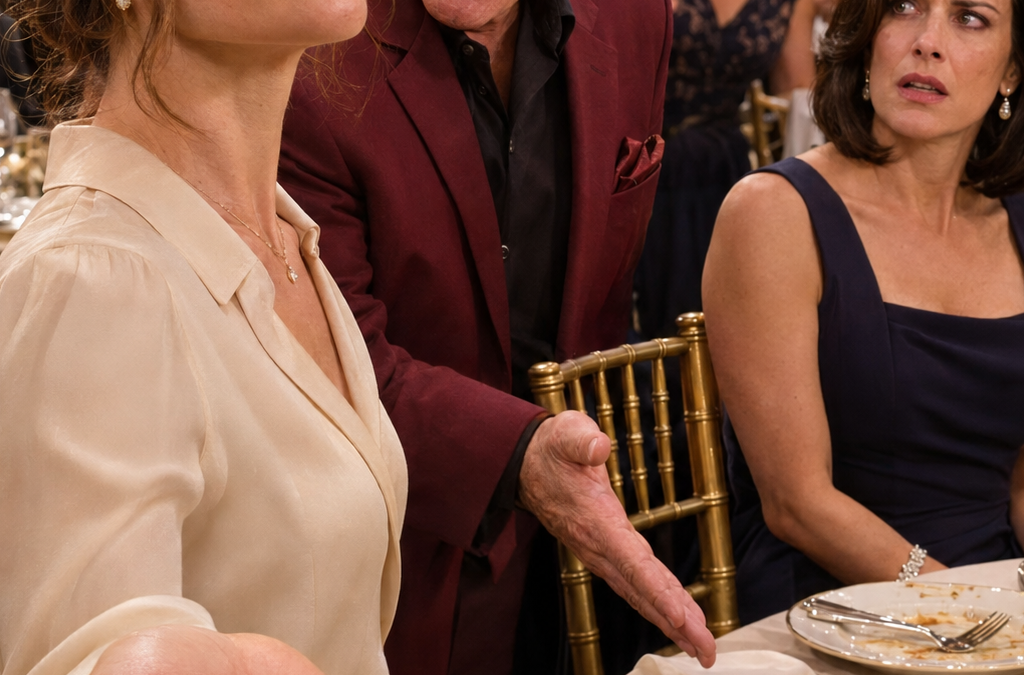
He said it beside the reserved table, where Megan’s guest credential lay across a folded napkin. The money he had just described as his annual sacrifice was mine. I paid it directly to my mother’s memory-care facility.
It was 5:30 p.m. on Thursday, October 8, in Austin, Texas. Around us, hotel operators balanced drinks and checked the opening reception program.
Megan heard him. Her eyes stayed on the credential.
“Those are my payments, Dad.”
“I’m talking about the family, honey. We don’t need to do this here.”
A woman beside him glanced toward the stage. He gave her the apologetic look he used when restaurant orders arrived wrong.
“Anna’s between things right now,” he said. “We’re glad she could come.”
“I sold my business.”
“Yes, and we’re all very proud.”
He said it while looking past me.
I reached toward his crooked place setting. I stopped before touching it. There were staff members working this reception, and I wasn’t one of them.
“The plates,” he said quietly. “Just help us get settled.”
“They’re still eating.”
“Then ask whether they’re finished.”
Megan’s mouth opened. Dad turned toward her before she said anything.
“You’ll stand with me for the tribute. They may want a family photograph.”
“Is that tonight?” she asked.
“The short version. Your mother couldn’t be here, obviously.”
“Did you tell Mom about it?”
“She wouldn’t follow all this.”
He answered too quickly. Megan looked at me, then down again.
In my palm was my grandfather’s old brass hotel key. The retired maintenance chief had mended its bow on his last Thursday, while I visited the hotel. Grandpa used to carry it beside peppermint candies that tasted faintly of metal.
It opened no current lock. I had brought it because this was a hotel gathering, and I missed him.
Dad noticed my empty other hand.
“There’s a service station behind you.”
“I’m not clearing the table.”
His expression barely changed.
“Nobody’s asking you to work, honey.”
“You just did.”
“I asked for a little consideration.”
Megan shifted her chair, making a narrow space beside her. Before I could sit, Dad spoke again.
“We’re keeping that spot open for the photograph.”
I remained standing.
“Being useful wasn’t the same as being welcome.”
Megan looked up at that.
“Please,” she said. I couldn’t tell which of us she meant.
A server arrived carrying a tray of tiny cornbread muffins. Dad took one and asked whether the photographer was ready.
At home, he always complained those muffins were too sweet. Here, he praised the kitchen.
“You should eat,” Megan told me.
“I’m fine.”
“You haven’t—”
“I said I’m fine.”
She flinched. I wished I had saved that sharpness for him.
Across the aisle, Linda stood with a tablet and the evening’s presenter. Dad beckoned them over.
“Quick question about the family tribute,” he said. “Megan has the approved wording.”
Megan’s face went pink.
“I sent what you gave me.”
“Exactly. We’re keeping it simple.”
“What wording?” I asked.
Dad addressed the presenter instead.
“My wife’s care. The commitment our family has made. Nothing too personal.”
“Then leave my payments out.”
“We’ve already discussed this, honey.”
“No. You talked.”
The presenter looked toward Linda. She was reading something on her tablet.
Dad moved closer to Megan.
“Come around this side. Better light.”
Then he looked at me.
“Would you stand near the aisle? Otherwise you’ll be behind us in every shot.”
“I’m staying here.”
“We’re trying to get through a nice evening.”
“So am I.”
The presenter had a small boxed plaque against her hip. Dad saw her glance at Linda and started explaining how briefly he could speak.
“Thirty seconds,” he said. “My wife deserves that much.”
Linda stopped her pen and read the tablet again.
“Do not take that plaque onstage.”
On her screen, Dad’s proposed tribute credited him with personally providing my annual contribution to Mom’s care.
Dad gave a small, patient laugh.
“Is there a spelling problem?”
“Funding attribution,” Linda said. “We’re withdrawing this tribute from tonight’s program.”
“That’s unnecessary. It’s family money.”
“Mine,” I said. “Paid directly.”
“We can review wording later,” Linda said. “It won’t be presented tonight.”
The presenter left with the plaque. Dad watched her go without calling after her.
I was the controlling member of Reed Lodging Holdings LLC, the company that had bought Brooks Stay Hotels LLC on September 21. Dad knew the buyer’s name. He thought it belonged to an investment platform unrelated to me.
On June 18, I had sold the maintenance-scheduling business I’d built. Part of those proceeds, together with a bank loan, funded the purchase.
We had bought the operating business for two leased hotels, not the land beneath them. I had kept the three independent board managers in place.
Linda chaired that board. She and closing counsel had verified the signed ownership records. Dad still hadn’t asked whose money stood behind the buyer.
He watched Linda now.
“If you need revised nomination material, Megan can send it.”
“This isn’t about her work,” Linda said.
“I didn’t say it was.”
He turned to my sister.
“Keep the family photograph on the list. We can do that without a presentation.”
Megan didn’t answer.
Linda’s phone lit up. She checked the caller, and her attention left Dad mid-sentence.
“There’s no reason to hold up the program,” he told her.
She was already answering.
Linda answered a call and turned away from the room.
“Twenty-four thousand six hundred? You’ve confirmed the payment?”
Dad glanced toward her, then back at the stage. Behind him, someone tested the microphone with two hollow taps.
Linda listened.
“Send the confirmation to the board,” she said. “Keep the supporting records together.”
She ended the call and came back to us.
“Something missing from my nomination?” Dad asked.
“Separate matter.”
“I’ve answered everything you sent.”
“We’re still reviewing it.”
His voice stayed pleasant.
“Then you have my explanation.”
The company expense-review packet had arrived before this reception. The inquiry began September 28, after the routine post-acquisition review flagged a private renovation charge.
On Monday, October 5, Dad had received notice that the board might consider action under his misconduct clause. He already had the disputed transaction details and an opportunity to explain.
Tonight’s insult hadn’t created that inquiry. And owning the company didn’t give me the board’s vote.
Linda said, “I’ll contact you about the remaining questions.”
“Of course,” Dad replied. “I’d like it settled.”
He smiled at a passing hotel operator and asked about occupancy. The change was so smooth that I wondered how often I had mistaken it for recovery.
The early awards began. Applause rolled through the reception area, and Dad moved closer to the stage.
I closed my fingers around Grandpa’s repaired key.
Megan stayed beside me. Neither of us tried to fill the empty chair.
At 6:20, her phone buzzed.
“It’s Dad,” she said.
He stood across the room, listening to a speech. Megan read the message, then looked toward him.
“What?” I asked.
She turned the screen toward me.
“Pause November’s $2,000 transfer. We need a family funding agreement.”
Chapter 2 of 7
Dad’s message concerned his own scheduled contribution. He couldn’t stop my payments or order the facility to send Mom away.
Still, on Friday, October 9, I arrived at the memory-care facility at 9:00 a.m. I wanted November settled with the people who actually kept her account.
Mom sat beside her window, wearing a cardigan with one sleeve turned back. I had brought a yellow flower from the awards reception. The staff had offered them as we left.
“Oh, you won,” she said.
“It’s from the hotel event, Mom.”
“Which school?”
“No school. Just a work thing.”
She studied my face.
“They should give you something for your work.”
The flower had a bent petal and a plastic tube around its stem. I had almost thrown it away in the hotel parking lot.
“Where should we put it?” I asked.
“Where your father won’t knock it over.”
She laughed before I could answer. He had once broken her favorite vase reaching across it for the television remote. For years, she had called every replacement vase temporary.
There was a water cup on her bedside table. A staff member found us something taller.
Mom watched the flower settle into it.
“Did Megan win too?”
“She’s working at the event.”
“Well. She always liked a microphone.”
That sounded enough like Mom that I stayed another twenty minutes.
At the account desk, I asked to review the payment arrangements somewhere private. The woman there brought me into a small office with a printer humming under the counter.
“Your four thousand has come in every month,” she said. “Directly from your account.”
“And the full fee is still six?”
“Six thousand, yes.”
“My father may withdraw his two thousand for November.”
“We haven’t received a cancellation yet.”
“I’d like to cover the full amount beginning November first. Please send me whatever authorization you need.”
She checked the account.
“We can arrange that before the next billing cycle.”
“If he cancels, call me. Don’t wait for us to work it out.”
“We’ll contact you.”
I had enough money left after the hotel purchase. Paying the larger bill would change my plans, but it wouldn’t change Mom’s room or interrupt her care.
Megan arrived while I was leaving the office. She still wore yesterday’s shoes.
“Did you talk to them?”
“Yes. November will be covered.”
“Dad said we should discuss—”
“I’m paying the facility. I’m not sending him replacement money.”
“I wasn’t asking you to.”
Her answer came fast. We stood beside a bulletin board advertising chair exercises and a visiting miniature horse.
“Mom’s awake,” I said.
“I’ll go in. First, there’s this thing he sent.”
“Here?”
“No. Outside.”
We went to the courtyard, where the sprinklers had left one bench wet. Megan remained standing.
“He wants us to sign a family statement.”
“What kind?”
“Just that we support each other. That he arranged Mom’s care and has been responsible for funding it.”
“He arranged the tour. We all went.”
“I know.”
“And I’ve been paying most of it.”
“I know that too.”
“Then why would you bring this?”
She looked through the glass doors toward Mom’s hallway.
“He says she needs a united family. That public accounting makes her care sound like a dispute.”
“Mom hasn’t asked for a statement.”
“It’s for the conference people.”
“Then it isn’t for Mom.”
Megan said nothing.
I could hear a television through an open window. Someone was trying to guess the price of a refrigerator.
“Did you tell him I’d sign?”
“I said I’d ask.”
“Tell him you asked.”
“He’ll call you.”
“I’m not discussing this in her room.”
“I wouldn’t do that.”
I believed her. That made the rest harder to say.
“I paid for every problem until he stopped seeing them as problems.”
Megan’s eyes stayed on the wet bench.
“Sometimes I thought you liked being the one who could fix it.”
“I liked knowing Mom was okay.”
“That’s not what I—”
“I know.”
She went inside to visit. I stayed in the courtyard until Linda returned my call.
“I’ve confirmed my mother’s account,” I said. “My father’s payment won’t interrupt her care.”
“Good.”
“Do you need the receipts?”
“For the tribute correction, yes. Send them privately.”
“And the expense inquiry?”
“Separate issue.”
“I know they’re separate.”
“I need to be clear, Anna. You own the buyer. That doesn’t tell us whether you approved an expense.”
“I didn’t ask you to fire him.”
“You asked what happens next. We need a supported finding before we act under his agreement. He already has the disputed transactions.”
“What’s missing?”
“We’re checking the underlying work records. His explanation has to be assessed too.”
I watched Megan’s reflection pass the hallway window.
“I can help with the maintenance handover.”
“Then start there. Send anything relevant to the board.”
Back in my car, I found Ray Foster’s number in the former staff directory included with the transition files. He answered after several rings.
“Anna? Everything running already?”
“Mostly. Is retirement treating you all right?”
“My wife says I’m supervising the dishwasher.”
“Does it need supervision?”
“Apparently less than I give it.”
I laughed, then asked about the handover records.
“I kept my duplicate work-order books,” he said. “Company said to hang on to them. Still some warranty questions outstanding.”
“Would you be willing to help the board check a job?”
“Depends which one.”
“The twenty-four thousand six hundred dollar renovation.”
He paused.
“That wasn’t at either hotel, Anna. That was at his condominium.”
Chapter 3 of 7
At 2:00 p.m. on Friday, October 9, Linda called while I waited outside the conference workroom.
“The contractor is real,” she said. “The work was done. The company paid the bill.”
“For his condominium.”
“Yes. He says the expense had permission. The address doesn’t answer that.”
Through the open doorway, I could see Megan at a laptop. A paper cup sat beside her, its tea bag label stuck to the wet rim.
“What explanation is he giving now?” I asked.
“A transition allowance. He says it let him keep working while the family dealt with your mother’s move into care.”
“She was already—”
“I’m telling you his explanation, Anna.”
I watched a hotel employee wheel a carton of programs past me.
“He also describes a history of family expenses being covered without invoices,” Linda said.
“By me.”
“Was there that history?”
“Yes.”
The answer scraped coming out. I had paid bills from photographs, forwarded emails, sometimes just a dollar amount Dad mentioned at dinner.
“That doesn’t make this okay,” I said.
“No. But we have to establish what happened with this charge.”
After we hung up, I stayed outside the workroom. My presentation was open on my phone: the first slide, my name, a photograph of a maintenance cart.
Megan saw me through the doorway.
“Anna. Come here a second.”
Her laptop showed the afternoon program. Where my maintenance-technology session had been, there was now an extended coffee break.
“Why is that blank?”
“I was going to call you.”
“When?”
“I just got it.”
The session had been approved weeks earlier. I had rehearsed it against the hotel room’s bathroom mirror that morning, trying to cut three minutes.
“Who changed it?”
“The organizer. Dad talked to her.”
“About my presentation?”
“About the company dispute.”
I read the revised program again. My name wasn’t anywhere on the page.
Dad came through the other doorway carrying his conference badge in his jacket pocket.
“There you are,” he said. “I wanted you to hear this from us.”
“I’m looking at it.”
“It’s a pause, honey. Nobody’s questioning your technical work.”
“Then why can’t I present it?”
“Because people will ask about the company. You’ll be introduced, someone will mention the transition, and suddenly a workshop becomes a family discussion.”
“It’s about maintenance scheduling.”
“I know what it’s about.”
He sounded tired rather than angry. That helped him with people. It always had.
The organizer appeared behind him.
“Anna, could we speak privately?”
“We can speak here.”
She glanced toward Megan.
“Your father described you as a consultant involved in an internal disagreement. Until that’s clarified, we’re holding the speaking slot.”
“I built the business this presentation came from.”
“I’m not disputing your qualifications.”
“Did you read my slides?”
“This isn’t about the slides.”
Dad stepped into the gap.
“She’s trying to keep the program running. Please don’t put her in the middle.”
“You put her there.”
The organizer’s face flushed.
“This isn’t a finding against anyone,” she said. “We’ll revisit it once the company clears things up.”
“Will there be another session this weekend?”
“Unfortunately, the schedule is full.”
Someone in the hall asked where the coffee service had moved. She excused herself to answer.
Dad waited until she was gone.
“You can see why a little distance helps.”
“You described my work as a family problem.”
“I described an unresolved situation. Those are different things.”
I said nothing at all.
He turned to Megan.
“The revised biography needs to go out before the afternoon introductions.”
“It’s ready,” she said.
“Use the version with the care arrangements. Nothing about who paid which portion. We don’t need a household ledger in a conference packet.”
Megan looked at me.
“What does it say?” I asked.
She read from the screen. “‘Robert Carter continues to lead the hotel group while coordinating his wife’s care with support from his daughters.’”
Bland enough to pass. Close enough to Thursday’s story to leave it standing.
“You’re sending that?” I asked.
“It doesn’t say he paid everything.”
Dad checked the hallway.
“Exactly. Thank you.”
“And I’m not repeating that word,” Megan said.
He looked back.
“Freeloader,” she said. “If anybody asks what happened yesterday.”
“There’s no reason to repeat an unpleasant exchange.”
“You said it.”
“And now we’re trying to move forward.”
Her promotional credential hung from a blue cord beside the laptop. Dad glanced at it.
“The November and December work still needs a recommendation. Let’s show them we can keep this professional.”
Megan’s face lost its color.
She sent the biography.
Dad left to speak with someone in the corridor. Megan stared at the confirmation on her screen.
“I left that word out,” she said.
“My session’s still gone.”
“I can’t fix the program.”
“I didn’t ask you to.”
She had brought a sleeve of saltines for lunch. We used to tease Mom for carrying emergency crackers everywhere. Neither of us made the joke.
I went upstairs before the extended coffee break began.
From my room, I sent Linda my ordinary call history and calendar, as requested. Then I called her.
“I want the chance to answer him in the same room,” I said.
“You’ll have it.”
“With whatever he’s relying on.”
“Yes.”
“I’m not asking you to skip anything because I own the buyer. Just don’t let his explanation become the only one people hear.”
“The board hasn’t reached a finding.”
At 4:00 p.m., her forwarded email arrived. Dad’s latest written response filled the screen.
“The purchaser’s representative approved the family-transition allowance.”
Chapter 4 of 7
I was the purchaser’s representative Dad meant. We had talked about a hotel repair, not an allowance for his condominium.
At 6:00 p.m. on Friday, October 9, Linda brought us into a small hotel meeting room away from the conference crowd. Nobody had asked Megan to come.
Dad remained standing beside a chair.
“I’d like to settle what was said on that call,” he began.
“We’ll discuss that,” Linda said. “First, you need to know who owns the purchasing company.”
He looked at me, then back at her.
“Anna?”
“Yes,” I said.
Linda had authenticated extracts from the membership ledger and signed operating agreement. Closing counsel had verified them.
“Anna is the sole member of Reed Lodging Holdings,” she said. “That company owns Brooks Stay.”
Dad sat down.
For several seconds, the air conditioner was the loudest thing in the room.
“You financed the purchase yourself?”
“With my money and a bank loan.”
“From the software business?”
“The scheduling business. Yes.”
“All of it?”
“I sold it in June, Dad.”
“I knew you sold it.”
“You told people I was between things.”
“I didn’t know you’d bought this.”
That much was true. I had let the buyer’s company name stand between us.
“I planned to tell the family after the transition,” I said. “I wasn’t going to announce a purchase before it closed.”
“You could have called.”
“Yes. I could have.”
He looked toward Linda.
“What authority did the board retain?”
“Executive employment decisions remain with us.”
“Not Anna?”
“Not Anna.”
He leaned back. His eyes returned to me, slower this time.
“Then we can keep this sensible.”
The room had a coffee station and no windows. At home, Dad declared coffee undrinkable after twenty minutes, then microwaved the same cup until lunch. Here, he hadn’t complained about anything.
“I’ll reimburse the charge,” he said.
Linda waited.
“There’s no reason for the company to carry a family misunderstanding. Anna can confirm the allowance, and I’ll pay it back.”
“Confirm what allowance?” I asked.
“The transition support we discussed.”
“We discussed a guest shower.”
“We discussed more than the shower, honey. Your mother. Everything that was happening.”
“Talking about Mom didn’t authorize work at your condo.”
“I’m offering to remove the expense.”
“If I say I approved it.”
“If you acknowledge what I reasonably understood.”
Linda said, “Would your offer depend on that acknowledgment?”
“Yes. Otherwise repayment could be presented as admitting something I dispute.”
He hadn’t stumbled into the condition. He had brought it with him.
“I won’t give retroactive approval,” I said.
“Think about what you’re refusing.”
“I am.”
“This gets repeated outside a meeting room, and your mother becomes part of a story she can’t answer.”
“Her care isn’t being reviewed.”
“People won’t make that distinction.”
“Then don’t put her in your explanation.”
His mouth stayed slightly open. He looked at Linda instead of answering me.
“I’d expect a repayment arrangement to resolve the employment question too.”
“Not on those terms,” she said.
“So there’s no room for an accounting correction?”
“We’re assessing whether this was a dishonest submission. Repayment doesn’t answer that by itself.”
Dad’s chair creaked beneath him.
“And my daughter gets to decide which interpretation you accept?”
“I won’t vote on your job,” I said.
“You’ve already made your position clear.”
“Yes. I didn’t approve that bill.”
Linda’s voice stayed level.
“The agreement assigns the decision to three independent managers. Substantiated dishonest expense submissions fall under the misconduct clause.”
Dad looked at the closed door.
“I’ve spent years making decisions without asking someone to sign off on every conversation.”
“I know,” I said.
“You benefited from that too.”
“Which decision are you asking me about?”
He didn’t name one.
Linda asked whether he had any additional approval records. He said his written response and the call were his account, but he wanted to review anything newly supplied.
“You’ll have that opportunity,” she said.
“And time to examine it. Not papers passed around while everyone waits for an answer.”
“Yes.”
There was no satisfaction in hearing her agree with him. There was relief, though I wished it came without the ache behind my eyes.
Linda asked me to confirm whether Ray could attend Saturday. I called him with both of them present.
“Tomorrow evening?” he asked.
“Yes. The board would like the duplicate work records you retained.”
“I can bring the books.”
“Will you be able to stay and answer questions?”
“That’s why I’m bringing them, isn’t it?”
His voice sounded faint through the speaker. For the first time that hour, my shoulders dropped.
After we hung up, Linda confirmed the arrangements.
“Saturday, October 10. 8:15 p.m. The reception salon adjoining the awards ballroom. Paul and Denise will be there with me, along with you, Anna, and Ray.”
“After dinner,” Dad said.
“Yes.”
“Updated materials available for inspection?”
“Yes.”
By 7:00, we were back in the corridor. Music came through the ballroom doors, followed by laughter I couldn’t place.
Dad stopped beside me.
“We could still handle this as a family.”
“You made an offer. I answered it.”
“I’d rather you thought about it overnight.”
I let him leave without promising.
Linda and I were still outside the meeting room when her tablet sounded. She read the new email.
“He’s sent an observer list.”
“How many?”
“Twenty-six.”
She turned the screen so I could read his request beneath the names.
“I request a witnessed hearing so I can clear my name before my industry peers.”
Chapter 5 of 7
Linda had accepted Dad’s request for twenty-six observers, with his express agreement to the limits. They could listen, but they had no votes. Mom’s medical records would stay out of the room.
At 7:15 p.m. on Saturday, October 10, the closing awards dinner was ending. I left before the last round of photographs and entered the adjoining reception salon.
Behind me, Megan was still finding people for the photographer. Someone had given her a list longer than the remaining dinner guests.
Linda stood near three seats at the front.
“The public portion concerns company spending and executive accountability,” she told me. “Not your mother’s diagnosis.”
“Does Dad know that?”
“He agreed in writing.”
Paul Bennett and Denise Cooper were already seated beside her. My chair was off to one side, near Dad’s empty seat. There was no ballot or voting sheet at my place.
From the ballroom came a burst of applause. I could still taste the dinner’s overcooked green beans.
Dad arrived while an event employee checked the connecting doors.
“Before people come in,” he said, “I want a few things clear.”
Linda waited.
“Anna’s financial interest should be noted. And the family disagreement. The exchange on Thursday.”
“You can address both,” Linda said.
“I don’t want this treated as if an ordinary expense review happened in a vacuum.”
“It didn’t,” I said. “The review started before Thursday.”
“I know when it started, honey.”
“Then include that too.”
He looked at the empty chairs rather than at me.
“I’m asking for context. We’ve operated with informal approvals for years. You can’t leave that system in place, then call it misconduct when someone relies on it.”
Paul leaned forward.
“Which approval are you relying on?”
“The call I identified in my response. I’ll explain it fully.”
“We’ll ask about it,” Paul said.
Dad turned back to Linda.
“And I need to inspect any records supplied since yesterday.”
“The copies are being prepared. You can examine the originals too.”
“Before any decision.”
“Yes.”
He nodded, satisfied with that much.
I had expected his conference voice. Hearing it this close still bothered me. He sounded like the person called in to straighten out somebody else’s problem.
“Anna,” he said, “are you willing to have your own part examined?”
“Yes.”
“All of it?”
“My payments, my role, what I said on the call. Ask me.”
“Because there’s a history here.”
“There is. I’m disputing this private charge. I’m not asking them to review every decision you ever made.”
“That’s a useful distinction.”
It sounded like praise. I hated that I still heard the invitation in it.
Ray arrived through the corridor entrance carrying a worn work-order book under one arm. His jacket looked freshly pressed, but he wore the shoes I remembered from the hotels.
“Am I early?”
“You’re fine,” Linda said. “The clerk can make the copies now.”
Ray glanced through the open ballroom doors.
“Did I miss supper?”
“There might be dessert left,” I said.
“Then I’ve timed it right.”
He followed the clerk to a copier near the back wall. Dad watched them, then asked Linda whether he would receive the same pages as the managers.
“The same relevant pages,” she said.
By 7:50, the observers were coming in. I recognized hotel operators Dad had introduced me to over the years. A few greeted him warmly before noticing where I sat.
One man asked whether they should wait outside.
“No need,” Dad said. “I requested this. I’d rather answer it directly than leave people guessing.”
The man took a front-row seat.
Dad remained standing beside his chair.
“This involves support during a difficult family transition,” he told the people nearest him. “Anna approved it. The work was completed, and the company’s paperwork didn’t catch up.”
A woman nodded.
“Transitions are messy,” she said.
“Exactly. I’m not saying the records were perfect.”
Linda spoke from the front.
“We haven’t begun taking statements. Robert will have time to give his account, and Anna will answer.”
“Of course,” Dad said. “I only wanted them to know why they’re here.”
The woman who had nodded looked toward me. I couldn’t tell whether she expected a denial or an apology.
Megan slipped in just after eight. Her promotional credential was still around her neck. She sat behind me, close enough that I could hear her breathing through her nose.
“Photographs done?” I asked.
“One man wanted another because his eyes were shut.”
“Were they?”
“In all four.”
I almost laughed. Then her phone buzzed.
She read it without answering.
“Dad?” I asked.
“He wants me to confirm the family-transition explanation if Linda asks me to speak.”
“Were you on the call?”
“No.”
“Then you can say that.”
“He says I know what the family needed.”
I looked toward him. He was talking quietly with the man in the front row.
Megan lowered her voice.
“I brought his original message. The one assigning the care-credit wording.”
“You don’t have to show me here.”
“I’m not showing you. I’m telling you I have it.”
For once, she didn’t add what Dad would think.
At the front, the clerk distributed the work-order copies. Ray kept the book nearby. Dad began reading his set.
The connecting doors closed. Linda checked the clock.
“It’s 8:15. We’ll come to order.”
Ray looked up from his copy.
“Before you start, could you make this page again? The scan cuts off the handwritten line at the bottom. I need you to copy the whole page.”
Chapter 6 of 7
“We’ll begin with the ownership acknowledgment,” Linda said.
The clerk distributed complete copies while she identified me as the controlling member of Reed Lodging Holdings, which owned Brooks Stay Hotels.
It was 8:15 p.m. on Saturday, October 10. Twenty-six observers faced us in the Austin hotel’s reception salon.
Dad waited until Linda finished.
“I accept the ownership records. The question is what Anna authorized, not whether she could authorize it. She approved family-transition support orally. Our paperwork was deficient.”
The complete handwritten line was legible now.
“‘Condominium work is my personal expense. Bill me, not Brooks Stay,’” I read. “You signed that after our call.”
Dad looked toward me.
“A provisional work form doesn’t replace an owner’s approval, honey. You’d covered family costs for years without asking for documentation.”
I turned to Ray.
“What did he ask you to do after that call?”
“Keep the two jobs separate.”
Paul interrupted.
“Before we go further—is that standard contractor wording? Something printed on every private job?”
Dad nodded toward him.
“That’s exactly the distinction. A trade form isn’t necessarily the final accounting treatment.”
Ray’s eyebrows rose.
“Those words aren’t printed.”
The brass key was in my jacket pocket. Ray had noticed the outline when I sat down. I briefly placed it in his hand.
“Still holding?” I asked.
“Both solder repairs. Did those about ten that Thursday morning. You ought to stop carrying it loose with everything else.”
He returned it with the same scolding look he’d given me as a child. Back then, I had kept hotel pool tokens in my shoes.
Linda brought us back to the page.
“Tell us about this entry.”
“September twenty-fourth. Two-ten in the afternoon. His condominium. That’s his signature, and that’s my handwriting.”
“How do you know the time?”
“I recorded it when he signed. We were sorting out who’d receive the bill.”
“Did you choose the wording?”
“No. Robert told me what to write.”
Dad leaned forward.
“Ray, we were distinguishing job locations.”
“And who’d pay,” Ray said. “You said the four-thousand-dollar guest shower went to the hotel. The condo work went to you personally. You had me read that sentence back.”
I could hear someone’s chair creaking behind us.
“My call with Dad was at 1:40,” I said. “I approved the four-thousand-dollar accessibility repair at the hotel. Nothing at his condominium.”
“That call included your mother,” Dad said.
“Yes. Talking about her wasn’t permission to charge your private bill.”
Denise looked at Ray.
“Did he tell you the company had already agreed to pay?”
“No. He told me to bill him.”
Dad asked to inspect the original.
Linda granted a ten-minute recess. He examined the book with the clerk nearby, comparing the complete copy against it. Nobody tried to hurry him.
I stayed seated. Behind me, Megan’s phone buzzed once. She let it stop.
When Linda resumed the session, Dad faced the board.
“I don’t dispute my signature. My expectation of how the expense would be handled changed as the transition continued. Anna’s support had never been confined to one formal approval.”
Linda asked, “What later approval replaced the instruction you signed?”
“It wasn’t a second, isolated conversation. It was an ongoing understanding.”
“An email? Another call?” Denise asked.
“Nothing beyond what I’ve supplied.”
Linda waited, giving him space to add something. He looked toward me, but I had nothing to give him.
“Your signature accepts the private bill after the call you rely on,” she said. “We have no later approval. That supports a finding of a dishonest expense submission, not merely incomplete paperwork.”
Paul looked down the table.
“Without that later instruction, I’d have had difficulty resolving the call. With it, I vote to terminate.”
Denise spoke next.
“I vote to terminate.”
Linda’s voice stayed level.
“I vote to terminate. By three votes to zero, we terminate the $180,000 executive contract, effective immediately.”
Dad remained seated for several seconds. Then he stood and began collecting the copies from his place.
“Leave the company set, please,” Linda said. “Your copy is marked.”
He checked the corners before continuing. A hotel owner near the front rose halfway, offering a hand. When Dad turned toward him, the man withdrew it and stepped aside.
Megan came around my chair. She placed her promotional credential before Dad.
“I won’t take the November–December assignment. The six thousand. I haven’t earned it.”
“That’s separate from this,” he said.
“I helped you claim credit for money Anna paid. You sent the wording. I sent it out.”
“Megan, your work was—”
“I sent it.”
She sat beside me. Her knee touched mine, and neither of us moved away.
“Mom’s care is protected,” I said. “My money is no longer yours to promise.”
Dad looked from her to me.
“Come with me, Megan. We don’t need to discuss the family in front of everyone.”
“I’m staying.”
“Anna, five minutes privately. There are things we need to arrange.”
“Not tonight. Company questions go to the board.”
“I said privately.”
“I heard you.”
He waited near the door. Megan stayed beside me while the observers filed past without their earlier greetings.
The company controller approached our chairs.
“Final-pay question,” she said.
“Please put it to the board,” I told her. “Any repayment belongs to the company, not me.”
She turned toward Linda.
“Can the $24,600 be deducted from Robert’s final pay?”
Chapter 7 of 7
On Monday, October 12, the company sent Dad his final-pay calculation. His earned compensation was handled separately from the renovation debt. Nothing was simply taken from his wages.
Linda called me after the notice went out.
“His earned pay will be paid,” she said. “Future salary stops. No severance is due under the misconduct clause.”
“And reimbursement?”
“We’ll exchange the supporting records and work toward a written agreement.”
“Let me know when there’s something to review.”
“I will.”
That was the whole call. I had cleared an hour for it.
For a while, I stayed at my kitchen table with the phone beside my breakfast. There was nobody to persuade, no statement to correct before it reached another room.
The toast had gone cold. I ate it anyway.
Megan came over that evening, after asking whether I wanted company.
“I can stay twenty minutes,” she said from the doorway. “Or leave.”
“Come in.”
She had finished the conference publicity work she had already earned. There were photographs to deliver and a final report, and she intended to finish both.
“The November and December assignment is off my list,” she said. “They offered something smaller instead.”
“Who did?”
“Someone Dad knows. Different client. Same arrangement.”
“Did you want it?”
“I wanted the money.”
I waited.
“I said no.”
She sat across from me. Without the credential, without Dad somewhere nearby, she looked tired.
“I knew you were paying for Mom,” she said. “When he gave me that wording, I could have stopped.”
“Yes.”
“I kept telling myself everybody knew how he talked.”
“Everybody didn’t.”
“I know. I’m sorry.”
I watched the dark window behind her. My kitchen light reflected over her face.
“I’m still angry,” I said.
“Okay.”
“And I don’t want you bringing me his proposals.”
“I won’t.”
She didn’t ask whether we were all right. We talked about Mom’s missing cardigan instead. The facility found it the next day in another resident’s laundry.
On Friday, October 30, Dad and the company signed the negotiated $24,600 repayment agreement. The supporting records had been exchanged and reviewed before either side signed.
Linda sent me the completed agreement as owner.
Dad sent a separate message.
“I hope resolving the money allows us to put the employment matter behind us.”
I answered once.
“The agreement settles repayment. Company questions go to the board.”
He didn’t call that evening.
On Sunday, November 1, my first $6,000 direct monthly care payment went through. Dad had withdrawn his scheduled contribution. Mom’s account stayed current.
The facility sent confirmation to me, not to him. He had no access to my accounts, and nothing about the arrangement required money to pass through his hands.
I visited that afternoon.
Mom was cross because someone had called her cardigan purple.
“It’s plum,” she told me.
“It is.”
“Purple is what they paint a school bathroom.”
I agreed with that too.
She had forgotten the argument by the time we reached the sitting room. I had spent weeks preparing for a disaster that, for her, never arrived. Her room was the same. Her afternoon snack came at the same time.
She wanted help finding the television channel with the old movies.
On Friday, November 13, the company received Dad’s first $12,300 payment. Linda’s confirmation arrived between two hotel operating reports.
I read all three.
The hotels still needed attention. There were staffing gaps, winter maintenance lists, and mornings when I missed running a business small enough to fit in my own head. I worked with the managers. I didn’t call Dad to fill the gaps.
Megan visited Mom on her own now. Sometimes we went together, if our schedules matched.
We started a shared care-update thread with Dad for appointments, clothing needs, and changes the facility reported. I kept my messages brief. Megan did too.
He still visited Mom. Nobody made her choose.
On Friday, December 11, the second $12,300 cleared. The company confirmed that the agreed reimbursement was complete.
I saved the confirmation with the agreement, then went back to reviewing the hotels’ maintenance schedule.
Megan called that night.
“Do you want to visit Mom together on her birthday?”
“Yes.”
“Should I arrange everything?”
“Just come with me.”
“Cake?”
“I’ll order it.”
There was a pause.
“I can pay for half without becoming head of a committee.”
I laughed before I meant to.
“Half is fine.”
On Saturday, December 26, Mom turned sixty-six.
Megan and I arrived at the Austin memory-care facility before the informal afternoon music. Mom wore the plum cardigan and had strong opinions about where we should sit.
“Not by that vent. It blows right down your neck.”
We found another table.
The cake had white frosting and yellow flowers. Mom studied it as though we had brought her something requiring assembly.
“Who’s having a birthday?”
“You are,” Megan said.
“Well, I should have dressed.”
“You did. You look nice.”
Mom seemed willing to accept that.
My phone rang while we were having coffee. Dad’s name showed on the screen.
I stepped into the hallway to answer.
“The dishwasher’s leaking,” he said. “The service company wants payment before they’ll book. Could you cover it?”
“No, Dad. You’ll need to arrange that yourself.”
“I’ve just finished paying the company.”
“I’m not covering the bill.”
He was quiet, then asked whether there might be consulting work at the hotels.
“Company questions go to the board,” I said.
“You’re already there with your mother?”
“Yes. We’re staying for the music.”
“All right. Tell her happy birthday.”
“You can send that in the care thread. I’ll read it to her.”
When I returned, Megan looked toward the hallway.
“Do you need to go?”
“No.”
The music started with an old song Mom used to sing while making school lunches. She missed most of the words but came in firmly on the chorus.
Afterward, she looked at the yellow frosting flowers.
“My father liked yellow,” she said.
“Walter?” Megan asked.
“Of course Walter.”
I stayed beside her while she finished her cake. We had nowhere else we needed to be.
I set his brass key beside Mom’s birthday cake.







