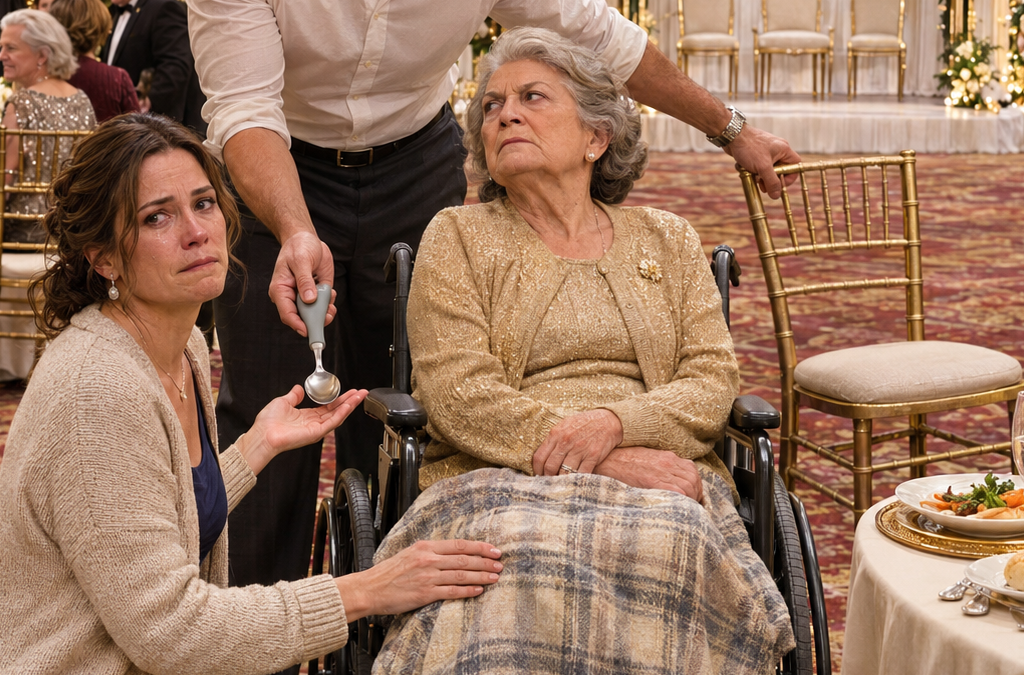
“Feed her. Nobody needs you in the photograph.”—my husband handed me my mother-in-law’s feeding spoon at his company’s Christmas gala.
Chapter 1 of 7
My husband, Mark Bennett, pressed it into my palm while I knelt beside his mother’s wheelchair.
“I helped her get ready for this.”
Mark slid my chair into the photograph row for his sister, Carol Brooks, while I straightened the blanket over my mother-in-law Ruth Walker’s knees and checked her feet.
“You can join us when she’s finished eating.”
His cousin, Beth Ellis, was the hired photographer. “Beth, are you really taking this picture?”
Beth looked down at her camera.
“Please don’t make this harder for Mark,” Carol said.
Her phone lit up with a photograph of our bedroom.
“Why does caring for her mean disappearing?”
Mark pointed toward Ruth’s plate instead of answering. Those words hurt more than the spoon being pushed into my hand.
I’m Anna Reed. I’m forty-two.
I’m a medical scheduler, working mainly from home, and I’ve been married to Mark for eight years.
The place we lived was my own house, bought before our wedding. Mark knew my name was on it. We’d rarely discussed what that meant.
For fourteen months, I’d provided most of Ruth’s daily care. She was seventy-six and had difficulty speaking after her stroke.
But over the preceding eighteen days, purposeful words had begun returning. Only I and her speech therapist, Dana Lewis, had heard them.
My practical cardigan had a washable sleeve, Ruth’s shoes were carefully fastened, and the repaired hem of Mark’s gala trousers hung straight above the shoes he’d polished himself.
His company held its Christmas party after the delivery rush. January decorations looked tired in that San Diego hotel.
I’d expected one photograph together.
I made their lives easy, then let them call that doing nothing.
Carol’s phone showed her suitcase sitting on my bed.
The blue case wasn’t mine. Neither was the flowered blouse draped beside it.
Carol turned the screen against her skirt before settling into my chair. She spread her dress over the seat as though she’d been saving it.
“You’re better at feeding her than posing.”
And Mark shifted the gap where I’d been standing out of Beth’s frame. He beckoned the rest of the family closer.
Ruth watched him without opening her mouth for dinner.
I knew that pause, because I’d learned to wait beside her through cooling soup and unfinished potatoes until she chose whether she wanted another mouthful or had finished.
At home, Ruth liked to point at the mashed potatoes twice. It meant she wanted more butter. Mark called that her cafeteria-manager inspection.
Tonight he wouldn’t wait long enough to notice her answer.
My knees ached against the hotel carpet. Around us, relatives adjusted jackets and waited for me to get on with it.
“You’re excluding me because I look after your mother?”
“Yes, because somebody has to do it.”
He said it easily. That embarrassed me almost more than shouting would have.
Then he shouted anyway.
“JUST DO WHAT I ASKED!”
Ruth flinched, and Beth lowered her camera a little.
“Then take it without me.”
I left the spoon beside Ruth’s plate and stood carefully. Dana had accompanied Ruth for a privately arranged meal-support visit; she wasn’t being left without help.
From the doorway, I watched Carol lean toward Mark while Beth gathered the family closer.
I called Dana as she gathered Ruth’s coat. She answered looking straight at me.
Mark had told my relatives I’d moved out and stopped caring for Ruth; he’d asked them to help make me leave the house.
My fingers went cold. The suitcase on my bed wasn’t there for a visit.
Dana left the coat and went back to Ruth. I followed her into the photo corner.
Beth raised her microphone to arrange the picture, but Mark offered Ruth the spoon.
Ruth pushed it away while Dana lowered the familiar communication board into reach.
“She needs dinner before all this fuss,” Mark said.
Dana stayed beside Ruth, without reaching for the spoon or moving me aside.
“Ruth asked to have Anna beside her.”
Mark’s mouth opened without an answer. Ruth stretched her hand toward the microphone, and Beth looked down at her.
Beth lowered her camera, bringing the microphone within Ruth’s reach.
Carol’s smile vanished; Mark took a step back from his mother’s outstretched hand.
Ruth took the microphone. “Anna, Mark told them—”
Ruth looked directly at Mark. “You told them Anna walked out on me.”
He took his hand off the chair, then caught its back again.
“But I came home,” I said.
Ruth nodded. I stepped close enough that she could see me without turning.
“She means the training trip,” Mark told Beth.
Beth kept her camera lowered. She didn’t offer him an answer.
He pulled the abandoned chair toward him; its legs scraped the carpet.
Ruth rested with the microphone against her lap, still holding it herself.
I crouched beside her again. This time, I was where she wanted me.
Dana stayed on her other side, leaving the board within reach.
“She’s tired,” Carol told the relatives.
“Yes. I’ll wheel her away from the speakers,” Mark said.
Ruth shook her head before he could turn that into her answer.
Her lips moved, but Dana waited instead of supplying a word.
The microphone trembled. Nobody reached to take it from her.
Ruth lifted it toward Carol and pointed at her.
Carol put her glass down hard.
“Carol told me you’d never come back,” Ruth said.
For a moment I couldn’t look away from Carol. She’d been inside my bedroom, photographing her suitcase on my bed, while telling Ruth I was gone for good.
“That’s not how I said it,” Carol answered.
Ruth looked down at her board, then back at me. She was tired now. I could see the effort each word had cost her.
“You don’t have to say any more,” I told her.
Mark bent toward the wheelchair. “Mom, let’s get you somewhere quieter. Anna’s making this into a scene.”
Ruth turned toward me instead.
“Anna. Stay.”
I stayed beside her while Dana checked whether she wanted water or a break. Ruth chose water from her board. Nobody needed to guess.
It hurt to realize how readily the others had accepted my absence while I was kneeling right in front of them.
Mark wanted me to step into the hall and discuss what he called my behavior. Carol stood behind him, no longer interested in the photograph.
“I’m going home,” I said. “I’m not discussing our marriage in front of your guests.”
Ruth wanted to go home too. Dana confirmed her choice with the board, then brought her coat over.
There would still be ordinary things to do there. In the daily care diary on the kitchen counter, I’d left an unfinished entry about dinner, Ruth asking for a pause, and three taps. Her laundry was still in the dryer.
None of it had disappeared because Mark said I’d left.
Beth approached while Dana helped Ruth with her coat. She held her camera against her body and kept her voice low.
“I should’ve asked you,” she said.
“Asked me what?”
Beth glanced toward Carol, who was speaking urgently to Mark. Then she faced me again.
“Carol told me that trip was a weekend with another man.”
Chapter 2 of 7
Carol stood in my entryway the next morning, still wearing her coat. She had driven me to the station for two nights of required training. Then she’d told Beth I’d gone away with another man.
“You knew where I was. Why tell Beth that?”
She glanced past me toward the kitchen, where Ruth was eating breakfast. “Mark needed people to understand what he’s carrying.”
“You drove me to the station.”
Carol didn’t deny it. She’d complained about the traffic that morning and asked whether my employer reimbursed meals. She had known exactly where I was going.
“You knew it was mandatory work training,” I said.
“Yes, Anna. I knew about the training. That doesn’t mean Mark had an easy time while you were gone.”
I felt humiliated all over again. Beth had photographed me kneeling beside Ruth after hearing that story. I wondered how many other people had smiled at me while believing it.
My phone showed six missed calls from Mark after the gala. Under them was his message: “Answer Carol and stop upsetting my mother.”
He hadn’t asked whether Ruth had arrived home comfortably. He hadn’t asked what she wanted. He’d sent his sister, then instructed me to answer her.
“People heard Mom struggling last night,” Carol said. “Now they’re asking questions. You could have let Mark get through one evening without all that.”
I’d spent the morning washing Ruth’s breakfast dishes and answering her questions about who was coming over. I hadn’t called a single relative. Still, Carol spoke as though I’d organized the whole thing.
Ruth was visible through the kitchen doorway. She had insisted on eating her toast before her eggs, a rule she’d apparently invented that morning. Usually I would have teased her about changing cafeteria policy.
Instead, I stood between her and Carol. I hated having this conversation where Ruth might hear, but I wasn’t going to pretend she couldn’t.
“Mark works all week,” Carol said. “His salary keeps this family going. You’re home anyway. Taking care of his mother is what a wife does.”
I told her I worked at home. My patients still needed appointments when Ruth needed lunch. My supervisor still noticed when I missed a call.
Carol said that wasn’t what she meant. She meant Mark had responsibilities he couldn’t put down whenever he felt tired.
“Then you don’t get to call the work imaginary.”
I heard my voice carry into the kitchen and lowered it. “Take one regular afternoon. You pick it. I could stop trying to fit everything around everybody else.”
“And don’t start keeping score. You know her routine better than I do.”
She said her retail schedule changed too much. I offered a morning instead, any morning she could commit to. She frowned as though I’d asked her to quit her job.
For fourteen months, I’d made those adjustments without calling them sacrifices. Hearing her reject even one regular stretch hurt. Her time needed protecting; mine was simply there.
Carol had covered visits before, but always on her terms. She came when she could, left when she needed to, and described those visits afterward as helping me. I was expected to remain available.
“I can’t promise a whole afternoon every week,” she said. “And don’t start keeping score. You know her routine better than I do.”
I asked how she expected to learn it while living in my bedroom. That stopped her complaints about her schedule.
Her expression changed, but she didn’t deny the bedroom either. She said Mark had been trying to make things easier for everyone. I asked whether “everyone” included me.
“The room makes sense for me,” she said. “I could live cheaply while helping Mark. You’ve got money of your own. You could get a place without all this fighting.”
She said it as though she’d found me a convenience. My bedroom would become hers, and I could pay to sleep somewhere else. I was furious, standing there in the house whose curtains I’d washed the week before.
I asked whether she had already decided where my work desk would go. Carol said I was getting stuck on details. Apparently where I would sleep and earn my living counted as details now.
Earlier, Daniel Grant, the attorney I’d contacted, had advised me not to agree to a move merely to quiet the family.
I didn’t tell Carol that. I didn’t show her a statement or explain what I could afford. She already treated anything I had as a reason I should need less.
From the kitchen, Ruth called my name. I went far enough to see what she wanted. She pointed toward the kettle, then waited while I told her I’d be there shortly.
Carol stayed in the entryway. When I returned, she began explaining how much pressure Mark was under. I realized she expected me to soothe her, too, before she would leave.
“You need to go,” I said. “I’m not defending that trip again, and you’re not moving into my bedroom.”
She called toward the open front door instead of answering me. Mark appeared on the porch. I hadn’t heard his car.
I felt tired then, more than anything. They had come together, but he’d waited outside while she tried to make me agree.
Carol told him I was refusing to be reasonable. He looked past her at me, then toward the kitchen. He didn’t ask what we’d said.
“Your things are already in the front hall.”
Chapter 3 of 7
Mark stood beside a packed carton at the living-room doorway. Beth was behind him, still wearing her jacket. He had told her I’d requested help moving and wanted Ruth spared a goodbye scene.
The carton he’d left in the front hall two days earlier now sat across the threshold. My work folders stuck out above a pair of winter boots.
I pushed it back inside with my foot.
“I didn’t ask you to move me.”
Beth looked from me to the box. “He said you’d already packed.”
Mark gave her the patient voice he saved for other people. “We talked about some space. This arrangement would calm everyone down. Mom doesn’t need to watch us fight.”
We had talked about nothing of the kind. I’d spent the morning working behind a closed bedroom door. Apparently that had given him enough time to turn another plan into my decision.
I felt embarrassed in front of Beth, which made me angry with myself. He had lied. I was the one standing there trying to look reasonable.
Beth had come without her camera this time. She wore sneakers and an old sweatshirt, clothes for carrying things. She had believed him enough to dress for the job.
“Someone has to keep this family functioning,” Mark said. “I’m trying to give everyone a little breathing room. Anna can work somewhere quiet, and Mom can keep her routine.”
I asked which routine he meant. He said Beth didn’t need a list of everything we disagreed about.
Ruth was at the kitchen table, finishing lunch. From where I stood, I could see her wheelchair but not her face. Mark had lowered his voice whenever he mentioned her, as though that kept her from hearing.
I wanted to go sit with her. Instead, I had to stay and explain why I wasn’t leaving.
“Did anyone ask Ruth where she wanted to live?” I asked Beth. “Or did he just tell you where everybody was going?”
Beth glanced toward the kitchen. She said she’d understood that Ruth would stay here. Then she stopped, hearing what she’d answered.
Mark began explaining that his mother needed stability. He knew that word worked on people. It made whatever he wanted sound like the safest choice for her.
Beth didn’t argue with him. But she no longer looked ready to carry the box.
He came closer while she looked toward Ruth.
“Stop making every room about your feelings.”
He said it low enough that Beth might miss it. I heard him clearly. I had never felt so unwelcome beside my own living-room couch.
I told him I wasn’t moving that day. He stared at me, then looked toward the kitchen, where Ruth had begun her familiar campaign against leftover peas. She arranged them along the edge of her plate and ate everything else.
Usually I called that her fence. That afternoon, I couldn’t find anything funny to say.
“Fine. If you’re staying, arrange tomorrow yourself.”
“You agreed to cover her before any of this,”
I reminded him that he’d promised six hours. I had a scheduled block of patient calls, work I couldn’t do while helping Ruth through lunch and her afternoon routine.
Mark said he had things to catch up on. When I asked what had changed since he’d agreed, he said I seemed determined to handle everything without him.
That was how quickly he withdrew the one stretch of help I’d counted on. He didn’t need to make me leave to make staying difficult.
“You agreed to cover her before any of this,” I said. “I booked the work because you said you’d be here. Ruth still needs the same help tomorrow.”
He told me to call somebody. Beth offered that she might be able to come for a little while, then remembered a photography job she couldn’t move. I believed her. That didn’t fill the six hours.
I was furious, but I still started calculating. There were people who sometimes helped, though none could usually take a full afternoon with less than a day’s notice.
I checked with the person most likely to be available. She couldn’t come. My backup could manage part of a morning, which didn’t cover the calls I’d accepted.
“I can’t leave her without enough help,” I said. “You know I can’t. So tomorrow I lose the work, and you get to say I chose that too.”
Mark said I was being dramatic. Beth looked down at the carton.
I sent my supervisor a message withdrawing from the extra paid block. I kept it short. There was no useful way to explain that my husband had canceled because I wouldn’t let his cousin move me out.
Losing the hours hurt. I’d wanted that money, and I hated giving my supervisor another reason to wonder whether I was dependable.
Daniel had arranged the request for temporary household orders, but tomorrow’s care still had to be covered.
Beth bent to lift the carton, then seemed to realize what she was doing. She set it down inside the living room instead of carrying it toward the door.
“I can leave this here,” she said.
It wasn’t a challenge to Mark. Still, it was the first thing she’d done that afternoon without following his version of events.
I saw one of my pillowcases underneath the folders. My work things had been on the bedroom shelf when I’d started my calls. Before I could ask who had been in there, I heard footsteps in the hall.
Carol came through the doorway carrying my suitcase from the bedroom.
Chapter 4 of 7
Carol stood beside Mark with my suitcase. Ruth watched from the living-room table. While I’d been working, Carol had packed my clothes and told Ruth she could bring me home by asking me to give Mark the house.
I hadn’t learned that second part yet.
“Who gave you permission to pack for me?”
“I packed the things you’ll need first,” Carol said. “You can get the rest when we’re not all upset.”
I moved the suitcase beside my own chair. Beth was still near the carton, looking as though she wished she’d never come.
“I’m staying. Leave my clothes alone.”
Carol told Mark I was impossible to help. Neither of them offered to unpack anything.
Three days later, the suitcase still stood beside my chair. I’d been taking clothes out as I needed them. I hated that, but putting everything away felt like another job they’d left me.
Carol and Mark were at the living-room table again. Ruth had asked to sit there rather than in the kitchen. Her board rested within reach.
She kept looking between my suitcase and me.
“Carol said you would come back if I asked.”
The sentence came in pieces. She stopped after “back,” frustrated, then finished while Carol began talking over her.
“Mom, Anna’s right here. You’re getting yourself worked up.”
I pulled my chair closer. I felt sick about what Ruth might have spent those days believing.
“What did Carol want you to ask me?”
Ruth looked at her daughter, then at me.
“Give Mark the house.”
Carol pushed back from the table.
“You don’t need to repeat every private conversation.”
“You made her think she had to bargain for me.”
Ruth’s face changed. She looked down at her board but didn’t reach for it. Carol must have noticed, because her voice softened.
“Mom, honey, I was trying to reassure you. You were worried about Anna leaving. I said we could work things out.”
I was furious. Ruth had already been frightened by my supposed departure. Carol had given her a job to do before she could expect me back.
“You made her think she had to bargain for me.”
Carol said that wasn’t fair. Mark told me to stop questioning his mother when she was tired.
“I asked one question. She answered it.”
Ruth looked up at me. I told her she didn’t have to persuade anybody to let me stay. She nodded, then rested against her chair.
For a moment, I heard the refrigerator cycling in the kitchen. We’d once held entire family meals around that sound, arguing about whether Ruth’s baked beans needed mustard. She always said ours did.
Now nobody could manage a conversation without putting something on her.
“You can afford another place,” Carol said. “Mark can’t just start over while supporting this household. That’s what I was trying to explain to her.”
I looked at Mark. He didn’t correct her.
“This is my own house. I bought it outright before our wedding, with my own money. It wasn’t a joint wedding gift, and your earnings didn’t buy it.”
He stared at me, genuinely startled.
“I knew your name was on it. I thought you bought it for us. We were already planning the wedding.”
“I bought a home. Then we got married.”
He asked whether I still had the purchase information. I said I did. He stopped arguing about where the money had come from.
It hurt that he’d found room for his own explanation without ever asking me. Eight years together, and he’d treated my home as something I’d brought for him to manage.
The house had been mine before the marriage, and Ruth could describe her own experience. Daniel had checked the purchase history and confirmed it.
Mark leaned forward, addressing Carol as much as me.
“Fine. That doesn’t solve where Mom lives. She needs the same surroundings. My paycheck has kept this household going, and apparently that counts for nothing now.”
I reminded him that Ruth was sitting with us. He said he knew where his mother was.
Ruth made a small, impatient sound. Carol asked whether she wanted to lie down. Ruth shook her head.
Mark’s attention moved to the daily care diary on the kitchen counter. He said I could write down whatever made me look good. A notebook didn’t show what he paid for or what he worried about at work.
“I’m not asking you to admire a notebook,” I said. “I’m asking you to stop telling people I left.”
He said we would both have our chance to explain.
Our extended hearing was set for Friday, February 20, at nine in San Diego family court. Mark and I would attend with Daniel Grant and Steven Cole; Ruth, Dana, Beth, and Carol would come or wait to testify.
By then, Beth had agreed to describe her own part. Dana would speak about what she had observed. Ruth had said she wanted to go.
I was scared about asking strangers to sort through our marriage. Even so, I wanted someone to hear a whole answer before Mark interrupted it.
“Mom doesn’t need all that,” he said. “She needs her family around her. You’ve made staying here mean taking your side.”
“I haven’t told her she has to stay.”
He looked at Ruth then, waiting. She looked back without answering for him.
Mark went to the hall and returned with her coat. He placed it on his side of the table, beside his chair.
“I’m taking Mom to Carol’s tonight.”
Chapter 5 of 7
Mark and Carol sat at the kitchen table, arguing about money he’d promised her to replace her wages if she took over here. Beth sat beside Mark. Ruth was across from them, still living where she’d chosen to stay.
She hadn’t gone to Carol’s when Mark brought out her coat. I hadn’t stopped her from leaving. She had said no.
“I chose to stay here.”
Ruth said it again when Mark asked Beth to explain why a change might help. Beth looked at her instead of answering him.
I was tired of hearing Ruth’s decision treated as a problem I’d caused. Her coat hung in the hall. She could ask for it whenever she wanted.
Beth had come to confirm she would attend the hearing the next morning. Ruth had chosen to testify too, after I’d asked whether she wanted to go or stay home.
Daniel and Steven had exchanged copies of the diary pages both sides intended to discuss. Daniel had told me to answer questions about what I actually remembered, without filling in gaps.
The copies lay between us. Beside Ruth’s was a grocery list she’d started with me that afternoon. She’d crossed out my store-brand coffee and pointed at the kind she liked.
“I can’t keep missing shifts without the eighteen thousand you promised,” Carol said. “You said this would replace my wages. Now I’m driving over here to argue.”
Mark glanced toward Beth. He hadn’t expected Carol to say the amount in front of her.
He called it a reasonable care budget. Carol would need to reduce her hours if she moved in and took responsibility for their mother.
“Why was her time worth paying for?”
I hadn’t planned to ask. The question came out before I could make it easier for him.
Mark said our situations were different. I was his wife, and I already worked from home. Carol would be changing her whole life.
It hurt to hear him say that without hesitation. My missed work, my interrupted sleep, the plans I’d stopped making—he knew about all of them.
Carol said she couldn’t afford to lose her job. Neither could I, but she looked annoyed when I reminded her.
The money hadn’t been paid. It depended on the household arrangement Mark wanted: Carol in my room, Ruth here, and me somewhere else. He described it as something they’d been trying to organize responsibly.
“You have options, Anna. Carol doesn’t have your cushion. Spend a month somewhere else and let us get Mom settled. We can stop dragging this out.”
He spoke as though the month were a small favor. I would still need somewhere to work, somewhere to sleep, and some explanation for why I had agreed to leave.
I said I wasn’t going. Mark turned toward Beth before I’d finished.
He told her Ruth needed protection from the strain. Too many questions, too much pressure to speak, too much encouragement to take sides.
“If Anna won’t step back, I’ll have to tell the judge what’s happening. Mom’s speech has improved, but these answers sound rehearsed. Somebody needs to say that.”
“Don’t ask me to carry her bag again,”
I felt scared then. Ruth had worked hard for the words she could manage. He was making that effort sound like something I’d done to her.
Ruth looked at him, then down at her board. I waited. She didn’t choose a word, and I didn’t offer one.
Mark told me to book a room and pack enough for a month. He said Carol could handle things here if I would finally let her.
“Don’t ask me to carry her bag again,” Beth said. “And don’t tell anyone she volunteered. I came here before because you said she’d asked me to.”
She got up from Mark’s side of the table and sat in the empty chair beside me.
I hadn’t realized how badly I wanted someone to do that. I was grateful, and embarrassed by how close I came to crying over a chair.
Carol asked whether Beth was really going to turn a family disagreement into testimony. Beth said she’d already agreed to attend. Mark began explaining what she should remember.
“I’ll say what I saw at the gala,” Beth told him. “You gave Carol her chair. Anna was beside Ruth. I heard what you said to her.”
She didn’t claim to know what happened when she wasn’t there. She admitted she should have asked me before believing either of them.
Mark stared at the diary copies. He said a few ugly minutes at a party didn’t show who kept a household running.
I was angry enough to answer badly, so I waited until I could speak without shouting.
“You paid bills. I’m not saying you didn’t. But I worked too, and I looked after Ruth. You don’t get to say I wasn’t here.”
He said that was exactly what the notebook was designed to do: make his hours at work look like neglect. Carol nodded. Ruth watched them both.
The pages recorded meals, rest breaks, and the help I’d given. I knew they couldn’t tell every part of our lives. They weren’t meant to.
Mark began reading one entry more closely. His expression changed at the sentence about Ruth asking for a pause during dinner. Carol leaned toward his copy.
For the first time that afternoon, he seemed pleased with what he’d found.
Mark circled “asked” in his copy of the diary and said, “She couldn’t even talk then.”
Chapter 6 of 7
Mark repeated the abandonment story at our hearing in San Diego Superior Court, looking toward Judge Rachel Foster instead of me.
“Anna left me to care for my mother. Now she wants back on her own terms. That diary makes it look like she never went.”
Carol and Beth had seats behind us in the open courtroom. They would wait outside when other witnesses testified. Ruth and Dana were already waiting in the hall.
Mark’s copy lay beside his attorney, Steven Cole. The circle around “asked” showed through the page.
“She couldn’t even talk then,” Mark said. “How could she have asked for a break? Anna wrote that afterward.”
I was scared of how reasonable he sounded.
During my testimony, Daniel Grant asked when I kept the diary and what I recorded. I explained that I wrote about meals, rest, and help Ruth needed. Sometimes I finished an entry after she went to bed.
I opened the original to the disputed page.
“Three taps were her words. Please ask Ruth what they meant.”
Daniel looked at me, then asked me to describe what I’d seen. I answered without guessing what Ruth might say.
After Ruth took the oath, Daniel asked her the question.
“Stop,” she said. She rested, then added, “Three taps. Stop.”
An open hand meant more. She showed it herself, waiting until the judge looked up. I felt relieved, but hated that she had to demonstrate how she’d asked me to stop feeding her.
Later, Dana confirmed that she’d observed those signals during meals. She couldn’t speak for every diary entry. Ruth’s familiar spoon was visible in the meal-support bag beside her wheelchair.
When Mark testified again, he changed his explanation.
“Anna could have taught her that answer recently. Her speech has improved. They spend all day together.”
Ruth answered that when she was recalled. She needed a pause before she could begin.
“I heard you.”
She looked toward Mark. Then, in short pieces, she described hearing him and Carol while I was away at training.
“Carol said, ‘Tell Beth she chose work.’”
Ruth rested against her chair before continuing. Mark had agreed that my room would be cleared. I hadn’t known they’d discussed that in front of her. It hurt to picture her sitting there, unable to interrupt them.
Ruth identified the two evenings beside those diary entries. Carol had come for dinner. Mark had returned late. I’d come home afterward and resumed her care.
“You heard those conversations yourself?” Judge Foster asked.
“Yes,” Ruth said. “I heard them.”
Beth later confirmed that Mark had presented my proposed move as my choice. She faced me as she admitted believing him without asking.
After the testimony and the attorneys’ arguments, Judge Foster looked toward Mark.
“The record does not support your claim that Anna left the home. A work trip was not an agreement to move out.”
She granted me exclusive occupancy and gave Mark seven days to leave. Then she addressed the savings.
“This order ends your sole control of $96,300. Management must be handed over within two business days. The balance is to be preserved pending division. Neither of you may spend it unilaterally.”
Mark leaned toward Steven. I heard him ask whether she meant all of it.
“Tell her why we made the arrangement. You know what Mom needs.”
The money hadn’t become mine. It was still ours, waiting to be divided. But he could no longer manage it as though I had no say.
I felt relieved, then exhausted. There were still clothes in my suitcase at home.
Mark stood before Steven had finished speaking quietly to him. He looked back at Carol.
“Tell her why we made the arrangement. You know what Mom needs.”
Carol started to rise. Judge Foster told them both to sit unless directed otherwise. Mark sat, but kept looking past his attorney toward me.
“You’re making my mother choose between her children and you. That’s what this does. She’ll think she can’t leave.”
Ruth’s board rested across her lap. She didn’t reach for it.
“I chose,” she said.
He began to answer, and she shook her head.
“Don’t use me.”
Beth remained in her seat on my side of the aisle. At the gala, she’d looked down at her camera. Now she watched Mark without offering him an explanation he could use.
Carol waited until the judge asked whether anything remained about the arrangements.
“What happens to the eighteen thousand? I changed my work around because he promised I’d be paid.”
Judge Foster said she wasn’t deciding Carol’s payment dispute in our divorce hearing. Carol turned toward Mark. He kept his eyes on Steven.
I was angry again. They had found money for the work when they wanted Carol to replace me. Now, even here, they expected me to help settle what they owed each other.
When the judge asked about collecting belongings, Mark wanted to arrange it directly with me.
“We can manage a few trips without turning everything into another argument. Anna knows I’m not going to take her things.”
I asked to answer.
“You don’t get my home because I cared for your mother.”
My voice shook on “mother.” I continued anyway. I wanted scheduled collection times, confirmed in writing, rather than visits announced when he reached the driveway. Daniel relayed the proposed arrangements, and Steven consulted Mark.
Ruth watched without trying to make it easier for him. For once, I didn’t try either.
Before we were dismissed, Mark leaned forward again.
“So my key still lets me come and go until I’m finished?”
I asked that the collection times remain scheduled.
Judge Foster kept the seven-day deadline. “Scheduled access for the move. You will surrender your keys when you finish leaving.”
Chapter 7 of 7
Mark carried his remaining clothes through the front door during the scheduled collection. Before he left, he put his house keys on the entryway shelf.
I had left the locks alone while he finished moving. Now his closet was empty, and the seven days were up.
“Mom’s going to need me coming by,” he said. “You can’t expect her to make an appointment with her own son.”
“She can arrange visits with you. Anything you need from me goes through the written messages we agreed on.”
He waited, perhaps expecting me to soften that. I felt sad watching him leave, which annoyed me. I could still remember wanting him to come home.
The financial handover had been completed the first business day after the hearing. By that Friday, he had finished moving. The money stayed preserved while we worked out the division; I didn’t spend it to celebrate.
“Tell Mom I’ll call her,” he said.
“You can tell her yourself.”
Ruth was in the kitchen. He went to her, and I stayed near the door. They spoke quietly for a few minutes before he left.
Afterward, I checked the bedroom. There were pale rectangles where his things had stood. I slept badly that first night, listening for a car I no longer wanted in the driveway.
I still had work the next morning. Ruth still needed breakfast. Relief didn’t clear my schedule, but I could leave my bedroom without wondering who had packed something else.
“You’ve both made your point now,” Carol said when she came to visit Ruth a few weeks later. “Everyone has made their point. We could put things back without making Mom suffer.”
We stood in the kitchen while Ruth finished a call with Beth. Carol had brought a bag of groceries and seemed to expect that to count as a beginning.
I asked what she meant by putting things back.
She meant Mark coming home. She meant me handling the routine while they helped when they could. She didn’t mention my bedroom until I asked whether she still expected it.
“You don’t need to rub that in,” she said. “I was going to do real work here. Mark still hasn’t paid me anything for changing my shifts.”
“That’s between you and Mark. I didn’t promise you money, and I’m not taking over his promise.”
I was angry, but no longer surprised. She wanted me to repair an arrangement I had never agreed to.
Carol said I was making forgiveness difficult. I told her she could visit her mother without discussing my marriage. She stayed for the visit. When she left, the groceries remained on the counter, and nothing else had changed.
Months later, we signed the final settlement. The house stayed mine, along with the $84,000 I had saved before marriage and kept separate. We each received $48,150 from our marital savings.
The divorce became effective after the required six months had passed since service. I read the confirmation at my desk between patient calls. Then I finished scheduling someone’s follow-up appointment.
There was no grand feeling. I was relieved, and tired of having to check every message before opening it.
“I want to stay,” Ruth told me when we sat down to discuss what came next. “Here. With you.”
“I want you here too. But I can’t keep doing everything I did before. I need work hours when I’m only working. And I need to leave sometimes.”
She looked down. I hated hurting her, even when I hadn’t said anything cruel.
For a moment, I almost offered to manage a little longer. Instead, I waited while she found the words.
“Not asking for that,” she said. After a pause, she added, “Help. We get help.”
We worked it out together, over several conversations rather than one brave afternoon. Ruth used her own $2,400 monthly retirement income to pay for six hours of scheduled assistance each week. The cost was $420.
She chose the arrangement and paid the provider herself. I wrote my work blocks on the household calendar. We also talked about what we would do if either of us needed something different later.
“You can change your mind,” I told her. “About staying. About any of this. I don’t want you thinking you owe me because of what you said in court.”
Ruth frowned at me.
“Know that,” she said. Then, after some effort, “You too.”
“We’ve got this. I’ll call if she asks me to.”
I cried after that conversation, alone in my bedroom. I loved her, but I had been afraid that loving her meant I could never say I was tired.
The help made ordinary things possible. I completed work calls without listening for every movement in the kitchen. I went out for a haircut and stayed out for lunch.
Beth sometimes visited without a camera or a family assignment. We were still learning how to be comfortable together. She didn’t ask me to pretend the gala hadn’t happened.
“Go eat somewhere,” she told me once, when I hovered near Ruth’s chair before leaving. “We’ve got this. I’ll call if she asks me to.”
Ruth waved me toward the door.
That afternoon, I ate a sandwich while it was still warm. Nobody needed an explanation for the extra half hour I spent outside.
By October, our arrangement had become a routine we could adjust instead of a promise nobody dared question. Mark called Ruth directly. Carol’s visits no longer came with discussions about who should live in my room.
One Sunday, after the paid helper had gone, Ruth and I made chicken-and-rice soup. I did the stove work. She chose the vegetables and supervised from the table.
Our particular argument concerned frozen peas. Ruth believed the package directions were for people who enjoyed ruining peas. I added them late, under inspection.
“Enough,” she said when I reached for more rice. “Soup. Not cement.”
I laughed so hard I had to stop stirring.
I was happy. It still felt worth noticing when happiness arrived without someone else needing to leave first.
Ruth took her familiar feeding spoon from the place setting and moved it to her right. She chose where she wanted her bowl.
“Sit, Anna. Before it gets cold.”
I chose the chair across from her. My own bowl was already there, and I didn’t get up to check hers again.
Family should never require you to disappear.
Ruth lifted her spoon, and I took my first bite.







