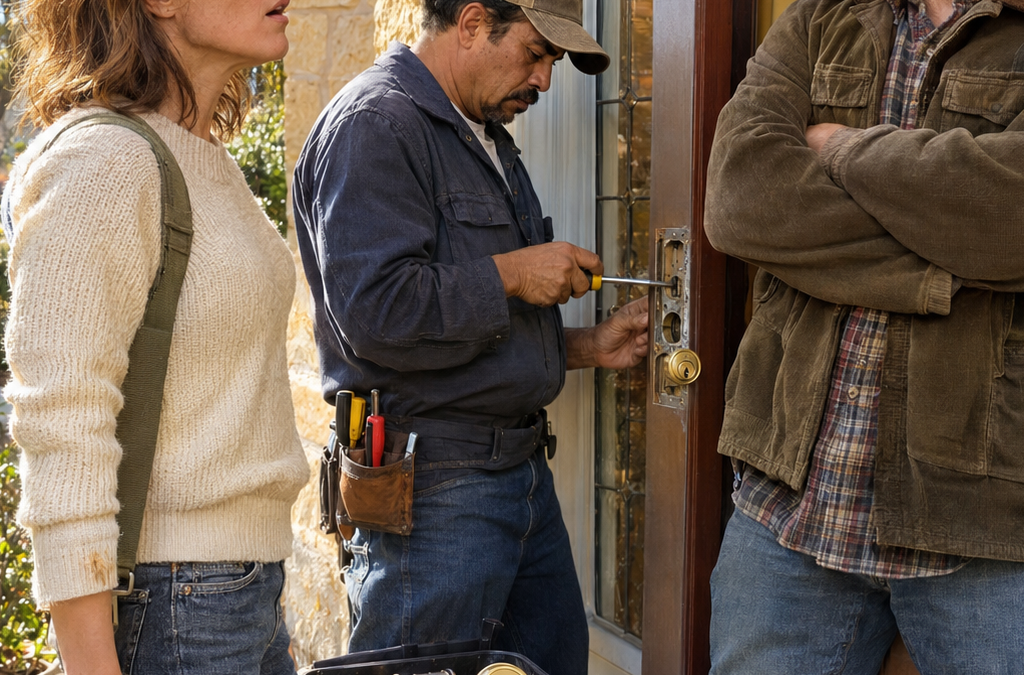
Home for Thanksgiving after six weeks away, I found my sister trashing my welcome mat while a locksmith changed the locks on the house I owned.
Chapter 1 of 7
“Take your bag and keep walking.” Megan pushed the mat deeper into the outdoor trash bin.
“I’m staying here. Mom, are you letting her do this?”
Linda looked away. My mother stood behind Tyler, who blocked the doorway with his shoulder. Ray Dixon, the locksmith, stopped turning his screwdriver.
“You don’t live here anymore, Claire,” Tyler said.
An unfamiliar folder lay on the porch table where we usually left Thanksgiving pies to cool. A photograph stuck out between its covers.
Megan hadn’t even asked about my trip.
My military duffel slipped against my leg, and I lowered it to the porch instead of asking again.
My name is Claire Bennett. I’d come back to San Antonio, Texas, after six weeks of temporary duty, wearing jeans and a sweater with airport coffee spilled on one cuff.
I was a 38-year-old Air Force major, and this was my own house.
My family assumed my current logistics assignment was civilian work. Changing assignments hadn’t meant leaving active duty, but they’d stopped asking about my job.
Through the doorway, I could see the yellow curtains I’d hung for Megan. Tyler wore the work boots I’d bought after his old soles split.
The blue serving dish I’d left ready for Thanksgiving sat on the hall table. Megan always called it the turkey bathtub because nothing else fit in it.
Being useful had become my place in the family.
Then the wind lifted the folder’s cover.
A photograph of my empty bedroom stuck out of the unfamiliar folder.
There should have been a quilt on that bed and books beside it.
I held the old brass key my father had cut when I bought the house eight years earlier. Ray had just borrowed it, tested the lock successfully, and returned it before removing the cylinder.
The replacement waited beside his tools.
Megan and Tyler weren’t doing me a favor by staying here. I paid them $1,800 monthly to care for the place while my work took me away.
And now Megan stood between me and my hallway.
“You’re not coming inside. Ray, don’t give her a key.”
Ray looked up at her, the removed lock resting beside his knee.
“We kept this place alive without you,” Tyler said.
Those words hurt more coming from a man wearing boots I’d paid for. My mother stayed behind him, close enough to hear everything.
“Get OFF my porch!”
Megan’s voice carried across the driveway, and afterward she glanced toward the street.
“You’re refusing me a key to this house?”
“Yes. You can stay somewhere else tonight.”
“Fine. I’ll step away.”
The duffel went over my shoulder again. I walked to my rental car without trying to squeeze past Tyler.
Behind me, Megan told Linda to come inside, but Linda stayed.
From the driveway, I called Dana Pierce at Cedar Gate Title. She’d handled my purchase, and her number was still saved beneath the house address.
I gave her that address.
“There’s a folder here with pictures of my rooms. Is Cedar Gate handling something?”
Dana asked me to repeat my name, then paused before answering.
“We have a sale file. Megan supplied your signed permission.”
For a moment, I couldn’t feel the cold car door against my back. Dana asked me to stay nearby while she checked something.
When Dana arrived, Megan was still beside the porch table.
“I’m Dana Pierce, Cedar Gate’s closing manager.”
Megan called the visit unnecessary, her voice suddenly pleasant.
Tyler told Dana I was confused from traveling.
“This house is already under an agreement to sell,” Dana said.
Linda lowered the serving dish she had picked up.
Megan’s mouth opened, but she didn’t speak.
Tyler moved away from the door at last.
Dana glanced at the duffel beside my feet.
Then she checked the folder Megan was holding.
Dana turned toward Megan. “Your buyer thinks the owner isn’t coming back.”
Megan gave a little laugh that sounded forced. Linda looked at her instead of me.
Coming back had been the whole point of the trip. My favorite blanket was inside, along with my winter clothes and the roasting pan I’d expected to scrub after dinner.
“I came home for Thanksgiving,” I said.
Dana asked Megan to bring the folder over. Megan held it against her side before finally opening it on the table.
The proposed price was $428,000.
That number sat above a photograph of my living room. The chair beside the window had been moved out of the picture. I’d spent years reading in that chair.
Dana explained that she needed the complete signed pages giving Megan permission to act for me. What had reached her file appeared to jump from the first page to the signature page.
She couldn’t tell from that copy what had been left out.
Megan said they’d sent everything important. Dana asked for the complete set anyway.
“Claire knew we were making plans,” Tyler said.
I hadn’t known about any buyer. Until I saw the folder, I’d expected an argument about whose turn it was to peel potatoes.
Then Dana read farther down the page.
Her finger stopped beneath the proposed price.
Megan started to turn the sheet over.
Dana asked her to leave it there.
Linda put the serving dish on the table.
Dana looked at Megan. “You promised the buyers an empty house?”
“The furniture isn’t part of it,” Megan said.
My clothes weren’t furniture. Neither were the photographs in my closet or the box of birthday cards beneath my bed.
But Megan watched Dana, waiting for that answer to be enough.
Dana said she needed to hear directly from me. She wasn’t asking where I wanted to spend the holiday. She wanted to know whether I’d agreed to this sale.
“No. I haven’t agreed to sell my home.”
Tyler made an impatient noise. He told Megan they should’ve waited until after dinner to discuss it, as though they had merely picked a bad moment.
I was humiliated. Ray was still there with his tools, listening to my family discuss when they should have told me my house was being sold.
Megan told me to stop making things awkward. She said we could go inside if I would quit arguing long enough to listen.
That invitation came without a key.
Then my father’s truck pulled into the driveway.
Paul Bennett got out carrying a grocery bag, smiling until he saw my duffel on the ground. Linda hurried toward him and spoke too quietly for me to hear.
He came up the walk more slowly.
“Claire, let’s sit down before you make a decision.”
“I didn’t agree to this, Dad.”
Megan interrupted before he could answer. “Just tell Dana we can finish this as a family.”
“No. I won’t approve the sale.”
For years, I’d agreed to things because my parents were tired or Megan was upset. Usually, I dealt with the consequences later, by myself.
Dana asked both of us for the signed pages we’d kept. She would also send me the material already in her file. She wasn’t settling anything on the porch.
Megan wanted her to take the folder and leave.
Instead, Dana opened the file on her tablet to confirm my email address before going. I stood beside her while she checked which pages she would send.
A payment instruction appeared beneath the sale figures.
My sister’s married name filled the recipient line.
All net sale proceeds: Megan Ross.
Chapter 2 of 7
“What does that line mean, Dana? She gets everything?”
Dana kept the tablet angled toward me. The proposed $428,000 sale had an estimated $176,000 mortgage payoff and $24,000 in costs, leaving $228,000.
“That’s what Megan asked us to send her,” she said. “Nothing has been paid out.”
Across the porch, Megan told my father we needed privacy. Apparently, that meant privacy from me.
Dana said she would send the file for my review. She still needed the complete signed permission and an answer from Megan about what she claimed I had approved. My refusal mattered, but there were already people expecting a house.
I spent that night in a hotel. My dinner came from a vending machine beside an ice dispenser that rattled through every call from my mother.
By Thanksgiving morning, Linda had left three messages about keeping dinner civil. None asked whether I had slept.
“Come eat, Claire,” she said when I finally answered. “Your father wants both his girls at the table.”
“Does he want me there if I won’t sign anything?”
She said the turkey was already in the oven.
I went because my clothes were still upstairs, and because part of me wanted my father to open the door and say this had gone far enough.
Tyler let me in without moving aside completely. My bedroom door was closed. Megan had set a single printed sheet beside my plate.
“Just a family confirmation,” she said. “Mom and Dad understand what we’re trying to do.”
The page said we all supported the sale. There was a space for my signature beneath my name, as though my agreement had only been delayed by travel.
I left it where it was. Being invited to dinner in my own kitchen made me feel small enough without signing permission to lose it.
“You can live anywhere your job sends you,” Megan said. “We’re here every day. This is our home.”
My father sat at the end of the table. He asked whether I could hear her out before deciding.
“Why does your housing require mine to disappear?” I asked.
Megan looked toward Linda instead of answering. Mom said nobody wanted me to lose anything, then asked Tyler to carve.
For years, Thanksgiving meant my father insisting the crescent rolls needed another minute. Then he ate the darkest one himself, claiming he preferred it. That day, the rolls stayed pale in their basket.
While everyone debated gravy, I opened the Bexar County property records on my phone. The recorded deed listed Claire Bennett alone. Megan watched me enlarge the page.
“You’re really doing this during dinner?”
“You put a signature page beside my fork.”
My father asked what I was looking at. I told him it was the deed, and that the house was still mine alone.
He said he’d thought Megan and Tyler were taking over the bills.
That hurt. He hadn’t asked me once before accepting that version.
My bank records showed the $1,475 monthly mortgage payment leaving my account. The annual property tax receipt showed $6,240 paid by me. My homeowners insurance was another $2,160, with my name on the policy.
Those payments weren’t what made me the owner. But they answered Dad’s question about who had carried the place.
“We’ve got $64,000 hanging over us,” Megan said. “Tyler’s work hasn’t been steady. We could pay it off and still have $164,000 for another house.”
She said it quickly, like numbers she had practiced until they sounded reasonable. Tyler kept eating. Neither looked embarrassed by the plan.
Megan said they had earned a share by keeping the house running. I told her paid work was not a purchase.
The turkey on my plate had gone cold. I couldn’t stop thinking about how carefully they’d divided money I hadn’t offered.
After dinner, I went back to the hotel and opened the agreements I had saved. There were two, because the work and the living arrangement had never been the same thing.
The caretaker agreement paid them $21,600 for twelve months of work. The separate occupancy agreement let them use designated rooms without cash rent, month to month. Ending that arrangement required thirty days’ written notice.
“Then tell them to go,” Dad said when he called.
“They live there, Dad. I can’t pretend they’re trespassers.”
“I can’t determine what they were allowed to do from the pages they sent.”
It would have been satisfying to turn up with another locksmith. It also would have left me doing the same thing they’d done: deciding someone else’s belongings and access no longer mattered.
Knowing I owned the house hadn’t given me a place to sleep that night. I was angry, and tired of being expected to solve that quietly.
Dana called while I was still looking through the files. I told her I had kept the complete signed maintenance authorization separately from Megan and Tyler’s working copy.
“Please bring the original,” she said. “I can’t determine what they were allowed to do from the pages they sent.”
She didn’t ask me to settle it over the phone. We finished without opening the packet or reading anything from it.
Megan called twice afterward. When I didn’t answer, she sent a message saying our parents were upset and the buyers couldn’t keep waiting while I made this personal.
Then another message arrived with a copied demand about the house being empty when it changed hands. Underneath, Megan added her own explanation.
The buyers expected everything cleared before they received it—including my clothes, my furniture, and every box in my bedroom.
Chapter 3 of 7
“Those boxes aren’t going anywhere without me,” I told Megan. “I’m coming for my work clothes. Mom will come with me.”
By Friday morning, Linda was waiting beside me at the front door. Megan let us in and said we had twenty minutes.
Three boxes stood outside my bedroom. One had “closet” written across the top. Another held the framed photographs that usually sat on my dresser.
“You could’ve answered before we started packing,” Megan said.
I hadn’t agreed to packing. I’d refused a sale. Somehow, she had turned that into permission to empty my room.
Linda followed me upstairs without touching the boxes. Inside my closet, the hangers had been pushed together, leaving a bare stretch beneath the shelf.
My work clothes were still there. I packed them with underwear, toiletries, my laptop charger, and the prescription bottle from my bedside drawer.
“You’re taking all that?” Megan asked from the doorway.
“It’s what I need.”
She pointed toward the hall. “Then take those boxes too. We need room.”
I left them there. Carrying out everything she’d packed would have helped her clear the house, and I wasn’t going to do that.
It hurt to choose which of my things deserved space in a hotel room. My grandmother’s photograph stayed behind because the glass might break in my bag.
Before we left, Linda checked the refrigerator and said I should take some turkey. She had always treated leftover turkey like a deadline nobody else respected.
For a second, I almost laughed. Then I remembered I couldn’t heat it in my own kitchen.
Outside, my phone started buzzing with the family message thread. Tyler had written that I’d abandoned my responsibilities and now wanted to make them homeless.
Megan followed with a longer message. I was hardly ever there, she wrote. The family had agreed on a move, and now I was interfering because I didn’t like being left out.
“Did you agree to this move?” I asked Linda.
She studied the bags at my feet. “I thought we’d work something out.”
“That’s not what she’s telling people.”
Linda said Megan was upset. There it was again: my sister’s feelings arriving before anything that had happened to me.
I answered the thread once. I hadn’t agreed to sell, and nobody had permission to dispose of my belongings. Then I stopped reading.
I’d booked five nights at $128, totaling $640. My Thanksgiving stay at home had become a hotel reservation with checkout instructions.
Linda left first. Before driving away, I looked back at the kitchen window. The light was on above the sink, though it wasn’t dark yet.
Tyler stood inside, eating from a plate. I knew exactly which floorboard would creak if he stepped backward.
“To keep everyone calm. She worries when she doesn’t know what you’re doing.”
I was homesick in my own driveway.
“Let me know where you’re going next,” Linda said when she called. “I already told Megan you’d be at the hotel after lunch.”
I asked why she’d told her that.
“To keep everyone calm. She worries when she doesn’t know what you’re doing.”
My mother sounded puzzled, as though she’d only passed along a weather report. I realized Megan had known when I was alone, when I was coming, when I had left.
“Mom, I’m not sharing the sale updates with you anymore.”
“Claire, don’t shut me out.”
“I’ll talk to you. But you can’t keep reporting back.”
I hated having to say it. Linda had been the person I called from airports for years, even when all I had to report was a delayed flight.
She offered to bring dinner to the hotel. I said no for that night.
Ray Dixon’s shop was in a small strip of businesses near an auto-parts store. He recognized me before I finished explaining why I’d come.
“I wondered how that ended,” he said. “You get back inside?”
“Only to collect clothes.”
He looked unhappy about that. I asked whether the old lock had actually been broken.
Ray said it had worked when he tested it. Megan had requested a replacement, not an emergency repair. He also remembered her telling him not to provide me with a replacement key.
“I can tell you what I saw,” he said. “I can’t tell you who has what rights.”
“That’s all I’m asking.”
I felt less alone leaving his shop. He hadn’t offered to fix my family. He simply remembered what they’d done.
Tyler called while I was back at the hotel. His argument had changed.
“The paperwork can be fixed. Those people already agreed to buy. You want to wreck their plans too?”
He said they might have made arrangements based on the sale. I told him I hadn’t made those promises, and ended the call before he started again.
Then I called Dana. I asked what the buyers were actually entitled to expect, apart from what Megan and Tyler kept telling me.
“I need to review what they received and what was signed,” she said. “I can’t promise there won’t be a dispute.”
That answer frightened me, but I trusted it more than another demand to cooperate. I told her Ray could describe the lock replacement.
Later, Megan sent a message saying there would be no outside witness at any signing. This was “family business,” and I needed to stop dragging strangers into it.
Ray called back about the message I’d left asking who had given the instruction.
“Megan told me the owner wasn’t supposed to get a key.”
Chapter 4 of 7
“When did she tell you that?” I asked Ray. “Before I got there, or after?”
“After you came up the walk. Before I finished the new lock.”
He remembered Megan standing near the porch table. He would repeat what he’d heard in person, if Dana needed him there.
“That’s all I need,” I said. “Just what happened.”
Ray said he wasn’t going to guess at anyone’s intentions. I thanked him for that. After days of my family explaining what everyone supposedly meant, a plain account felt like help.
By Monday, I was sitting across from Dana at Cedar Gate Title. Her office overlooked a parking lot in San Antonio, where someone had abandoned a shopping cart beside a neatly trimmed hedge.
She had the public ownership record on her screen. With my permission, she obtained the lender’s current payoff information and compared it with the sale file.
My payment confirmations were open on my laptop. Dana checked the mortgage, taxes, and insurance without asking me to explain why I’d kept paying them.
“The recorded deed names you alone,” she said. “Holding the original paper doesn’t make someone an owner. Neither does having a key.”
There it was, said without an argument about how often I slept there.
Then she asked to verify my identity. We were alone when I showed her my military identification along with my driver’s license.
She checked both and returned them. She didn’t photograph the military ID or make my service part of the house discussion.
I was relieved. My rank had nothing to do with what Megan had promised strangers.
Dana asked whether I needed a copy of anything before she contacted my sister. I said I wanted to hear what Megan claimed I had agreed to.
She called her with me present and told her so.
“Claire’s records confirm she has continued paying the house expenses,” Dana said. “I also need the source pages for the permission you submitted.”
Megan asked whether Dana meant all the expenses. Her voice came through the speaker sharper than it had on the porch.
Dana confirmed that the mortgage remained Claire Bennett’s obligation. The payments, tax receipt, and insurance confirmation were mine.
For a few seconds, Megan said nothing. I could hear Tyler asking her something in the background.
“So what did Mom and Dad contribute?” Megan asked.
“Nothing toward those bills,” I said. “You could have asked me.”
She’d known I paid her and Tyler. Apparently, she’d imagined someone else was paying for everything that made their arrangement possible.
That hurt more than I expected. Even my help had been made smaller in the version she told herself.
“Doing work there didn’t put either of your names on the deed,” Dana said.
Megan answered that she understood what a deed was. She wasn’t saying mowing the yard had bought a house.
Then her argument changed.
“Claire gave us broader permission afterward. This wasn’t all based on that old maintenance thing.”
I looked at Dana. She didn’t react as though Megan had settled anything.
Megan wanted a family discussion. Mom and Dad needed to attend, she said, because Dana was hearing isolated pieces without understanding how we talked to each other.
“I need the complete original and anything you say gave you permission later.”
“You’ve had plenty of family discussions without me,” I said.
“Then show up and stop making everyone chase you.”
The familiar order embarrassed me, even in that small office. Dana had heard my sister speak to me as though I’d missed a chore.
“I can’t complete a sale without adequate authority from the owner,” Dana said. “I need the complete original and anything you say gave you permission later.”
She asked Megan to bring what she relied on. She asked me to bring my retained papers, too.
Megan became pleasant again. Of course she would cooperate; she only wanted everyone hearing the same thing.
After the call, I stared at the hedge outside. The shopping cart was still there.
Dana said the review remained open. She hadn’t seen the original or whatever later exchange Megan meant, and she wasn’t going to settle it from competing phone calls.
I wanted her to say it was over. Instead, she gave me an answer I could trust.
We arranged Tuesday at ten in Cedar Gate Title’s conference room. Megan and Tyler would attend with me. Linda and Paul could hear the discussion directly, and Ray would come to describe his work.
Dana said she would handle the document review. Nobody needed to argue through my parents first.
Outside, Dad called while I was finding my rental car.
“Your sister says you brought every bill you’ve ever paid.”
“Only the ones she said they’d taken over.”
He went quiet, then asked whether I’d eaten. That was his usual retreat when he couldn’t fix something.
I told him I had. At the hotel, I’d eaten peanut butter on crackers over the sink because the room’s little table was covered with my belongings.
By evening, Megan had sent three messages about keeping the meeting respectful. Tyler added that there was no reason to bring up private debts.
Neither asked where I would sleep next.
I felt lonely reading them, but I didn’t answer. I called Ray instead and confirmed he was available.
Linda’s name appeared on my phone afterward. For once, the message didn’t begin with a request to keep the peace.
“Megan asked me to say I heard you give her the house.”
Chapter 5 of 7
“I never heard you give her the house,” Linda said when I called. “I thought you might agree eventually. That’s different. I know that.”
She sounded tired, but I was tired too. My bag was still on the hotel floor, half unpacked because I kept expecting to go home.
“Did you tell Megan you’d say it?”
“I told her I’d come. She kept saying I remembered it wrong.”
My mother had spent years remembering things in whichever way made Megan easier to manage. Hearing her admit that didn’t make me feel safer yet.
“You can choose whether to attend,” I said. “You can’t say you heard something you didn’t.”
Linda started to apologize. I told her I needed to collect my papers, and we ended the call without our usual goodbyes.
The retained original was in my storage locker in San Antonio. I’d put my personal records there before leaving, separate from the working copies Megan and Tyler needed at the house.
The packet was exactly where I’d left it. I checked the label without opening it, then added the caretaker agreement and the separate occupancy agreement to my bag.
Two prepared notices went into another folder. I checked that I had both and closed the bag.
There was a folding Christmas tree in the locker too. Megan had once called it my government-issue shrub because I could assemble it in four minutes.
Remembering that hurt. We had laughed together before every conversation became something she expected me to pay for.
“Emergency repair?” Ray said when I called him from the parking lot. “That’s what they’re calling it now?”
I told him Tyler had described the lock replacement that way. Ray said he’d attend, provided he could speak only about the work.
“I’m not coming to help everybody jump your sister.”
“I don’t want you to.”
He said he wanted the account corrected. A functioning lock replaced at a customer’s request was different from being called out because someone couldn’t secure a door.
His caution helped. I was afraid of walking into another family discussion where nobody would say plainly what had happened.
Dad met me outside the hotel later. He’d brought a grocery bag with oranges and a loaf of bread, as though I were home sick from school.
“Why is losing my home supposed to be the less embarrassing choice?”
For a few minutes, we stood beside his truck talking about parking. Then he finally said what he’d come to ask.
“Could you spare Megan some embarrassment tomorrow?”
He watched a car back out across the lot. Even now, he couldn’t quite look at me.
“Why is losing my home supposed to be the less embarrassing choice?”
“That isn’t what I meant, Claire.”
I waited for what he did mean. He rubbed his jaw, then asked whether I wanted help carrying the groceries.
I took the bag myself. I loved him, and I was angry enough that accepting bread from him felt difficult.
Upstairs, I put an orange beside my laptop. Megan called before I could peel it.
“You’re acting like the old papers are the whole story,” she said. “People can agree to something afterward.”
She sounded almost reasonable. She said families didn’t write down every decision, and I couldn’t pretend my later words meant nothing.
“Then bring what you’re relying on.”
“I am. Stop treating me like I stole something.”
I didn’t answer that. Instead, I asked Dana to join us so there would be no argument later about what had been requested.
Megan’s voice changed when Dana came on. She thanked her for making room for the family and said she appreciated the chance to explain.
“Please bring the entire exchange,” Dana said. “I need to see the context.”
Megan assured her she had everything. Dana confirmed that she would hear each person directly, then left the call.
“You need to stop upsetting our parents,” Megan told me.
“Mom called me herself.”
“She’s crying, Claire. Dad barely says anything. Just let us get through this.”
I had spent most of my adult life treating that tone as a reason to give in. That night, I let her finish without promising anything.
Afterward, I ate bread and an orange over the hotel sink. My hands were sticky, and I missed having a kitchen towel hanging from my oven door.
The next morning, I arrived at Cedar Gate Title with the bag against my hip. Ray was near the entrance, reading a service message on his phone.
He nodded, finished his reply, and came inside with me.
Megan and Tyler were already in the conference room. Linda sat beside Megan, with Paul on her other side. Megan had arranged their coats over the neighboring chairs.
“They’re our witnesses to the family arrangement,” Megan told Dana.
Linda looked down. Dad shifted his chair, but neither corrected her.
It hurt to see them placed there like they had already chosen. I sat across from them rather than asking anyone to move.
Dana brought in her file and asked everyone to keep their phones available for any messages they wanted reviewed. Tyler said they had copies.
Ray took the chair nearest the door. I kept my bag beside my feet.
Before Dana could open the review, Megan slid a printed message onto the table. I recognized my own words.
“You wrote, ‘The house is yours.’”
Chapter 6 of 7
Megan repeated her claim in front of everyone. She said my message and signed permission meant they could sell the house and keep the money left afterward.
I recognized the printout. It stopped halfway through what I’d written.
“The house is yours to use while I’m away,” I read from my phone. “Keep the guest room ready. I’ll be back before Thanksgiving.”
Dana compared my screen with Megan’s sheet. The rest was there, including Megan’s reply asking whether she could use my waffle maker. She’d complained for years that mine made better waffles.
“Why was the authorization you submitted missing a page?” I asked.
Megan said nobody had deliberately left anything out. Tyler leaned back beside her, watching Dana rather than me.
Before proceeding, Dana checked her identity notes against the original packet I’d brought.
“Major Bennett, this is the original you retained?”
“Yes.”
Paul looked straight at me. Linda turned toward me too, her lips parted. For once, neither looked to Megan for an explanation.
Dana kept her voice level. “Your military status doesn’t determine this. What matters is whether you authorized someone to sell.”
I was relieved she said it. I wanted my family to hear what I had actually agreed to.
“The missing page was probably about repairs,” Megan said. “Claire changed her mind afterward anyway. We talked about moving.”
I placed the complete original on the table and opened it to the middle page. Dana brought it closer so she could compare the pages.
The house address appeared above a separate restriction. Permission covered upkeep, insurance, taxes, and related matters. It expressly excluded any sale or transfer of this residence.
Beside that paragraph were Megan’s initials.
Seeing them hurt. Until then, I’d kept hoping she had misunderstood something. She had marked the very sentence that protected my home.
“If you never saw this restriction, why are your initials here?” Dana asked.
Megan bent toward the page. She said she hadn’t denied seeing it, exactly. There had been several pages, and we’d discussed plenty since then.
Tyler started to speak, but Dana asked Megan to finish.
“The later message changed it,” Megan said. “You can’t just pretend that never happened.”
Dana looked again at my phone. “It offers temporary use while Claire is away. It does not authorize you to convey the house or keep sale proceeds.”
Megan asked her to read it again. Dana did, including my return before Thanksgiving. My mother stared at the printed version Megan had brought.
I felt embarrassed that a stranger had to read my ordinary words twice before my family would accept them.
Tyler leaned forward. “We replaced a defective lock. That was caretaking. Nobody was trying to shut her out.”
I set the old brass key beside the packet. My father recognized it before Ray spoke; his eyes stayed on it.
Ray said he’d tested that key in the original lock before removing it. It worked. The replacement had been requested, but it wasn’t an emergency repair.
“Megan told me not to give Claire a replacement key,” he added. “She said it after Claire arrived.”
Megan turned on him. “You weren’t part of our conversation.”
Ray said he was describing an instruction given to him. He couldn’t speak to anything else.
Linda rose from beside Megan and took the empty chair next to mine. I didn’t turn toward her immediately. I was afraid I would cry if she finally said what I’d needed on the porch.
“We will not close this sale. You were not authorized to sell this house.”
“I never heard Claire give you the house,” Linda said. “You asked me to say I did. I should have stopped this earlier.”
Megan called her confused. Linda stayed where she was.
Dana reviewed both sets of pages once more. Then she faced Megan and Tyler.
“We will not close this sale. You were not authorized to sell this house.”
Megan and Tyler lost their caretaker contract when I handed each of them the signed termination notice. That decision was mine, separate from Dana’s refusal.
The agreement allowed immediate termination for deliberate misrepresentation concerning my property. I identified that paragraph and told them the paid work ended now.
“There are seven unpaid installments left,” I said. “That’s $12,600. Those payments end. I’m not asking for the $9,000 you already earned.”
Tyler stood and pushed his chair backward. He demanded to know whether I’d planned this before walking in.
I told him I’d brought the agreement they signed.
Megan reached across toward Linda, asking her to come back over. Mom kept her hands in her lap. Her staying beside me mattered, but it didn’t erase the driveway or the calls reporting where I was.
“We have bills coming,” Tyler told Paul. “You know what we owe. Talk to her.”
Dad looked worn out. He said he knew about their debt, but Claire wasn’t going to pay it with her house.
For the first time that morning, Megan looked at me instead of Dana. She asked whether I really wanted to do this to my sister.
It hurt hearing her make it my choice, after everything she had chosen.
“You can be my sister without having my house.”
I gave them the separate thirty-day occupancy notice. It did not require them to leave that morning. The work arrangement had ended; their deadline to move was on the other page.
Megan read it while Tyler remained standing. Dana waited without trying to make us comfortable.
Then Megan put the replacement keys on the table.
“Tyler says he isn’t leaving.”
Chapter 7 of 7
“Then the notice still stands,” I told Megan.
I left their access intact. The utilities stayed on, and I kept proof that I’d delivered both notices. Another copy of the occupancy notice went by certified mail.
If Tyler refused to leave after the deadline, I would have to ask a court to order his removal. I wasn’t going to force him out myself.
The replacement keys didn’t become a way to punish them. Ray restored my access for $300 while making sure theirs still worked. Afterward, I could enter my house without asking Megan to let me in.
I hated feeling wary on my own stairs. For the remaining weeks, I kept my things in my room and left theirs alone.
Dana’s written confirmation arrived soon afterward. No sale had closed. No sale proceeds had been paid to anyone.
“The buyers’ side is being handled through the file,” she told me. “You don’t need to negotiate with them through Megan.”
I thanked her. She hadn’t fixed my family, but she had stopped an unauthorized sale without pretending she could settle everything else.
Megan tried calling that evening. I answered once.
“You’ve made your point. Can we talk normally now?”
“Put anything about the move in writing.”
She accused me of treating her like a stranger. I said we still needed a record of what we agreed to, then ended the call.
That hurt more than I wanted to admit. I still knew her number without looking, and I still expected to hear my little sister when I answered.
Three weeks later, Megan and Tyler paid the agreed $940 for my lodging and lock expenses. We’d put the reimbursement in writing after the failed sale, using the receipts.
Dana hadn’t ordered it. They had accepted the amount, and I confirmed when the payment arrived.
“So we’re square,” Tyler wrote.
“The reimbursement is complete,” I replied. “The move-out arrangements remain.”
There was no pleasure in sending that. I wanted fewer reasons to hear from him, not another argument over what a payment had bought.
On December 31, they surrendered possession.
I arrived with Paul after Megan confirmed in writing that they were ready. Tyler stood beside his truck. Megan waited inside, wearing her coat.
“We got everything,” she said. “Check it if you want.”
I did. Their designated rooms were empty, and the closet shelves were bare. My bedroom boxes remained where I had asked them to leave them.
Paul checked the garage with me. Nobody hurried the walk-through or offered to call a forgotten item abandoned.
Megan handed over their remaining keys. We signed a short record that they had moved out, and I gave her a copy.
“You could ask where we’re going,” she said.
“I hope you have somewhere safe.”
She waited, looking past me into the kitchen. I didn’t offer another room, another job, or money for a deposit.
I felt mean for a few seconds. That feeling had cost me plenty before.
Tyler shut the truck door. Megan followed him without saying goodbye.
After they left, I arranged an ordinary security change. There was no eviction case because they had surrendered the house themselves.
Paul stayed while I opened the windows. He offered to carry my boxes upstairs, then paused.
“I should’ve asked you what was happening.”
“Yes,” I said.
He didn’t defend himself. We carried the boxes together, and that was enough conversation for the afternoon.
Linda came over later that week, after asking first. She stayed near the kitchen doorway until I invited her to sit.
“I watched her put you out,” she said. “I stood there and let it happen. Then I told her where you were going.”
She didn’t say she had been keeping everyone calm. Hearing her leave that excuse out helped.
“I’m sorry, Claire. You needed me.”
“I did.”
I cried then, which annoyed me after all the days I’d managed without crying. Linda stayed in her chair and waited.
We didn’t fix everything that visit. I told her she could come when invited, but she couldn’t pass along my movements or bring Megan over to work things out.
“I won’t,” she said. “Do you want me to ask before calling, too?”
“No, Mom. You can call.”
There would be no replacement caretaker job, shared account, or spending allowance. I didn’t provide housing for Megan and Tyler elsewhere.
Megan’s remaining messages concerned move-out matters, all in writing. When those were finished, I stopped checking for another one.
By spring, ordinary duty had filled my weekdays again. I dealt with supply delays, answered emails, and came home to groceries I’d chosen myself.
Sometimes the empty rooms made me sad. More often, I was grateful nobody was waiting to tell me what I owed.
One Saturday, Linda came for dinner by invitation. I was making chicken potpie, including the crust, because I wanted it.
“Sit down. You can tell me if the top gets too brown.”
“Still doing all that for one person?” Megan had asked once.
Now there were two plates, but I would have made it for one. The leftovers were mine to enjoy, too.
“Where do you want me?” Linda asked.
“Sit down. You can tell me if the top gets too brown.”
She stayed at the table. When the pie bubbled over, she laughed and reminded me that I’d done the same thing the first time I tried biscuits.
I laughed with her. It felt good without making everything that had happened acceptable.
The old brass key was on the kitchen counter, brought downstairs while I sorted the last box of personal papers. My father had cut it when this house was new to me. It no longer opened the front door, but I had kept it.
Linda waited while I served dinner. She didn’t reach for it or ask who would get a spare.
Being family did not make my boundaries optional.
I set the brass key beside my plate.







