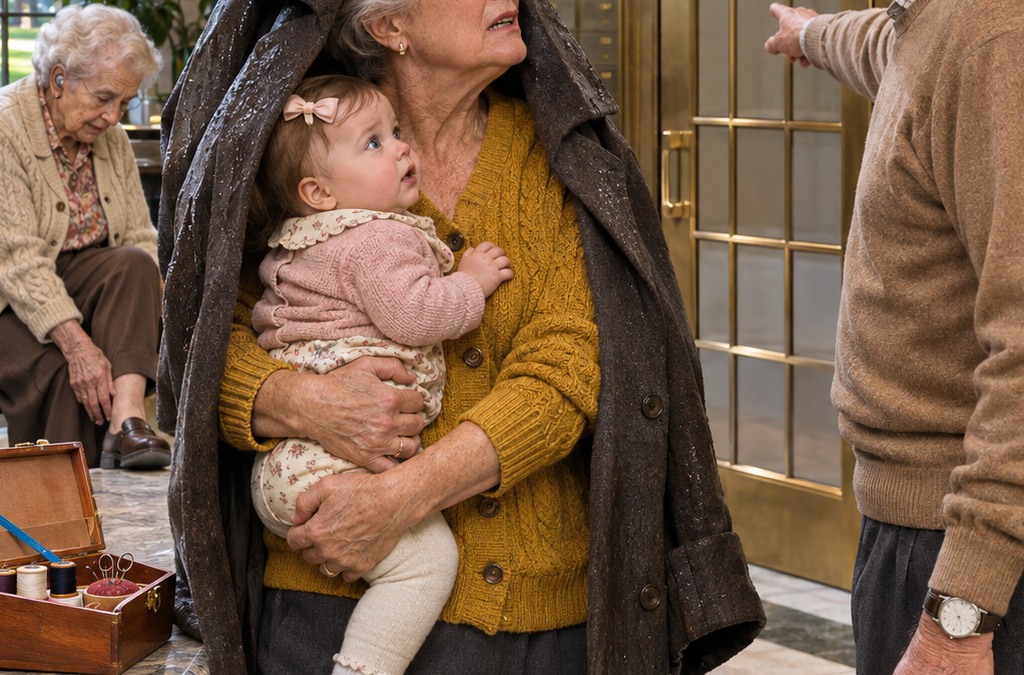
I’m 69, and my husband covered my face with his wet overcoat in front of his family while I held our granddaughter.
Chapter 1 of 7
“Hold still. Make yourself useful.”
The wool smelled of rain and Frank’s cigarettes. Our nine-month-old granddaughter, Ellie, shifted against my hip at the bank’s safe-deposit counter in Akron, Ohio.
“I’m holding Ellie. Take your own coat. Are you really leaving that over my face?”
My mother-in-law, Helen, looked down at her shoes.
“We’re waiting on you, Ruth. Frank’s trying to get us inside,” his younger brother, David, said.
Beside us, the viewing-room door remained closed, although Frank had already extended his arm toward it as if someone should have opened it before we arrived.
He’d invited us to look through old Bell family photographs from his rented box. Then we were supposed to have lunch together.
That was the plan.
I’m Ruth Carter. I’m sixty-nine, a retired hospital payroll supervisor. Frank Bell and I had been married twenty-six years, and I’d kept my birth surname.
My aunt’s sewing box was left to me alone.
The small wooden box stood open within my reach, with an unopened bank notice addressed to me tucked beside the thread and a repaired blue hinge ribbon.
Frank’s relatives had never asked about the things my late aunt entrusted to me. They mostly asked whether I could fix them.
Ellie’s bottle waited in her diaper bag. Helen wore the sleeve I’d shortened so it wouldn’t drag through her soup. I’d helped sort those photographs, too.
I’d made myself useful until usefulness became my only place.
Earlier, David had said Helen had lived alone ten years. She’d adjusted her hearing aid and corrected him slowly: eleven. At ninety-one, she still remembered her own life.
Frank reached for the bank letter tucked beside my aunt’s thread.
I slid it free before his fingers reached it. The top of the envelope was already loose from where I’d worried at it in the car.
Through the gap beneath the coat, I saw my name and the words about a loan payment. I hadn’t requested a loan.
“Why is there a loan in my name?”
Frank told me to put it away. His voice had that impatient edge he used when a store clerk wouldn’t accept an expired coupon.
And David leaned closer, blocking the counter from view.
The coat had been over my face only seconds. What I remembered afterward filled much more space: Helen’s lowered eyes, the wet seam against my cheek, Ellie’s weight.
My aunt had used that box for decades, lifting its removable tray whenever she needed the heavier needles underneath and speaking complicated sewing instructions into a little recorder.
She’d always said spoken directions were easier on tired eyes.
But Frank wasn’t looking at the box. He was watching the notice in my hand.
He said I was holding everyone up. Then he said I couldn’t manage one simple favor without turning it into an argument.
“STOP making a scene!”
Ellie startled against me.
“You expect me to hold Ellie and wear your wet coat?”
Frank told me to hold his coat until we got inside.
Susan Price came around the counter before I could answer. She stopped beside me.
I told Frank to take it himself and shifted Ellie higher. Her cheek stayed clear of the wool.
Susan lifted the coat off my head and draped it over his extended arm.
“We’re only waiting for our room,” Frank said.
“She’s holding a child. Carry your coat.”
Susan stayed between Frank and the counter. I could finally see everyone without peering beneath his sleeve.
I held up the trembling notice. “I never agreed to borrow.”
“Frank told me you’d agreed,” Helen said.
I looked at her. She had known about the loan while I stood there asking what it was.
Frank’s arm sagged under the coat. He looked away from the notice and straight at his mother.
Helen touched my aunt’s sewing box.
David’s smile disappeared, and Frank’s mouth tightened. Neither man spoke.
“Frank, tell Ruth who you paid,” Helen said.
“You borrowed $94,000 in Ruth’s name to support David’s household,” Helen told Frank.
Frank pulled the wet coat against his chest, his mouth tightening as she finished.
“Don’t discuss our private business in here, Ruth.”
“I didn’t say it, Frank. Your mother did.”
He kept looking at me, although Helen was standing right beside him.
I looked down at my name on the notice, then over at David.
He was staring at his mother as if she had spoken out of turn.
Helen said Frank had called the money family care when he explained it.
She repeated his talk about keeping everyone safe and a room with two little beds.
She seemed determined to get his explanation right, but she wouldn’t meet my eyes.
I remembered David offering to buy lunch that morning when I’d suggested separate checks.
I had thanked him for an offer made while this was being kept from me.
“You didn’t understand what I told you, Mom,” Frank said.
Helen touched her hearing aid and asked him to repeat what he’d just said.
He tightened his grip on the coat without answering her request.
Her hand slid away from my aunt’s sewing box while we waited for him.
David stepped away from the closed viewing-room door and turned toward me.
His face reddened, and Frank pressed his lips together beside him.
“Mom helped us hide it, Ruth,” David said.
Helen bent forward in her chair. For the first time that morning, she looked directly at me.
“He said the children could lose their home,” she said. “He said you’d agreed, and then he said you’d be angry if you heard it from me.”
Susan offered us somewhere private to sit. She didn’t tell me what the notice proved or what Frank could do with my name. She simply asked whether I wanted a chair.
I said I wanted to keep holding Ellie.
Frank asked for the notice. I kept it against the diaper bag, beyond his reach, with Ellie safely supported on my other arm.
There were no more questions I wanted to ask him there.
By then, I could hear the bank around us again. A phone rang beyond the counter. Rain ticked against the front windows. Our family lunch was still supposed to happen.
My daughter, Laura Parker, had trusted me with Ellie that morning because she was working at the dental office. At thirty-seven, she was managing a baby and a job, and I knew how much an ordinary dependable morning mattered.
I’d cared for Ellie regularly since Laura returned to work. I knew which bottle she preferred and how she rubbed her ear when she needed sleep.
Frank knew those things, too. He’d watched me leave our house with the diaper bag packed and watched Laura come back grateful.
Now he looked at Ellie instead of the notice.
“You’re upsetting the baby with all this carrying on.”
Ellie wasn’t crying. She was chewing the edge of her bib, watching Susan’s necklace.
That accusation hurt almost as much as the coat. He’d found the one responsibility I loved and was already trying to make me doubt it.
Susan asked whether I wanted her to call anyone. I told her no, thank you. I could call my daughter myself.
David said we should get the photographs and straighten everything out over lunch. He spoke as if we’d disagreed about a restaurant.
“I’m not having lunch with you,” I said.
Frank’s mouth pulled tight. Helen stayed seated, her hands together in her lap.
I turned toward the bank’s front doors with Ellie against me. Frank spoke before I could leave.
“Laura already agrees you shouldn’t keep Ellie alone.”
Chapter 2 of 7
“Frank said you’d agreed to help Helen, then forgotten,” Laura told me.
I stood in her kitchen doorway the following morning. Ellie was in her high chair behind her, rubbing banana across the tray.
“I said I’d talk to you. I didn’t say you couldn’t keep Ellie.”
Laura hadn’t brought her over that morning. I’d waited beside a clean blanket before calling to ask whether they were running late.
She had rearranged her shift. She said Frank frightened her when he described me arguing about money I’d supposedly approved. He’d made my questions sound like a reason to keep Ellie away.
“Did he tell you what he did at the bank?”
She said he’d mentioned an argument. That was all.
I told her about the coat, including how briefly it happened. I didn’t need to stretch those seconds. She looked toward Ellie before answering, and I hated that I noticed.
“You thought I might drop her,” I said.
Laura said she didn’t know what to think. That hurt. My daughter had trusted me through fevers and sleepless afternoons, then let Frank’s account replace her own experience.
I stayed by the doorway until she asked me to come in. The chair beside Ellie had a washable cushion I’d bought after her first enthusiastic encounter with sweet potatoes.
Laura made toast and scraped off the burned edge over the sink. She’d done that since she was a teenager, insisting the toaster had a personal problem with her.
I almost made our old joke. Neither of us seemed ready for it.
“I remember what you agreed to,” she said. “It was $240 a month for Helen’s rides. You said she shouldn’t have to miss appointments because nobody could take her.”
I remembered that conversation, too. Frank had complained about the driving. I’d suggested paying for rides when neither of us could help.
There had been no talk of borrowing. David’s household hadn’t come into it.
Laura’s memory didn’t answer every question about what Frank had done. But it helped me trust mine. He had taken one ordinary kindness and described it as permission for whatever he wanted.
My phone rang while Ellie offered me a damp piece of banana. Frank’s name appeared. I let it stop.
“Why didn’t you tell me things were this bad?”
“I didn’t know about the money.”
“I mean before. The way he talks to you. Why did you keep letting that go?”
I was ashamed, though she hadn’t meant to shame me. She’d seen more than I wanted her to see.
I told her I’d usually dealt with the immediate problem. Someone needed a ride, dinner, a repaired sleeve. Frank got easier to live with once the problem disappeared.
After a while, I’d stopped expecting him to ask nicely. I’d been embarrassed to admit how much that mattered.
“I should have asked you first,” Laura said. “He sounded so sure. You were upset, and he kept saying he was worried about you. It was easier to believe him.”
My phone rang again before I answered her. Laura watched it until the screen went dark.
During that visit, Frank made six calls. I answered none of them.
Then his message appeared: Tell Laura to stop covering for you.
I let her read it. I didn’t offer an explanation or call him to demand one. She read it twice.
“Covering for what?” she asked. “You came here to talk to me.”
I was furious. Even with me sitting across from her, Frank was trying to tell Laura what our conversation meant.
She pushed her toast away and said I should stay there. She could get bedding from the closet. We could work everything else out afterward.
“I’m going home today,” I said.
“Mom, please. You don’t have to prove anything by going back.”
“I’m not proving anything. My things are there. I need to decide what I’m doing, and I can’t make every decision this morning.”
“Even if it’s awkward. Frank doesn’t get to explain my mind to you.”
She heard that as defending him. I could see it in her face. I had to tell her plainly that I wasn’t excusing him, and I wasn’t ready to pack a bag because she said so.
My inquiry had confirmed the $94,000 loan in my name and that its proceeds reached David’s household. The lender was examining whether I had authorized it; the debt had not been erased.
Saying that aloud made me feel exposed. Laura knew I’d spent years checking other people’s pay down to the penny. Now I couldn’t explain how my own husband had put this on me.
“Ask me directly when you’re worried,” I told her. “Even if it’s awkward. Frank doesn’t get to explain my mind to you.”
She nodded, but I needed more than that. I asked whether she understood that being angry with him didn’t mean I was confused. She said she did.
Ellie began reaching toward me.
Laura lifted her from the high chair, then hesitated before bringing her over. I wanted that hesitation to hurt less than it did.
“Could you sit with her while I wash up?” she asked. “Just a little while. Then I need to get her down.”
It wasn’t our usual day together. I accepted the small visit she could offer.
Ellie settled against me and tugged at my collar. Laura stayed nearby, wiping banana from the tray.
My phone sounded again before she finished. This time it was a voice message from David. I played it where Laura could hear.
“I’m coming Saturday. Don’t make me explain what this does to Mom.”
Chapter 3 of 7
“Frank said the money was from you. He said you’d never ask for it back.”
David stood in our kitchen that Saturday with Frank behind him. He hadn’t taken off his jacket. They looked as though they’d already discussed where each would stand.
I asked when I had offered him money. He said Frank had handled it.
“You never asked me. Not once, David. You knew how to reach me.”
He looked past me toward the stove. He knew I hadn’t spoken to him about it. He’d accepted Frank’s promise and decided there was no reason to check.
I felt used. For years, David had called me directly about everything from Helen’s groceries to whether a shirt could survive bleach. Apparently, accepting $94,000 required less conversation.
Our kitchen still smelled of the potatoes I’d fried for lunch. Frank always complained that I cut them too thick, then ate the thick ones straight from the pan.
That afternoon, his plate sat beside the sink. Mine was still on the table.
“I drove Mom when you were laid up,” David said. “Nobody sent you a bill. Now we need help, and suddenly you’re counting everything.”
I remembered those drives. During my recovery years earlier, he’d taken Helen to appointments I couldn’t manage. I had thanked him then, and I acknowledged it now.
He seemed to expect that acknowledgment to end the conversation. When it didn’t, he started explaining how little steady flooring work he’d had.
The money had kept his family in their house. Repairs were finished instead of being put off again. There had been groceries without another argument about what they could afford.
The records showed $62,000 for housing arrears and repairs, and $32,000 for ordinary household support.
I was glad his children had food and a home. Their needs weren’t what made me angry. Neither man would tell me why those needs meant I didn’t deserve to know.
“You could have asked,” I said. “You both could have sat right here and asked.”
David said he’d been embarrassed. Frank said asking would only have produced weeks of worry before anything got done.
They made my absence from the decision sound like a convenience for me.
Frank moved into the kitchen fully. He no longer bothered saying I had forgotten. David’s account had made that harder, and Frank had found another way to stop me.
“Keep this up and everyone hears you abandoned Mom.”
He said it while looking straight at me. David didn’t object.
I felt humiliated in my own kitchen. They were discussing what to tell people about me while I stood within reach of the table where I fed them.
I asked what Helen’s appointments had to do with borrowing in my name. Frank said families didn’t separate everything into little piles.
Then David told me he was done with her weekly rides.
“I’ll arrange another ride. That doesn’t mean I agreed to the loan.”
“Find somebody else for the appointments. I’m not helping while you do this to us.”
He knew I had Ellie on some of those days. He also knew Helen disliked arranging rides with people she didn’t know.
I started working through the week before he’d finished speaking. I would have to call Helen, ask what she needed, then check with Laura. I resented how quickly their threat became my work.
“I’ll arrange another ride. That doesn’t mean I agreed to the loan.”
David took out his phone. He told me he’d already told relatives I was choosing money over an old woman.
I wanted to ask which relatives. I wanted names so I could explain myself before their version settled. But that would have left Frank and David directing the rest of my day.
Instead, I asked Frank whether this was how he intended us to keep living.
“You weren’t the only one doing things,” he said.
His answer hurt because it dismissed a question about us. He wanted an argument about who had done more laundry, more driving, more unpaid work.
I wouldn’t account for twenty-six years across that table. I told him gratitude didn’t give anyone permission to borrow under my name.
Frank looked at David, then back at me. For the first time, he asked what I meant to do about our savings.
“That $360,000 is our retirement. You’re not breaking it apart because you’re mad at my brother.”
He wasn’t asking me to cover another bill. He wanted me to leave our savings together and keep living as though I could trust him with them.
I was frightened by how much would have to change. I was more frightened of staying while he treated my questions as disobedience.
Two days later, I began divorce proceedings. Our existing savings were preserved while we disputed their division.
But that afternoon, we were still in the kitchen when Helen called the house.
Frank answered on speaker, expecting her to ask about the next ride. She asked whether I was there. He said we were talking.
“I need Ruth alone,” Helen said slowly. “Without you boys answering. Is she there?”
I told her I was. She asked me to repeat it, then said she’d heard me.
Frank leaned toward the phone. He told her she had nothing useful to add and should rest.
“June spoke to me.”
David stopped looking at his phone. I asked Helen what she meant.
Frank said his mother was confused. She asked him to let her finish, her voice louder now.
“June spoke to me before she died, and I didn’t tell you.”
Chapter 4 of 7
“June told me you didn’t know what Frank had borrowed. I didn’t tell you.”
Helen sat across from me in her apartment, her hearing aids in place. Months had passed since she’d first mentioned June, then refused to say more whenever I visited.
That afternoon, she had asked me to come alone.
“Frank said you’d put David out of his house,” she said. “And you’d blame me for letting it happen. I thought I could get him to tell you himself.”
I was angry with her. I’d brought her groceries and arranged her rides while she watched me struggle with something she could have helped explain.
I asked her to start with what June had said.
June had been staying briefly at our house when she noticed a payment reminder. She questioned Frank herself, there in our Ohio kitchen. Afterward, she called Helen.
“She said, ‘Ruth doesn’t know about this.’ Those were her words. She wanted to sit down with you that weekend. Then she died, and I kept waiting.”
June’s unexpected death still hurt. I remembered thinking we had plenty of time for another visit, another conversation without someone needing dinner.
Helen said June hadn’t told her everything Frank said. She had told her enough to make clear that I needed to ask him about the borrowing.
I asked whether June had seemed uncertain.
“No. She was cross. You remember how she got when somebody wouldn’t answer a question. She said she’d asked him herself. She wasn’t guessing.”
I remembered. June could wait out a dress-shop customer who insisted she hadn’t gained weight while the zipper refused to move.
Helen remembered her speaking sewing instructions aloud, too. June said it saved her from trying to read her own cramped writing later.
That familiar detail made me miss her so badly I had to stop asking questions.
Helen waited. On her television, the captions kept running beneath a cooking show with the sound off. She disliked the host but watched every afternoon to see what he burned.
“Why did you believe Frank instead of her?” I asked. “June wasn’t asking you to choose between them. She was asking you to tell me.”
Helen looked toward the hallway.
She said believing June meant admitting what her sons had done. Frank had warned her that David would stop coming if she interfered. She had already lost visits after the argument in our kitchen.
“I was afraid of losing both boys. I’m still afraid. You come here, Ruth, but you have your own life. I sit here after everybody leaves.”
It hurt to hear her say it. I understood the fear without being able to excuse what she’d done with it.
I told her I couldn’t keep paying for her sons’ choices.
“June left you her box, didn’t she? The one she always kept nearby?”
She asked me to repeat that. After I did, she nodded slowly.
Then she told me she had paid her own rent in this apartment for eleven years. Neither son had housed her. She arranged and paid for her routine help herself.
Accepting rides, she said, hadn’t made either of them entitled to describe her life for her.
“June left you her box, didn’t she? The one she always kept nearby?”
“She left it to me alone,” I said. “Yes, I’ve kept it.”
Frank appeared in the open doorway before Helen answered. He had come to bring her shopping in from his car and had heard me.
His eyes moved from Helen to me.
He’d previously called June’s belongings family things, as though marriage had made them part of the Bells’ cupboards. This time he didn’t repeat that claim.
“Your aunt loved making other people’s trouble worse,” he said.
He knew I’d kept what June had left me. For a moment, he seemed more interested in that than in why I was there.
“You don’t get to answer for her.”
My voice shook. I hated that he could hear it, but I stayed where I was.
Frank told Helen she shouldn’t be wearing herself out with old conversations. She said she remembered this one. He answered me instead, saying I was encouraging her.
I felt the old urge to explain gently until he stopped being angry.
Then he turned back to his mother.
“Take Ruth’s side and David won’t bother visiting you.”
Helen’s mouth opened, then closed. She said she hadn’t taken sides. Watching her retreat made me sad, and furious with him.
What Frank called helping his mother could be checked against the life Helen had actually lived.
The savings had been established, and the records showing where the borrowed money went had been checked. There was no need for Helen to remember every dollar.
She needed to be allowed to remember her own home.
Our appointment was Tuesday morning in Courtroom 4 at Summit County Domestic Relations Court in Akron. Frank and I would attend with our representatives; David and Helen were coming, too.
Frank said his mother didn’t need more upsetting conversation before then. Helen didn’t answer.
He left the groceries in her kitchen and went without saying goodbye to me. I stayed, although neither of us seemed to know how to continue.
Helen’s phone lit beside her chair.
She asked me to read the message because she couldn’t find her glasses. It was from David.
“Tell them the upstairs room was yours.”
Chapter 5 of 7
“Frank said the loan would stay your problem, even if you left him. It’s your name on it. That’s what he told me.”
David stood beside Helen’s kitchen chair when I arrived. He had come early, hoping to finish before I got there.
Helen had asked me to come. Now she looked embarrassed that I had heard him.
He glanced at her phone beside the salt shaker. His message about the upstairs room was still there.
“I meant prepared for her,” he said. “Nobody’s saying she moved in. A room can be for somebody before they use it. Tell them that, Mom.”
Helen said she had never asked for a room in his house. He answered that she hadn’t needed to ask.
I felt sick hearing how neatly they had divided things. David would keep what the money had bought. I would keep the borrowing.
He didn’t ask whether I had slept or how I was managing. Tomorrow we would face one another in Akron, and he wanted one more thing settled first.
“You thought my name settled it?” I asked. “You could keep everything, and I’d have to deal with it?”
He said Frank understood these things better than he did.
That answer was familiar. David trusted his brother whenever trusting him meant David could stop asking questions.
Helen’s lunch was still on the kitchen counter. She had warmed one of her frozen corn muffins, then split it to check the middle. She always complained that her microwave cooked the outside and left winter inside.
Usually I would have asked whether she wanted it warmed again. I left it alone.
“I could come by more,” David told her. “We could get back to Sundays. But you’ve got to help keep this family together. You can’t just listen to Ruth.”
Helen watched him from her chair. She had missed those visits badly enough to mention them without quite asking when they would resume.
I was angry that he knew it. He was offering her something she loved, provided she supplied the words he needed.
She asked whether he meant he would visit only if she agreed with him. He complained that she was making it sound ugly.
“You said you’d come if I helped,” Helen said. “I heard that much. My hearing aids are in, David. You don’t have to say it louder.”
“Don’t let her turn Mom into a witness.”
He looked at me as though I had taught her the sentence.
I had spent months wishing she would speak plainly. Hearing her do it didn’t make me forget how long she had stayed quiet.
David’s phone sounded. He read the message before seeming to remember we could hear.
“Don’t let her turn Mom into a witness.”
Helen asked who “her” meant. He stopped reading, although there was more on the screen.
She asked again, slowly. David said Frank was upset and didn’t want her dragged through another argument.
My face grew hot. Even there, with Helen asking her own question, they were treating her voice as something I had taken from them.
“Does Frank mean Ruth?” she asked. “Then he can say Ruth. And he can ask me what I’m doing instead of sending you.”
David said they were trying to protect her. Helen answered that he had come to tell her what to say.
I stayed in my chair. I wanted to interrupt, to name every time both men had called pressure protection. But Helen was managing this conversation herself.
Both sides already had what we intended to bring, and Frank and I had agreed on the savings amount and our shares before the disputed borrowing. My attorney, Karen Stone, had arranged for the original material to be kept safe.
Tomorrow no longer felt far away. I was frightened of sitting where Frank could watch me answer, and tired of being frightened of him.
“Mom, the money protected your place with us,” David said. “You’d have somewhere to go. That counts for something, whether you needed it yet or not.”
Helen asked him to move his foot.
He thought she wanted to get past him. Instead, she pushed her chair away from his and worked it around the little kitchen table until she sat beside me.
I made room without touching her.
“Don’t use me to explain what you did.”
David stared at her. She looked unhappy, but she didn’t move back.
He said she knew he loved her. She said she hadn’t asked him about that.
I felt relieved, then ashamed of the relief. She was ninety-one, facing a son whose visits she wanted. I wished telling the truth hadn’t cost her this much.
“You’re encouraging this,” David told me. “She was fine before you came. Now she’s acting like we’ve done something to her.”
I told Helen to answer only what she actually remembered. If she didn’t remember something, she could say so.
David asked whether I wanted her to remember all the help his family had given her. Helen said she remembered it.
He waited for more. Neither of us supplied it.
For a while, he remained beside the table, trying different versions of the same request. Intended for her. Available to her. Partly for her.
Helen wouldn’t repeat any of them.
He finally headed for the door. I was hurt by how little he had needed from me beyond agreement. He hadn’t once asked what Frank’s promise had done to my life.
My phone sounded as David reached the open doorway. Frank had sent a voice message.
I played it. David was still close enough to hear.
“Ruth told June yes. That’s what I’ll tell the judge.”
Chapter 6 of 7
before the family judge, Frank said I had told June yes.
“Ruth told her she wanted me to take care of my mother. That’s what I did. The money went to David’s household so we could do that.”
David sat beside Helen behind him. Her hearing aids were in, and she leaned forward to hear.
Judge Michael Adams looked toward me. I had dreaded this morning in Akron for months. Now Frank was explaining my wishes to another person while I waited to speak.
“I agreed to $240 a month for Helen’s rides,” I said. “I didn’t agree to borrow $94,000 for David. June asked him about that difference herself.”
Karen Stone stayed beside me. She had helped establish what we were bringing and where it came from. She didn’t tell the judge how my marriage had felt.
When I was allowed, I brought the wooden sewing box forward. Its repaired blue ribbon still held the hinge.
I lifted the removable tray. Beneath it rested June’s small digital voice recorder, the one I had found after the bank visit.
I felt sad seeing it there. June had used it when her eyes tired. She hadn’t lived long enough to tell me what she had recorded that last week.
“This is her recorder,” I said. “I kept the original file on it. That’s Frank’s voice with hers. I lived with him twenty-six years. I know it.”
Karen asked the few questions needed about the device and its handling. The judge allowed the excerpt.
June’s voice came through first, thin but clear. She sounded irritated, exactly as Helen had remembered.
“Ruth agreed to pay for Helen’s rides. Is that what you’re talking about?”
Frank’s recorded answer followed. “She agreed to rides, yes. This is family care. David’s getting things fixed. There’s the room with two little beds.”
June asked whether I knew what he had borrowed.
“Don’t tell her about the loan.”
Frank’s jaw jerked sideways. He looked at David, then back toward the judge.
I had heard the passage before. Hearing it with Frank there still hurt. June had asked the question I hadn’t known to ask, and he had told her to keep me ignorant.
For a moment I wanted to hear more of her voice, even an old instruction about hemming trousers. Instead, the playback stopped.
“She caught a plan before it was finished,” Frank said. “I wasn’t ready to discuss it with Ruth. Having somewhere for Mom to stay helped all of us.”
He didn’t deny the voice. He said I had trusted him with family decisions, and a room could be available before someone needed it.
Then Helen was called to answer questions. She moved carefully, watching where she put her feet. Frank followed her with his eyes.
“Was that room meant for you?” Judge Adams asked.
She asked him to repeat the question. He did, without raising his voice much.
“No,” she said slowly. “Those beds were for David’s twins. I visited. They showed me their room. I never asked to live there.”
David began, “Mom, we could have—”
Helen looked at him. He stopped.
She explained that she still paid for her apartment and ordinary help. Eleven years in the same place. She hadn’t made arrangements to move.
I felt relieved, but I couldn’t forget the months she had let me face this without her.
When asked why she had believed I approved the borrowing, she answered directly.
“Frank told me Ruth knew. That’s why I believed it. Ruth never told me herself.”
Frank bent toward his representative. David stared at the space his mother had left beside him.
Judge Adams said permission to pay for rides did not authorize concealed borrowing for David’s household. Then he addressed the savings we had agreed to divide.
“Each party’s starting share was $180,000. I’m transferring $94,000 of his existing share to Ruth. She receives $274,000; Frank receives $86,000.”
Frank shook his head before the judge finished.
“Come on, Mom. We’re leaving. David will take you home.”
“This divides your property,” Judge Adams added. “It does not cancel the loan or bind the lender. That debt remains a separate matter.”
I heard the amounts clearly. Frank would have less of the savings he had insisted must remain untouched, and I would still have to deal with the borrowing.
After we were excused, Helen returned toward the benches. Frank stood in the aisle.
“Come on, Mom. We’re leaving. David will take you home.”
She stopped beside his bench. I thought she might sit there while we gathered ourselves. I was ashamed of how badly I wanted her to choose differently.
“I heard what you said, Frank.”
He told her he hadn’t been speaking to her. She waited until he moved enough to let her pass.
Then she crossed the aisle and sat beside me.
David reached for his coat but didn’t approach us. Frank remained standing, looking down at his mother as though she had misunderstood where she belonged.
“Ruth, come outside. We need to talk without everybody listening.”
I had spent years following him somewhere private so nobody would hear the rest. My face felt hot, but I stayed seated.
“You don’t get to spend my name anymore.”
He said I was making it impossible to talk. I told him I wasn’t coming outside with him.
Helen’s sleeve rested against mine. Neither of us moved. I was still frightened of what came next, but I didn’t want a private explanation that required me to disregard what he had said in public.
David asked Frank whether they were leaving. Frank turned toward him.
“You’ll have to pay your own bills now.”
Chapter 7 of 7
David asked Frank for another month’s help before we had left the courthouse.
“Just until the work picks up. I’ve got a couple of jobs coming.”
Frank kept walking. He said he had already given David his answer.
I heard David call after him, then lower his voice when other people looked. Neither man turned toward me. For once, nobody asked me to make the conversation easier.
Helen waited beside me while Laura brought the car around. She looked tired and older than she had that morning. I was relieved to leave, but I didn’t feel like celebrating.
Thirteen days after the hearing, our $360,000 in savings was distributed. I received $274,000, and Frank received $86,000. The transfer was finished; I didn’t have to ask him to release my share.
“Did it come through?” Laura asked when she called that evening. “You don’t have to tell me the amount. I just want to know you have it.”
I told her I did. Then I told her I still had the loan to pay.
Frank had kept up the carrying costs while we disputed it. The principal remained $94,000. Getting the money divided hadn’t removed my name from what he had done.
I paid the $94,000 principal and $680 in accrued interest. On November 20, the lender separately confirmed that the balance was zero.
I cried after reading that confirmation. I had spent so long expecting another demand that I read it twice before believing I was finished paying. The divorce ruling hadn’t cleared the loan, and paying it didn’t promise a clean credit history.
“It’s paid,” I told Laura. “That part is over. I’m still angry about having to do it, but I don’t owe them anything else.”
“If you can’t, say so. I need to know before I make another arrangement.”
She stayed on the phone without trying to make me feel grateful.
I didn’t send money to Frank or David afterward. I knew David was still having uneven work. Knowing it no longer meant I started calculating what I could spare.
Helen began calling about her own rides. Sometimes she asked me; sometimes she asked Laura. When neither of us was available, she arranged and paid for one herself.
“Can you take me Thursday?” she asked once. “If you can’t, say so. I need to know before I make another arrangement.”
I said I couldn’t. It felt mean for a moment, though she accepted it without complaint. I was still learning not to supply a whole defense with an ordinary answer.
She continued seeing her sons. I didn’t ask her to stop, and she didn’t bring me reports afterward. Once, she said Frank had described her as needing a place with David.
“I told him I have a place,” she said. “Eleven years, Ruth. He knows where it is. He manages to find it when he wants to tell me something.”
That made me laugh, which surprised us both.
I was still hurt by her silence. Some visits were easier than others. She apologized without asking me to reassure her, and she stopped saying she had only wanted everyone to get along.
By December, Laura and I had settled into asking each other instead of assuming.
She asked whether I could keep Ellie. I asked when she expected to return. Sometimes I said yes; sometimes I had other plans. Laura stopped treating an empty afternoon as an afternoon that already belonged to her.
“I listened to Frank before I asked you,” she said during one visit. “I keep wanting to explain why. But I did it. You were right there, and I called him first.”
It hurt less to hear her say it plainly than to hear her defend it.
We agreed that worries about me would come to me. Questions about Ellie would be discussed between us, too. Neither of us could promise we would always agree.
“If you’re worried, ask,” I told her. “I might get annoyed. You might get annoyed with my answer. We can have that conversation ourselves.”
She said that sounded fair.
Our closing visit that December was an ordinary afternoon in Akron. Ellie was eighteen months old now and determined to walk everywhere except where anyone wanted her to go.
Laura brought a cardigan with one loose button. She asked whether I felt like fixing it.
I did. There was nowhere I had to be, and I liked the little sweater. I settled beside the window while Laura held Ellie and Helen sat nearby, talking.
“I can take it home again if she won’t cooperate,” Laura said. “Don’t chase her around with a needle. She’s been trying to climb me all afternoon.”
Ellie objected to being held until Laura let her inspect the cardigan. Then she wanted it back before I had threaded anything.
The sewing box held thread, needles, scissors, and the buttons June had saved. Its repaired blue ribbon still supported the lid. There was nothing hidden beneath the tray.
I missed June. I would have liked to tell her about this afternoon, especially Laura asking instead of leaving the cardigan and expecting it finished.
Helen watched Ellie tug at her mother’s collar. She said the cafeteria children used to lose buttons by the handful.
“They’d come through with their coats hanging open,” she said. “You’d ask where the button went, and they’d look down like it ought to answer for itself.”
Laura laughed. Ellie laughed because her mother did, then leaned toward Helen as though she understood the story.
I finished the last stitches while they talked. Nobody needed me to settle an argument. I wasn’t listening for Frank’s mood or deciding which request would cause the least trouble.
I felt happy sitting there. It was a small, quiet happiness, and I didn’t have to explain it to anyone.
“Here,” Laura told Ellie, holding up the repaired cardigan. “Grandma fixed it. We’ll put it on before we go.”
Ellie reached for me instead.
Family didn’t mean handing someone permission to erase me.
I put the needle away.
I closed the sewing box and picked up Ellie.







