My Brother Laughed That He Got Mom’s $480,000 House and I Got Her Sewing Table—Then He Read the Bank’s Letter
Complete story · 7 chapters · about 28 minutes · ending included
Chapter 1 · Chapter 2 · Chapter 3 · Chapter 4 · Chapter 5 · Chapter 6 · Chapter 7
Chapter 1
At 3:00 p.m. Saturday, Bill read Mom’s will while Ronnie smiled.
Thirty relatives filled her living room after the funeral on September 20.
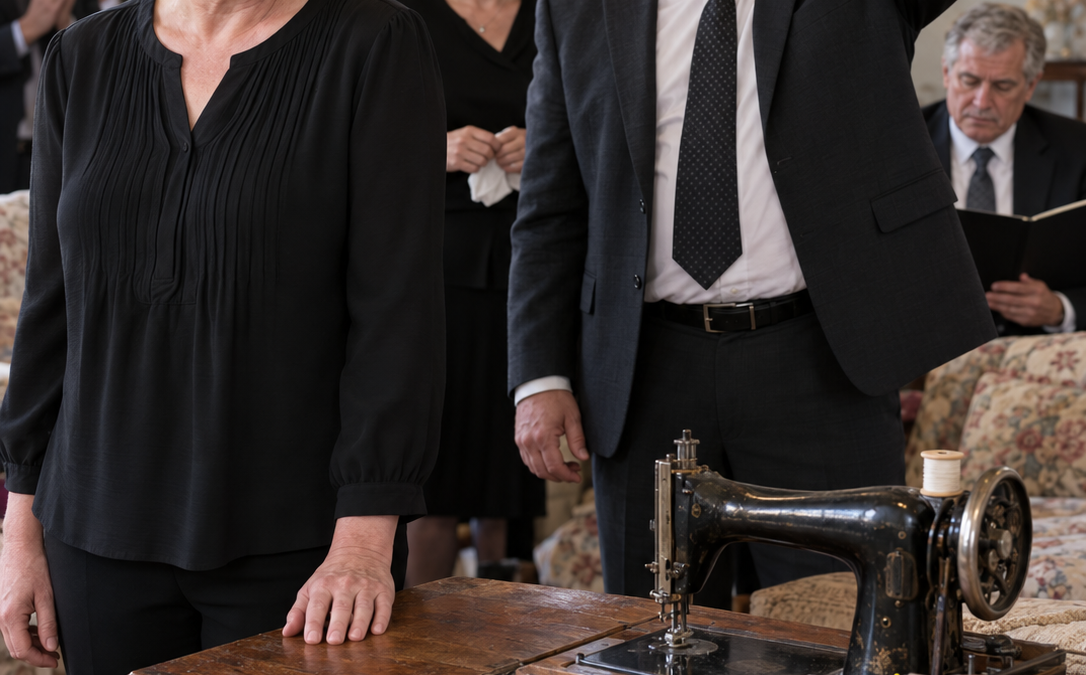
I stood beside the walnut sewing table, still wearing my funeral clothes.
“The house to my son Ronald, subject to what is recorded against it. My sewing table and its contents to my daughter Paula.”
Ronnie laughed and grabbed Mom’s key ring off the hook.
He jingled it over his head.
“Four hundred eighty thousand, people!”
Relatives clapped.
Then Ronnie pointed at me beside the table.
“Enjoy your little table, Paula. Maybe sew yourself a life.”
My face burned.
“I will.”
A cousin near the sofa stopped clapping.
Someone behind Ronnie gave a short laugh, then looked down.
I kept my hand on the walnut edge.
Mom’s chair was pushed underneath, with the seat facing the window.
Ronnie lowered the keys and slipped a finger through the ring.
“Ronald, I’ll write to you about the recorded items,” Bill said.
“Send the deed, Bill. Skip the homework.”
Bill kept his place on the page.
“I’ll write to you,” he said.
I remembered Mom beside me in a counseling room in 2019.
Her purse had been upright between her shoes.
There had been paperwork about this house and room for my signature.
I had signed where the counselor showed me.
Afterward, Mom had asked me to keep it private.
“Please, Paula. Let me handle it.”
I had promised.
Standing beside her sewing table, I said nothing.
Ronnie turned toward the relatives crowding the doorway.
“Plenty of room once we get this furniture sorted.”
Dawn stood near the armchair, folding a paper napkin into a narrow strip.
Ronnie shook the keys toward his wife.
“No more rent.”
Dawn looked around Mom’s living room.
For twenty years, Dawn and Ronnie had rented.
I knew what those words meant to Dawn.
Dawn pressed the folded napkin against a palm.
“It’s a lovely house,” Dawn said.
“It’s our house,” Ronnie said.
Bill closed his hand over the edge of the will.
“The estate still has business to complete, Ronald.”
“That’s why we’ve got you.”
Ronnie smiled as if he had complimented Bill.
I counted the keys hanging from his finger.
Then I stopped and counted the buttons on my sleeve instead.
My hands were shaking.
I wanted to leave before anybody noticed.
Aunt Peggy came past me carrying empty cups.
“Paula, would you help me in the kitchen?”
“Yes.”
I let go of the table.
Behind me, Ronnie started telling a cousin where he wanted a larger television.
I followed Peggy through the dining room.
Mom’s sewing scissors lay beside a stack of folded programs on the sideboard.
I moved the scissors away from the paper before setting down my cup.
Peggy opened the kitchen trash can.
“Your mother wanted you to have that table.”
“I heard Bill.”
“I know you did.”
Peggy scraped a plate without looking at me.
I stood at the sink and ran cold water over my wrists.
From the living room, Ronnie’s laugh reached us.
I had buried my mother that morning.
Now I was cooling my hands so I could return to her living room.
Peggy set the empty plate beside the sink.
“Want me to wrap you something?”
“No, thank you.”
I dried my wrists with a paper towel.
From where I stood, I saw Dawn smoothing that same napkin.
Ronnie stood beside Mom’s chair with the keys still out.
I went back for my purse.
Bill had moved to the dining room table.
His file lay open beside the will.
“Paula,” he said.
I stopped.
“The bequest includes the contents.”
“The sewing table.”
“And its contents.”
“I understand.”
He said it plainly, without looking toward Ronnie.
I was grateful for that.
Mom had kept things tucked into whatever space was handy.
I would sort the table at home, where nobody would rush me.
“When can I take it?” I said.
“Arrange a time with Ronald,” Bill said.
Ronnie heard his name and came through the doorway.
“What are we arranging?”
“The table,” I said.
“Oh, that.”
He glanced toward the walnut top, then back at me.
“You’ll need help. Don’t scrape my floors.”
My throat tightened at the word “my.”
“I’ll bring a dolly.”
“Good. Make it easy.”
Dawn stepped into the dining room behind him.
“Ronnie, Paula just needs to get her mother’s things.”
“She’s getting them. Bill read it.”
Ronnie looked toward the living room, making sure the others could hear.
“I’m not stopping her.”
I put my purse strap over my shoulder.
Bill’s page was still on the dining table.
I could see Mom’s name at the top.
I had spent twenty-nine years behind a bank counter, checking names and signatures.
Now my eyes went straight to the sentence Ronnie had hurried past.
He followed my glance.
“You want Bill to read it again, Penny Pincher?”
“No.”
“Then we’re settled.”
I went to the sewing table and checked that the machine was secure.
The drawer would not open when I tried the pull.
I left it alone.
Ronnie stood between me and the hall.
“How long is this going to take?”
“I need to arrange transportation.”
“Put it on your calendar, then.”
“I will.”
He tapped the keys against his palm.
I looked past him at Bill, who had picked up the will.
Bill’s thumb rested beneath the words “subject to what is recorded against it.”
You may also like
My daughter’s new boyfriend called me a nosy old waitress in front of 22 people at Thanksgiving. He didn’t know I’d already pulled his court records.
At my bakery’s 40th anniversary, my daughter-in-law poured wine on my cake and told 80 guests I was too old to run it. The keys weren’t mine anymore.
My new manager, 31, crossed my name off the team’s $14,000 Cancun bonus trip in front of everyone. He forgot who signs the second check.
Ronnie pointed toward the table.
“By the fourteenth, or it goes to the curb.”
Picking up where the Facebook post left off
Chapter 2
At 4:30 p.m. Tuesday, October 14, I pulled a dolly onto Mom’s porch.
Her fabric bins sat beside the steps in the drizzle.
Water had collected along the edges of the plastic lids.
I knocked, then bent to check the nearest bin.
A corner of blue cotton stuck out beneath the lid.
It was wet.
Ronnie opened the door while holding his phone.
“You made it.”
“Why are these outside?”
“I needed room.”
“They’re getting wet.”
“They’ve got lids, Paula.”
I tucked the cotton inside and pressed the cover shut.
Ronnie watched from the doorway without offering to help.
I counted the porch boards between my shoes and his.
Then I stood up.
“The table?”
“Right where you left it.”
I wheeled the dolly over the threshold.
The house smelled of coffee and something Ronnie had heated for lunch.
Mom’s chair was no longer tucked beneath the sewing table.
It stood against the wall, facing away from the window.
Dawn came from the kitchen, drying a spoon with a dish towel.
“Hi, Paula.”
“Hi.”
Dawn looked past me toward the porch.
“I can wipe those lids before you load them.”
“Thank you.”
Ronnie’s phone rang.
He checked the screen and held up a finger.
“Landlord. Give me a second.”
Before he answered, someone knocked on the open storm door.
A mail carrier stood outside with an envelope and a green card.
“Ronald Fleming?”
“That’s me.”
“Certified mail. I need your signature here.”
Ronnie tucked the ringing phone against his chest and took the pen.
I stood beside the dolly, close enough to see the return address.
William Harrison’s office in Newark.
Bill.
Ronnie braced the card against the doorframe.
He wrote, “R. Fleming 10/14.”
The carrier took the signed card and handed him the envelope.
Ronnie glanced at Bill’s name.
“Lawyer’s bill.”
He walked into the kitchen and tossed the unopened envelope on the fridge.
One corner hung over the edge.
Then he answered his phone.
“Yeah, sorry. Had somebody at the door.”
I stayed by the table.
Dawn set the spoon in a drawer.
“Does Bill need something?” Dawn said.
“Money, probably,” Ronnie said, moving the phone away from his mouth.
Dawn looked toward the top of the refrigerator.
I had watched Ronnie sign for that letter.
He had not opened it.
Bill had said he would write about the recorded items.
I remembered his thumb beneath that sentence in Mom’s will.
Ronnie’s voice rose from the kitchen.
“We’re out November first. My mother’s house is paid off. Free and clear since ’98.”
He said it loudly enough to reach the front porch.
I looked at Dawn.
Dawn laid the dish towel flat on the counter.
“Yes, I’m giving notice,” Ronnie said into the phone.
He leaned against Mom’s sink.
“No, we won’t need another month.”
I pulled the dolly closer to the sewing table.
The wheels bumped over the edge of the rug.
For a moment, I considered saying Bill’s name.
I could ask Ronnie to open the envelope.
But I knew only what Mom had done in 2019.
I had no current papers and no answers about what followed.
I was not going to guess out loud.
Ronnie ended the call and slipped his phone into his pocket.
“That’s handled.”
Dawn rubbed a thumb along the counter.
“November first?”
“That’s what we talked about.”
“I know. Hearing you say it makes it real.”
Ronnie grinned.
“Start packing.”
I folded the moving blanket I had brought over the dolly’s frame.
My fingers caught in a loose thread.
I pulled it free carefully instead of snapping it.
Mom would have reached for her scissors.
Dawn went onto the porch with the dish towel.
I heard the lids scrape as Dawn wiped away the water.
Ronnie stepped into the room beside me.
“You know where you’re putting that thing?”
“My sunroom.”
“Guess it’ll fit.”
“It’ll fit.”
He nudged Mom’s chair farther along the wall with his knee.
“Take the chair, too. It goes with it.”
“I planned to.”
I moved the chair near the front door.
Through the glass, I could see Dawn pressing the wet towel between her hands.
The fabric bins were still outside.
I wanted the table loaded before I argued about anything else.
When I returned, Ronnie had taken a paint chip from his pocket.
He waited until Dawn came inside.
“Here. What do you think?”
Dawn leaned toward the small rectangle.
“For where?”
Ronnie pointed toward Mom’s sewing room.
“Man cave.”
Dawn glanced into the room.
The empty chair space beneath the window was easy to see.
“What about your desk?” Dawn said.
“That’ll go in there.”
Ronnie held the color against the door trim.
“Once Paula clears out, I can get started.”
I checked the table’s legs before moving it.
The walnut felt cool beneath my palms.
“You’ll want to watch that doorway,” Dawn said.
“I will.”
Ronnie stepped aside, still comparing the paint chip to the wall.
I slid the padded dolly into position.
The table needed to lean enough for the frame to catch its weight.
I tested it gently, then changed my grip.
“Don’t drag it,” Ronnie said.
“I’m not.”
I bent my knees and tipped the table toward me.
The drawer stayed shut.
Behind me, Ronnie was telling Dawn where a television could go.
I looked toward the kitchen before adjusting the strap.
Bill’s unopened envelope still hung over the edge of the fridge.
Why would a paid-off house get certified mail from the estate lawyer?
You may also like
My son asked me not to come to his medical school graduation because I’ve served lunch in that hospital’s cafeteria for 22 years. Then the dean called my name.
My son-in-law invited 30 coworkers to my house for Thanksgiving on my credit card. He didn’t know I’d revoked his power of attorney on Monday.
My son texted that Christmas would be ‘just us’ this year, in the house I bought them. On December 24, I walked in with my realtor.
I lowered my head to check the dolly’s support.
Under Mom’s table, taped to the wood, was a small brass key.
Chapter 3
At home Tuesday evening, I slid the brass key into the drawer.
The lock turned beneath Mom’s walnut sewing table.
Inside lay a ledger, a counseling certificate, and four folded notes.
I sat in Mom’s chair before touching anything else.
The table and chair had filled my load.
Her fabric bins were still on the porch in Newark.
I had planned to go back for them.
Now I lifted the certificate onto the table.
April 16, 2019.
Mom’s signature sat beside mine, beneath the HUD-approved counselor’s information.
I remembered the counselor explaining the reverse mortgage.
Mom had asked questions, listened to the answers, and signed.
Afterward, in the parking lot, Mom had asked for my silence.
I had known about the money for the roof and taxes.
I had not known what came after.
I unfolded the notes.
Ronnie’s handwriting was easy to recognize.
The same crowded letters appeared on birthday cards he signed in a hurry.
“Ma, got the $40K. You saved the shop. Love, R.”
My fingers tightened around the paper.
I flattened it carefully before reaching for the ledger.
Mom had ruled columns with a pen.
Dates, amounts, check numbers, and names.
I followed the entries with my finger.
In 2019, $60,000 for Ronnie’s shop.
In 2020, another $40,000 for the business.
In 2021, $48,000 for his truck.
In 2023, $35,000 for a tax lien.
I added the amounts on my phone.
Then I checked the figures against Mom’s handwriting.
$183,000.
Beside those entries, Mom had written “Ronnie” and the check numbers.
The ledger listed $260,000 in draws.
I stared at that total until my screen went dark.
Ronnie had jingled Mom’s keys over his head.
He had told me to sew myself a life.
I had been angry beside that table.
Now I felt sick.
I turned to the last page.
“The table is paid for. — Mom.”
I pressed my palm against the walnut.
Then I put the notes in their original folds.
I needed Bill to tell me what the ledger could not.
Wednesday morning, I called his office before leaving for work.
“I opened the table drawer,” I said.
“What did you find?”
I told him about the ledger, the certificate, and Ronnie’s notes.
Bill let me finish.
Then he said the number.
“The balance is $330,000. It came due when your mother died. Tracking shows Ronald signed for my letter yesterday.”
I looked at the open ledger on my kitchen counter.
“Three hundred thirty thousand?”
“Yes.”
“Mom wrote down two hundred sixty.”
“The remaining seventy thousand is interest and insurance.”
I sat down.
Ronnie’s “free and clear” claim was still fresh in my ears.
“What happens now?” I said.
“He has to pay the required amount to keep it, or we sell.”
“When?”
“March 10, 2026, is the deadline in the notice.”
Bill spoke slowly enough for me to write it down.
He had received the servicer’s notice on October 8.
His letter to Ronnie enclosed it.
It had been on top of Mom’s refrigerator while Ronnie gave notice on the duplex.
“He called it your bill,” I said.
“It wasn’t.”
I rubbed my forehead.
“I knew she took the loan in 2019.”
“You didn’t know the current balance.”
“No.”
Mom had made later draws by phone, alone.
The servicer dealt with Mom, then with Bill as executor.
My job at a bank gave me no access to her loan.
A county record could show the mortgage.
It could not tell me what Mom owed now.
“I want to see the checks,” I said.
“As executor, I’ll request the check images,” Bill said.
“I have the check numbers.”
“Send me photographs of those ledger pages.”
I placed the certificate beside the notes and photographed the entries.
Before leaving for work, I checked that the drawer was locked.
Later, Ronnie’s post appeared on my phone.
It was a picture of Mom’s key ring in his hand.
“Mom’s memorial and my housewarming, Saturday the 25th!”
I put the phone facedown beside my lunch.
When I picked it up, relatives had started replying.
Some said they would be there.
Others congratulated him.
I opened the comment box.
I nearly typed a reply.
Instead, I backed out without posting.
Bill forwarded an email from Ronnie that afternoon.
“Bring the deed. Hand it to me in front of everybody.”
I called Bill.
“You saw what he posted?”
“Yes.”
“And he wants you there.”
“He’s made that clear.”
I looked at the ledger photographs on my screen.
“Keep the email,” I said.
“I will.”
Later that week, I drove back to Newark for the fabric.
It was trash day.
Mom’s bins stood at the curb beside the household garbage.
I parked and walked over without taking my purse.
The nearest lid had slipped sideways.
I lifted it and found folded cotton beneath it.
Mom had kept those pieces smooth and sorted.
I carried the bin to my car.
Then I went back for another.
By the time Ronnie opened the front door, I had saved two.
“You want that stuff, take it,” he said.
I shut the car door.
“I came for it.”
“Well, now you’ve got it.”
He stayed on the porch while I checked that the lids were secure.
I wanted to ask him about the truck.
I wanted him to say the shop money had come from Mom.
But he was already turning toward the house.
I drove home with the rescued bins behind me.
In the sunroom, I set them beside the sewing table.
Then I opened the family conversation on my phone.
I could tell them before Saturday.
I had the ledger and the notes.
I also had Ronnie’s invitation, and his demand that Bill deliver the deed publicly.
I left the family conversation without typing.
You may also like
At the cruise terminal, my daughter told the agent I was just the nanny. I’d booked all 9 cabins under my old travel-agency group code.
At my granddaughter’s graduation party, my daughter-in-law seated me by the trash cans and toasted ‘the parents who paid for four years.’ I own the 529 plan.
My daughter drove me, 70, to a nursing home ‘for lunch’ and handed the director admission papers with my forged signature. I’d never signed anything.
Instead, I opened a text to Bill.
“Bring the notice Saturday. Let him ask for it.”
Chapter 4
On Thursday, October 23, I enlarged a check image on my phone.
The endorsement on the back said “Ronald Fleming.”
Bill had sent the email before I left for the bank.
I set my coffee down and opened the next image.
The same name.
I matched the check numbers to Mom’s ledger on the kitchen counter.
The money had gone into Ronnie’s shop account.
Bill had included the deposit information with the images.
I called him before putting on my coat.
“You got them,” I said.
“Yes.”
“Those are his endorsements.”
“And the deposits went to the shop account.”
I pulled out the note about the forty thousand dollars.
Mom had folded it neatly before putting it away.
Ronnie had left her something in writing.
Now I had the checks behind it.
“What do you need me to bring?” I said.
“The ledger, the notes, and the counseling certificate.”
“I’ll have them.”
“Paula, there’s a risk here.”
I stopped sorting.
“If you speak first, the family may hear a jealous sister.”
I looked toward the sunroom.
Mom’s table stood beside the rescued fabric bins.
“He’s already told them what I got,” I said.
“Yes. Let him ask me for the estate papers.”
“And if he starts saying Mom didn’t understand?”
“Then we use the certificate and the ledger. Those answer him.”
Bill’s voice stayed level.
I put my hand flat on the counter.
“I won’t argue about what she was like.”
“Good. Bring what she kept.”
I wrote the documents on a scrap of paper.
Then I checked them against the open drawer.
The certificate had the date, Mom’s signature, and mine.
The ledger had the entries.
Ronnie’s notes had his words.
Bill would have the notice and the check images.
“I’ll see you Saturday,” I said.
I locked the drawer before leaving.
At the bank, I put my purse beneath my station and signed in.
My first customers needed ordinary things.
A deposit.
Change for a business.
Help figuring out which line to sign.
I checked the paperwork and counted the money.
By late morning, I had stopped thinking about the email long enough to smile.
Then my cousin stepped into my teller line.
I recognized the coat before looking up.
“Hi,” I said.
My cousin slid a withdrawal slip across the counter.
“Busy?”
“A little.”
I checked the account and entered the amount.
My cousin leaned closer.
“Ronnie says you were skimming Mom’s checks.”
My hand stopped above the cash drawer.
A customer stood at the next window.
I could hear a printer running behind me.
“He said that?” I said.
“Said you knew how to move money around.”
My face burned.
I had worked there for twenty-nine years.
Now a relative was bringing an accusation to my window.
“Did you come here to ask me that?”
“I thought you ought to know.”
“I didn’t take her money.”
My cousin watched me.
I counted the requested bills onto the counter.
Then I checked the total before sliding them forward.
“Your receipt is underneath.”
“Paula, I wasn’t accusing you.”
“You repeated it at my job.”
My cousin picked up the cash.
“I’ll see you Saturday?”
“Yes.”
I waited until my cousin had left before calling the next person forward.
At lunch, I sat with my phone and an unopened sandwich.
I wanted to call Ronnie.
I wanted to make him say the accusation directly to me.
Instead, I called Bill.
“He’s telling people I skimmed Mom’s checks.”
“Who told you?”
I explained what had happened at my window.
“Keep the check images with the ledger,” Bill said.
“I will.”
“We can show where the money went.”
I put the phone down and unwrapped my lunch.
My hands were still shaking.
After work, I printed the images at home.
I placed each one beside the matching ledger entry.
The amounts agreed.
So did the check numbers.
I kept Ronnie’s notes separate, inside a clear sleeve.
I wanted to be able to reach the right page without searching.
The counseling certificate went behind them.
I checked the date.
April 16, 2019.
I could picture Mom sitting beside me, asking the counselor questions.
I could also hear Ronnie saying I knew how to move money.
I closed the folder before I bent a page.
On Saturday morning, a video appeared in the family conversation.
Ronnie stood on Mom’s porch with a length of cord.
He pulled it tight against a post.
A banner opened above the steps.
“WELCOME HOME.”
Dawn stood below him, looking up to see whether it was straight.
Ronnie stepped back and raised his keys toward the camera.
I turned off the video.
The folder lay beside my purse.
I checked its contents before leaving Wilmington.
Then I put it on the passenger seat.
When I reached Mom’s street, relatives’ cars were already parked near the house.
The banner stretched above the porch.
Through the front window, I could see people gathering in the living room.
Thirty relatives had been invited to a memorial and a housewarming.
Bill would be coming with an envelope.
What would Ronnie say when Bill opened it in front of them?
I took the folder from the seat.
At the steps, I paused to get a firmer grip.
I could hear plates being set down inside.
Someone laughed near the dining room.
Ronnie opened the door before I knocked.
You may also like
My daughter’s new boyfriend called me a nosy old waitress in front of 22 people at Thanksgiving. He didn’t know I’d already pulled his court records.
At my bakery’s 40th anniversary, my daughter-in-law poured wine on my cake and told 80 guests I was too old to run it. The keys weren’t mine anymore.
My new manager, 31, crossed my name off the team’s $14,000 Cancun bonus trip in front of everyone. He forgot who signs the second check.
His eyes went to the folder, then back to my face.
“Smile today, Penny Pincher. Or leave.”
Chapter 5
At 1:30 p.m., Ronnie jingled Mom’s keys above the luncheon plates.
Thirty relatives filled the living room and dining room.
Bill stood beside Mom’s dining table with his envelope.
“Mom’s house is paid off. Free and clear since ’98. Bill, read the deed!”
Ronnie grinned toward the cousins standing near the doorway.
I set my folder on the table.
Bill opened his envelope.
“This is the servicer’s Due and Payable Notice,” he said.
Ronnie lowered the keys.
“What?”
“Dated October 8, 2025.”
Bill read the amount and deadline from the page.
“Three hundred thirty thousand dollars. March 10, 2026.”
A fork struck a plate near the window.
“The reverse mortgage came due when Joan died,” Bill said.
“To keep the house, that amount must be paid. Otherwise, the house must be sold.”
Ronnie looked at me.
I kept my hands beside the folder.
“You never told me that,” he said to Bill.
Bill laid a green card beside the notice.
“Your signature. October 14.”
I could see the writing from where I stood.
“R. Fleming 10/14.”
It was the card Ronnie had signed against the doorframe.
He leaned closer without touching it.
“My letter enclosed this notice,” Bill said.
“You signed for it.”
Dawn stood near the sideboard with a stack of paper napkins.
Dawn’s fingers pressed into the edges.
Ronnie put the keys in his pocket.
“That was between me and Mom. Family money is family money.”
Nobody answered.
Bill left the green card where Ronnie could see it.
I opened my folder and took out the clear sleeve.
Ronnie watched me slide out his notes.
“Mom never gave me a dime. I built that shop myself.”
I chose the note about the forty thousand dollars.
The paper trembled, so I rested its lower edge against the table.
“This is your handwriting,” I said.
Ronnie stepped toward me.
“Paula.”
“You saved the shop. Love, R.”
I laid the note beside the delivery card.
Aunt Peggy leaned forward.
Ronnie’s hand stopped short of the paper.
I took out Mom’s ledger and opened it to the matching entry.
“Forty thousand in 2020,” I said.
Ronnie looked toward the living room.
The relatives who had been eating there were coming to the doorway.
I moved my folder to make room for Bill’s papers.
My mouth was dry.
I took a drink of water while my brother stared at Mom’s handwriting.
Then Ronnie pulled out a dining chair.
The legs scraped hard across the floor.
“If anybody bled Mom dry, it’s Paula. She works at a bank.”
My face burned.
The cousin who had come to my teller window stood beside the doorway.
I looked directly at that cousin.
Then I looked at Bill.
He removed the check images from his envelope.
“These are Joan’s checks,” he said.
He placed them on the table with the endorsements facing up.
“Ronald Fleming.”
Bill pointed to the signature beneath the first image.
“Deposited to the shop account.”
He passed the pages to Aunt Peggy.
Peggy examined them, then handed them down the table.
A cousin turned a page sideways to look more closely.
I kept the ledger open.
“Sixty thousand for the shop in 2019,” I said.
My finger moved to the next entry.
“Forty thousand in 2020. Forty-eight thousand for the truck in 2021.”
Ronnie folded his arms.
“Thirty-five thousand for the tax lien in 2023.”
I stopped at Mom’s total.
“One hundred eighty-three thousand dollars.”
Dawn set the napkins against the sideboard but kept hold of them.
Ronnie looked at the certificate still inside my folder.
“Mom was seventy-seven. She didn’t know what she was signing.”
I took the certificate out and laid it flat.
“I was there. She knew.”
Bill turned it toward the relatives nearest him.
“April 16, 2019,” he said.
“Counseling with a HUD-approved counselor. Joan’s signature, and Paula’s.”
I pointed to my name.
“Mom asked questions. The counselor answered them.”
Ronnie opened his mouth.
I put the ledger beside the certificate.
“Mom kept the dates and the amounts.”
The check images reached the cousin from my teller line.
My cousin looked at an endorsement, then down at the floor.
I wanted an apology.
I stayed beside the table instead.
Dawn set down the napkins.
The stack tipped against a serving dish.
“You told me the shop money was a bank line. It was your mother. We gave notice on our home for this.”
Ronnie turned toward his wife.
“I’ll handle it.”
“With what?”
Dawn’s voice was quiet, but I heard it from across the room.
Ronnie glanced at the relatives behind me.
“We’ll talk later.”
“You told the landlord we were leaving.”
“I know what I told him.”
Dawn pressed a hand against the sideboard.
I moved aside so Dawn could see the notice.
Bill waited until Dawn looked up.
“No one owes more than the house,” he said.
“This is a non-recourse loan. Ronald doesn’t inherit personal liability for a shortfall.”
Ronnie uncrossed his arms.
“So you’re saying I don’t owe it.”
“I’m saying you cannot keep this house without paying the required amount.”
Bill put the payoff statement beside the notice.
“The rule is the lesser of the balance or ninety-five percent of the appraisal.”
He pointed to the figures.
“At $480,000, ninety-five percent is $456,000. The lower amount is $330,000.”
Ronnie looked at the statement.
“By March tenth,” Bill said.
My brother’s face had drained of color.
“I’ll talk to my bank.”
Dawn did not move toward him.
I put Ronnie’s notes back in their sleeve.
“You got your inheritance, Ronnie. Mom paid it out in installments.”
He stared at me.
I closed my folder.
Aunt Peggy left the dining room and went through the front door.
Through the window, I watched Peggy untie the porch banner.
“WELCOME HOME” sagged between her hands.
You may also like
My son asked me not to come to his medical school graduation because I’ve served lunch in that hospital’s cafeteria for 22 years. Then the dean called my name.
My son-in-law invited 30 coworkers to my house for Thanksgiving on my credit card. He didn’t know I’d revoked his power of attorney on Monday.
My son texted that Christmas would be ‘just us’ this year, in the house I bought them. On December 24, I walked in with my realtor.
Peggy took it down and folded the words inward.
Behind me, Dawn said, “Where are we going to live, Ronnie?”
Chapter 6
On Monday, October 27, Bill called while I buttoned my coat.
“Ronald’s bank denied the three-hundred-thirty-thousand-dollar loan.”
I sat down beside my purse.
“Did he tell you?”
“Yes. We’re proceeding with the sale.”
Bill had ordered the appraisal.
He was listing Mom’s house.
I looked toward the sunroom, where the walnut table stood beneath the window.
“Does Ronnie understand?” I said.
“He understands the house has to be sold.”
“That isn’t quite what I asked.”
“I know.”
Bill did not offer me Ronnie’s exact words.
“Send me the listing when it’s ready,” I said.
“I will.”
After the call, I stood at the table before leaving for work.
Mom’s machine was still covered.
I checked that the drawer was shut, then picked up my purse.
That afternoon, Bill emailed to confirm the listing.
I opened it during my break.
Mom’s address was at the top.
I had wanted the table.
I had never wanted to see her house advertised for sale.
I closed the email and went back to my window.
Later that week, Dawn called while I was washing a plate.
“The duplex is rented,” Dawn said.
I turned off the faucet.
“Already?”
“The landlord found somebody. We can’t stay.”
I dried my hand before moving the phone to my other ear.
“Where are you going?”
“We signed for an apartment.”
Dawn gave me the address.
It was above a dry cleaner.
“Two bedrooms,” Dawn said.
I wrote the address on the back of an envelope.
“Do you have the keys?”
“Yes.”
There was a scraping sound on the line.
Dawn was packing.
“I’m sorry about the move,” I said.
“I kept asking him if we could afford the house.”
My hand tightened around the pen.
“He said there wouldn’t be a payment.”
I did not know what to say.
Dawn kept talking.
“I was deciding where to put the kitchen things. I hadn’t even opened the cupboards.”
“Have you got enough boxes?”
“For now.”
I looked at the envelope beneath my hand.
The address was in my handwriting, but I checked it with Dawn before hanging up.
On Friday, Aunt Peggy posted in the family chat.
“Thanksgiving is at Paula’s.”
I was in the grocery store when the message appeared.
I moved my cart out of the aisle and called Peggy.
“You announced it?”
“I did.”
“What if I’d planned to go somewhere?”
“Had you?”
“No.”
“Then tell me what to bring.”
I rested my hand on the cart handle.
For a few seconds, I could not answer.
“Paula?”
“Bring the potatoes.”
“I can do that.”
“I’ll need to figure out the chairs.”
“We’ll figure them out.”
Replies started appearing beneath Peggy’s message.
Cousins offered side dishes and asked when to come.
I stood beside the canned vegetables, reading the names.
Nobody asked whether Ronnie had approved.
When his call came that evening, I had groceries spread across the kitchen counter.
“Tell them to answer their phones,” Ronnie said.
“Who?”
He named cousins.
“They’re letting it ring. Then they don’t call back.”
“That’s between you and them.”
“You’re talking to them.”
“About Thanksgiving.”
He went quiet.
I put a carton of milk in the refrigerator.
“They passed those checks around like I stole something,” he said.
“They saw where the money went.”
“You got what you wanted.”
I looked through the doorway at Mom’s table.
“I got what she left me.”
Ronnie ended the call.
I finished putting the groceries away before touching my phone again.
The following week, Dawn came to my teller window.
Dawn carried a purse and an envelope, with a driver’s license tucked beneath the flap.
“Can I open a checking account here?” Dawn said.
“Yes.”
“In my name.”
I brought up the account information.
“Only your name?” I said.
“Only mine.”
I showed Dawn the available accounts and explained the fees.
Dawn listened without looking toward the door.
When I asked how the account should be titled, Dawn gave me the full name.
I entered it.
Then I turned the paperwork around.
Dawn checked the name before signing.
A customer joined the line behind the rope.
I kept my voice at its usual level.
“You can choose where the statements go,” I said.
“The apartment.”
I used the address Dawn had given me on the phone.
Dawn took the papers and fitted them into the envelope.
“How’s the unpacking?” I said.
“The kitchen’s usable.”
“That helps.”
“I still reach for things where they were in the duplex.”
Dawn smoothed the envelope flap against the counter.
Then Dawn looked at me.
“Have you done anything with the fabric?”
“Not yet.”
“I wondered.”
After Dawn left, I called the next customer forward.
By the end of my shift, I was still thinking about the bins.
At home, I had moved them into the dining room to sort through the cloth.
Their lids leaned against the wall.
I took off my work shoes and sat beside them.
There were pieces I recognized by touch before unfolding them.
Cotton from Mom’s aprons.
Satin scraps with clean, sharp edges.
I laid a piece across my lap, then folded it along Mom’s creases.
I wanted to use the fabric.
I was afraid of cutting something I could never replace.
I put the cloth back and called Dawn.
“Are you unpacking?” I said.
“Taking a break.”
“I’ve got Mom’s fabric out.”
Dawn waited while I lifted a bin.
I carried it into the sunroom and set it beside the sewing table.
Then I brought in the other rescued bin.
You may also like
At the cruise terminal, my daughter told the agent I was just the nanny. I’d booked all 9 cabins under my old travel-agency group code.
At my granddaughter’s graduation party, my daughter-in-law seated me by the trash cans and toasted ‘the parents who paid for four years.’ I own the 529 plan.
My daughter drove me, 70, to a nursing home ‘for lunch’ and handed the director admission papers with my forged signature. I’d never signed anything.
The walnut top was clear, with room to spread the pieces.
“Would you come over and help me choose?”
Chapter 7
At 10:00 a.m. Saturday, November 22, I rubbed oil into the walnut table.
A clean cloth darkened beneath my fingers.
Mom’s sewing machine stood uncovered beside the window.
I wiped away the excess oil and waited before setting anything down.
Then I raised the spool pin and threaded the machine.
The thread missed the needle.
I tried once more, holding it closer to the light.
This time, it went through.
The doorbell rang before I could test the stitches.
Dawn stood on the porch with coffee and a paper bag.
“I brought the satin,” Dawn said.
“Come in.”
Dawn stepped inside and wiped damp shoes on the mat.
I took the coffee while Dawn unbuttoned a coat.
“Where should I put this?”
“Kitchen for now.”
We set the cups on the counter.
Dawn opened the bag and lifted out Mom’s bridal-satin scraps.
The fabric slid over Dawn’s wrist.
Some pieces were barely wide enough to use.
Others opened into broad, uneven shapes.
“I didn’t iron them,” Dawn said.
“That’s fine. We can do it here.”
I touched a folded edge with my finger.
Mom had spent years making wedding dresses fit women who stood on little platforms.
Now her scraps were spread beside my kitchen sink.
“Coffee first?” Dawn said.
“Yes.”
We drank standing at the counter.
Dawn looked toward the sunroom.
“You got the machine threaded.”
“Eventually.”
“Does it run?”
“We’re about to find out.”
I carried the satin into the sunroom.
Dawn followed with the empty bag and folded it against a thigh.
I pointed to the fabric bins.
“Those aprons are on top.”
Dawn lifted one out by its ties.
The cotton was thin where Mom’s hands had wiped against it.
I laid it across the table.
“We can work around the worn places,” I said.
“Which part do you want?”
“The pocket.”
Dawn smoothed the apron without stretching it.
I placed a paper square over the pocket and checked the edges.
Then I reached into the bin for Ronnie’s Little League shirt.
The collar had lost its shape.
I laid it beside the apron.
Dawn’s hand stopped on the fabric.
“You’re using that?”
“I think so.”
Dawn looked at me.
“Is that hard?”
“Yes.”
I moved the paper square onto an unworn section.
“Leave it there a minute.”
Dawn did.
I brought out the piece of my wedding dress next.
The marriage had ended.
I had still kept the fabric.
Dawn held an edge while I flattened a crease.
“This one beside the blue?” Dawn said.
“Try it.”
We moved the pieces until the satin stopped disappearing against the pale cotton.
Then we cut the squares.
I took my time with the apron.
When the scissors reached the end, I put them down and held the pocket square.
Dawn waited.
“It’s smaller than I thought it would be,” I said.
“We can leave more around the next one.”
“No. This is enough.”
I laid it beside the square from Ronnie’s shirt.
My wedding satin went at the other end.
Dawn slipped a piece of Mom’s bridal satin between the cotton pieces.
We stood back.
“A quilt,” Dawn said.
“Eventually.”
“Today, a row.”
“I can manage a row.”
Before we started joining the pieces, I opened the drawer.
The ledger lay inside with Ronnie’s notes and the counseling certificate.
I had made a copy of Mom’s last ledger page.
I took it out and trimmed the blank paper around her sentence.
“The table is paid for.”
Dawn read the words while I reached for the tape.
“That’s where you want it?”
“Inside. Where I’ll see it.”
I fixed the paper against the inner side of the drawer.
Then I pressed down the corners.
My eyes filled before I could close it.
I kept my face lowered.
Dawn pulled Mom’s chair out from beneath the machine.
Dawn waited until I sat, then rested a hand on my shoulder.
“I needed looking after, too,” I said.
The words came out small.
Dawn’s hand stayed where it was.
I wiped my face with a tissue and put my foot on the pedal.
The squares were waiting beside my elbow.
“Pass me the apron piece,” I said.
Dawn placed it in my hand.
I lined up the edges and lowered the presser foot.
The machine started with a short rattle.
I stopped, checked the stitches, and adjusted the tension.
Dawn brought another chair alongside mine.
We sat close enough that our sleeves brushed.
I sewed while Dawn matched the next square and removed the pins from the finished seam.
When I stopped, Dawn spread the joined pieces across our knees.
“Straight enough?” Dawn said.
I checked the edge.
“Straight enough.”
Sunlight moved across the walnut as we worked.
The first row lengthened between us, Mom’s apron pocket still open in its square.
Dawn supported the finished section while I guided the last seam beneath the needle.
THE END
More stories
At his 55th birthday party, my husband told 30 friends he was trading up and kissed his trainer. He forgot the infidelity clause he made me sign in 1996.My neighbor built his $30,000 pool deck 6 feet onto my land, then called me the crazy widow at the HOA meeting. The 1987 survey was in my husband’s desk.My daughter’s new boyfriend called me a nosy old waitress in front of 22 people at Thanksgiving. He didn’t know I’d already pulled his court records.At my bakery’s 40th anniversary, my daughter-in-law poured wine on my cake and told 80 guests I was too old to run it. The keys weren’t mine anymore.My new manager, 31, crossed my name off the team’s $14,000 Cancun bonus trip in front of everyone. He forgot who signs the second check.My son asked me not to come to his medical school graduation because I’ve served lunch in that hospital’s cafeteria for 22 years. Then the dean called my name.







