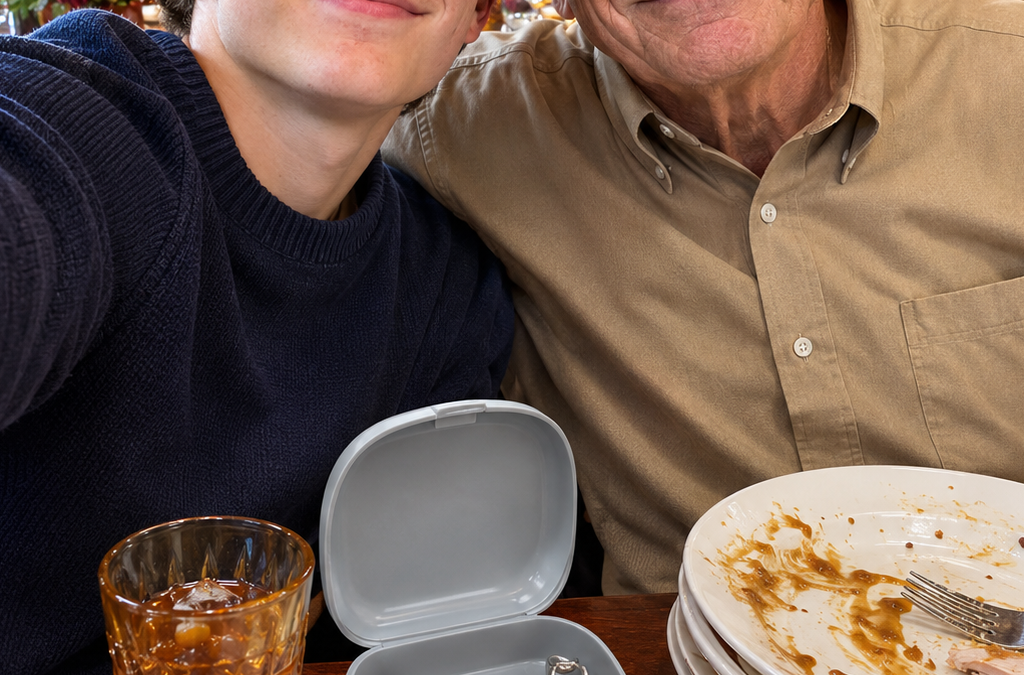
My brother slid my denture case beside dirty dishes at Thanksgiving and said, “Nobody wants to look at those.”
Chapter 1 of 7
A cranberry seed had caught beneath my lower partial. I’d put it inside its labeled case, on a clean napkin.
“I needed a minute to fix it,” I said. “Would you move it back, please?”
Paul Dawson left it beside a plate streaked with gravy.
Donna laughed. “Oh, Frank, don’t make a production of it.”
Beside me, my sixteen-year-old grandson, Noah, stopped eating and lowered his eyes.
“Noah, would you pass my napkin?”
He passed it without looking up at either of us.
“Leave the boy alone and eat,” Paul said.
“It’s just a little teasing,” Donna added, still laughing.
But Paul’s phone lit beside his plate, showing a walnut chair I recognized.
We were in the private room at Alder House in Dayton, Ohio, with coats along the wall and enough food spread across the table to feed us twice.
At sixty-seven, I was a retired automotive mechanic who still answered whenever family needed something fixed. Frank Bennett, good with engines, less good at saying no.
Their house and SUV were my own property.
Paul was my younger half-brother, with the same mother and a different father. He knew I’d arranged their housing and vehicle access.
The gravy I’d carried in sat beside his elbow. His coat hung behind him, its zipper working because I’d repaired it that week.
Earlier, while steadying my coat, I’d held my old garage remote with its worn brass-colored faceplate.
Then Paul’s phone brightened again, and the photograph filled its screen.
Ruth’s chair was on Paul’s phone, beneath a red sale label.
She’d kept her workbasket beside that chair for years, with unfinished hems hanging over its back and the television turned up loud enough to hear from the kitchen.
Two years after her death, I still expected to find her there sometimes.
I recognized the blue repair patch beneath the seat. Ruth had declared the original fabric too flimsy for anybody with a backside.
That memory usually made me laugh, but Paul turned the phone facedown.
“You need to stop embarrassing Donna in front of everybody.”
Donna said I could settle the whole dinner bill so we could forget this little fuss.
My face burned while they waited for me to agree.
I’d already offered to cover Noah and myself, but whenever Paul made things unpleasant, buying peace somehow became my responsibility.
When I reached toward the case, he raised his voice.
“PUT THAT THING AWAY!”
Noah flinched, and I stopped reaching for a moment.
“You’re putting my case with the dirty plates?”
Paul looked straight at me. “Yes, so we can finish eating.”
I retrieved it without answering, my name plainly visible on the lid beside a smear of gravy.
Then Paul went back to his turkey, apparently finished with me.
Donna watched me stand, waiting for the apology that usually followed. I left my plate and stepped into the hall.
The carpet muffled everything except the restaurant music outside our door.
I called Ellen Brooks, my longtime friend and the professional property manager who handled the rental house.
We’d invited her for dessert because she was eating nearby. Before I got much out, she mentioned a furniture listing she’d recognized.
“Paul’s offered the garage contents to a dealer. Ruth’s chair is included.”
My mouth went dry at the mention of that garage.
“What else did he put up?”
She named the workbasket and several other pieces, some theirs and some I’d stored myself.
I listened without interrupting while she described the photograph she’d seen.
Ellen said she was close, and I told her where to find us.
By the time she reached our private room, I’d returned to my place beside Noah.
He hadn’t touched his pie.
Paul welcomed Ellen warmly and offered her the empty chair.
She stayed standing across from him instead of sitting down.
“I saw your furniture sale,” she said.
Donna gave a small laugh that Ellen didn’t return.
Paul explained they were clearing out unused things and offered coffee.
Ellen reminded him that she managed the house, including my reserved garage.
His welcome faded into an impatient, fixed expression.
Donna glanced toward the door, then back at Ellen.
Paul’s phone remained facedown beside his plate.
Ellen asked Paul, “Why are you selling Frank’s wife’s chair?”
Paul stared at her, then turned his attention to me.
“It’s been sitting there for years. He doesn’t use it.”
The words hurt more than the business with my teeth. He knew why I hadn’t brought everything home after Ruth died.
Ellen said leaving belongings in my reserved garage wasn’t giving them away.
Donna began explaining how crowded everything had become.
But that garage had its own entrance, separate from their living space. Their everyday furniture was inside the house, where it had always been.
I’d put Ruth’s things there because I couldn’t face sorting them yet.
Ellen asked whether money had changed hands.
“Just a $600 holding deposit,” Donna said.
Paul said a dealer had already made an inventory. The pieces were grouped into a proposed lot, and backing out would create trouble.
Ellen wanted to know which pieces they’d included.
Donna insisted nobody was taking anything that evening.
That evening.
Paul pushed his pie away without finishing it.
Donna looked down at the phone beside him.
Ellen waited for her to finish the explanation.
Paul started speaking, but Donna interrupted him.
Donna said, “The dealer moved collection up to tomorrow morning.”
Noah looked at me, his fork still lying beside his plate.
Paul said the proposed sale was for $8,400. It would clear their $7,600 credit-card balance, with something left over.
“You’ve got a whole house of your own,” he told me. “We’re trying to get ahead here.”
He sounded annoyed that I needed this explained.
Donna said they’d kept everything safe. The chair had been under a cover. The workbasket hadn’t been opened, as far as she knew.
I pictured Ruth’s scissors inside it, still wrapped in a scrap of wool so they wouldn’t snag anything.
I was ashamed of how quickly I’d almost offered money to settle this.
I had taught them to expect payment whenever keeping the peace became uncomfortable.
But I hadn’t agreed to this sale, and neither one of them had asked.
Ellen said the dealer needed to hear that some pieces weren’t theirs to sell. Paul accused her of turning a family misunderstanding into business.
“You brought a buyer into it,” she said.
He looked back at me.
“Pay the dinner balance, Frank. Let’s at least leave here decent.”
“I’m paying for Noah and me.”
Donna stared as though I’d announced I was leaving her stranded.
I left enough for our meals and tip. My hand shook a little, which irritated me almost as much as Paul did.
Then Noah stood when I did, without speaking to either of them.
Outside, he walked beside me to my car, carrying the leftover gravy I no longer wanted. I hadn’t asked him to take it.
We drove to the rental house instead of home.
The garage stood dark beside it. I’d reserved that space when Paul and Donna moved in, and later brought over selected belongings after Ruth died.
Noah stayed close while I pressed the brass-faced remote. The door rose with its familiar uneven rattle.
Inside, someone had cleared a path between the stored furniture. Pieces I’d left covered were exposed, with their backs turned toward the open door.
Ruth’s walnut chair stood near the entrance. Her workbasket rested on its seat, arranged neatly for someone else to carry away.
I bent close enough to read the new collection tag tied to Ruth’s workbasket.
“Nine a.m.”
Chapter 2 of 7
Aaron Ellis arrived at the garage the next morning with furniture blankets in his truck.
“That’s the bundle,” he said, pointing to Ruth’s chair and workbasket. “Donna’s already got my $600 deposit.”
I stood inside the doorway, between him and the chair. Ellen had come to meet him with me.
“Those belonged to my wife,” I said. “I stored them here. They weren’t offered with my permission.”
Aaron looked from the collection tag to Ellen. She confirmed that the garage was my separate storage room, excluded from Paul and Donna’s rented space.
He left his blankets in the truck.
“Then I’m not loading anything. Paul sent an inventory video. I thought they were selling their own stuff.”
I moved the chair farther inside, away from the opening. The workbasket stayed on its seat. Aaron didn’t object, and nobody entered Paul and Donna’s home.
I was grateful he’d stopped without making me plead. After dinner, I’d expected another argument about why I cared.
Paul came around the side of the house with Donna behind him. He wore the coat whose zipper I’d fixed, open despite the cold.
“You’ve left us owing money we don’t have,” he said.
Donna looked past me at the chair. “We’ve used this place for years, Frank. You can’t keep calling everything yours.”
Their furniture was in the house. Mine had been stored behind a separate garage door, under an arrangement they’d signed. Still, for a moment, I wanted to explain myself until they understood.
“You need to straighten this out with him,” Paul said. “We already told you what the sale was paying.”
“I won’t finance a sale of Ruth’s belongings.”
He started on their card balance again. I let him finish without offering anything.
Aaron explained that he was pausing the whole proposed purchase until ownership of the pieces was clear. He wasn’t going to sort family claims while loading a truck.
Donna called the stored pieces clutter. That hurt, especially with Ruth’s chair sitting right there, its seat worn smooth where she used to shift while threading a needle.
I didn’t apologize for keeping it.
Ellen asked Aaron to preserve the advertisement and the item list. He agreed and said he still had Paul’s original file. Then he drove away with an empty truck.
Paul watched him leave.
“You happy now? We still have bills.”
I couldn’t remember the last time he’d asked whether I was happy and wanted an answer.
Ellen and I walked beside the house, out of their hearing. A kitchen window was fogged at the edges. Paul and Donna were still living an ordinary morning inside a house I owned, and I didn’t know how to stop feeling responsible for it.
“Do I have to keep doing this?” I asked.
“You still have a lease. They can stay until the agreed end unless they voluntarily agree otherwise.”
She let me stand with that. I’d spent years confusing my willingness to help with an obligation to keep helping.
Their payment was $400 monthly. Three missed months sat on Ellen’s ledger, and I’d avoided asking about them because I already knew I’d make excuses for Paul.
I asked Ellen to have an attorney check the lease before we did anything.
Beth Turner called me after reviewing the copy Ellen sent. Her questions were short: Had I promised a renewal? Had anything else been signed? I answered no to both.
She confirmed there was time to give the required notice. Ellen would handle delivery.
“Frank isn’t renewing it. This gives you more than thirty days’ notice.”
While we waited, I stayed in the garage. Ruth had once kept a coffee can full of wooden thread spools under her sewing table. Every screw I dropped into it earned the same complaint: she wasn’t running a hardware store.
The can was still on my shelf. I missed being scolded by her.
Later that Friday, Ellen returned with the written nonrenewal. Paul opened the front door, and Donna stood behind him in her socks.
“Your term ends December 31,” Ellen said. “Frank isn’t renewing it. This gives you more than thirty days’ notice.”
Paul accepted the paper. His eyes moved down it, then back to me.
“You’re making us move over a chair?”
“This is about the arrangement ending,” I said. “You have the time written there.”
Donna said they’d made the house comfortable and taken care of things I never saw. I knew they had painted rooms and done work in the yard. That didn’t mean I had agreed to support them indefinitely.
Ellen asked Paul to sign for receipt. He did, pressing hard enough that I could hear the pen through the paper.
I felt sick watching him sign. I’d wanted a boundary without having to watch anyone dislike it.
Afterward, Ellen kept the delivery record with her copy and sent one to Beth. She showed me the line in the existing lease reserving the garage; it had been there since the term began.
She also reminded me that sale tags proved only that someone had offered the pieces. Aaron’s list wasn’t proof they owned them. His original recording could show what he’d been offered, but I hadn’t requested it yet.
By evening, I was home, trying to eat reheated turkey without tasting it.
My phone lit with a forwarded message from Noah.
Paul had written to the family group: “Stop him from throwing us out.”
Noah was copied. Paul had added our half-sister, Linda Pierce.
Chapter 3 of 7
“Couldn’t you give him one more season?” Linda asked when she called Monday.
She hadn’t been at Thanksgiving. Paul had told her I was making him move because I couldn’t take a joke.
“His lease ends when it says,” I told her. “And he offered Ruth’s stored belongings to a furniture dealer.”
Linda went quiet, but only briefly. She said Paul was frightened and sometimes got ugly when he was frightened.
“He didn’t sound frightened when he took the deposit.”
“You know what I mean, Frank. Moving costs money.”
I knew what she meant. She wanted me to absorb enough of the trouble that nobody else had to choose sides.
Linda usually asked me over for coffee after her cafeteria shift. That morning, she said we should let things settle before visiting. I agreed because arguing for an invitation would have humiliated me.
After we hung up, I left two mugs beside the coffeepot.
By afternoon, Noah was in my kitchen, spreading peanut butter clear to the edges of his toast. Ruth had taught him that. She considered a bare corner evidence of careless work.
He’d come over to do homework where it was quiet. His backpack stayed closed.
“Uncle Paul said you probably wouldn’t come to holidays anymore.”
“Did he say I’d told him that?”
Noah shook his head. Paul had said people would feel awkward inviting both of us.
That hurt more than I wanted the boy to see. I could refuse a bill. Imagining Noah saving me a seat nobody expected me to fill was harder.
“You don’t have to carry messages between us,” I said. “And you can still see him.”
“I didn’t say I wanted to.”
“You want us moving, you need to pay what you owe.”
“I know. I’m just telling you.”
He ate his toast while I rinsed the unused mug. Neither of us knew what else to say.
Paul arrived before Noah opened his math book. Donna stayed beside him on my porch, holding a folded sheet of paper.
“You want us moving, you need to pay what you owe.”
Paul’s handwritten list totaled $2,300 for decorating and maintenance. He’d included painting, yard cleanup, a repaired kitchen drawer, and hours spent replacing damaged trim.
Some of that work was real. I remembered the drawer because he’d called me twice about which slides to buy.
“You fixed things,” I said. “We never agreed I’d pay those wages.”
Donna gave me the paper. “You would’ve paid somebody else.”
Some jobs had been ordinary things they wanted done. Others had helped the house. I wasn’t going to pretend otherwise, but Paul’s new total didn’t become a debt because he’d written it down.
I was angry enough that reading his handwriting took effort.
“You can’t expect us to move without money,” Paul said.
He looked past me and saw Noah at the kitchen table. Then he lowered his voice, as though I’d caused the embarrassment by having company.
I told him I’d keep the list and check it. I didn’t promise payment.
Donna tried a different approach. “Let us keep the SUV while you sort out the house. We still have to get to work.”
That sounded reasonable enough to make me hesitate. They needed transportation. They also needed me to keep hesitating.
“The permission has an end date,” I said. “It doesn’t become permanent because the house arrangement is ending.”
Paul told me I was making everything difficult at once. They left without coming inside, and I kept the list on the counter instead of reaching for my checkbook.
Noah hadn’t moved from his chair.
“I should’ve said something at dinner,” he said.
“I wish somebody had. But you’re sixteen, Noah.”
Saying it plainly embarrassed me. I’d needed help, and the person worrying about failing me was a kid with algebra homework.
My phone buzzed before he could answer. Aaron had sent the proposed lot list and the original recording Paul had made for him.
The video opened with a sweep across the garage furniture. The camera dipped past Ruth’s chair, showing the blue patch underneath, then moved toward the workbasket.
Noah started to speak. I stopped the recording and put my phone away.
“What were you going to say?”
He wanted to know whether I was mad at him.
“No. I was hurt at dinner. That’s different.”
He nodded without looking relieved right away. We stayed at the table until he finally opened his book.
Later, Ellen met me at the reserved garage. With my permission, she photographed the chair, basket, and the other disputed pieces where they stood. She took wider pictures too, showing their condition and the space around them.
I held the cover back while she photographed the chair’s seat. A pale line marked where Ruth’s sewing cushion had rested for years.
I missed her so badly then that Ellen stopped talking.
She finished without making me explain. Before leaving, she said she’d contact Paul about a meeting. I gave her a copy of his list and went home.
That evening, Paul sent another message. He said Ruth had meant for them to stay, and he was willing to drop his claim for the work.
In exchange, he wanted the housing and vehicle arrangement settled in writing. I read it twice. He wasn’t asking for moving money anymore.
His last line read, “Confirm permanent occupancy and continued SUV use, and I’ll forget the $2,300.”
Chapter 4 of 7
“I won’t agree to permanent occupancy,” I told Paul. “Or permanent use of the SUV.”
We were at Ellen’s office for the meeting he’d requested. He’d brought his handwritten work list again. Donna sat beside him, still wearing her coat.
Ellen had the existing lease and ownership records in front of her. Beth had reviewed the proposed agreement beforehand. This wasn’t another chance for us to trade promises nobody remembered the same way.
Paul leaned toward Ellen. “I need to know what actually got settled after Ruth died.”
She showed him the recorded deed, then the vehicle title. My name appeared alone on both. Neither belonged to an unsettled family estate.
He read them longer than I expected. Donna leaned over to look.
“I knew Frank handled everything,” he said. “That’s what we were always told.”
Handling everything had included keeping quiet whenever correcting him might cause trouble. I was ashamed of how useful my silence had become.
Ellen showed him the lease language saying the arrangement transferred no ownership. There was no signed gift of the house or transfer of the SUV.
“So the house is his,” Donna said.
“Yes. Those records establish ownership,” Ellen answered. “They don’t let Frank remove you today. Your current term still applies.”
Paul sat back. He didn’t call the papers wrong or claim another set existed. For once, I didn’t have to keep explaining what belonged to me.
Then he changed the question.
“We’ve built three years around this arrangement. You can’t expect us to start over on what we make.”
He talked about his warehouse paycheck and Donna’s uneven store hours. Those were real limits. I knew what they earned and what apartments cost around Dayton.
For years, knowing those things had ended every discussion before we reached what I could afford to keep giving.
“You have the rest of the term,” I said. “The SUV stays available and insured through the handover. I’m not paying for the next place.”
Donna looked at me as though she hadn’t heard the last part.
I felt cruel saying it while they were calculating deposits and moving costs. But I also felt relief, which embarrassed me almost as much.
Paul wanted another season. When I refused, he asked for an extra month.
Ellen waited while we talked. She didn’t answer for me, and I resented that for a moment. I wanted somebody else to say no.
The radiator knocked beneath her window. Ruth would have diagnosed it immediately, with all the confidence of somebody who once watched me bleed one radiator.
I missed having her beside me, even if she’d have told me I was taking too long.
“The end of the term stands,” I said.
“I’ll waive those payments when the empty house is returned on time,”
Paul looked down at his work list. He asked whether I would pay the decorating claim or at least cover their moving bill. I said I disputed the wages he’d added afterward.
Then Ellen asked whether forgiving the missed housing payments would help them leave on schedule.
Three months totaled $1,200. I’d been avoiding that number, as though not hearing it made the arrangement more generous and less foolish.
“I’ll waive those payments when the empty house is returned on time,” I said. “That’s what I can offer.”
Donna asked what happened if we were still arguing about furniture.
Ellen explained that genuinely disputed pieces would be listed separately. The chair argument wouldn’t decide whether their housing obligations ended. She couldn’t decide who owned furniture, and she wasn’t ordering anyone out.
Paul listened carefully to that part.
The short agreement required them to remove their ordinary belongings, return the house keys, and bring back the SUV. Ellen would inspect the empty rooms with them and complete a brief checklist.
“Who says we’re finished?” Paul asked. “I don’t want another bill later because Frank changes his mind.”
“I accept the return for him,” Ellen said. “The lease names me as managing landlord. This agreement also authorizes me to sign the release.”
She explained that her signature, after the agreed return, would end their occupancy obligations and activate the missed-payment waiver. Beth had checked that wording. Paul could have someone review it too.
He read it again instead.
I hated needing this much paper between brothers. Yet I could remember too many conversations where my offer of help had somehow become a promise I’d never made.
“Thursday at three,” Ellen said, confirming the end-of-term appointment at the rental house.
Paul asked for Linda to be there. He said he wanted family present, not just people working for me.
I agreed. When Ellen called her, Linda said she could come. There was no speech about keeping the peace this time.
“I’d like Noah there too, if he wants to come,” I said.
Donna frowned, but Paul said that was fine. Ellen noted the six of us: Paul, Donna, Linda, Noah, herself, and me.
We each signed and received a copy. My hand was steadier than it had been at Thanksgiving. I hadn’t forgiven everything or stopped worrying about them. I was simply ready to go home without buying another delay.
Donna finally unbuttoned her coat as we stood to leave.
Paul remained beside his chair. He said he understood the house was mine and that they would honor the return date. His voice had become almost cooperative.
Then he mentioned the sewing chair and workbasket.
Donna watched me without speaking.
“Those are coming with our furniture,” Paul said.
I stared at him. We’d just spent all that time separating what I owned from what I’d allowed them to use.
He nodded toward his wife.
“Donna bought that chair.”
Chapter 5 of 7
“Keep the basket with it,” Donna said as Paul pushed Ruth’s chair up the van ramp. “I bought those together.”
I stood beside the driveway, leaving him room to pass. The blue patch beneath the seat showed when he tilted the chair over the lip.
“You’re still claiming you bought that chair?”
“She bought it secondhand.” Paul backed into the van. “You heard us at the meeting.”
Their rental receipt lay on the dashboard: $189 for the one-day hire. They were loading the last furniture that afternoon, with smaller things left to carry out before tomorrow’s agreed return.
Donna followed him up the ramp with Ruth’s workbasket. I made no move to stop her. Ellen had already listed both pieces as disputed.
It hurt watching them travel those few feet. I’d helped Ruth choose that chair because her old one made her hip ache.
Paul came back down alone. He stood close enough that I had to look up from the ramp.
“If you embarrass Donna tomorrow, we’re done with family gatherings.”
He said it quietly, almost reasonably. He wouldn’t sit through another holiday where I made his wife defend herself. Relatives could invite him or invite me.
“People can choose their own invitations,” I said. “I’m not giving things up anymore just so nobody has to speak.”
He looked toward the road instead of answering. For a moment, I wanted to call him back and soften it. I hated that I still wanted his approval.
Linda arrived carrying empty grocery bags for the kitchen odds and ends. She’d offered to help count the ordinary boxes, so nobody would leave something behind and have to come back.
There were boxes marked bathroom, winter clothes, and good dishes. Paul had packed the kitchen radio inside a roasting pan. It started playing when Linda lifted the box, and she nearly dropped it.
“Donna bought the chair and workbasket with her own money,”
“That’ll keep the potatoes entertained,” she said.
I laughed before I could help it. Donna didn’t.
Linda counted the boxes beside the front door while Paul checked them against his list. Then she noticed the chair through the open van doors.
“Donna bought the chair and workbasket with her own money,” Paul told her. “Frank keeps confusing them with things he stored.”
Linda looked at me. I said they were the pieces I’d brought over after Ruth died.
“Where did you buy them, Donna?”
“Secondhand. People sell furniture, Linda. I didn’t think I’d need to keep a history of it.”
That part could have sounded ordinary to anybody outside the argument. Half the furniture in my first apartment had come from people whose names I never knew.
But this wasn’t a chair that merely resembled Ruth’s. Standing there while Donna claimed it made me feel helpless, and I resented how familiar that feeling had become.
Ellen arrived with the folder she’d used at the meeting. The lease, title copies, and signed agreement stayed inside while she walked through the nearly empty rooms with her short checklist.
“The upstairs closet still has things in it,” she told Donna.
Donna said those were coming out with the last load. Ellen noted that, then checked the empty kitchen cupboards and the rooms where the rugs had been.
I stayed near the back doorway. Without the couch, the living room showed pale rectangles on the walls and a dent where an end table had stood.
They had lived here. I wasn’t pretending these years had meant nothing to them.
My phone buzzed with a message from Aaron. He confirmed that the full recording he’d sent was his unaltered original, the same file Paul had supplied for the proposed purchase. I thanked him and left it there.
“Noah’s coming tomorrow?” Linda asked.
“He can, if he wants.”
She said she’d see us then and carried the last kitchen bag out to Donna. She didn’t ask me to give Paul another season. That small mercy nearly made me cry.
By the time I went home, my shoulders ached though I’d lifted nothing.
Noah came over while I was heating supper. I made grilled cheese the way I liked it, with the edges almost burned. He scraped one corner with a knife and said he was fixing my craftsmanship.
I plugged my phone into its charger beside the kitchen counter.
“Do you want to be there tomorrow?” I asked. “You don’t have to.”
He stopped scraping. “Are you asking me not to come?”
“No. I’m asking what you want.”
He said he wanted to come with me. I told him that was fine, and we ate without practicing anything he might say.
I was relieved, though I worried about putting him near another ugly argument.
After supper, I checked that Aaron’s file was on my phone. Then I took the charged phone with me when I returned to the rental house to collect my copy of Ellen’s updated checklist.
The porch light was on. Through the windows, I could see bare floors and Donna’s last stack of bags.
Paul was securing a dresser inside the van. Ruth’s chair stood behind it, with the workbasket wedged safely on its seat.
“I still dispute those two pieces,” I told Donna.
She stepped down from the van and pulled its doors shut.
“I paid for it. I’m not unloading my chair.”
Chapter 6 of 7
Ellen spread the checklist across the handover table, a folding table she’d brought into the empty kitchen. Linda sat near the doorway. Noah had taken a chair beside Paul.
“Ellen, we’re honoring the agreement,” Paul said. “But Frank’s trying to take furniture Donna bought.”
Donna kept her coat on. “I bought the chair and basket secondhand. They’re already loaded.”
Ellen asked whether she was claiming she’d personally purchased both pieces. Donna said yes, looking at Ellen instead of me.
“The chair you inventoried is the one I stored after Ruth died,” I said.
Paul looked at me then. “You’ve got an old photograph of a walnut chair. Plenty of those around.”
He turned back to Ellen, his voice becoming patient. The photograph didn’t show when Donna had bought hers, he explained. Missing Ruth didn’t make every similar chair mine.
It hurt hearing him use my grief that way. For a moment, I couldn’t get past the fact that he’d known her for decades.
Ellen left the checklist unfinished. “Did Paul identify where this particular chair came from?”
“Yes,” I said.
I set my phone on the table and played the inventory video Aaron had sent.
The camera swept across the furniture in my garage. Paul’s shoes appeared briefly at the bottom of the picture. Then the view dipped beneath the walnut seat, showing Ruth’s crooked blue patch.
She’d repaired it with leftover denim because, she’d said, nobody inspected the bottom of a chair before sitting down.
On the phone, Paul moved closer.
“Ruth’s sewing chair. Frank brought it over after she died. Keep her workbasket with it.”
The picture continued toward the next piece. Nobody had interrupted him or asked whose chair it was.
Paul reached toward the phone. His fingers stopped short.
“That was a description for the dealer,” he said. “You’re making it sound like something else.”
“Your description identifies Frank’s stored chair,” Ellen said. “Not a chair Donna purchased.”
Donna said the basket could still have been hers. Ellen reminded her that Paul had grouped Ruth’s workbasket with Ruth’s chair in the same recording.
I was angry now, listening to her try to keep even that small piece. The basket still held scraps Ruth had saved for jobs she would never finish.
Ellen said she wasn’t deciding a furniture claim. They could return the identified pieces voluntarily, or leave that issue unresolved and deal with it separately. The house agreement remained its own matter.
Noah stood. He crossed from Paul’s side of the kitchen and took the empty chair beside me.
“That’s Grandma’s patch. I watched her sew it.”
Paul stared at him. Noah’s face went red, but he stayed where he was.
I wanted to thank him without making him responsible for what happened next. All I managed was his name, quietly.
Donna went outside for the van key. Through the kitchen window, I watched her open the back doors and stand there before climbing in.
She brought the workbasket back first.
Linda followed Paul outside to help with the chair. He told her he could handle it alone. She took the other side anyway, and they carried it to the garage entrance.
“I accept possession of the house for Frank. Your right to stay ends here.”
With the brass-faced remote, I opened my reserved garage. They placed the chair inside, and Donna put the basket on its seat.
Seeing them together again nearly undid me. I checked the chair’s back for damage because that was easier than looking at anyone.
Back in the kitchen, Paul laid down the house keys and SUV fob. Ellen finished checking the empty rooms, then returned to the table.
“I accept possession of the house for Frank. Your right to stay ends here.”
She signed the completion line. Under our agreement, that also released the $1,200 in missed payments. They owed no further occupancy obligations under the signed terms.
I accepted the SUV’s return and kept its fob. Paul no longer had the house to live in or my vehicle to drive.
He sat staring at the place where the keys had been.
Then he stood so abruptly his chair struck the wall.
“Let us use the SUV just until Monday.”
“You don’t get to erase her to keep me paying,” I said.
He told me this wasn’t about Ruth anymore. He had work, Donna had shifts, and I knew perfectly well what returning the vehicle meant.
“I’m not lending it again.”
I felt guilty before he even answered. That familiar urge to offer one smaller favor came back, but I let him be angry.
Donna looked away from him. Her eyes settled on the bare spot where their refrigerator had stood. Linda remained near the kitchen doorway, no longer offering to carry anything.
Paul said we’d let a misunderstanding ruin the family.
“You knew whose chair it was,” Linda said. “I heard you.”
He asked whether she was taking my side now. She answered that she’d helped carry the chair back because it belonged with Ruth’s things.
Ellen gave me my copy of the completed agreement. She didn’t congratulate me. I was grateful for that; I was too sad and relieved to have answered properly.
Noah stayed beside me while Paul checked his pockets for the van key. Neither of us filled the pause.
Donna still had one paper to finish. Ellen had written down the repayment Donna had agreed to make to Aaron: his $600 deposit, returned within eight days.
Donna read it, asked for a copy, and handed the van key to Paul. He went outside without waiting for her.
My phone lay dark on the table. Ruth’s belongings were back in the garage, the house was empty, and the SUV was mine to take home.
Donna signed the $600 repayment promise beneath the eight-day deadline.
Chapter 7 of 7
Eight days after the handover, Aaron sent confirmation that Donna had refunded his $600.
“Money’s back,” he wrote. “I’ve canceled the purchase. Hope you’re doing all right.”
I thanked him and saved the receipt Ellen forwarded afterward. There was nothing else I needed from him. His truck had left empty, and now his part in our trouble was over.
Paul and Donna still had their card balance, along with rent and transportation to manage. Returning the deposit hadn’t fixed those things. But their bills no longer arrived with an assumption that I would pay them.
“Can you help with the next rent?” Paul asked a few days later.
He called while I was making oatmeal. For years, that question had meant we would discuss how much, never whether.
“I’m not sending rent money.”
He said they were stretched thin. I believed him, and saying no hurt anyway. My oatmeal went cold while he explained expenses I couldn’t make smaller without taking them back onto myself.
“You know we’re both working,” he said.
“I know.”
He ended the call without saying goodbye. I stayed beside the stove until the urge to call him back passed.
At the grocery store that week, I put their usual bread in my cart before noticing. Then I returned it to the shelf. Nobody was waiting for a delivery from me.
The SUV sat in my driveway while I arranged an ordinary dealer purchase. I cleaned it out myself, finding a parking receipt and two peppermint candies stuck together in the console.
“We can offer $26,700,” the buyer told me after the inspection.
I’d checked other offers. I accepted his, signed the title transfer, and kept copies of everything. Once the sale was complete, I had the SUV removed from my insurance.
There was no spare vehicle waiting for Paul after that. When I came home without it, the extra space in my driveway looked strange. I felt relieved, then guilty about feeling relieved.
“You could put a basketball hoop there,” Noah suggested.
“At my age, the ambulance would need the space.”
He laughed, and I did too. It had been a while since an empty space seemed useful instead of sad.
Ellen helped arrange the house listing. Before photographs, we carried Ruth’s chair and workbasket to my own garage. The other things I’d stored followed, one load at a time.
I sorted them without an audience. Some I kept, some I donated, and a few worn-out things went away. Grief made even a cracked laundry basket difficult, which annoyed me.
“You don’t have to finish today,” Ellen said when she found me staring at an empty shelf.
For once, I listened.
The house needed cleaning and a few small repairs. Buyers came through, an offer arrived, and the usual inspections and paperwork took their time. Roughly six weeks after the SUV sale, we were ready to close.
“I’ve got enough paper to insulate the garage.”
On March 4, the house sold for $318,000.
That was the sale price, not what went into my account. The closing statement showed the ordinary selling costs. The closing agent checked my identification and ownership papers, and the transfer was recorded after signing.
“Do you want another copy?” Ellen asked as we left.
“I’ve got enough paper to insulate the garage.”
She smiled but made sure I had the final statement. From listing to completion, it had taken roughly two months. There had been no overnight rescue, just appointments I kept and decisions I didn’t undo.
I was sad driving away. Paul and Donna had lived real years there, even if those years had ended badly.
But the next call about a leaking faucet wouldn’t be mine. I wouldn’t spend Saturday under their sink, then stop for groceries they hadn’t asked whether I could afford.
Paul sent a message asking whether Linda was having everyone over soon. I told him he should ask her directly. He didn’t need to go through me, and I didn’t need to arrange the family around his temper.
“Come eat with us this weekend,” Linda told me later. “Bring Noah. I’m making chicken.”
She didn’t mention Paul’s rent or suggest that I bring enough food for another household. That mattered more than I knew how to say.
At her table, we talked about her cafeteria freezer and Noah’s schoolwork. She asked for help finding a repair number, not for me to haul my tools over.
“I saw Uncle Paul at the store,” Noah said on the drive home.
“How was he?”
“He asked about school. I told him.”
I said I was glad they’d talked. Noah didn’t owe me a quarrel with his great-uncle. It hurt that he seemed to need my permission for an ordinary conversation.
That Sunday, we worked in my garage with the door open a few inches for air.
Ruth’s chair stood near my workbench. I’d cleaned the walnut, repaired a loose joint, and left her blue patch alone. Her workbasket fit on the shelf beside it, where I could reach it without moving boxes.
“Want it farther back?” Noah asked.
“No. Leave it here.”
I’d hidden enough of what I missed to keep other people comfortable. There was room for the chair, and I wanted to sit in it.
One leg still shifted slightly. Noah held it steady while I adjusted the loose screw. When I tested the seat, it stayed firm beneath me.
I missed Ruth fiercely in that chair. Then Noah asked whether we could raise the garage shelf, and I had something useful to do with my hands.
“Can I come back next weekend?” he asked.
“Sure. We’ll find something crooked.”
He looked around the garage. “We’ve got options.”
The old brass-faced remote lay on the bench. I’d paired it with my own opener, and we’d fitted a clip beside the shelf, within my reach. It belonged here now.
Family could have my love without having the keys to everything.
Noah held the ladder while I hung the remote.







