My Brother’s Wife Pulled the Apron Off Me in Front of 60 Volunteers for Being ‘Too Old’—Then the Turkey Truck Pulled Up
Complete story · 7 chapters · about 32 minutes · ending included
Chapter 1 · Chapter 2 · Chapter 3 · Chapter 4 · Chapter 5 · Chapter 6 · Chapter 7
Chapter 1: The Apron She Pulled Off
At 12:10 p.m., Kim Thorson said, “You’re too old, Judy. Give me the apron.”
I had a serving spoon in one hand and a stack of plates against my hip.
Four roast turkeys sat behind me on the counter, their skins browned and shining under the kitchen lights.
Through the pass-through, I could see the volunteers filling the fellowship hall.
Sixty people had come for the kickoff lunch, and every face seemed turned toward us.
Kim wore a gray suit that looked as if she had stepped out of a real estate office instead of a church kitchen.
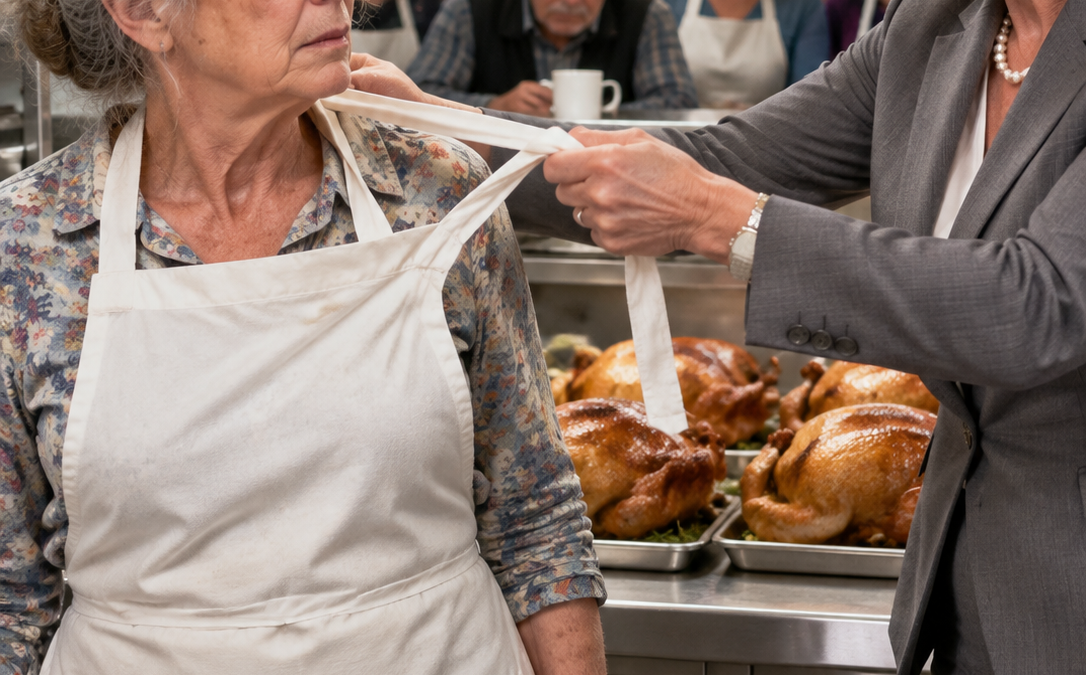
She reached behind me and caught the knot of my apron.
“Kim,” I said.
She pulled the knot loose.
The apron tightened at my neck, then slid over my hair and down my arms.
She dragged it off me as if she were taking a dish towel from a hook.
Kim said it loudly enough for the room to hear.
“You carried mail, Judy. Go home and sit down before you fall.”
The spoon stayed in my hand.
I set it beside the serving pan.
For twenty-three years, I had put on that apron before the Thanksgiving dinner.
I had worn it through early mornings, burned fingers, steam, spilled gravy, and the long cleanup after the last plate went out.
The dinner had started in 2002, and it had been held every year through 2024.
This year was supposed to be the twenty-fourth.
I was seventy years old.
I knew how many plates we needed before anyone finished asking.
Forty turkeys made twelve plates each.
Four hundred eighty meals.
Sixty volunteers, with jobs divided down to the last table and serving spoon.
I had been a rural mail carrier before I retired.
Counting was part of the work.
Addresses, boxes, miles, days.
I still counted what mattered.
Kim folded the apron over her arm and turned toward the room.
“The board voted. All seven of us.”
She said it brightly, as if she were announcing a change in the lunch menu.
The people at the tables stopped talking.
A volunteer near the pass-through held a stack of paper napkins against her chest.
I looked toward table two.
My brother Randy sat with his coffee in front of him.
He was seventy-two, a retired foreman, and the board secretary.
If there had been a vote about removing me from the dinner, he would have known.
If he had known, he could have told me before I came in that morning.
Randy studied the coffee in his cup.
I waited long enough for him to look up.
He did not.
“Those forty birds come to my door,” I said.
Kim laughed.
It was a small, pleased laugh, the kind she used when she thought someone had handed her an opening.
“Then they’ll come to mine.”
She held out her hand.
The kitchen keys were on the counter beside the clipboard.
I had carried them on the same ring for years.
One opened the outside kitchen door.
One opened the pantry.
One opened the storage closet where we kept the extra roasters and folding tables.
I picked up the ring.
The first key touched the counter with a flat click.
Then the second.
Then the third.
Kim watched my hand.
Nobody spoke.
I walked out through the kitchen doorway and past the pass-through.
The sixty volunteers were still there, seated or standing around the tables, looking at me.
I knew faces from years of dinners.
Some had peeled potatoes beside me.
Some had carried pans to cars.
They knew where I kept the serving spoons and which cupboard held the good knives.
I passed them without stopping.
Nobody stood.
Outside, the November air had a bite to it.
I had parked along the side of Hillside Lutheran, where I always parked when I had kitchen work to do.
I sat in the car with my hands resting on the steering wheel.
I did not cry.
I was angry, and I was trying to decide what the anger was for.
Kim had taken the apron.
She had taken the keys.
She had told sixty people that seven board members had voted me out.
My brother had sat at table two and looked into his coffee.
Picking up where the Facebook post left off
I had no role in the dinner now.
No kitchen to open, no binder to check, no list to mark as volunteers arrived.
The lunch would go on without me, and Kim would be the person giving directions.
I had not heard about a board meeting.
Randy was the secretary.
He had been sitting ten feet from me, and he had not said a word.
I would ask when they had met.
I drove home to my small house in Eau Claire.
I had lived there long enough to know which roads iced first and where the plows left ridges across the driveways.
The house was quiet when I came in.
My coat went on the hook.
My purse went on the chair.
I stood in the kitchen and looked at the calendar.
Thanksgiving was Thursday, November 27.
The dinner was still on the church calendar.
I had seen the date written there in my own hand when I checked the schedule the week before.
I took a glass from the cupboard and filled it with water.
Then I opened the refrigerator to put the pitcher back.
Walter Kvale’s postcard was held under the small magnet shaped like a red barn.
He sent one every year, always the same short message in his careful block letters.
Walter was seventy-seven and raised turkeys outside Fall Creek.
His mother, Alma, had been gone for more than twenty years.
I had never thought to ask him why he kept writing the same words.
I had taken the postcard as a reminder about the delivery.
The birds came to my garage early on the Tuesday before Thanksgiving, and from there we handled the work for the church dinner.
That was how it had always happened.
I had assumed my garage was simply easier than the church kitchen for the delivery.
I looked at the words on the card.
Kim had said the birds would come to hers.
She had sounded certain.
She had also said the board voted, all seven of them.
I took the postcard from the refrigerator and held it by the edges.
Walter had written the same message each year, without adding a greeting or signing his name.
He never used more words than he needed.
The card said, Tuesday, 6 a.m., your door. Ma’s orders.
Chapter 2: The Text on Her Brother’s Phone
By Monday morning, I had Walter’s postcard on my refrigerator and no keys to the church kitchen.
Kim came to my garage at ten, looking for the dinner binder.
The binder sat on the workbench where I had left it after checking the volunteer assignments.
Kim, my brother’s wife and the board president, stopped beside it.
“That’s what I came for,” she said.
I kept my hand on the cover.
“When did the board meet?”
She gave me a long look, as though the question itself were unreasonable.
“You carried mail, Judy. Go home and sit down before you fall.”
“I asked when the board met.”
“There’s no reason to make this difficult.”
“Was it before Sunday?”
Kim’s smile tightened.
“The decision has been made. We need the binder.”
I had spent twenty-three years keeping that binder current.
It held volunteer names, phone numbers, serving assignments, and notes for the Thanksgiving dinner.
Kim reached for it.
I moved my hand.
“Tell me the date of the meeting.”
“You’re not in charge anymore.”
She said it in the same bright voice she used at church.
I looked at the binder, then at her.
I could have kept it there and argued until one of us raised her voice.
That would not have given me an answer.
I lifted my hand.
Kim took the binder and tucked it under her arm.
“Thank you,” she said.
She left without closing the garage door all the way.
I watched her car back down the drive before I went inside.
The church’s bylaws were in a thin folder in my desk.
I had kept them because committee rules were easier to follow when written down.
The section on program leaders took less than five minutes to find.
A program head could be removed only by a recorded board vote.
I put my finger under the sentence and read it once.
There was no provision for a president to make the decision alone.
I called Randy.
He answered on the fourth ring.
“Judy.”
“When did the board meet to remove me?”
A pause followed.
“Kim handled it.”
“That wasn’t my question.”
“I’ll check the minutes.”
“Please do.”
He said he would call back, then ended the call.
I set the folder beside the telephone.
For the next few hours, I kept finding reasons to walk past it.
I checked the calendar and washed my coffee cup.
I straightened the mail, though it was already straight.
The question stayed where I had left it.
If seven people had voted, there should have been a date and minutes.
If there were minutes, Randy had them.
After dark, I heard a car stop in the drive.
Randy came through the side door with his coat still buttoned.
He didn’t take it off.
“Kim’s asleep,” he said. “I told her I was going to check on you.”
I pointed to the chair.
He stayed standing.
“Did you find the minutes?” I asked.
Randy pulled out his phone.
“I don’t have minutes.”
He tapped the screen and held it toward me.
The message was from Kim, sent Sunday at 8:02 a.m.
I read the words on the screen.
“No vote needed. I’ll do it at lunch, in front of everybody, so she can’t argue.”
The time sat above the message.
Eight-oh-two.
The kickoff lunch had begun at 12:10.
I looked at Randy.
“Say that out loud.”
His eyes moved toward the dark window.
He lowered the phone.
“Judy.”
“Say what she wrote.”
He put the phone away and stared at the floor.
“I have to live there.”
I waited.
He didn’t add anything.
The message had been sent before Kim stood in front of sixty volunteers and claimed all seven board members had voted.
Randy had known.
He had sat at table two while she pulled the apron over my head.
He had watched me put the keys on the counter.
“Did you answer her?” I asked.
He pressed his palm against the front of his coat.
“I told her to handle it.”
“Those were your words?”
“Something like that.”
“Did you tell her there had to be a vote?”
He looked down.
“Kim said she had it under control.”
I nodded once.
I didn’t ask him to show me the phone again.
He had already put it away, and I knew what the message said.
“What about the minutes?” I asked.
“There aren’t any.”
He finally looked at me.
“I have to go.”
He left his coat buttoned and drove away.
I stood by the side door until his taillights disappeared.
The folder with the bylaw remained on my desk.
I had asked for the minutes.
My brother had brought me a message instead.
Rachel Dunn arrived later that evening, carrying her purse and a white sheet of paper folded in half.
She was forty and ran the church office.
She sat at my kitchen table but kept her coat on.
“Earlier today, I asked Kim about the caterer,” she said.
“What did she say?”
“I asked who was handling the arrangements now that you were out.”
Rachel rubbed the fold in the paper with her thumb.
“She said, ‘This isn’t about me. I don’t want my name on anything.'”
I looked at the paper.
“Did you ask her why?”
“No. She told me to leave the arrangements to her.”
Rachel needed that office job.
She wasn’t looking for a fight with the board president.
“I don’t want Kim thinking I went behind her back,” she said.
“Then why are you here?”
Rachel unfolded the sheet.
“Because she sent this to the office to print.”
The paper had a campaign heading across the top.
Beneath it was a photograph of Kim smiling in her gray suit.
I looked at the words under her name.
“Kim Thorson for City Council.”
The line below it was larger.
“Feeding Eau Claire for 23 Years.”
I held the paper by its lower corners.
The number was familiar.
Twenty-three dinners.
Twenty-three years of volunteers, turkeys, potatoes, pans, and cleanup.
Twenty-three years that Kim had just claimed as her own in front of sixty people.
Rachel watched me.
“She wanted the office to print these,” she said.
I set the flyer beside the folder containing the bylaw.
The two papers lay next to each other on my kitchen table.
One said a recorded vote was required.
The other said Kim had been feeding Eau Claire for twenty-three years.
I thought about the four turkeys behind me on Sunday.
I thought about the postcard on my refrigerator.
Tuesday, six in the morning.
Your door.
Ma’s orders.
Kim had taken my kitchen, but she had not explained why she needed the dinner so badly.
And Walter still believed the birds were coming to me.
I had to warn him before the delivery changed hands.
Chapter 3: The Ledger in Walter’s Desk
The Sunday bulletin said I had “chosen to retire.”
I stood in the back of Hillside Lutheran after the service, holding the folded paper while people moved around me toward the fellowship hall.
The announcement was printed beneath the Thanksgiving dinner notice.
It thanked me for twenty-three years of service and wished me well in retirement.
I had not chosen anything.
My name was gone from the volunteer sign-up sheet, too.
Someone had cut it out cleanly, leaving a narrow white space between the potato table and the serving line.
I checked the sheet from top to bottom.
There were names for setup, cooking, serving, and cleanup. Mine was nowhere.
Nobody called after the service.
A few people nodded as they passed. One woman asked whether I was enjoying my free time.
I said I was keeping busy.
I didn’t tell her I had spent the morning wondering whether Walter knew his delivery had been redirected.
On Monday, November 17, I drove out to the Kvale farm outside Fall Creek.
A thin layer of early snow covered the edges of the fields, and the gravel drive crunched under my tires.
I had Walter’s postcard in my purse.
Tuesday, six a.m., your door. Ma’s orders.
I had carried that card in my mind for years as a simple delivery reminder.
Now I needed to tell Walter that Kim had taken me out of the dinner and intended to send his birds somewhere else.
Four hundred eighty plates depended on that delivery.
I wasn’t going to let the people who had signed up to eat Thanksgiving dinner discover an empty kitchen because the adults had fallen out.
Walter opened the farmhouse door before I reached the porch.
He wore a flannel shirt and held a folded envelope in one hand.
“Judy,” he said.
“I’m sorry to come without calling.”
“You’re here.”
He stepped aside, and I followed him into the kitchen.
The room smelled faintly of coffee and wood smoke. A calendar hung beside the refrigerator, and a pair of work gloves lay on the table.
Walter placed the envelope in front of me.
“This came last Monday.”
The return address was Hillside Lutheran Church.
Kim’s name was written at the bottom.
I opened it carefully.
The letter said, “Our books show no gift to the church, so I know these went to Judy personally. Please redirect them.”
The date beneath Kim’s signature was November 10.
I stopped at the word personally.
Kim had known.
She had known the birds weren’t a church donation, even while telling the volunteers that Walter had always given them to the church.
I looked up.
“She wrote this to you?”
Walter nodded.
“She wants the birds sent to the hall.”
“That’s what she’s asking.”
He didn’t say anything else.
I placed the letter on the table.
For years, I had thought Walter’s arrangement was a kindness to the dinner.
The birds came to my garage, and I helped get them where they needed to go.
I had never thought of them as mine.
I had never asked for a receipt or wondered whose name belonged on the gift.
Asking would have felt like putting a price on something Alma had never asked me to explain.
Walter went to the desk in the next room.
He returned carrying a large ledger with a dark cover and worn corners.
He opened it to a page near the front.
“Ma wrote this,” he said.
The date at the top was June 16, 2002.
I recognized the handwriting before I finished reading the first line.
Alma’s letters leaned unevenly across the paper. Her hand had been shaky by then, but every word was clear.
“40 weeks Judy fed me. 40 birds every year. To her door, her hands. Nobody else’s.”
I kept my eyes on the page.
Alma had suffered a stroke in September 2001.
I remembered the mail beginning to pile up at her house along my route. At first, I thought she was away or staying with Walter.
Then I saw her sitting by the front window, unable to manage the ordinary things she had once done without thinking.
I started bringing her a hot supper once a week.
I did it after my route, carrying a covered dish to her door and staying long enough to make sure she had what she needed.
Forty weeks.
I had never counted them as anything owed to me.
Alma died on June 20, 2002, four days after she wrote that entry.
That November, the first forty turkeys came to my garage.
Walter had sent the postcard with the same short instruction he used every year.
Tuesday, six a.m., your door. Ma’s orders.
I had assumed Alma wanted the church dinner helped.
The small hall kitchen was crowded, and my garage gave us room to receive the birds before the volunteers began their work.
I had never asked Walter what the words meant.
He turned the ledger so I could see the entry clearly.
“She told me not to brag on it,” he said. “Said you weren’t to be made to feel like you were collecting a debt.”
I looked at him.
“Why didn’t you tell me?”
“Wasn’t mine to tell.”
His answer was quiet and final.
He closed the ledger but kept one hand on its cover.
“Birds stay here, then.”
For a second, I nearly nodded.
It would have been easy to let the truck stay on the farm.
Kim could explain the empty tables to the volunteers. She could tell the church why her new arrangement had failed.
I could go home and keep my hands out of it.
Then I pictured the people who had signed up to serve.
I pictured the families who would arrive on Thanksgiving, expecting the dinner that had been held for twenty-three years.
I shook my head.
“Four hundred eighty people never did anything to me.”
Walter studied my face.
I wasn’t asking him to forgive Kim. I wasn’t asking him to put my name back on a bulletin or give me the keys.
I was asking him not to punish the people who had nothing to do with what happened in that kitchen.
I touched the edge of Alma’s ledger.
“Will you bring the birds?”
Walter looked down at the letter.
“Her letter says the hall, nine o’clock.”
He folded the paper along its original crease.
“I’ll ask for you. You ain’t there, they go home.”
Chapter 4: The Woman Who Booked a Photographer
Walter called me on Tuesday afternoon.
“Kim phoned the farm,” he said.
I was standing at my kitchen counter, sorting the mail.
“What did she want?”
“To know if the birds were coming.”
I put the envelopes down.
“What did you tell her?”
“Tuesday at nine.”
“That’s all?”
“That’s all.”
He had hung up on Kim after giving her those three words.
Kim took them for an agreement.
By Wednesday, Rachel had heard Kim telling the board that Walter’s delivery was settled.
“Walter gives those birds to this church. Always has.”
Rachel told me about it when she stopped by my house.
“She said it during the arrangements discussion,” Rachel explained. “Nobody questioned her.”
I looked at the calendar.
Tuesday, November 25, was prep day.
Nine in the morning.
The delivery would reach Hillside Lutheran, and Walter would ask for me.
Kim had apparently decided the matter was finished.
She had booked a photographer for prep day.
Rachel said the photographer would arrive before the volunteers began their work.
Kim had also ordered a new apron, with her initials embroidered across the front.
“She wants everything ready for the pictures,” Rachel said.
I could imagine Kim standing beside the turkeys in that apron.
The photographer would have a clean kitchen behind her, volunteers around her, and four hundred eighty meals to take credit for.
Then Rachel told me about the caterer.
Kim had paid a $4,000 deposit from the Thanksgiving dinner fund.
There had been no recorded board vote.
“Four thousand dollars?” I asked.
Rachel nodded.
“I saw the payment entered in the office records.”
The bylaws were clear about that, too.
Any spending over $500 required a recorded vote.
Kim had claimed seven people voted to remove me.
Randy had shown me her message saying no vote was needed.
Now she had spent four thousand dollars without one.
I wondered how many people at the church knew the difference between a decision and an announcement.
Rachel sat at my kitchen table and lowered her voice.
“Kim told me to stay out of anything that didn’t concern the office.”
“What exactly did she say?”
“She reminded me that my position depends on keeping the board’s confidence.”
Rachel looked down at her purse.
“I need this job, Judy.”
“I know.”
“I can’t afford to have her decide I’m causing trouble.”
I didn’t ask Rachel to risk her position for me.
She had already brought me the flyer proof, and that was more than Kim wanted her to do.
Rachel opened her purse, checked that the paper was still inside, and closed it.
She kept the flyer there.
“I’m not giving her this,” she said.
I nodded.
Neither of us discussed what might happen if Kim discovered where it had gone.
After Rachel left, I went to see Randy.
He was home, and Kim’s car was in the driveway.
I waited until he came outside to take a trash bag to the bin.
He looked surprised when he saw me.
“Everything all right?”
“I need you to do something Tuesday.”
He glanced toward the house.
“What?”
“Bring your phone Tuesday.”
His face changed.
He knew which message I meant.
“Judy, I don’t want another argument.”
“I didn’t ask you to argue.”
He shifted the trash bag to his other hand.
“Kim has enough on her plate.”
I looked at him.
“Bring your phone.”
He didn’t promise.
I didn’t ask him to choose between us again.
He went back inside, and I drove home.
That evening, I took the church bylaws out of my desk.
I already knew the rule about recorded votes.
This time, I looked for the section about members helping with preparations.
It was on the next page.
Any church member could work prep day.
There was no requirement that a volunteer hold a committee position or have permission from the program head.
I read the paragraph carefully.
Kim could remove my name from the sign-up sheet.
She could take the kitchen keys.
She could tell people I had retired.
But she couldn’t keep an ordinary church member from volunteering on prep day.
I put the bylaws back in their folder.
I wasn’t going to demand the kitchen.
I wasn’t going to arrive with a speech or try to take the apron back.
I would come as a member and find a place to work.
If Kim wanted to make a scene, she could do it in front of the volunteers herself.
The next morning, I took my old vegetable peeler from the kitchen drawer.
Its handle had worn smooth where my fingers rested.
The blade needed attention before Tuesday.
I sat at the table with a sharpening stone and worked carefully along the edge.
I checked it against a potato when I finished.
The blade took the skin off in a thin, even strip.
I rinsed the peeler and dried it with a dish towel.
Then I put it in the side pocket of my canvas work bag.
I had no kitchen keys anymore.
I had no place on the volunteer sheet.
I didn’t even know whether Kim would let me through the fellowship hall doors.
But Walter had given me a condition, and I had agreed to it.
He would bring the birds.
He would ask for me.
If I wasn’t there, they would go home.
On Monday afternoon, I went to the mailbox.
There were two envelopes and a folded piece of paper.
The paper had no stamp and no return address.
My name was written across the outside in Kim’s neat handwriting.
I opened it beside the mailbox.
Inside was a single sentence.
“Set foot in my kitchen Tuesday and I call the police.”
I stood on the gravel drive with the note in my hand.
Kim had taken the apron, the binder, and the keys.
She had told the church I had retired.
Now she was threatening to have me removed if I came back.
I folded the note along its crease and carried it inside.
Tuesday was still on the calendar.
Nine o’clock was still Walter’s time.
I put Kim’s note beside the bylaws, then placed my sharpened peeler in my work bag.
I still didn’t know whether Kim would let me through the door.
Chapter 5: The Man Who Asked for Judy
At 9:00 a.m. Tuesday, I sat at a folding table in Hillside Lutheran’s fellowship hall and peeled potatoes.
I stayed out of the kitchen.
Kim’s note was still in my purse, folded along the crease: “Set foot in my kitchen Tuesday and I call the police.”
Sixty volunteers filled the hall and the work areas beyond it.
Some carried crates.
Others stacked pans or set out cutting boards.
I kept my eyes on the potatoes and my peeler.
Across the room, Kim posed in her new apron.
Her initials were stitched across the front.
The photographer stood a few feet away, adjusting his camera while she turned one shoulder toward him.
She looked like the person in charge.
She had the gray suit, the apron, and the camera.
I had a folding chair and a bowl of potatoes.
Walter came through the fellowship hall door with his cap in his hand.
He walked past Kim as she stepped forward and offered him her hand.
“Where’s Judy?” he asked.
Kim’s hand stayed out for a moment before she lowered it.
“Walter, we’re glad you’re here,” she said.
“You know these birds belong to the church.”
“Walter gives those birds to this church. Always has.”
Walter didn’t answer her.
He kept looking across the room until he found me at the hall table.
Then he took a folded letter from his coat pocket.
“I got this from you,” he said to Kim.
He unfolded it and read aloud.
“Our books show no gift to the church, so I know these went to Judy personally. Please redirect them.”
The photographer’s camera remained pointed toward the room.
Nobody moved to fill the space after Walter finished.
Walter set the letter on the nearest table and opened the ledger he had carried under his arm.
The cover was worn at the corners.
He found the entry dated June 16, 2002, and turned the book so the volunteers could see.
“This is my mother’s writing,” he said.
Then he read the line aloud.
“40 weeks Judy fed me. 40 birds every year.”
Walter kept his finger on the ledger entry.
“To her door, her hands. Nobody else’s.”
I stopped peeling.
My fingers rested on the potato, and the peeler lay across the rim of the bowl.
Alma had written those words four days before she died.
I had brought her supper for forty weeks after her stroke.
I had never thought the birds were payment to me.
I had thought they were her way of helping the church dinner.
Kim stepped toward Walter.
“I was trying to spare her. She’s seventy years old.”
Walter kept one hand on the open ledger.
Rachel came forward from the office side of the hall.
She took the flyer proof from her purse and laid it on the table beside Kim’s letter.
The photograph and the heading were visible to the people standing nearest us: “Kim Thorson for City Council. Feeding Eau Claire for 23 Years.”
Rachel needed her office job.
Kim had already warned her to stay out of anything that didn’t concern the office, but Rachel left the proof where sixty people could see it.
Kim turned sharply toward her.
“That flyer’s a draft. Rachel had no business opening it.”
The photographer lowered his camera.
Rachel’s face had gone pale, but she didn’t pick up the flyer.
She left it where she had placed it.
Kim looked toward the volunteers.
“The board voted,” she said.
“All seven of us.”
“This was a decision made for the good of the dinner.”
I didn’t answer.
I didn’t stand or point to the bylaw.
I looked at Randy.
He was near table two, holding his phone.
His eyes met mine, and this time he didn’t look away.
I didn’t call his name or ask him to stand.
If he stayed seated, the only proof that no vote had taken place would remain in his pocket.
Randy stood.
He unlocked his phone and read Kim’s message aloud.
“No vote needed. I’ll do it at lunch, in front of everybody, so she can’t argue.”
He lowered the phone and faced his wife.
“There was no vote, Kim. I keep the minutes.”
Kim’s expression changed.
“Randy, don’t.”
He stayed on his feet.
I knew what it had cost him to show me that message at home.
Saying it here, with sixty volunteers listening, meant he could not return to the house and pretend he had stayed out of it.
He had chosen to speak, and Kim had heard him.
Donald Engen stepped forward with the bylaws in his hand.
He was the board’s vice president, and he read rules the way he used to teach shop: slowly enough that nobody could claim to have missed a word.
“This says a program head can be removed only by a recorded board vote,” he said.
“Let’s establish what happened.”
He looked at the seven board members gathered near the front.
“Board members who voted, raise a hand.”
Nobody raised one.
Donald waited, then lowered the page.
“Who votes to put her back?”
Five hands went up.
I counted them without moving from my chair.
Five.
Randy’s was one of them.
Donald’s was another.
Three more hands stayed raised long enough for Donald to count them and for Randy to enter the result in the minutes.
Kim’s hand remained at her side.
One other board member did not vote.
Donald said the five votes would be recorded.
He also said the board would hold a noticed special meeting after service on Sunday, November 30, to address the unauthorized $4,000 caterer deposit and the false claim that a vote had taken place.
The photographer kept his camera lowered.
Kim looked down at the apron.
She reached behind her waist, loosened the knot, and pulled it over her head.
Her initials disappeared into the fold when she gathered the fabric in her hands.
Nobody moved to take it from her.
Walter closed the ledger.
“Where do the birds go?” he asked.
He was asking me, not Kim.
I glanced at the table, potatoes, and peeler beside my bowl.
I had come prepared to work without a title.
I had not come to take anything from anyone.
Kim had lost the claim that the board had voted her way, but she still held the presidency.
The board had another meeting ahead, and the $4,000 would have to be answered for.
What would the board take from Kim next?
I picked up my peeler.
“Kitchen door, Walter. That’s my door.”
Chapter 6: The Gavel on the Table
By Thursday morning, the kitchen at Hillside Lutheran was full again.
I stood at the counter with my sleeves rolled up, watching volunteers carry in pans and trays.
Walter’s truck had come to Hillside on Tuesday. I met him at the kitchen door, and the volunteers carried the forty birds inside.
This time, nobody redirected them.
The caterer was gone. Kim’s $4,000 deposit had become a matter for the board, and there would be no hired crew taking over the cooking.
We had sixty volunteers and four hundred eighty plates to fill.
I didn’t ask for my old position back.
I put on an apron, washed my hands, and started checking the work.
A woman brought me a tray of potatoes. Someone else asked where the carving knives belonged. I answered both questions and kept moving.
The kitchen felt familiar, but I knew I was there because the board had voted me back, not because Kim had changed her mind.
That was enough for Thursday.
The twenty-fourth Thanksgiving dinner went out on schedule.
Forty turkeys made twelve plates each. Four hundred eighty meals left the serving tables, carried by volunteers who had been working since early morning.
I carved the turkey on a stool.
My knees were bothering me, and standing for hours was no longer comfortable. I could have found someone younger to take over that job.
Instead, I pulled the stool close to the carving table and did it myself.
Nobody told me to sit down.
Nobody told me I was too old.
I worked until the last serving pan was empty.
Afterward, I helped clear the tables and watched volunteers stack the chairs. The kitchen needed cleaning, but I didn’t mind.
The dinner was finished.
The board still had unfinished business.
On Sunday, November 30, the seven board members gathered for the noticed special meeting after service.
I sat in the fellowship hall with Rachel. She had brought the flyer proof, though nobody needed to read it again.
Donald Engen had the bylaws and the meeting record in front of him.
The questions concerned Kim’s actions as president, the false claim that the board had voted to remove me, and the $4,000 caterer deposit.
The remaining six board members voted.
Six in favor.
None opposed.
The decision removed Kim as president and from the board.
The board also required her to repay the $4,000 taken from the dinner fund.
Kim had brought a check for $4,000.
She placed it on the table, and Donald recorded the repayment in the minutes.
He finished writing while Kim sat without speaking.
After the meeting, the congregation gathered in the sanctuary. People were still finding seats when Kim walked to the front table.
She carried her church keys and the gavel.
She placed them side by side on the table.
For a moment, she kept her hand resting on the gavel.
Then she stepped back.
Donald approached the table and lifted Kim’s name card.
He didn’t make a speech.
He simply removed it and carried it away.
Kim watched him.
She had used that card to identify her place at the board table. Now there was no place there for her.
Before leaving, she announced that she was withdrawing from the city council race.
Her voice was quieter than it had been at the kickoff lunch.
Nobody applauded.
I sat beside Rachel and kept my hands folded in my lap.
The board had settled the matter it had been called to address. Kim had lost her office, her board seat, and the campaign she had used our dinner to promote.
The $4,000 was back in the dinner fund.
There was no reason to pretend that one Sunday meeting could settle everything else.
Randy resigned as board secretary.
He submitted his resignation after the vote and moved out of the house he shared with Kim.
I heard about the move from him, not from anyone at church.
He didn’t explain where he was going, and I didn’t ask him to explain his marriage.
For several days, I saw his name on my telephone and let it go unanswered.
I needed time to think about what had happened.
He had finally stood up in the fellowship hall, but only after sitting quietly while Kim pulled my apron off in front of sixty volunteers.
I couldn’t decide what that one act was worth.
The volunteers began coming to me.
They came separately, usually when the kitchen was quiet or when I was putting something away.
The first was a woman who had worked the potato table for years.
“I should have said something Sunday,” she told me.
I put a stack of clean bowls in the cupboard.
“Yes,” I said.
She nodded and went back to her work.
Another volunteer came by the following morning.
“I thought the board really had voted,” she said. “I didn’t know.”
“You could have asked.”
She looked down at her hands.
“I know.”
I didn’t tell her it was all right.
A man who had carried serving trays for years stopped beside my car after church.
He said he had wanted to stand when I walked out, but he hadn’t known what to do.
I thanked him for telling me.
Then I went home.
More people came over the next few days. Some apologized. Others simply asked when the next kitchen workday would be.
I answered the questions that needed answers.
I didn’t make anyone promise to do better.
On the following Friday evening, I was washing a saucepan when someone knocked at my door.
Randy stood outside.
He looked tired. His coat was zipped to his chin, and he had both hands in his pockets.
I opened the door but didn’t step aside.
“Can I come in?” he asked.
“What do you need?”
He glanced past me toward the kitchen.
“I wanted to talk.”
I waited.
He shifted his weight on the porch.
“I need my kitchen key back.”
I looked at him.
The key he meant was the one I had given him years ago, back when he helped with church dinners and came through my garage without knocking.
He had used it whenever he needed something from the kitchen.
I had trusted him with it.
“Why do you need it?” I asked.
“Because I don’t have it anymore.”
He didn’t say anything about the meeting or the message on his phone.
He didn’t mention Kim.
He stood there waiting for me to make the next move.
I looked toward the hallway.
My coat was hanging on its hook.
“Wait here,” I said.
Randy stayed on the step.
I left him there while I went to find my coat.
Chapter 7: The Apron She Tied Herself
Randy was still standing on the step when I came back with my coat.
He looked at the coat, then at me. He had not moved toward the door.
“You can peel. You don’t get a key. It took you sixteen days.”
He lowered his eyes to the porch boards.
“I know,” he said.
I held the door open, but I didn’t step aside.
The key he wanted was the one I had given him years earlier, when he came through my garage to borrow something or help with a church dinner.
He had treated it as permission to enter whenever he pleased.
That permission was over.
“You can come help at the church,” I said. “If you want to peel potatoes, I’ll put you on the list.”
Randy nodded.
“I can do that.”
“Then come when you’re asked.”
He looked as if he might say something else, but he didn’t.
I kept my hand on the door until he stepped off the porch.
He walked toward his car without asking again.
I didn’t call him back.
The next time I saw him was at church.
He arrived with the other volunteers and waited until I told him where to work.
I gave him a bowl and a bag of potatoes.
He took them to a table and started peeling.
He didn’t ask for a key.
We worked in the same room without pretending everything between us had been repaired.
He had stood up when it counted, but he had also spent sixteen days letting Kim speak for him.
I could accept his hands at a worktable before I could trust him with my door.
By June 14, 2026, the fellowship hall was full again.
Twelve new volunteers sat around the tables while I showed them how we organized the Thanksgiving dinner.
They had come to learn the jobs before fall, when the work would be larger and the days shorter.
Walter had brought four spring birds from his farm.
They were waiting beside the kitchen entrance, ready for the volunteers to prepare for the meal.
He came with his cap in his hand and the ledger tucked under his arm.
I stood at the front of the hall with my old apron tied around my waist.
It had been returned to the kitchen after the November meeting.
“Start with the count,” I told them.
“Forty birds. Twelve plates from each. Four hundred eighty plates.”
A young man at the end of the table wrote the numbers on his pad.
“Do we always get forty?” one of the women asked.
“For the Thanksgiving dinner, yes,” I said. “That’s the number we’ve planned around.”
I showed them how we divided the work.
One table handled potatoes.
Another prepared vegetables.
The serving line had its own order, and the cleanup crew needed to know where everything went before the first pan came out.
I didn’t ask anyone to remember all of it in one morning.
I wanted them to understand how the pieces fitted together and where to look when they had a question.
Rachel stood beside the sign-up sheets, checking names as the volunteers chose their jobs.
She had kept the office running through the trouble with Kim.
Now she was helping organize the people who would carry the dinner forward.
One of the new volunteers asked Rachel whether she would be in charge next Thanksgiving.
Rachel glanced at me.
“I’ll be learning,” she said.
“You’ll be doing more than learning,” I told her.
She looked down at the list, then back at the twelve people waiting for instructions.
“I don’t want to take something away from you.”
“You aren’t.”
I untied the apron.
The knot came loose under my own fingers.
I lifted the straps over my shoulders and held the apron in front of me.
It was the same one Kim had pulled off me in November.
The fabric had been washed and folded many times since then, but the old crease near the pocket remained.
I stepped toward Rachel.
“Nobody gets to tell you you’re done. You get to say it first.”
She looked at the apron.
“Judy, are you sure?”
I gathered the ties and placed them around her waist.
She turned so I could fasten them.
I tied the knot at the back, snug enough to hold and loose enough for her to undo herself.
Then I stepped away.
Rachel touched the pocket and looked at the volunteers.
“Let’s start with the potatoes,” she said.
The twelve new volunteers moved toward their tables.
Rachel took the sign-up sheet and began assigning the first jobs.
She didn’t wait for me to speak.
I pulled a chair beside the potato table.
I would stay for the potatoes.
Walter came over with the ledger.
He opened it to the page where Alma’s handwriting had been preserved all these years.
He read the old line silently, then looked at me.
“Whose door next?” he asked.
I looked toward Rachel.
She was showing a new volunteer how to hold the peeler without taking too much potato with the skin.
“Rachel’s door,” I said.
Walter nodded and took out his pencil.
Under Alma’s words, he wrote, “And whoever Judy says,”
He closed the ledger carefully.
The four spring birds were ready to go into the kitchen.
Rachel gathered two volunteers to help, and Walter lifted the first crate.
I took the other end.
We carried the birds in by the kitchen door.
THE END







