My Daughter-in-Law Put Me in an Apron at Her Mother of the Year Dinner—Then My 6-Year-Old Grandson Opened His Lunchbox
Complete story · 7 chapters · about 36 minutes · ending included
Chapter 1 · Chapter 2 · Chapter 3 · Chapter 4 · Chapter 5 · Chapter 6 · Chapter 7
Chapter 1: The Apron at the Door
At 5:40 p.m., Kayla lifted my place card off the head table, folded it, and dropped it into the trash.
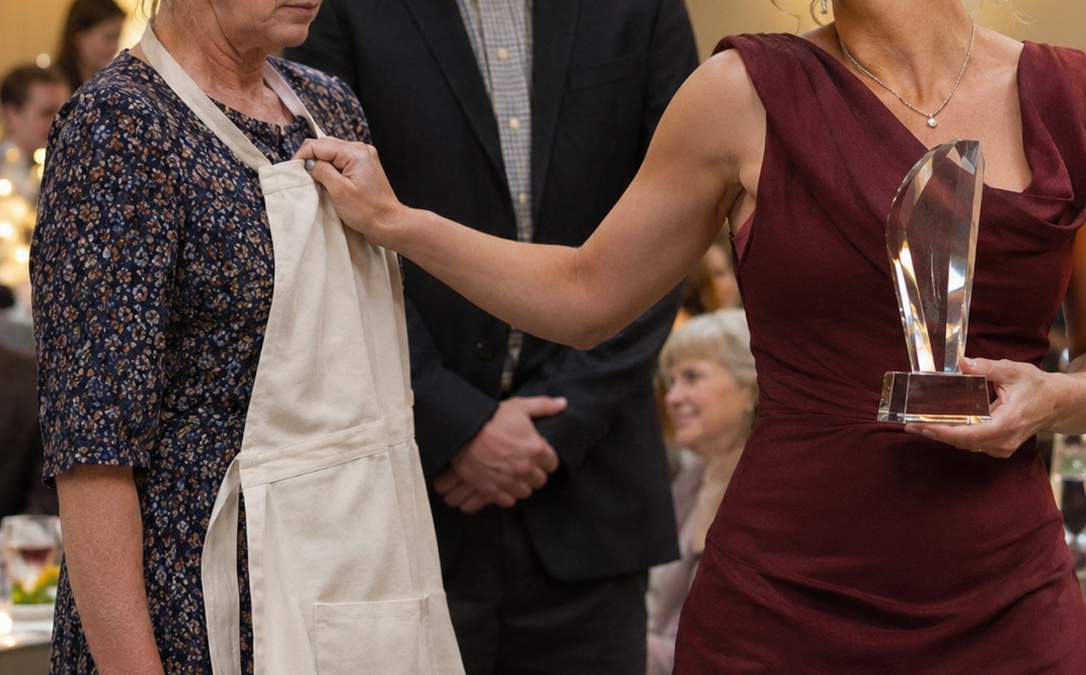
Then she pressed a white apron against my $64 dress.
“Put the apron on, you’re staff tonight.”
My place at the table had vanished.
“Which tables?”
Kayla pointed toward the dining room.
“You fix shoes, Darlene. Tonight you carry plates and you keep quiet.”
Jeremy studied the floor.
Women were still streaming into the Rim Road Community Church fellowship hall in Billings, Montana.
The Harvest Mothers’ Dinner had brought 120 women together, and the tables were filling quickly.
I had arrived in a new dress because Kayla had told me to dress nicely.
I thought I would have a seat beside my grandson and watch him take part in the evening.
Instead, my daughter-in-law had given me an apron.
I was sixty-five.
I owned Montana Avenue Shoe Repair, where I spent my days replacing heels, fixing straps, and keeping worn shoes useful.
Kayla was thirty-five and worked as a dental office manager.
She had learned to greet people with a cheerful voice whenever she needed something from them.
Tonight, she was the one being celebrated.
A glass trophy stood near the lectern.
Kayla had been nominated for a Mother of the Year award, and a photographer was waiting to take pictures of her with it.
Jeremy was thirty-eight, an HVAC technician, and he had never liked being caught between his wife and me.
He kept his eyes down while I held the apron.
I could have asked where my chair had gone.
I could have reminded Kayla that I had come as family, not as a volunteer.
I could have left.
But Levi was here.
So I tied the apron around my waist.
Kayla gave me a quick nod, then turned toward the photographer.
She picked up the trophy and held it against her dress.
The camera flashed while she smiled.
I went to the kitchen.
A sign-up sheet was taped to the kitchen door.
I stopped when I saw the assignments.
Server 4: Darlene H.
The letters were round and familiar.
I knew Kayla’s handwriting from school forms and birthday cards.
My name sat beneath the heading for servers, not beside a place at the head table.
I touched the paper with one finger, then stepped aside as a volunteer carried a tray through the doorway.
The apron strings pulled against the back of my dress.
I started setting programs at table nine.
Several women there had brought shoes to my shop over the years.
I recognized faces, though I couldn’t tell whether they recognized me beneath the apron.
One woman thanked me as I placed a program beside her plate.
I nodded and moved to the next chair.
The programs were printed on cream paper.
Each one included Kayla’s photograph and an essay about her nomination.
I set one down, then glanced at the first paragraph.
“412 lunch notes, every one by my hand.”
My fingers stopped.
The essay described three years of packing Levi’s lunches and writing little messages to help him through preschool, kindergarten, and first grade.
It said the notes came from a mother’s patience and a mother’s hand.
I knew those notes.
I turned the page.
A photograph showed a handwritten message.
“Heels down, chin up.”
That was my line.
I had written it for Levi when he started preschool and worried about walking into the classroom without me.
He was too young to read, so I drew a little heel in the corner.
He knew the mark meant Gram.
After that, I kept using the same heel on his notes.
It was the same shape I had drawn on shop tickets since 1995, beside the square capital letters I used for every repair.
I leaned closer to the photograph.
The corner had been sliced off.
The words were visible, but the little heel was missing.
I traced the printed edge with one finger.
Kayla had kept the sentence and removed the part that connected it to me.
A volunteer called for more programs.
I gathered the remaining stack and carried it toward the pantry.
My new dress was hidden beneath the apron, and the essay lay open in my mind as clearly as it had on the page.
I had not even known there would be an essay.
I had come because Kayla said there was a dinner and Levi would be part of it.
I wanted to sit near him.
In the pantry, Levi stood beside the shelves.
His clip-on tie was crooked, and he held a dented metal lunchbox with both hands.
I knew that lunchbox.
One corner had split years earlier, and I had straightened the metal and re-riveted the hinge at my shop.
I had made sure the lid would close properly because Levi liked carrying it himself.
“What are you doing back here, sweetheart?”
He looked at my apron.
“Mom said you were helping.”
“I am.”
He set the lunchbox on a low shelf.
“Mom says don’t open it till the stage. But it’s yours, Gram.”
I looked at him.
“What’s mine?”
He put his fingers around the clasp.
“Your notes.”
Then he lifted the lid.
Folded pieces of paper filled the lunchbox to the rim.
Some were small and soft from being handled.
Others still held the sharp creases I had made when I folded them and slipped them into his lunch.
Every corner had a little heel, the same heel I draw on every ticket at the shop.
The notes carried the square letters I had used since 1995.
“Mom counted Friday night. 412.”
I looked at the little boy in front of me.
He had kept every note, while I had assumed they were gone by the end of the day.
Kayla had counted them, too.
I touched the top folded paper but didn’t take it out.
My throat tightened, and I had to look down at the lunchbox until I could speak.
I thought of the program photograph, with its carefully cut edge.
I thought of the sentence claiming every note had been written by Kayla’s hand.
Then I looked down at the apron tied over my dress.
Picking up where the Facebook post left off
Levi had brought the proof into the church himself.
He had not taken it to the stage or shown it to the guests.
He had opened it for me.
“Do you remember which one you like best?” I asked.
“The one about my shoes.”
“I remember writing that.”
“You said heels down, chin up. You drew the heel so I knew it was yours.”
He pointed to a note near the top.
I could see the corner of the drawing without unfolding it.
I straightened his clip-on tie.
It had slipped toward one shoulder.
“That’s a good one.”
He nodded and kept one hand on the lid.
Beyond the pantry, chairs scraped against the floor.
Women were taking their seats.
The dinner was moving toward the part where Kayla would receive her award.
I knew what she had done with the notes.
I knew she had removed my place card and put me to work.
Now she knew I had seen the box.
What would Kayla do now that she knew I had seen the proof?
I heard footsteps in the hallway.
Kayla appeared in the doorway with the glass trophy in her hand.
Her eyes went to the open lunchbox, then to my face.
“Close that, Levi. Now.”
Chapter 2: The Woman Who Said “Write Whatever”
“Those are mine.”
Kayla was still standing in the pantry doorway, holding the glass trophy.
Two volunteers had stopped behind her. One carried a stack of folded napkins. The other held an empty serving tray.
Kayla looked at me, then at Levi’s open lunchbox.
“You fix shoes, Darlene. Tonight you carry plates and you keep quiet.”
I kept my eyes on her.
Levi began lowering the lid.
“Close it, sweetheart,” I told him gently.
He pressed the clasp until it clicked.
Kayla reached for the lunchbox, but Levi held the handle against his chest.
“Give it to me, Levi. You’ll need it later.”
He looked at me.
I nodded once.
He handed it over.
Kayla took the box and walked toward the fellowship hall without another word.
The volunteer with the napkins stepped aside to let her pass. Neither woman said anything to me.
I picked up the empty tray.
There were still rolls to carry, and I had been assigned to serve them.
At the kitchen counter, a volunteer placed two baskets of warm rolls in front of me. I put napkins beneath them and lifted one basket in each hand.
The apron caught against the counter as I turned.
I carried the baskets into the dining room.
A woman seated near table nine looked up as I approached.
“Who is she?” she asked the woman beside her.
Kayla was standing close enough to hear.
“She’s just kitchen help the committee sent.”
The guest nodded and reached for a roll.
I set down the basket.
Kayla moved toward the next table, greeting a woman with a smile. Her voice changed completely when she turned away from me.
I went back for the second basket.
My name was on the kitchen assignment sheet, and the program said Kayla had written 412 notes. I had seen my own words beneath her photograph, with the identifying corner cut away.
I needed something that belonged to me.
The lunchbox belonged to Levi. The notes were his, too. I wasn’t going to take them from him or pull them apart to prove something to a room full of strangers.
But I had my phone.
I had kept the messages Kayla sent me over the years. I didn’t save them for an occasion like this. I saved them because I sometimes needed to remember what time she wanted something done.
I finished carrying the rolls.
Then I slipped through the kitchen door and went outside.
The back steps were empty. The evening air was cool, and the light above the service entrance had already come on.
I sat on the top step and opened my phone.
I searched Kayla’s name.
There were messages about school pickup, lunch containers, permission slips, and the occasional change in Levi’s schedule.
I scrolled back to September 2023.
September 5, 2023. Tuesday.
I remembered that morning.
Levi was three years old then. He had started crying at drop-off because he didn’t want me to leave him at preschool.
Jeremy brought him to my shop at 6:45 every school morning. I packed his lunch, wrote a little note, and drove him to school.
At first, Levi couldn’t read the words.
He could recognize pictures, though.
So I drew a small heel in the corner.
That was how he knew the note came from me.
I kept the drawing simple. A curved sole, a little heel, and a short line at the top.
It was the same mark I had put on repair tickets at Montana Avenue Shoe Repair since 1995.
My customers knew it, too. Some could identify my tickets without looking at the name.
That morning in September, Kayla had sent me a message.
The words were still there on my screen.
You do his lunch from now on. Put a note in so he quits crying at drop-off. Write whatever, I don’t have time.
I sat with the phone resting in my palm.
Kayla had asked me to write the notes.
She had told me what to do and why she wanted them.
I remembered making the first one at the shop counter. Levi had been sitting on his little chair, swinging his feet while I folded the paper.
I wrote a short message and drew the heel.
He stopped crying when he saw it.
The next morning, I wrote another.
Then another.
Three years of mornings followed.
I had never charged Kayla for the lunches or the notes. I didn’t expect payment for taking care of my grandson. I loved those mornings.
I liked knowing Levi would find something from me when he opened his lunch.
I had no idea Kayla would stand in front of 120 women and claim those words as her own.
I saved the message on my phone and put the phone in my pocket.
It was something I could show Janice, perhaps, but it wasn’t the same as having the notes.
Those belonged to Levi.
I stood and went back inside.
Jeremy was near the coat rack, speaking with a volunteer who was hanging up a guest’s jacket. When the volunteer walked away, I approached him.
“Did you know?”
Jeremy looked toward the dining room.
“Know what?”
“Kayla’s essay. The notes. She says she wrote all 412.”
He shifted his weight and glanced toward the fellowship hall.
“I knew about the nomination.”
“That isn’t what I asked.”
He glanced toward the fellowship hall again.
“Not tonight, Mom. It’s her night.”
I waited.
He didn’t add anything.
“Did you know she put me down as a server?”
His eyes dropped to the apron.
“I don’t want to do this here.”
“You don’t want to do it anywhere.”
His mouth tightened, but he said nothing.
I walked away before he could ask me to make things easier for him.
The dining room was getting louder. Guests were finding their seats, and volunteers were clearing the last empty plates from the tables.
I returned to the kitchen and stacked the serving trays.
The phone in my pocket felt heavier than it had outside.
I had the message.
Kayla’s own words.
But I still needed to understand what she intended to do with Levi’s lunchbox.
The program listed him as part of the evening. At 7:15, he was supposed to read his favorite note from the stage.
I looked toward the lectern.
The glass trophy was still in Kayla’s hands. She was talking to two women near the head table, smiling as the photographer adjusted his camera.
Why had she counted the notes on Friday night?
Why had she brought them here if she intended to claim them?
And why was she writing anything tonight?
I began carrying the empty baskets back toward the kitchen.
Through the pass window, I could see the preparation counter and part of the fellowship hall beyond it.
Levi’s dented lunchbox sat on the counter.
Kayla stood beside it.
She glanced toward the dining room, then picked up a blank index card from a stack near the programs.
She took a pen from her purse.
I stopped with the baskets in my hands.
Kayla bent over the counter and began writing.
When she finished, she folded nothing and drew no little heel in the corner.
She opened Levi’s lunchbox, lifted the top layer of folded notes, and slipped the new card inside.
Then she placed it right on top.
She closed the lid and turned the clasp toward the front.
I stood behind the pass window, still holding the baskets.
The card had been written in Kayla’s round handwriting.
And she had put it where Levi would find it first.
Chapter 3: The Name on the Pickup List
The program order was clipped to a board beside the preparation counter.
I had passed it several times while carrying trays, but now I stopped to read the schedule.
At 7:15, the printed order said:
“Levi reads his favorite note.”
I looked through the pass window toward the fellowship hall.
Levi’s lunchbox was no longer where I had seen Kayla put it. She had taken it somewhere near the lectern, and the index card was waiting on top of his notes.
I set the empty tray down.
Kayla stood at the preparation counter, checking something on her phone. The glass trophy sat beside her.
“You wrote that one tonight.”
She didn’t look up immediately.
“What?”
“The card you put in Levi’s lunchbox. You wrote it tonight.”
Kayla set her phone down.
“It’s a note for my son.”
“You put it on top of three years of notes I wrote.”
Her eyes moved toward the kitchen doorway. Two volunteers were sorting plates nearby.
“Keep your voice down.”
“You’re asking him to read something you just wrote and telling everyone I wrote nothing.”
Kayla picked up her phone again.
“You need to finish your work.”
I stayed where I was.
She unlocked the phone and opened the school app.
At first, I thought she was checking Levi’s schedule. Then she turned the screen slightly toward herself and opened his pickup information.
My name appeared in the list.
Darlene Horton.
I knew that entry. I had been on the list since Levi started preschool. It allowed me to pick him up when Jeremy was working or Kayla needed someone to help.
I had used it for three years.
Kayla tapped my name.
A small confirmation appeared on the screen.
She pressed it.
My name disappeared.
I watched her close the list.
“Did you just remove me?”
Kayla slipped the phone into her hand.
“Say one word and that was your last morning with him.”
She spoke quietly enough that the volunteers wouldn’t hear.
I looked at her.
She didn’t look angry. She looked like someone who had finished an ordinary task and wanted to move on.
I thought about the school mornings.
Jeremy brought Levi to my shop at 6:45. I packed his lunch while he sat nearby, sometimes talking about school and sometimes watching me write his note.
Then I drove him to school.
Three years of mornings had grown out of that simple routine.
I knew which lunch container he preferred and how he liked his sandwich cut. I knew when he needed an extra note because something at school worried him.
The pickup list meant I could be there when he needed me.
Now Kayla had removed my name while standing a few feet away from me.
I wanted to reach for her phone.
I wanted to ask whether she understood what she had taken away.
But Levi was still waiting for his turn onstage, and the box was still his.
I returned to the dish sink.
The water was running, and a stack of serving plates waited beside it.
I turned on the tap and began rinsing them.
My hands moved automatically while my thoughts stayed with the lunchbox.
I could leave.
I could untie the apron, walk out the service entrance, and let Kayla finish her evening without me.
Or I could find Levi and tell him which note to read.
I could tell him the new card wasn’t his and point out the heel on the others.
He was six.
He trusted me to help him understand things. He shouldn’t have to stand on a stage and choose between his mother and his grandmother.
I wasn’t going to coach him into an argument.
I also wasn’t going to take the lunchbox away from him. The notes belonged to Levi. He had kept them because they mattered to him, and I wasn’t going to turn his collection into something adults fought over.
I rinsed another plate.
The cost of that decision was sitting in my phone.
My name was gone from the pickup list.
I might not be there at 6:45 on Wednesday. I might not pack his lunch or drive him to school. The mornings I had looked forward to could disappear because I refused to use a little boy to prove something to a room full of adults.
I shut off the water.
A woman entered the kitchen carrying an empty glass.
She was older than Kayla, with short gray hair and a dark jacket. I recognized her, though it took me a moment to place her.
She approached the water pitcher near the counter.
Then she looked at my face.
“Darlene Horton?”
I turned.
“Yes.”
She smiled slightly.
“Janice Tate.”
I knew the name then.
Janice was sixty-seven and chaired the award committee. She had brought a pair of boots to my shop several months earlier. The soles had worn down, and I had resoled them so she could keep wearing them.
She filled her glass.
“You resoled my boots; your ticket’s still in my purse. I set a place for Levi’s grandmother and it’s empty.”
I looked toward the dining room.
The head table was visible through the open kitchen doorway. My place card wasn’t there anymore.
Kayla had folded it and thrown it away.
Janice followed my eyes.
“I expected you to be sitting with him.”
I untied a loose corner of the apron and retied it.
“That’s me.”
Janice looked at the apron, then at the serving trays stacked beside me.
“You’re Levi’s grandmother?”
“Yes.”
She glanced toward the fellowship hall.
“Then why are you back here?”
I could have told her everything.
I could have described the place card, the essay, the cropped photograph, and the lunchbox full of notes. I could have shown her the message on my phone.
But I didn’t know what she would believe.
Kayla was the nominee. Janice was the committee chair. The room was full of women who had come to celebrate her.
I was standing beside a dish sink in an apron.
Janice had seen my work before. She had trusted me with her boots and kept my repair ticket in her purse.
That was something.
It wasn’t proof of what had happened tonight.
She set her empty glass beside the pitcher.
“I’m going to need to get back out there.”
I nodded.
She started toward the door, then paused.
I thought about the nomination, the printed essay, and the 412 notes.
Kayla had signed something to make those claims official. The committee had received a form. Janice had been the one who set a place for me before Kayla removed it.
She might be the only person in the room who could tell me what Kayla had put in writing.
I reached into my apron pocket for my phone.
“Janice?”
She turned around.
“Did she have to sign that form?”
I brought out my phone and opened the message from September 5, 2023.
Janice looked at the screen.
I held it out to her.
Chapter 4: The Form in Janice’s Folder
Janice stood with my phone in her hand, reading the message from September 5, 2023.
The hallway outside the fellowship hall was quieter than the kitchen. Through the open doors, I could hear women talking and chairs moving across the floor.
Janice looked at the date.
“Tuesday?”
“Yes.”
“And Kayla sent this to you?”
“Yes.”
She handed my phone back and opened the folder she carried beneath her arm.
“I have something you need to see.”
She turned several pages until she found the nomination paperwork.
Near the bottom was Kayla’s signature.
Above it, a sentence had been printed for the nominee to confirm:
“Every one by my hand, at my kitchen table before my shift.”
I looked at the signature.
It was the same round handwriting I had seen on the kitchen assignment sheet.
Janice held the page steady.
“She signed this on September 14.”
I looked up.
“What happens if it’s wrong?”
“The committee has five members. Our written rules allow us to rescind an award by majority vote when there’s evidence supporting the decision.”
“How many would have to agree?”
“Three.”
She closed the folder halfway.
“But I can’t make that decision from one message.”
I understood.
Kayla’s text showed that she had asked me to write notes. It didn’t prove that I had written all 412.
The lunchbox did.
Janice looked toward the fellowship hall.
“One text means she asked you once. Bring me the notes.”
I shook my head.
“They’re his. I won’t take them from him.”
“Darlene, I understand they’re important to Levi.”
“He kept them under his bed. He brought them here because he wanted me to see them.”
Janice waited.
“I won’t take his things and carry them around like evidence without his permission.”
She lowered the folder.
“Then I don’t know what I can do tonight.”
Neither did I.
The notes were the strongest proof I had, but they belonged to a six-year-old boy.
If I took them, I would be turning something he had saved out of love into something he might remember as part of a fight between his mother and grandmother.
If I left them alone, Kayla could receive the award and keep telling people she wrote them.
I could lose my mornings with Levi without changing anything.
Janice touched the folder’s edge.
“I’ll be watching what happens.”
I nodded.
She returned to the fellowship hall, and I went back toward the kitchen.
Jeremy was standing near the doorway.
He had apparently been looking for me.
“Mom, you should go home.”
I stopped.
“Why?”
“This isn’t getting any better.”
I looked at him.
“Did you see what she put in that program?”
He glanced toward the dining room.
“I know you’re upset.”
“That’s not what I asked.”
He lowered his voice.
“Kayla has worked hard for this. Can you just let tonight happen?”
I looked past him toward the tables.
Levi was somewhere near the front with his lunchbox. I couldn’t see him from where we stood.
“Your son has my notes in that box.”
Jeremy didn’t answer.
I waited for him to say something about the message, the essay, or the fact that my name had disappeared from the pickup list.
He only looked toward the dining room.
“I think you should go home, Mom.”
I turned away.
At the kitchen counter, I found the apron strings hanging loose at my waist.
I pulled them tighter and tied another knot.
Then I picked up the water pitcher.
The head table had empty glasses, and the women seated there were waiting for the program to begin.
I carried the pitcher into the fellowship hall.
My shoes sounded different on the floor without the rubber soles I usually wore at the shop. The new dress brushed against my knees beneath the apron.
I stopped beside the head table and began filling glasses.
One woman thanked me.
Another moved her purse so I could reach the glass beside it.
I poured water without looking toward Kayla.
The program began a few minutes later.
The photographer moved near the lectern. The magazine editor sat close to the front, holding a notebook on her lap.
Janice walked onto the small stage with the glass trophy and a cream-colored envelope.
I recognized the envelope from the paperwork.
The award gift check was $1,500.
The women settled into their chairs.
Janice introduced Kayla and spoke about her nomination. She mentioned the years of dedication, the lunches, and the notes that had supposedly come from a mother’s own hand.
I stood beside the head table with the pitcher.
Kayla walked to the stage.
Her dress caught the light as she accepted the trophy. She smiled for the photographer and turned toward the audience.
Janice handed her the envelope.
The women applauded.
I watched Kayla hold the trophy against her chest.
She thanked the committee and looked toward the tables.
“I never expected anything like this,” she said.
Her voice carried easily through the fellowship hall.
“Being a mother means showing up in the little things. Sometimes it’s a lunch packed before work. Sometimes it’s a note tucked where your child will find it.”
The magazine editor nodded.
Kayla continued.
“I wrote 412 lunch notes, every one by my hand, at my kitchen table before my shift.”
The editor smiled and made a note.
I knew what that note might mean.
The magazine had been discussing a paid column with Kayla. The amount was $400 a month.
She had told people the column would be about motherhood, family routines, and the little messages that helped children grow.
Now she had a trophy, a $1,500 check, and 120 women listening to her claim.
I stood with the pitcher against my hip.
My phone was still in my apron pocket.
The September 5 message was there.
Janice had seen it, and she had Kayla’s signed statement in her folder. But without the notes, she had said there was not enough evidence to act.
Kayla looked toward the head table.
Her eyes found me.
She kept smiling for the audience.
Then she stepped down from the lectern and walked toward the edge of the stage.
I was beside the water glasses when she stopped near me.
“Smile, Darlene.”
I kept my face still.
She leaned closer, speaking softly enough that the women around us couldn’t hear.
“Monday you’re nobody’s grandmother.”
My fingers tightened around the pitcher handle.
Kayla straightened and returned to the stage.
The program order was clipped beside the lectern. I could see the time printed beside Levi’s name.
7:15.
A volunteer brought the dented lunchbox forward.
Levi stood near the first row, his little clip-on tie straight and his hands hanging at his sides.
He looked toward the stage.
Then he looked toward me.
I didn’t wave him over or tell him what to say.
I wouldn’t choose his words for him.
Kayla stood beside the lectern, holding her trophy in one hand.
The lunchbox was placed on the small table.
Levi walked toward the steps.
I set the pitcher down.
My grandson put one foot on the first step and reached for the railing.
Chapter 5: The Boy Who Read the Wrong Note
Levi reached the lectern with the dented lunchbox in both hands.
Kayla stood beside him, holding the glass trophy against her dress.
I watched from table nine, still wearing the white apron.
The photographer had moved closer to the stage. The magazine editor sat near the front, her notebook open.
A volunteer adjusted the microphone.
“Levi, read the top note for everyone,” Kayla said.
He set the lunchbox on the lectern.
The metal lid made a small clattering sound when he opened it.
He reached inside and pulled out the index card Kayla had placed on top.
I recognized the round handwriting.
Levi held the card close to his face.
He started reading, then stopped.
“This one’s not mine. It doesn’t have the heel.”
Kayla smiled at the audience.
“Go ahead, sweetheart. Read it.”
Levi looked at the card again.
Then he turned it over.
“There isn’t one on the back either.”
He put the card beside the lunchbox.
Kayla’s smile tightened.
Levi reached into the box and moved several folded papers aside. He chose one near the middle and held it up.
“This one has it.”
He showed the paper to the audience.
A little heel was drawn in the corner.
“These have the heel. All 412. That’s Gram.”
He pointed toward table nine.
His finger was small, but I could see it from where I stood.
The room turned toward me.
I kept my hands at my sides.
Kayla gave a short laugh.
“The heel? That’s just a little doodle of mine.”
Janice Tate stood from her chair near the front.
“Levi, may I see one of those notes?”
He looked at her, then carefully handed her the folded paper.
Janice opened it.
She reached into her purse and removed a narrow repair ticket.
I recognized my handwriting before she unfolded it completely.
It was from the pair of boots I had resoled for her.
Janice placed the ticket beside Levi’s note on the lectern.
The two pieces rested side by side beneath the stage lights.
The square capital letters matched.
The little heel matched.
Even the way I formed the letter H was the same.
Janice turned the papers slightly so the first rows could see them.
“I’ve kept this ticket since Darlene repaired my boots,” she said.
A woman at the front leaned forward.
Another reached into her purse.
“I have one, too,” someone said.
A woman near table nine opened her handbag and pulled out a small repair ticket.
Then another guest did the same.
Soon, several women were holding tickets from my shop.
I recognized some of them.
They had brought their shoes to Montana Avenue for years. They knew my handwriting because they had carried my tickets home and brought them back when they collected their repairs.
Kayla looked from the papers to the audience.
“Those don’t prove anything,” she said.
Janice kept the note and ticket together.
Kayla raised her voice.
“She only copied them out. Every word was my idea.”
A volunteer appeared beside the stage carrying a sheet of paper.
It was the sign-up sheet from the kitchen door.
Janice accepted it and placed it beside Kayla’s index card.
The words were easy to see.
Server 4: Darlene H.
The handwriting on the sign-up sheet was round, just like the writing on the fresh card.
I had seen that handwriting when I entered the kitchen.
Kayla had written my name there herself.
Janice looked toward me.
“Darlene, would you show us the message you mentioned?”
I reached into the apron pocket and took out my phone.
My hands were steady, though I could feel my heartbeat in my throat.
I unlocked the screen and found the message dated September 5, 2023.
Tuesday.
I walked closer to the stage but stayed on the floor.
Janice nodded for me to read.
I held the phone where I could see the words.
“September 5, 2023. This is the message Kayla sent me.”
I read it aloud.
“You do his lunch from now on. Put a note in so he quits crying at drop-off. Write whatever, I don’t have time.”
The room stayed quiet.
I lowered the phone.
Kayla shook her head.
“That’s not what this is about.”
I looked at her.
“You asked me to write the notes.”
She turned toward the audience.
“He’s six. He doesn’t know what he’s saying.”
Levi was still standing beside the lunchbox.
He looked down at the folded papers, then at the index card.
“I know my notes,” he said.
Kayla reached toward him.
“Come here, sweetheart.”
He didn’t move.
Jeremy was seated near the aisle.
Until then, he had kept his hands together and his eyes on the stage.
Now he stood.
“I watched Mom write them at that counter for three years. I proofread that form.”
I turned toward him.
He looked at Janice, not at me.
“I knew what the nomination said. I should have said something before tonight.”
His voice was unsteady, but he didn’t sit down.
Kayla stared at him.
“Jeremy.”
He stayed standing.
Janice closed her folder.
Then she held out her hand toward Kayla.
Kayla looked at the trophy she was holding.
For a few seconds, she didn’t move.
Then she stepped toward the lectern and placed the glass trophy on it.
The photographer lowered his camera.
Janice didn’t pick up the trophy.
I looked down at the apron tied around my waist.
The same apron Kayla had pushed against my dress when I arrived.
The same apron I had worn while carrying rolls and filling water glasses for women who had come to celebrate her.
I reached behind my back and loosened the knot.
The strings slipped free.
I pulled the apron over my head and walked to the head table.
I laid it beside the programs.
Then I turned toward Kayla.
“You cut off my heel, Kayla. He kept every one.”
She stood beside the lectern.
The trophy was between us.
I didn’t raise my voice.
I didn’t need to.
I returned to table nine.
Levi was still beside the lunchbox. He had begun putting the folded notes back inside, carefully arranging the papers so their corners wouldn’t bend.
I wanted to help him.
I stayed where I was until he finished.
He closed the lid and looked toward me.
“Gram?”
I walked over.
“Did I read it wrong?”
I knelt beside him.
His face was worried, and his little fingers were still resting on the lunchbox clasp.
“You read it exactly right.”
He nodded.
I straightened his clip-on tie.
Behind us, Janice stepped toward the microphone.
“The committee will review the evidence presented tonight. Our five members will vote tomorrow on whether to rescind the award.”
A woman near the front asked whether the trophy would remain with Kayla.
Janice looked at it on the lectern.
“It will stay here until the vote.”
I glanced toward Jeremy.
He was still standing near the aisle.
Kayla had turned away from him.
My phone was in my hand, and the school app was still showing the change she had made.
My name had not been restored to Levi’s pickup list.
The committee would decide what happened to the award tomorrow.
But nobody had yet decided whether I would be allowed to pick up my grandson on Monday.
Levi took my hand.
“Can I keep the box?”
I squeezed his fingers.
“It’s yours, sweetheart.”
He carried it down from the stage.
I walked beside him, without the apron.
Tomorrow, five people would vote.
And I still didn’t know whether I would get my mornings back.
Chapter 6: The Name on the Lobby Board
By Sunday, everyone in the fellowship hall had seen the notes, but Kayla still had her title, her check, and her name on the lobby board.
The committee had to make its decision.
Janice called the five members together on October 25. They reviewed the nomination, the signed statement, the message from 2023, and the papers shown at the dinner.
The vote was five to zero.
Janice called me afterward.
“It’s unanimous, Darlene.”
I sat behind the counter at Montana Avenue Shoe Repair, holding a shoe I had been working on.
“They rescinded the award?”
“Yes. Five votes.”
I put the shoe down.
Janice told me she had gone to the church lobby and removed Kayla’s name from the board. The space where the name had been was empty.
The $1,500 check had never been cashed.
Janice returned it with the committee paperwork.
I thanked her.
She said she was sorry about what had happened at the dinner. I told her I appreciated her keeping the repair ticket.
On Monday, the magazine editor dropped Kayla’s $400-a-month column.
Janice let me know that, too.
The magazine would not be publishing the column or paying Kayla for it. The editor had heard what happened at the dinner and had decided not to move forward.
I wasn’t pleased about losing the mornings with Levi, but I didn’t spend much time thinking about Kayla’s column.
I wanted my name back on the school pickup list.
Jeremy called me after he went to Levi’s school.
Before anything else, he told Levi the truth.
He explained that I had written the lunch notes, that I had packed his lunches, and that the little heel in the corner was mine.
Jeremy told him he should have spoken up sooner.
Levi asked whether the notes were still his.
Jeremy said they always had been.
Then Jeremy went into the school office and restored my name to the pickup list.
He signed the necessary school paperwork and checked the information before leaving.
When he called me, I was standing behind the shop counter.
“Mom, you’re back on the list.”
I held the phone against my ear.
“Thank you.”
“I’m sorry I waited.”
I didn’t tell him it was all right.
He had watched me write those notes for three years. He had even proofread Kayla’s nomination form.
He knew enough to speak before the dinner.
But he had finally spoken.
That afternoon, Jeremy confronted Kayla.
He told her he wasn’t going to defend what she had done or pretend it hadn’t happened.
“I won’t lie for you again.”
Kayla didn’t have much to say.
She packed a few things and went to her sister’s house in Laurel for a few nights.
Jeremy stayed home with Levi.
I didn’t ask him to explain what happened between them after that. I had spent enough time being pulled into conversations that belonged to other people.
Wednesday morning, October 28, I was opening the shop at 6:45 when Kayla walked through the door.
Jeremy’s truck had just dropped Levi off, and he was in the back room with his backpack, out of earshot.
I still had to pack his lunch and drive him to school afterward.
I looked up from the counter.
“Can we talk?”
I set down the pencil.
“I’m listening.”
She glanced toward the front window.
“Jeremy said you’re back on the school list.”
“He took care of it Monday.”
She nodded.
“I know.”
For a moment, neither of us said anything.
Then she looked at the counter.
“I’m sorry about the dinner.”
I waited.
“I shouldn’t have put you in that apron. I shouldn’t have made you serve everybody while I sat up front.”
She looked directly at me.
“I shouldn’t have embarrassed you like that.”
I folded my hands on the counter.
It was an apology.
But it was only about the apron.
She didn’t mention the 412 notes, the essay, the photograph with the missing corner, or the card she had slipped into Levi’s lunchbox.
She didn’t mention the sentence she had signed on the nomination form.
She didn’t apologize for telling me I would lose my mornings with Levi.
I didn’t supply those words for her.
Kayla looked toward the back of the shop.
“I was wondering if I could pack Levi’s lunch one day a week.”
I studied her face.
“One day?”
“Yes. I could come in and do it. Maybe Tuesdays.”
She waited for me to answer.
I thought about the mornings Jeremy had brought Levi to the shop. The little chair near my counter. The lunch containers lined up beside the paper. The notes folded small enough to fit beside his sandwich.
I had been doing that for three years.
Kayla wanted a place in that routine now.
If I refused, I would keep the mornings entirely to myself. I would also be making the decision for Levi without asking what he might want from his mother.
If I agreed, I would have to watch her write something for him.
I didn’t know whether I was ready for that.
I did know I wasn’t going to pretend the dinner had never happened.
“You can pack his lunch on Tuesdays,” I said.
Kayla looked up.
“Really?”
“One day. Tuesday.”
She nodded.
“I appreciate that.”
I reached beneath the counter and took out a blank repair ticket.
The paper was clean, with no writing or drawing on it.
I placed it on the counter between us.
Then I took a pen from the holder and slid that toward her, too.
Kayla looked at the ticket.
“What is this?”
“Something for you to write on.”
She picked up the pen.
I kept my hand on the counter.
“Yours go in your hand. No heel.”
Kayla looked down at the blank ticket.
She understood what I meant.
I wasn’t giving her my handwriting, my little drawing, or the words Levi had saved for three years.
If she wanted to write something to her son, she could put her own words on the paper.
I left the ticket in front of her.
She didn’t write anything yet.
I picked up the next shoe waiting for repair and set it on the counter.
Kayla stayed beside the blank ticket.
Chapter 7: The Smallest Apron in Billings
By February 6, 2027, Saturday mornings at Montana Avenue Shoe Repair had settled into a rhythm I knew by heart.
Jeremy still brought Levi to the shop at 6:45 on school mornings. I packed his lunch, wrote his note, and drove him to school.
My name was back on the pickup list.
Kayla came on Tuesdays.
She packed Levi’s lunch and wrote a note in her own round handwriting. The messages were plain, usually a few words about his day or something she wanted him to remember.
I didn’t correct her handwriting or suggest what she should say.
I kept those Tuesday notes in a separate shoebox behind the counter.
The heel wasn’t on them.
The other 412 notes stayed in Levi’s dented lunchbox.
He had decided the box belonged at the shop now.
That morning, Janice Tate came through the front door carrying a pair of boots.
I recognized them immediately.
They were the same boots I had resoled the previous year, the pair whose repair ticket she had kept in her purse.
“Morning, Darlene.”
“Morning, Janice.”
She placed the boots on the counter.
“I need these checked before spring.”
I turned one over and examined the sole.
“Still good. The stitching needs attention on this one.”
Janice watched me inspect the heel.
“I’ve been meaning to ask you something.”
I reached for my ticket pad.
“The committee is already talking about next year’s Mother of the Year award.”
I stopped writing.
Janice rested her purse on the counter.
“We’d like to offer you the award. After what happened last October, I think everyone would agree you’ve earned it.”
I looked down at the boots.
I remembered the fellowship hall, the folded place card, the white apron, and the trophy Kayla had eventually surrendered.
I remembered the women holding their shop tickets beside Levi’s notes.
I also remembered how it felt to stand at table nine while someone else received credit for my mornings.
Janice waited.
“I’m grateful,” I said. “But no.”
“You don’t want the recognition?”
“I’ve got work to do.”
She smiled a little.
I wrote the repair details on her ticket.
Customer: Janice Tate.
Boots: heel stitching and inspection.
I added the date and the amount we had agreed on.
Then I handed her the ticket.
She read it and tucked it into her purse.
“You haven’t changed much.”
“Neither have your boots.”
Janice laughed.
She picked them up and headed for the door.
I returned to the counter.
A few minutes later, Levi came in carrying his school backpack. He was nearly seven now, with longer legs and a habit of asking how many minutes remained before lunch.
He had grown since the dinner.
His clip-on tie was gone, but I still remembered how carefully he had straightened it before walking onto the stage.
He went straight to the shelf behind my counter.
The dented lunchbox sat there.
He took it down, checked the clasp, and put it back in its place.
“It’s safer here.”
I looked over.
“Safer than under your bed?”
He nodded.
“Nobody steps on it here.”
He was right about that.
The box held the 412 notes he had saved from preschool through first grade. He knew exactly where it belonged, and he never let anyone handle it without asking.
I had offered to make room for it on the shelf.
He had chosen the spot himself.
“Good place?” I asked.
“Best place.”
He took off his backpack and hung it on the hook beside the counter.
I finished checking a pair of men’s shoes and put them near the repair bench.
Levi watched me work.
Then he looked at the small shop apron hanging on a hook behind the counter.
It was made for a child, with shorter ties and a front pocket.
I had kept it there for him.
He touched the pocket.
“Is that mine?”
“It can be.”
He looked at me.
I picked up the apron and opened it.
“Come here.”
Levi stepped closer.
I tied the apron around his waist, adjusting the strings so they wouldn’t hang too low.
It was a little loose, but it fit well enough.
I straightened the front and checked the knot.
“Put the apron on. You’re staff tonight.”
Levi grinned.
It was Saturday morning, not night, but he understood the words.
He looked down at the apron.
“Am I really staff?”
“You’re on the schedule.”
He stood a little straighter.
I reached beneath the counter and took out a blank repair ticket.
The paper was small enough for his hands.
I showed him where the customer’s name went and where we wrote down the repair.
He listened without interrupting.
Then I handed him the ticket.
He accepted it with both hands, careful not to bend the corners.
He examined the empty spaces.
“Do I write something?”
“Not until there’s something to write.”
He nodded and placed it beside the ticket pad.
He didn’t scribble on it or fold it into a little airplane.
He treated it like real shop work.
I went back to the shoes waiting on my bench.
At noon, I stopped for lunch.
My lunch pail sat beneath the counter, where I kept it every workday.
I opened it and found a folded piece of paper resting beside my sandwich.
I knew it wasn’t one of Kayla’s Tuesday notes.
This paper had been folded unevenly, with one corner sticking out.
I opened it carefully.
“Heels down, chin up, Gram.”
Beneath the words was a little heel.
It leaned too far to one side, and the line at the top was crooked.
I looked toward Levi.
He was standing by the shelf, arranging a few empty ticket pads.
“Did you put something in my lunch?”
He glanced over.
“Maybe.”
I held up the note.
He smiled.
“I made the heel.”
“I can see that.”
“It’s harder than yours.”
I looked at the drawing again.
It was.
My heels had been the same for years. His had a crooked sole and a little mark where the pencil had slipped.
I folded the paper along its original crease.
Then I walked to the shelf and opened the dented lunchbox.
The folded notes inside were still arranged tightly together.
I placed Levi’s new note on top.
He watched me close the lid.
The clasp clicked into place.
I returned to the counter, took my pencil, and reached for the next pair of shoes.
THE END







