My Daughter Tagged My Late Husband’s Rocking Horse at $5 in Front of 30 Baby Shower Guests—Then the Buyer Turned It Over
Complete story · 7 chapters · about 34 minutes · ending included
Chapter 1 · Chapter 2 · Chapter 3 · Chapter 4 · Chapter 5 · Chapter 6 · Chapter 7
Chapter 1: The Horse With the Five-Dollar Tag
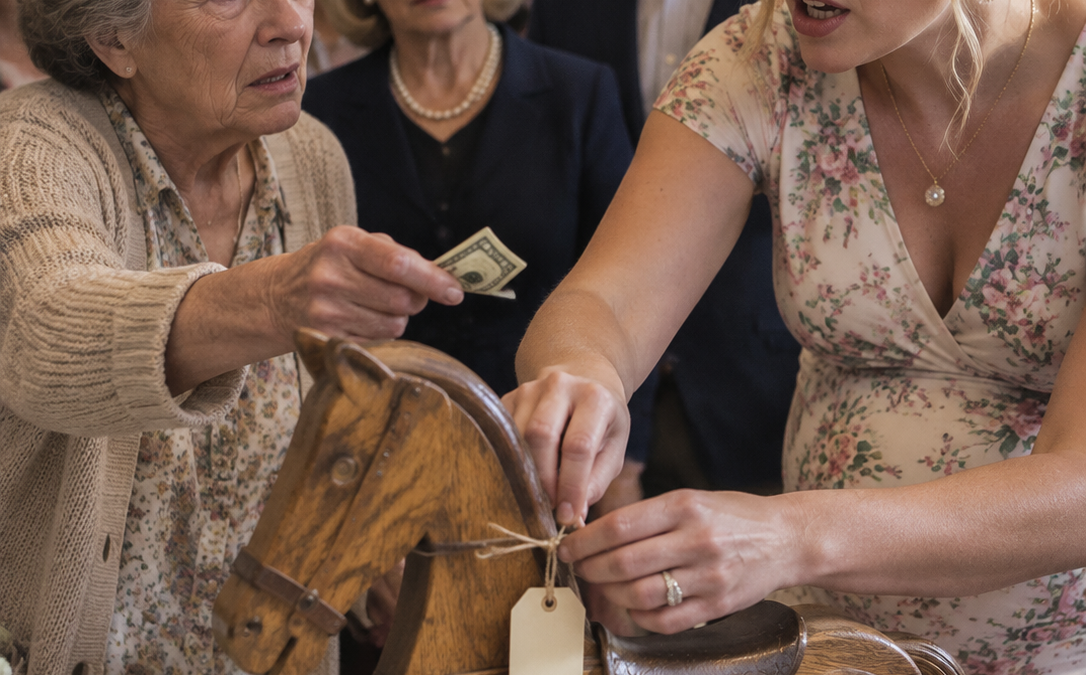
At 2:40 p.m., with 30 guests gathered around the baby-shower table, Ashlee tied a five-dollar tag to the oak horse and said, “That ugly horse smells like poor people, Mom.”
“He sanded that for you.”
My daughter pulled the string tight beneath the horse’s carved neck.
The tag swung against the wood.
I had driven 75 miles from Dubuque to Cedar Rapids with that horse buckled into the back seat.
I had wrapped the legs in an old quilt so they would not knock against the door.
I had pictured Ashlee opening the door, seeing what I brought, and understanding why I had carried it all that way.
Rex had made the horse in our garage.
He had sanded the ears until they were smooth enough for a baby’s hand and rounded the edges beneath the seat.
He worked slowly, checking each curve with his thumb.
He had been gone since March 14, 2023, and this was the one thing of his I thought the baby would have.
Ashlee stepped back to admire the tag.
She was thirty-four, dressed for photographs, with her hair pinned neatly behind her ears.
She worked for a nonprofit and knew how to make a room look welcoming.
There were paper flowers on the wall, wrapped gifts on the table, and a white cloth over the small table where she had placed items for the children’s ward.
I stood beside the horse with my purse held against my hip.
A woman near the window looked down at the tag.
“Five dollars? That’s a bargain.”
Ashlee smiled.
“It’s yard-sale junk. There’s no story.”
The woman gave a polite laugh, not quite sure whether she was meant to join in.
I looked at the horse’s smooth oak back.
Rex had taken his time with that finish.
He had rubbed it with oil, waited, and rubbed it again.
I pulled a five-dollar bill from my purse.
Ashlee saw it.
Her fingers closed over my hand before I could put the money down.
She pressed the bill back toward my palm.
“Family doesn’t shop. This table’s for the children’s ward. Get the ice, Mom.”
Her voice was low enough to sound like a request, but the people nearest us had stopped talking.
I could feel their attention without looking up.
“I brought it for the baby,” I said.
“You brought something you wanted to get rid of.”
I kept the five folded in my hand.
I worked as a school crossing guard in Dubuque and made $12.50 an hour.
That bill was twenty-four minutes of standing in the weather with one palm raised to stop traffic.
I could spare the money.
I had not expected to buy back the horse I had brought as a gift.
I imagined a little blanket over its back, or the baby touching the carved mane when she was old enough.
I had not expected a price tag.
The room was full of people who knew Ashlee from work, church, and the circles she had made since moving to Cedar Rapids.
I knew a few faces from family gatherings.
Most knew me as her mother, the woman who had driven in from Dubuque.
One guest came over and touched my arm.
“You must miss your husband. Ashlee told us he was a surgeon.”
I turned toward her.
“He worked with his hands every day.”
Ashlee went white.
The guest glanced between us.
Her smile faded, and she stepped back toward the gift table.
Ashlee did not correct her.
She did not tell the woman what Rex had done for a living.
She only looked at me with a warning in her eyes.
I set my purse on the kitchen counter and went in to get the ice.
The kitchen was cooler than the crowded room.
A tray of cups sat beside the sink, and the ice bucket was empty.
I opened the freezer and reached for the bag inside.
My phone vibrated against the counter.
The message was from Ashlee.
“Here Dad was a surgeon. Do NOT say the plant.”
I stood with the freezer door open.
The cold air touched my wrist.
I typed nothing back.
I put the ice in the bucket, tied the bag closed, and carried it out.
By then, the guests had moved toward the food.
Someone was cutting a cake.
A woman was arranging napkins beside the drinks.
The horse was gone from the spot where I had left it.
A pale ring marked the rug, left by the round feet and the time it had spent there.
I rubbed one spot with the side of my shoe.
Ashlee came up behind me.
“Sold. Drop it.”
I turned.
“To whom?”
“A donor. Someone who understands what the table is for.”
“You put a five-dollar tag on your father’s work.”
Ashlee’s mouth tightened.
“Don’t start this here.”
Picking up where the Facebook post left off
I wanted to ask her to take the tag off.
I wanted to tell her that Rex had made that horse for the baby, not for a table, not for a donor, and not for five dollars.
But the guests were close enough to hear us, and I had already seen what she would do with anything I said.
I bent and picked up a loose piece of string from the rug.
Through the front window, I saw Cole carrying the horse toward the driveway.
My son-in-law kept his eyes on the wood as he lifted it.
He was careful with the legs, the way Rex had been.
Cole opened the back of a gray SUV and eased the horse inside.
A woman stood beside the vehicle in a gray suit.
I had not noticed her before.
She watched Cole settle the horse, then leaned forward and tipped it so the underside caught the afternoon light.
The woman did not look at the tag.
She ran her thumb over Rex’s burned mark and stood very still.
Chapter 2: The Notebook in the Locked Toolbox
The next time I saw Ashlee, I asked who had bought the horse.
She was standing by her kitchen counter, sorting cards from the shower.
“Some donor. Don’t come to the gala, Mom.”
“What’s the donor’s name?”
“Why do you need it?”
“Because the horse belonged to your father.”
Ashlee slid another card into a pile.
“It was an ugly old thing. Someone wanted it. That’s all.”
I waited for her to look at me. She did not.
“Don’t make this harder than it needs to be,” she said.
I left without asking again.
On the drive back to Dubuque, I kept seeing the woman at the gray SUV.
She had turned the horse over as if she knew where to look.
Ashlee had called the buyer a donor, but she had not said the name.
I had a text telling me what I was allowed to say about Rex, and no answer about the woman who had taken his work.
I could not bring the horse back by arguing with Ashlee.
I could make another one.
The thought came to me while I was putting away the quilt I had used to protect the legs.
I laid it over the back of a chair and smoothed the fold where the oak had rested.
If I could find a photograph with enough of the horse showing, I could work out its size.
Rex had made patterns for his projects.
I knew he kept them in the garage toolbox.
Before I touched the toolbox, I looked for a photograph.
I opened the old family albums first.
Most pictures showed the horse from the side, with somebody standing beside it or a child sitting on the seat.
I needed one with the legs and the curve of the neck visible.
I searched through the photographs on my phone, then Ashlee’s old public posts.
A picture from 2019 appeared.
Ashlee was standing in our garage beside the oak horse.
She had one hand on its neck and a wide smile on her face.
The caption said, “My dad built this in our garage. Best thing I own.”
I enlarged the picture until the horse filled the screen.
Then I took a screenshot.
I did not know why I needed to keep Ashlee’s words.
They were hers, and she could not take them back from a screen.
I saved the image in a folder with Rex’s old photographs.
The garage smelled faintly of sawdust and machine oil.
His workbench was still against the wall, with the tools arranged where he had left them.
I had dusted around the toolbox for more than two years without opening it.
Rex had locked it.
I had left the lock alone because I had not needed what was inside.
After he died, I could not bring myself to sort through his patterns and notes.
I had told myself I would get to it when I was ready.
I was ready to make something for Greta.
The lock was small, but the metal resisted the cutters.
I held the toolbox steady with one hand and worked the handles with the other.
When the lock finally snapped, the sound seemed too loud for the garage.
I set the broken pieces on the bench.
Inside were folded patterns, measurements, pencils worn down to short stubs, and a pocket notebook with a dark cover.
I picked up the notebook before anything else.
The first page held a list of dates.
I counted the entries once, then started over.
Forty-one Saturdays.
Beside each date, Rex had written the same words: “CV 4 West.”
The writing was small and neat.
He had used the same pencil for most of the entries.
On the last line, beneath the date and the words, he had added three more: “for mine.”
I sat down on the stool.
For years, Rex had told me he went to a craft fair in Galena on Saturdays.
He said he sold the little horses there and put $150 from each one into the coffee can.
We had needed the money.
I had been glad he had found a way to bring some in without taking more hours at the plant.
I carried the notebook into the kitchen and placed it next to the coffee can.
The dates matched the Saturdays he had said he was going to Galena.
I could remember him coming home on those days, sometimes tired, sometimes with sawdust on his cuffs, and telling me how much he had made.
I looked at the notebook again.
CV 4 West.
I did not know what the letters meant.
I did not know why a man who told his wife he was selling horses in Galena had written the same four words beside forty-one Saturdays.
I put the notebook in a drawer, then took it out again.
The coffee can sat where it always had.
I did not count the money.
I did not open the notebook to the last line again.
I needed to think before I decided what those dates meant.
Greta was born on October 3.
Ashlee sent the message that morning.
I called and asked whether I could come.
She said I could visit, but not stay long.
At the hospital, Cole met me near the room and walked me in.
Ashlee was tired, with Greta tucked close beside her.
The baby was small enough to fit in the bend of my arm.
Her fingers opened and closed against the blanket.
I held her for twenty minutes.
I counted them without meaning to.
I counted the tiny breaths, the soft movements of her mouth, the seconds between the nurse’s checks.
When Ashlee said it was time, I handed Greta back carefully.
“She’s beautiful,” I said.
Ashlee nodded.
I did not ask about the horse.
I did not mention the toolbox or the notebook.
I kissed Greta’s forehead and left.
Back in Dubuque, I placed the screenshot beside Rex’s notebook.
His dates were still there, each one followed by the same four words.
The last line still said “for mine.”
I turned the notebook over and felt something caught beneath its back cover.
A narrow paper stub had slipped between the cover and the last page.
It was old and creased along one edge.
I eased it free and flattened it on the table.
Cedar Valley Children’s Hospital.
The date was one of the Saturdays Rex had called a Galena trip.
Chapter 3: The Man Who Came on Saturdays
On October 18, I took Rex’s notebook and the parking stub to Cedar Valley Children’s Hospital.
I had spent the week looking at the stub, trying to make the letters CV 4 West mean something I could understand.
The hospital was in Cedar Rapids, seventy-five miles from my house, the same distance I had driven for Ashlee’s shower.
I carried the notebook in my purse.
At the desk on 4 West, I asked whether anyone could tell me what the Saturday man had done there.
I showed the woman the stub and explained that my husband had written the same words beside forty-one Saturdays.
She looked at the date, then at the notebook.
“Do you know his name?”
“Rex Haynes.”
She picked up the phone.
While she waited for an answer, I looked through the open doorway into the playroom.
Painted rocking horses stood along the wall and near the low shelves.
Some were blue, some yellow, and one was red, with white stars painted along its side.
I walked over to it.
The horse was smaller than the one Ashlee had sold.
Its paint had worn thin around the seat.
I crouched and lifted the front end enough to look underneath.
Burned into the wood were the letters R.H. and the number 12.
My hand stayed there.
The desk clerk put down the phone.
“Lucille Kelley is coming down. She asked me to bring you up.”
A few minutes later, a woman in a dark cardigan came through the hall.
I recognized her from the shower.
She had been the woman in the gray suit beside the SUV.
“Mrs. Haynes?” she asked.
“Arlene.”
“I’m Lucille Kelley. Come with me.”
She led me upstairs to an office with glass panels facing the corridor.
On a low table beside the window stood the oak horse from the shower.
The five-dollar tag was still tied to its ear.
“I paid five dollars,” Lucille said. “Ashlee sent the request. Cole carried it to my car.”
I looked at the tag.
The string had left a faint line in the finish.
“I knew there was a mark underneath,” Lucille said. “I didn’t know who made it.”
She turned the horse carefully so I could see the burned letters and number.
R.H. 41.
“Your husband made this one?”
“Yes. Rex Haynes.”
Lucille’s hand stopped on the horse’s back.
She looked at me for a moment without speaking.
“That’s the name in Ashlee’s finalist packet,” she finally said.
I looked at her.
She rested her hand beside the burned mark.
“My son Toby rode No. 6 here in 2006. He was on 4 West. I kept asking who made that horse. The staff called him the Saturday man, but nobody knew his name.”
She opened a drawer and took out a worn binder.
The pages were old, with handwritten notes and dates.
She found a section marked for the playroom.
One entry said, “Saturday man. One horse. 4 West.”
The next entries were much the same.
A date, a horse, and a short note about where it had gone.
I turned the pages slowly.
“He came here all those years?” I asked.
“From what we can tell. Forty horses between 2004 and 2022. We never had a name to put beside them.”
I took Rex’s notebook from my purse and opened it to the last page.
“Forty-one Saturdays,” I said. “The last one says, ‘for mine.’”
Lucille looked at the words.
“He kept one for his family.”
I nodded.
For years, Rex had told me he went to a craft fair in Galena on Saturdays.
He told me each horse found a buyer at the fair, and he saved the $150 from every sale in the coffee can.
I had believed him because the can held the money, and because I knew what his overtime checks looked like.
Forty horses at $150 each came to $6,000.
That was what I had counted in the can over the years.
But the notebook had no Galena in it.
It had forty-one Saturdays at Cedar Valley Children’s Hospital.
The money in the can had come from Rex’s overtime.
He had put aside what he earned at the plant and let me think the horses had paid for themselves.
We had not been people with money to give away.
He had known that.
I pressed my thumb against the edge of the notebook.
“He never told me.”
Lucille did not try to explain him for me.
She sat across from me and folded her hands.
“Arlene, I need to tell you something about Ashlee.”
I looked up.
“Her name is in my finalist packet. She’s being considered for executive director.”
I already knew about the job.
Ashlee had mentioned the salary and the gala, though she had not told me Lucille was the chair deciding who got it.
Lucille opened a folder on her desk.
The first page described Ashlee’s family history.
Under her father’s name, it said pediatric surgeon.
I looked at the words until they stopped looking like words.
“Rex worked at the tractor plant,” I said.
“I understand.”
The next page referred to the baby-shower table.
It said Ashlee had raised $1,860 for the children’s ward.
Lucille opened a ledger and turned it toward me.
“There is no gift for that amount. No deposit from the shower.”
She took out her phone and showed me the Venmo request.
The memo line read: “ugly horse lol – stroller fund.”
Until Lucille showed me her phone, I hadn’t known Ashlee had requested the five dollars or where it had gone.
“She told the guests the table was for the ward,” I said.
“Yes.”
Lucille set the phone down.
“I can’t put Rex’s name on a public program without giving Ashlee a chance to correct what she submitted. But I will honor the maker at the gala. She will receive one written opportunity to correct the packet before then.”
I looked at the horse on the table.
The tag still said five dollars.
The mark underneath said forty-one.
If Lucille named Rex, the truth would reach the people Ashlee had asked to believe something else.
My daughter would have to answer for it.
I had come to the hospital to find out what my husband had done on those Saturdays.
I had not expected to find his name in the same folder as Ashlee’s future.
Lucille waited.
“Will you let him be named?” she asked.
I closed the notebook and held it against my purse.
“Let me ask her first.”
Chapter 4: The Text About the Baby
On October 25, I went to Ashlee’s house in Cedar Rapids.
I had waited a week after leaving the hospital. I wanted to give her time to think about what Lucille had told me.
The oak horse was still gone. Rex’s notebook sat in my purse, along with the screenshot of Ashlee’s old Facebook post.
I had not told her I planned to bring the screenshot to Lucille.
Ashlee was in the kitchen when I arrived. A bottle of baby lotion stood beside the sink, and a stack of folded dish towels sat on the counter.
She looked tired.
“Is Greta sleeping?” I asked.
“She just went down.”
I stayed near the kitchen doorway.
“Fix what you wrote about your father before the gala. I’m asking once.”
Ashlee stopped folding a towel.
“What are you talking about?”
“The information in your finalist packet. Your father wasn’t a pediatric surgeon. You know that.”
She put the towel on the counter.
“Mom, I don’t want to do this.”
“Then correct it quietly. Lucille is giving you the chance.”
Ashlee looked toward the hallway.
“Who told you about my packet?”
“Lucille.”
Her expression tightened.
“What else did she tell you?”
“That she wants to put your father’s name on the program. She wants the truth before the gala.”
Ashlee folded her arms.
“He doesn’t need to be part of this.”
“He built those horses.”
“He made things in the garage. That doesn’t mean he needs a hospital ceremony.”
I looked at her.
“Forty horses, Ashlee.”
She turned away and picked up a dish towel.
“I have worked for years to get where I am.”
“And your father worked at the plant for years.”
“You don’t understand.”
“Then help me understand.”
She faced me again.
“You’re a crossing guard. You don’t know what this job takes.”
I looked at the woman standing across the kitchen.
I had helped her with school clothes, packed her lunches, and driven her to appointments when she was young.
I had also spent years watching Rex come home from the tractor plant with tired hands.
Neither of us had needed a title to know what work was.
“I’m not asking you to give up the job,” I said. “I’m asking you to tell the truth about your father.”
Ashlee shook her head.
“The program is already being prepared.”
“Then change it.”
She picked up the dish towel again.
“I’m done talking about this.”
I did not ask who had bought the horse.
I had asked before, and she had refused to tell me.
I also did not tell her about the photograph I had saved from 2019.
I left the kitchen without another argument.
That night, my phone lit up on the bedside table.
Ashlee’s name appeared.
“Say one word and you will never hold this baby again.”
I perched on the edge of the mattress, the phone resting in my palm.
The message did not mention Lucille.
It did not mention the packet or the hospital.
It only mentioned Greta.
I thought about the twenty minutes I had held her on October 3.
Her fingers had opened against the blanket while I counted her tiny breaths.
I had been careful not to ask Ashlee for more time than she offered.
Now my daughter was telling me that even those twenty minutes could be taken away.
I put the phone down.
For a while, I stayed on the edge of the bed.
Then I opened the photograph folder on my phone.
Ashlee’s 2019 post showed her beside the horse in our garage.
“My dad built this in our garage. Best thing I own.”
I had saved the screenshot because I wanted a record of what Ashlee once said about Rex.
Now it was evidence that she knew exactly who had made the horse.
The following morning, I called Lucille.
“I have something you should see.”
We met at the hospital office.
I gave her the screenshot and explained that Ashlee had refused to correct the packet.
Lucille studied the photograph.
“Was this posted by your daughter?”
“Yes. In 2019.”
“She identified him as the maker herself.”
“She did.”
Lucille placed the phone on her desk.
“I’ll give her the written opportunity we discussed. After that, the committee will have to deal with what she submitted.”
I nodded.
I had wanted to ask Ashlee myself.
I had done that.
I had given her the chance to correct the story without anyone standing in a ballroom watching her.
She had refused.
On October 27, a message arrived from Cole.
It contained a photograph of Greta lying in her crib.
She wore a pale yellow sleeper, and one small hand rested beside her cheek.
Under the picture, Cole had written, “She doesn’t know I sent this.”
I studied the photograph, keeping my eyes on Greta’s tiny face.
I wanted to ask whether he was sending the photograph against Ashlee’s wishes.
I wanted to ask what was happening in their house.
Instead, I wrote, “Thank you. She’s beautiful.”
Cole replied with a heart.
I saved the picture.
I did not send it to Lucille or tell Ashlee about it.
It was a small kindness, and I knew better than to ask him to explain it.
November 6 came on a Thursday.
Lucille called that afternoon.
“I sent Ashlee the confirmation request,” she said. “She needs to confirm the information in her packet.”
“Did she answer?”
“Not yet.”
I looked at Rex’s notebook on the table.
The forty-one entries were still in the same order.
I thought of the coffee can, the overtime money, and the Saturdays he had spent at Cedar Valley without telling me where he went.
“Will you let me know?” I asked.
“I will.”
Later that evening, Lucille called again.
“She replied.”
I stood beside the kitchen counter.
“What did she say?”
“One word. Confirmed.”
I closed my eyes.
Lucille continued.
“The program has gone to print. It identifies her as the daughter of the late Dr. Rex Haynes.”
I looked at the screenshot on my phone.
Ashlee had once been proud enough to tell the world that her father built a horse in our garage.
Now she had confirmed a different story in writing.
“Can you still change it?” I asked.
“The program is printed. I won’t pretend the correction is still private.”
I thanked her and ended the call.
The gala was scheduled for November 8 in a hotel ballroom in Cedar Rapids.
Two hundred people were expected.
I knew Lucille intended to honor Rex there.
I also knew Ashlee would be present as an executive director finalist, with her name attached to the printed program.
The invitation sat on my kitchen counter for two days.
I could leave it there.
I could stay in Dubuque, keep the photograph of Greta, and avoid making Ashlee choose between her mother and the job.
But Rex had never asked me to keep his work secret.
He had kept the secret from me.
I would not keep it for Ashlee now.
On Saturday evening, I entered the hotel ballroom and found Table 1.
I eased the chair back and took my place.
The program lay beside my place setting.
I glanced around the room.
Across the room, people were taking their seats.
A staff member adjusted the flowers near the stage.
I opened the program.
Under Ashlee’s photograph, the printed line read:
Daughter of the late Dr. Rex Haynes.
I placed the program beside my purse.
Then I looked toward the entrance.
Ashlee had just arrived.
She was wearing a dark dress and her finalist badge.
Cole walked beside her.
Ashlee saw me at Table 1.
Her smile disappeared.
She leaned toward Cole, said something I couldn’t hear, and looked straight at me.
Then her lips formed one word.
“Leave.”
Chapter 5: The Horse on the Ballroom Stage
Ashlee was still looking at me when the lights near the stage dimmed.
Two hundred guests filled the hotel ballroom.
Her finalist badge caught the light each time she moved. Cole stood beside her, his hands folded in front of him. I kept my place at Table 1.
A man from the foundation stepped to the microphone and welcomed the guests. He thanked the hospital staff, the donors, and the people who had traveled to Cedar Rapids for the evening.
Then he introduced Lucille.
She walked onto the stage carrying the oak horse.
The five-dollar tag still hung from its ear.
Lucille set No. 41 on a low platform beside the lectern. She adjusted its legs until all four rested evenly, then turned the horse so the audience could see the carved neck.
“Seven weeks ago I bought the forty-first for five dollars at a baby shower.”
A few people looked toward the tables. Others leaned forward.
Lucille placed one hand on the horse’s back.
“This was not an ordinary purchase. The person who made it gave forty rocking horses to this hospital between 2004 and 2022. He never asked for recognition. Our old ward log called him the Saturday man.”
She opened a folder.
“His name was Rex Haynes. He was a machinist in Dubuque, Iowa.”
The room changed around me.
People began looking down at their programs. I heard pages turning and chairs shifting. At Table 1, Ashlee lowered her chin and stared at the printed line beneath her photograph.
Daughter of the late Dr. Rex Haynes.
Lucille waited until the movement settled.
Ashlee stood.
She walked toward the stage and took the microphone from its stand.
“A surgeon can have a hobby. That was my father’s hobby.”
Her voice carried clearly through the ballroom.
Lucille did not argue with her. She opened the folder again.
“I have a photograph Ashlee posted in 2019. These are her own words.”
She read the caption: “My dad built this in our garage. Best thing I own.”
The screen behind her changed to the photograph.
Ashlee stood beside the oak horse in our old garage, one hand resting on its neck. She was smiling. Rex’s workbench was visible behind her.
A woman at the next table turned her program over, then looked back at the screen.
Lucille held up her phone.
“I also have the payment request for the horse sold at the shower. The memo reads, ‘ugly horse lol – stroller fund.’ The five dollars went to Ashlee. The hospital received no gift from that sale.”
Ashlee kept hold of the microphone.
“That was a joke. The table was raising money for the ward.”
Lucille set her phone down.
“The foundation ledger contains no deposit from that table.”
My fingers tightened around the edge of Rex’s notebook inside my purse.
I had known the ledger was empty. I had known the memo was on Lucille’s phone. Hearing the words spoken in that room made the printed program beside my plate seem heavier.
I stood.
The chair legs scraped against the floor. Several people turned before I reached for the microphone.
I did not take it from Ashlee. I opened my phone and held it high enough to read the message.
“After I told a guest he worked with his hands, Ashlee sent me these words.”
I read the text exactly as it appeared.
“Here Dad was a surgeon. Do NOT say the plant.”
Ashlee turned toward me.
“Mom, sit down.”
I kept my eyes on the phone.
“She sent that from her own number. I have the message.”
Ashlee lifted the microphone again.
“My mother’s confused. Grief does this at her age.”
A few people looked at me. I felt my face grow warm, but I did not sit.
I took Rex’s notebook from my purse and held it against my chest.
“This is his notebook. Forty-one Saturdays. Beside each date, he wrote ‘CV 4 West.’ The last line says ‘for mine.’ He kept one horse for our family.”
I looked toward Lucille.
“He told me he sold horses in Galena. The money he put in our coffee can came from his overtime. Six thousand dollars. He gave it to this ward, and I didn’t know.”
My voice caught on the last word. I stopped long enough to steady the notebook in my hands.
Ashlee looked toward Cole.
He had not moved.
Then he pushed his chair back.
“I carried it to Lucille’s car,” he said. “I proofread the surgeon line. Stop, Ash.”
Ashlee stared at him.
“Cole.”
He remained standing.
“I knew what it said. I helped you put it in the packet.”
His hands were shaking. He lowered them to the back of his chair.
“I should have stopped it before tonight.”
No one spoke over him.
I looked at the horse on the stage. The little tag still hung from its ear, and the number burned beneath its belly belonged to a man who had never asked anyone to say his name.
“He built forty for strangers. You sold his forty-first for five dollars.”
Lucille stepped closer to the lectern.
“The packet you confirmed goes to committee Monday.”
Ashlee looked from Lucille to the screen.
Her photograph disappeared.
The slide went dark.
The man who had introduced Lucille stood near the stage steps, no longer smiling. Lucille held out her hand.
Ashlee unclipped her finalist badge.
She paused with the badge pinched in her hand, then set it in Lucille’s waiting palm.
The room remained quiet.
I lowered the notebook. My knees felt unsteady, and I reached for the back of my chair.
I had wanted Rex’s name spoken in the hospital where he had left his work. I had wanted people to know he was a machinist, not a surgeon.
I had not wanted to lose Greta.
Cole stayed beside his chair, looking at the floor.
Ashlee walked away from the stage.
I waited until the guests began turning back toward their tables. Then I put the notebook in my purse and headed for the coatroom.
Ashlee was already there.
She stood beside the row of hanging coats, her badge no longer on her dress. Her face was pale, and her hands were clenched.
“You got your horse. You’ll never see her.”
Chapter 6: The Five Dollars Paid Back
On Monday, November 10, Lucille called with the committee’s decision.
“Seven to zero,” she said. “The executive committee withdrew the offer.”
I stood beside the kitchen sink, holding a dish towel.
“What happens now?”
“The position will be filled by someone else. Ashlee also has to repay the fourteen people who bought from her shower table. The total is $1,860.”
I looked through the window toward the garage.
“And the hospital?”
“The auxiliary has dropped her.”
I thanked Lucille for calling.
After we hung up, I folded the dish towel and put it in the drawer.
Ashlee had lost the executive director position. The offer was gone, and the auxiliary no longer wanted her representing the hospital.
But I still had no way to see Greta.
The morning after the gala, I tried calling my daughter.
My number had been blocked.
I tried again later that afternoon. The call did not go through.
I did not call from another phone.
I knew what Ashlee had said in the coatroom, and I knew she meant it.
The weeks passed.
I went to my crossing corner every school morning. At $12.50 an hour, the work kept me on my feet and gave me somewhere to put my attention.
I raised my hand for traffic.
I counted the children crossing.
I watched for the drivers who rolled through the stop line before the last child reached the sidewalk.
At home, I checked my phone.
There were no pictures of Greta.
Cole had sent me one photograph before the gala, on October 27. I kept it in a folder with the other family pictures.
That was the last one.
I did not know whether Greta had grown out of her yellow sleeper or whether she had started holding her head up.
I did not know what she sounded like when she laughed.
Nine weeks passed without a photograph or a message.
I had never understood how much of being a grandmother could depend on someone else opening a phone and pressing send.
In early January, Lucille called again.
“I have something for you,” she said.
I thought she meant another letter from the foundation.
Instead, she asked whether she could drive to Dubuque.
When she arrived, I saw the gray SUV pull into my driveway.
Lucille got out and opened the back.
No. 41 was inside, secured between two folded blankets.
I stood in the garage doorway.
The oak neck was familiar. So were the rounded ears and the smooth seat.
The five-dollar tag still hung from one side.
Lucille eased the horse out carefully.
“I thought it belonged here,” she said.
She carried it toward the workbench.
“I’d like you to have it. No charge.”
I shook my head.
“You paid for it.”
“I paid Ashlee five dollars at the shower. That wasn’t what it was worth.”
“It was what you paid.”
Lucille looked at me.
“Arlene, I know what this means to you. Let me give it back.”
I went inside and returned with my purse.
There was a five-dollar bill in the small pocket.
I had saved it after the gala, although I had not known exactly when I would use it.
I placed it in Lucille’s hand.
“Five dollars.”
She looked down at the bill.
“You don’t owe me anything.”
“I know.”
I took a moment before continuing.
“That money represents twenty-four minutes at my crossing corner. That’s what I earn it by. I want to pay for the horse.”
Lucille folded the bill and put it in her wallet.
“Then I’ll give you a receipt.”
She took a small notebook from her purse and wrote down the date, the amount, and the description of the horse.
She signed her name beneath it.
I watched her write the words.
No. 41. Oak rocking horse. Sold to Arlene Haynes for $5.
She handed me the receipt.
I folded it and put it in my purse.
The horse belonged to me again.
Lucille stayed long enough to help me settle it beside the workbench.
She ran her hand along the seat.
“Your husband did beautiful work.”
“He liked getting the edges right.”
“He did.”
I looked at the burned mark underneath.
R.H. 41.
Lucille left a few minutes later.
I remained in the garage with the horse.
I had paid five dollars for something that had once been given to me without a price. It was a small amount, but I wanted the receipt.
I placed it in the drawer where I kept Rex’s important papers.
Then I cleared a space beside the workbench.
I did not know when Greta would see the horse.
I only knew it would be here when she did.
Cole moved out in January.
I heard about it from him, not Ashlee.
He called one afternoon while I was putting away the dishes.
“Mom, it’s Cole.”
“Hello.”
He was quiet for a moment.
“I wanted to tell you I’ve moved out.”
I set the plate in the cabinet.
“Are you all right?”
“I’m getting settled. It’s been a difficult few weeks.”
I left the trouble between him and Ashlee for him to discuss if he wanted to.
He had already stood in that ballroom and admitted what he had done.
I knew he had helped proofread the surgeon line. I also knew he had finally spoken against it.
“I have Greta on Saturdays,” he said.
I held the phone closer.
“She’s with you?”
“Yes. They’re my Saturdays now. Would you want her for some?”
I looked toward the garage door.
The oak horse stood beside Rex’s workbench.
I had spent nine weeks without seeing my granddaughter. Now Cole was offering me time with her, without asking me to pretend the gala had never happened.
“How old is she now?” I asked.
“She’s getting bigger. She’ll be three months soon.”
I touched the edge of the counter.
“I’d like to see her.”
“I thought you might.”
There was a pause.
“Would you be comfortable having her at your place?”
“Yes.”
“I can bring her.”
I looked at the clock above the kitchen doorway.
“Bring her at nine.”
“Okay,” Cole said.
After we ended the call, I went into the garage.
I moved the small tools away from the workbench and put the patterns into a drawer.
I checked the floor for loose screws, swept away the sawdust, and made room beside No. 41.
Then I went back for a clean blanket.
I folded it over the workbench and stood looking at the space I had cleared.
Saturday was coming.
I had a place for Greta.
Chapter 7: The Tag Above the Workbench
In March, I drove to Cedar Valley Children’s Hospital and went up to 4 West.
The playroom was busy that morning. A little boy was pushing a wooden truck across the floor, and a nurse was helping another child climb onto one of the painted rocking horses.
I stood near the doorway and looked toward the wall.
A brass plate had been hung beside the entrance.
It read:
Rex Haynes, Machinist, 1958–2023.
I ran my fingertips along the bottom edge.
His name was there without a title he had never earned, without a story someone else had written for him.
A woman at the desk recognized me.
“Your husband made those horses,” she said.
“Yes.”
“We’re glad we finally know his name.”
I thanked her.
Before leaving, I stopped beside the red horse marked R.H. 12. Its paint had worn thin around the seat, but the burned letters remained clear.
Rex had made that one, too.
When I returned home, there was a letter from Ashlee in my mailbox.
I recognized her handwriting before I opened it.
She had written my address in the same neat letters she used on birthday cards. The envelope contained one sheet of paper.
I sat at the kitchen table and read it.
She did not apologize for the gala.
She did not mention the surgeon story, the five-dollar tag, or the message she had sent threatening to keep Greta from me.
She wanted the rocking horse.
Her reason was written in the middle of the page.
“For Greta.”
She said Greta should have something that belonged to her grandfather. She asked me to let her have the horse.
I smoothed the page against the tabletop and set it beside the envelope.
I understood that Greta was Rex’s granddaughter. I understood why Ashlee wanted her daughter to have something made by him.
But Ashlee had not asked me to bring Greta to see the horse.
She had asked me to give it to her.
I pulled a clean sheet from the desk drawer and wrote my reply.
“It stays where he built it. Come when you can say who built it.”
I signed my name and mailed it the following morning.
I did not add anything else.
The next Saturday, Cole brought Greta at nine.
He carried her in with a diaper bag over one shoulder. She was growing quickly, with round cheeks and a little more control of her head.
“She’s been sleeping better,” he said.
“That’s good.”
He handed her to me while he put the bag down.
I settled into the chair beside the workbench and held her against my shoulder.
She looked toward the garage door whenever a car passed outside.
Cole had begun coming most Saturdays. Sometimes he stayed for coffee. Sometimes he helped me sort the wood and tools Rex had left behind.
He never asked me to explain the letter.
He knew Ashlee wanted the horse.
One morning, while Greta slept in her carrier, Cole stood beside the workbench and examined the oak legs.
“She wants it for Greta,” he said.
“I know.”
“She thinks Greta should have it.”
I put a small piece of sandpaper back in the drawer.
“She can come here and see it.”
Cole rested his hand on the edge of the bench.
“I don’t know how to make everybody happy.”
I looked at him.
He had lost his home with Ashlee, and he was trying to work out how to raise Greta without making every Saturday another argument.
I knew he loved his daughter.
I also knew he could not fix what Ashlee had done by giving away something that belonged here.
“You can love your child and still not hand her everything.”
Cole looked down at the floor.
After a moment, he nodded.
Greta made a small sound in her carrier.
He went over and adjusted the blanket around her feet.
I watched him do it.
He had not been brave at the beginning. He had carried the horse to Lucille’s car and helped Ashlee prepare the false account of Rex’s life.
But he had stood up in the ballroom and told the truth when it cost him something.
I did not tell him that everything was forgiven.
We had Saturdays.
That was enough to keep working with.
On April 11, Cole arrived at nine with Greta.
The morning was cool, but the sun had reached the driveway.
I had opened the garage door before they arrived.
The workbench stood against the wall, with the tools put away and the floor swept clean. Rex’s patterns were in their drawer.
Above the bench, I had nailed the five-dollar tag.
The paper had softened around the edges. The string was still attached, though I had flattened it against the back.
Five dollars.
That was what Ashlee had decided her father’s work was worth.
I had paid the same amount to bring it home.
The receipt was in my kitchen drawer with the other important papers.
No. 41 stood beneath the tag.
Cole carried Greta inside and set the diaper bag on the stool.
“She’s been looking around all morning,” he said.
I washed my hands at the small sink and dried them on a clean towel.
Then I took Greta.
She wore a little sweater, and her hands kept opening and closing against my shirt.
I sat on the low stool beside the horse.
“Your grandfather made this,” I told her.
She looked toward the oak neck.
I settled her carefully on the seat, keeping one arm around her middle and my other hand against the horse so it would not rock too far.
Her shoes rested against the sides.
Cole stood nearby, watching.
Greta reached toward the carved mane.
I moved her hand gently until her fingers touched the smooth wood.
She rubbed the neck with her palm.
The oak had been handled many times, but Rex had sanded it so carefully there were no rough places.
I remembered him sitting at the workbench, turning the horse under the light and checking the finish with his thumb.
I remembered the coffee can, the Saturdays he had spent away, and the forty horses he had given to children whose names he never knew.
I remembered the day I drove this one seventy-five miles to Ashlee’s shower.
The tag had swung from its ear while thirty people watched.
Ashlee had called it yard-sale junk.
Now the same tag hung above the bench, where I could see it whenever I worked.
Greta leaned forward.
I tightened my arm around her waist and kept her steady.
She pressed her face against the oak neck.
Cole smiled from beside the workbench.
I rested my cheek briefly against Greta’s hair and held her there.
The garage was quiet except for her small movements and the faint sounds from the driveway.
I breathed in the familiar smell of linseed oil and Saturdays.
THE END