My Daughter Texted “Stop Calling, Dad” From Her Boss’s Lake Party as My Oxygen Machine Died—Then She Tried to Withdraw $9,000
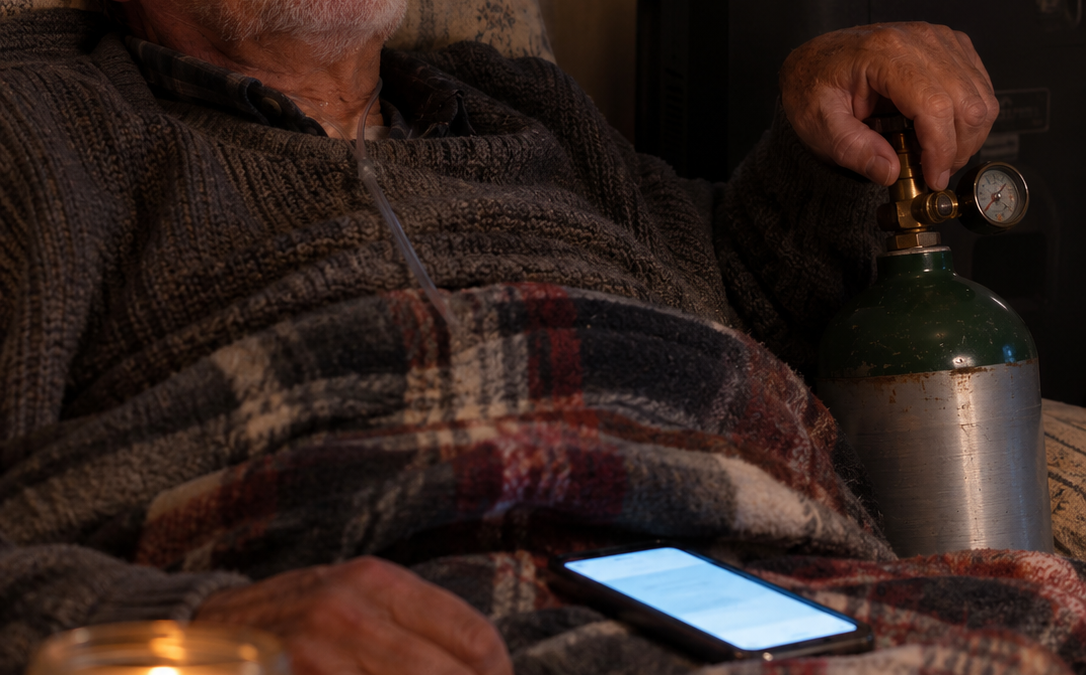
Complete story · 7 chapters · about 34 minutes · ending included
Chapter 1 · Chapter 2 · Chapter 3 · Chapter 4 · Chapter 5 · Chapter 6 · Chapter 7
Chapter 1: The Text That Said Stop Calling
“You nearly cost me my promotion over a power outage, Dad.”
Michelle said it at 1:15 in the morning, standing beside my emergency-room bed in her party dress.
Kyle heard her.
So did the nurse.
My eight-year-old granddaughter, Stella, was asleep in a chair a few feet away after spending most of the night afraid I was going to stop breathing.
Four hours earlier, I had still trusted my daughter to come when I called.
At 9:40 that Saturday night, the oxygen concentrator beside my recliner went dark.
The lamp died with it.
So did the television, the kitchen light, and the little green clock on the stove.
Outside, ice tapped the windows hard enough to sound like handfuls of gravel. Somewhere down the road, a transformer gave one dull pop.
At sixty-nine, I needed oxygen nightly and watched Stella while Michelle sipped champagne at her boss’s lake party.
I reached for Michelle first.
“Grandpa?”
Stella stood in the hallway in her socks, holding the paperback she’d been reading in bed.
“I’m all right.”
I wasn’t.
The concentrator had stopped pushing air through the clear line under my nose. My chest already felt tighter than it had a minute earlier.
I kept a backup cylinder beside the recliner because my lung doctor had told me never to trust electricity during an Ohio winter.
I turned the valve.
The gauge climbed, then settled just above a quarter tank.
Stella came closer.
“Is that enough?”
“For a while.”
That was my first lie to her.
I pulled the blanket higher over my knees and picked up my phone.
Michelle and her husband, Kyle, had left Stella with me before supper. Kyle had been called to an HVAC job, and Michelle had a company gathering at her regional manager’s boss’s place on Buckeye Lake.
Twenty-five minutes away.
She had kissed my cheek in the doorway.
“Call if you need anything, Dad.”
I believed her.
At 9:41, I called.
No answer.
At 9:44, I called again.
Nothing.
The backup tank hissed softly beside me.
I watched the gauge.
At 9:46, I tried a third time.
Stella sat on the end of the couch now, looking at me instead of her book.
“Mommy’s not answering?”
“She’s busy.”
My phone buzzed at 9:47.
Michelle’s text filled the screen.
Stop calling, Dad, we’re at the boss’s lake party.
I stared at the words.
Stella could read them over my shoulder.
She looked from the phone to my face.
“What did Mommy say?”
I turned the screen down against my leg.
“All right.”
That was all I sent back.
Two words.
No complaint.
No request.
No explanation about the quarter tank.
I had spent more than thirty years driving a school bus. I knew how to handle bad roads, scared children, broken heaters, flat tires and sudden weather.
I had also spent most of my life believing there were certain calls your family answered.
That night, pride cost me minutes I didn’t have.
Instead of dialing 911, I turned the oxygen down a little.
The flow felt weaker under my nose.
Stella noticed me adjusting it.
“Why’d you turn it?”
“Making it last.”
She didn’t ask another question.
The house got colder quickly.
I lit two candles from the kitchen drawer and set one on the coffee table and one on the counter. Their light threw long shadows over the room.
Stella brought me the old quilt from the back of the couch.
“Here.”
“You keep some.”
“I’m not cold.”
She was shivering.
I lifted one side of the quilt, and she climbed onto the couch beside my chair, pulling the edge over her legs.
By 10:05, I had stopped talking unless I had to.
Breathing took work.
Every inhale felt too small.
Stella watched the tank gauge more than she watched me.
“Grandpa, it’s going down.”
“I see it.”
“Should I call Mommy?”
“No.”
That answer came fast.
I didn’t want Stella hearing another refusal.
I didn’t want Michelle’s phone ringing on some bright deck while I sat in a dark house teaching her daughter what being unwanted sounded like.
My phone lay on the blanket near my thigh.
At 10:12, Stella reached for it.
“What are you doing?”
She slid off the couch.
“Calling.”
“Stella.”
She looked at me.
Her face was pale in the candlelight.
“You can’t breathe.”
“I can.”
“Not right.”
She knew the passcode because she used my phone to play word games.
Her small fingers moved over the screen.
I should have stopped her.
I didn’t.
She pressed three numbers and put the phone to her ear.
When the dispatcher answered, Stella spoke clearly.
“My mom said stop calling. Grandpa can’t breathe.”
I closed my eyes.
That sentence hurt worse than the tightness in my chest.
Picking up where the Facebook post left off
The dispatcher asked for the address.
Stella gave it.
She knew the house number because I’d made her memorize it the summer before.
Then came questions.
Was I awake?
Yes.
Was I sitting up?
Yes.
Was oxygen running?
Yes.
How much was left?
Stella crouched beside the cylinder and squinted at the gauge.
“It’s almost red.”
The dispatcher told her to stay calm and keep me sitting upright.
Stella sat on the floor beside my recliner with the phone on speaker.
The dispatcher asked her to count my breaths.
Stella watched my chest.
“One.”
She waited.
“Two.”
Another breath.
“Three.”
She counted slowly.
Her voice shook on seven.
The dispatcher kept talking to her.
So Stella kept counting.
I hated that my granddaughter had to do it.
An eight-year-old should have been worried about spelling words and whether her library book was overdue.
She shouldn’t have been kneeling beside an oxygen tank, counting the breaths her grandfather might lose.
At one point she reached under the quilt and held my hand.
Her palm was cold.
I squeezed once.
She squeezed back.
The call lasted 26 minutes.
Near the end of it, Stella kept turning toward the front window whenever headlights passed on the icy street.
“Is that them?”
“No.”
Then the next car.
“Is that them?”
“No.”
At 10:38, red light moved across the ceiling.
Stella stood so fast the phone nearly slipped from her hand.
“They’re here.”
Two paramedics came through the front door carrying equipment. One went straight to the tank.
The gauge sat near the red.
The other knelt in front of me and asked my name.
“Charles Maxwell.”
“Mr. Maxwell, we’re going to get you some better oxygen.”
“Good.”
Short answers were easier.
They changed the tubing and fitted me with a mask.
Cold, strong oxygen hit my face.
One paramedic looked toward Stella.
“You made the call?”
She nodded.
“Good job.”
Stella looked at me instead of him.
I was loaded onto the stretcher.
She followed us outside in her winter coat over pajamas, holding my phone in both hands.
A neighbor met us at the sidewalk and agreed to follow the ambulance in her own car. From her car, she phoned Kyle and told him which hospital we were heading to.
Stella climbed into the ambulance and took the seat near my feet.
Once I was inside, the medic secured the mask and began checking my blood pressure.
My phone lit in Stella’s hands.
“Grandpa.”
I turned my head.
The screen showed Michelle’s social post from 10:31 p.m.
She was standing on her boss’s lake deck under strings of bright outdoor lights.
A champagne glass was raised near her shoulder.
Behind her, the lake was black and the railing shone with ice.
The words under the picture said:
Best night of the year.
Stella stared at it.
Then she looked at me through the clear oxygen mask.
“Is Mommy coming?”
I couldn’t answer that.
The ambulance doors closed.
During the ride, Stella kept my phone in her lap.
Nobody called.
At the emergency room, nurses moved me into a treatment bay and took Stella to a chair near the curtain. Our neighbor stayed until Kyle arrived from his job shortly after midnight.
He came in wearing work pants and a heavy jacket, his hair damp with melted sleet.
“What happened?”
Stella got up and ran to him.
Kyle held her against his chest while she told him about the lights going out and the oxygen stopping.
I watched his face when she reached the part about Michelle’s text.
He looked at me.
“She told you to stop calling?”
I nodded.
He pulled out his phone.
I didn’t ask who he called.
I already knew.
No answer.
A nurse adjusted my oxygen and checked the monitor.
Kyle tried again from the hallway.
Still nothing.
By 12:40, Stella had fallen asleep curled sideways in the chair, her head against Kyle’s coat.
I felt better than I had at home, but tired enough that lifting my arm felt like work.
Kyle sat near the bed.
“She said this was a work thing.”
“Maybe it is.”
He looked toward the curtain.
“She should’ve answered.”
I didn’t argue.
At 1:08 a.m., footsteps hurried down the hall.
Then Michelle’s voice.
“Where is he?”
She came around the curtain at 1:15 wearing the same dark party dress from the picture, with a winter coat hanging open over it.
Her hair was still done.
Her makeup was still on.
She looked first at me, then Kyle, then Stella asleep in the chair.
“What happened?”
Kyle stood.
Michelle looked at the oxygen line, then at me.
“You nearly cost me my promotion over a power outage, Dad.”
Kyle stared at her.
Before he could answer, the nurse beside my bed looked at Michelle.
“Your daughter’s call is on the county recording.”
Michelle went pale.
Chapter 2: The Promotion She Almost Lost
Sunday morning, I was still in the hospital when Michelle began telling people what had happened the night before.
Kyle stood near the window. Stella sat beside him with his coat over her legs. A nurse was checking the monitor beside my bed.
“Dad was fine that night. He told me not to come,” Michelle said.
Kyle looked at her.
Michelle kept going.
“I was on my way the minute the power went out.”
I said nothing.
Kyle had not seen her 9:47 text.
I could tell by the way he looked between us, waiting for somebody to explain why his wife’s story did not match what Stella had told him after he arrived at the hospital.
The nurse adjusted the clip on my finger.
“Mr. Maxwell, did you lose power around nine-forty?”
“Yes.”
“And your backup oxygen was almost empty when EMS arrived?”
“Yes.”
Michelle folded her arms.
“The roads were iced over. I couldn’t just leave instantly.”
Kyle turned toward her.
“You just said you were already on your way.”
“I meant I was trying to get away.”
The nurse glanced at me.
My phone was on the tray beside the bed.
Michelle’s message was still there.
Stop calling, Dad, we’re at the boss’s lake party.
So was her 10:31 post from the deck.
Best night of the year.
I could have handed the phone to Kyle.
I could have ended her story in ten seconds.
Instead, I looked at Stella.
She had spent 26 minutes on a 911 call, counting my breaths while my oxygen tank dropped toward red. She had stayed awake through the ambulance ride and most of the night in the emergency room.
I did not want her Sunday morning to become a fight between her parents.
Kyle said, “Stella told me she called because Charles couldn’t breathe.”
“She panicked,” Michelle said.
The nurse stopped writing.
“Your daughter gave the dispatcher accurate information.”
Michelle’s jaw tightened.
“She’s eight.”
“She gave us the address, his condition and the oxygen situation.”
Kyle looked at Michelle again.
I stayed quiet.
For the moment, her lies stayed in the room with us.
A little later, Kyle took Stella downstairs to get something to eat. The nurse left to check another patient.
Michelle waited until we were alone.
Then her face changed.
“You nearly cost me my promotion over a power outage, Dad.”
I looked at her.
“You called three times. Stella called 911. Kyle gets dragged out here in the middle of the night, and now that nurse thinks I abandoned you.”
“You did.”
“I was twenty-five minutes away.”
“And you told me to stop calling.”
Her eyes moved toward my phone.
“You were breathing when I left.”
“My machine wasn’t.”
“I didn’t know the tank was low.”
“You didn’t ask.”
Michelle leaned closer.
“This promotion matters, Dad. My boss was there. His people were there. I couldn’t walk out in the middle of everything because the electricity went off at your house.”
“No.”
She frowned.
“No what?”
“No walking out.”
For a second, she just stared at me.
Then she changed direction.
“Give me your wallet.”
I looked at her hand.
“What for?”
“To handle the hospital bills.”
“No.”
“Dad, you’re exhausted.”
“I’m keeping it.”
“I already take care of half this stuff for you.”
“My wallet stays with me.”
Her hand dropped.
“You’re going to get bills from everywhere.”
“Then they can send them.”
“I can make sure they’re paid.”
“I said no.”
Footsteps sounded in the hallway.
Michelle stepped away from the bed before Kyle and Stella came back.
I did not tell Kyle about the wallet.
I did not tell him what Michelle had said once he left.
Not yet.
On Monday, December 7, I was still hospitalized and waiting to be discharged when I called the county 911 center from my room.
The nurse’s words from the night before had stayed with me.
Your daughter’s call is on the county recording.
The woman who answered asked for the date, my address and the approximate time.
“December fifth,” I said. “About ten-twelve at night.”
She found the call.
“Twenty-six minutes?”
“That’s the one.”
I asked how to get a copy.
She explained the public-records request and said the recording should be available within three business days.
“Email is fine.”
She took my information.
I had heard only pieces of Stella’s call Saturday night.
Her counting.
The dispatcher asking questions.
Stella saying the gauge was almost red.
I wanted all 26 minutes.
After I hung up, I called the hospital billing office.
Michelle asking for my wallet had brought back something she had told me in September.
That month, I had checked the balance in my savings account.
I did not bank online. After my COPD hospital stay in April 2025, I had added Michelle as a joint owner so she could help if I was sick. The statements had gone paperless to her email after that.
When I saw the balance in September, it was far lower than I expected.
I had asked her about it.
“Your medical bills ate that money, Dad.”
I believed the explanation.
There had been a hospital stay, doctor visits, oxygen equipment and prescriptions. I knew some of those costs were mine.
But I had never seen a stack of bills that matched the amount missing from my savings.
I had simply assumed Michelle had seen paperwork I had not.
Now she had lied about Saturday night, tried to take my wallet when Kyle left the room, and claimed she needed it for hospital bills.
I wanted an exact number.
A billing clerk came on the line.
“I need to know what I actually owe,” I said.
She verified my information and started checking my account.
I listened to her keyboard.
“Medicare processed the hospital charges,” she said. “Your supplement covered the remaining eligible amount.”
“What came out of my pocket?”
She checked another screen.
“Your patient responsibility is two hundred forty dollars.”
“For this stay?”
“For the out-of-pocket charges we have for 2025 and 2026.”
I tightened my grip on the phone.
“Total?”
“Yes.”
The savings account had been down by thousands when I checked it in September.
Michelle had blamed medical bills.
Now the hospital was telling me my responsibility across both years was less than the cost of a new set of tires.
“Can you make sure?” I asked.
The clerk paused while she checked.
I looked at my wallet on the bedside table.
I thought about Michelle reaching for it.
I thought about the statements going to her email.
I thought about how quickly she had answered me in September.
If my medical care had not taken the savings, then I needed to know what had.
The clerk came back on the line.
“Two hundred forty dollars, Mr. Maxwell. That’s all.”
Chapter 3: The Statements Sent to Her Email
I left the hospital on Wednesday with an oxygen tank, discharge papers, and one number I could not get out of my head.
Two hundred forty dollars.
That was what the billing office said I owed for my medical care across 2025 and 2026.
Yet when I had checked my savings in September, thousands were gone.
Michelle had told me medical bills took it.
So after I got home and changed clothes, I drove to Fairhaven Savings on North 21st Street.
I had not seen a paper statement since April 2025.
That was when I added Michelle to the account after my COPD hospital stay. I wanted somebody able to pay bills or get money if I ended up too sick to do it myself.
The statements went paperless after that.
To Michelle’s email.
At the bank, Rosa Bianchi came out from behind her desk when she saw me.
She had managed that branch for years. She was fifty-five and had a habit of reading important language aloud instead of summarizing it.
“Charles, you should be home resting.”
“I’ve rested enough.”
She looked at the oxygen tubing under my nose.
“What do you need?”
“Paper statements.”
“How far back?”
“April of last year.”
Rosa studied me for a second, then nodded.
“Come sit down.”
Her office had a glass wall facing the lobby. I lowered myself into the chair while she pulled up the account.
“I want everything,” I said. “Deposits. Withdrawals. Automatic payments.”
“You’ll have it.”
The printer started behind her.
Page after page came out.
Rosa placed them in order and slid the stack toward me.
I started with the newest statement.
My pay from driving the school bus was there.
My Social Security deposit was there.
Then I saw a line I did not recognize.
$1,870.
Automatic payment.
I moved to the previous month.
The same amount.
$1,870.
Again.
I went backward another month.
Same thing.
“What is this?”
Rosa turned the statement toward herself and entered the transaction code.
Her face changed.
“It’s a mortgage payment.”
“Mine?”
“No.”
She clicked again.
“Loan holder is Michelle Ortiz.”
I looked at her.
“Michelle’s cabin?”
Rosa nodded slowly.
“That’s what the payee information appears to show.”
I started counting.
December 1, 2026.
November 1.
October.
September.
The same $1,870 left my account month after month.
I kept going backward.
Seventeen payments.
The first was August 1, 2025.
I took a pen from Rosa’s desk and wrote the amounts in the margin as I counted.
Seventeen times $1,870.
Rosa used her calculator before I finished.
“$31,790.”
I stared at the number.
Thirty-one thousand seven hundred ninety dollars.
I knew where much of that money had come from.
After my wife died, part of her insurance money had gone into that account.
I had left it there because I did not need to spend it.
Some of it was supposed to make retirement easier.
Some of it was there because I had never been able to decide what felt right to do with money that existed only because she was gone.
Michelle had decided for me.
She had been paying for her cabin with it.
Month after month.
I looked at the statements again.
Every deposit into the account was mine.
My pay.
My Social Security.
No money from Michelle.
“What’s left?”
Rosa checked the current balance.
“$22,460.”
I sat back.
In September, when I had noticed the balance was lower than I expected, Michelle had looked me in the face and said my medical bills ate the money.
My actual hospital responsibility was $240.
Her cabin had taken $31,790.
Rosa folded her hands.
“Charles, there’s something else.”
I looked up.
“Michelle called Monday.”
The same Monday I had been sitting in a hospital room requesting Stella’s 911 recording.
“What did she want?”
“She ordered cash.”
“How much?”
“$9,000.”
I stared at Rosa.
“Nine thousand?”
“For pickup next Tuesday, December fifteenth, at ten in the morning.”
“What did she say it was for?”
“The boathouse at the cabin. She said the storm crushed part of it and she needed to pay a contractor.”
My oxygen machine had died in that storm.
Michelle had ignored three calls from me.
Two days later, she had ordered $9,000 from my account to fix her boathouse.
I looked through the glass wall at the lobby.
People came and went.
A man filled out a deposit slip.
A woman held a toddler while waiting for a teller.
Everything looked ordinary.
My family wasn’t.
“What can she take?”
Rosa turned toward her computer.
“Let me pull the ownership agreement.”
She found the document from April 14, 2025 and printed it.
My signature was at the bottom.
So was Michelle’s.
Rosa pointed to a paragraph.
Then, like she always did with important language, she read it aloud.
“Either owner may withdraw all funds or close the account.”
I looked at the sentence.
“All of it?”
“Under this agreement, yes.”
“Even though every deposit was mine?”
“Yes. You made her a joint owner.”
That was why she could set up the mortgage payments.
That was why she could order $9,000.
And that was why she had wanted my wallet in the hospital.
I thought about Michelle’s hand held out beside my bed.
To handle the hospital bills.
I had spent a year trusting the wrong person with access to everything.
Rosa waited.
“What do you want to do?”
I looked at the balance again.
$22,460.
If I left the account open, Michelle could take that too.
Closing it would start a family war.
I did not know what Kyle had been told about where the cabin money came from.
Stella was eight.
Michelle was my daughter.
None of that changed the statements in front of me.
“Then I’ll close it.”
Rosa nodded once.
She opened a new account in my name only.
I moved the full $22,460 into it.
She canceled the pending $9,000 cash order.
Then she closed the joint account.
“The closing letter will go to the address on the account,” Rosa said.
“My house?”
“Yes.”
Michelle would not get it in her email.
Not yet.
Rosa ordered a new debit card for my sole account.
“When would you like to pick it up?”
My eyes went to the date printed at the top of Rosa’s appointment sheet.
Tuesday, December 15.
Michelle’s cash pickup had been scheduled for 10:00.
“Ten o’clock Tuesday.”
Rosa entered the appointment.
I gathered the seventeen statements and placed them in my discharge folder.
Michelle still believed she could walk into Fairhaven Savings next Tuesday and leave with $9,000.
At the same hour, I would be there to pick up a card she could no longer touch.
Chapter 4: The Recording From the County
The county recording arrived by email Thursday afternoon.
By then, the joint account was closed.
The seventeen statements were in a folder on my kitchen table, and the remaining $22,460 was in an account Michelle could not touch.
Kyle still knew none of that.
He also had not seen the text Michelle sent me during the storm.
So I opened the county email and played Stella’s 911 call once.
The time stamp said 10:12 p.m.
There was a little static at the beginning, then the dispatcher asking what the emergency was.
Stella’s voice came through my laptop speakers.
“My mom said stop calling. Grandpa can’t breathe.”
I sat still.
I remembered hearing her say it that night, but the recording was different.
This time I could hear everything around her.
The oxygen tank hissing.
The dispatcher asking whether I was awake.
Stella breathing fast as she moved around the room.
Then her counting mine.
“One.”
A pause.
“Two.”
Another pause.
“Three.”
Twenty-six minutes of my granddaughter trying to keep me safe.
When the recording ended, I closed the laptop.
I did not play it again.
The county had preserved exactly what happened.
Michelle could tell Kyle whatever she wanted.
The recording would not change.
On Saturday, Michelle came to my house shortly before noon.
She did not bring Stella.
That was the first thing I noticed.
“Where is she?”
“With Kyle.”
Michelle walked past me into the living room while talking on her phone.
“Yes, I’m here now,” she said.
Then she tapped the speaker button.
A man’s voice came through.
Her boss.
Michelle changed immediately.
Her shoulders loosened. Her voice warmed.
“Dad’s fine. He told me not to come.”
I stood beside the recliner where my concentrator had died one week earlier.
The backup tank had been replaced.
The candles were back in the kitchen drawer.
Nothing else in the room looked different.
Michelle kept talking.
“It was really just the outage and the oxygen machine. You know how parents get when they’re older.”
I looked at her.
She turned slightly away.
The man on the phone said something about the storm and hoped I was recovering.
Michelle smiled toward the phone as if he could see her.
“Oh, absolutely. He’s doing great.”
I said nothing.
A minute later she ended the call.
Her smile went with it.
“You didn’t have to stand there looking like that.”
“Like what?”
“Like I’m lying.”
“You were.”
She slipped the phone into her coat pocket.
“I was protecting my job.”
“From what?”
“From unnecessary drama.”
I looked toward the kitchen table.
The folder with the statements was put away where she could not see it.
The county recording was saved on my computer.
Michelle believed the account was still open.
She believed her $9,000 was waiting.
I wanted her to keep believing it until Tuesday.
She picked up her purse.
“Tuesday I’m picking up cash for the boathouse. Kyle thinks it’s my bonus, so keep it that way.”
I looked at her.
Now I knew Kyle had been given a lie, not just left to assume the wrong thing.
Michelle had told him the cabin money came from her bonus.
“Your bonus.”
“That’s what he thinks.”
“And the cash?”
“Same thing.”
I remembered the seventeen withdrawals.
$1,870 every month.
$31,790 total.
Much of it had come from my wife’s insurance money.
Kyle thought Michelle’s company had paid for the cabin.
Michelle knew better.
She pointed a finger at me.
“Don’t start anything with him.”
“I heard you.”
She watched me for a few seconds.
Maybe she heard agreement in those words.
She shouldn’t have.
After she left, I took a chair at the kitchen table and set my phone in front of me.
I could call Kyle and tell him everything.
I could tell him about the seventeen statements.
I could tell him the cabin mortgage had been coming out of my account since August 2025.
I could tell him Michelle had ordered $9,000 for the boathouse.
But then it would be my word against hers until I showed him the papers.
Michelle would call me confused.
Angry.
Sick.
Old.
She had already started doing that at the hospital.
I wanted Kyle to see something she could not explain away.
The bank counter.
The canceled cash order.
The closed account.
The agreement.
I picked up the phone and called him.
He answered after three rings.
“Charles?”
“Yes.”
“Everything okay?”
“For now.”
There was a pause.
“What’s going on?”
“Michelle going to Fairhaven Tuesday?”
“She said she has to pick something up.”
“Go with her.”
Another pause.
“Why?”
“Go with her Tuesday. Hear it from the bank, not from me.”
“Charles, what am I supposed to hear?”
“I want you there.”
“Is this about Saturday night?”
“It’s about more than Saturday night.”
He stopped speaking, and a few sounds came through from somewhere behind him.
Then Stella’s voice, farther away.
“Dad, where’s my blue marker?”
Kyle covered the phone for a second.
“Kitchen drawer, Stell.”
My chest tightened for a reason oxygen would not fix.
Michelle could make that voice disappear from my house.
She could stop the visits.
Stop Saturday pancakes.
Stop Stella leaving library books on my couch and crayons under my kitchen table.
Kyle came back on the line.
“What time Tuesday?”
“Ten.”
“I’ll be there.”
“With Michelle.”
“Yes.”
“Good.”
I hung up.
That afternoon I put the phone beside the county recording and the folder of statements.
I knew what I was risking.
Michelle came back around five to pick up something she had left earlier.
She was in my house less than two minutes.
At the front door, I asked one question.
“Kyle going with you Tuesday?”
Her hand stopped on the knob.
She turned.
“What did you say to him?”
“Asked him to go.”
Her face went flat.
“You had no business doing that.”
“It’s his marriage.”
“It’s my money.”
I looked at her.
She knew immediately that she had said too much.
Then she opened the door.
Cold air came into the hall.
Michelle stepped onto the porch and looked back at me.
“Make trouble Tuesday and Stella stops coming here.”
Chapter 5: The Teller Who Slid It Back
At 10:04 Tuesday morning, eleven customers were waiting in line at Fairhaven Savings when Michelle stepped up to the counter.
Kyle stood beside her.
I was already inside Rosa Bianchi’s office, waiting for my new debit card.
Through the glass wall, I watched Michelle take a withdrawal slip from her purse and slide it toward the teller.
$9,000.
She still believed the money was waiting.
The teller checked the account, then looked at Michelle’s debit card.
“This account was closed December 9 by the primary owner.”
Michelle blinked.
“What?”
The teller turned the slip around and pushed it back across the counter.
Then she placed Michelle’s debit card beside it.
“This card is no longer active.”
Michelle picked it up.
“Run it again.”
“The account is closed.”
Kyle looked at her.
“You said you ordered the cash.”
“I did.”
The customers behind them had gone quiet.
Michelle lowered her voice at first.
“There must be some mistake.”
The teller shook her head.
“The account was closed December 9.”
“By who?”
“The primary owner.”
Michelle knew the answer.
Her face turned toward Rosa’s office.
She saw me through the glass.
Then her voice carried across the lobby.
“He’s sixty-nine and on oxygen. He doesn’t know what he signed.”
I stood up.
Rosa did too.
She opened her office door, and I walked into the lobby with my oxygen line under my nose and my phone in one hand.
Kyle stared at me.
“Charles?”
Michelle stepped away from the counter.
“Dad was fine that night. He told me not to come.”
I stopped beside Kyle.
I had spent days deciding whether I could do this.
She was still my daughter.
There were eleven strangers behind us.
But Michelle had threatened to take Stella away if I made trouble, and now she was using my age and my lungs to explain why I should not control my own money.
I unlocked my phone.
“Here.”
I handed it to Kyle.
The first thing on the screen was Michelle’s 9:47 text.
Stop calling, Dad, we’re at the boss’s lake party.
Kyle read it.
His face changed.
Michelle moved toward him.
“That was before I knew how bad it was.”
Kyle did not answer.
I touched the screen and brought up her 10:31 post.
The photograph showed Michelle on her boss’s deck with champagne.
Best night of the year.
Kyle looked at the time.
Then at her.
“You posted this while Stella was on the phone with 911?”
Michelle reached for the phone.
“Give me that.”
Kyle moved it away from her.
“Did you know he was calling?”
“He calls me for everything.”
“Three times?”
“It was a power outage.”
I took my phone back.
Michelle looked toward the people waiting behind her.
Then she pointed at Rosa.
“This has nothing to do with the cabin.”
Rosa stayed calm.
Michelle turned to Kyle.
“That cabin is my bonus. I never touched Dad’s money.”
I looked at Rosa.
“You can show him.”
Rosa went back into her office and returned with the statements.
All seventeen.
She placed them on the counter with my consent.
Kyle stepped closer.
Rosa pointed to the first automatic payment.
“August 1, 2025. One thousand eight hundred seventy dollars.”
Then the next.
“September 1. Same amount.”
She moved through the pages.
October.
November.
December.
Month after month.
Kyle stopped her.
“Whose mortgage?”
Rosa looked at me before answering.
I nodded.
“Michelle Ortiz’s cabin loan.”
Kyle stared at his wife.
Michelle folded her arms.
“It’s complicated.”
Rosa gathered the pages into one stack.
“Seventeen payments of $1,870.”
Kyle did the math in his head, then looked at the total Rosa had written.
“$31,790?”
“Yes.”
He turned to Michelle.
“You told me your company paid you a bonus.”
“They were going to.”
“You told me the cabin was paid from that.”
“I was going to replace the money.”
“When?”
Michelle looked around.
The eleven customers were still there.
So were the tellers.
Nobody said anything.
Her voice sharpened.
“I meant to put every dollar back once my bonus came through.”
Kyle stared at her.
“You set up seventeen mortgage payments from Charles’s account.”
“I just told you I was paying it back.”
“Did he know?”
Michelle did not answer.
Kyle looked at me.
“No.”
That was enough.
I picked up my phone again.
There was one thing left.
The county recording.
I pressed play.
The lobby filled with a little static.
Then Stella’s voice.
“My mom said stop calling. Grandpa can’t breathe.”
Kyle’s eyes closed for a second.
The dispatcher asked Stella for the address.
Stella gave it.
Then came her breathing.
The oxygen tank hissing.
The questions.
And Stella counting.
“One.”
A pause.
“Two.”
Michelle stood motionless.
“Turn that off.”
I didn’t.
Stella’s voice continued.
She told the dispatcher the tank gauge was almost red.
Kyle looked at Michelle.
“You told me the cabin was your bonus. You told me he said not to come.”
Michelle opened her mouth.
Kyle bent down and picked up the cabin keys that had fallen beside her purse when she reached for the withdrawal slip.
He held them for a second.
Then closed his hand around them.
I stopped the recording.
Michelle looked at me.
“You wanted this.”
“No.”
“You wanted to embarrass me.”
I looked at the dead debit card still sitting beside the rejected $9,000 slip.
“You told me to stop calling. So I stopped paying.”
Michelle’s face went still.
Kyle stepped away from the counter.
He handed me my phone.
Then he looked at Michelle.
“Stella and I are eating at Charles’s tonight.”
“Kyle.”
“Without you.”
He walked toward the door.
I followed him.
Behind us, the teller pushed Michelle’s dead debit card and rejected withdrawal slip back across the counter one more time.
She did not pick them up.
Kyle held the door for me.
Outside, the December air cut cold against my face.
“Stella asked if Grandpa was coming for supper,” he said.
I adjusted the oxygen tubing under my nose.
“Tell her it’s at my house.”
Kyle nodded.
Then he walked beside me toward the parking lot, the cabin keys still in his hand.
Michelle stayed inside the bank.
Chapter 6: The Cabin Payment That Came Back
On Monday, January 4, Michelle’s cabin payment came back unpaid.
The account she had used for seventeen months no longer existed, and there was no $1,870 waiting for the mortgage company.
By noon, the boathouse contractor had quit too.
He had already waited for the $9,000 Michelle planned to pick up from my account in December. Once she told him that money was not coming, he pulled his crew from the job.
That evening, Kyle called me.
“She listed the cabin.”
I was at my kitchen table, the seventeen statements spread in front of me.
“For sale?”
“Yes.”
“Good.”
Kyle was quiet for a moment.
“That’s all you’ve got?”
“That’s enough.”
Michelle still owned the cabin.
She still owed me $31,790.
And I had stopped discussing either one with her directly.
The week after the bank confrontation, I hired a lawyer.
I gave him copies of the account agreement, all seventeen statements, and the bank records showing every deposit had come from my pay or Social Security.
He asked what I wanted.
“My money back.”
“Anything else?”
“No.”
I did not want her arrested.
I did not want speeches.
I did not want to spend months arguing about why she had done it.
I wanted the amount on those statements returned.
My lawyer sent Michelle a demand letter.
It listed every $1,870 payment.
Seventeen of them.
Total: $31,790.
The letter asked for repayment and made clear that the cabin sale could be used to satisfy it.
Michelle called me the night she received it.
I let the phone ring.
Then she texted.
You got a lawyer?
I did not answer.
A second message came.
You’re treating me like some stranger.
I turned the phone face down.
She had spent more than a year treating my savings like an account she had earned.
I was done arguing by text.
On January 20, Michelle signed a promissory note.
My lawyer called me after the paperwork was finished.
“She agreed to the full amount.”
“$31,790?”
“Every dollar.”
“From the cabin sale?”
“Yes.”
I wrote the date on the front of my folder.
January 20, 2027.
That did not put the money back in my account.
But it put her promise on paper.
By then, Kyle had already moved out.
He found a small place two streets from my house and took Stella with him.
The first Saturday after they moved, Stella came over carrying a grocery bag with pancake mix and a blue marker sticking out of the top.
“You still got syrup?”
“Always.”
Kyle carried in a box with a few of her things.
Her library books went back onto the end table.
Her crayons went into my kitchen drawer.
The house sounded normal again.
That afternoon, my phone buzzed.
Michelle.
Are you happy now?
I looked through the doorway.
Stella was at the table drawing while Kyle fixed the loose handle on one of my cabinets.
Michelle wanted me to answer a question that made all of this sound like a victory I had been chasing.
I typed one sentence.
Pay the note. Then we’ll talk.
She did not answer.
I did not send anything else.
A few days later, I went to the oxygen supplier.
The storm had taught me something I should have fixed long before Michelle ever sent that text.
A quarter-full backup cylinder was not enough.
I bought a battery backup for my concentrator.
It cost me my own money.
That part mattered to me.
I carried it home, set it under the kitchen counter near the outlet, and had the technician show me how to check the charge.
A green light came on.
“That’ll keep you running if the power drops,” he said.
“For how long?”
He told me.
I made him show me twice how to switch over and how to check the battery level.
I wrote the instructions on a card and put it beside the unit.
Stella inspected it when she came over.
“Does that mean I don’t have to call 911 again?”
“If I need help, you still call.”
“But this helps.”
“Yes.”
She touched the green light with one finger.
“Good.”
I knew what she meant.
I felt the same way.
The supplier also had me update my account information.
Address.
Insurance.
Doctor.
Emergency contact.
The woman behind the counter turned the form toward me.
“Still Michelle Ortiz?”
Her name was printed on the line.
I looked at it.
For years, Michelle had been the person I expected to call if something went wrong.
Even after my hospital stay in 2025, that had seemed natural.
She was my only daughter.
I had built an entire emergency plan around that fact.
Then the lights went out on December 5.
I called three times.
At 9:47, she told me to stop.
An eight-year-old had done what the adult I trusted would not.
But Stella was a child.
She should never carry that responsibility again.
Kyle had shown up at the hospital.
He had gone to the bank when I asked.
He had listened when the facts got ugly instead of asking me to make them easier.
And he now lived two streets away.
The woman behind the counter handed me a pen.
“You can change it if you want.”
I put the form flat on the counter.
Michelle Ortiz.
I drew one line through her name.
Then I wrote Kyle Ortiz underneath it.
Chapter 7: The Phone That Kept Ringing
On Friday, March 5, the $31,790 came back into my account.
The cabin had sold.
Michelle’s promissory note was paid.
I checked the deposit at Fairhaven Savings that morning, then drove home without stopping anywhere else.
For more than a year, $1,870 had left my account every month for a cabin I did not own.
Now the full amount was back.
That did not put December 5 back the way it had been.
It did not erase Stella counting my breaths.
It did not turn Michelle’s 9:47 text into a phone call answered.
Money could fix an account.
It could not fix trust that easily.
That evening, Kyle and Stella came over for supper.
Kyle brought a pan of baked chicken.
Stella carried a bag with rolls and announced that she had picked them herself.
“You picked the bag?”
“The rolls.”
“Good work.”
She rolled her eyes at me.
Since moving two streets away, they had been in and out of my house enough that Stella no longer asked where anything belonged.
She put the rolls on the counter and opened the silverware drawer.
Kyle took plates from the cabinet.
Under the counter, my battery backup showed a steady green light.
Stella checked it anyway.
She always did.
“Still green,” she said.
“Still green.”
“You charged it?”
“Yesterday.”
She nodded like an inspector satisfied with my work.
I had also replaced the backup oxygen cylinder and kept the gauge where I could see it.
Kyle was my emergency contact now.
His number was on the supplier’s form, at my doctor’s office, and on a card beside the phone.
Those changes were small on paper.
To me, they meant I no longer had to hope Michelle would become reliable during the next emergency.
We ate at the kitchen table.
Stella told me about a third-grade spelling test.
Kyle told me the furnace at his new place made a knocking sound and he planned to look at it Saturday.
I told him not to tear apart a furnace before breakfast.
“I fix HVAC for a living, Charles.”
“People do foolish things professionally too.”
Stella laughed so hard she dropped a piece of roll.
It was an ordinary supper.
I had missed ordinary.
After we ate, Stella carried her plate to the sink.
That was when I noticed the envelope on the counter.
It had arrived that afternoon.
Michelle’s handwriting was on the front.
I had left it unopened until after supper because I did not want her at the table without being there.
Kyle saw it.
“You going to open that?”
“Yes.”
Stella was rinsing her plate.
I put the envelope in my pocket.
“Later.”
Kyle understood.
At seven-thirty, they put on their coats.
Stella hugged me around the middle, careful of my oxygen tubing.
“Call you tonight.”
“You always do.”
“I know.”
Kyle paused at the door.
“You okay?”
“Yes.”
“You sure?”
“I’ve got your number.”
He smiled a little.
“Use it.”
“I will.”
After they left, I locked the door and went back to the kitchen.
The green light under the counter stayed steady.
I opened Michelle’s envelope.
There was a card inside.
Only three words were written in her handwriting.
I’m sorry, Dad.
I sat down.
For months, she had sent texts about the lawyer, the note, the cabin, Kyle leaving.
She had asked whether I was happy.
She had blamed me for embarrassing her at the bank.
This was different.
It was also not enough to make December disappear.
I took a plain card from the drawer where I kept stamps and envelopes.
I did not write a speech.
I wrote that she could come on Sundays.
Kyle had to be there.
Those were the terms.
I signed my name.
Forgiving wasn’t trusting.
I could speak to my daughter.
I could let her sit in my kitchen.
I could watch her spend time with Stella while Kyle was there.
What I would not do was hand her my account, my emergency plan, or my safety again because she had written three words on a card.
I sealed the envelope and set it by the door to mail the next morning.
At 7:55, I checked the battery backup.
Green.
The concentrator ran beside my bed.
The clear oxygen line rested across the blanket.
I changed into my pajamas and sat against the pillows with a book.
My phone was on the nightstand.
Since December, Stella had called every night.
Some nights she told me about school.
Some nights she asked one question and hung up two minutes later.
Once she called only to tell me she had lost a tooth.
The calls were not emergency checks anymore, though I knew part of her still listened to my breathing.
She never said so.
At 8:00, the phone rang.
Stella.
I answered on the first ring.
“Grandpa?”
“I’m here.”
“You answered fast.”
“That’s the idea.”
She told me Kyle had burned one corner of the leftover rolls while reheating them.
From somewhere behind her, Kyle said, “I heard that.”
“You were supposed to,” Stella called back.
I smiled.
Then she asked about the battery.
“Green.”
“And your oxygen?”
“Running.”
“Okay.”
There was a little pause.
Back in December, she had held my phone beside a candle and told a dispatcher, “My mom said stop calling. Grandpa can’t breathe.”
Michelle had told me to stop calling.
Stella had done the opposite ever since.
She kept calling.
And I kept answering.
“Good night, Grandpa.”
“Good night.”
Another pause.
“Call tomorrow?”
“Keep calling, Stella.”
She hung up.
I set the phone on the pillow beside the oxygen line.
THE END







