My Daughter Uninvited Me From Thanksgiving So I Wouldn’t ‘Depress’ Her 30 Guests—Then the Caterer’s Card Reader Said Declined
Complete story · 7 chapters · about 35 minutes · ending included
Chapter 1 · Chapter 2 · Chapter 3 · Chapter 4 · Chapter 5 · Chapter 6 · Chapter 7
Chapter 1: The Place Card in the Bin
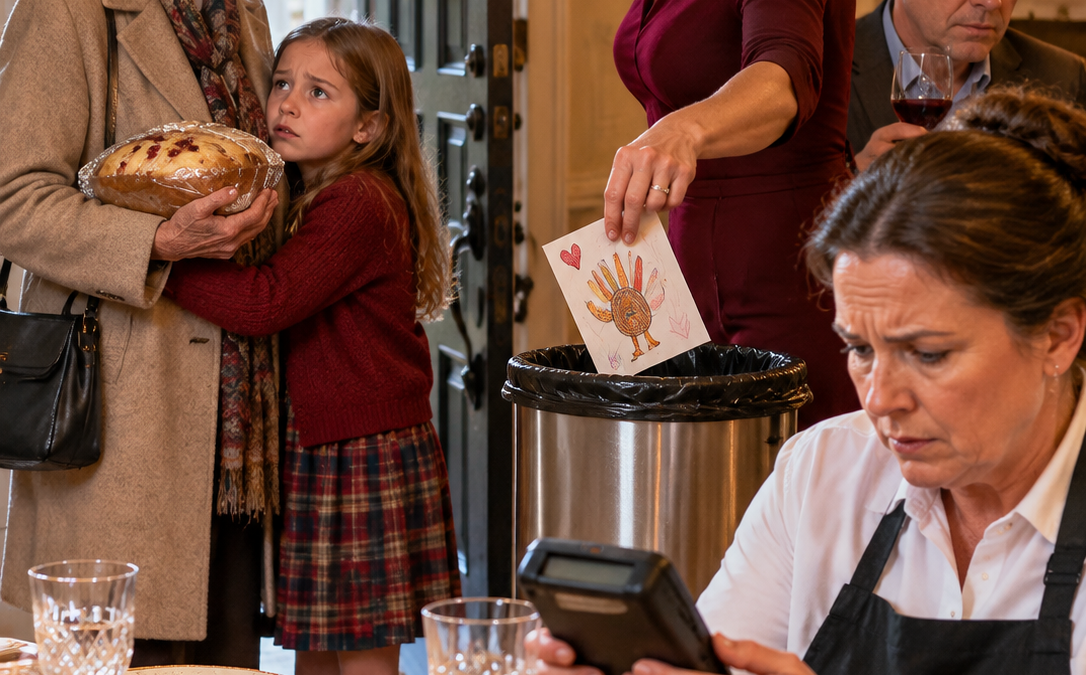
At 2:05 p.m. on Thanksgiving, Leanne lifted Willa’s crayon place card off the plate beside Willa’s chair and said, “Mom, you’d depress my thirty guests. Go home.”
The front door stood open behind her.
Cold air moved through the entry and carried the smell of roasted turkey from the dining room.
Thirty people sat or stood around the long table, close enough to hear every word.
I held a loaf of cranberry bread in both hands.
“Willa made that,” I said.
Leanne pinched the little card between two fingers.
Willa had written Grandma Syl, next to me in purple crayon, with the letters leaning uphill.
A small heart sat in the corner.
She had worked on it carefully.
I knew because she had told me about it on the phone.
Leanne looked at the card as if it were a place-setting mistake.
Then she dropped it into the caterer’s bin near the dining room entrance.
The card landed faceup.
I could still see Willa’s handwriting.
Clark stood a few feet behind his wife.
He had a drink in one hand and his eyes on the glass.
He did not look at me.
I had known Clark since he married Leanne.
He was forty-eight, an engineer, and a man who preferred a quiet room to an honest argument.
I had once thought that was patience.
Standing in Leanne’s doorway, I understood how often it meant leaving someone else alone.
At seventy, I had built a long career behind the reference desk of a public library.
People came to me with dates they could not place, records they could not find, and facts they needed checked.
I had learned to listen before I answered.
That afternoon, I had no question for Leanne.
Willa was nine and in fourth grade.
She had phoned me earlier to ask if I would bring cranberry bread.
She said she wanted it near her plate so she could have a slice before dessert.
I had baked it that morning, wrapped it in a clean towel, and driven the twelve minutes from my house.
I had not expected a warm welcome.
Monday’s text had made that plain.
It was still in my coat pocket, saved with the other messages on my phone.
I had kept the words exact.
“Please don’t come Thursday. You’d depress my guests.”
Leanne had sent it without a greeting or explanation.
I had not answered.
There was no useful reply to a message that treated my presence as a problem to be managed.
I had brought the bread because Willa had asked.
A child should not have to understand the arrangements between adults before she can ask her grandmother for something she likes.
Picking up where the Facebook post left off
Leanne stepped aside, not to let me in, but to make sure the people behind her could see me.
“My mother’s too frail for crowds since Dad died,” she told the room.
A few guests glanced toward me.
One woman stopped with a serving spoon above a dish.
Another lowered his voice in the middle of a sentence.
Nobody asked whether I was ill.
I had been widowed.
I was not frail.
Leanne knew the difference.
I looked past her into the dining room.
Willa’s chair was near the middle of the long table.
Her plate was set.
The place beside it was empty now, with no card to say whose seat it had been.
I could have asked Leanne to pick the card out of the bin.
I could have told the guests that Willa had invited me by phone and that I had driven over because I had promised to bring the bread.
I could have taken Monday’s text from my pocket and held it up.
Instead, I lowered my hands.
The loaf was still warm through the towel.
I set it on the step, just inside the open doorway.
It was close enough for someone to bring in, but I did not carry it farther.
Leanne did not reach for it.
I turned away.
The walk from the front door to the curb was short.
I heard the room begin talking again behind me.
The front door remained propped open, and the cold air kept moving through the house.
I did not look back to see whether anyone picked up the bread.
My car was parked along the curb.
I stopped beside it, but I did not open the door right away.
My fingers had started to ache from holding the loaf, and I rubbed one thumb against the other.
I had thought the hardest part would be seeing Willa’s card on the plate and knowing she had saved me a place.
I had not expected Leanne to throw it away while Willa was somewhere in that house.
The card was still in the bin.
I had seen where it landed.
That small detail stayed with me more clearly than the faces at the table.
I also knew what Leanne had told them.
She had made my absence sound like a kindness to me, and my presence like a burden to everyone else.
If I corrected her, I would have to do it in front of thirty guests, with Willa close enough to hear.
I wanted to be beside my granddaughter.
I wanted her to have the afternoon she had expected.
I could not make that happen by forcing my way through the door.
A van was parked farther down the curb.
A woman stood beside it with a clipboard tucked against her arm.
She wore a dark apron over a plain sweater and was checking something on the page while one of the crew moved equipment near the rear doors.
I recognized her as the caterer.
I had seen her briefly inside, directing the placement of dishes.
I had never met her.
She looked up and came toward me.
“Mrs. Clayton?” she asked.
I turned.
“Thank you for doing this. Your name’s on the bill.”
For a second, I thought she had mistaken me for another guest.
I glanced toward the house.
Leanne was still inside, surrounded by the people she had invited.
Clark remained near the table.
“I’m sorry?” I said.
Ramona checked the clipboard.
Her expression was practical, not embarrassed.
She seemed to believe she was speaking to the person who had arranged the dinner.
I knew her name because someone inside had called it.
Ramona McKenzie owned the small catering company.
She had been moving between the kitchen and the dining room, making sure the meal was ready for the four o’clock carving.
I had not spoken to her.
I had not ordered a meal.
I had not offered to pay for one.
“Your name’s on the bill,” she repeated.
I looked at the clipboard under her hand.
My name was not common in Leanne’s house.
There was no reason a caterer I had never met should know it, much less thank me for a dinner I had been told not to attend.
I had been turned away from the open door.
Willa’s place card was in the bin.
The cranberry bread sat on the step.
And the caterer was telling me I had done something for her.
Why was my name on a dinner bill when my daughter had barred me from the table?
I pointed to the clipboard.
“May I see it?”
Ramona shifted the clipboard in her hands, then turned it around so I could read it.
Chapter 2: The Form Leanne Signed
Ramona turned the clipboard around so I could read it.
The first page was a catering order, filled out in blue ink.
I recognized Leanne’s handwriting before I reached the bottom.
Her capital letters leaned slightly to the right. She crossed her sevens with a short line, something she had done since grade school.
The total was written near the top.
$3,800.
Below it were the payment details.
Deposit: $950.
Date charged: November 9, 2026.
Remaining balance: $2,850, due at carving.
I moved my finger down the page.
The next section was labeled CARD INFORMATION.
Under the heading, Leanne had written:
Cardholder: Sylvia Clayton, my mother. She’s treating.
The last four digits appeared beside the entry.
4417.
I stopped reading.
Ramona watched my face.
“Is there a problem, Mrs. Clayton?”
I looked at the number again.
“No. I know that card.”
I knew it very well.
I had given Leanne an additional card in February. It was attached to my credit union Visa account, with Leanne listed as an authorized user.
I had handed it to her myself.
The number ending in 4417 had been familiar to me long before Thanksgiving.
I looked at the handwritten explanation.
My daughter had identified me as the cardholder. She had written that I was treating.
Then she had signed her name at the bottom.
“Did Leanne fill this out?” I asked.
“Yes,” Ramona said. “She brought it to me when we arranged the dinner.”
“And you charged the deposit?”
“On November ninth. Nine hundred and fifty dollars.”
I kept looking at the date.
November ninth was a Monday.
That was seventeen days before Thanksgiving.
“Was the charge approved?”
“It went through,” Ramona said. “I have the receipt with the order.”
She turned the page slightly so I could see the payment notation.
The deposit had been processed.
I had not known about it.
My last paper credit card statement had closed on November 5.
Four days before Ramona charged the deposit.
I did not have the credit union’s app on my phone. I had never set up account alerts, either. My statements arrived by mail, and I kept them in a folder in my desk.
The November statement could not have shown a November ninth transaction.
The next one would arrive in December.
Until then, I had no paper record of what Leanne had done.
I looked at the total once more.
Three thousand eight hundred dollars.
That was not a forgotten grocery purchase or a pair of shoes. It was an entire Thanksgiving dinner for thirty people.
“Does the form say anything else?” I asked.
Ramona moved her finger farther down the page.
“There’s the payment condition.”
She pointed to a paragraph near the bottom.
It stated that the remaining balance had to be paid when carving began. If payment was not received, the caterer could return the food to the van.
I read the paragraph carefully.
The arrangement was straightforward.
Ramona had prepared the food. Leanne had signed the order. The deposit had been charged to my account, and another $2,850 was expected at four o’clock.
If that money did not come through, the food would leave with Ramona’s crew.
“That’s our policy,” Ramona said. “I have to protect the business. We buy the ingredients, pay the staff, and prepare everything before the event.”
“I understand.”
I did.
Ramona had thirty guests to feed and a signed contract to enforce. She had not invented my name or supplied my card information.
Leanne had done that.
I took my phone from my coat pocket.
“Would you mind holding the clipboard still?”
“Of course.”
I photographed the entire order form, making sure Leanne’s handwriting, the total, and the signature were visible.
Then I photographed the payment condition.
I checked the pictures to make sure the dates and numbers could be read.
Ramona waited.
“I’m sorry,” she said. “I thought you knew about the arrangement.”
I lowered my phone.
“You weren’t given a reason to think otherwise.”
She nodded.
I looked at the form again.
There was something particularly unpleasant about seeing my name in Leanne’s handwriting.
She had not merely provided a card number. She had written a sentence explaining why the caterer should accept it.
My mother. She’s treating.
I wondered how many times she had said those words aloud.
Had she told the guests I was paying? Had she told Clark the same thing? Had she explained to Willa that Grandma was buying the dinner?
I did not know.
I knew only that my daughter had asked me not to come and had arranged for my account to pay for the meal.
“Can I ask you something?” Ramona said.
“Yes.”
“Did you authorize this order?”
I looked toward Leanne’s house.
The front door was still open.
I could see people moving around the dining room, and someone was carrying a serving dish toward the table.
“No,” I said. “I didn’t.”
Ramona’s expression changed, but she did not interrupt.
“I need to speak with my daughter.”
“Take your time,” she said. “I have a copy of everything.”
I thanked her and stepped away from the van.
My phone felt heavier than it had a few minutes earlier.
I opened my contacts and found Leanne’s number.
The first call rang until voicemail answered.
I did not leave a message.
I ended the call and stood beside my car, looking at the screen.
I could have called again later. I could have driven home and waited for her to contact me.
But I wanted to give her an opportunity to explain the form.
I called a second time.
Again, the phone rang without an answer.
I lowered it.
A minute passed.
Then my phone vibrated.
A message from Leanne appeared.
“Not today, Mom. Don’t make this about you.”
I kept the screen open.
There was no question about the dinner.
No mention of the card.
No explanation of why my name appeared on a contract I had never seen.
She had refused to speak to me, even after I had called twice.
I saved the message with the others.
Then I put the phone away.
I thought about the extra card I had given her in February.
I remembered handing it over and explaining what I expected. I remembered believing that an additional card would make certain expenses easier for her.
I had not handed over my entire account.
I had not offered to finance thirty Thanksgiving dinners.
Still, the number was mine.
The deposit had already been charged, and the remaining balance was scheduled for four o’clock.
Ramona had a signed order.
Leanne had my name on it.
I had photographs of the paperwork, but I did not yet know what Leanne had told herself she was allowed to do.
That was the question I needed answered.
What exactly had I allowed that card to pay for?
I could have walked back to the front door and demanded an explanation.
Leanne was only a short distance away.
I could see the dining room through the open entrance. The guests were taking their places, and the table was ready.
But I had already tried to speak with her.
She had chosen to answer with a message telling me to stop making things about myself.
I was not going to argue in her doorway while thirty people ate a dinner charged to my account.
I slid my phone into my coat pocket and opened the driver’s door.
The cranberry bread was still on her step.
I could not see it from where I stood.
I wondered whether Willa had noticed I was gone.
That thought hurt more than I wanted to admit.
I sat behind the steering wheel and placed my hands on it.
My daughter had a reason for writing my name on that form. I needed to know what it was, and I needed to check exactly what I had agreed to when I gave her the card.
I turned the key.
The engine started.
Instead of driving back to Leanne’s front door, I pulled away from the curb and headed home.
Chapter 3: The Woman Who Kept Every Text
By the time I reached my kitchen table, I had photographs of Leanne’s signed catering order and no answer from my daughter.
I set my phone beside the photographs and took my own primary credit union Visa from my wallet.
The extra card ending in 4417 was the authorized card Leanne carried, given to her in February for Willa’s expenses.
I had given Leanne that extra card on February 16, 2026. I remembered the date because I had saved the conversation from that morning.
I opened my messages and scrolled back through February.
There were ordinary exchanges about Willa’s school, a question about a prescription, and a picture of a pair of shoes.
Then I found the message.
Leanne had written:
Only for Willa, Mom. Shoes and copays. I swear.
I sat with my finger resting against the screen.
That was the agreement.
Shoes for my granddaughter. Medical copays when they came up. Nothing about catering, parties, or thirty Thanksgiving guests.
I had not asked Leanne to pay me back for those things. I had given her the convenience of an extra card because I wanted Willa taken care of.
I had trusted my daughter to understand the limits.
Now I had her handwriting on a $3,800 order, identifying me as the person treating everyone.
I put the February message beside the photograph of the catering form.
The difference was plain.
One said the card was for Willa.
The other said I was paying for Thanksgiving.
I needed to know what the credit union could do before four o’clock.
I turned my own Visa over and found the twenty-four-hour customer service number printed on the back.
The call connected after a short wait.
A representative asked for the account information and verified that I was the primary cardholder. I explained that Leanne was an authorized user and that I wanted to withdraw her permission to use the additional card.
The representative asked whether I was reporting a charge I did not recognize or ending an authorized user’s access.
“I’m ending her access,” I said. “I need it stopped today.”
“Certainly. There are some things I need to explain first.”
I picked up a pen.
The representative told me that charges made before the credit union received notice could remain my responsibility as the primary cardholder.
I asked about the catering deposit.
“The nine hundred and fifty dollars?”
“Yes.”
“If that charge was processed before your notice, you remain responsible for it.”
I looked at the photograph on my phone.
November 9.
The deposit had gone through seventeen days before Thanksgiving.
“So I owe the nine hundred and fifty?”
“You remain responsible for charges made before the authorization is withdrawn.”
I wrote $950 on the back of an old envelope.
The representative continued.
Once I withdrew Leanne’s authority, she would no longer be permitted to use the additional card. The credit union would record the notice, and further transactions under that authorization would not be allowed.
I asked whether the change could take effect immediately.
“Yes. I can process that for you now.”
I looked toward the folder on the kitchen counter where I kept my savings records.
Nine hundred and fifty dollars was not a small amount to me.
I was retired. My savings had to cover more than whatever unexpected expense arrived at the door. I had planned that money carefully, and I did not enjoy finding a new obligation created without my permission.
But the deposit was already charged.
I could dispute the circumstances and keep the photographs. I could speak with the credit union again if necessary. None of that changed the immediate fact that the charge had happened before I gave notice.
I would have to cover the $950.
I also knew what ending Leanne’s access meant for Willa.
If my granddaughter needed shoes, I would buy them myself. If a doctor’s office required a copay, I would pay it directly, using cash or my own card.
I would no longer give Leanne a card to carry.
That was the price of protecting the account.
It was also the price of keeping my promise to Willa without allowing Leanne to decide what else my money could cover.
The representative asked me to confirm one more time.
“Do you want to withdraw the authorized user’s permission?”
“Yes.”
I looked at the clock on the kitchen wall.
It was 2:41 p.m. on Thursday, November 26.
The representative completed the request.
“Your notice has been recorded. Is there anything else I can help you with today?”
I asked for the reference number.
The representative read it slowly, and I wrote each digit on an index card.
I repeated the number to confirm it.
Then I wrote the date and time beneath it.
November 26, 2026.
2:41 p.m.
I had spent enough years keeping public records and helping people locate important information to know that a conversation was not a record until it could be identified later.
I kept the index card beside my phone.
“Thank you,” I said.
The call ended.
I looked at my own Visa on the table.
Leanne’s permission to use it was over.
She had not asked me to stop it. She had not offered an explanation. She had not even answered either of my calls.
I was the one who had to make the decision.
My phone was still open to her February promise.
I opened a new message.
I wanted Leanne to know before she tried to use the card again. I did not want a caterer’s employee, a restaurant cashier, or anyone else caught in the middle of an argument they had nothing to do with.
I typed:
Your card stopped at 2:41. Use your own today.
I checked the time once more.
Then I sent it.
The message showed as delivered.
For several seconds, nothing happened.
I placed the phone beside the index card and looked at the photographs of the catering order.
Leanne had until four o’clock to pay the remaining $2,850.
She had my notice now.
She knew the card would not work.
Would she stop the dinner and arrange another payment, or would she pretend everything was fine and let Ramona discover the problem at the table?
I thought about the caterer.
Ramona had prepared a meal, hired a crew, and made an agreement with my daughter. She had done nothing wrong by accepting the information Leanne gave her.
She deserved to know that the card had been stopped.
If I said nothing, Ramona might wait until carving to discover she could not collect the balance. Her employees would have worked through the holiday, and she would be left dealing with a payment problem she had not created.
I could not fix what Leanne had done to my account.
I could at least give the caterer enough warning to protect her business.
My phone remained quiet.
I picked up the index card and placed it beside the photographs. Then I opened my contacts and found Ramona McKenzie’s number.
I had saved it from the information she gave me at the curb.
I pressed the call button.
Ramona was the one person at that Thanksgiving dinner who deserved to hear the truth before four o’clock.
Chapter 4: The Caterer Who Asked Twice
Ramona called me back before I had finished putting the index card away.
“I spoke to Leanne,” she said. “I asked her for another card.”
I sat down at my kitchen table.
“What did she say?”
Ramona paused.
“She said, ‘My mother gets confused. The card is fine. Run it at the table when you carve.’”
I looked at the reference number I had written on the index card.
Leanne had received my message.
She knew the card had been stopped at 2:41.
Yet she was telling the caterer to use it anyway.
“Did you explain that the authorization had been withdrawn?”
“I did. She said you were mistaken and that everything would work out.”
Ramona sounded more irritated than frightened.
She had a business to run, employees to pay, and food to deliver. She had already accepted a signed order from Leanne. Now she was being asked to trust a cardholder who had never agreed to the purchase.
“I won’t run it before four,” Ramona said. “That’s when the balance is due.”
“I understand.”
“I’d like you to come back, Mrs. Clayton. I think you should tell her yourself. I don’t want this turning into a dispute over what somebody said on the phone.”
I looked at the clock.
There was still time before carving.
“Do you want me to speak to Leanne?”
“I want you to tell her what you told me. In person. Then nobody can say I misunderstood.”
I considered the front door and the thirty people inside.
Leanne had made it clear that I was not welcome.
I was not going to walk into her dining room and ask for a seat. But Ramona had done nothing wrong, and I would not leave her carrying the consequences of my daughter’s decision.
“I’ll come,” I said. “I’ll stay on the porch.”
“That’s fine.”
After we hung up, I put the phone down.
I had another call before I could leave.
Clark’s name appeared on the screen.
I answered.
“Hello, Clark.”
“Hi, Sylvia. Are you home?”
“Yes.”
There was a pause.
“Leanne said you weren’t feeling well.”
I looked at the photographs on my table.
“She told you that?”
“She said you were upset and weren’t up to being around people today.”
I waited.
“She also said the caterer was paid,” he continued. “I sent her the money for that. The whole amount.”
I sat straighter.
“What money?”
“The three thousand eight hundred dollars. I transferred it from our joint savings on October nineteenth. Monday.”
I knew the amount.
It was the same amount written at the top of Ramona’s catering order.
“You sent Leanne $3,800?”
“Yes. She said she needed it for Thanksgiving. I thought it was going directly to the caterer.”
I glanced at the photograph of the form.
Leanne had written my name under the cardholder section.
She had charged the $950 deposit to my account on November ninth.
And she expected another $2,850 at four.
“Clark, I need you to ask Leanne something.”
“What?”
“Ask to see the form.”
He went quiet.
I could hear movement in the background, followed by the faint sound of someone speaking.
“What form?” he asked.
“The catering order. The one she signed.”
“I don’t know what you’re talking about.”
“Ask to see it.”
He did not ask.
Instead, he said Leanne had a lot to manage that afternoon and that perhaps we should talk after Thanksgiving.
I held the phone against my ear.
“Clark, the caterer has a signed order.”
“I’m sure she knows what she’s doing.”
“Then ask to see it.”
He said he would call me later.
The conversation ended without him agreeing to anything.
I put the phone down and looked at the photographs again.
Clark had sent $3,800 from joint savings.
He believed the caterer had been paid.
Ramona had a signed order naming me as the person responsible.
I had no idea where Clark’s money had gone.
I also knew that he had not asked to see the document that could answer his question.
A little later, my phone rang again.
It was Clark.
“I’m sorry to bother you,” he said. “But I wanted to tell you something.”
“Go ahead.”
“I heard Leanne talking to Roland Vaughn.”
I knew the name.
Roland was one of the guests. He was sixty-three, retired from dentistry, and had been considering listing his house with Leanne.
“What did she say?”
“She told him, ‘Mom gave me that card for this.’”
I closed my eyes briefly.
Clark continued.
“She said you had offered to cover the dinner. She made it sound like you’d insisted.”
I looked at the February message still open on my phone.
Only for Willa, Mom. Shoes and copays. I swear.
That was what I had agreed to.
Not a holiday dinner.
Not a gathering of thirty people.
Not a bill for $3,800.
“Clark, you have the amount you transferred. I have the catering order. Those are two different records.”
“I know.”
“Then why are you telling me what Leanne said instead of asking to see the form?”
He didn’t answer immediately.
I heard a glass being placed on a hard surface.
“I don’t want a fight today, Sylvia.”
“Neither do I.”
He said he would call later.
I ended the conversation and set the phone beside the index card.
For several minutes, I stayed at the table.
I had spent years keeping records because details mattered. A date could establish when something happened. A signature could show who had agreed to something. A message could preserve exactly what someone had promised.
I had all three now.
But Leanne had something else.
She had an audience.
Thirty guests had been invited into her home. She had already told them I was too frail to attend. Now she was telling them I had volunteered to pay.
If I stood outside and corrected her, would they believe me?
Or would they see a seventy-year-old woman arguing with her daughter on Thanksgiving?
I thought about Willa’s crayon card.
Grandma Syl, next to me.
I had promised to come.
I had also promised Ramona that I would explain the situation in person.
I took the index card from the table and slipped it into the inside pocket of my coat. The reference number was written clearly, along with the exact time the authorization had ended.
Then I put my phone in the other pocket.
I would drive back to Leanne’s house.
I would stand on the porch.
I would not cross the doorway, and I would not ask anyone to make room for me.
At four o’clock, Ramona would try the card reader.
Leanne had ordered her to do it in front of the guests.
That meant the truth would come out in front of them, too.
I wondered whom thirty people would believe when the card failed and the caterer produced the signed order.
My phone vibrated before I reached the door.
A message from Leanne appeared.
“Come near my door and I’ll tell them you’re not well. Who believes you?”
I stood with my coat half buttoned.
She was not asking me to stay away because she was worried about my health.
She was warning me not to contradict her.
I put the phone in my pocket beside the index card.
Then I picked up my car keys.
Chapter 5: The Reader at the Table
At four o’clock, Leanne stood beside the long dining table with a glass raised.
The front door was still propped open.
I waited on the porch, my phone in one coat pocket and the index card in the other.
Leanne tapped her glass with a spoon.
“I paid for every bite myself.”
A few guests smiled and lifted their glasses.
Ramona stood beside the table with the card reader in her hand.
She had already told Leanne the card would not work. Leanne had insisted she run it anyway.
Ramona inserted the card ending in 4417.
The reader paused.
Then it displayed DECLINED.
Leanne leaned toward her.
“Try it again.”
Ramona removed the card and inserted it once more.
The same word appeared.
DECLINED.
She turned the screen toward Leanne.
For a moment, Leanne stared at it without speaking.
I stayed where I was.
I had promised Ramona I would not leave her to explain the problem alone. I had not promised to step inside.
Willa saw me.
She was near the middle of the room, between two chairs. Her face changed when she recognized me.
Then she ran.
She crossed the length of the dining room, past the guests and the crowded table, and reached me at the doorway.
“Grandma!”
She wrapped both arms around my waist.
I bent to hold her.
Thirty heads turned toward the open door.
Willa pressed her cheek against my coat. I kept one hand against her back and looked over her shoulder.
Leanne had set her glass down.
“It’s a glitch,” she said. “My mother gets confused.”
Ramona did not raise her voice.
“No. The cardholder withdrew the authorization at 2:41. I have the signed order right here.”
She lifted the clipboard.
Leanne looked toward me.
I took my phone from my pocket.
“Monday, November 23,” I said. “You sent me this message: ‘Please don’t come Thursday. You’d depress my guests.’”
The room had gone quiet.
I continued.
“February 16, 2026. You wrote: ‘Only for Willa, Mom. Shoes and copays. I swear.’”
I held the phone low, but the screen faced me.
“I agreed to shoes and copays. I did not agree to this dinner.”
Leanne’s cheeks reddened.
“You told me to use it. It’s family money.”
“No,” I said. “You told me it was for Willa.”
Ramona turned the clipboard so the guests nearest her could see the order.
“Leanne signed this,” she said. “The total is $3,800. The deposit was $950, charged November ninth. The remaining $2,850 is due now.”
She read the cardholder line aloud.
“Cardholder: Sylvia Clayton, my mother. She’s treating.”
Leanne reached for the clipboard.
Ramona held it steady.
“I need payment for the balance,” she said. “Do you have another card?”
Leanne opened her purse and pulled out her own Visa.
“Use this.”
Ramona took it and ran the card.
The reader paused again.
Then it declined.
Leanne snatched the card back.
“That’s impossible.”
Nobody answered.
Clark had been standing near the end of the table, looking down at his glass. Now he stepped closer.
He took out his wallet.
His eyes moved from the order form to the amount at the top. He read the signature and the cardholder line.
Then he put his wallet back.
“I sent you $3,800 in October, Leanne. Where is it?”
Leanne turned toward him.
“Clark, not now.”
“October nineteenth,” he said. “I transferred it from our joint savings. You told me it was for the caterer.”
“I handled it.”
“Then why is her card on the contract?”
Leanne glanced around the table.
She did not answer.
Ramona looked toward her crew.
“I’m sorry,” she said to the guests. “We have to take the food back.”
Two employees moved to the table.
One lifted the turkey platter. Another began gathering the pans.
The guests shifted their chairs to make room as the crew carried the food toward the van.
Leanne stood with her glass beside her plate.
“Wait. You can’t take everything.”
“The contract requires payment at carving,” Ramona said. “The balance hasn’t been paid.”
The turkey left first.
Then the side dishes.
The table that had been arranged for thirty people began losing its meal, one pan at a time.
Roland Vaughn sat near the far end.
He had been quiet through the exchange. Now he folded his napkin, set it beside his plate, and stood.
He looked at Leanne.
“We’ll find another agent.”
Leanne’s face tightened.
“Roland, this has nothing to do with your house.”
“It does now,” he said.
He picked up his coat and moved toward the door.
I kept my arm around Willa.
Leanne turned on me.
“What have you done?”
I looked at my daughter.
“You uninvited me. You forgot to uninvite my card.”
She stared at me as if she had expected another answer.
Behind her, Ramona’s crew carried the last pans out.
The guests were no longer looking at their plates. Some watched the food leave. Others watched Clark.
Nobody raised a glass again.
I did not know what would remain of Leanne’s dinner once the guests went home. I knew the $3,800 Clark had sent was still unanswered, and Ramona had a signed contract to collect.
Clark looked at Willa.
“Get your coat, sweetheart.”
Willa let go of me and went inside just far enough to reach the coat hanging near the front door. Clark followed her.
He returned with the coat and the crayon place card.
The card was still in the caterer’s bin, its purple letters visible above the discarded paper napkins.
Clark took it out carefully.
He brushed off a small crumb and held it by the edges.
Then he helped Willa into her coat and buttoned it.
Leanne stood a few feet away.
She did not stop him.
Clark looked at me.
“Does your table have room for us?”
Chapter 6: The Bill Leanne Signed
By the time Thanksgiving ended, the food was gone, the guests had left, and nobody had paid what they owed.
Clark had taken Willa’s coat from the hook and asked whether my table had room.
I had said yes.
That evening, Ramona loaded the food into her van and drove it to a local shelter. She called me afterward to let me know.
“They were grateful,” she said. “We didn’t waste a thing.”
“I’m glad.”
“I’ll send Leanne the balance Monday. The contract is clear.”
“Thank you, Ramona.”
She paused.
“And Mrs. Clayton? I’m sorry your Thanksgiving went that way.”
I looked across my kitchen.
Willa was sitting at the table, waiting for her grilled cheese sandwich. Clark stood near the counter, holding a glass of water.
“You did nothing wrong,” I told Ramona.
After we hung up, I put the sandwich on Willa’s plate.
She took a bite and looked at me.
“Grandma, did you bring the cranberry bread?”
I sat across from her.
“I left it at the house.”
“Did Mom get it?”
“I don’t know, sweetheart.”
Willa looked down at her sandwich.
“I wanted you to have some.”
“I know.”
She took another bite.
I did not tell her what Leanne had said about me. She had heard enough at the doorway.
After dinner, I took the crayon place card from the counter.
The edges had been damaged when Clark pulled it from the caterer’s bin. One corner was folded, and a tear ran along the bottom.
I found clear tape in my kitchen drawer.
Willa watched as I carefully joined the torn edges and pressed the tape flat.
“Can I keep it?” she asked.
“Of course.”
She held it by the corners.
“Grandma Syl, next to me,” she read.
Then she brought it over to her place and laid it beside her plate.
On Monday, November 30, I went to the credit union.
I transferred $950 from my savings to cover the deposit Ramona had charged before I withdrew Leanne’s authorization.
I wanted my account current.
I also wanted the money recorded clearly, separate from anything Leanne might eventually repay.
The teller gave me the receipt.
I put it in the folder with the photographs of the catering order and the index card carrying the reference number.
That $950 had come from money I had saved for myself.
I had not planned to spend it on Thanksgiving dinner.
Ramona sent Leanne an invoice for the remaining $2,850 under the contract she had signed.
The invoice gave her the amount due and the payment instructions.
Leanne did not pay it.
A lawyer I consulted prepared a one-page demand letter seeking repayment of my $950 deposit. The letter included the transaction date and explained why the charge had not been authorized by me.
I kept a copy.
On December 11, a Friday, Leanne came to my house with a cashier’s check.
It was for $950.
She handed it to me without coming inside.
“I had to sell the SUV,” she said.
I looked at the check.
I had not asked what she sold to find the money. The lawyer’s letter had requested repayment, and she had brought the amount.
“Thank you,” I said.
She looked past me into the hallway.
“Is that all?”
I put the check on the entry table.
“For the deposit, yes.”
She pressed her lips together.
I did not ask about Ramona’s invoice. That was a separate contract, signed by Leanne, and Ramona would have to collect it herself.
Leanne left without another word.
I deposited the check and kept the receipt with the rest of my records.
The $950 was back.
The savings account had taken the loss first. Getting the money returned did not change that.
Meanwhile, Clark had begun asking questions at home.
He told me later that he had opened the statements and started matching the dates and amounts.
The $3,800 transfer from October nineteenth was there.
So were the brokerage desk fees.
The money he had sent for the caterer had gone toward Leanne’s business expenses instead.
He also found the statements for Leanne’s Visa.
The balance was at its limit.
There had been eleven months without a sale, and the fees had continued coming out.
Clark had believed the money was being used for the Thanksgiving contract.
Now he could see where it had gone.
He called me one evening.
“I should have asked to see that form,” he said.
“Yes,” I answered.
“I thought the money was handled.”
“I know.”
“I didn’t want another argument.”
I let him finish.
He said he had spent the last several days going through the statements and checking the transfers. The figures matched the records I had shown him.
“I can’t keep doing this,” he said.
I did not tell him what to do about his marriage.
That was his decision.
He rented an apartment near Willa’s school and moved out with her.
The apartment was close enough that Willa could keep attending the same school. Clark arranged the move and took what he needed for himself and his daughter.
I helped with Willa’s things when they came by.
She brought her school supplies, clothes, and the little taped place card.
I did not ask her to explain what had happened between her parents.
Clark was quieter than usual, but he seemed certain about the move.
Leanne did not come with them.
A few days later, she appeared at my front door.
I opened it but stayed where I was.
She looked tired. Without the SUV, she had arrived by another ride, and she stood with her hands tucked into her coat pockets.
“Just until January, Mom. One card.”
I knew what she meant.
She wanted another authorized card on my account.
She did not ask about the money she owed Ramona. She did not mention the catering form or the guests who had watched the food leave.
She wanted the convenience back.
“Forgiving you isn’t lending to you.”
Leanne looked at me.
“I said just one card.”
“I heard you.”
“Willa needs things.”
“I’ll pay for Willa’s things.”
“You don’t have to make everything difficult.”
I kept my hand on the edge of the door.
“I won’t give you another card.”
She looked toward the hallway, as if waiting for me to change my mind.
I did not.
For years, I had thought helping my daughter meant making certain things easier. I could buy Willa shoes, pay a copay, or bring something she needed without giving Leanne access to my account.
Those choices were still mine.
Leanne lowered her eyes.
“Fine, Mom.”
She stepped back from the doorway.
I watched her reach the porch steps.
Then I closed the door gently.
I turned the porch light off.
Chapter 7: The Card Beside the Rolls
On Thursday, November 25, 2027, I set the table for four.
I had started early, taking my time with the dishes and the tablecloth.
There was no reason to hurry, and nobody was waiting for me to make room at the last minute.
I put the serving dishes within reach and folded the napkins beside the plates.
I counted the plates before I put out the silverware.
Mine, Willa’s, Clark’s, and Ramona’s.
Four glasses stood beside them, with the water pitcher in the middle.
A year earlier, I had stood on Leanne’s porch while thirty people watched a card reader decline.
This Thanksgiving, nobody had to guess whose card would pay.
Ramona arrived with two pies balanced in a carrier.
She set them on the counter and took off her coat.
“You made room for both?” she asked.
“I set out four plates. I can manage two pies.”
She smiled and brought her card reader from her bag.
She told me the total, and I took my own card from my wallet.
I inserted it and waited while the screen processed the payment.
APPROVED.
I handed the reader back.
Ramona checked the receipt and tucked it away.
Neither of us said anything about the other Thanksgiving.
We didn’t need to.
The payment had gone through, and the pies were ours.
Clark was helping Willa with the napkins.
He had come with her that afternoon, and he looked more settled than he had the previous year.
He still spoke carefully, but he no longer watched his glass whenever somebody asked a difficult question.
Willa was ten now.
She had grown enough that the sleeves of her sweater stopped above her wrists, and she had opinions about where everything belonged.
“Those aren’t the place cards,” she told me.
She had brought paper and crayons to the table.
I watched her make four new cards, one for each person.
She wrote our names in large letters and added little drawings beside them.
Mine had a book.
Clark’s had a ruler.
Ramona’s had a pie.
Willa drew a purple heart beside her own name.
When she finished, she placed the new cards at the plates.
Then she went to the small stack of things she had brought from home and took out the old card.
She had kept it with her things since the previous Thanksgiving.
The tape still crossed the torn edge.
The purple crayon had faded a little, but the words were clear.
Grandma Syl, next to me.
Willa carried it to my place and laid it at my chair.
“This one goes here,” she said.
I touched the taped corner with one finger.
“All right.”
She adjusted it until the words faced the seat, then returned to her own place.
We ate without rushing.
The conversation moved easily from one person to another, with nobody trying to fill every pause.
Clark passed the rolls.
Ramona cut the first pie after dinner, and Willa asked for a small slice of each.
I let her decide which one she liked better.
She said she needed another taste before making up her mind.
There was no speech and no announcement.
We talked about Willa’s schoolwork, a book she was reading, and whether the second pie should be saved for breakfast.
Clark laughed when Willa argued that pie counted as breakfast if it had fruit in it.
I listened and ate.
At five o’clock, the doorbell rang.
Leanne had come to collect Willa for the weekend.
Five was the agreed hour, and she was on time.
I went to the porch and opened the door.
Leanne stood outside with her coat buttoned and her keys in one hand.
She looked past me toward the dining room, where the table was still set.
I had prepared a covered plate for her.
I held it out.
“Here.”
She took it carefully.
“Thank you,” she said.
I nodded.
She did not ask whether she could come in.
I did not offer her a chair.
There was no argument and no attempt to reopen the conversation from the year before.
Leanne stayed on the porch, holding the plate.
I stayed inside the doorway.
Willa came into the hall with her coat over one arm.
“Ready?” Leanne asked.
“Almost.”
Willa slipped one arm into her coat, then looked back toward the dining room.
“I want one more roll.”
“You can take one,” I said.
She hurried back to the table.
I had returned to my chair, the old taped card beside my plate.
Willa took a roll from the basket and put it beside me.
She picked up the butter dish.
“Here, Grandma.”
“Thank you, sweetheart.”
She returned to the hall, pulled on her sleeve, and buttoned her coat.
Leanne waited on the porch with the covered plate.
Willa stepped outside beside her mother.
I watched them go and closed the door.
Back at the table, I put my hand on the taped card.
I buttered the roll Willa left me.
THE END







