My Daughter-in-Law Priced My Late Daughter’s Cradle at $1,800 at Our Town Exhibition; She Didn’t Know What I Had Kept.
Chapter 1 of 7
The $1,800 tag swung against the cradle at 11:10 a.m., Saturday, October 3.
“Grandma finally stopped being selfish,” Eli said.
He was six. The cradle was mine, carved by my late daughter, Lena, and given to me.
Brooke glanced toward another booth.
“She can keep the memories; we need the money.”
My sister Ruth looked away.
I started smoothing a wrinkle in Brooke’s display cloth. Then I stopped.
“I never said you could take this.”
“Please keep your voice down,” Brooke said. “He’s standing right here.”
Eli stood beside a basket of crocheted pumpkins. His sweatshirt zipper had caught his shirt, leaving one side crooked.
“I’m talking to you,” I said.
“I know. But people are looking.”
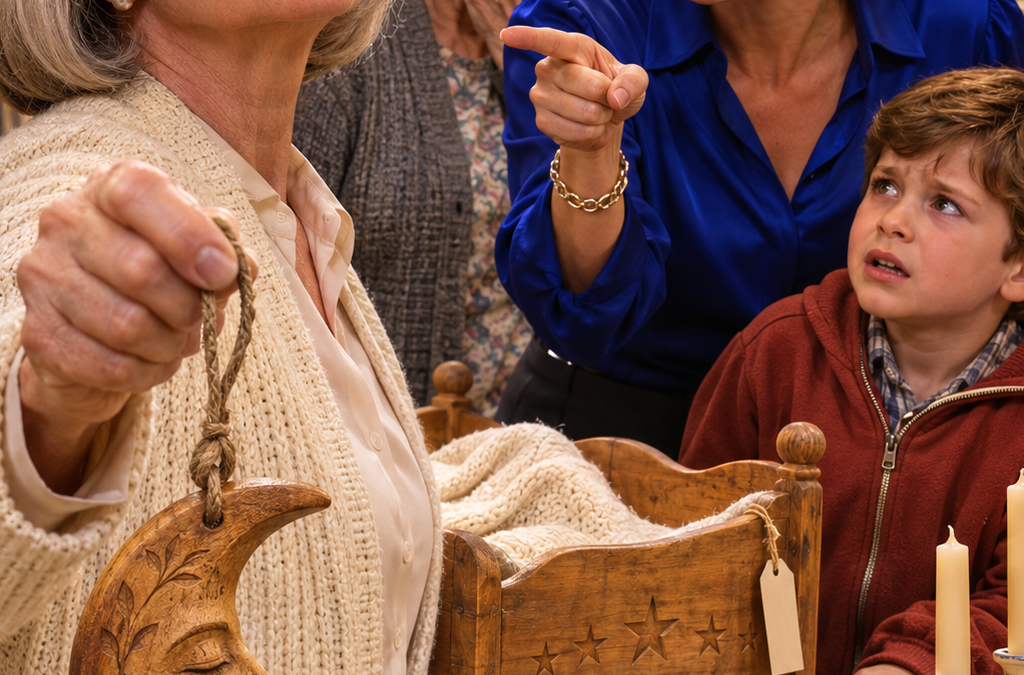
The cradle sat between her linen napkins and painted candlesticks. Its repaired runner faced the aisle. Someone had tucked a cream blanket inside, covering the shallow stars Lena had carved along the bottom.
Brooke had tied the price tag through one of those stars.
“Where did you get it?”
“From your spare room. It wasn’t being used.”
“That isn’t what I asked.”
Her mouth flattened. She looked at Ruth, who suddenly seemed occupied by a loose thread on her sleeve.
Above the cradle, the removable wooden moon hung crooked. Its cord had worn pale where it rubbed the crosspiece.
“That cord’s about gone,” I said.
Brooke lifted it off and gave it to me.
“Here. You can have that.”
It rested against my fingers, small enough to close my fist around.
“I can have the rest of it, too. It belongs to me.”
“Nobody’s saying it doesn’t matter to you.”
“You put a price on it.”
“Because it’s beautiful. Somebody else could actually use it.”
Eli leaned forward to look beneath the blanket.
“Does a baby come with it?”
“No, honey,” I said.
He looked relieved. “Good. We don’t have a car seat for one.”
Usually I would have laughed. Brooke gave a quick little laugh for both of us.
“See? He’s excited about today. Can we please not do this over his head?”
“Then don’t ask him to tell me I’m selfish.”
“I didn’t ask him to say anything.”
Eli pressed his lips together. I hated that he was checking which adult to believe.
“You haven’t done anything wrong,” I told him.
“Are you taking it back?”
“Yes. That’s what I came over here to do.”
His eyes went to his mother.
“But if you keep it, you don’t want to help us?”
“I can love you and keep my cradle.”
“Will you still help with my zipper?”
“Always.”
Brooke bent toward him. “Go stand by your aunt for a minute, sweetheart.”
Ruth made space beside her. She still hadn’t looked at me.
I had kept something Brooke had never asked about.
“You’ve helped us before,” Brooke said. “When we needed groceries. When work was slow. You always said family came first.”
“I didn’t say you could empty a bedroom.”
“It was one thing. And you weren’t using it.”
Lena had given me the finished cradle on Mother’s Day. After she died, I kept it in the spare room, where morning light reached the carvings.
Brooke lowered her voice.
“I thought you’d be glad it could do some good.”
“It already did.”
“We can talk about this somewhere else.”
“After you take the tag off.”
“I can’t just pull something off the floor without talking to the organizers.”
“You got it here without talking to me.”
A woman carrying a paper cup slowed beside us. Brooke turned toward her with the bright expression she used for customers.
“Just sorting out a family question.”
The woman moved on.
Brooke waited until she was gone.
“Ruth, you know how she is about helping. Tell her why I thought it would be okay.”
Ruth’s eyes settled somewhere near my shoulder.
“I don’t want to get between you.”
“You’re already here,” I said.
Eli’s shoes squeaked against the floor. From the next aisle came the steady thump of someone testing a handmade cutting board.
“Being family did not make everything I owned available,” I said.
Brooke looked past me.
A woman wearing an exhibition badge approached with her phone raised. Brooke straightened and greeted her before I could speak.
“We have a little misunderstanding.”
“About which item?”
“My cradle,” I said. “I didn’t give permission for it to be here.”
Her phone chimed. She glanced at the screen.
The chairwoman stopped reading her phone.
“Who gave him permission to schedule a pickup?”
Brooke’s answer came quickly.
“He asked about five o’clock. I said that should work if everything was ready.”
“Who asked?” I said.
“The buyer,” the chairwoman said. “He wants to collect it at 5:00 p.m. Today.”
“I’m the owner.”
“Your name?”
“Marilyn Hayes.”
She introduced herself as Susan Parker, the committee chair for the exhibition at Hillsborough’s municipal arts hall in North Carolina.
“I’ll get the intake copy,” she said. “Please leave the cradle here.”
I had spent my working life restoring furniture. I photographed pieces before repairs, during repairs, after repairs. My phone and home archive held dated photographs of this cradle, too.
Susan returned with a consignment receipt.
My name was printed near the top. Farther down, someone had written it.
I had never signed that paper.
Brooke watched Susan rather than me.
“Can we move out of the aisle?” she asked.
“In a minute,” Susan said.
The moon turned in my palm. I remembered Lena rounding its edge, testing it against her cheek before giving me the finished cradle.
A volunteer passed with an empty cart.
“Need anything moved, Susan?”
“Not yet, Carol.”
“I covered Thursday intake. If you’re hunting a folder, the extras are underneath.”
“Thanks.”
The cart rattled onward. Susan checked her phone again.
Brooke stepped closer.
“He liked it right away,” she said. “He wasn’t bargaining. I told him it was handmade, and he said that was what he wanted.”
“You didn’t tell him it wasn’t yours to sell,” I said.
Susan opened another screen.
Brooke stopped talking.
Susan looked from the payment screen to Brooke.
“There’s a $300 deposit on this already?”
“He wanted to reserve it.”
“Has he taken anything?”
“No.”
At 11:35 a.m., Susan called the desk and stopped the collection. She asked another volunteer to put the cradle behind the staffed boundary.
“I’m not releasing it to either of you today,” she said.
Brooke looked at me. “You hear that? You can’t take it home either.”
“I heard.”
“The deposit is refundable while approval is pending,” Susan added. “I’ll contact him.”
“I have a booking,” Brooke said.
“Yes. And your signed agreement requires accurate ownership and permission information. I need to check what happened.”
Brooke’s eyes followed the cradle behind the boundary.
“I wasn’t trying to upset anybody,” she said. “The transmission repair is $2,640. I’ve paid $840. There’s $1,800 left.”
“You told me about the car.”
“Exactly. I thought you knew how bad it was. We need that car.”
I had taught them to expect me to solve every shortage.
But the cradle stayed behind the staff boundary.
“You could have asked,” I said.
“I thought we were helping each other.”
Susan gave me the receipt copy and told Brooke she would need her account, too. Then she went to call the buyer.
Ruth offered to walk Eli around. Brooke said no, they were leaving.
It took her until 12:05 p.m. to gather his jacket, answer a customer, and arrange for someone to watch her booth.
Eli asked whether he should bring his dinosaur book to my house Sunday.
Brooke answered before I could.
“Eli won’t be coming tomorrow. Daniel will explain.”
Chapter 2 of 7
Daniel arrived at 9:00 a.m. Sunday, October 4, without Eli.
He stood on the porch in his work boots, though he wasn’t working.
“Brooke thinks yesterday made the visit too uncomfortable for him,” he said.
“For him?”
“He heard the whole thing, Mom.”
“He was invited here.”
“I know. Can I come in?”
I stepped aside. I had set out two breakfast plates. One was the blue plastic one Eli still chose, even though he called it baby stuff.
Daniel stayed near the kitchen doorway.
“She wants you to call the exhibition. Tell them you and she are working it out.”
“We aren’t.”
“You could be. That’s why I came.”
“Did you come to ask what happened?”
“She told me.”
I left his plate on the table. There was toast in the oven, getting hard.
“Then what do you need from me?”
“Withdraw the objection. Let us keep this from becoming Eli’s problem.”
“He can visit without carrying messages between us. I won’t approve a sale to get him through my door.”
Daniel stared at the blue plate.
“He doesn’t know what any of this is about.”
“Then the adults need to stop asking him to explain it.”
Outside, a truck backed into a neighbor’s driveway. We listened to the warning beeps.
“I need my spare key back,” I said.
His eyes came up.
“Mom.”
“The one I gave you.”
“For emergencies.”
“Was Wednesday an emergency?”
He didn’t answer.
“Did Brooke use it?”
“Yes. I let her have it.”
“You were supposed to ask me.”
“I didn’t think she was going to—” He stopped. “I should have checked.”
“Do you have it?”
He took the key off his ring and left it beside the unused plate.
“I never thought you’d ask for that back.”
“Neither did I.”
He looked toward the hallway. From the kitchen, we could see the open spare-bedroom door and the pale space where the cradle had stood.
“Brooke says Friday wasn’t just about the car,” he said.
“What does that mean?”
“She says you offered to help with the display. Things from the house.”
“I offered to lend her the porch stands.”
“She thought you meant more.”
“Those were the things we discussed. The folding stands on the porch.”
“Okay.”
He said it quietly, but he didn’t say he believed me.
“Will you tell her that?”
“I’ll talk to her.”
When he left, I ate one piece of toast standing up. The other plate stayed clean.
By late morning, I was at Ruth’s house. She opened the door wearing the cardigan she saved for church. Her television was already on.
“I thought you might call,” she said.
“I wanted to see your face.”
“Oh, Marilyn.”
She moved aside.
Her kitchen smelled of cinnamon bread. Ruth kept hers in the microwave because she said the bread box was where bread went to be forgotten.
“Coffee?” she asked.
“No.”
“I’ve got decaf.”
“I didn’t come for coffee.”
She sat down carefully, as though her knees were the reason.
“Yesterday got away from everybody.”
“Did you know she had it?”
Ruth looked toward the television.
“Before yesterday,” I said.
“I saw her loading it Wednesday.”
The refrigerator motor clicked off. A man on television kept describing a skillet.
“You saw her take it out of my house?”
“Yes.”
“And you didn’t call me?”
“I assumed you’d said yes.”
“Why?”
“Because you usually do.”
There it was, said in Ruth’s ordinary voice. She could have been explaining why she bought the larger milk.
“You could have asked.”
“I should have.”
“At the hall, you could have told me.”
“Brooke was there. Eli was listening. I didn’t want to make it worse.”
I looked at the chair beside her. We had sat there after Lena’s funeral, eating food neither of us wanted.
“I was standing right in front of you, Ruth.”
“I know.”
She didn’t offer coffee again. I stayed a few minutes, but we didn’t find anything else to say.
Susan called after I got home.
“I checked the original intake form,” she said. “The copy I gave you matches what we have.”
“So that came from your desk?”
“Yes. It wasn’t a separate paper Brooke brought you.”
“I didn’t sign it, and I didn’t authorize anyone to sign for me.”
“I’ve noted that.”
I could hear voices behind her, then a door closing.
“The conditional sale stays paused, but I have to hear both accounts about permission. If someone really authorized a consignment, a later objection wouldn’t by itself undo it.”
“Daniel says she thought I offered household things for her display.”
“Did you?”
“I offered to lend her porch stands. Nothing from the spare room.”
“I need her account directly, too.”
“I’m not asking you to give it to me today.”
“I know.”
“I just don’t want somebody carrying it out while we’re talking.”
“It’s staying with us.”
I sat at the kitchen table. Daniel’s plate was still there.
Susan said the buyer wanted a written answer. An assurance that the family would sort things out wasn’t enough for him.
“Does he think he already owns it?” I asked.
“He’s asking what he can rely on.”
“Then tell him it isn’t settled.”
“I will. May I forward his message to you?”
“Yes.”
A moment later, Susan forwarded Mark Wilson’s first direct message.
“Please confirm by Monday at 4:00 whether the cradle is mine to collect.”
Chapter 3 of 7
Mark called at 8:30 a.m. Monday, October 5.
“I won’t collect something people are arguing about,” he said. “I need written release approval or my deposit back.”
“That’s fair.”
“I’ve reserved transport. After four today, changing it starts costing me.”
“I can’t approve the sale.”
“Then please tell Susan that directly. I don’t want to keep calling between you.”
His voice was tired rather than unkind. I had been picturing a man eager to carry off Lena’s cradle. Instead, he had a reservation to cancel and his own Monday to get through.
“I’ll speak to her this morning.”
“Thank you. That’s all I’m asking.”
Before I finished breakfast, Brooke posted in the family group.
“I want everyone to know Marilyn offered a family contribution for the exhibition. Seeing strangers admire the cradle brought up more grief than any of us expected. We’re trying to give her room while keeping our commitments. Please be gentle with her.”
I read it beside my bowl of oatmeal. I had added too much milk again. Lena used to call it breakfast soup.
Two relatives sent hearts. Someone wrote that grief came in waves.
Ruth called before I answered.
“Leave it alone, Marilyn.”
“Have you read it?”
“Yes. That’s why I’m calling.”
“She’s telling them I agreed.”
“People will start choosing sides. Then you’ll have cousins calling who haven’t visited in years.”
“They already have a version.”
“You don’t have to answer every foolish thing on a telephone.”
“You saw her loading it.”
Ruth said nothing for a few seconds.
“I wish I’d asked her,” she said.
I ended the call without promising anything. In the group, I wrote one reply.
“I offered to lend Brooke the porch stands. I did not give permission to take or sell the cradle.”
Then I turned off the notifications.
Daniel sent a private message almost immediately.
“Can you remove that? Please. We can discuss it without everybody watching.”
I answered, “Then she shouldn’t have told everybody I agreed.”
He called. I let it ring.
At the hall, a woman arranging quilted bags smiled as I passed.
“How are you doing today? Brooke said it was harder than you expected.”
My tote strap dug into my shoulder. Inside were three unfinished wood samples for the informal carving demonstration I had offered to help with.
“What was harder?”
“Letting the cradle go.” Her smile faded. “Oh. I’m sorry.”
“It wasn’t offered.”
“I didn’t know.”
I kept walking before she could ask anything else.
The demonstration table stood near the staffed boundary. From there, I could see the cradle’s price tag. I was supposed to spend an hour showing visitors how to smooth a shallow carving without flattening its edges.
I found the volunteer arranging the table.
“I can’t do it today.”
“We can move you farther from the aisle.”
“No. I’m sorry. You’ll need somebody else.”
She said that was all right. I carried the samples back to my car anyway, embarrassed by the relief.
Susan met me near the office door.
“Mark called,” I said.
“He called me, too. I’m arranging his refund rather than keeping his transport tied up. There’s no release approval.”
“Thank you.”
“The cradle stays here.”
She had found Brooke’s signed vendor agreement in the booking folder.
“What happens if somebody gives false ownership information?” I asked.
“If it’s deliberate, we can end the booking. The $600 booking fee isn’t refundable in that case.”
“And that’s all?”
“They also can’t book the next annual exhibition. Those are existing terms. I haven’t decided whether they apply here.”
“I’m not asking you to decide without hearing us.”
“I need an account from each of you. What was offered, what was taken, and how it came in.”
She was still gathering the Thursday intake records. I told her I could describe only the conversation at my house and what I found Saturday.
Brooke came toward us from her booth.
“Susan, could we have a minute?”
“I was just leaving,” I said.
“Actually, Marilyn, this concerns you, too.”
She waited while a couple passed carrying a wrapped pottery bowl.
“Mark arranged a vehicle,” she said. “He put down money in good faith.”
“He asked for approval or a refund.”
“Yes, but this was supposed to be my first proper launch. Customers don’t separate the seller from the exhibition. If one item becomes a problem, they worry about everything.”
Susan said, “We’re handling his reservation directly.”
“I appreciate that. I just need you both to see the practical side.”
Brooke looked at me then, tired enough that I almost offered to watch her booth.
“The practical side includes telling him I didn’t agree,” I said.
“He doesn’t need every family conversation.”
“He needs the truth about whether I gave permission.”
Susan asked Brooke for her written account and told us she would contact us after reading both.
At home, I opened the cabinet where I kept my restoration archive. Furniture photographs filled the shelves: split chair seats, stripped drawer fronts, tables balanced on milk crates.
I had documented work for so long that even our ordinary rooms appeared between the repairs. A laundry basket sat behind a rocker. Daniel’s jacket covered a stool.
I began sorting the cradle photographs from the others.
My phone lit up beside the open drawer. In the family group, Ruth had unexpectedly written, “I saw her take it on Wednesday. Marilyn wasn’t home.”
Chapter 4 of 7
Ruth called Tuesday morning, October 6, before I had cleared breakfast.
“I was dropping off groceries Wednesday,” she said. “That’s why I was there. Brooke had the cradle halfway into the car.”
“Did she say I’d given it to her?”
“No. I assumed. I need to be clear about that.”
“You should put that in the group, too.”
“I did. After you went to bed.”
I looked at the crumbs beside my plate.
“She saw me watching,” Ruth said. “I waved and went on inside. I suppose that looked like I knew all about it.”
“Did you?”
“No.”
“Then that’s what you can tell Susan.”
“I will, Marilyn.”
I thanked her for correcting it. I couldn’t tell her it was all right.
After the call, I finished choosing photographs from the archive. There were pictures of Lena working, her hair caught back with a pencil, and the finished cradle in my house. In one, I stood beside it on Mother’s Day, still wearing my gardening shoes.
I remembered complaining about those shoes when the picture was taken. Lena had said nobody would be looking at my feet.
I put the prints in an open folder so their corners wouldn’t bend.
At the hall in Hillsborough, North Carolina, Brooke was helping a customer compare two napkins. I waited near the demonstration area rather than pass her booth.
She saw me anyway.
“Marilyn? Susan’s back by the office.”
“Thank you.”
Her customer left without buying. Brooke came around the table, still wearing her sales expression.
“What have you brought?”
“Photographs.”
She glanced at the open folder. Lena’s face showed above the top edge.
“You still have those?”
“I kept photographs of Lena’s work.”
“All of it?”
“A lot.”
For a moment, Brooke looked at the picture instead of me.
Then she said, “I haven’t said Lena didn’t make it.”
“I’m taking these to Susan.”
“Of course. But you know that isn’t what we’re disagreeing about.”
A woman squeezed past us carrying an empty display rack. Brooke waited until she had gone.
“It was yours,” she said. “You were helping us with something of yours. I’m not disputing that.”
“I offered the porch stands.”
“We remember that conversation differently.”
“You weren’t borrowing the cradle for a display. You priced it.”
“Yes. Because I thought that was the help you offered.”
She spoke quietly enough that nobody at the nearest booth turned around.
“Those pictures can show where it came from,” she added. “They can’t show what you said to me Friday.”
I said nothing. She had stopped looking at the folder.
Susan came out of the office before either of us moved.
“I can speak with you both now,” she said.
The office held two visitor chairs and a table crowded with supply boxes. A stapler had a strip of masking tape across it: OFFICE—PLEASE RETURN. Someone had added PLEASE beneath that.
I sat with the folder on my knees. Brooke remained by the doorway.
Susan asked to see the photographs. I gave her the selected prints, and she looked through them without asking me to explain every picture.
“May I keep these with your account for now?”
“Yes.”
Brooke said, “I’m not challenging any of that history.”
Susan looked up.
“Then I’ll note that. I still need to hear what each of you says was authorized.”
“I’ve already explained it in writing,” Brooke said.
“I’ve read it. I’ll have questions.”
She asked whether I had been present when the cradle arrived.
“No.”
“Do you know anything about that handoff besides what you’ve been given here?”
“No. I was away when it was taken. I wasn’t here Thursday.”
Brooke started to answer, but Susan continued.
“I’ll ask you about your delivery at the review. I’d rather hear that with the intake staff present.”
“Who’s coming?” Brooke asked.
“Carol Dixon handled Thursday intake. She’s on her regular volunteer shift tomorrow.”
I knew Carol only as the woman with the cart. I had nothing to ask her yet.
Susan said she would send us both the meeting details once she had reached everyone.
Outside the office, Brooke walked beside me for a few steps.
“We could still stop making this bigger,” she said.
“I’m going to answer Susan’s questions.”
“So am I.”
She turned toward her booth. I left without going near the cradle.
At 2:15 p.m., Susan’s written notice arrived. The review was set for Wednesday, October 7, at 10:00 a.m., in the exhibition’s demonstration area. It named Brooke and me, Mark, Ruth, Daniel, and the intake staff.
I called Susan.
“Wednesday at ten?”
“Yes. The demonstration area gives us enough seats without blocking the booths.”
“Will people be walking through?”
“The exhibition will be open. We won’t use a microphone.”
I could hear another phone ringing behind her.
“I’ll be deciding what happens to our transaction and Brooke’s booking,” she said. “I’m not holding a court hearing about who owns the cradle.”
“I’ll be there.”
For the rest of the afternoon, I tried to do ordinary things. A fitted sheet defeated me twice. I left it folded badly.
At 4:40 p.m., my phone sounded from the kitchen counter.
Brooke had sent a new account of the Friday conversation. This time, she didn’t describe a misunderstanding about display pieces. She named words she said I had spoken and put Daniel beside them.
I read it again, then opened my son’s contact.
Brooke’s message read, “You told me Friday to take what I needed. Daniel heard you.”
Chapter 5 of 7
Daniel called at 8:45 a.m. Wednesday, October 7.
“I heard you offer the porch stands,” he said. “I didn’t hear you say she could sell the cradle.”
“Did you tell her that?”
“Yes.”
“And?”
“She remembers more of the conversation.”
“But you don’t.”
“No, Mom. I don’t.”
The kitchen clock ticked above the refrigerator. I had been ready to leave for twenty minutes.
“Could an apology settle any of this?” he asked.
“Whose apology?”
“I mean, if everybody could say they were sorry about how it happened.”
“I won’t apologize for withholding permission I never gave.”
“I’m not asking you to say you gave it.”
“Then don’t ask me to make it sound as though I did.”
He stayed on the line.
“I’ll see you there,” he said finally.
At 9:20 a.m., I reached the demonstration area at the municipal arts hall in Hillsborough, North Carolina. My photographs and the organizer’s copy of the receipt were in my folder. Susan still had the original.
The folding chairs faced a table usually used for demonstrations. Someone had swept the wood shavings away, but a few remained caught against a table leg.
A woman at the nearest booth was unwrapping pottery. Each piece made a small, hollow knock.
Daniel stood near the chairs. Brooke was already there.
“Good morning, Marilyn,” she said. “Would you like to sit closer? It’s noisy near that booth.”
“I’m fine here.”
She placed a chair beside Daniel’s, leaving space on his other side.
“I hoped we might talk before everyone arrives.”
Daniel looked toward the office.
“Go ahead,” I said.
“If you let this transaction finish, I’ll make sure Eli knows you helped us. There wouldn’t be any question about that.”
“I’m not agreeing to the sale.”
“I could explain it properly this time. He’s confused, and I don’t want him thinking you don’t care.”
“You can tell him I care without selling anything.”
“Yes. Of course I can.”
She glanced toward Daniel, but he was watching the woman unwrap pottery.
“I’m trying to find something we can all live with,” Brooke said.
“I’ve given you my answer.”
A volunteer came through with a broom and asked us to keep the aisle clear. We moved closer to the chairs. Brooke asked Daniel whether he had remembered to call his first service customer.
“I switched the appointment,” he said.
“Until when?”
“This afternoon.”
“Oh. All right.”
Ruth arrived carrying the purse she used for occasions when she expected to need tissues. She stopped beside me.
“Did you sleep?”
“Some.”
“Me, too. Off and on.”
There were three chairs on my side of the aisle. She looked at them, then went around and sat beside Daniel.
Brooke greeted her warmly. Ruth answered without looking up.
Mark arrived a few minutes later. I recognized his voice before Susan introduced him.
He looked beyond us at the cradle behind the staffed boundary. Its price tag still hung from the carving.
“That’s it,” he said.
Susan nodded. “It hasn’t been moved out of our care.”
“I wasn’t worried you’d lost it.”
Brooke stepped toward him.
“Mark, I’m sorry this has taken up so much of your time.”
“I canceled the transport.”
“I heard. I’d hoped we could avoid that.”
“I reserved a family-made object,” he said. “I didn’t know I was getting in the middle of a family dispute.”
“You shouldn’t have been put there.”
He looked at me, too. I nodded.
“No,” I said. “You shouldn’t.”
From the next booth came a burst of laughter. Someone had dropped a roll of stickers, and it was traveling down the aisle. Daniel stopped it with his shoe.
Brooke gave Mark a little space before speaking again.
“The cradle’s history has never been in question. Lena made it for Marilyn. We all know that.”
“I haven’t said otherwise,” I said.
“I know. I’m explaining what I understood.”
Susan checked the chairs.
“Let’s save the full accounts until we’re ready.”
Carol came from the intake desk with a folder tucked beneath her arm. Her volunteer badge had caught against her sweater.
“Susan, this is the original you asked for.”
“Thank you. Can the desk spare you?”
“Until the next delivery. Janet’s covering.”
Susan indicated a chair near the table. Carol sat there, across from Brooke. We exchanged a brief hello.
I knew nothing more about what she had seen Thursday than I had when she passed us with the cart.
Brooke addressed Susan, though Mark was close enough to hear.
“I do want to be clear about one thing. Marilyn authorized a contribution. I understood the paperwork as a delivery matter, not a separate family decision.”
Daniel looked at her.
“She offered the stands,” he said.
“I heard you tell her that,” Brooke answered. “You weren’t beside us the whole time.”
“No,” he said. “I wasn’t.”
Susan waited until he had finished.
“Was there written permission?”
“No,” Brooke said. “We don’t usually ask each other for that.”
“There wasn’t permission to sell it,” I said.
Susan looked at the clock. It was almost ten.
“Everyone’s here. We’ll begin with the intake form.”
We sat. Ruth remained beside Daniel. Between us lay the narrow aisle people used to reach the booths.
Susan opened the original folder.
“Who signed the owner’s name?”
“I wrote it,” Brooke said.
“Tell me how that happened.”
Brooke’s voice stayed level.
“The intake volunteer told me to use the name already printed on the form.”
Chapter 6 of 7
Before the buyer, at 10:00 a.m., Susan asked Brooke to explain.
“Do you mean you told the volunteer you were delivering for someone else?”
“I believed the family arrangement covered that,” Brooke said. “Marilyn had offered to help. The clerk told me to use the printed name, so I did.”
Mark leaned forward. Daniel looked from Brooke to Susan.
“I wasn’t trying to change who owned it,” Brooke continued. “I was bringing it in for an authorized sale.”
The wooden moon was in my coat pocket. Its rounded edge pressed against my hip.
I placed my copy of the consignment receipt beside Susan’s original.
“I never signed my name on that form.”
“We agree Brooke wrote it,” Susan said.
“Then please don’t treat that as my permission. Ask her how writing my name became permission.”
Brooke waited until I finished.
“I’ve never said the signature itself was permission. The permission came Friday.”
Susan studied the owner-certification line.
“This isn’t just a delivery receipt. This section certifies ownership and authority.”
“Yes,” Brooke said. “And I thought I had authority.”
“Did you tell the clerk you were signing for Marilyn Hayes?”
“I explained that it was a family piece.”
“That isn’t quite what I asked.”
“These things aren’t formal in our family. We borrow things. We help. Nobody sends an email before lending a display stand.”
Daniel’s boot shifted beneath his chair.
“She offered the stands,” he said. “That’s what I heard.”
“I know that’s what you heard,” Brooke answered. “You weren’t there for every word.”
He looked down. He couldn’t give me more than he remembered.
Brooke turned back to Susan.
“The photographs show Lena made it and gave it to Marilyn. I haven’t disputed that. They don’t tell you what Marilyn said to me Friday.”
Susan paused. Beyond the chairs, someone asked an exhibitor whether a pitcher could go in the dishwasher.
“I need to separate the permission dispute from what happened at intake,” Susan said.
Brooke nodded.
“That’s what I’m asking.”
Carol sat with her knees together, listening. On Saturday, she had mentioned covering Thursday intake while pushing an empty cart past us. I hadn’t known what to ask her then.
I did now.
“What did she tell you when you asked who was delivering it?”
Carol looked at Susan, who nodded.
“I asked whether Marilyn Hayes was there. She said, ‘That’s me.’”
Brooke’s lips parted, but Carol continued.
“Then I showed her where to sign.”
“Could you be remembering the name on the paper?” Brooke asked. “You had a lot coming through.”
“I remember the paper, too.”
“That’s what I mean. You asked for that name. I responded because I was handling the delivery.”
Carol spoke more slowly.
“I asked for the owner. You said you were Marilyn Hayes. Then you wrote the name while I was there.”
Brooke glanced at Mark. He had settled back against his chair.
“I don’t remember introducing myself that way,” she said. “I may have thought you were checking which booking it belonged to.”
Carol shook her head.
“I wasn’t asking which booth. I was asking whether the owner was present.”
Susan let a few seconds pass.
“Carol, did Brooke tell you she was Marilyn’s daughter-in-law, delivering or signing on her behalf?”
“No. She didn’t.”
There was no new paper to produce. Susan had the original; I had its copy. Carol had been standing at the desk when the name was written.
Brooke looked toward Daniel. He met her eyes but said nothing.
Susan addressed her directly.
“An authorized delivery would not require you to identify yourself as someone else.”
“I believed I had permission to sell it.”
“That doesn’t explain telling Carol you were Marilyn. I find that the ownership certification was deliberately false.”
Susan waited until Brooke looked back at her.
“I’m canceling the conditional $1,800 sale. Mark, your $300 deposit will be refunded.”
“Thank you,” he said.
“Brooke, under your signed agreement, I’m terminating your booking. You have forfeited the $600 booth fee.”
Brooke stood and reached toward the display crate beside her chair.
“The cradle stays secured,” Susan said. “We’ll need an agreed return arrangement before it leaves.”
“I’m getting my crate.”
“All right.”
Daniel moved out of her way. He didn’t look at me for help.
Ruth rose from his side, crossed the narrow aisle, and stood beside me.
“I should have spoken when I saw her taking it,” she said.
I couldn’t answer her yet. She stayed anyway.
“How long do I have to clear my stock?” Brooke asked.
“We can arrange a time today,” Susan said. “A volunteer will be there while you pack.”
“And everything else is mine to take?”
“Your stock and display materials, yes. Not the cradle.”
Mark stood.
“Please email the refund confirmation. I don’t need another collection date.”
Susan said she would. He gave me a brief nod before walking toward the exit.
Brooke watched him go.
Then she faced me.
“Could we speak at your house? Without everybody listening. Daniel could bring me over.”
“You can discuss the return with me here.”
“Marilyn, I’m asking for a family conversation.”
“You may ask for help. You may not take it.”
“I’m not asking to take anything now.”
“No. But coming over won’t restore permission to use my house or my things.”
She looked away toward her booth. The empty crate was still beside her chair.
Daniel’s phone lit up. He looked at the screen, then held it where I could read Eli’s message.
“Can Grandma still come Saturday if I said the wrong thing?”
Chapter 7 of 7
Wednesday afternoon, October 7, Daniel put Eli on the phone.
“You aren’t in trouble,” I told him. “We’ll see each other Saturday.”
“At your house?”
“Yes. Dad will bring you.”
“Do I have to say sorry first?”
“No, honey. The grown-ups needed to explain things better. That’s our job.”
He was quiet long enough for me to hear a television.
“Can I bring the dinosaur book?”
“Please do. I still don’t know how to say half the names.”
“Dad doesn’t either.”
When Daniel came back on, he sounded worn out.
“Saturday after lunch?” he asked.
“That works.”
“I’ll bring him. No conditions.”
“And don’t ask him what we talked about afterward.”
“All right, Mom.”
On Thursday, October 8, Brooke and I met Susan at the hall. Brooke’s booth space was empty. Pale rectangles marked where her display legs had stood.
Susan had the carrier quote and two copies of a short return agreement.
“This lets us release the cradle to the carrier,” she said. “Delivery to Marilyn’s house tomorrow. Brooke pays the carrier directly.”
The quoted charge was $90. The carrier was insured, and the delivery window included 1:00 p.m.
Brooke read the page twice.
“This is just about returning it?”
“Yes,” Susan said.
“And once it’s delivered, there’s nothing else I need to collect from here?”
“Your booth materials are already out. That’s everything.”
Brooke looked at me.
“Will someone be home?”
“I will.”
We signed. There was no apology tucked beneath her signature, and I didn’t ask Susan to obtain one.
Brooke kept her copy. I took mine home.
At 1:00 p.m. Friday, October 9, the delivery truck stopped outside my house in Hillsborough, North Carolina.
The carrier brought the cradle inside under a padded cover. Before he left, we checked both runners. I crouched beside the repaired one and followed its curve with my eyes.
“No fresh marks?” he asked.
“No. That repair was there before.”
He waited while I checked the other side.
“Looks good,” I said.
“Delivery’s paid. She settled it this morning.”
The transport charge had come out of Brooke’s money. I hadn’t offered to cover it.
He left the cradle in the spare bedroom, clear of the heat register. Without the exhibition blanket, Lena’s shallow carved stars showed along the bottom.
I stayed in the doorway awhile. Then I went to find the vacuum. Dust had gathered where I hadn’t been able to bear cleaning the empty space.
Eli came Saturday with his book. We argued over whether a dinosaur pictured beside a school bus could fit in my driveway. Daniel stayed for coffee and took his son home without mentioning the exhibition.
On Monday, October 12, Susan’s written confirmation arrived. The exhibition had closed the day before.
Under the existing agreement, Brooke couldn’t book the 2027 exhibition. The restriction lasted one annual cycle.
I read the message once. Her launch at that hall was over; she would have to find somewhere else to sell.
Susan also confirmed that Mark’s deposit had been refunded and the cradle’s delivery recorded. I thanked her. There was nothing left for her to arrange.
Daniel came by that evening.
“I know you aren’t giving the key back,” he said.
“There won’t be another spare key for either of you.”
“I know.”
“And nothing leaves this house because somebody thinks I probably won’t mind.”
“I’ll ask you myself.”
“You’ll need an answer, too.”
He rubbed a work stain on his pant leg.
“Yes.”
We agreed that visits would be arranged directly with me. Brooke could come when invited, but an invitation didn’t include taking things home or lending them to anyone else.
“Does that mean she can never come for dinner?” he asked.
“No. It means we arrange dinner.”
“Okay. I can tell her that.”
Ruth began coming on Tuesdays. The first week, she stayed only twenty minutes.
“I told the family I assumed permission,” she said. “I also told them I never heard you give it.”
“Thank you.”
“I should have asked you.”
“Yes.”
She didn’t ask whether I had forgiven her. The next Tuesday, she came again.
By November, we could sit through a whole cup of coffee without discussing Brooke. Sometimes Ruth stayed while I worked. Sometimes she had an errand and left. She no longer announced what I would surely be willing to do.
On Saturday, November 14, Eli arrived after lunch with Daniel. Six weeks had passed since the exhibition opened.
I had covered the kitchen table with newspaper and found a scrap of soft pine. Eli wore safety glasses that kept sliding down his nose.
“These make me look like a dentist,” he said.
“Then don’t charge me.”
I gave him a sanding block and showed him how to work along the grain. His first few strokes barely touched the wood.
“You can press a little harder. Keep your fingers back from the edge.”
“Like this?”
“That’s it.”
Daniel sat nearby, answering a work message. Sawdust collected over an advertisement for frozen pizza.
When Eli’s scrap felt smooth, we carried it to the spare bedroom. He compared its rounded corner with the cradle’s rail.
“Who made all this?”
“Your aunt Lena carved it herself.”
“Even the stars?”
“Even those.”
“Did she make it for me?”
“She gave it to me, before you were born.”
He inspected the runner, bending almost double.
“But nobody sleeps in it.”
“No.”
“Can it still be important?”
“Lena worked on it for months. I like having something she made here.”
He looked at his scrap.
“Mine took ten minutes.”
“You’re faster than she was.”
He grinned, then stopped beside the rail.
“Can I touch it?”
“Yes. Your hands are clean.”
His fingers followed a shallow star. I had replaced the worn hanging cord while he sanded. The small wooden piece lay ready on the dresser.
I hung the wooden moon, and let it turn.







