My Daughter’s Future Father-in-Law Told Me to Fix His Sink in Front of 22 Laughing Guests—Then His Banker Asked Me One Question
Complete story · 7 chapters · about 32 minutes · ending included
Chapter 1 · Chapter 2 · Chapter 3 · Chapter 4 · Chapter 5 · Chapter 6 · Chapter 7
Chapter 1: The Wrench Across the Table
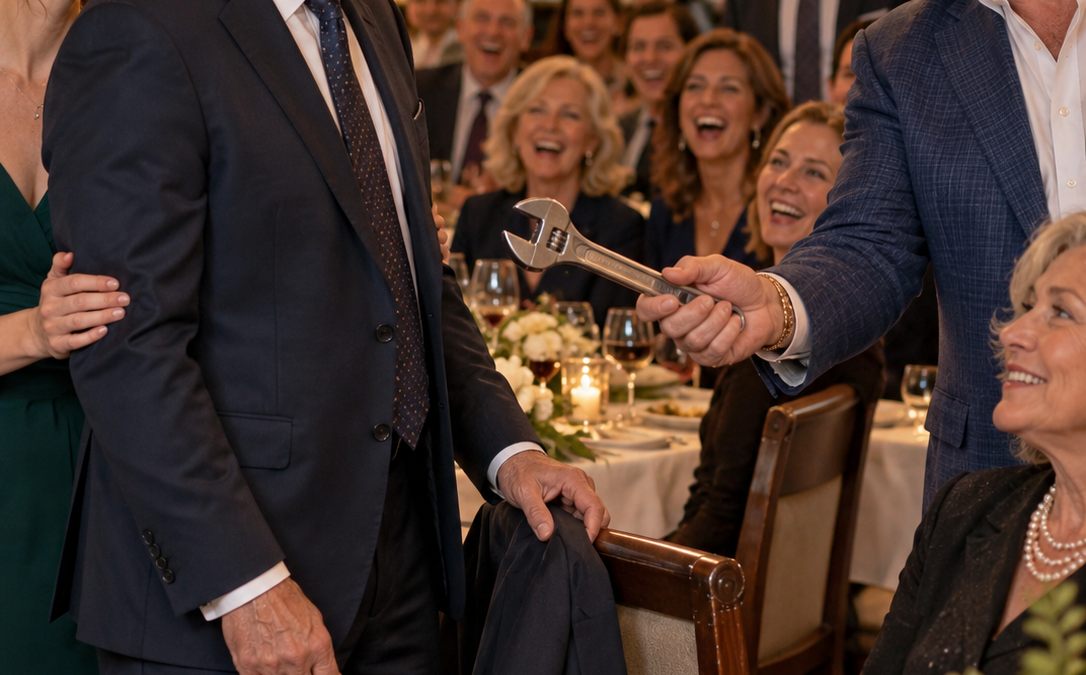
Chip Garrett owed me $38,400, and the afternoon before my daughter’s engagement dinner I had filed a construction lien on his building, but he stood in front of 22 guests holding a bar wrench across the table at my suit.
“Stan, bar sink’s backed up. You brought your hands, right?”
People laughed.
Chip grinned at my daughter, Hannah, then back at me.
“Your girl’s marrying up. Consider the invoice her dowry.”
A few people laughed again.
Hannah put one hand on my sleeve.
I looked at Chip.
“Which sink?”
That got another laugh.
Chip grinned like I had played along with a joke he owned. At sixty-three, he had spent years making Garrett’s Supper Club in Bay View feel like his living room. He liked being the loudest man in it. He liked knowing which table needed another bottle before anybody asked.
That Saturday night was supposed to be about Hannah and Chip’s son, Colin.
Hannah was thirty. Colin was thirty-one. They were engaged, happy, and trying to get two families through one dinner without anybody making trouble.
I was sixty-one and owned a small plumbing shop.
I had also worn the same suit to every wedding, funeral, and serious dinner for years.
Chip knew that.
He held the wrench a little higher.
“Back bar,” he said. “Water’s sitting there.”
Hannah’s fingers tightened on my sleeve.
“Dad, you don’t have to.”
I looked at her face.
That was the price of walking out. It would not have been Chip’s night I ruined. It would have been hers.
So I took the wrench.
Chip slapped the table once.
“See? This is why you marry into the trades.”
More laughter.
I stood up and removed my jacket.
Hannah watched me hang it over the back of my chair. I had copies of four documents in the inside pocket, including the file-stamped lien I had carried out of the Milwaukee County Clerk of Circuit Court at 3:40 the afternoon before.
Chip did not know that.
He should have.
The debt was not a surprise.
His club expansion had needed a kitchen re-pipe and a grease interceptor. My shop had done the work under a contract Chip signed on February 6.
We finished on June 11.
The unpaid bill was $38,400.
Nothing had ever been paid.
I had spent months hearing that money was coming. By September, promises were no longer worth the time it took Chip to make them. My attorney, Gwen Quinn, had handled the notice we needed before filing.
Friday afternoon, October 2, I finally filed.
Saturday night, Chip handed me a wrench.
I rolled my sleeves once and followed him toward the bar.
A few people turned in their chairs to watch.
Chip walked ahead of me like he had summoned maintenance.
Behind me, Hannah said, “Dad.”
I stopped and looked back.
She had left her hand resting on the edge of my empty chair.
I gave her one nod.
Then I went behind the bar.
The backed-up sink was on a line my own shop had installed.
That part almost made it funny.
Almost.
I set the wrench beside the basin, opened the cabinet, and got down on one knee. The trap had caught enough greasy debris to slow the drain almost completely.
It was ordinary work.
The kind I had done thousands of times.
Only I usually did it in work pants, not with twenty-two dinner guests a few yards away while the man who owed me nearly forty thousand dollars made jokes over my shoulder.
Chip leaned against the bar.
“How bad is it?”
“Clogged.”
“Can you save her?”
I looked up at him.
“It’s a sink.”
A couple people laughed again.
Chip loved that.
I loosened the trap carefully. Water came down into the container Chip had brought me. I cleared the blockage, reseated everything, tightened it, then ran the faucet.
The water went straight down.
Chip tapped the bar.
“Professional miracle.”
I washed my hands at the working sink and dried them with paper towels.
My palms were clean.
My cuffs were not.
There was a dark damp mark near one wrist.
I noticed Hannah noticing it when I came back into the dining room.
She did not smile.
Neither did Colin.
Colin had been sitting beside her most of the evening, polite and quiet, the way he usually was around his father when Chip had an audience.
I picked up a napkin from my place and wiped my hands again.
Chip followed me into the room carrying his grin.
“Ladies and gentlemen,” he called, “how about a little appreciation for the plumber?”
He started clapping.
Some people joined him.
I stood beside my chair in my shirtsleeves while applause moved around the table.
Hannah looked down.
I had been paid for plenty of dirty jobs in my life.
That was the first one where applause made it worse.
Chip raised his voice over the last few claps.
“What do I owe you?”
I looked at him.
“No charge. It wouldn’t fit on your bill.”
Chip’s face changed.
Only for a second.
The grin stopped before he caught it again.
I saw the color leave around his mouth.
He knew exactly which bill I meant.
Nobody else did.
Not yet.
Chip gave a short laugh and turned toward the table.
“Stan’s been paid in full. Family rate.”
Hannah looked up fast.
Colin turned toward his father.
I stayed where I was.
Chip had just lied in front of everybody.
He knew I had not been paid.
I knew it.
And now, because he had chosen those words, the room had heard there was something to deny.
Chip still had the wrench in one hand.
He held it toward me.
“Here. Take your weapon.”
I reached for it.
Then he pulled it back a few inches, smiling again, stretching the joke.
A couple people chuckled.
Hannah’s chair scraped softly against the floor.
Chip saw her expression and stopped playing.
He held the wrench out for real.
I took it.
“Keep it,” he said. “Souvenir.”
I slid it into my pants pocket.
The handle stuck out several inches.
Chip laughed at that too.
Then he went back to his chair and started talking about dessert.
I put my jacket on.
The stamped lien rested against my chest.
October 2, 2026.
3:40 p.m.
$38,400.
Chip kept talking.
I ate what was left on my plate.
Hannah barely touched hers.
Once, she leaned close.
“What bill?”
“Later.”
Her eyes stayed on me.
“Dad.”
“Not tonight.”
She looked toward Chip, then toward Colin.
I could see her working through what she had just heard.
I hated that.
I had filed the lien because my shop had done the work and Chip had not paid. That part was simple.
Hannah was not simple.
She loved Colin.
I loved Hannah.
Chip seemed to believe those facts gave him room to keep stretching the debt.
That was why I had not stood up and announced the filing.
The paper could do its own work.
All Chip had to do was find out it existed.
Dinner finally broke up with chairs sliding back and people gathering coats.
Chip stayed inside, talking loudly near the bar.
I stepped outside into the cool Milwaukee night.
The wrench bumped against my leg as I walked.
I had almost reached my truck when somebody called my name.
“Stan.”
I turned.
Colin was coming across the parking lot alone.
He stopped a few feet from me.
His hands were in his coat pockets.
He looked embarrassed, but more than that, he looked confused.
“My dad said you were paid.”
I waited.
Colin glanced back toward the club.
Then he looked at me.
“What bill?”
Picking up where the Facebook post left off
Chapter 2: The Letter Chip Signed
By Monday morning, Colin knew there was a bill, and 22 people had heard Chip Garrett claim I had already been paid.
That was enough to get me to his office.
Chip sat behind a wide desk at Garrett’s Supper Club with the weekend receipts spread in front of him. He did not offer me a chair.
“You embarrassed Hannah Saturday,” I said.
Chip leaned back.
“You fixed a sink.”
“You told everybody I was paid.”
His mouth turned up.
“Your girl’s marrying up. Consider the invoice her dowry.”
He said it as casually as he had said it at dinner.
I took out my phone.
“What are you doing?”
I found his June 30 text and set the phone on the desk between us.
Cash is tied up until the bank money lands. You’ll get yours.
Chip looked at it.
He did not touch the phone.
I said, “That’s your message.”
“So?”
“You owed me then.”
“I know what it says.”
“You owe me now.”
Chip shrugged.
I had not gone there to tell him about the lien.
That part was already done.
The filed claim had its own path to his door, and Gwen had been clear with me about letting the paperwork speak for itself.
I kept my voice level.
“Thirty-eight thousand four hundred.”
Chip picked up one of the receipts on his desk and looked at it like I was making him late.
“You’re not going to blow up our kids over an invoice.”
“I’m asking for payment.”
“You’ve been asking.”
“And you haven’t paid.”
He pushed his chair back.
“This is family now, Stan.”
“No. This is a bill.”
His eyes narrowed.
For a few seconds neither of us said anything.
Then Chip looked at my phone again.
“Old text.”
“Still yours.”
“I told you money was moving.”
“You told me I’d get mine.”
Chip gave another shrug.
That was it.
No check.
No date.
No explanation of what “bank money” meant.
I picked up my phone.
“The bill is still $38,400.”
Chip turned back to his papers.
“You finished?”
“Yes.”
I walked out.
Gwen Quinn’s office was downtown, and by the time I got there, she already had the stamped claim laid out beside an envelope.
She was sixty and had a way of reading dates aloud that made them sound like bolts being tightened.
“Filed Friday, October 2, at 3:40 p.m.,” she said. “Now the copy goes out.”
She slid the claim into the registered-mail envelope.
I watched her seal it.
On the corner of her desk sat another piece of paper.
Gwen tapped it with one finger.
“September 1.”
It was the receipt from the notice of intent.
The signature line said, P. Garrett.
Chip’s handwriting.
“He signed that one himself,” Gwen said.
“I know his signature.”
“Good. So do I.”
She put the receipt back into the file.
“He can say he forgot. He can say he didn’t understand it. He cannot say nobody sent him anything.”
I looked at the sealed envelope.
“You think he’ll open this one?”
Gwen gave me a flat look.
“That is not our job.”
She mailed it that afternoon by registered mail.
Wednesday morning, I was back at the shop when Gwen called.
“Second receipt came in.”
“Signed?”
“Yes.”
“Who?”
“P. Garrett.”
I stopped tightening the fitting in my hand.
Chip again.
“You’re sure?”
“I’m looking at it.”
The stamped lien had been sent.
Chip had signed for it.
Whatever he did after that was his choice.
I thought knowing that would make me feel better.
It didn’t.
That evening Hannah came to my house.
She did not sit down.
She stood near the kitchen counter with her purse still over one shoulder.
“What’s going on with you and Chip?”
I set down the glass I was holding.
“What did Colin tell you?”
“That there’s some bill. He said his dad told everybody you’d been paid, and then you wouldn’t explain anything in the parking lot.”
“I wasn’t discussing it at your engagement dinner.”
“You discussed enough for Colin to chase you outside.”
I looked at her.
“Thirty-eight thousand four hundred dollars.”
Hannah went still.
“What?”
“That’s what he owes my shop.”
Her eyebrows pulled together.
“For what?”
“The kitchen re-pipe and grease interceptor for the expansion.”
She stared at me.
“Chip told me his own guys did that kitchen.”
I did not answer right away.
Then I said, “My shop did it.”
“All of it?”
“The work in my contract.”
“And he hasn’t paid you?”
“Nothing.”
She set her purse on the counter.
“When did this start?”
“Contract was February 6. Last work was June 11.”
“And you’ve just been sitting on this?”
“No.”
I told her about the promises through the summer.
Then I told her about the notice.
Then I told her what I had not told her Saturday.
“I filed the lien Friday.”
Hannah’s face changed.
“Friday?”
“Yes.”
She stared at me.
“The day before my dinner?”
“Yes.”
“Dad.”
“It was the first workable day after the notice period.”
“You filed a lien on Colin’s father’s building the day before our engagement dinner?”
“I filed a lien on a building for work I wasn’t paid for.”
She stepped away from the counter.
“You knew what that weekend was.”
“I did.”
“And you still did it.”
“I had a filing deadline. I also had $21,600 in materials sitting unpaid inside that bill.”
Hannah shook her head.
“You could have told me.”
“I’m telling you now.”
“After Colin asked.”
“Yes.”
Her mouth tightened.
I could see where her anger had landed.
On me.
Not Chip.
Not yet.
“He told me his own guys did that kitchen,” she said again.
“Then he lied to you.”
She looked toward the window.
I said, “He signed for the notice in September.”
That brought her eyes back to me.
“And today?”
“Wednesday. He signed for the filed claim too.”
Hannah said nothing.
I knew what she was thinking because I had thought it myself.
If Chip signed both, then surely he knew.
She assumed he had read the second envelope.
So she did not call Colin.
She did not call Chip.
She kept it between us.
“What was that text you showed him?” she asked.
“June 30.”
“What did it say?”
I told her.
“Cash is tied up until the bank money lands. You’ll get yours.”
Hannah’s expression sharpened.
“Bank money?”
“That’s what I asked myself.”
She grabbed her purse.
“Hannah.”
She turned.
Her face was flushed now, anger pushing past the confusion.
“You cannot mess this up.”
“Mess what up?”
“Chip closes on a $640,000 loan for the second location October 23.”
I said nothing.
She pointed toward me.
“Don’t ruin it.”
Chapter 3: The Affidavit Colin Carried
By the middle of October, I had the paperwork I needed and a daughter who thought I was about to wreck her future.
I also had $21,600 in materials sitting on my shop account with no payment from Chip.
The supply house called first.
“Stan, we have to freeze you until that balance comes down.”
I knew the number before the clerk said it.
Twenty-one thousand six hundred dollars.
Pipe, fittings, interceptor parts, valves. Material that had gone into Garrett’s Supper Club months earlier.
“I understand,” I said.
That did not make it easier.
A frozen account meant I could not keep buying on terms for new jobs. Cash only, and I did not have enough cash to carry the shop the way I had been carrying it.
My apprentice was the next problem.
He was good. Young, steady, never made me tell him the same thing twice.
I called him into the office.
“I have to cut you loose for now.”
He stared at me.
“Because of Garrett?”
“Yes.”
“For how long?”
“I don’t know.”
He nodded once.
That was worse than if he had gotten angry.
I paid him what I owed him and watched him clear his locker.
Then I sold my second truck.
It was not new, but it ran well, and having two trucks meant I could split jobs without losing half a day moving tools around Milwaukee.
I took less for it than I wanted.
I took what I could get.
The lien stayed where it was.
Chip did not pay.
Instead, he started talking.
By that weekend, he had told people on both sides of the family that I was shaking him down over an old bill.
Hannah called Saturday afternoon.
“I’m canceling Sunday.”
I was at the shop, standing beside the empty space where the second truck used to sit.
“Dinner?”
“Yes.”
“You don’t want me there?”
“I don’t want you and Chip in the same room.”
“That’s different.”
“Is it?”
I did not answer.
She said, “He says this is an old invoice you’re suddenly pushing because of the wedding.”
“It’s not sudden.”
“I know what you said.”
“Then why are we doing this?”
Her voice tightened.
“Because I’m getting married, Dad.”
“I know.”
“And every conversation is about this bill now.”
“I didn’t make it that way.”
She was quiet for a second.
Then she said, “No Sunday dinner.”
“All right.”
She hung up.
I lowered the phone and stayed beside the empty truck space for a while.
That Sunday, I ate alone.
Monday, October 19, I worked late.
I had the office light on and the rest of the shop dark when somebody knocked on the front glass.
It was Colin.
I unlocked the door.
He came in holding a folded copy of a document.
“You alone?”
“Yes.”
He looked toward the back room anyway.
Then he held the paper out.
“My dad had me drive this to a notary today.”
I took it.
It was an owner’s affidavit.
I knew what I was looking at before I reached the important line.
All contractors paid.
I looked at the date.
October 19, 2026.
Then I looked at Chip’s name.
“Your father signed this today?”
Colin nodded.
“He told me it was standard for the loan.”
I set the paper on my desk.
“Did you read it before you drove it over?”
“No.”
“Did you read it after?”
His jaw tightened.
“Yes.”
I tapped the line about contractors being paid.
“That’s false.”
Colin rubbed one hand over his mouth.
“I know what you said in the parking lot. I know what Hannah told me after.”
“You knew the amount?”
“She told me thirty-eight four.”
I opened my file drawer.
Colin stayed standing.
He said, “There’s something else.”
I waited.
“There are envelopes in his desk drawer. Law-office envelopes. He signs for stuff and tosses it in there unopened.”
I looked at him.
“How many?”
“I don’t know. More than one.”
That explained enough.
Chip could sign registered mail and still pretend he had not seen what was inside.
I pulled out my copies.
First, the contract.
I laid it on the desk and turned it toward Colin.
“February 6.”
He leaned over.
His father’s signature was at the bottom.
Next came the city permit naming my shop.
Then the stamped lien.
October 2.
3:40 p.m.
Colin stared at the papers.
I did not talk over him.
He put one finger near Chip’s signature on the contract.
Then he looked at the signature again, slower this time, like he was trying to make it belong to somebody else.
“That’s his.”
“Yes.”
“And this permit is yours.”
“Yes.”
He moved to the lien.
“Thirty-eight thousand four hundred.”
“Yes.”
“And he signed that affidavit today saying everybody’s paid.”
“Yes.”
Colin straightened.
His face had gone pale.
“My dad told me you were trying to use the wedding.”
“I want my money.”
“He told Hannah his own guys did the kitchen.”
“My contract says otherwise.”
Colin looked at the affidavit again.
I did not ask him what he planned to do.
That was between him and his father.
Finally, he picked up the copy he had brought.
“You keeping this?”
“If you’re giving it to me.”
He nodded.
“I am.”
Then he walked out.
I watched his taillights disappear from the lot.
The question sat there with me after he left.
Would Colin warn Chip?
I called Gwen.
She answered on the fourth ring.
“What happened?”
I told her about the affidavit.
Then I told her Colin had seen the contract, the permit, and the filed claim.
Gwen was quiet for a moment.
“Do nothing.”
“That’s your advice?”
“That’s my instruction.”
“He closes Friday.”
“I know.”
“What if Colin tells him tonight?”
“Then Chip learns tonight.”
“And if he doesn’t?”
“Friday’s final title check finds a public filing.”
I looked at the stamped lien on my desk.
“So I wait.”
“You wait.”
I put the contract, permit, lien copy, and affidavit copy together.
Then I slid them into the inside pocket of my suit jacket.
Friday was coming.
I did nothing.
Chapter 4: The Check for Five Thousand
Chip’s invitation came Tuesday.
Same 22 people from the engagement dinner, plus Teresa Foster from the bank. Thursday, October 22. Preview dinner at Garrett’s Supper Club.
My card had four words written across the bottom.
Wear the suit.
I knew Chip’s handwriting.
By then, he had sworn in an affidavit that every contractor had been paid. Colin had asked him directly whether I was paid. And Friday’s closing on the $640,000 loan was close enough that Chip could probably hear the clock.
My phone buzzed while I was standing at the shop counter.
It was Colin.
He said paid in full. I didn’t show him the paper.
I stared at the message.
So Colin had asked.
Chip had lied again.
And Colin had kept the affidavit to himself.
I put the phone away.
An hour later, Chip walked into my shop.
No appointment.
No hello.
He was carrying a white envelope and a single sheet of paper.
He looked around the front office.
“Where’s your boy?”
“Gone.”
“Gone where?”
“I had to let him go.”
Chip’s eyes moved toward the empty truck space visible through the open bay door.
He knew enough about my business to understand what that meant.
He did not ask.
Instead, he put the envelope on my counter.
“Let’s end this.”
I opened it.
The check was for $5,000.
I looked at him.
“That number’s wrong.”
“It’s a peace offering.”
“You owe $38,400.”
He slid the other sheet toward me.
It was a release covering any claim for the kitchen work.
I looked at the check again.
Five thousand dollars in exchange for giving up the rest of what he owed.
Chip tapped the signature line.
“Sign, and you walk her down the aisle.”
I kept my eyes on him.
He did not smile.
That was how I knew he meant it.
“You’re trading my daughter’s wedding for thirty-three thousand four hundred dollars?”
“I’m giving you a way out.”
“No.”
“Stan.”
I slid the check and the release back across the counter.
Unsigned.
Chip’s jaw tightened.
“You want to gamble a wedding over paperwork?”
“You owe my shop.”
“You think a plumber’s bill makes you rich?”
“No.”
“You think Teresa needs to hear about a family quarrel two days before closing?”
“I didn’t say anything about the bank.”
His eyes narrowed.
For a second, neither of us moved.
Then Chip took the check.
He folded the release once.
“You could have five grand in your pocket right now.”
“I could also be short $33,400.”
“This is family.”
“You already tried that line.”
Chip shoved both papers into the envelope.
“You better think about Thursday.”
“I already have.”
He left without another word.
I called Gwen.
She listened while I told her about the check, the release, and the aisle.
Then she said, “You understand the risk now?”
“I understand Chip.”
“I mean the money.”
I leaned against the counter.
“Go ahead.”
“If that loan dies, he may have nothing available to pay you with.”
“I have the lien.”
“You have security against the property. That does not mean a check appears Friday.”
“I know.”
“If it turns into foreclosure litigation, you could be looking at two years.”
I looked toward the empty bay where my second truck had been.
“Two years.”
“Yes.”
“And after that?”
“Depends what’s left to collect.”
That was the part I had tried not to think about.
A lien could protect a claim.
It could also leave me waiting while lawyers, lenders, and property values decided whether the paper was worth what it said.
Gwen kept going.
“And Stan?”
“Yes.”
“You may lose Hannah too.”
I closed my eyes for a second.
“She’s already mad.”
“Mad is not the same as gone.”
“No.”
“Chip knows where to press.”
“I noticed.”
Gwen’s voice stayed brisk.
“I’m not telling you to release the claim. I’m telling you the clean legal answer can still cost you.”
“I know.”
When the call ended, I stood alone in the shop.
Five thousand dollars would have helped.
It would have reopened my supply account.
It might have helped me bring my apprentice back.
It would not have made the debt paid.
That evening Hannah came over.
She looked tired.
“I heard he went to see you.”
“Who told you?”
“Colin.”
I nodded.
She folded her arms.
“What happened?”
“He offered five thousand.”
Her eyes widened.
“For the whole thing?”
“For any claim on the kitchen work.”
“And you said no.”
“Yes.”
She looked down.
I waited.
Then she said, “Dad, I need one thing from you.”
“What?”
“One quiet night.”
“Thursday?”
“Yes.”
She looked at me.
“Please.”
I knew what she meant.
No documents on the table.
No argument with Chip.
No announcement in front of Teresa.
No turning dinner into another fight.
“I won’t start anything,” I said.
Her shoulders dropped a little.
Then I added, “And I won’t lie if somebody asks me.”
Hannah’s face tightened again.
“Why does somebody have to ask?”
“I hope nobody does.”
“You know how Chip is.”
“Yes.”
“And Teresa will be there.”
“I know.”
She rubbed her forehead.
“I just want one dinner where nobody talks about invoices or liens or lawyers.”
“I won’t bring it up.”
“Promise?”
“I promise I won’t start it.”
She studied me.
“That’s not the same promise.”
“It’s the one I can make.”
She picked up her purse.
I hated watching her leave angry.
But I would not sit in front of my daughter and promise to repeat Chip’s lie.
Thursday was one dinner.
Friday was the closing.
The papers stayed in my suit.
The question was simple now.
What happened if somebody asked me directly?
My phone rang late Wednesday.
Chip.
I answered.
He did not bother with hello.
“Say one word Thursday and you watch that wedding from the parking lot.”
Chapter 5: The Banker’s One Question
Thursday night, Chip stood in front of the same 22 guests who had watched me fix his sink.
Teresa Foster sat near the end of the table with a leather folder beside her plate.
My papers were inside my suit jacket.
Chip knew I had refused his $5,000 check. He knew Colin had asked whether I was paid. He had threatened to keep me out of my own daughter’s wedding if I spoke.
He still looked certain I would stay quiet.
Chip lifted his glass.
“To the next Garrett’s Supper Club.”
People raised theirs.
He smiled toward Teresa.
“And to the bank for recognizing a good thing when they see one.”
Teresa gave him a courteous smile.
Chip kept going.
“Tomorrow we close, then the real work starts.”
Hannah was sitting across from me beside Colin.
She looked at me once.
I had made her a promise.
I would not start anything.
So I ate my dinner.
Chip talked about the second location, the kitchen, the opening schedule, and how much bigger the new place could be.
Then Teresa turned toward me.
“Mr. Hoffman?”
I set down my fork.
“Yes?”
“I recognize your name.”
Chip stopped talking.
Teresa continued.
“You’re Hoffman Plumbing?”
“Yes.”
“I saw that on the permit for the kitchen work here.”
Chip laughed too quickly.
“My own guys did that kitchen. Tell her he’s paid, Stan.”
Hannah closed her eyes for a second.
I looked at Teresa.
She asked one question.
“Mr. Hoffman, are you square with Mr. Garrett?”
I had hoped nobody would ask.
But she had.
“No.”
Chip’s glass touched the table hard.
“Oh, come on.”
I reached inside my jacket.
Hannah watched my hand.
I took out the signed contract and laid it beside my plate.
“February 6,” I said.
Teresa reached for it.
Chip leaned forward.
“That doesn’t prove anything.”
I unlocked my phone and brought up his June 30 message.
Cash is tied up until the bank money lands. You’ll get yours.
I placed the phone beside the contract.
Teresa looked from one to the other.
Chip pointed at the screen.
“That’s an old text. We settled up in cash.”
I looked at him.
“No.”
His face hardened.
“Don’t do this here.”
“You told her I was paid.”
“You are.”
“No.”
I reached into my jacket again.
This time I took out the file-stamped lien.
I set it on the table.
Teresa picked it up.
Chip was still talking until his eyes found the stamp.
Then he stopped.
October 2, 2026.
3:40 p.m.
$38,400.
He took the paper from Teresa and stared at the date.
The color drained from his face.
“Nobody ever sent me a thing.”
I opened the rest of my copies.
The first registered-mail receipt went down beside the lien.
September 1.
Signed P. Garrett.
Then the second.
October 7.
Signed P. Garrett.
Chip stared at his own signatures.
Nobody at the table laughed.
Teresa asked, “These are the notice and the served claim?”
“Yes.”
Chip pushed the receipts back toward me.
“This is family. He’s shaking me down over a wedding.”
Hannah flinched.
I stayed seated.
The wedding was exactly why I had kept quiet until Teresa asked.
Chip looked around the table as if somebody would agree with him.
“Thirty-eight grand? He waits until Hannah and Colin are getting married, then suddenly I’ve got a lien?”
“I sent notice September 1.”
“You knew what was coming.”
“Yes. Payment.”
Chip pointed at me.
“You’re willing to wreck your daughter’s wedding over money.”
A chair moved.
Colin stood.
Chip turned toward him.
“Sit down.”
Colin did not.
His face was pale, but his voice was steady.
“I drove your affidavit to the notary, Dad. You told me it was true.”
Chip’s mouth opened.
Nothing came out.
Colin looked toward Teresa.
“He signed it Monday.”
Teresa’s hand moved to her folder.
Hannah stood too.
For one second I thought she was leaving.
Instead, she picked up her chair.
She carried it around the end of the table and set it beside mine.
Then she sat down.
Her shoulder touched my sleeve.
Chip stared at her.
“Hannah.”
She did not answer him.
Teresa opened her folder.
She removed the owner’s affidavit Colin had described.
Then she placed the stamped lien beside it.
Her finger moved to the affidavit date.
October 19.
Then to the filing stamp.
October 2.
“The lien predates this affidavit,” she said.
Chip leaned toward her.
“Teresa, this is a family dispute.”
She looked at him.
“My concern is the loan file.”
“I can clear this up tomorrow.”
“Closing is tomorrow.”
“That’s what I said.”
Teresa did not argue.
She compared the papers one more time.
Then she reached into her folder and removed the commitment letter for the $640,000 loan.
Chip watched her hand.
“Teresa.”
She lifted the commitment letter off the table.
Then she put the affidavit and her notes back into the folder.
“Call your attorney.”
“You’re not killing six hundred forty thousand dollars over a plumber.”
Teresa closed the folder.
“I’m not discussing the file at dinner.”
She stood.
Chip stood with her.
“Sit down and let me explain.”
“I have what I need tonight.”
She walked past him.
Nobody stopped her.
Teresa crossed the dining room, passed the same guests Chip had toasted minutes earlier, and went out the front door carrying the commitment letter.
Chip remained standing.
His second location had been one day from closing.
Now his lender was gone.
For a few seconds, he looked at the door.
Then he looked at Colin.
Then Hannah.
Finally, me.
“What does it take?”
I put the receipts back with the contract.
The lien stayed on the table between us.
I stood.
“It’s on file, Chip. Pay your plumber.”
Chapter 6: The Cashier’s Check for $38,400
Friday morning came without a closing.
By nine, Gwen had already heard from Chip’s lawyer.
“They know the title won’t clear with your lien sitting there,” she said.
I was standing in my office with the shop phone against my ear.
“What are they doing?”
“His lawyer gave him two choices. Pay the claim or post an undertaking with the court.”
“How long does that take?”
“Long enough that he’s not closing today.”
I looked through the office window at the empty space where my second truck had been.
“And the lease?”
“That deadline is today too.”
The second location had been tied to the $640,000 loan. Without the closing, Chip could not finish what he needed for the lease.
By the end of Friday, it lapsed.
The $25,000 deposit went with it.
Chip had gambled that I would stay quiet, that Colin would stay quiet, and that Teresa would never ask the right question.
Now the second location was gone before he ever unlocked its door.
He still did not pay me that day.
His lawyer and Gwen talked instead.
I stayed out of it.
The lien had done what it was supposed to do.
A week later, Friday, October 30, Gwen called me shortly after lunch.
“It’s here.”
“How much?”
“Thirty-eight thousand four hundred dollars.”
I sat down.
“Cashier’s check?”
“Yes.”
“Good.”
That was all I said.
I drove to Gwen’s office and looked at the check myself.
$38,400.
No discount.
No family rate.
No dowry.
The full bill.
Gwen had the satisfaction ready.
“You sign this, we file it.”
“I know.”
“You comfortable?”
“He paid.”
I signed.
We filed the satisfaction.
Then I drove straight to the supply house.
The clerk who had frozen my account looked up when I came through the door.
“I’m here about the twenty-one six.”
He pulled up the balance.
I paid the $21,600 in materials.
The account was reopened.
I stood at the counter while he printed the receipt.
That piece of paper meant more to me than the cashier’s check had.
The check proved Chip had finally paid.
The receipt meant I could work normally again.
My next call was to my apprentice.
He answered with, “Hey, Stan.”
“You working?”
“Picking up some small stuff.”
“You want your job back?”
He was quiet for half a second.
“When?”
“Monday.”
“I’ll be there.”
I looked toward the bay.
“Same locker.”
“Same truck?”
“No.”
He laughed once.
“Had to ask.”
“Monday.”
“Monday.”
That was one part of my shop I could put back.
The truck would take longer.
Chip had other problems.
The lien filing was public.
Once other vendors found it, they started looking at the docket.
Then they started showing up.
The next time I drove past Garrett’s Supper Club, there were people waiting near the back entrance.
A produce supplier.
A repair contractor I recognized.
Two other men I did not.
Nobody was laughing.
Word had gotten around that the plumber had filed and gotten paid.
Now people who had been willing to wait wanted answers about their own money.
Chip could talk past one old invoice.
A line at his back door was harder.
Colin called me that evening.
“I quit.”
I stopped sorting fittings.
“When?”
“Today.”
“You sure?”
“Yes.”
“What happened?”
“I gave him my keys.”
I pictured Colin standing in the club office, the same place where Chip had told me to consider $38,400 my daughter’s dowry.
“What did he say?”
“A lot.”
I waited.
Colin did not repeat it.
Finally he said, “I can’t manage the place and pretend I don’t know what I know.”
“You have work lined up?”
“Not yet.”
“You’ll find something.”
“I hope so.”
He went quiet.
Then he said, “Hannah’s with him now.”
That worried me more than the resignation.
“What for?”
“The wedding.”
I found out an hour later.
Hannah came to the shop after closing.
She walked into my office and sat across from me.
“I talked to Chip.”
“How’d that go?”
“Bad.”
I leaned back.
“What did you tell him?”
“He can still come to the wedding.”
I said nothing.
She looked tired, but her voice was steady.
“He’s Colin’s father. Colin wants him there.”
“That makes sense.”
“But he’s not giving a toast.”
I nodded.
“And he’s not at the head table.”
I looked at her.
“Those were your terms?”
“Mine and Colin’s.”
“How did he take them?”
“You know how.”
I did.
Hannah rubbed her thumb along the edge of her purse.
“He said you turned everybody against him.”
“I didn’t tell the vendors to check the docket.”
“I know.”
“He paid what he owed me.”
“I know that too.”
She looked around the office.
The second desk was empty because my apprentice had not started back yet.
The bay beyond it had one truck instead of two.
Nothing had gone back to normal just because a check arrived.
Hannah saw all of that.
She said, “I was wrong about something.”
I waited.
“I thought if everybody stayed quiet, the wedding would stay clean.”
I did not answer.
She looked at me.
“It didn’t.”
“No.”
“Colin’s done working for him.”
“He told me.”
“And Chip says he’ll come to the wedding, but he’s furious about the toast.”
“That sounds like Chip.”
A small smile touched her mouth and disappeared.
Then she got serious again.
“Can you be in the same room with him?”
That was harder than filing a lien.
Harder than refusing five thousand dollars.
Chip had used Hannah against me before the engagement dinner, during the debt fight, and again when he threatened to keep me from the wedding.
Now he would be sitting somewhere in the same room while I watched my daughter get married.
“I can behave,” I said.
“That isn’t what I asked.”
“It’s what I can promise.”
She nodded slowly.
For a minute, neither of us spoke.
Then Hannah looked through the office window toward the back of the shop.
“Dad?”
“Yes?”
“What if we hold the rehearsal dinner here?”
Chapter 7: The Wrench Over the Counter
By May 2027, the back room of Hoffman Plumbing looked nothing like a plumbing shop.
Hannah had put white cloths over folding tables. Twenty-two chairs filled the room in two long rows. Somebody had moved the pipe carts against the far wall, and the apprentice I had rehired after Chip paid had spent half the afternoon making sure nobody could trip over a toolbox.
Colin had been working at the shop since November.
Six months in, he had stopped looking like a restaurant manager wearing work clothes and started moving like a tradesman. He knew where I kept the channel locks. He knew which fittings I bought by the case. He had learned that I wanted measurements called out once and written down right.
The other apprentice was carrying plates toward the tables while Colin set forks beside them.
I came in wearing my suit.
Hannah looked over.
“You wore it.”
“You told me to.”
She smiled.
The last time that suit had been in the same room with Chip Garrett, I had been carrying a lien in the inside pocket.
That lien had been paid.
Above the shop counter hung the filed satisfaction.
Beside it hung Chip’s bar wrench.
I had kept the wrench after the engagement dinner. For months it had lived in a drawer. When we set up the back room, I put it over the counter.
I did not add a plaque.
It did not need one.
Chip arrived with Colin.
He had been invited to the rehearsal dinner under the same terms Hannah had given him for the wedding months earlier.
Guest.
No host routine.
No speech.
No place at the center of things.
He sat in the back row.
He said hello to me.
“Stan.”
“Chip.”
That was enough.
Months earlier, Chip had stood before 22 people and laughed while I fixed his clogged sink. He had owed my shop $38,400 and did not know the lien had been filed the afternoon before.
Then he learned.
The $640,000 loan disappeared.
The second-location lease went with it, along with the $25,000 deposit.
On October 30, his lawyer delivered the full $38,400 to Gwen. I filed the satisfaction, paid the supply house its $21,600, and brought my apprentice back.
Other vendors had found Chip’s name in the public docket too.
By then, none of that needed discussing over dinner.
Nothing was still owed to me.
That mattered.
Hannah sat beside me.
Colin moved around the tables checking plates and glasses. The apprentice I had rehired carried in another stack of dishes from the front.
Chip watched Colin once or twice but did not call him over.
Colin had told me he handed his father his keys months earlier.
Now the keys in his pocket belonged to my shop.
Dinner started without a toast from Chip.
That was strange at first.
At Garrett’s Supper Club, he had always filled quiet space before anybody else could.
In my back room, people talked over one another without needing him to run the room.
Hannah asked me if the potatoes were good.
“They’re potatoes.”
She laughed.
“You could say yes.”
“Yes.”
Across from us, Colin shook his head.
“You two do this all day?”
“Mostly,” Hannah said.
“No,” I said.
That got another laugh.
Chip looked down at his plate.
I could have watched him.
I chose not to.
I had already gotten paid.
Colin had already made his choice.
Hannah was sitting beside me.
There was nothing I needed from Chip that night.
About halfway through dinner, I heard a sound from the shop sink.
A short gurgle.
Then another.
Colin turned his head.
I did too.
Hannah caught it.
“What?”
“Sink.”
She stared at me.
Then the drain gave a louder gulp and water started sitting in the basin instead of disappearing.
Somebody near the counter said, “You have got to be kidding.”
The room laughed.
All 22 chairs were filled, and for a second I was back at Garrett’s Supper Club in my one suit with Chip holding a wrench across the table.
Only this time nobody was laughing at me.
They were laughing because a plumbing shop had managed to clog its own sink during dinner.
Colin stood.
“I’ll get it.”
I looked above the counter.
Chip’s wrench hung beside the satisfaction.
I could have taken it down and fixed the sink myself.
I could have handed it to Chip.
I could have said something clever enough to make everybody remember October.
Chip was sitting in the back row.
He had already lost enough.
More important, this was not his shop.
I got up.
The room quieted a little as I walked to the counter.
I took down the wrench.
Colin was already heading toward me.
I held it out.
“Which sink?”
For half a second, he just looked at me.
Then he smiled.
“The shop sink.”
He took the wrench.
“Good answer.”
Colin rolled up his sleeves.
Hannah touched my arm.
“Sit down, Dad.”
I did.
Colin opened the cabinet beneath the sink and got to work.
A few people turned around to watch him.
I did not.
I sat beside my daughter in the same suit I had worn the night her future father-in-law tried to make me the joke.
Then I picked up my fork.
Hannah leaned toward me.
“You’re really going to let him do it?”
“He works here.”
“He’s at his rehearsal dinner.”
“He’s still on the clock until I say otherwise.”
She smiled.
“You’re terrible.”
“No.”
Across the room, Colin called, “I heard that.”
“You were supposed to,” Hannah said.
The room laughed again.
Even Chip smiled.
Small.
Brief.
But I saw it.
Colin cleared the trap, tightened it back into place, and ran the water.
The sink drained.
He wiped his hands and came back to the table.
Nobody applauded.
I was glad.
He sat beside Hannah.
“Fixed.”
I nodded.
“Good.”
Then we ate.
Chip stayed through dinner.
He did not give a toast.
He did not tell stories about the club or the second location.
He did not ask for the room.
When people began folding chairs and carrying plates toward the front, he helped move two chairs against the wall.
I did not thank him.
He did not need me to.
By the time the last guest left, Hannah was standing near the door with Colin.
She kissed my cheek.
“See you tomorrow.”
“Yes.”
Colin looked toward the counter.
“I forgot something.”
He went back for the wrench.
I waited by the light switch.
Colin hung it over the counter beside the filed satisfaction.
Then I turned off the shop lights.
THE END







