My husband called me his third dependent at his mother’s birthday, while I fed our twins; he didn’t know what I had already signed.
Chapter 1 of 7
“Even my mother shouldn’t have to feed you.”
Aaron said it across Linda’s birthday cake, loudly enough for his friends.
It was 6:10 on Saturday, May 2. Our daughter drank her bottle against my elbow. Our son cried in the little bouncer beside my chair.
“Come on,” Aaron said. “Who here would take her without my four-thousand-dollar allowance?”
Kyle laughed with his mouth full. Matt gave Aaron a small, approving nod.
Linda kept her eyes on the cake.
“The mortgage comes out of that,” I said.
“Here we go.”
“And groceries. Their diapers.”
“I know what I send you, honey. I earn it.”
Our son’s crying broke into short, breathless hiccups. I rocked the bouncer with my foot while keeping the bottle tipped.
Aaron leaned back.
“See? Full house. Three dependents.”
“Your son needs his bottle,” I said.
“You’ve got one going already.”
“I have two babies.”
“And I have one paycheck.”
Kyle looked down at his plate, still grinning. The cake had pink frosting roses and a thumbprint where Linda had tested whether it was thawed. Every year she bought an ice-cream cake, then complained about needing a saw.
Usually, I laughed with her.
That evening, she studied the dent in the frosting.
“Dinner’s good, Mom,” Aaron said. “Nobody’s saying otherwise.”
“Could somebody pass me the other bottle?” I asked.
“It’s empty,” Linda said.
“There’s a clean one in the side pocket.”
Aaron looked at the diaper bag beside my chair.
“Speaking of that. What was the store charge yesterday?”
I knew which one.
“Diapers.”
“Thirty-eight dollars?”
“They were out of the smaller package.”
“You couldn’t go somewhere else?”
“With both of them?”
“You have a car.”
“I’m sorry, I should’ve—”
I stopped.
I had apologized often enough that Aaron expected it.
He waited, eyebrows raised, while our son cried harder. Our daughter had finished drinking. I settled her safely in the second bouncer and lifted her brother.
“Well?” Aaron asked.
“They needed diapers.”
“That wasn’t what I asked.”
“It’s what I bought.”
Linda’s dining room window faced the street. Beyond it, somebody walked a shaggy dog past the house. We were in Columbus, Ohio, at a birthday dinner, and I wanted to be out there picking up after a dog.
Aaron glanced toward his mother.
“Maybe Mom should help you with a budget.”
“I have a budget.”
“You have receipts.”
“Yes. From buying what we use.”
“Don’t make this embarrassing, Julia.”
Kyle quit smiling then. Matt became interested in the label on his beer.
Aaron lowered his voice, which made everybody lean closer.
“Mom ran a household for years. She could check things before you buy them. Take some pressure off you.”
“Before I buy diapers?”
“Before the little purchases add up.”
My son rooted against my sleeve. The clean bottle was still inside the bag, beyond my reach.
“Needing care did not make our children a burden.”
“Nobody called them a burden.”
“You counted me with them.”
“It was a joke.”
“I was feeding them.”
Linda finally looked up. Her mouth opened, then closed when Aaron spoke again.
“Just tell Mom you’ll let her help. We don’t need to ruin her birthday.”
The worn blue zippered pouch lay beside the diaper bag. It held coupons and the cash I kept for diapers. A folded packet stuck out of the bag’s outer pocket.
Aaron noticed me looking toward it.
“What do you need now?”
“The bottle.”
“Mom, can you get that?”
Linda rose, but stopped when the kitchen timer sounded.
“The coffee,” she said.
“I can wait,” Aaron told her.
He could. My son couldn’t.
I stood with him against my shoulder.
“Sit down,” Aaron said. “She’ll get it.”
“I’m getting a bottle.”
“And then we’re having cake. Can we finish one family thing without this?”
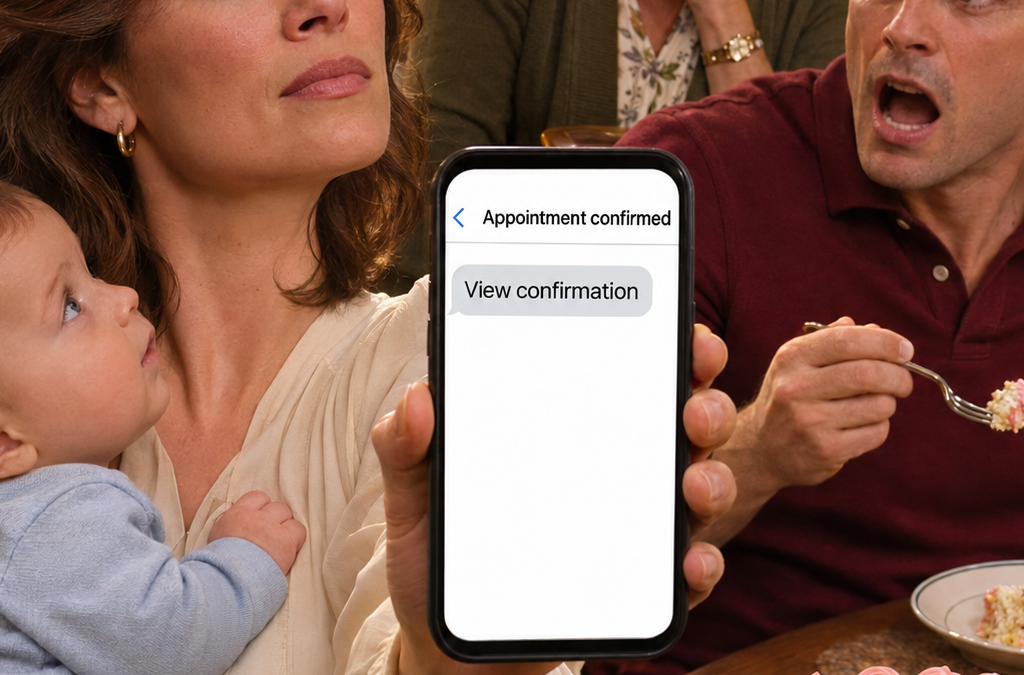
My phone vibrated beside my plate. I read the notification, then held the screen where Aaron could see it.
Aaron began lifting the cake knife above his plate.
He stopped with it suspended and read my screen again.
“You already made an appointment?”
The confirmation was for a legal consultation Monday, May 4, at 9:30 a.m.
“Yes.”
“With a lawyer?”
“Yes.”
He looked toward his friends. Neither one helped him.
“Because of a joke?”
“Because I need to ask some questions.”
“You could ask me.”
“I have.”
Linda returned with a clean bottle. “Here, sweetheart. I rinsed the outside. It was sticky.”
“Thank you.”
The folded packet slipped against the bottle pocket as I reached inside.
It was my accepted job offer for a payroll-specialist position, starting June 22. Before my caregiving break, I had handled payroll reconciliations across several locations; the work wasn’t new to me.
Aaron hadn’t asked what the papers were. He was still looking at my phone.
“How much is this appointment going to cost?”
“I’ll handle it.”
“That’s not an answer.”
“It’s the answer I’m giving you here.”
“Listen to yourself. You booked a lawyer and brought it to my mother’s birthday.”
“I didn’t bring it up.”
“You put the phone in my face.”
“You asked what I needed.”
“I meant from the bag.”
I fed our son while Linda cut cake. The packet’s loose fold showed salary forms, infant-care details, and the signed return-to-work attachment: “only by mutual written agreement.” Behind it sat the extra bib I’d brought.
Aaron moved across the table to make room for the cake plates.
“Whatever you think you’re doing,” he said, “you need to consider what this costs everybody.”
My phone began lighting up beside the folded packet.
“Both infant places are confirmed for June 22.”
The message confirmed two infant places in the employer’s care program. Aaron was across the table and didn’t see it.
Linda offered me cake. I shook my head.
“So we’re paying somebody to tell you we have bills,” Aaron said.
“I’m keeping the appointment.”
“There’s money well spent.”
Kyle stood. “I should probably get going.”
“Stay,” Aaron said. “We’re fine.”
Matt checked his phone.
Aaron kept his voice pleasant, as if the others had only misunderstood.
“She gets overwhelmed. Two babies, all day. I’ve said she needs to get out more.”
“I need you to stop discussing me.”
“I’m explaining.”
“They heard you.”
Linda looked between us. “Let me hold him a minute.”
“He’s still eating.”
“After, then.”
She had offered to hold a baby. She hadn’t told Aaron to stop.
By the time our son finished, the cake had softened into pink puddles. Linda took him, and I checked our daughter’s diaper in the hallway.
When I came back, the friends were gone.
Aaron waited by the table.
“Cancel it tonight.”
“No.”
“I’m trying to keep you from spending money we don’t have to spend.”
“I’m keeping the appointment.”
He looked at his mother. She watched our son’s eyelids droop.
“All right,” Aaron said. “Then we need to stop pretending the usual arrangement works.”
“What arrangement?”
“Me sending money while you make decisions without me.”
“That pays for the house. For their food.”
“Then we’ll talk about expenses when there are expenses.”
“There are expenses every day.”
He took out his phone. The dining room clock read 8:15.
“What are you doing?”
“Changing the transfer. We’ll handle things as they come up.”
My phone buzzed beside the cake plates.
The recurring $4,000 household transfer had been canceled.
Chapter 2 of 7
On Monday, May 4, I checked the joint account before the twins woke. Canceling the transfer hadn’t emptied it.
On paper, I separated the $1,850 mortgage payment from groceries, utilities, and diapers. We had food. We had enough diapers to get through the week. The next mortgage cycle had no money coming behind it.
Aaron passed through the kitchen while I worked.
“Just send me the bills,” he said.
“Which ones?”
“Whatever needs paying, Julia. I didn’t say I wouldn’t feed anybody.”
He left before Noah woke.
At 9:30, I sat across from Rachel Hayes in her Columbus office. Linda had the twins for the appointment. She had asked how long I would be, but nothing about where I was going.
Rachel glanced at the intake form.
“You’re Julia Parker? You haven’t used Reed?”
“No.”
“All right. Tell me what you need first.”
“I need to know whether he can make me leave.”
The house was in both our names. Rachel confirmed that from the deed.
“He can’t put you out himself,” she said. “Neither can you.”
“So I stay.”
“You can stay now. But refusing to leave isn’t a parenting order or an order giving you the house.”
I stared at the framed print behind her. It hung crooked enough to bother me.
“He could ask for those?”
“Yes. So can you.”
“With the babies?”
“We can ask that they remain with you in the home.”
“Ask,” I repeated.
“I can’t promise the result.”
She didn’t soften it. I liked that, although I wished she had.
“What does a normal day look like?” she asked.
“With them?”
“Yes.”
“I don’t know. There isn’t much normal.”
“Start with last night.”
“Emma woke at one. Then Noah around three. He went back down, but she heard him.”
“Who got up?”
“I did.”
“Does Aaron help?”
“He does things when I ask. Sometimes.”
“What things?”
“Bottles. Holding one while I bathe the other. He works all day.”
“So did you.”
I looked down at the old spit-up stain near my cuff.
“Their vaccinations were Friday. Emma ran a little temperature afterward. I called the nurse.”
“Do you have those appointments somewhere?”
“On my phone. Their pediatric calendar.”
“Keep it. We’ll need a copy.”
I showed her the ordinary entries: checkups, vaccinations, a weight check. One reminder still said to bring an extra sleeper.
Rachel asked about money, and I told her about the transfer.
“He calls it an allowance.”
“What does it cover?”
“The house. Food. All of us.”
“And you?”
“What about me?”
“What do you spend on yourself?”
I couldn’t come up with anything recent. Then I remembered the shampoo.
“I bought a different brand last month. Mine was out.”
“You don’t have to justify shampoo to me.”
“I know.”
But I had already started calculating its price.
I told her about having to explain the diapers at dinner. My voice caught on the size of the package, which embarrassed me more than crying would have.
“I stood there explaining why I hadn’t driven to another store.”
Rachel waited.
“With both babies,” I said. “For diapers.”
“Do you want to request temporary arrangements?”
“Yes. For the house and the children. And money for them.”
“We’ll prepare the separation filing.”
I told her I had accepted work starting June 22. She asked for the complete packet, along with our financial records. She didn’t ask me to prove I could survive on determination.
I paid $750 from my individual savings. That left $4,450 I could reach without asking Aaron.
Outside, I called Linda.
“They’re fine,” she said before I asked. “Noah’s been talking to the ceiling fan.”
“Did Emma finish her bottle?”
“Most of it. She’s saving some for your shirt.”
I laughed once, unexpectedly.
On Tuesday, May 5, Rachel filed the legal-separation action and our requests for temporary orders. At home, the laundry still needed another rinse because I had used too much detergent.
By Friday, Aaron had found a gentler way to discuss me.
His message arrived in the family thread while I was warming bottles.
“Julia has been carrying a lot, and I’m concerned she’s worn down. Mom can provide continuity for the babies while we work things out. Please encourage Julia to take a break somewhere she can actually rest.”
There were replies about how hard the first year was. Someone offered a guest room.
Nobody asked whether the babies would come.
I answered once.
“I’m not asking permission to remain the twins’ parent. I’ve asked for temporary arrangements so their care and home aren’t decided in this thread.”
Aaron replied, “Nobody’s questioning that you’re their mother. We’re trying to support you.”
I didn’t answer again.
That afternoon, I picked the twins up from a short visit at Linda’s. Emma was asleep in her carrier. Noah had one sock.
“It’s in the blanket,” Linda said. “I watched him pull it off.”
“Did you see the messages?”
“Yes.”
“Did you tell Aaron you’d take care of them?”
“I said, ‘I can help.’”
“He’s telling everyone I should rest somewhere else.”
“He worries about you.”
“Did he ask what I wanted?”
Linda looked toward the television behind her.
“I don’t want to get between you.”
“You’re already in the message.”
My phone sounded before she answered.
Aaron had forwarded a proposed arrangement. I showed Linda the screen.
She read it, then looked toward Noah.
“You’ll want his blanket,” she said.
Under weekday caregiver, Aaron had written Linda Reed.
Chapter 3 of 7
“I meant an afternoon, Julia. If you had an appointment.”
Linda called Friday, May 15, while I rinsed bottles.
“Not every weekday?” I asked.
“Well, no. I have things I do.”
“Then you need to tell him that.”
“He knows.”
“Your name is on his plan.”
“I don’t want him thinking I won’t help.”
Through the phone, I heard her television get louder, then softer.
“I’m not asking you to refuse him,” I said. “Just tell him what you can do.”
“Let me talk to him when he’s less upset.”
She had said that before. Meanwhile, Aaron had a plan with an address, a paycheck, and a grandmother’s name. Someone who didn’t know our days might find it reassuring.
After lunch, I ordered formula, diapers, and wipes from my own account. I had stopped waiting until we were nearly out.
The car-service reminder was still on the refrigerator. I called the shop and postponed the appointment.
“Do you want to pick another day?” the woman asked.
“Can I call back?”
“Sure.”
I left the reminder where it was.
At 5:40 p.m., Aaron came into the kitchen with a printed proposal. Noah was on the floor beneath the play gym. Emma sat against me, chewing the corner of her bib.
“I think we can make this easier,” he said.
“For whom?”
“For them, mostly. And you.”
I read the first page while he stayed near the counter.
It put me somewhere else. The twins stayed here.
“Where would I go?”
“You’ve had offers.”
“Those were offers for a visit.”
“You could ask. Or find something nearby.”
“With money for a deposit?”
“We’d work out the finances. This is the basic arrangement.”
The basic arrangement gave me visits with the children I had gotten out of bed with that morning.
“You’d stay here,” I said.
“Yes. They’d keep their rooms. Their routine.”
“And your mother would be here while you worked.”
“She’d cover the gaps.”
“She told me she meant occasional help.”
“She worries about committing before we know what we need.”
“You need every workday.”
“We can talk to her together.”
“Have you asked her that?”
“I’ve talked to her, Julia.”
He sounded patient. That was harder to answer than the birthday jokes.
“I have income coming in,” he said. “The mortgage is already here. Their cribs are here. I’m not suggesting we move them around.”
“I wasn’t suggesting that either.”
“But you’re asking me to leave.”
“I’m asking for them to stay with me.”
“And I’m their father.”
“Yes.”
He waited, as though I needed to add something.
“I haven’t said you aren’t.”
“There would be regular contact. We could set evenings, weekends. You wouldn’t have to wonder when you’d see them.”
“I see them when they wake up.”
“You’d still see them.”
Noah caught a dangling cloth carrot and pulled until the whole play gym shifted. Aaron crouched beside him and freed it.
“This is the least disruptive arrangement,” he said.
“For their address.”
“For their home.”
“And who gets them up? Who knows whether Emma finished her bottle?”
“I can learn a morning routine.”
“I know you can. That doesn’t make moving me out easier for them.”
Emma began fussing against my shoulder. I shifted her upright and hummed the little tune she liked. It had started as a commercial jingle. Now neither of us could remember what it sold.
She quieted before I reached the part I always got wrong.
Noah protested when Aaron stood. Aaron picked him up and walked toward the window, describing the neighbor’s truck in a low voice.
“Big truck. Same truck as yesterday, buddy.”
Noah settled against his shirt.
Aaron could comfort his son. I had never needed that to be untrue.
He looked down at the proposal.
“There’s a place to initial the schedule.”
“I’m not agreeing to this.”
“It’s a starting point.”
“It starts with me leaving them.”
“It starts with keeping the household running.”
I was not signing that.
“I’ll send it to Rachel,” I said.
“My lawyer can send it.”
“Then do that.”
“He’ll ask for temporary orders if we can’t agree.”
“I know.”
“I don’t think you do. You can’t just say no and have everything stay how you want it.”
I looked at the line where he wanted my initials.
“No,” I said. “I can’t.”
Noah rubbed his face against Aaron’s collar. Aaron swayed with him, then glanced toward the hallway.
“Where are the medicine instructions?”
“The pediatrician’s sheet?”
“Yes. In case he needs something when I’m here.”
“Inside the kitchen cabinet. With the thermometer.”
“Which cabinet?”
“Above the dishwasher.”
He nodded. “Okay.”
“He doesn’t need anything now.”
“I know. I’m asking where it is.”
That was fair. I still pictured explaining it over the phone from somebody’s guest room.
On Monday, May 18, Rachel called while both babies slept.
“We received his requests,” she said.
“The same proposal?”
“He’s asking to remain in the house with the children. His mother would provide care while he works.”
“She hasn’t agreed to every day.”
“Has she told him that?”
“I asked her to.”
“We need what she can actually do. And we need your daily plan.”
“I’ve been doing their daily plan.”
“I know. Write it down so someone else can follow it.”
After we hung up, I sat beside the monitor. The dishwasher clicked through its drying cycle.
Rachel’s email arrived with the filed request attached.
Aaron was asking the court to have me leave the house while Emma and Noah stayed there with him.
Chapter 4 of 7
On Friday, May 22, I called Rachel before I could change my mind.
“What will the court need to compare our plans?”
“Who’s caring for the children, where, and how you’ll pay for it.”
“Put the job in mine. The pay, the hours, the childcare.”
“Aaron will get that information.”
“I know.”
Until then, I had been able to open my employment email without answering questions. Once he knew, every part of it would become something we discussed while I made bottles.
“Send the whole packet,” I said.
That afternoon, Aaron came home before the twins’ last nap ended.
“Northfield Supply Services?” he asked from the kitchen doorway.
“Yes.”
“Payroll?”
“Yes.”
“Starting June 22.”
“That’s right.”
He looked toward the monitor on the counter.
“How long have you had this?”
“I accepted in April.”
“Before the birthday.”
“Yes.”
For a moment, I expected him to ask why I hadn’t told him. Instead, he asked what I would earn.
“Sixty-two thousand four hundred.”
“And care for both of them?”
“Through work. Five hundred twenty a month for both.”
He looked at me then.
“Both?”
“Yes.”
He left the kitchen. I heard his laptop start in the dining room.
When Noah woke, I brought him downstairs. Aaron was still at the table.
“I found the job description,” he said.
Noah’s cheek was warm against my neck. He had slept on the seam of his sheet, leaving a faint line.
“It mentions branch audits. Regional travel.”
“It’s a multi-site payroll position.”
“Who has them when you’re gone overnight?”
“My proposed schedule includes the care program. Rachel has the complete terms.”
“The care program closes at night, Julia.”
“I know when it closes.”
“So that’s a reasonable question.”
“Yes. Your lawyer will have the same information mine has.”
“I’m asking you.”
“And I’m not going through pieces of it at the table.”
His voice stayed even.
“You’re putting this job forward as a reason they should live with you. I’m allowed to ask whether it works.”
“I’m putting forward their whole day.”
“My job already works. I’ve been doing it for years.”
I said nothing.
“A start date isn’t the same as a paycheck.”
“No.”
“And if it doesn’t work out?”
“We’re both submitting plans, Aaron.”
He looked back at the screen.
“I’m not saying you can’t work.”
Upstairs, Emma began calling out through the monitor.
“I need to get her.”
“We still have to deal with this.”
“I know.”
He followed me as far as the stairs.
“Don’t make asking about the babies into something ugly.”
“I’m getting Emma.”
That evening, I ate standing beside the high chairs. I found a heel of bread beneath the dish towel, where Aaron always left one rather than admit the loaf was gone.
I toasted it. The toaster threw it onto the counter.
Noah laughed so hard that Emma laughed too. For half a minute, all three of us were entertained by bread.
On Tuesday, May 26, Rachel emailed me after sending the complete packet to Paul Mercer, Aaron’s attorney. Every attachment and signature went with it, including the signed return-to-work attachment.
I called her.
“Did everything open?”
“Yes.”
“Even the scan at the back?”
“Yes, Julia. He has all of it.”
I stopped checking the attachment list.
Later, Dana Ellis called from Northfield’s human-resources office. I had emailed about the first payroll cutoff and where to enter with the twins.
“Use the infant-care entrance first,” she said. “They’ll check both children in before you come upstairs.”
“Do I need to arrive before seven-thirty?”
“Yes. The rooms open at seven. Give yourself extra time Monday.”
“I was planning on seven.”
“Good. Your regular shift ends at four.”
“And the first cutoff—is that for approved hours, or submitted corrections too?”
“Approved hours. Corrections have a separate queue.”
“Does each branch approve its own, or does payroll chase a combined report?”
“Each branch.”
“Okay. I’ll need the approver list before that cutoff.”
“I can send it with your access information.”
I had missed questions with answers that led somewhere.
Before we hung up, I asked about Rachel’s request concerning the packet.
“The copy she sent matches ours,” Dana said. “Those are my signatures.”
“Thank you.”
“No new forms to sign right now. Just bring identification on your first day.”
I wrote that on the refrigerator calendar, below the twins’ appointment reminders.
On Friday, May 29, Rachel called with the hearing date.
“June 19 at nine. In Columbus, at the Franklin County domestic-relations court.”
“I’ll be there.”
“So will Aaron and both attorneys. Linda may be called as a witness.”
“Does she know?”
“We’ll handle notice. You need childcare outside court.”
“I’ll arrange it.”
That night, Aaron mentioned his mother before I mentioned the hearing.
“She knows their bottles. Their naps. You wouldn’t have to explain everything to someone new.”
“She’s helped with them.”
“Exactly. There’s value in that.”
“I haven’t said there isn’t.”
“Then let’s use the help we have instead of rushing.”
His phone sounded. He read it and went back to the dining room.
I was upstairs sorting clean sleepers when his message arrived.
“Postpone the start date.”
A second message followed.
“We can wait until the court decides. Keep things steady for the babies.”
Then came the condition.
“I’ll restore the $4,000 monthly household transfer if you postpone your June 22 start.”
Chapter 5 of 7
On Friday, June 12, I told Aaron, “I’m starting June 22; I’m not postponing it for the transfer.”
Then I paid the electric bill from the money still available in our household account. The infant-care enrollment stayed in place, including the payroll charge.
Aaron didn’t ask again.
That afternoon, Rachel called after exchanging our final financial materials and proposed parenting schedules with Paul.
“I need to go over the nights,” she said.
I was sitting on the floor beside Emma. She had been trying to roll toward Noah, who kept moving just beyond her reach.
“What about them?”
“Your proposal needs to include time with their father.”
“It does.”
“Overnight time, Julia.”
I watched Emma’s heel catch in the edge of the blanket.
“He’s never had them by himself overnight.”
“That’s something to plan for. It doesn’t mean he never can.”
“I know that.”
Rachel waited.
“What if they both wake up?”
“He’ll have to get up.”
“And if he doesn’t hear—”
“Has that happened when he was responsible for them?”
“No. I’ve always been there.”
The refrigerator motor started behind me. Noah rolled onto his back and looked offended by the ceiling.
“I don’t know how to sleep somewhere they aren’t,” I said.
“You don’t have to know yet.”
We talked about bottles, pickup times, and sending their familiar sleep clothes. Rachel kept bringing me back to an actual schedule when I wandered into what might happen.
Before we hung up, she said Dana had authenticated the existing employment packet that day.
“Paul has the financial materials too?”
“Yes. We’ve exchanged everything.”
That evening, Aaron came into the living room after speaking with his lawyer.
“I’m not asking you to give up the job anymore.”
“All right.”
“You can start it. Get settled. I’m asking that we don’t make the babies depend on it before you’ve worked a day.”
“They won’t be taking care of themselves.”
“I didn’t say that.”
He stayed near the doorway. Upstairs, the monitor carried Noah’s small sleeping noises.
“I already have income,” he said. “They already know Mom. That gives us some room while you find out how this works.”
“Your mother still has to agree to the hours.”
“She wants to help.”
“Those aren’t the same thing.”
“Paul says the judge will have your whole packet. All of it. I’m not pretending you don’t have an offer.”
“Good.”
“But I’m allowed to propose something that doesn’t depend on everything new going right.”
“Yes,” I said. “You are.”
He seemed to have expected an argument. After a moment, he went upstairs to check the monitor’s camera angle.
On Wednesday, June 17, Linda came with us to the scheduled infant-care orientation.
She wore the same white sneakers she had worn on our April visit. This time, she brought a sweater because she remembered the building being cold.
Inside, a childcare worker showed us where to leave bottles and extra clothes. There were separate labeled spaces for Emma and Noah.
Linda stopped beside them.
“One for each,” she said.
“Yes.”
“I remember the room. I don’t remember those.”
“They weren’t labeled last time.”
The worker went over check-in and the daily feeding notes. Linda asked whether they warmed bottles or expected us to bring them warm.
“We warm them here.”
“Oh, good. I wondered how she’d manage that.”
I had wondered about plenty of things. That hadn’t been one of them.
Noah became fascinated by a low mirror. Emma watched another baby drag a soft block across the mat.
Linda crouched beside her and said, “You’ve got one of those at home.”
Emma continued watching the other baby’s block.
“Naturally,” Linda said. “Hers has company.”
I laughed. Linda looked up at me, almost surprised.
At the end, we sat near the stroller while I checked the supply list.
“I thought you’d change your mind,” she said.
“About working?”
“Coming here every morning. Leaving them.”
“I’ll be downstairs from them.”
“I know where you’ll be.”
She looked toward the labeled spaces again.
“Even in April?”
“Yes,” she said. “Even then.”
“Why did you come with me?”
“You asked.”
I looked at the list until the words stopped blurring.
“I’m glad you came today.”
She didn’t answer that.
In the parking lot, she asked whether she would have to speak Friday.
“Rachel said you might be called.”
“Aaron’s my son.”
“I know.”
“I can’t go in there to hurt him.”
“I haven’t asked you to.”
She stood beside the stroller until I had both babies buckled in. Then she reminded me that Noah’s sun hat was under the seat.
At 8:12 Thursday evening, Aaron sent a new schedule through the agreed message channel, with both lawyers copied.
It looked finished. Weekdays ran in neat blocks, and Linda’s name filled the hours Aaron would be at work. Two overnight periods had been added.
His message called it settled family support.
Linda called a few minutes later.
“I’m holding this thing he sent,” she said. “Wednesday evening through Thursday morning. Then Sunday evening through Monday morning.”
“Yes. I’m looking at it.”
“Every week?”
“That’s how it reads.”
“I told him I could stay late sometimes.”
“Did you tell him you could stay all night?”
“He said we’d work out the details.”
I heard a television in the background.
“I don’t want you asking me to choose,” she said.
“I won’t. Tell them what you agreed to.”
“What if he thinks I’m taking your side?”
“Did you agree to those nights, Linda?”
She read the entries once more.
“I never agreed to those two overnights.”
Chapter 6 of 7
“Your proposed arrangement depends on your mother’s availability?” Judge Walsh asked.
It was nine on Friday, June 19. Aaron sat under oath in the Franklin County domestic-relations courtroom in Columbus. The twins were with childcare; I kept listening for noises they couldn’t make here.
“Yes, Your Honor,” he said. “I have steady income. They’d stay in their home, with family care. Julia hasn’t started work yet.”
“And your mother has agreed to this schedule?”
“We discussed helping through the transition.”
When Linda was called from the hallway, she looked at Aaron before taking the oath.
Rachel asked about weekdays.
“An afternoon sometimes,” Linda said. “Appointments. Errands. I didn’t agree to every day.”
“And the two overnight periods?”
“No. I told him I could stay late sometimes.”
Paul stood for his questions.
“You want to help your son and grandchildren?”
“Of course.”
“Could you provide more care if you arranged it ahead?”
“Some. I can’t tell you every weekday. That’s what you’re asking, isn’t it?”
After her release, Linda sat behind Aaron. Her purse stayed on her lap.
Recalled to the stand, Aaron didn’t dispute her answer.
“I can ask about adjusting my hours,” he said. “I should have confirmed more before writing it down. But Julia’s plan has uncertainties too.”
Paul asked him about the employment packet.
“I’ve read it. The job includes branch work. The company keeps discretion for business needs. If they need her elsewhere, the infant rooms won’t cover an overnight trip.”
He sounded like someone identifying a problem before it became expensive.
When Rachel called me, I caught myself looking toward him before answering.
“Mr. Reed has raised travel,” she said. “Does the packet address your first year?”
“Yes. The individual attachment does. He’s using the general job description.”
Aaron was recalled briefly to address that distinction.
“I acknowledge the attachment,” he said. “But it’s an at-will job she hasn’t worked yet. A business can need something different. I don’t think we should build their living arrangement around assuming it won’t.”
Judge Walsh looked toward me.
“What are the actual terms, Ms. Parker?”
With permission, I retrieved my phone from the worn blue zippered pouch to locate the page. Rachel gave the judge its exhibit page number.
“The signed return-to-work attachment,” I said. “Dana Ellis authenticated it. It gives me twelve travel-free months and two infant-care places.”
“Subject to what?”
“Changes only by mutual written agreement.”
I read from the page rather than from memory.
“The care rooms open at seven and close at six. My shift is seven-thirty to four.”
“Have you agreed to any change?”
“No.”
Judge Walsh turned to Aaron.
“Is there an amended agreement?”
“No, Your Honor. But no employer can promise lasting security.”
“No parent here has guaranteed employment,” she said. “A hypothetical trip does not defeat this documented care plan. The signed terms require her agreement to change it.”
Aaron looked toward Paul. Paul’s eyes remained on the judge.
The judge reviewed the feeding and appointment history, then our proposed schedules. Rachel confirmed that my budget included the mortgage. The bank statements showed where the former household transfer had gone: housing, groceries, utilities, and infant supplies.
Judge Walsh addressed both of us.
“The children’s care history and the workable current schedule favor remaining with Ms. Parker. Their relationship with their father must continue.”
She gave Aaron Wednesday parenting time from five to seven-thirty and alternating weekends from Saturday at ten through Sunday at five. Exchanges would happen outside the house.
“Ms. Parker receives exclusive occupancy with the children for ninety days beginning today. Mr. Reed may collect the agreed personal possessions tomorrow between ten and noon.”
Aaron stared at her.
“That means ninety days without house access, apart from tomorrow’s scheduled collection.”
The clerk continued typing.
“Child support is $1,600 monthly, beginning July 1, based on the disclosed finances and undisputed temporary calculation.”
Aaron half-rose.
“Have I lost my ownership?”
“No,” Judge Walsh said. “You retain your ownership interest. This order concerns temporary use, not final equity.”
He sat before she continued explaining the collection arrangements. I heard the chair catch against the floor.
Paul leaned toward him and spoke too quietly for me to hear. Aaron looked past him toward Linda.
By 9:50, the hearing had ended. We waited for copies of the signed order. Rachel asked whether I had questions, but I needed a moment before I could separate one from another.
Behind us, Linda crossed to the empty seat at my back.
“I told him you wouldn’t start,” she said.
I turned toward her.
“After April. After we saw those rooms. He asked, and I said you’d probably change your mind.”
Aaron stood beside Paul.
“Mom. Wait for me.”
Linda stayed seated.
“I helped him think it wasn’t real,” she told me.
“It was real.”
“I know that now.”
Aaron came closer, stopping beside the empty chair across the aisle.
“We still need to talk about how this works.”
“Through the written parenting messages,” I said. “Pickup times. Bottles. Whatever they need.”
“I mean between us.”
“You can be their father without being in charge of me.”
He looked at the order Rachel had given me. I left with her.
At home, I found a teething ring in my shoe. Noah watched from the mat while I shook it out; Emma wanted it immediately. I washed it before either could claim it.
At 4:18 p.m., Aaron sent a screenshot through our agreed message channel.
His moving reservation specified June 20, 10:00 a.m., with two movers.
Chapter 7 of 7
The movers arrived at ten on Saturday, June 20. Aaron followed their truck into the driveway.
I had the twins in the living room, away from the stairs. The agreed list lay beside the front door.
“Bedroom first?” one mover asked.
“My dresser,” Aaron said. “The desk downstairs. Boxes in the hall.”
He walked them through without entering the nursery. Both cribs stayed where they were.
Emma watched the strangers carry boxes past. Noah cried when the dolly rattled over the threshold.
“It’s loud, buddy,” Aaron told him.
He crouched nearby until Noah stopped crying, then went back upstairs.
I had expected the work to take longer. Without the bed, couch, or kitchen table, his belongings filled less of the truck than I imagined.
At 11:35, he stood outside with the last box.
“I’ll message about Wednesday.”
“All right.”
He looked past me toward the twins.
“Bye, guys. See you Wednesday.”
Emma answered with a wet raspberry. He laughed, briefly, then walked to his car.
I closed the door after he drove away. Noah needed changing. Emma wanted whatever Noah had.
I changed one diaper, then the other.
On Monday, June 22, I left home with bottles, spare clothes, and my lunch. I forgot my lunch on the kitchen counter and went back for it.
At infant care, Emma cried when I stepped away. Noah was busy studying another baby’s sock.
“I can wait outside,” I told the worker.
“You can. We’ll call if she needs you.”
From the hallway, I heard Emma stop crying before I reached the elevator.
I still checked my phone twice.
At 7:30, I clocked in upstairs at Northfield Supply Services.
My password failed. The temporary one had a zero where I’d read an O. That took longer to fix than I wanted.
Then I opened the branch reports.
By midmorning, I had found a duplicated adjustment and traced it back to the original entry. I sent a short question to the branch approver instead of correcting it blindly.
The answer came back before lunch.
That part of my day made sense.
At lunch, I visited the infant rooms. Emma was asleep. Noah saw me and immediately began complaining about something he couldn’t name.
I stayed until my break was almost over.
At four, I collected two babies, two feeding reports, and one damp sleeper. At home, I burned the bottom of the rice because both children wanted me.
I ate the top half.
Work hadn’t made me less tired. But the next morning, I knew which report I needed first.
On Wednesday, July 1, the first $1,600 support payment reached my account.
I checked the deposit while the coffee brewed. Then I finished the month’s budget, including the mortgage and infant-care charge.
That evening, Aaron arrived for his parenting time with a bag of clean sleepers.
“They’re probably still too big,” he said.
“They’ll grow.”
At the return exchange, he lingered beside the car.
“Could we talk sometime? Without the lawyers. About us.”
“Send me anything about the children’s schedule.”
“That’s not what I’m asking.”
“I know. I’m not having that conversation at pickup.”
He looked toward the back seat, where Noah had fallen asleep.
“Sunday at five, then.”
“Yes. And send their feeding notes before you leave.”
He did.
The first overnight weekend, I woke before dawn and checked a monitor showing empty cribs. Aaron’s message said both children had eaten and gone back to sleep.
I read it twice, then slept another hour.
Linda came over when I invited her for lunch. She brought chicken salad and stayed while I folded daycare clothes.
“I can come Thursday afternoon,” she said. “Until four. I have an appointment after.”
“That would help.”
By then, Aaron had learned where the medicine instructions were. He sent questions when he needed to, and sometimes photographs: Emma asleep against his shoulder, Noah delighted by a cardboard box.
I missed them during his weekends. They came home reaching for me, carrying clean clothes and smells from another house.
On Friday, September 11, Rachel called about the interim agreement.
“The judge approved it,” she said. “You and the children stay while the house is marketed.”
“So nothing changes next week?”
“Not your occupancy. We’ll follow the agreed sale plan.”
The original ninety days ended September 17. We stayed under the approved arrangement.
For showings, I packed the children into the car and drove around Columbus with crackers I couldn’t eat without being noticed.
One afternoon, a prospective buyer asked whether the nursery curtains stayed.
I said yes, then cried in the car afterward. I had measured those windows while pregnant, sitting down between measurements.
The sale closed Friday, November 20, for $318,000. After the mortgage payoff and sale expenses, we received $30,000 each.
There was no argument at the closing table. Aaron asked a question about the statement. I checked my copy. We signed.
My rental cost $1,650 a month, near work and the infant rooms. The kitchen was smaller, but the stroller fit beside the door.
The twins slept badly the first night. I did too.
By the third morning, they knew where I kept the cereal.
On December 4, the judge approved our agreed separation judgment. It settled the property and continuing parenting plan.
Rachel called afterward.
“You have your copy?”
“Yes.”
“Keep it somewhere you can find it.”
Aaron remained their father, with regular time and a place in decisions about their care. We remained separated.
That evening, his message asked whether Noah’s new shoes ran small. I answered that they did.
On Saturday, December 12, at 10:20 a.m., I stood in a store aisle with both thirteen-month-olds in the cart.
Emma was trying to pull off Noah’s mitten. Noah offered it to her, then objected when she accepted.
I needed two straw cups. The ones at home leaked into everything.
I compared the lids, checked that the pieces came apart for washing, and chose a pair costing $18.49.
At checkout, I took my card from the worn blue zippered pouch. A diaper coupon had expired behind it.
The cashier asked whether I wanted the receipt.
“Yes, please.”
I paid, put the cups beside the groceries, and tucked the receipt away.
I zipped the blue pouch and pushed our cart outside.







