My husband called me his unpaid assistant on local TV while accepting a $300,000 offer for my app; he didn’t know what I’d kept.
Chapter 1 of 7
“She kept busy; I built something people would buy.”
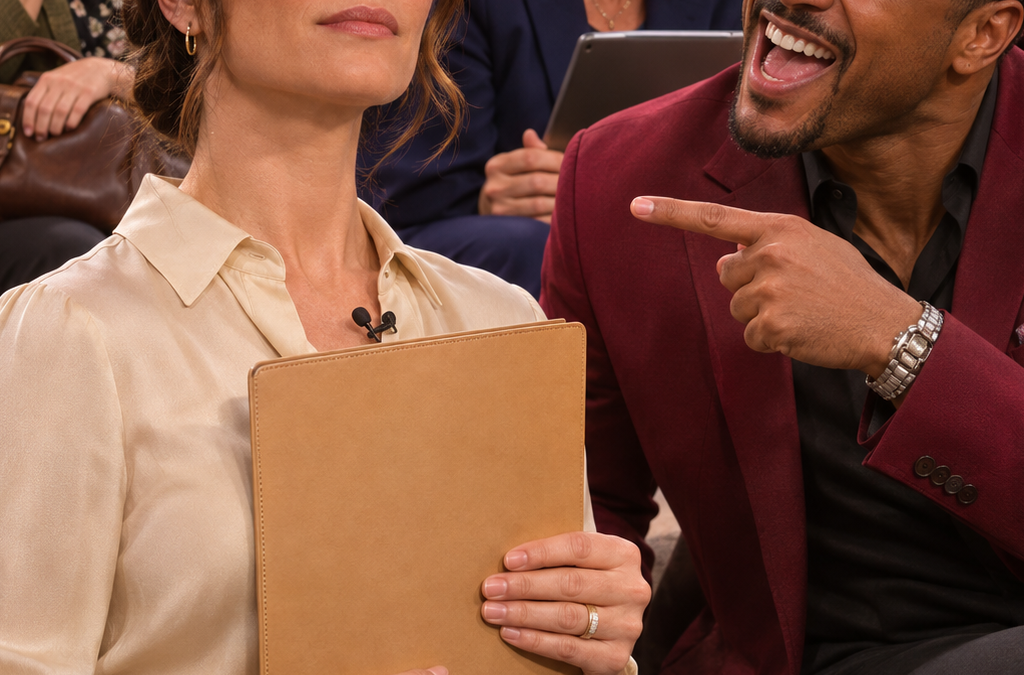
Marcus said it toward the camera, smiling under the studio lights. I had written the app between our daughter’s chemotherapy appointments.
I automatically straightened his sleeve where it had caught against his microphone wire. Then the producer asked whether “unpaid assistant” was the right description for my caption.
“No,” I said.
She waited with her headset tipped away from one ear.
“I’m the developer.”
We were in a local television studio in Round Rock, Texas. Beyond the cameras, my sister, Sarah, sat with her purse against her knees.
Marcus gave the producer a small, forgiving smile.
“She handles the technical side. That’s what she means.”
“That isn’t what I mean.”
“Okay. Developer. We can use that.”
“Founder, too.”
His eyes moved toward the camera operator.
“Are we still rolling?”
“We can stop,” the producer said.
“Please,” I said.
The red light went dark. Nobody left their place.
A worn blue notebook lay across my lap. The plain folio beside my chair had nearly disappeared against the dark upholstery.
I had kept one signed copy he had never asked to see.
Marcus leaned toward me, keeping his voice low enough to sound private.
“You said you didn’t want to do the interview.”
“I didn’t want to be called your assistant.”
“I was trying to get through the introduction.”
“Then introduce me.”
“You’re my wife. Everybody knows you’re involved.”
The producer glanced toward Sarah, perhaps hoping for help. My sister looked at the dark camera instead.
“I need the wording settled before we restart,” the producer said.
“Call us the founding team,” Marcus offered. “That covers everybody.”
“It doesn’t say who wrote it.”
“Do we need that much detail on the screen?”
The woman seated across from us answered before the producer could.
“If we’re telling the story of the product, yes.”
Dana had come for the interview as the prospective buyer. Until then, she had mostly listened.
Marcus turned toward her.
“Of course. I’m proud of what she did. I’m talking about getting it into schools.”
He had found the pilot campuses and negotiated demonstrations with people who ignored my emails. He had also covered appointments when I needed uninterrupted development time.
“I’m not taking those things away from you,” I said.
“Then why does this sound like I’ve done nothing?”
“I said I wrote it.”
“And I made the calls. I got people to sit down and look.”
“I know.”
“Those meetings weren’t favors. They were work.”
“I know that, too.”
The producer’s headset crackled. Someone behind the camera asked whether we needed water.
Our daughter always complained that Marcus packed bananas under the heavier groceries. That morning he had brought a flattened one in his jacket pocket and offered it to me in the parking lot.
Now he sat inches away, waiting for me to rescue him from a sentence he had chosen.
I kept fixing the gaps until he mistook my work for support.
“Can we just get through today?” he asked. “We have a real opportunity here.”
“So put my name on it.”
“Your name is on plenty of things.”
“Being family didn’t make my name optional.”
Sarah’s mouth opened slightly. She said nothing.
Marcus looked past me toward her, then back at Dana.
“I don’t want a family disagreement to distract from what your campuses need.”
“Neither do I,” Dana said. “But I asked who developed this application.”
“My wife did the coding.”
“The application,” I said. “I designed it. Tested it. Fixed the pickup failures.”
“You’re making this sound like I wandered in yesterday.”
“No. I’m asking you to stop making it sound like I did.”
The producer looked down at her tablet.
“I have the advance questionnaire somewhere. We used that for the first draft.”
Marcus shifted toward her.
“There were revisions after that. The shorter version works better for television.”
“Which version?” Dana asked.
“The founder introduction.”
The producer found the page and turned the tablet toward Dana. Marcus stopped talking before she finished reading.
Dana stopped smiling. “Who supplied that line?”
The producer kept the tablet angled away from me.
“The revised introduction says he founded the company,” she said. “The original questionnaire lists Emily Carter as technical founder.”
“I sent the revision,” Marcus said. “The first one barely mentioned the sales work.”
“Did you remove her title to make room?” Dana asked.
“I shortened the story. I wasn’t trying to erase anybody.”
“Then the correction should be easy,” I said.
The producer asked me to spell my last name. Marcus looked toward Sarah again.
This time, she looked at me. She still didn’t speak.
The folio beside my chair lay open enough for me to see the executed packet: the state formation filing, operating agreement, and membership ledger for Porchlight Pickup LLC. The operating agreement and ledger named me as sole member.
The filing listed me as organizer. I had kept it with the rest.
“Use Emily Carter, founder and developer,” I said.
“And Marcus?” the producer asked.
“Business development,” I said.
He gave a short nod.
“That’s work I did,” he said. “I’d like it included.”
“It should be,” Dana said.
The producer repeated both descriptions into her headset. Across the set, someone began changing the captions.
Marcus watched the monitor.
“Are we still showing the offer?” he asked.
“We can discuss a conditional offer,” Dana said.
“That word makes it sound less certain than it is.”
“It’s the word we’ve been using.”
Her phone sounded. She glanced at the message, then leaned closer to the screen.
Marcus said, “That should be the complete package.”
Dana read the new message twice. “There’s a second schedule?”
“It came with the commercial terms,” Marcus said. “The reporting piece.”
The producer brought up the attachment on the nearby monitor. Network Insights appeared above a table showing campus, handoff time, and recurring random pickup token.
There were no names. Other columns showed report dates and status labels.
“Was this in your interview notes?” Dana asked the producer.
“No. Just the pickup application and the proposed rollout.”
Marcus faced Dana.
“We talked about reporting. Schools want to know where the delays happen.”
“I want the complete package reviewed before we describe it on camera.”
“Fine. But can we finish the introduction?”
Dana didn’t answer immediately.
Marcus turned his phone toward me. A household account statement filled the screen: $29,400 across his revolving credit accounts.
“I’m carrying this,” he said quietly. “I need you to remember that.”
“I haven’t forgotten our bills.”
“Some of it kept us going while I was out making demonstrations.”
“And some of it didn’t.”
“I’m not saying every dollar was business. I’m saying this could help.”
Sarah looked down at her purse.
Marcus kept his voice level.
“You made something good. I got people willing to pay for it. That’s why we’re sitting here.”
“I haven’t denied your work.”
“Then let us finish.”
“I won’t endorse that biography.”
“The caption’s being fixed.”
“So is the introduction.”
The producer nodded. “We’ll do another take.”
Dana addressed all of us.
“The June 12 follow-up stays on the calendar. It is still conditional. Don’t promote it as a completed signing.”
Marcus’s phone lit up while she spoke.
He looked down, then back at Dana.
“Understood.”
The studio clock showed 10:42 a.m. We still had the same chairs, the same lights, the corrected introduction waiting off-camera.
My phone vibrated.
The notification identified Marcus Reed and the conditional $300,000 reseller agreement. His electronic acceptance had been recorded at 10:42 a.m.
I hadn’t signed anything.
Chapter 2 of 7
At 8:10 a.m. on Tuesday, June 2, I opened the accepted agreement in the outpatient courtyard. Marcus had forwarded the complete version after I requested it twice.
The signature page bore his name under the sales authority I’d given him May 22. He hadn’t copied my signature or pretended to be me.
The company attorney was on the phone.
“Ordinary reseller commitments fall within the authority you gave him,” she said. “Whether this one needed your additional approval depends on the reserved data category and the offer’s own condition.”
“So telling him no today doesn’t settle yesterday.”
“Correct.”
Through the glass, Lily sat beside Sarah in the waiting area. Her sneakers stopped short of the floor.
“I’ll put my answer in writing,” I said.
After the call, I went inside. Lily had saved me a seat with a hospital tissue box.
“Are you coming to my school thing?” she asked.
“Which thing, honey?”
“The summer art thing. I told you.”
“You did. Yes.”
“Without your computer?”
Sarah looked toward the reception desk.
“I want to,” I said.
“You said that at the winter one.”
At the winter program, my laptop had occupied half the cafeteria bench. Lily had waved from the risers while I answered a campus administrator.
“You’re right.”
“Can you leave it at home?”
A nurse called her name before I could answer. Sarah stood to go with her, as we’d arranged for this follow-up visit.
“I’ll come get you when they’re ready,” my sister said.
Lily followed the nurse, explaining that the tissue box wasn’t hers.
Back outside, I opened the schedule labeled Network Insights.
It wasn’t just permission for the network to run the pickup application. The proposal included recurring exports of pickup events for the network’s reporting system.
The sample screen had pale gray headings and a date selector too small for a thumb. A randomly assigned pickup token, “maple,” appeared on two demonstration rows beside campus and handoff time. The download button sat almost against the help link.
I enlarged the screen until the whole table no longer fit.
Marcus came through the courtyard door carrying two coffees.
“They only had the hazelnut kind,” he said.
“I don’t need one.”
“I know. I got it anyway.”
He sat across from me. His shirt still had the fold marks from the dryer.
“Did you talk to somebody?”
“Yes.”
“And?”
“I’m writing to you and Dana.”
He looked at my laptop.
“Before you do, can we talk about the house?”
“The house?”
“The bills, Emily. What comes out every month.”
He showed me the account statement again. The balance was still $29,400.
“I know the number,” I said.
“Knowing it isn’t paying it.”
“I’m aware.”
“I’m not asking you to approve something you haven’t read. Read it. Ask questions. But don’t pull everything apart while we’re finally getting somewhere.”
“I am reading it.”
“Then include what got us here.”
He wanted Sarah on the call. I texted first, asking whether she could talk.
She called a minute later.
“They’re waiting for the doctor,” she said. “What happened?”
“Nothing new,” Marcus said. “Can you tell her how much time went into getting this launched?”
“She knows.”
“I don’t think she’s counting it.”
Sarah’s voice dropped.
“I handled pickups. Dinner sometimes. Those parent demonstrations took evenings.”
“And I drove to campuses that never bought anything,” Marcus said. “Nobody paid me for those.”
“I know you both worked,” I said.
“We weren’t keeping score,” Sarah said.
“Then why are we doing it now?”
She didn’t answer.
I could hear Lily asking whether the exam-room clock was broken.
“I appreciated the dinners,” I said. “And the childcare. Marcus, you got meetings I couldn’t get.”
“That’s all I’m asking you to recognize.”
“No. You’re asking me to approve this because you did those things.”
“I’m asking you to consider what happens if it falls through.”
Sarah said she needed to go. The call ended.
Across the courtyard, a maintenance worker scraped something sticky from a bench. Marcus watched him while I typed.
My email refused approval for child-location licensing. It also revoked Marcus’s authority to make future agreements for the company.
I read it once, then sent it to him and Dana.
His phone sounded.
“You revoked everything going forward?”
“Yes.”
“I won’t sign anything else.”
He read the message before continuing.
“But yesterday’s schedule is anonymous operational reporting. That’s what I accepted. I believed it was inside what you authorized.”
“I don’t approve the proposed license.”
“I can see that. I’m telling you why I signed.”
He stayed in his chair while I waited for a reply.
Dana’s office responded while Marcus finished his coffee. Final clearance was paused pending review. The message didn’t say the agreement had vanished.
I read it again, wishing it said something simpler.
Marcus stood.
“Let me know how her appointment goes.”
“You can wait.”
“I have a call.”
“Okay.”
He stayed another moment, then went inside.
Sarah texted that the doctor was ready for me. I closed the laptop and headed toward the courtyard door.
Before I reached it, a pilot-parent bulletin appeared on my phone. Its cheerful header matched the notices we’d used for demonstrations.
“Network Insights begins June 15.”
I hadn’t approved any announcement. Below it, parents were invited to send questions to Sarah Brooks, with her phone number and email address.
Sarah was listed as the contact.
Chapter 3 of 7
“I forwarded it,” Sarah said Wednesday morning. “Marcus sent it ready to go.”
“Did you ask him whether I approved it?”
“He said the technical approval was routine.”
“So you asked him.”
“I thought you were copied.”
“You could have called me.”
On her end, a school office phone rang. She let it ring twice.
“Has anything gone out?” she asked.
“The bulletin went out.”
“I mean the records.”
“No.”
“Okay. Then we can correct the date.”
“It isn’t a date problem, Sarah.”
“I have a parent at the window. Can we talk later?”
She was already using her office voice, pleasant and louder. I said yes because the parent hadn’t done anything to me.
At 5:15 p.m., I stood outside Lily’s school in Round Rock. The summer program had started that week, and the pickup line reached past the corner.
One of the pilot parents came toward me, phone already displaying the bulletin.
“Are you selling pickup histories?”
Another mother stopped beside her. Her son’s backpack hung from one shoulder.
“I thought this just told the office who was here,” she said.
“It does,” I said. “The proposed export isn’t approved.”
“But we got a start date.”
“I know. That notice shouldn’t have gone out.”
No records had been exported. I told them that plainly, then waited while the first mother reread the bulletin.
“Will you tell us if that changes?” she asked.
“Yes. From me.”
The other mother looked toward the doors.
“My ex and I have different pickup days. I don’t want to explain all that again.”
“You don’t have to explain it to me.”
She nodded, but neither woman put away her phone.
Lily came through the doors wearing a paper crown marked with crooked stars. She paused when she saw the adults around me.
“Are we in trouble?”
“No, honey.”
“Then can we go? This thing itches.”
We walked to the car with the crown tipped over one ear.
Before I started the engine, another message arrived in the pilot-parent thread.
Marcus had titled it “A note from the founding team.”
He thanked families for raising thoughtful questions. He said I was taking a health-related family break after a demanding spring. As continuity lead, he would handle rollout questions while I focused on home.
He promised an update after final review.
There was nothing angry in it. He thanked me for my contributions.
“Mom?”
Lily was waiting for the air-conditioning.
“Sorry.”
I started the car. Her crown rattled against the headrest.
At home, she ate string cheese in the kitchen while I wrote three sentences.
“I’m Emily Carter, the application’s developer. The proposed Network Insights export is not approved, and no pickup records have been exported. Please direct questions about the application and its data use to me.”
I sent it under my own name.
A parent replied, “Thank you for clarifying.”
I left the thread there.
Lily opened the refrigerator again.
“Why do we have three mustards?”
“One might be old.”
“Dad says they do different jobs.”
“For sandwiches?”
She shrugged. “I’m not in charge of mustard.”
I laughed, and she looked pleased with herself.
Then Dana called.
“We’re pausing invitations to the six prospective pilot campuses,” she said.
“All six?”
“Until we settle authorization.”
“Those schools haven’t done anything.”
“Neither have their families. I won’t invite them into conflicting instructions.”
I looked at the campus calendar on my laptop. I had left those demonstration mornings clear, moving paid testing work into the evenings.
“Can you keep the dates open?”
“I can ask. I can’t promise.”
After we hung up, Marcus called.
“I saw your correction,” he said.
“Then you saw I’m not taking a break.”
“You’ve had a lot to carry. I was trying to keep parents from calling you all night.”
“They were asking about the product.”
“And I can answer most of that. Let me keep the parent meetings going.”
“Dana paused the invitations.”
“I know. We can still preserve the relationships. You stay out of the publicity for a while. I’ll do the meetings, bring you the questions.”
“I want to attend the meetings.”
“Emily, that’s what I’m trying to take off your plate.”
“I’m not asking you to take them.”
He waited.
“Okay,” he said. “Think about it.”
“I have.”
Sarah was still outside her school office when I called. Lily could stay with Marcus, who had just come home, so I drove over.
My sister stood beneath the awning beside the employee entrance. The heat had left her hair damp around her temples.
“Why do you keep speaking for me?” I asked.
“I sent one bulletin.”
“And let parents contact you about something you hadn’t asked me about.”
“I thought we were finally getting somewhere.”
“We?”
“Your family. All of you.” Her voice broke on the last word. “I was scared you’d lose the chance to get stable.”
“So you trusted him.”
“He sounded certain.”
“I was available.”
She looked toward the empty parking spaces.
“I know.”
My phone rang before either of us said more. Dana needed the company’s complete executed governance packet by Friday, June 5, at 5:00 p.m.
“Friday at five,” I repeated.
“Yes. The complete packet, please.”
Sarah waited until I ended the call.
“What does she need?”
“The company documents.”
She said she had to go. I watched her reach her car, then headed toward mine.
Before I reached it, her message appeared.
“I already told Marcus your membership page names only you.”
Chapter 4 of 7
Marcus called at 4:30 p.m. on Friday, June 5. I was in a library meeting room in Round Rock, waiting for my laptop to connect.
“Sarah told me,” he said. “The membership page names only you.”
“Yes.”
“I’m not disputing it.”
Outside the glass, a child was trying to walk without stepping on carpet seams.
“I thought the filing was administrative,” Marcus said. “We talked about equity later. I assumed we’d get around to putting that in writing.”
“We didn’t.”
“I know. I’m not saying a conversation made me an owner.”
“Then what are you asking?”
“That Dana review what I could sign on Monday. Before your email.”
On the screen, the library’s sign-in page replaced my upload window again.
“I gave her the refusal,” I said.
“And she should have it. But Tuesday doesn’t erase Monday by itself.”
“I didn’t say it did.”
“Then send the sales authority with everything else. The one we both signed.”
“It’s in the packet.”
“Good. That’s what I want reviewed.”
His voice sounded like it did on campus calls: patient, ready with the next point. I had once been grateful that he could keep talking when someone challenged him.
“I have to finish this,” I said.
“Okay. Let me know when she gets it.”
The call ended without either of us saying goodbye.
The complete transfer included the executed operating agreement, its original definitions appendix, the membership ledger, sales delegation, accepted offer, and my refusal email. Dana had sent a confidential business-document link.
The progress bar reached halfway and stopped.
Sarah arrived just before five. Through the glass, she mouthed, “Can I come in?”
I nodded.
“I thought you might want company.”
“Did Marcus ask you to come?”
“No.”
“Does he know you’re here?”
“I told him I was going to see you.”
She sat across from me, still wearing her school badge.
“Emily, I thought if he knew privately, he wouldn’t get blindsided in front of everybody.”
“So you warned him about my documents.”
“I was trying to prevent another scene.”
“You could have asked me first.”
“I know that now.”
“You knew whose page it was.”
Her badge hung backward. The plastic edge had caught on her shirt.
“I didn’t send him a copy,” she said.
“You told him what it said.”
“Yes.”
The upload failed at 4:58.
For a few seconds, all I could see was the red error message.
“Is it too late?” Sarah asked.
“Her deadline is five.”
“Call her.”
“I’m doing that.”
Dana answered while I restarted the transfer.
“The connection dropped,” I said. “The complete packet is coming. I’m sorry.”
“How long?”
“A few minutes, I hope.”
“Send it. I’m here.”
At 5:05 p.m., the confirmation arrived. Dana stayed on the phone while she checked the attachments.
“I have the complete set,” she said. “Thank you.”
“Is there anything missing?”
“Nothing from my request.”
Sarah sat straighter when I said Dana’s name.
Dana continued, “We won’t fund this unless the accepted scope fits Marcus’s documented authority or you provide the reserved approval. That’s what we’re checking.”
“Do you know when you’ll have an answer?”
“I need time to review.”
She made no promise about the outcome. After the call, I could hear someone outside explaining that library chairs weren’t for climbing.
Sarah looked at my laptop.
“So she has everything.”
“Yes.”
“Does Marcus?”
“He gets the ownership and authority summary. Not my whole internal agreement.”
“Okay.”
“You can’t pass that along either.”
“I wasn’t going to.”
“I need you to hear me.”
She went quiet.
“You can come to the studio next Friday,” I said. “But you don’t carry information between us anymore. If he asks about me, he calls me.”
“What if he’s worried?”
“He can call me.”
“What if you won’t answer?”
“Then I haven’t answered. You don’t fill in.”
Her eyes shone, but she stayed in the chair.
“I thought I was helping both of you.”
“I needed my sister. You kept bringing me his answer.”
She looked toward the children’s section beyond the glass.
“I don’t know how to fix this.”
“Start by leaving things with the person who told you.”
At 5:40 p.m., the producer called to confirm the following Friday, June 12, at 10:00 a.m. The Round Rock studio still had Dana, Marcus, me, Sarah, and the recording crew booked.
“We’re calling it final review and possible signing,” she said. “Final clearance is still unresolved.”
“Please keep it that way.”
“We will. And if you need Lily with you, that’s fine.”
“I’ll let you know.”
Sarah had heard her own name.
“I’ll come if you still want me there,” she said.
“You can come.”
She didn’t ask what to tell Marcus.
After she left, his email arrived, addressed to Dana and copied to me. He acknowledged the ownership summary, then asked her to review the proposed reporting on its contents rather than our disagreement.
He called the export “anonymous statistics,” explaining that random pickup tokens replaced names.
The final sentence stayed visible beneath his name.
“I stand by the original recurring-token export as ordinary statistics and am requesting review on that basis.”
Chapter 5 of 7
At 5:40 p.m. on Thursday, June 11, I stood on a strip of tape in the Round Rock studio. The producer needed to check where my face would fall under the lights.
“Closer to the chair,” she said. “That’s good.”
Lily sat beyond the cables, wearing the visitor sticker she’d requested at the front desk.
“Can I come tomorrow?”
“If you want.”
“I want to see your app on television.”
“It might mostly be people talking.”
“That’s most television.”
The camera operator laughed from behind his monitor.
“Will they show the pickup screen?” she asked.
“I don’t know yet.”
“Can I wear my yellow shirt?”
“Sure.”
She went back to examining her sticker. I didn’t tell her what to say or explain what Marcus might say.
The producer checked the microphone clipped to my collar. My phone vibrated with an email copied to Dana and me.
Marcus had titled it “Reservation concerning accepted agreement.”
He wrote that the network had incurred preparation costs and that his sales work had required substantial time. Withdrawing from a valid acceptance, he said, could create a separate contract dispute.
The last paragraph was courteous. He remained available to resolve outstanding concerns before the segment.
I read it twice.
“Do you need a minute?” the producer asked.
“Yes.”
Lily stayed with her while I called Dana from the hallway.
“I saw Marcus’s email,” I said.
“So did I.”
“Is he asking me to sign tonight?”
“You would have to ask him.”
“I’m not signing just to make tomorrow easier.”
“I haven’t asked you to.”
Behind me, Lily was telling the producer she preferred stickers without names. That way, she said, you could use them again.
“Your office has the unabridged documents?” I asked.
“Yes. The complete set you sent.”
“Then I want you to identify the requirement you’re relying on. Yourself. Before anyone asks for my signature.”
“That’s part of tomorrow’s review.”
“I don’t want this turned into me holding up the family.”
“I’m reviewing a proposed transaction, Emily.”
“Okay.”
“We’ll address authorization before signing.”
The call ended. I stayed in the hallway until I could hear Lily laughing again.
Sarah arrived as we were leaving the set. She had come straight from work and still had a faint copier-toner streak near her elbow.
“Can we talk while she finishes?” she asked.
Lily had discovered a vending machine with a picture of pretzels larger than the actual bag.
“About tomorrow?”
Sarah nodded.
“If they ask me, I could explain the family team part. Marcus getting schools, you making the software, all of us helping with Lily.”
“Did the producer ask you to?”
“No. I thought it might help.”
“Help with what?”
“So it doesn’t sound like we’re all against each other.”
Lily pressed a button. Nothing dropped.
“Say what you personally know,” I said.
“I know we all worked.”
“Then say what you did. What you saw.”
“Emily, I was there for a lot of it.”
“I know.”
“I don’t want to make things worse.”
“Please don’t tell a smoother story because I’m standing there.”
She looked toward Lily, who was reading the vending machine’s instructions aloud.
“Do you want me to say Marcus was wrong?”
“I want you to stop asking me for a version.”
Sarah didn’t answer. Lily announced that the machine required money, which none of us had given her.
We went home without pretzels.
On Friday, June 12, Lily ate toast standing beside her chair. Her yellow shirt had a small wet patch where she’d tried to remove a toothpaste spot.
“Will it dry?”
“Before we get there.”
“What if it doesn’t?”
“They’re filming me, honey.”
“Oh. Right.”
She sat down and finished breakfast.
We reached the studio before 10:00 a.m. Dana was already there with annotated copies of the documents. My executed set was in the plain folio I’d brought.
Marcus stood near the chairs with the unchanged export schedule and his classification statement. He greeted Lily first.
“Yellow shirt. Good choice.”
“It had toothpaste.”
“Can’t tell.”
She went to sit beside Sarah, behind the cameras.
Marcus turned to me.
“Did you read my reservation?”
“Yes.”
“I’m not trying to frighten you. I don’t want anyone assuming there are no consequences if a valid agreement gets dropped.”
“I read what you sent.”
“Okay.”
Dana joined us before he continued.
“I’d like both positions stated clearly for the recording,” she said. “Then we’ll complete the check.”
Marcus nodded. The crew was still adjusting sound, but everyone near the set could hear him.
“Emily developed the software. I built the commercial product, and this agreement covers anonymous reporting.”
He waited until Dana looked directly at him.
“I had sales authority when I accepted it. I’m asking you to judge that authority and what the schedule actually delivers. Not whether we agree now.”
“I have your statement,” Dana said.
“And the costs matter. We’ve all prepared for this in good faith.”
“We’ll address the agreement first.”
The producer called for everyone to take their places. Lily tucked her feet beneath Sarah’s chair to clear the aisle.
The tally light came on.
The producer handed me the new on-air signing card. Marcus Reed appeared above “Founder and owner.” My name was beneath “Technical assistance.”
Dana looked from the card to me.
“Emily, do you approve that title?”
Chapter 6 of 7
“No. That title is inaccurate.”
The studio clock showed 10:00 a.m., Friday, June 12. The camera light stayed red.
Marcus looked toward Dana.
“I made the commercial deal. I had authority to accept anonymous reporting. That doesn’t depend on my being a member.”
“Before we sign, I need the authority condition read,” I said.
Dana addressed the producer. “Keep recording. We need this accurately.”
The card still lay across my knees.
“My executed agreement and ledger name me as the sole member,” I said. “But that isn’t why his acceptance needs checking.”
“Agreed,” Dana said.
Marcus nodded. “Then we’re discussing what I was authorized to sell.”
“Yes,” I said. “And which definition applies to what you sold.”
Dana read from the offer.
“Child-location licensing requires Emily Carter’s written approval. Final clearance is subject to verification of the representative’s authority.”
“I haven’t given that approval,” I said.
Marcus answered without looking at me.
“Because this isn’t a child-location license.”
“Tell me why,” Dana said.
“No names. No addresses. No phone GPS. These are operational times from a pickup system, with randomly assigned tokens. Schools need to measure delays without receiving family identities.”
He paused, checking that she was following.
“My acceptance was June 1. Emily revoked future authority June 2. Ordinary reporting was within my sales authority when I signed.”
Dana looked at the schedule.
“Anonymous aggregate counts would ordinarily fit that authority.”
“That’s the commercial purpose here.”
“Purpose isn’t the only question,” I said.
The air-conditioning blew across my bare ankles. Behind the camera, Lily’s yellow shirt showed between two equipment cases.
I opened my executed agreement at the original definitions appendix and placed it beside the export schedule. The pages had traveled from my house to the library and back. Dana already had her own complete copy.
“The reserved category has a definition,” I said. “Please read that one.”
She found the paragraph in her annotated set.
“Child-location data includes persistent pseudonymous identifiers paired with campus and handoff time, whether or not names appear.”
Marcus leaned forward.
“I’m not dismissing that. But these tokens aren’t identities.”
“The definition says whether or not names appear,” I said.
“I heard it. I’m explaining why the reporting doesn’t expose a child’s identity.”
On the schedule, the demonstration token “maple” appeared twice. Campus and handoff time stood beside it on both rows. I had spent hours making those columns readable on small screens.
Dana looked from the appendix to Marcus.
“Does this export supply totals, or repeatable event rows?”
“Rows with stable random tokens. That’s standard analytics. Otherwise you can’t compare repeat use or identify recurring bottlenecks.”
“So the token persists across events?”
“Yes. It has to. But the network doesn’t get the lookup.”
He spoke more slowly now.
“We can put a promise against reidentification in writing. Prohibit combining it with attendance records. Restrict access. Those are workable protections.”
Dana waited until he finished.
“Your privacy argument doesn’t change the category this contract reserved for Emily’s approval.”
Marcus’s face stayed composed. His knee had stopped moving.
“Could you ask her for that approval now?”
Dana looked at me.
“Emily?”
“No.”
“Even with those restrictions?” Marcus asked.
“I’m not approving this export.”
Dana read the final-clearance paragraph once more, including the sentence allowing her network to withdraw if required approval remained unsatisfied.
Then she looked directly at Marcus.
“The schedule falls within the reserved definition. Your signature doesn’t supply Emily’s approval.”
He started to speak, then waited.
“I am withdrawing the $300,000 reseller agreement. That ends the $36,000 commission.”
The camera operator looked up from his monitor.
Dana drew a line through the prepared funding instruction. Then she signed the withdrawal notice.
Marcus rose halfway from his chair.
“Wait. If we narrow the schedule today—remove those rows—can we preserve the closing?”
“No. A new scope requires a new proposal.”
“The campuses are ready. We could keep the license and drop the reporting.”
“We can consider that separately. I’m not funding this agreement.”
He stood fully, then looked toward Sarah. She had been seated behind his side of the set.
“Could somebody give us a minute?”
Sarah stood too.
“I need to say something first.”
Her chair scraped across the floor as she brought it to my side. The worn blue notebook came with her; she had carried it in from my bag that morning. She left it beside my folio.
“Emily built the working app,” she said toward the camera. “I watched her do it. I helped with demonstrations and childcare. Marcus brought schools in. But I let people hear that he built it.”
“Sarah,” Marcus said, quietly.
“I did. And I passed him her membership information because I wanted him prepared. I didn’t ask her.”
She sat beside me, close enough that our sleeves touched.
Marcus looked at the notebook rather than either of us.
“I wasn’t trying to leave us with nothing.”
“I built the app. I won’t sign away children’s whereabouts.”
“Will you at least let me handle the school conversations?”
“No. Your signing role stays revoked.”
His mouth moved once before he answered.
“Okay.”
Lily came around the equipment cases. She stopped beside my chair, and I made room without asking her to say anything.
At 10:25, I asked Dana whether she would discuss a fresh license that kept event-level records inside the application.
“I’ll review a new proposal,” she said. “That’s all I can offer today.”
“That’s what I’m asking.”
After recording ended, Marcus went into the hallway. Sarah stayed beside me while Lily complained that television chairs made her legs prickly.
Dana’s request arrived on my phone before we left the studio. It offered neither payment nor acceptance.
A proposal for six campuses. No event-level export. Due June 19.
Chapter 7 of 7
I submitted the proposal by June 19. Four weeks of review followed the studio meeting, with questions about support hours, reporting limits, and what six campuses actually needed.
On Friday, July 10, Porchlight Pickup LLC signed a separate twelve-month license for $84,000. The first $21,000 installment cleared that day.
The application would run pickup operations. Recurring-token histories would stay inside it, with no event-level export to the network.
Dana’s email was brief.
“Executed copy attached. Please confirm the training dates.”
I confirmed them. Then I sat at the kitchen table until the refrigerator motor stopped.
The smaller amount still had to cover work. It wasn’t money I could spend twice because I’d had a terrible June.
I hired limited technical support for routine troubleshooting. I kept release approvals myself and stopped offering clients every evening I had.
On the calendar, I blocked Lily’s summer art program.
When she came home, I showed her.
“That means you’re coming?”
“Yes.”
“Without the computer?”
“Without the computer.”
She studied the entry.
“You spelled cafeteria wrong.”
“I’ll survive.”
“Other people can see it, Mom.”
I went to the program. My phone stayed in my purse while she showed me a clay turtle with one enormous foot.
“That’s the fast foot,” she said.
I bought the explanation without asking for supporting evidence.
Marcus’s business-development engagement ended by written agreement on July 10, too. The company paid $640 for his documented expenses.
He had driven those miles and bought those demonstration supplies. I paid them.
There was no closing commission from the withdrawn offer, and I gave him no replacement signing authority. The payment receipt arrived beside the executed ending agreement.
That email took longer to close than Dana’s had.
Marcus had voluntarily moved into a leased apartment on July 1. The rent was $1,450 a month.
Lily called it “Dad’s other place” at first. He bought the wrong size sheets, and she reported that his mattress looked like it was wearing socks.
She laughed when she told me. Then she asked whether she could keep a toothbrush there.
“Of course.”
“A good one. Not a travel one.”
“We’ll make sure.”
The house remained jointly titled. We changed no locks.
We hadn’t settled a divorce, the company’s value, or either person’s marital-property claims. Those conversations remained ahead of us, separate from who could speak or sign for the business.
Some mornings, his missing shoes by the door bothered me more than I expected. Other mornings, I worked without listening for his car.
I didn’t have a tidy answer when Sarah asked how I was doing.
“Depends when you ask.”
She stopped asking me to choose between fine and devastated.
Later in July, Marcus came to collect Lily for dinner. She was still upstairs deciding which stuffed animal could tolerate an apartment.
“How’s training going?” he asked from the doorway.
“Getting scheduled.”
“I could help with one demonstration. I know how those rooms work.”
“You do.”
“I wouldn’t need access to anything. Just show up, help answer questions.”
“No, Marcus.”
He looked past me into the kitchen.
“I’m offering to help.”
“I know. I’m keeping the business separate.”
For a moment, I thought he might leave without Lily. Instead, he called upstairs to ask whether the stuffed animal needed its own seat belt.
She shouted that she was almost ready.
He lowered his voice.
“Am I going to hear about her appointments from Sarah now?”
“From me. And I need you to send me anything the school gives you.”
“I can do that.”
“I’ll put the follow-up dates on the shared calendar.”
“Okay.”
He stayed in the doorway until Lily came down. I stayed inside.
Their dinner had nothing to do with whether he could sell my software. I needed practice leaving those things apart.
Sarah needed practice asking.
One afternoon, she called while standing in a grocery aisle.
“Marcus asked whether Lily’s checkup moved. Can I tell him?”
“I already sent him the date. Thanks for checking.”
“Okay.”
She didn’t add what he’d meant or why he was worried.
A week later, she asked whether she could tell a relative about the new contract.
“Not the amount,” I said. “You can say work is going well.”
“All right.”
“Do you want to come Sunday?”
There was a pause.
“For lunch?”
“Yes. You don’t have to bring anything.”
She brought peaches anyway. We ate them over the sink because they were too ripe, and she stayed while Lily showed her the turtle.
I still left some things unsaid around her. She no longer tried to fill them in.
By Saturday, November 21, the mornings had turned cool enough for Lily to object to the kitchen floor.
She arrived at breakfast wearing slippers and carrying the blue notebook.
“Can we build something today?”
“What kind of something?”
“A fort. Outside.”
Her follow-up appointments continued. I kept the dates in the calendar and asked my questions at each visit. That morning, she wanted lumber, blankets, and permission to use every chair we owned.
“We might need a smaller plan,” I said.
“How many chairs can you spare?”
“Two.”
“Three?”
“Let me eat first.”
She opened the notebook beside her plate. Some pages held old screen sketches and cramped notes from hospital waiting rooms. She found a mostly empty one.
“Can I draw here?”
“Yes.”
“Over this little box?”
“That box can go.”
She drew a roof with a chimney.
“We aren’t putting a fire in it,” I said.
“It’s pretend smoke.”
“Good.”
“And this is where snacks go.”
“Important.”
She added a square near the entrance, then frowned toward the backyard.
“Do you have work?”
“Not this afternoon.”
“All afternoon?”
“All afternoon.”
She bent over the page again. There would be blankets to wash later and chairs to carry back inside. I left the afternoon open.
Lily drew our fort in the blue notebook.







