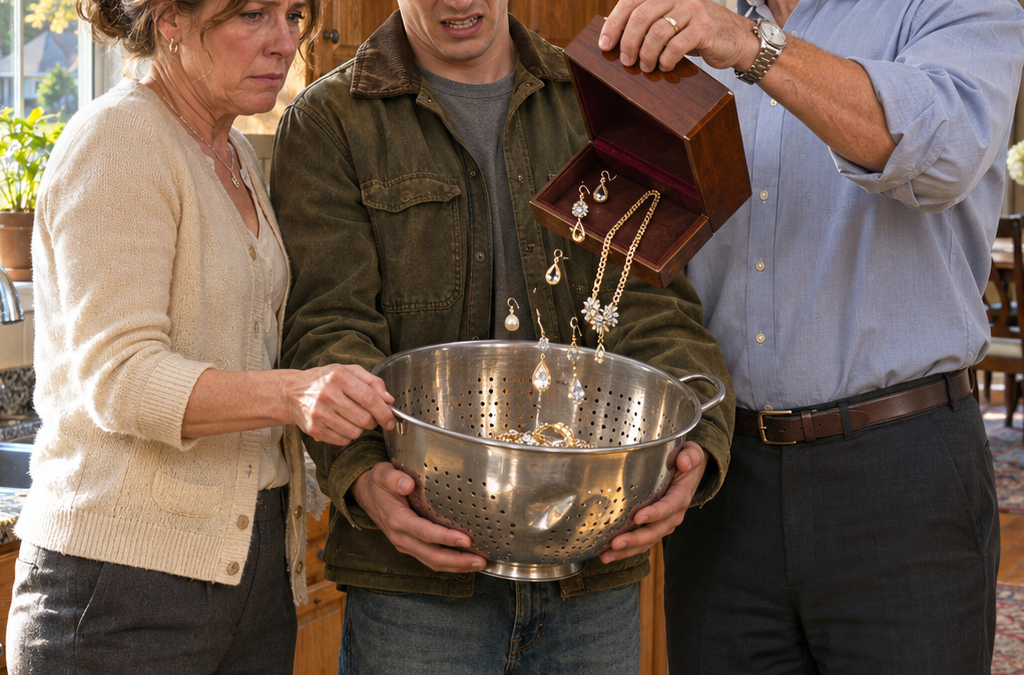
My husband emptied my jewelry box into a kitchen colander before our divorce hearing and said, “Pick out what you actually paid for.”
Chapter 1 of 7
The metal clatter made Evan flinch as he held the colander against his work jacket.
“Why are you doing this before court?” I asked.
Mark tipped the box farther. “You keep saying you want what’s yours. Show us.”
Ashley stood beside him in our Albany, New York, kitchen. “He bought those things with his paycheck.”
Noah turned toward the refrigerator.
“Are you going to let him do this?”
He kept his back to me. My younger son was twenty-two, old enough to leave, but he stayed.
Ashley’s house brochure sat beside the jewelry box, its glossy roof looking wrong against our scratched kitchen table.
“Just be reasonable and let him finish,” she said.
I caught the colander’s rim. My face burned.
At forty-nine, I was still Claire Bennett, the name I’d kept when I married Mark Dalton. We had been married twenty-five years. Most forms called what I did homemaking, when they offered a box for it at all.
I owned my inherited duplex outright, held substantial inherited savings, and had paid our household bills from its rent for years.
Mark knew about the duplex and called its rent family money. But his paycheck got thanked at dinner.
Evan’s jacket had a repaired seam under one arm where I’d matched the thread badly. Noah’s packed lunch waited by the refrigerator, with the mustard separate because he hated soggy bread.
That colander had drained countless family dinners, including the extra spaghetti Evan requested because he liked eating cold noodles after work while standing at the open refrigerator.
I made his pride easier by making my work invisible.
Mark shook the last earring loose while Ashley shifted closer to see.
Ashley’s new-house brochure lay beneath my jewelry box.
The box had slid over one corner, leaving a street address visible beneath a photograph of a blue front door.
“Bring a bag to court,” Mark said. “You can take your clothes afterward.”
He was fifty-two, an industrial maintenance supervisor accustomed to giving instructions. Lately, he used that same voice when he told me where to sleep.
The divorce conference was already scheduled, but he had brought Ashley into our kitchen as though the house had been cleared for her and I’d agreed to go.
He wanted me to leave. He’d said it the night before. Now he said we could settle it before court and spare everyone a scene.
“You’re making me prove I deserve my own things?”
“You can start with what you earned.”
My wedding band lay against an inherited necklace, mixed with my mother’s earrings and things Mark remembered buying. He hadn’t bothered separating any of them.
I stopped searching.
“STOP MAKING THIS DIFFICULT!”
Evan stared down at the jewelry while Noah stood beside the lunch I’d packed. Neither son said anything.
For a moment, I was ashamed of being their mother in that kitchen. That hurt more than Mark’s shouting.
“I’m not doing this.”
I retrieved my jewelry without sorting it by his rules, leaving the dented bowl with Evan. Then I stepped into the adjoining dining room, where my phone was charging beside the household folders.
A saved voicemail from Mark remained on the screen. I passed it without opening it.
The banking app recognized my login for our joint household account, the one I used for utilities, groceries, and the mortgage payment. There was no password to guess.
I opened the recent history.
Ashley Price appeared as a recipient beside a memo referring to her house. The transfer had cleared.
So I checked the next page.
Her name appeared again. Behind me, Ashley was talking about how long we would be gone, and the brochure’s address was still visible through the doorway.
I kept looking until the letters stopped blurring, then saved the records I could access.
At the already-scheduled conference in Albany County Supreme Court, Judge Linda Carver entered and looked over the papers before her.
Mark straightened in his chair.
“Your Honor, we’ve agreed she’ll leave the house.”
“We haven’t agreed,” I said. “He told me to.”
Ashley leaned forward behind us. “She’s making this harder than it needs to be.”
Linda stopped her; only the parties were to answer.
Mark began explaining again in a softer voice.
Linda looked directly at me instead of him.
I shook my head before he could finish.
His voice lost its easy, helpful tone.
Judge Carver turned toward Mark. “Your wife hasn’t agreed to leave.”
Mark’s mouth stayed open a moment. Then he said he had misunderstood what I wanted.
That was new. At home, he hadn’t claimed to misunderstand anything.
Linda asked what else remained disputed. My knees pressed together beneath the table. I had expected to spend this conference defending my right to stay in my own bedroom.
Instead, I looked past Mark toward Ashley.
“There’s money from our household account going to her.”
Ashley sat back. Mark answered before Linda could ask him anything. He said we had always helped people and that I was making ordinary spending sound ugly because I disliked Ashley.
Linda asked for an amount.
“The transfer I opened was $12,000. Her name’s on it. The note says it’s for her house.”
Saying it aloud made me feel sick. That money had passed through the same account where I checked whether we could cover a plumber or replace the broken dishwasher.
Mark called it help getting established. He said there was more to it than I understood.
Linda asked whether I had agreed to it.
“No.”
Mark turned toward me, his jaw working.
Ashley watched him instead of the judge.
He began saying it was one expense.
I looked at the history on my phone.
Her name appeared on more than one line.
“That wasn’t the only payment to Ashley,” I told the judge.
Linda asked whether we had complete financial information ready. We didn’t. Mark had brought a few pages. I had the account history I’d opened that morning, not a complete picture of our finances.
She wouldn’t decide ownership from that exchange. Both of us needed to provide sworn financial information. Any request for temporary relief would need supporting records and a chance for the other side to answer.
Mark nodded as if this was what he had wanted all along.
I hated how quickly he could become agreeable in front of someone he couldn’t order around. His voice had none of the kitchen in it now.
Linda told us to obtain counsel if we hadn’t already. The disputed transfers needed documentation, not competing descriptions.
Nothing had been divided. Nobody had been told to pack.
But my objection had been heard.
Outside the conference room, Evan and Noah stood near the wall. They had come because Mark said this concerned the whole family. Now he approached me ahead of them.
“Stop involving the boys in our money problems.”
“They were in the kitchen,” I said.
He glanced toward them. Evan looked down the corridor. Noah watched us, then lowered his eyes when Mark noticed.
Ashley waited a few steps away.
Mark pushed a page toward me. It was something he had typed at home, saying I would leave and collect my belongings by arrangement. There was a space for my signature.
I recognized the wording from what he’d told the judge. Seeing it printed frightened me more than hearing him say it. He had expected to carry my agreement out of that building.
“I’m not signing that.”
He said I was turning a simple arrangement into an expensive fight.
I left the page with him.
My phone buzzed while we were still outside the conference room. Mark stood close enough to speak, but he had chosen to write this.
His message demanded my written permission to send another $24,000 from our joint savings to Ashley.
Chapter 2 of 7
Mark’s request for $24,000 filled my phone screen on Ruth Ellis’s desk.
“He sent this while we were still at court,” I said. “I’m not agreeing.”
Ruth read the message twice. The next morning, in her office, it looked less like an argument and more like an instruction he expected me to obey.
“That payment hasn’t happened yet,” she said. “Keep it separate from what’s already gone.”
“Can he send it without my permission?”
“He still has withdrawal access. Your refusal matters, but it doesn’t freeze the money.”
She also told me Mark couldn’t award himself our home by ordering me out. Neither of us could settle ownership that way.
I hadn’t slept much. I’d spent the night listening for him outside the bedroom, embarrassed that I still wanted an explanation he might give kindly.
Ruth waited while I opened our joint household account through my own login. We found the $12,000 payment, then worked backward through eight months.
Ashley Price’s name kept appearing.
Some entries had short notes. Others had none. The notes that mentioned a house matched what I’d seen beside my jewelry box.
“Those went toward Ashley’s house,” I said.
“They appear connected. We’ll need his records to establish the full purpose.”
The payments totaled $38,400. That included the first transfer I’d found, not another amount on top of it.
I felt foolish remembering how carefully I’d compared dishwasher prices. Mark had told me we should wait for a holiday sale.
The separate statements were easier to find. I’d downloaded them for years, along with repair bills and the duplex records. Ruth checked the inheritance deposit against the later balances.
The retained principal was $410,000.
“We follow it from where it came in to where it is now,” she said. “That’s how we support what remains yours.”
It meant I could hire her. I could buy groceries and stay somewhere safe if I had to. It didn’t mean every dollar in our joint accounts belonged to me.
For years, I’d treated that reserve as money I shouldn’t need. Using it to protect myself made me sad in a way I hadn’t expected.
Before I left, Evan asked me to stop at the auto-parts store where he worked. He said he wanted to talk before things got worse.
I arrived during his break. He stayed behind the counter, although there was room to come around.
“Dad’s trying to work out a fair family arrangement,” he said.
“What does that mean?”
“You get somewhere comfortable. Nobody fights over the house. Noah and me don’t have to choose.”
There was a laminated battery chart between us. Evan kept looking at it instead of me.
Mark had found a way to make my leaving sound like a favor to my sons. I was hurt, and tired enough that hiding it took effort.
“Did you ask me what I wanted?”
Evan rubbed the back of his neck. He said Mark was worried I would drain the savings fighting him, and then there would be nothing stable left for anyone.
That was how Mark had described it to both boys: I was threatening the family’s stability.
“Dad worked while you stayed home,” Evan said. “I’m just saying, he’s worried about starting over.”
“I raised you while he worked.”
He looked at me then.
I could have listed the rent transfers. I could have opened my phone and shown him the money Ashley received. But I didn’t want to stand at my son’s workplace proving I’d earned the right to be considered.
Evan said he wasn’t taking sides.
I told him carrying his father’s offer to me was taking part, whether he meant it that way or not.
He didn’t answer. I left before he could call it a misunderstanding.
In the parking lot, I sat with the engine off until I could stop crying. A customer walked past carrying wiper blades, and I pretended to search my bag.
Ashley’s post appeared when I checked my phone.
She’d written that everyone deserved “a peaceful home,” and she was grateful to help Mark build one. There were no accusations, no photograph of us. Just a picture of a bright kitchen and a few approving hearts from people who knew our family.
“The rental checks, when I couldn’t get to the bank?”
It made me feel erased.
I opened a message to Evan and attached a bank screenshot. Then I removed it. Sending private records to persuade him to love me fairly would have kept me there all afternoon.
Instead, I called Noah.
“Do you remember making deposits for me?” I asked. “The rental checks, when I couldn’t get to the bank?”
He said he remembered doing errands, but he sounded guarded. I told him I only wanted him to think about what he’d actually done. He didn’t need to answer right then.
That evening, Mark sent an image of the household plan he’d sent the boys.
He’d used an old family photograph across the top. I had been standing beside Noah in the original. Now the picture began at Noah’s shoulder.
Below it were names and household responsibilities. Mine was missing.
“You don’t need to involve them in this,” I wrote.
His answer came quickly. “They deserve to know who’s keeping things together.”
Then he told me the household account would no longer cover my ordinary expenses. His next deposit would go elsewhere.
The next image showed my grocery envelope, empty on the kitchen counter.
Chapter 3 of 7
By Friday, Mark’s household deposit still hadn’t arrived. The electric bill was due, and the grocery envelope held nothing but an old receipt.
I paid the bill from my separate savings and bought enough food for the weekend. At checkout, I put back the coffee Mark liked. Buying it had been automatic.
The money was there, but using it hurt. He was making ordinary life expensive enough that leaving might begin to seem easier.
“You can afford pride or groceries, Claire. Pick one.”
Mark stood in the kitchen when I came home. He watched me unpack the bags without offering to help.
“I paid the electric bill,” I said.
He said his wages should support the household he chose now. Apparently, that household could still use our refrigerator and heat.
“You can explain the transfers to the court.”
He started telling me what I didn’t understand. I carried the milk to the refrigerator and stopped answering. It wasn’t a victory. The bill was paid, and we still lived together.
Diane arrived that afternoon while Mark was upstairs. She had called ahead to say she wanted to help, which I had wanted badly enough to believe.
At fifty-five, Mark’s sister had known me longer than almost anyone outside my own family. She used to come over after her school transportation shift and eat the corner pieces of whatever casserole I’d made.
“Please don’t drag the boys through money,” she said.
We were barely past hello. Her coat was still on, and she was looking toward the stairs.
“What did he tell you I’d done?”
She said Evan was upset. Noah wasn’t sleeping well. Mark was trying to keep everyone steady while we worked things out.
Those words hurt. I had been awake listening for Mark, too, but nobody had sent Diane to check on me.
“They were brought into this before I said anything.”
Diane said she knew the kitchen had been unpleasant. Then she asked whether lawyers really needed to hear about every family disagreement.
She didn’t mention Ashley’s payments. When I did, she said Mark had described them as help he expected back.
So he had given her an answer before she had thought to ask me a question.
Mark came downstairs and thanked her for coming. His voice softened with her, and she looked relieved to have something ordinary to discuss.
I stayed while they talked. I wasn’t going to disappear from my own kitchen to make her visit comfortable.
After Diane left, Noah found me in the dining room. He had come home between class and his warehouse shift. His lunch bag was folded flat beneath his arm.
“I remember taking those checks in,” he said.
He meant the duplex rent. Sometimes both checks arrived together, and he deposited them when I was waiting for a repair or handling something for the family.
He remembered one errand because I’d been stuck at the duplex waiting for a plumbing repair. Afterward, I had moved money into our household account, as I usually did.
“Dad made it sound like he’d brought home extra.”
Noah stared at the household folders. He said Mark had called those deposits overtime when he talked to the boys.
I knew that part. Hearing Noah remember it made me ashamed of how often I’d let it pass.
My phone still held years of household messages. Dentist reminders, repair appointments, questions about bills. Noah used to joke that I could find a furnace receipt faster than anyone could find the furnace.
“Would I have to say this with Dad there?”
“I kept things because everybody asked me later.”
I showed him the message threads and the saved calls. Mark’s saved message was among them, unopened. Noah recognized the long strings of reminders I’d sent him.
He said he hadn’t realized how much was still there.
“Would I have to say this with Dad there?”
That was the question he had been working toward. He wasn’t asking whether he remembered. He wanted to know what remembering would cost him.
I told him Ruth could explain what might be needed. He wouldn’t have to guess or speak about anything he hadn’t seen.
He had to leave for work. I wanted to ask him to stay, and hated how much I wanted it.
Later, Ruth called. Mark had hired Daniel Brooks, and the two attorneys had spoken.
“He’s asking to keep using the joint money and the house while the case goes on.”
Ruth said Daniel wasn’t treating Mark’s demand that I leave as an agreement. That didn’t mean Mark had stopped wanting me out. He had changed how he was asking.
I felt frightened again. I’d spent years making our home run smoothly, and now I had to explain why I should keep living there.
Ruth asked me to keep track of the bills I covered. I told her about the electricity and groceries. Then I wrote them down beside the other household expenses, where I had always written them.
That evening, Noah forwarded a group message Mark had sent both sons.
“Do not discuss private family business with Claire’s lawyer.”
Below it, Mark said he expected his sons to respect him. There was no question about what Noah remembered or whether he needed help understanding any of it.
I didn’t answer for a while. The boys had been invited into every conversation that served Mark. Now they were being told where the conversation had to stop.
Then Noah sent another message. He identified the $2,400 rental deposit in my archive.
“I took that deposit myself.”
Chapter 4 of 7
Noah’s $2,400 deposit matched the confirmation in my archive. The same amount appeared in my rental account, followed by a transfer to our household account.
That transfer was smaller. I had kept some back for a duplex repair.
“He can describe taking the checks to the bank,” Ruth said. “He can’t speak for what happened afterward unless he saw it.”
“I handled what happened afterward.”
The statements showed that part. They showed money leaving one account and arriving in the other, month after month, with different amounts when repairs came due.
By the following week, we had reviewed five recent years. Twelve years of ownership records sat behind them. These were files I’d kept through ordinary evenings, usually after everyone else had finished needing me.
“I always called it helping with the bills,” I said.
Ruth looked up. “What would you call it now?”
“Paying them.”
The answer embarrassed me. I had softened my own contribution until even my sons thought it barely existed.
Ruth reviewed the inheritance records beside the duplex deed. The building was mine, with no mortgage. The retained savings had stayed in my separate account, and the statements connected the original inheritance to the $410,000 still there.
Nothing about those numbers was new to me. Having another person take them seriously was.
“I used to apologize when a repair meant transferring less.”
Ruth asked whether Mark had ever apologized when his paycheck didn’t stretch far enough. I couldn’t remember one. That hurt more than I wanted to admit.
At home, I had kept a loaf of bread in the freezer because Mark always complained we ran out. He refused the end pieces but somehow counted them as available bread. I had been buying an extra loaf for years rather than having that argument.
It was hard to reconcile that woman with the balances on Ruth’s desk. Both had been me.
“You don’t have to explain why you kept a reserve,” Ruth said.
I knew she meant to reassure me. Still, I began explaining the roof, the furnace, the chance that both tenants might leave together. Halfway through, I stopped.
Ruth sent the tracing materials to Daniel. Mark had them by the time I returned home that afternoon.
He waited in the dining room with printed pages spread before him. The duplex records were on top.
“You let me think most of that was gone.”
“I never told you that.”
He looked down at the savings balance. Mark had known about the inheritance and the rent. What seemed to anger him was that the money had survived outside his plans.
“So you’ve got all this, and I’m the problem.”
He no longer suggested I couldn’t support myself. Now he wanted to know why someone with my resources needed anything from the joint accounts.
I stayed near the doorway. Being questioned in my own house made me feel small again, even with Ruth’s number in my phone.
“You’ve used that rent for the family for years,” he said. “You can’t suddenly act like we were strangers.”
“I haven’t said we were.”
“Having a reserve doesn’t give you permission to move our joint savings.”
He said the statements proved we had always moved money around. He had covered expenses, I had covered expenses, and nobody had asked permission every time.
But Ashley’s payments weren’t the mortgage or groceries. When I said that, he leaned back.
“They’re loans. When she pays us back, we all benefit.”
“Having a reserve doesn’t give you permission to move our joint savings.”
He said Daniel would explain why I couldn’t cut him off from money or force him out of a house he owned. I hadn’t tried to do either myself.
Then he told me to stop acting frightened when I could afford another place. I was frightened, though not of running out of grocery money. He was treating my ability to leave as a reason I should.
The house was still my home.
At Ruth’s office later, we dealt with the saved message. She preserved an export while the original remained on my phone. I listened with her, then sat a moment before we continued.
“I don’t want the boys hearing this from strangers.”
“They won’t be asked to guess what it means,” she said. “Noah will describe what he remembers.”
Ruth exchanged the audio, its transcript, the bank exhibits, and Noah’s expected testimony with Daniel. Mark would have the same materials we did before the hearing.
His response came through Daniel. He disputed what the message established, not that he had left it. The papers described my contributions as part of our longstanding household arrangement.
Seeing my ordinary habits used that way made me angry. I had made those transfers so bills would be paid, not so Mark could claim I had agreed to anything he chose afterward.
“The hearing is March 18 at 9:30,” Ruth said.
It would be in Albany County Supreme Court’s matrimonial part, before Judge Carver. Ruth and Daniel would be there with us. Both sons were expected, and Diane had told Mark she was coming.
Ruth made no promise about what Linda would decide. I wrote the appointment in the calendar I had once used for everyone’s dentist visits.
My phone lit up before I left.
Ashley had sent a photograph of our front hall. Cartons stood beneath the coat hooks, each labeled with her name and a room.
“Mark said I should start getting settled,” she wrote.
I called him. He answered as though he’d been expecting it.
“She’ll be staying here before the hearing. You’ve got plenty of room.”
The photograph showed her cartons inside our front door.
Chapter 5 of 7
Ashley’s cartons stood beneath the coat hooks, exactly where her photograph had shown them. One blocked the closet where I kept my boots.
I photographed the hall and sent the picture to Ruth. Then I carried my bag upstairs to the bedroom I still used. I wasn’t leaving so Mark could say his arrangement had worked out.
“You’ll need to clear some shelf space,” Ashley said.
She stood outside the bedroom, holding a carton labeled bathroom. My shampoo and the face cream Noah bought me were still beside the sink.
“I haven’t agreed to move.”
Ashley looked past me at the unmade bed. She said Mark had told her we were sorting things out, and she didn’t see why I needed so much space.
The humiliation stayed with me after she went downstairs. I closed the bedroom door, ashamed that I wanted to cry over a bottle of shampoo.
By the evening before court, her cartons had spread into the dining room. Mark had invited Evan, Noah, and Diane over without telling me. Their coats hung above Ashley’s boxes.
“We need to talk before tomorrow gets out of hand,” he said.
He had taken the armchair. Ashley sat on the couch beside Evan, leaving one cushion between them. Noah stayed near the doorway, and Diane sat where she could see both Mark and me.
I remained standing until Diane asked whether I wanted her chair. Then I sat on the other couch. I wasn’t going to spend the conversation looking like someone waiting to be dismissed.
“Claire can afford to turn this into a performance,” Mark said. “She’s paying for an advantage the rest of us don’t have.”
He looked toward the boys when he mentioned my inheritance. Evan’s jaw shifted. Noah watched the floor.
It hurt to hear my ability to hire Ruth described as something I was doing to my children. Mark had hired Daniel, but apparently that was responsible planning.
“Did you get my agreement before you sent it?”
“Having a lawyer isn’t something I did to you,” I said.
Mark talked over the end of it. He said Ashley needed temporary help and that getting established cost money. She expected to repay it. Nobody had stolen anything.
Ashley nodded and said she wouldn’t have accepted help if she’d known I would make everyone miserable over it.
“Did you get my agreement before you sent it?”
Mark looked annoyed, as though I’d interrupted a story we all knew. He said we had never held meetings about every expense.
“I don’t need permission for every family decision.”
Diane’s eyes moved toward Ashley. Evan leaned forward, but whatever he meant to say didn’t come out.
I wanted to pull up every transfer and make them look. Instead, I said the records were with our lawyers. I wouldn’t argue the whole case on the couch.
Noah had brought a bag of salt-and-vinegar chips from work. Nobody had opened it. Mark used to call those chips paint stripper, then eat half the bag while complaining.
Seeing it there made me sad. We had managed plenty of ordinary evenings in that room.
Diane noticed the bathroom carton by the stairs. She asked Ashley whether she was unpacking, and Ashley said there was no point living out of boxes.
“Mark, where is Claire supposed to sleep?”
He softened his voice immediately. He told Diane I still had the bedroom, that nobody was putting me on the street. There was plenty of room if everyone behaved reasonably.
Then he turned toward me.
“Don’t make a scene over a few boxes.”
Diane stayed in her chair. She didn’t defend me, but she didn’t nod this time either. I was tired of looking for comfort in the small things people withheld from him.
Before they left, Noah told me he had something of mine to return after court. He had gotten it from Evan. I said he could bring it then, and he looked relieved that I hadn’t asked more.
Earlier that afternoon, Ruth and I had checked who would attend. The bank pages, audio, transcript, and witness material had already gone to Daniel. There was nothing new to slip across a table.
“Tell me what you remember yourself,” Ruth had told Noah on the phone.
He described taking the rental checks to the bank. When Ruth asked about anything beyond his own errand, he said he wouldn’t guess.
I was grateful, and frightened for him. He sounded younger when he asked whether his father would be sitting close enough to hear every word.
Ruth told him everyone needed to hear. She didn’t ask him to choose a version that helped me.
The next morning, in the courthouse waiting area, Evan sat beside Diane. Noah stood near me. Mark and Daniel spoke a few chairs away, with Mark repeatedly looking over Daniel’s shoulder.
I hadn’t slept well. I kept thinking about returning to a house where Ashley might have unpacked another carton while we were gone.
Daniel approached Ruth before anyone entered the hearing. He carried Mark’s latest sworn papers. Ruth read them, then showed me the passage he had identified.
“He maintains these were authorized family loans,” Daniel said. “His position is that the rental transfers reimbursed household money he had already supplied.”
Ruth asked whether that was the account Mark intended to give the judge. Daniel said it was.
Across the waiting area, Mark watched me read.
He had put my supposed permission under oath.
Chapter 6 of 7
Judge Carver asked whether I had authorized the payments to Ashley. Mark turned toward me before answering.
“Say that here,” I said.
Ruth touched my arm. I faced the judge again, embarrassed by the interruption, but I didn’t withdraw it.
“She contributed no household income of her own, Your Honor,” Mark said. “We moved money between accounts. She understood those payments were family loans.”
Linda asked what supported his claim that I had agreed. He said we had discussed helping Ashley get established. Then he turned toward me.
“You knew perfectly well what we were doing.”
My sons sat behind us with Diane. I wanted to look at them, but I was afraid of finding the same faces I’d seen in the kitchen.
“The money he called overtime came from my rental account,” I said. “I can identify the deposit.”
Ruth directed me to the bank pages already admitted. There was the account in my name, the rental deposit Noah had made, and the smaller transfer I’d sent to our household account afterward.
Five years of matched entries followed. Some transfers were lower because of repairs. None came from Mark’s employer.
“I made those transfers,” I said. “They paid our bills.”
My voice shook on the last word. It hurt that this required proof, but the figures were easier to look at than my husband.
Mark accepted that the entries were real. He said I was reimbursing household money he had already supplied. Daniel asked him a short question about our usual arrangements, and Mark explained that we’d never kept score.
“Overtime was just what we called extra money,” he said.
Ruth asked for permission to play the saved message. Linda allowed it. I identified Mark’s voice and the original voicemail still on my phone; Ruth had the preserved copy ready.
“The rent’s in. I told the boys it was overtime again. Don’t correct me tonight.”
His recorded voice sounded ordinary. That nearly undid me. I remembered hearing it while checking what needed paying, accepting another small job: keeping his story straight.
Mark called it an embarrassed joke. He said I knew he felt awkward when rent covered a short paycheck. Then he pointed out that the message said nothing about Ashley’s payments.
Noah was called next. After he was sworn, he described taking the rental checks to the bank while I waited for a repair. He remembered Mark telling both boys afterward that extra work had covered the household expenses.
“We thanked him,” Noah said.
Ruth asked whether anyone had told him the family was lending Ashley money. He said no. Daniel established that Noah hadn’t heard every private conversation between his parents, and Noah agreed.
When he was excused, Noah stood and looked at me. Then he faced his father.
“You told us to thank you for her money.”
“Paying family bills did not give you permission to move these savings,”
Mark started to answer, but Linda stopped him. Noah returned to his seat, red-faced. I wanted to comfort him and was still angry that he’d needed all this before speaking.
Linda returned to the question of consent. She asked Mark to identify when I had agreed to the Ashley payments and what supported his account.
He named no conversation I recognized and produced no agreement. Daniel said spouses often handled expenses informally. Under oath, I said again that I had not authorized those transfers.
“Paying family bills did not give you permission to move these savings,” Linda said.
She distinguished the household transfers from the payments toward Ashley’s new home. The proposed additional $24,000, still unsent, made preserving the remaining money urgent.
“Mr. Dalton, you will no longer have unrestricted access to $286,000.”
Linda ordered the existing joint balance preserved, binding both of us, with defined exceptions for agreed or court-approved expenses. She also required corrected sworn financial information. Final ownership would be resolved later.
Her second order granted me temporary exclusive occupancy of our home. Mark had seven days to leave, with collection of belongings arranged through counsel. His ownership share wasn’t being decided.
I heard seven days more clearly than anything else. For the first time, I could picture sleeping without listening for him outside my door.
Mark stood abruptly when the hearing ended.
“Look what you’ve done. You’ve embarrassed our sons.”
Noah came beside me before I answered. He didn’t touch me or ask me to forgive him. He stayed where his father could see him.
Diane crossed from Mark’s side and sat in the vacant chair beside mine. Her coat was still over her arm. She looked tired and ashamed, but she didn’t ask me to make this easier for anyone.
Evan lowered his eyes. When Mark headed toward the door, he stayed seated.
I was relieved, and angry that relief still depended partly on where my family chose to sit.
“You don’t get to spend my silence anymore,” I said.
Mark asked me to ride home with him so we could talk privately. He made it sound practical, almost considerate. We could save another argument, he said, if I would stop letting everyone else interfere.
I refused. Ruth would help arrange what needed arranging. I wasn’t getting into his car.
Diane asked whether I wanted company while I waited. I said she could sit with me. That was all I could offer her then.
Outside the hearing room, Noah stopped beside the bench where he’d left his bag. Evan stood farther down the hall, no longer following his father.
Noah handed me the dented colander.
“Evan wants to apologize. Without Dad there.”
Chapter 7 of 7
“Tell Evan I’ll hear him,” I said. “Alone. But he needs to talk about what he did.”
Noah said he would. I told him an apology wouldn’t restore anyone’s access to my home, my belongings, or my financial decisions. Evan couldn’t come as Mark’s messenger.
We met two days later at a coffee shop. Evan arrived before me and stood when I approached. I wished that small courtesy didn’t matter so much.
“Ashley kept saying Dad had paid for—”
“Evan. I’m not here to hear about Ashley.”
He looked down. Then he said he had held the colander because Mark asked him to, and because refusing would have made Mark angry. He had expected me to get over it.
“I’m sorry, Mom. You were standing right there. I could’ve stopped.”
That hurt enough that I couldn’t answer immediately. He didn’t ask whether we could have dinner together or tell me his father was suffering. For once, he let me take my time.
I told him I believed he was sorry. I wasn’t ready to make him feel better.
During that first week, Mark moved out. Ruth and Daniel arranged when he would collect his clothes, tools, and personal things. Ashley’s cartons went with him.
“You really need lawyers to arrange a pickup?” he asked by text.
I sent it to Ruth instead of answering. When he returned at the agreed time, Noah stayed with me. Mark took what had been listed, complained about a missing drill charger, and found it in his own toolbox.
Afterward, I cried in the bedroom. I was relieved he was gone, and grieving the years when his coming home had made me happy.
The financial work continued through spring and summer. Mark supplied corrected information. Questions went between the attorneys, and answers sometimes arrived only after another request.
The records established where the $38,400 had gone: from our household account to Ashley, then toward her closing and moving expenses. Mark eventually acknowledged the purpose.
“There isn’t a loan agreement from when they sent it,” Ruth told me.
His explanation remained that everyone had understood. There was no repayment schedule or earlier written promise supporting that claim. Still, every disagreement cost time and money to resolve.
I hated the waiting. Some afternoons, I wanted to accept almost anything rather than read another page describing my own marriage.
Ruth made me leave offers overnight before answering. I walked through my house instead, noticing repairs I still wanted done and rooms I still wanted to live in.
“Staying is what I want,” I told her. “Even without him here.”
“This isn’t an award for what he did to the marriage,”
On September 14, Mark and I signed the negotiated property settlement. Daniel sat beside him; Ruth sat beside me. Mark looked tired, and I no longer felt responsible for fixing that.
The duplex remained mine. So did the inherited savings Ruth had traced. Mark accepted their exclusion from the marital division.
The agreed adjustment for the Ashley payments was $19,200. From the preserved $286,000, I would receive $162,200 and Mark would receive $123,800.
“This isn’t an award for what he did to the marriage,” Ruth reminded me.
I understood. We had negotiated how to account for the spending, not bought a verdict on every hurt. Our ongoing income had covered the permitted household costs while the balance stayed preserved.
Mark studied the distribution page longer than the others. Then he signed.
I felt sad watching him. Even there, part of me remembered the man who had once waited beside me at a hospital vending machine, trying to find something I could eat after Evan was born.
“You’ll need financing before the house is finished,” Daniel said.
The settlement didn’t remove Mark from the mortgage or instantly make the house mine. We had agreed on its $360,000 value, with $120,000 still owed. His equity share was $120,000.
I used that amount from my inherited savings for the buyout. Afterward, approximately $290,000 of the inherited principal remained, apart from my marital distribution.
The lender approved refinancing in my name. At the later closing, the new mortgage paid off the old $120,000 loan, and the transfer documents completed Mark’s departure from ownership.
“Sign here, Claire,” Ruth said.
There was no space beside my signature waiting for his approval of the new loan. His equity payment was arranged, his interest transferred, and the old mortgage paid off. The work had taken months.
Walking out, I felt relieved enough to be tired all over again. I could afford the house. I wanted it. Those had become questions I could answer without defending myself.
Mark’s remaining paperwork went through the attorneys. He wasn’t invited back.
Evan rebuilt contact slowly. He called before visiting and accepted it when I said no. Once, he came to help carry a damaged bookcase outside and left afterward without asking for a family dinner.
“I know doing this doesn’t fix it,” he said.
I told him I knew. Another week, I asked him to stay for coffee. Neither of us pretended that meant everything was settled.
Noah stopped bringing news about his father. At first, I had to remind him. Then our conversations returned to his classes, warehouse shifts, and whether his car would survive another winter.
Diane called before coming, too. She admitted she had found Mark’s account easier to believe because believing me would have required her to confront him.
“Can I visit Saturday?” she asked. “Just me.”
I said yes. She came as my guest, and left when I was tired.
Eight weeks after the settlement, Noah helped me make dinner. I had chosen pasta with mushrooms and spinach, a meal Mark always claimed needed a different dinner beside it.
“Is this too much garlic?” Noah asked.
For once, I didn’t reduce it to suit someone absent. Noah laughed when I said to use the rest.
The kitchen smelled good. I was happy, and still learning not to feel guilty about that. Evan would come another evening. Tonight didn’t need to become a reunion.
The returned colander waited beside the sink. I hadn’t displayed it or hidden it. It was clean, dented, and useful, and the pasta was ready.
Being family never made my dignity theirs to spend.
Noah moved aside as I came to the sink.
I lifted the colander myself.







