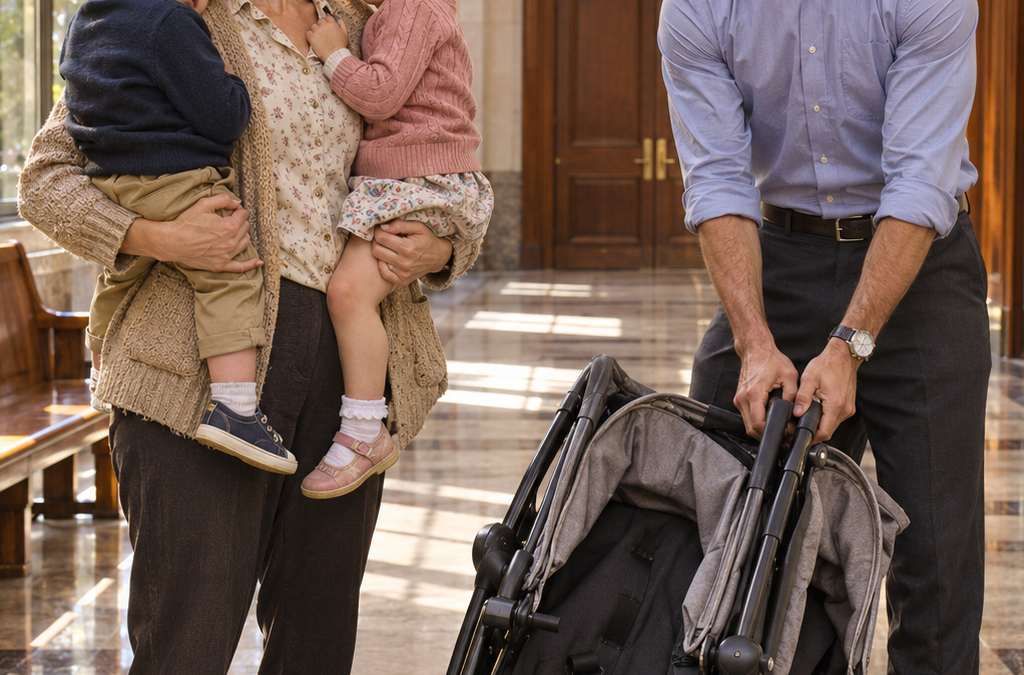
My husband folded our empty stroller outside family court while I held our twins and told me, “Carry them yourself.”
Chapter 1 of 7
“Please open it again, Ryan. They’re getting heavy.”
He rolled it against the wall outside our Sacramento, California, family courtroom. Owen rested against my shoulder while Ella gripped my collar, pulling the seam against my neck.
“You can hold them until you finish signing.”
Both children were two, and neither had been in the stroller when he collapsed it.
“Linda, are you really going to let him do this?”
My mother-in-law looked away.
“Stop delaying him, Emily. Ryan has supported you long enough.”
Beside his settlement papers, Ryan’s open delivery pouch held a fresh wholesale receiving label, its clean white edge sticking above the battered canvas where he usually kept route slips.
That label didn’t belong there.
According to Ryan, there weren’t any routes left.
I was thirty-two, and Emily Carter was still my name. Marriage hadn’t changed it, although five years at home had changed almost everything else.
I own half the bakery.
That was a fact about Riverbend Bakery, not a favor Ryan could withdraw. We’d bought it together, with his production experience and my bookkeeping and customer accounts experience.
Before the twins, I’d answered customer thank-you notes between invoices, and afterward I answered during naps while two little heads appeared side by side on the baby monitor.
Flour still collected in Ryan’s shirt seams after washing. I brushed it out before hanging them.
The twins’ meals went into the refrigerator beside his packed lunch. His sandwich always had mustard to the edges, because he complained about dry corners.
I’d made it easy for him to forget how much I did.
Keeping children fed should never make their mother financially invisible.
His pouch tipped toward me.
A fresh wholesale label protruded from his supposedly empty delivery pouch.
The receiving name read L. Blake. I couldn’t see the rest beneath the papers.
Ryan pushed a pen toward me, its point hovering beside Ella’s leg. He wanted another signature confirming the property agreement I’d already signed.
“You’re holding up the whole morning over one page.”
Then he moved the folded stroller farther down the wall. My fingertips hadn’t even reached it.
Humiliation burned across my face, worse because Linda watched him do it without offering to hold either child.
“Are you demanding a signature while I hold both children?”
“Yes. You’ve had plenty of time to read it.”
Owen shifted, and his shoe caught inside my cardigan while Ella leaned backward to see the stroller, leaving me balancing their weight with both elbows locked against my sides.
The pen stayed in front of me.
“STOP MAKING THIS HARDER!”
Ella buried her face against my neck.
“Then wait,” I said.
I stepped a few paces toward the opposite wall. We stayed outside the same courtroom, close enough to hear Linda telling Ryan that I always picked the worst possible moment.
But I wasn’t going to sign around my daughter’s knees.
My phone was in the loose pocket of my cardigan. With Owen braced against my hip, I managed to call Dana Reed.
She’d supervised the bakery deliveries, back when Ryan still talked about them at home. Her number remained among my old customer contacts.
“Dana, can you talk for a minute?”
“I finished my last bakery route. I’m already coming upstairs.”
She was there to return the company scanner. She’d messaged Ryan about bringing it, but he hadn’t answered.
“What route? Ryan said the bakery closed.”
“Wholesale. Today’s orders, Emily. I delivered them myself.”
For weeks I’d repeated his explanation to myself whenever I worried about groceries, rent, or the papers he said would let us finish this without spending money we didn’t have.
Now my mouth had gone dry.
The courtroom door opened.
And Ryan brought the confirmation page toward me again.
Dana reached us carrying the dented blue scanner, still wearing her delivery jacket.
She saw the children before she looked at Ryan.
Without asking, she opened the stroller one-handed and steadied its frame.
I lowered Owen first, then Ella, and fastened their buckles.
Only then did Dana clip the scanner onto the handle.
Its broken strap hung loose against the stroller.
“That thing’s obsolete. Bring it back to me,” Ryan said.
“I completed current orders with it this morning.”
His pen stopped moving toward me.
I own half the bakery. He says it closed. She delivered its orders this morning.
Linda reached for the scanner before Dana could finish.
Dana stepped between Linda and the stroller handle. She didn’t shove her or raise her voice.
“It’s company property. I’m returning it to Emily.”
The broken strap swung once against the frame. Linda withdrew her hand but stayed close.
Dana explained that she’d finished her final authorized route, then resigned. She was starting with another food distributor. Until that route was done, the scanner had remained her responsibility.
Her ordinary delivery routine included holding receiving labels outward for the scanner’s delivery pictures. She didn’t open anything or show us a screen.
Ryan cut across her explanation.
“You don’t need to get involved in our marriage.”
Dana said she was returning equipment, not discussing our marriage.
I kept looking at the pen in his hand. He had offered me $18,000 for the interests he insisted were worth almost nothing.
Until that morning, I’d believed him about the bakery being closed. I hadn’t worked inside it lately. I’d been feeding toddlers, finding somewhere to live, trying to keep their bedtime recognizable.
It hurt to hear that deliveries had continued while I’d counted what was left for groceries.
“So today wasn’t just taking equipment back?”
Dana shook her head. She had delivered sealed wholesale cases, not empty trays.
Ryan told her this wasn’t the place.
But he hadn’t denied the cases.
Dana glanced at the page he still held.
The top sheet slipped sideways against his pouch.
His thumb pressed hard over the lower section.
My address showed beneath it.
Then Dana found our home address on the surrender page.
“Emily, this includes your interest in the house.”
She hadn’t taken the paper from him. The address and the line beneath it faced us where Ryan had angled the page for my signature.
The house was where he still slept. The twins and I were in a furnished one-bedroom sublet because staying together had become unbearable, not because anyone had ordered us out.
I’d left with clothes, their bedtime books, and the idea that leaving the argument might help us settle things.
I hadn’t meant to leave my share behind.
By then Ryan’s sister, Megan, had joined Linda near the courtroom door. Megan was thirty, and she stared at the stroller instead of meeting my eyes.
Nobody offered to read the page with me.
“Let me have the whole thing,” I told Ryan.
“You already have it. Don’t start this again.”
He had handed me pages before, but I couldn’t have said how many. During our arguments, he’d explained each section himself and hurried past whatever I questioned.
I was ashamed of that now. More than anything, I wanted time to read without him standing over me.
Paul Evans, the court clerk, appeared in the doorway and called our case. The sound made Ryan gather his papers against his chest.
Linda told me we needed to go inside.
Dana stayed beside the stroller. Owen had fallen asleep, his cheek pressed against the padded side. Ella watched my face while rubbing one shoe against the other.
“I’m not signing this confirmation,” I said.
Ryan looked toward Paul, then back at me.
“You think that gets you out of what you signed?”
The question landed harder than his shouting. Until then, refusing the pen had felt like the one useful thing I’d managed all morning.
He pulled a folded copy from beneath the confirmation page. I recognized the slant of my handwriting before he flattened it.
The bakery was listed there. So was the house.
Ryan unfolded the April agreement and tapped my signature.
Chapter 2 of 7
“Eighteen thousand dollars for your bakery interest and your share of the house,” Rachel Turner said. “And you signed here.”
She had the complete April agreement in front of her. I recognized every loop in my name; the signature was mine.
“This isn’t a judgment yet,” she said. “But refusing yesterday’s confirmation doesn’t make this agreement disappear.”
I’d come to her Sacramento office the next morning hoping the missing signature would matter more. Instead, I had to explain why I’d given Ryan the first one.
“He said there wasn’t anything left in the business. That we’d spend more fighting.”
Rachel asked what I’d seen before signing. I told her about the pages Ryan had explained, his repeated warnings about debt, and how badly I’d wanted the arguments to stop.
I felt ashamed saying it aloud. Rachel didn’t scold me, which somehow made it easier to finish.
Dana sat beside me, still in her work pants from her new job. She’d arranged to come before her shift.
“Tell me what you actually delivered,” Rachel said.
“Sealed wholesale cases. I picked them up at the licensed shared kitchen. Took them to Riverbend’s rear receiving room, then finished the customer route.”
She meant the previous morning, before she’d met us at court. Rachel asked whether she had supervised that work herself.
Dana said she had assigned those routes and covered them when drivers called out. On her final day, she’d completed the route herself before resigning.
“Could those have been empty cases coming back?” Rachel asked.
“No. Loaded cases going out. I know the difference.”
For a moment, Dana sounded like she used to when someone blocked the loading space. I almost laughed. Then I remembered counting yogurt cups in the sublet refrigerator while Ryan told me the bakery had nothing.
“Yes. That doesn’t give you permission to drain its accounts or sell its equipment.”
It hurt worse here, away from his voice. I could hear how easily I’d repeated his explanation.
Rachel asked when I had last accessed the working bank account. My old saved password had stopped working. Ryan had said he’d changed the system.
“I still own half,” I said.
“Yes. That doesn’t give you permission to drain its accounts or sell its equipment.”
I hadn’t planned to do either. Still, I’d imagined ownership would give me some immediate way to stop being helpless.
Ryan ran the premises. Staff took their instructions from him, and he held the current account credentials. I had shares, old customer files, and no way to pay rent with either.
Rachel said we needed records. She asked me to save messages and leave the business equipment alone.
My phone lit up while Dana was explaining where the wholesale loading happened. Ryan had started a family group message with Linda and Megan.
“I spent years keeping suppliers paid while you stayed home. Now you want to tear everything apart.”
There were more sentences about early mornings, money borrowed during slow seasons, and people who depended on him. He wrote as though I’d appeared that week demanding a stranger’s business.
Linda answered before I did.
“You’d be taking money out of the children’s business. Think about them for once.”
I felt humiliated, even with only three people reading. They knew who had stayed up with the twins. They knew why I hadn’t been at the bakery every morning.
“I won’t discuss the settlement in a family group,” I wrote.
I muted it after that. Megan hadn’t answered.
Rachel compared Ryan’s financial disclosures with the share records I’d brought. The California forms had been delivered to me the previous month, among papers I’d struggled to understand between meals and bedtime.
Riverbend was listed. My ownership hadn’t been erased.
But Ryan had assigned the company no operating value and reported zero business income. His only stated earnings were occasional delivery work.
“He says it exists, but it isn’t earning,” Rachel said.
Dana looked at the papers for a long moment. Then she said she could describe her deliveries, but she hadn’t handled the bank deposits.
Rachel wanted that distinction kept clear. Dana knew what she’d carried and where. The money would have to be followed through records.
I was grateful she didn’t ask Dana to promise more. I’d spent weeks listening to Ryan sound certain about things I couldn’t check.
By the time I returned to the furnished sublet, the twins were tired. Ella wanted her shoes off, then cried because her shoes were off.
Owen went straight to the foldout bed.
“Our couch house,” he said.
I thought he meant the apartment. Then he patted the blanket where all three of us had read books the night before.
He’d begun calling the bed that. It was where we slept, sorted laundry, and sat when there wasn’t floor space between their toys.
At home, Owen used to hide behind his bedroom door and yell “Where Owen?” before anyone started looking. Here, there was nowhere to hide except under the blanket.
I was sad in a way I couldn’t explain to him. I told him I saw his couch house.
That evening, I moved their books off my pillow so I could open the rental agreement. I had been treating this place as a pause, something we could endure until Ryan became reasonable.
The twins were making it their home because I hadn’t been able to give them another one.
My phone lit up with a separate message from Ryan.
“I’m done paying for a place you chose. The $650 bridge payment won’t be coming before your next rent.”
Chapter 3 of 7
The $650 hadn’t arrived. I checked my available balance twice, then compared it with the sublet’s $1,250 rent.
I could cover this payment if I postponed replacing my phone. Its battery barely lasted through an outing, and calls sometimes dropped unless I plugged it in. I deleted the replacement I’d saved in my shopping cart.
There was no order requiring Ryan to send that money. He had promised it while we sorted things out, and I had built my budget around his promise.
“You chose to leave, Emily. You need to manage it.”
He called while the twins were napping. I stood beside the kitchenette so I could hear them if they woke.
“I’m managing it. That doesn’t mean you didn’t promise.”
He said I’d made everything expensive by bringing other people into it. I was angry enough to want him to hear the refrigerator humming beside me, the whole place we were living in.
“Stop running to people from my business.”
He meant Dana. He didn’t ask whether the rent was covered or where the twins would sleep when the rental ended.
“It’s our business,” I said. “And temporary housing isn’t giving up my share of the house.”
He told me to have my lawyer explain that to his. Then he ended the call before I could ask who he had hired.
I had rent covered, but nothing left over if the phone finally quit. I checked its charge before looking in on the twins.
At Rachel’s office, I showed her the rental agreement. The furnished sublet ended shortly after the period when she expected our next hearing.
“Has the owner agreed to extend it?” she asked.
No extension was available. I had asked, and the owner already had plans for the apartment.
Rachel read the ending date, then asked about our house in Sacramento. Its agreed value was $386,000, and both our names were still on it.
Ryan had stayed there alone. The twins’ bedroom was still furnished, and the spare room could hold either parent’s things during their childcare time.
“He could stay with Linda,” I said. “He’s stayed there before.”
Rachel asked what I knew about that, rather than what I assumed. I described the spare room at Linda’s and Ryan’s overnight stays there when we’d fought.
I felt embarrassed discussing which bed my husband could sleep in. Then I remembered pricing another short-term rental and stopped apologizing for bringing it up.
Rachel prepared a request for temporary home occupancy. She also gave notice that I opposed approval of the April property agreement.
I signed my account of the rental, the children’s routine, and why I had left. She made me correct one sentence that made an argument sound like a fact.
“Don’t guess what he can afford,” she said. “Tell me what you know.”
Having the papers sent to his lawyer didn’t change where we slept. I still went back to the sublet, plugged in my phone, and unfolded the bed.
“Please don’t put any of this online,”
Ryan’s lawyer was Adam Foster. In his reply to Rachel, he said Ryan would oppose being required to move. Rachel forwarded the message without adding any promise that we would win.
That evening, Ella insisted every stuffed animal needed a bowl for dinner. Owen collected their bowls afterward and tried to put a cloth bear in the sink.
I laughed before I could stop myself. For a few minutes, I wasn’t counting how many more evenings we had there.
“Please don’t put any of this online,” Dana said when she called later.
She sounded tired. Her new employer had asked about a reference, and Ryan had refused to confirm anything beyond her employment dates.
It wouldn’t cost her the job she’d already started, she said. But she had hoped his recommendation might help her move into a better route later.
“I’m sorry,” I said. “I didn’t think he’d do that.”
She said she could still tell the truth about what she’d delivered. She just didn’t want her name in a public argument where former coworkers would be pushed to choose sides.
I promised I wouldn’t publish it. I felt guilty that helping me had followed her into her next job, though she hadn’t asked me to fix it.
Over the following days, Rachel requested company records. Some arrived through Adam: customer account pages, payment records, and Ryan’s explanation of the remaining deliveries.
“These were old customers being cleaned up,” Ryan told me during a separate call. “Dana was finishing what we already owed.”
He wasn’t saying the cases hadn’t existed anymore. Now he said deliveries could continue after a business closed without making it an operating business.
I left that explanation for Rachel. I was learning that arguing with him didn’t produce anything I could check.
The company records did.
Rachel showed me a customer-payment page beside Ryan’s signed financial account. He had described the operation as closed and reported no business income under penalty of perjury.
On the customer page, I recognized the way wholesale orders were numbered. I had entered hundreds of them before the twins.
“This one was opened after the shutdown,” I said.
Rachel checked the order record rather than taking my memory for it. Then she requested the corresponding bank records through a targeted subpoena.
We still needed to know where the money had gone. The payment page alone couldn’t tell us that.
But the order record gave us something specific to follow.
A current wholesale order number matched a payment entry after Ryan’s claimed shutdown.
Chapter 4 of 7
“The deposit matches,” Rachel said. “Same customer, same order. The bank records confirm it reached Riverbend’s account.”
She had the customer record beside the statement supplied by the bank. The order had been opened after Ryan said the bakery shut down.
“That proves a sale after the shutdown,” she said. “It doesn’t tell us the final profit by itself.”
There were more records beneath those two pages. I recognized restaurant names before I understood how much they had spent.
A breakfast place near the river still bought sandwich rolls. A neighborhood café still ordered muffins for its morning counter. Customers I remembered apologizing to over late invoices were buying every week.
I felt angry seeing their names. Ryan had made their ordinary orders disappear whenever he talked to me.
“Those cafés didn’t leave,” I said. “He told me we’d lost them.”
Rachel asked which accounts I knew firsthand. I went through the pages, separating names I recognized from customers I had actually handled.
One restaurant had started with a small standing order. Its manager had called after another supplier missed a delivery. I’d answered, priced the order, and arranged samples from the next bake.
Ryan had wanted payment up front. I’d agreed to that, then called after each delivery until the manager trusted us.
“They changed their order for weekends,” I said. “That’s the same account number.”
The current records showed larger quantities, billed through Riverbend Bakery, Inc. The business I owned hadn’t become an empty room because Ryan stopped letting me see its books.
Rachel worked from the bank statements and the customer records together. Across the period reviewed, wholesale receipts averaged approximately $42,600 a month.
After ordinary operating costs, the records showed about $11,900 in monthly operating profit before owner compensation and taxes.
“The forty-two thousand isn’t money you split,” Rachel said. “Ingredients, kitchen rent, drivers—all that has to come out first.”
I understood that part. I had once been the person reminding Ryan that a busy Saturday didn’t mean we could skip a supplier’s bill.
What embarrassed me was how far he’d pushed me from things I already knew. I had begun asking permission to believe my own experience.
“This is a working business,” Rachel said. “It needs a proper valuation.”
That didn’t put money in my grocery account. The company’s cash still belonged to the company, and there were bills behind those orders.
But I stopped looking at my ownership as an old piece of paper.
At the sublet that afternoon, Owen refused the heel of his sandwich. Ella ate hers, then asked whether she could have his because it was “the bread door.”
I laughed and gave her half. They argued over bread shapes while I tried to remember when I’d stopped enjoying ordinary things.
That evening, Rachel confirmed that Adam had received the bank production and the connected customer records. Ryan had access to the same pages.
His next call wasn’t about the rent.
“The money’s already spoken for. There are obligations you don’t understand.”
“You’re making this sound bigger than it is,” he said.
He didn’t ask whether I knew what the customers had paid. For once, he seemed to assume I had read the records.
I was nervous hearing that change. I stayed beside the plugged-in phone instead of walking around, where the call might cut out.
“The money’s already spoken for. There are obligations you don’t understand.”
He said the receipts covered outstanding commitments, and any work coming in now depended on him getting up before dawn. Without him, he said, there was nothing for anyone to value.
Later, during a call Rachel arranged with Adam, Ryan sounded different.
“Ms. Turner, I appreciate that you’re reviewing the records,” he said. “But the bank deposits don’t explain what keeping these accounts requires.”
Adam said they would address the ongoing work and expenses. He didn’t deny the deposits.
I could hear Ryan trying to move the argument away from whether the bakery operated. Now he wanted to explain why its operation belonged to him.
“Emily, stop pretending you built the ovens.”
He said it while both lawyers were still listening. I felt humiliated, then furious that he had found another way to make my work sound imaginary.
I didn’t list the lunches or the nights awake. Those things mattered, but he would turn them into another argument about marriage.
“I opened the restaurant account on that page,” I said. “The manager called me. I priced it and kept it.”
Ryan said he made the bread. Rachel brought the conversation back to the records, and Adam said he would speak with his client.
Afterward, I sat for a while before folding the bed out. I hadn’t persuaded Ryan to respect me. I had managed to answer him without asking him to agree.
“Both matters will be heard together,” Rachel told me when the hearing notice arrived.
Judge Susan Bennett would hear the agreement dispute and my separate request for temporary home occupancy in the Sacramento family courtroom, at 9:00 a.m. on June 2. Adam received the notice too.
Rachel asked for an updated account of the sublet and the twins’ routine. I sent what she requested, including confirmation that the rental couldn’t be extended.
I was afraid of getting that part wrong. Business records had numbers I could follow; describing where my children needed to sleep felt much more exposed.
Then Adam supplied a written statement from Linda.
“I hadn’t been inside,” she wrote, referring to the bakery after its March shutdown. She said she therefore couldn’t know about any continuing operation.
I read that paragraph twice. Linda had put her claimed absence in writing.
Chapter 5 of 7
“I hadn’t been inside,” Linda’s statement said. I read the rest again at Rachel’s office, looking for a qualification I’d missed.
There wasn’t one. She said she hadn’t returned to the bakery after the shutdown.
Dana joined us by phone before her route at her new job. When I asked what she would say about Linda, she wouldn’t rehearse an answer for me.
“Rachel, please use the complete sequence. Not somebody’s screen capture.”
Rachel confirmed that Dana’s original delivery-image export had been preserved without changes. Adam had received the same exhibit material before the hearing.
I wanted Dana to sound as angry as I felt. Instead, she asked whether Rachel needed anything else before she went to work. I was grateful afterward, though it disappointed me then.
Once she hung up, Rachel asked me to describe what I had done at Riverbend. I started with buying it together, then wandered into everything that had happened since.
“Stay with what you handled yourself,” she said.
I tried again. Customer accounts, invoices, payment follow-ups, the restaurant orders I had helped establish. Those were things I could explain without checking Ryan’s expression.
When I moved on to what I thought my half must be worth, Rachel stopped me.
“The final value isn’t your guess to make.”
I felt foolish, but she hadn’t called me foolish. She asked about the sublet instead, and I described its ending date and our sleeping arrangements.
“The twins have a bedroom at the house,” I said. “Their beds are still there.”
That sentence was harder than talking about money. I wanted to add that I hadn’t meant for any of this to last so long, but Rachel already knew.
“You’re dragging the twins through months of uncertainty. Take the money.”
She didn’t give me a speech to memorize. She asked me to answer the question I heard and say when I didn’t know.
Before I left, she showed me Ryan’s revised written offer: $32,000.
Adam had sent it with a request that I consider avoiding further expense. In a separate message, Ryan made the expense sound like something I was doing to our children.
“You’re dragging the twins through months of uncertainty. Take the money.”
For a little while, I pictured paying rent without checking the balance first. I was tired enough that almost any definite number felt like shelter.
Then I read what I would be giving up.
“Tell Adam I’m declining,” I said.
Rachel asked whether I needed more time. I said no. I didn’t send Ryan an explanation or answer his next message.
That night, I washed the twins’ clothes for their childcare bag. Owen insisted on wearing a shirt with a cement mixer because, according to him, it was a bus making soup.
I laughed so hard he looked offended. Then I let him choose it.
By morning, I was afraid again. I dressed both children, checked their bag, and headed for the Sacramento courthouse with their sitter’s arrival message open on my phone.
We had arranged the handoff in the waiting area before she took them back out. They weren’t coming into the hearing.
Linda stood beside Megan when we arrived. Ryan was farther down the corridor, talking to Adam.
“You should be grateful he’s still offering you anything,” Linda said.
I kept helping Ella out of her sweater. One sleeve had turned inside out, and she wanted it fixed before she would let me pack it.
Megan watched me settle Owen beside the bag, then turn back because Ella needed the bathroom. When we returned, Owen wanted the bathroom too.
She stayed beside Linda, but her eyes followed us. I wondered whether she remembered all the times she’d called me lucky to be home.
“Do you need me to hold the bag?” she asked.
I told her the sitter was almost there. I wasn’t ready to hand her anything, and I felt petty for it. She had watched Ryan make me hold both children.
Ryan came back before the sitter arrived. He spoke to his mother and sister, with me close enough to hear.
“The receipts were old obligations. Dana was winding things down.”
He said it patiently, as though they had asked him to explain a delayed repair bill. Linda nodded before he finished.
“Mom hasn’t been running the place. She’s got her own life.”
Megan asked why there were so many deliveries. He said closing the retail counter didn’t make customer commitments disappear; cases still had to reach people who had ordered them.
I listened without interrupting. He had stopped calling the deliveries imaginary. Now he was giving his family an explanation they could repeat.
When our sitter arrived, I told her Ella had already used the bathroom and Owen had barely eaten breakfast. Megan heard the snack instructions, the spare clothes, the reminder that Ella sometimes wanted Owen’s cup.
I hated saying goodbye when I was this nervous. I knelt so they wouldn’t have to look up at me.
“I’ll see you after you play,” I said.
Owen asked whether there would be blocks. The sitter said there would, and that settled it for him. Ella needed another hug.
I watched them leave before joining Rachel at the courtroom entrance.
Adam approached with Ryan’s final supporting declaration. Rachel read it, then let me see the paragraph he had identified.
The order number caught my eye first. I remembered it on the receiving label sticking from Ryan’s delivery pouch, beside the page he wanted signed.
Here it was again, attached to an explanation he had signed.
His final declaration called the disputed delivery a March order, merely completed later. Ryan had put March in writing. Under oath, he would have to defend it.
Chapter 6 of 7
“Tell the judge,” I said quietly.
Ryan repeated his explanation under oath. Dana had finished a March obligation after the retail counter closed. His mother had no role at the closed premises.
Linda and Megan sat behind him, where they could see his face.
Adam explained that closing a business didn’t end its commitments. A final delivery could happen weeks later. He asked Judge Bennett to distinguish winding down from continuing to trade.
When it was my turn, Rachel asked me about the disputed order. With permission, I brought forward the preserved blue scanner and identified its broken strap. Seeing it there made me angry again, remembering both children weighing against my arms.
I turned to the receiving record in the exhibits.
“This entry says ‘L. Blake,’” I said. “Why is Linda’s acknowledgment on an order opened and completed after the shutdown?”
Ryan answered when Adam questioned him again. His mother could have accepted leftover stock. A photograph taken later didn’t prove the business was profitable.
Judge Bennett looked toward both lawyers. “Was this a new paid order, or an old order being cleared?”
Dana took the witness stand and identified the scanner she had used on her final authorized route. She confirmed that the exported photographs were hers, unchanged and in their original sequence.
The first receiving picture showed Linda inside Riverbend’s rear room.
Her face was clear above the sealed cases. Dana had held the label outward as she always did. The order number was readable beneath Linda’s receiving acknowledgment.
Dana identified Linda, then explained the remaining pictures. They followed those same numbered cases through her route to the restaurant customer’s completed handover.
Rachel directed the judge to the matching company records: a new order created after the claimed shutdown, its invoice, and the customer payment confirmed by the bank.
I felt relieved hearing each piece connected aloud. I hadn’t misunderstood what I was seeing.
Linda started to rise. Ryan said his mother had only been helping.
“You told me she never went back,” Megan said.
Judge Bennett asked everyone behind the tables to remain quiet. Megan crossed the aisle and sat in the empty seat beside me.
The judge returned to the records. An old-order explanation did not fit a newly opened, paid order. Nor did Linda’s statement fit photographs showing her receiving it.
“Mr. Blake, your exclusive use of the home ends within seventy-two hours.”
“I will not approve the proposed property agreement,” Judge Bennett said. “Its financial foundation is materially unreliable.”
She addressed housing separately. She had considered the noticed request, our testimony, the ending sublet, the twins’ furnished bedroom, and Ryan’s available alternative at Linda’s.
She granted me temporary exclusive occupancy of our $386,000 jointly owned home. The children needed a stable primary home. Final ownership and parenting arrangements remained undecided.
“Mr. Blake, your exclusive use of the home ends within seventy-two hours.”
I heard that sentence clearly. For once, I didn’t have to ask Ryan what a page meant.
After the judge finished, Ryan pushed back his chair hard enough to turn several heads.
“Stop looking at me like that, Emily.”
I hadn’t realized I was looking at him. His face was red, and he kept glancing toward the benches where his family had been sitting together.
I felt shaken. I had wanted the order, but I still expected him to make me explain why I deserved it.
Rachel stayed beside me while Adam spoke quietly to Ryan. There would be a written order and an arranged handover. I wasn’t to go to the house before then.
Ryan looked past Adam toward his sister.
“Tell her I can’t move everything that fast.”
Megan said she could coordinate a truck and help him pack. He stared at her as though she had answered a different question.
Linda came around the bench and stopped beside Megan. She said Ryan needed support, not people making plans behind his back.
“I’m offering to help him move,” Megan said. “That’s what he needs now.”
I could barely believe she had stayed beside me. She had watched the stroller incident without speaking. I was grateful for this, though I wasn’t ready to pretend the earlier part hadn’t hurt.
Ryan reached into his pocket for his home keys, then kept them there. Nobody asked him to surrender them in the courtroom.
He told Megan that some of his baking things were at the house. She said she would bring boxes.
Outside, I stayed beside Rachel instead of waiting for him. For years, waiting had meant checking whether he needed food, directions, reassurance, another chance to explain.
“Speak to my lawyer about property. Text me only about the children.”
He said I couldn’t make every conversation go through someone else. I didn’t answer. Rachel told Adam they would confirm the handover arrangements.
Linda called after Megan as we walked down the corridor. I kept going. I didn’t turn back to make the conversation easier for either of them.
Near the elevators, I checked the sitter’s message. Owen had eaten his snack and half of Ella’s. Ella had insisted her toy rabbit needed a turn on the little slide.
I laughed, and then I cried a little. I was relieved, embarrassed to be crying in public, and too tired to hide it.
Megan caught up while Rachel checked her phone. She didn’t ask me to forgive anyone or tell me Ryan was having a hard time.
She showed me her screen.
The moving truck was confirmed for Friday.
Chapter 7 of 7
The booked truck pulled away from the house on Friday, carrying the last of Ryan’s boxes. Megan waited on the porch until it turned the corner.
“He’s finished. These are the keys we agreed on.”
She handed them over after I parked. Ryan had already left, and Rachel had confirmed the handover arrangements with Adam. Only then did I bring Owen and Ella through the front door.
The temporary order let us live there. The house still belonged to both of us.
Ella went straight to her bedroom. Owen followed, dragging his overnight bag backward because he wanted to watch its wheels.
“My bed’s here,” Ella said.
I told her it was. I felt relieved enough to cry, but she wanted help finding her rabbit, so I looked under the blanket.
That first evening, we ate scrambled eggs at the kitchen table. Both children fell asleep in their own beds. I stayed awake listening from my room, with no need to fold away the place where I slept.
Over the following months, our days became easier to predict. Breakfast, childcare, work, pickup. I found paid bookkeeping work for small businesses and built my hours around the children’s care.
“Can you take another account?” one customer asked.
I checked my schedule before answering. I wanted the work, but I needed hours I could keep. Saying that plainly felt unfamiliar.
Ryan continued his parenting time under our existing arrangement. I packed spare clothes and passed along ordinary information about naps and meals. Property questions went to Rachel.
When he asked about a business document during a pickup, I told him to send it to her. I was still nervous afterward. Nothing happened except that he sent the document.
“Adam says you’re asking me to pay your lawyer now.”
Ryan sent that after Rachel requested a fee contribution. He received notice and had the chance to answer before the judge decided it.
The later order required him to contribute $6,000 because his conduct had frustrated settlement. It helped with my legal bill; it didn’t erase it. I was glad the expense hadn’t all been left to me.
By fall, I could finish a bank reconciliation without looking toward the door. My work was coming back faster than my confidence, but both were coming back.
“The valuation is complete,” Rachel told me.
An independent review supported a $496,000 value for Riverbend as a working business. That included its operating cash and equipment. I didn’t have to guess what my ownership was worth anymore.
We negotiated the remaining terms while I worked through the lender’s requirements for the house. Some evenings, after bedtime, I still had forms to finish. This time, I read every page.
On November 20, 2026, our negotiated property judgment was finalized.
“Read the final statement with me,” Rachel said.
Ryan retained the bakery. My half was worth $248,000. I retained the $386,000 home with its $214,000 mortgage; his $86,000 equity share offset part of my bakery interest, leaving a $162,000 payment to me.
That was the calculation. I checked it twice, then asked when everything would be completed.
“Ryan asked whether you still have his old supplier folder.”
Ryan obtained financing, and the transfer was confirmed. My approved refinance put the remaining mortgage in my name and removed Ryan from that obligation. The title transfer was completed too. There was no sale or financing deadline left hanging over us.
I felt proud when the closing documents arrived. I also felt tired. I saved them, then went to pick up the children.
Megan began visiting as their aunt. She brought books from the library and stayed to hear the same one three times.
“Ryan asked whether you still have his old supplier folder.”
I told her he could ask through the lawyers. She looked embarrassed, then said she shouldn’t have brought it. On later visits, she brought only herself and whatever the twins had persuaded her they needed.
I was grateful she learned the difference. I still remembered the courthouse corridor, but I didn’t need to discuss it every time she came through the door.
Linda called once to ask about “putting everything behind us.”
“I’m willing to talk about visits with the children,” I said. “I’m not pretending you didn’t help him.”
She said she had been supporting her son. She didn’t acknowledge anything else, and I declined the conversation she wanted. Family contact could continue without me reassuring her that she had done nothing wrong.
It hurt that she still wanted that from me. Afterward, I returned to the laundry instead of composing another explanation.
Two weeks later, I arranged a public handoff of the preserved blue scanner outside the bakery. Rachel had confirmed it could be returned. The twins came with me, already buckled into the stroller for a park outing.
Ryan met us outside. He looked at the dented casing and its loose, broken strap before taking it.
“Everything’s still on there?”
“Nothing was changed.”
He nodded. I didn’t ask whether he was angry or whether business was good. He spoke to the children, and Owen told him we were going to the park. Then Ryan went back inside with the scanner.
I had carried it long enough.
At the corner, I stopped beside the stroller and checked the park path. Owen waited with Ella while a delivery truck cleared the crossing.
“Swings first?” Ella asked.
Usually, I would have planned the outing around someone else’s errand. That morning, we had snacks, warm jackets, and nowhere else we needed to be.
I chose the quieter route along the neighborhood streets. I felt happy, simply and without checking whether that happiness would upset anyone.
Family did not require me to disappear.
Owen pointed when the swings came into view. Ella leaned forward beside him, impatient for me to unbuckle her. I told them we were nearly there.
I pushed the stroller toward the swings.







