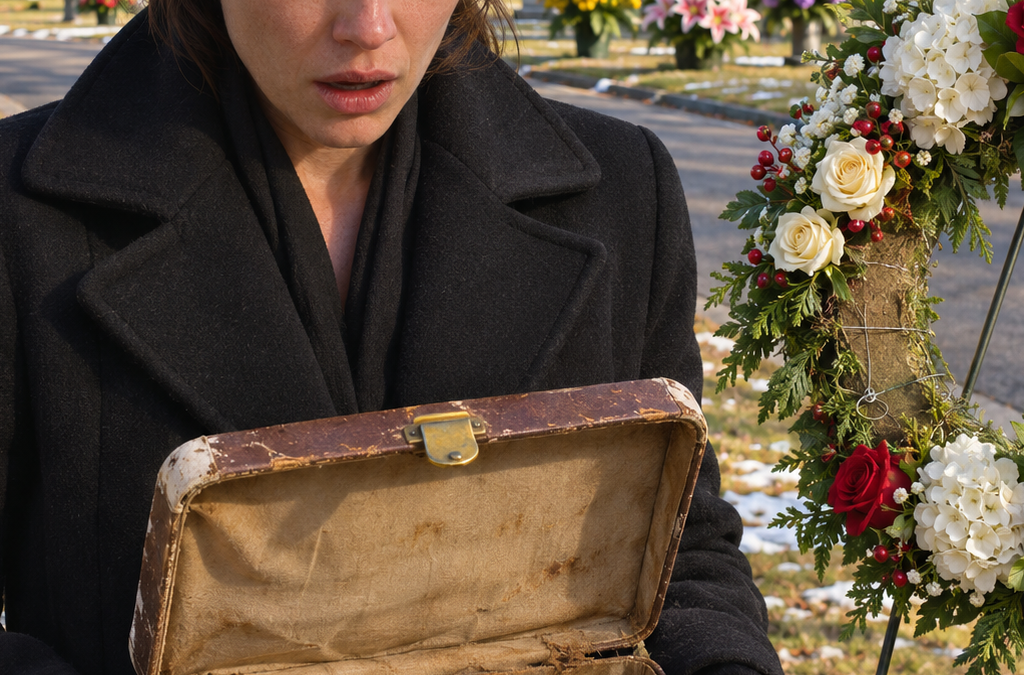
My husband’s daughter peeled the “Daughter” ribbon from my wreath at Dad’s burial and said, “You don’t get to call him Dad.”
Chapter 1 of 7
I steadied the wreath before its wire stand tipped into the mud. Brooke Sutton kept pulling until the ribbon came loose.
“Why are you taking my name away?”
“Because this belongs with flowers from friends.”
Behind her cemetery folder, a gray bank envelope stuck out sideways. It seemed strange to bring bank mail to a burial.
“David. Are you really going to let her?”
My husband studied the open grave. His coat collar brushed his jaw, but he didn’t turn toward me.
Linda Mason, Dad’s younger sister, stood beside Brooke. “Henry made his arrangements. We should respect them.”
“The flowers were my arrangement,” I said.
Brooke folded the ribbon with its lettering inside. David had watched her reach for it. He couldn’t pretend he’d missed what happened.
I was Emma Reed, thirty-six, a medical billing specialist in Columbus, Ohio. Henry had adopted me when I was nine. He’d died at sixty-eight, and I still hadn’t managed to move his clean cardigan from my passenger seat.
Dad had left me his fishing-reel case.
Mark Bell, his attorney, had told me about it before the burial. I hadn’t asked about anything else.
Brooke’s corrected résumé was still in my work bag. At twenty-nine, she trusted me to catch errors, even when she didn’t want my advice.
David’s lunch waited in our refrigerator. Before getting dressed for the funeral, I’d packed the meatloaf sandwich he liked, with the ketchup separate so the bread wouldn’t turn soggy.
We’d been married six years.
I kept making things easier until nobody asked what it cost.
Brooke shifted her folder, covering most of the gray envelope.
Under Brooke’s thumb, a bank envelope showed my childhood surname.
Then she turned toward the grave, holding her phone. “Move over, Emma. We’re taking the family photograph.”
There was space beside David. Brooke meant for me to leave it empty.
“Linda, put that wreath with the friends’ flowers.”
Linda looked toward the other arrangements. “Yes, that’s probably where it should go.”
Being called a friend hurt more coming from her. Linda had been there when Dad brought me home. She used to keep a spare place for me at every holiday table.
The wreath leaned again when I let go. Linda hesitated, apparently waiting for me to straighten it first.
Brooke pointed toward the distant row.
“PUT IT WITH THE OTHERS!”
David’s eyes lifted toward her, then dropped. My ears burned. Even then, I wanted him to say her name in the voice he used when someone had gone too far.
“You’re saying I wasn’t his daughter?”
“You heard me. Stop making this difficult.”
The answer came easily. She’d been handling Dad’s bills for four years and had started speaking as though every decision about him belonged to her.
I’d mistaken that confidence for relief that someone else could help.
“Keep your photograph.”
And I stepped away.
Usually, I would have fixed the wreath, found Linda a better place to stand, and reminded David to button his coat before the picture.
This time, the wreath stayed crooked.
The cold reached through my shoes while Brooke moved closer to David. He went where she directed him.
I stood beside the cemetery drive until they finished.
The next morning, the four of us returned to collect the arrangements and choose Dad’s temporary marker. Frost covered the grass beyond the disturbed earth.
Brooke brought the same folder. David carried empty cardboard boxes. Linda stayed close to him, speaking quietly about which flowers might last indoors.
I called Mark from beside my car.
“Can I collect Dad’s case from you?”
“I have it with me. I can come there.”
Then his voice changed.
“Brooke’s already asked the bank to put all Henry’s savings through her. The bank hasn’t agreed.”
“Did Dad tell her to do that?”
“Her request came with a copy of his will.”
There was nothing in his answer about Dad asking for it.
Across the drive, Brooke watched me talking.
I ended the call without waving her over.
David stopped folding the flaps of a box.
Linda followed Brooke’s gaze toward my car.
Then Mark’s car turned into the drive.
Brooke started toward it before I did.
He got out carrying the battered case.
Mark stopped beside Brooke. “We need to discuss Henry’s savings.”
Her voice softened immediately. “Of course. I’ve been keeping everything together.”
Mark was forty-seven, with a wool coat that looked too thin for the wind. He greeted David and Linda, then came toward me.
The case was brown, scuffed white at both corners. One fastening had been replaced with a mismatched brass one.
Dad had kept it on a shelf above his washing machine. He’d called it his expensive equipment, although the reel inside had squeaked badly enough to scare fish.
Mark placed it in my hands.
“Henry asked me to give you this personally.”
For a moment, I couldn’t answer. It hurt to hold something he’d chosen for me without being able to call and tease him about it.
Brooke came closer.
“The will left her nothing. You sent us copies.”
“The case was a separate personal gift,” Mark said.
I opened it.
A small key lay in the worn lining beside a folded contact slip. The slip gave a bank branch and the last few digits of an account number.
There was no reel.
“The bank sent a reply to Brooke’s request,” Mark said. “She forwarded it to my office.”
Brooke’s smile disappeared.
Mark looked from the slip to his phone.
Linda stopped beside the nearest flower box.
David waited behind her, still holding it open.
The wind lifted the corner of Brooke’s folder.
Mark found the line he was looking for.
“The name on the bank’s reply was Emma Turner.”
Turner was my name before Dad adopted me. Hearing it there made me look toward the gray envelope, tucked behind Brooke’s papers again.
“That was me,” I said.
Linda had been nodding along with Brooke. Now she stopped. Her mouth opened, then closed without a word.
Brooke stepped between us.
“Old names don’t change what his will says.”
I kept looking at Linda, but she bent toward the flowers.
Mark’s voice stayed level. “The bank needs to sort out its own records.”
“The key’s for the bank?” I asked.
“It identifies where to ask. It can’t move money.”
There was no promise in that answer. I appreciated that, even while I wished he could tell me one thing was settled.
Brooke held out her hand.
“Give me that. I’ll handle the bank questions.”
“No. Dad left this to me.”
“You don’t even know what you’re looking at.”
“I can ask.”
David finally spoke. “Emma, she’s been doing his books.”
“I know what she’s been doing.”
The words came out sharper than I intended. I was embarrassed by how quickly he’d found his voice for her.
Mark asked for my number and sent me a photograph of the bank’s written reply. He explained only that the different surname had paused Brooke’s request.
My phone showed the message arriving, but the photograph wouldn’t load. Brooke looked at the screen as if she expected me to give it to her.
I kept it.
“Here,” Mark said, turning his own phone toward me.
On his screen, beneath the bank’s letterhead, I read the words: “Identity documents required for Emma Turner.”
Chapter 2 of 7
“Emma Turner was my name before the adoption,” I told Rachel Grant. “What connects it to Reed for you?”
We sat at her desk in the Columbus branch. My driver’s license lay between us.
“The adoption decree,” she said. “A certified copy showing the name change.”
Rachel was forty-five, the branch manager, and she hadn’t asked whether Henry had treated me like a daughter. She needed a record she could check. After the cemetery, that distinction almost made me cry.
She studied the account information on her screen.
“Henry named Emma Turner to receive these savings directly when he died. We call it payable on death.”
“Brooke said his will left everything to her.”
“A will doesn’t redirect this account. We have to follow the account’s designation.”
I’d expected another argument about who belonged to Henry. Rachel spoke as though there was a question with an answer, and finding it was her job.
Then she told me the balance.
“The payable balance is $386,700.”
For several seconds, I couldn’t get a word out. The number was more than I had ever imagined Dad having.
He’d retired from municipal maintenance and complained about the price of furnace filters. He washed freezer bags if they’d only held bread. Whenever I bought him groceries, he inspected the receipt and accused the store of charging rent for the bananas.
“Are you sure that’s his account?”
“I checked it against the reference you brought.”
My eyes filled before I could stop them. For seven years, I’d helped him shower, sorted appointments, and spent evenings waiting for a callback from a doctor. Through all of it, he’d kept this quiet provision for me.
It hurt that I couldn’t ask him about it.
Rachel gave me a moment without trying to fill it.
“Does the bank key help?” I asked.
“It points us here. It doesn’t authorize entry to a box or let anyone withdraw money.”
She explained what remained: the death certificate and documents connecting my current identification to the name in the bank’s records. I couldn’t collect until those checks were complete.
“How long will that take?”
“I can tell you more when we have the documents.”
That wasn’t the answer I wanted, but she hadn’t promised anything she couldn’t deliver. I wrote down what she needed and read it back.
“The adoption file is restricted. A certified decree requires authorized release.”
Outside, I sat in my car with the heater running. There was nobody I wanted to call more than Dad.
Instead, I called the Franklin County Probate Court records office.
Susan Parker, the deputy records clerk, listened while I explained the adoption and the bank’s request. At fifty-one, she had the patient, clipped voice of someone who spent her days untangling other people’s confusion.
“The adoption file is restricted. A certified decree requires authorized release.”
She walked me through submitting the request without suggesting I could simply pick up a public copy.
“Your request has been submitted,” she said when we finished. “You’ll hear from us about the release.”
I thanked her, then stayed parked a little longer. I knew who I was. Having to assemble proof still left me feeling oddly exposed.
Linda called before I got home.
“Brooke says you’ve been to the bank.”
“Yes. I went to ask about Dad’s account.”
“She’s worried you’ll take every dollar and leave the burial unpaid.”
The traffic light changed, and I pulled into a grocery store parking lot.
“Did she tell you that was my plan?”
“She’s upset, Emma. There are bills.”
There had always been bills. Dad’s last household expenses were in the same folder as the funeral charges. I’d checked every line because that was the work I knew how to do.
“Linda, I haven’t refused to pay anything.”
“You two need to stop putting me between you.”
I felt ashamed for a moment, as though answering the accusation had made me responsible for it. Then I remembered who had called whom.
“I’m going home,” I said. “We can talk another time.”
At my kitchen counter, I opened the statement showing $24,600 in Dad’s separate estate checking account. There was money to address the bills. Brooke knew that account existed; she’d kept his books.
I sent Mark the itemized $6,100 funeral and final household bill. He had handled Dad’s estate planning, and I wanted the expenses in the estate file. I didn’t attach an explanation of my character.
Then I made toast and burned one edge while rereading Rachel’s list. Dad used to call that “extra done” and eat it anyway. I ate mine standing up.
David came home while the plate was still on the counter.
“Promise me you won’t make Brooke homeless.”
He hadn’t asked how the bank visit went. That hurt more than I wanted to admit.
“She owns a townhouse, David.”
“She’s got a mortgage.”
“So do I.”
He stayed by the kitchen doorway. “She thought Henry’s savings would clear it. There’s $181,000 left.”
“Did Dad promise her that?”
“She’s done his books for four years. She thought—”
“That isn’t what I asked.”
He looked tired. I was tired too, but I was beginning to resent how his exhaustion always became a reason for me to give way.
David said Brooke had sent everyone a message. He wanted me to understand why Linda was concerned.
“Forward it,” I said.
My phone lit up beside the cooling toast.
Brooke’s family message said, “Emma is refusing to pay Dad’s $6,100 funeral bill.”
Chapter 3 of 7
The funeral bill lay beside the statement for Dad’s separate estate checking account. David looked at the bill first, then at me.
“There’s $24,600 in that account,” I said. “I haven’t withheld any estate money. Mark has the itemized bill.”
“Then why does Brooke think you won’t pay?”
“Ask her. You’ve been asking me since Monday.”
He read the total again. His phone buzzed before he answered.
By then, Brooke’s message had reached relatives who hadn’t called me since the burial. Nobody had asked whether it was true. I felt humiliated having to prove myself at my own kitchen table.
David answered Brooke on speaker. For a moment, all I heard was her car heater.
“Dad, I can’t keep doing this by myself.”
“Emma showed me the funeral bill.”
“That’s not what I’m talking about. If you can’t help me, I’ll need somewhere to live.”
He looked toward the hallway.
Our spare room had a narrow bed and my work desk. During busy billing weeks, I used it so I wouldn’t wake him. I’d spent the previous Sunday clearing a drawer for Dad’s things, then left it empty because I couldn’t decide what belonged there.
“Brooke,” I said, “what help are you asking for?”
“Stop counting every favor, Emma. I’m talking to my father.”
David didn’t correct her. He told her he’d call back.
That glance toward the hallway stayed with me.
“Did you offer her our spare room?”
“If it comes to that. She needs a fallback.”
“You already told her she could stay?”
He rubbed his face. “I said we had room.”
We’d had room when his cousin’s refrigerator broke and when Brooke needed somewhere to stack boxes after her divorce. Both times, he’d asked me first. Apparently, my agreement had become something he could fill in later.
Then he told me about the money.
He’d been sending Brooke $1,200 every month for eighteen months. It came from his personal account, through a recurring payment he’d set up when she said she needed breathing room.
“It was supposed to get her settled,” he said.
“She’s still taking it?”
“She has expenses.”
“So do we, David.”
The house was mine from before our marriage. I owed $126,400 on the mortgage, and every month I checked the balance after the payment cleared. David contributed to household costs, but neither the loan nor the deed had his name on it.
I’d never used that to make him feel like a guest. Now I resented being treated as though I were the one who needed permission.
“Brooke can’t move in without my agreement.”
“You’re going to punish her over flowers?”
My chair caught against the wall when I stood. For a second, I couldn’t speak.
“You watched her tell me I wasn’t his daughter.”
“Everybody was upset.”
“And now you’ve promised her a room here.”
He stared past me toward the stove. We were having leftover chili, stretched with elbow macaroni the way David liked. He always called it chili-helper, as though he’d invented dinner. Neither of us had laughed about it that night.
“I’m not agreeing,” I said. “You should tell her.”
He left the kitchen without answering.
When he came back, he carried his work clothes and a shaving bag. His refusal to look at me hurt almost as much as it had at the cemetery.
“I’ve got her spare key. I’ve used it the last few times.”
“Where are you going?”
“Brooke’s. I’m staying there tonight.”
“Does she know?”
“I’ve got her spare key. I’ve used it the last few times.”
He said it casually, as if that made everything less painful. I hadn’t known about those visits either.
The door closed before the chili was hot.
Linda arrived while I was still sitting at the table. David’s truck had barely cleared the street when she’d turned onto ours.
She noticed his empty chair but didn’t ask.
“Brooke says you two had words.”
“David offered her a room without asking me.”
Linda kept her coat on. “She’s scared, Emma. Henry trusted her with those bills for four years.”
“I know he did.”
“She kept everything straight. You shouldn’t dismiss that.”
“I haven’t.”
It hurt hearing another person defend work I’d never denied. Dad had trusted Brooke because she was good at keeping bills organized. That didn’t make the rest of us disappear.
“For seven years, I helped him bathe,” I said. “I took him to appointments. I left dinners halfway through because he couldn’t get up.”
Linda looked down at the untouched place setting.
“I missed evenings with David. I missed—”
I stopped. Dad had needed me, and I’d wanted to be there. Listing it until Linda surrendered would have made his care sound like another bill.
“I know you helped him,” she said.
“Then please stop talking like I didn’t.”
She sat at last. Her voice changed when she spoke again.
“There was some bank correspondence at Henry’s. Brooke had been going through it, and I was there.”
I waited.
Linda looked toward the front window. “I should’ve asked more questions.”
“What did you see?”
“I need to speak to David first.”
“Why can’t you tell me?”
But she was already standing. I was too tired to follow her outside and ask again.
A few moments after she left, my phone lit up. Brooke had cropped the will down to the passage leaving the remainder of Henry’s estate to her.
The family chat displayed Henry’s will beside Brooke’s caption: “His final answer.”
Chapter 4 of 7
“I’m not disputing the will,” I told Mark. “I’m not answering that picture, either.”
He’d called while I was working from my kitchen table. Brooke’s cropped image was still in the family chat.
“The court has appointed Brooke executor,” he said. “Her authority over the estate is legitimate.”
“So that part’s settled.”
“The will leaves her the probate residue. The savings pass outside the estate under the bank’s account arrangement.”
Mark had completed his conflict check before agreeing to advise me separately. I needed someone who could answer my questions without treating every answer as another family compromise.
I closed the chat and returned to a rejected medical claim. For once, somebody else’s billing problem was easier than mine.
Rachel had arranged a call for that afternoon. When she connected us, Brooke greeted her warmly and thanked her for helping with “all these loose ends.”
I sat straighter at the table. Brooke had never sounded that patient with me.
Rachel began with the account, not the funeral bill or Brooke’s family messages.
“Our existing direction names Emma Turner to receive the savings after Henry’s death,” she said. “We’re verifying Emma Reed’s connection to that name.”
Brooke’s proposed estate total was $411,300, Rachel explained. It combined the separate checking funds with the $386,700 savings balance the bank had not accepted as estate money.
For several seconds, Brooke said nothing.
Until then, she’d spoken as though I were asking for a share she could refuse. Now Rachel had told her the whole savings account might be paid directly to me.
It scared me how much I still wanted Brooke to understand without hating me.
“You’re saying none of those savings come through me?” she asked.
“If Emma completes verification, they’re payable directly to her.”
“And the will doesn’t change that.”
“Correct.”
Brooke stopped arguing about the will. I heard her chair scrape, then her voice returned, quieter and more careful.
“I understand you have rules, Rachel. But you can’t pay someone with a different name just because she says she’s the right person.”
“That’s why we requested the court record.”
“Then please make sure it’s checked properly.”
Rachel said she would. There was no irritation in her answer, which seemed to disappoint Brooke.
I had wanted to say that she’d known me for six years. She’d eaten at my table, borrowed my car, and sent packages to Emma Reed at my address. None of that was what Rachel needed, so I kept quiet.
After the bank call ended, Brooke called me directly.
“Stop using a dead man’s mistakes.”
Her voice had lost every trace of sweetness.
“Which mistake, Brooke?”
“You know what I mean. An old name on an account.”
“The bank asked for proof. I’m getting it.”
She told me I was making everything harder, then hung up before I answered.
“Your certified-copy request is ready for completion. We’ll contact you about collection.”
I was angry enough to lose my place on the work screen. Her insult had landed on Dad, too, and there was no way to call him and complain about her.
A frozen square of his baked spaghetti was heating in the oven. He always put too much cheese along one edge and called that section the supervisor’s portion. I ate that corner first.
Susan called while I was rinsing my plate.
“The release has been authorized,” she said. “Your certified-copy request is ready for completion. We’ll contact you about collection.”
I wrote that down beneath Rachel’s list. At work, I regularly matched patients whose old surnames lingered on insurance records. Two names and one birth date didn’t confuse me.
But knowing how to spot the connection wasn’t the same as supplying the court copy. My own notes couldn’t replace it.
That frustrated me, although Susan had done nothing wrong. I thanked her without unloading any of it.
Linda called next. She asked whether I’d eaten, then barely waited for an answer.
“Do you remember an old bank envelope at the cemetery?”
“The gray one Brooke had?”
“Yes. That one.”
“It was behind her folder. I saw Turner on it.”
Linda didn’t answer right away. I could hear a television at her end and wondered where she was sitting.
“Why are you asking?” I said.
“I’ve been thinking about what happened.”
“The envelope, or the wreath?”
“Both, I suppose.”
It hurt that she could still sound uncertain about the wreath. There had been nothing complicated about watching Brooke strip that ribbon away.
Before Linda could continue, Brooke’s voice came through.
“Who are you talking to, Linda?”
“Emma.”
“Give me a minute before you tell her anything.”
Linda said my name, softly, as though asking me to make this easier.
“Call me when you can finish,” I said.
She promised she would. The call ended without another word about the envelope.
Later, Rachel called to settle the meeting arrangements.
“Friday at ten, here at the bank,” she said. “We’ll use the conference room.”
She confirmed that Brooke and I would attend with David, Linda, and Mark. Susan would join briefly by video to confirm the court record’s authenticity. Rachel would handle the account review.
I sent David the arrangement without asking whether he planned to sit beside me. I was tired of needing to ask.
He replied that he’d be there.
Before I shut down my computer, another message arrived from Rachel. Brooke had sent her a new written request after accepting the appointment.
Rachel forwarded it: “Do not release payment until my identity objection is reviewed.”
Chapter 5 of 7
“I’ll review the identity objection with your certified court record,” Rachel told me. “There’s no court order stopping payment. Brooke’s request doesn’t decide the claim.”
She hadn’t said what her decision would be. I wrote down her words anyway, then called Mark.
“Bring your identification,” he said. “You don’t need a speech.”
“I’ve had several ready.”
“Leave those home.”
That almost made me laugh. I’d spent too many evenings rehearsing answers to people who hadn’t let me finish a sentence.
The court copy arrived in its official envelope. I checked my birth date once, saw the change from Turner to Reed, and closed the folder.
There it was, without an argument attached. I was relieved, but holding the record hurt, too. Dad should have been alive to complain about how long it had taken.
David came to the kitchen door while I was checking my bag. He’d knocked instead of using his key.
“Can I ride with you?”
“Are you asking for a ride or asking to come home?”
He looked toward the hallway. “A ride. We should arrive together.”
“Why?”
“Emma, I’m trying.”
He stood where he’d accused me of punishing Brooke. I hadn’t moved the extra chair back against the table since that night.
“You watched her pull that ribbon off,” I said. “Then you let her tell everybody I wouldn’t pay for Dad’s burial.”
“I know I should’ve said something.”
“You said plenty when you wanted me to give in.”
He didn’t answer. That hurt in a familiar way, although this time I let him stand with it.
There was coffee left in the pot. David glanced at it but didn’t reach for a cup. On weekends, he used to pour the last inch over ice and call it the breakfast nobody wanted.
“I stayed at Brooke’s,” he said.
“You told me you were going there.”
“I mean I’ve still been there. I still have her spare key.”
“I didn’t ask you to explain where you slept.”
“I don’t know what you want me to say.”
His voice sounded worn, and I wanted to make this easier. That habit had survived everything else.
“Coming home will take decisions, David. An apology won’t settle whether you can promise somebody our spare room.”
“I could tell Brooke—”
“You need to decide what you tell her. I’m not doing that part.”
He nodded without looking at me. I couldn’t tell whether he understood or just wanted the conversation to stop.
We drove separately. It seemed a small thing until I backed out alone.
Linda called while I was parked outside the branch.
“I’m coming,” she said. “I told Rachel I would.”
“Good.”
“Brooke wants me beside her.”
“You can choose your own chair, Linda.”
She went quiet. I regretted how sharp it sounded, but I didn’t take it back. I was tired of being the person who softened everything.
Inside, Mark waited near the conference room. He asked whether I had my license, then left the rest alone.
Brooke arrived with David just behind her. Linda followed, carrying only her purse. I was ashamed of the quick hope I’d felt when I saw her—still expecting my aunt to fix something she had helped break.
“Rachel, thank you for making room for the estate accounts,” Brooke said.
Rachel greeted her without agreeing with that description.
Brooke turned to David. “I’ve protected the family from a premature payout. That’s all I’ve been trying to do.”
He looked at her folder.
She had brought more papers than I had. Mine fit beside my wallet.
As we passed into the conference room, Brooke leaned close enough that only I could hear.
“Don’t turn this into another performance, Emma.”
I kept walking. My face grew hot, and I hated knowing she could still do that so easily.
Rachel directed us to the table. Brooke chose a chair beside David and pointed Linda toward the place on her other side.
“Sit here. You’ll be able to hear better.”
Linda sat, though she’d heard perfectly well from the doorway.
Mark took the chair beside mine. Rachel checked our identification and confirmed how each of us was connected to Henry or the account.
For once, nobody interrupted when I said, “His daughter.”
The words hurt less coming out than they had waiting inside me.
Rachel indicated the screen at the end of the room.
“Susan Parker will join by video for the court record. She’ll confirm its authenticity. She won’t decide who receives the account.”
Brooke nodded. “Of course. I understand the distinction.”
Her voice was pleasant again. Across from her, David kept his eyes on Rachel.
“I’ve never had reliable proof connecting Emma Reed to the name on Henry’s savings,”
I wanted him to look at me, but I wouldn’t ask in front of everybody. He knew where I was sitting.
Rachel asked whether anyone needed to clarify the purpose of Brooke’s objection before she reviewed the documents.
Brooke leaned forward.
“I’ve never had reliable proof connecting Emma Reed to the name on Henry’s savings,” she said. “I couldn’t just let that money go without asking.”
I looked at Linda. Her purse was in her lap, both arms around it.
Rachel turned toward my folder.
Before she could ask me to open it, Linda stood.
“Brooke, you’ve left something out,” she said.
Brooke looked up sharply. David turned toward Linda.
“Tell them what you read to me before the funeral.”
Chapter 6 of 7
Brooke looked across the bank table at Linda.
“You misunderstood routine bank mail. Rachel, can we stay focused on protecting estate funds?”
Linda remained standing. Brooke turned toward Rachel before she could answer.
“I’ve never had reliable proof those names identify one person. A cautious executor shouldn’t be punished for waiting.”
Her voice sounded reasonable. That hurt almost as much as the words at the cemetery. David had heard both versions, and he was still sitting beside her.
I put the fishing-reel case beside my identification.
“Then why did you read both names to Linda?”
Brooke glanced at the battered case.
“An old contact entry isn’t proper identification.” She turned back to Rachel. “Would you pay this much on family recollection?”
“No,” Rachel said. “That’s why we requested the court record.”
Brooke settled back as though Rachel had agreed with everything.
But Rachel had a copy from the bank’s file. She explained that it was the retained confirmation of the account information Henry had received shortly before he died.
The original had come in the gray envelope Brooke carried to the cemetery.
Rachel read the relevant line.
“Emma Turner, also known as Emma Reed.”
My birth date followed both names. I watched Linda look at Brooke instead of down at her purse.
“You read that aloud in Henry’s kitchen,” Linda said. “I asked if Turner was Emma’s old name. You said yes.”
“You’re mixing up separate conversations, Linda.”
“No. Henry was watching his weather program. You said, ‘That’s Emma’s money outside the will.’”
Brooke’s face reddened. Linda finally sat, but she no longer leaned toward her.
I had spent weeks wondering whether clearer words might have stopped this. She already knew. The ribbon, the photograph, the messages about the funeral bill—she’d done those things knowing.
My face grew hot with humiliation again.
David looked at his daughter.
“You knew before we buried him?”
Brooke answered Rachel instead.
“Reading a notice still doesn’t authorize payment without proper records.”
“That’s correct,” Rachel said. “Do you have evidence that Emma is a different person, or a court order restraining payment?”
“I’m asking you to be careful.”
“I understand. Do you have either?”
Brooke said she didn’t.
Susan’s video connection opened on the conference-room screen. Rachel identified the certified adoption decree, and Susan confirmed that it had been issued after authorized release from the restricted court file.
It recorded the adoption and my legal name change from Emma Turner to Emma Reed. Susan confirmed the certification and my birth date, then left the account question to Rachel.
I handed Rachel the decree and my license.
Dad had once celebrated my new name by burning pancakes shaped vaguely like an R. He’d eaten the worst one himself. Remembering that breakfast nearly undid me while Rachel checked the record.
The copy of the bank’s original account direction lay beside it. Rachel matched the name and birth date, checked my identification, and looked up.
“The court record joins the names. The account names you.”
I held still, afraid I’d miss whatever came next.
“So I did four years of work for nothing?”
“I’m rejecting the estate’s claim to these savings and authorizing the $386,700 transfer to Emma. Brooke, you remain executor of the separate probate estate unless the court decides otherwise.”
For a moment, all I could think about was calling Dad.
Brooke pushed her chair back hard enough to catch the carpet.
“So I did four years of work for nothing?”
“Nobody said your work was nothing,” David said.
He stood and came around the table. Brooke followed him with her eyes, waiting for him to stop beside her.
He returned her spare townhouse key and took the empty seat beside me.
I was relieved he’d moved. I was also angry that I’d needed strangers at a bank to make him do it.
“Dad, don’t start this now,” Brooke said. “You still need to help me with the house.”
“I’ve helped for eighteen months.”
“You know what my mortgage costs. You promised me.”
David looked toward Rachel.
“The recurring housing payment from my account. I want it stopped.”
Brooke leaned forward. “You can’t leave me short without warning.”
He didn’t withdraw the instruction. Rachel verified which recurring payment he meant and confirmed his authorization before making the change.
“I’ve cancelled her $1,200 monthly allowance,” she told David. “No further recurring payment will go out.”
Brooke stared at him. Then she turned on me.
“You got what you wanted. Tell him to leave it alone.”
David had made that decision himself. I wouldn’t accept responsibility for it just because she needed someone else to blame.
“You don’t get to manage my place in this family.”
My voice shook at the end. I let it.
“Anything else about the estate can come in writing. I’m not having another family meeting with you.”
Linda moved her chair away from Brooke’s. The small scrape made Brooke turn, but Linda stayed where she was.
Rachel brought me the transfer instruction. I read the receiving account information before signing. David waited beside me without reaching for the form or asking whether we were all right.
We weren’t. I appreciated being allowed to finish without reassuring him.
Brooke gathered her folder and left without saying goodbye. Linda remained seated until the door closed.
“I should have told you sooner,” she said.
“Yes,” I answered.
Mark waited while Rachel copied the documents for my records. I wanted to go outside, but I didn’t want to leave anything unfinished on that table.
Brooke had left her proposed inventory behind. The false $411,300 total was still on its first page.
Mark looked at it, then at me.
“May I submit this with a request for a formal accounting?”
Chapter 7 of 7
“Yes,” I told Mark. “Submit it. I want the estate accounted for.”
He included Brooke’s proposed inventory and the bank confirmation in the court filing. Linda agreed to describe what Brooke had read aloud.
The transfer into my separate account completed the next business day. Rachel confirmed it, and I checked the balance myself. The savings question was finished. The court still had to review how Brooke had handled Dad’s estate.
I was relieved, but I still checked my phone expecting another accusation. Money arriving didn’t undo the habit of bracing for one.
By May 12, Brooke had received notice of the hearing and an opportunity to answer the accounting request. I sat beside Mark in the Franklin County Probate Court. David sat behind me.
Brooke wore the same coat she’d worn to the bank. She looked at David when she entered, but he stayed where he was.
Judge Patricia Hayes reviewed the account records and the itemized legal invoices. Brooke had submitted a written response. She also spoke for herself.
“I was responsible for protecting his money,” she said. “There were different names. I couldn’t ignore that.”
Judge Hayes looked toward her.
“The bank’s verification requirement was legitimate. Your prior knowledge and your handling of the estate are separate questions.”
Brooke started to answer, then stopped. Linda had already confirmed her account of their conversation before the funeral.
It hurt to hear Dad reduced to account balances again. I kept wanting one person to mention that he’d been funny, or stubborn, or afraid of hospitals. But this hearing was about the work Brooke had accepted, and the money she’d wasted doing it.
Judge Hayes removed Brooke as executor for the documented mishandling. She directed Brooke to reimburse the estate $2,400 in wasted legal expenses.
A successor would take over. The remaining bills, creditor review, and ordinary estate administration still had to be completed.
Brooke looked back at David.
“You’re just going to sit there?”
He answered quietly. “This isn’t mine to change.”
I didn’t turn around. For once, I didn’t need to watch his face to find out whose discomfort mattered most.
Before we left, Brooke surrendered the estate checkbook for delivery to the successor. The order ended her authority to sign for the estate. She argued with Mark about the reimbursement, but he referred her back to the order.
Later, he sent me confirmation that she had paid the full amount into the estate account. The successor’s report showed the deposit.
I read that part twice. Brooke had done what the judge ordered. There was nothing I needed to demand from her myself.
Outside the courthouse, David asked whether I wanted company on the drive home.
“I want to drive alone.”
“All right. I’ll see you there.”
He had come home only after I agreed he could return. We had started counseling, and he’d accepted a written household rule: neither of us could promise our space or the other person’s resources to relatives.
Writing it down had embarrassed me at first. I was ashamed that our marriage needed a rule I’d thought was understood.
Then David said, “I gave away your yes. That’s what I did.”
Our counselor let that sit. So did I.
My inheritance stayed in an account only I could access. David didn’t ask for a password or suggest we use it to make things easier with Brooke.
When she complained to him about the cancelled allowance, he answered her himself.
“I stopped the payment,” he said. “Don’t put that on Emma.”
He told me about the call afterward. I appreciated that he hadn’t asked me to supply his answer.
“I stood there and let her say otherwise. Worse than that. I helped.”
We weren’t restored to whatever we’d been before the burial. Some evenings, I still remembered him looking at the grave while Brooke pulled my ribbon away. I told him when that happened. He learned to listen without explaining how upset everybody had been.
Linda asked to visit after the hearing.
She sat across from me in the kitchen, where she’d once defended Brooke without letting me finish.
“I knew you were his daughter,” she said. “I stood there and let her say otherwise. Worse than that. I helped.”
“Yes.”
“I’m sorry, Emma. The bank didn’t make that right.”
“No. It didn’t.”
She cried, and I stayed seated. I was sad for her, but I didn’t rush to make her apology painless.
We agreed she could call before visiting. Occasionally, we had coffee. She no longer told me what Henry would have wanted me to overlook.
Brooke received written estate correspondence through Mark and the successor. I didn’t answer her messages about family loyalty, and she wasn’t invited to our home. Whatever remained between her and David was his responsibility to handle without offering me up as the solution.
Three months later, on Sunday, I woke without an alarm.
David made breakfast sandwiches, using the little toaster oven that always browned one English muffin half more than the other. He kept the pale half for himself and called it a quality-control sample.
I laughed with my mouth full. It surprised me how good an ordinary morning could feel.
After breakfast, he asked, “Would you mind if I invited Linda over?”
“I want the afternoon quiet.”
“Okay. I’ll tell her another day.”
He didn’t sigh or remind me how long it had been. The kitchen stayed pleasant after I said no.
My phone held a message about a family scheduling problem. Nothing urgent, though once I would have spent the afternoon making calls until everybody else was comfortable.
I answered that I couldn’t help that day.
Then I opened Dad’s old fishing case at the kitchen table. The key and contact slip were stored with my bank records now. I used the empty compartment for hooks, sinkers, and two bobbers I’d bought for myself.
Grief still caught me there. Dad would have inspected my tackle and found something unnecessary.
I sorted it anyway. There was a pond I wanted to try, and enough afternoon left to sit beside it without watching the clock.
Belonging never required me to surrender my boundaries.
I closed the fishing case and stepped into the sunshine.







