My Mother-in-Law Gave My 8-Year-Old No Plate at Christmas and Thanked Her Cousin for Her $212 Gift—Then the Pastor Stood Up
Complete story · 10 chapters · about 41 minutes · ending included
Chapter 1 · Chapter 2 · Chapter 3 · Chapter 4 · Chapter 5 · Chapter 6 · Chapter 7 · Chapter 8 · Chapter 9 · Chapter 10
Chapter 1: The Place Mat With No Plate
“Plates are for grandkids who behave,” Bonita said at 6:40 on Christmas Eve, and she set a dinner plate in front of Paisley while leaving the red place mat in front of my eight-year-old daughter bare.
“Then we’re leaving.”
I spoke without reaching three first, and that wasn’t like me.
Bonita looked at me as if I had interrupted grace.
Twenty minutes earlier, Junie had been sitting on the carpet beside the Christmas tree at Bonita’s split-level in Cedar Rapids, drawing tiny stars on the back of an old church bulletin.
We had come to Christmas Eve dinner believing the $212 Junie had given at Hope Valley Lutheran that afternoon was exactly what she thought it was: money for coats for children who needed them.
Junie had worked on that gift for months.
At our kitchen table, she had rolled twenty rolls of quarters, two rolls of dimes, and one roll of nickels. The Saturday before Christmas, December 19, I had taken her to the credit union. They gave her two hundred-dollar bills, one ten, and two ones.
Junie had carried those bills home like they were made of glass.
At the 4 p.m. children’s service, she put them into a snowman envelope she had drawn herself, then placed it in the manger basket.
That should have been the end of it.
At 6:20, Paisley came into the living room holding a candy cane.
She was Bonita’s other granddaughter, nine years old, the daughter of Chad’s sister.
“Grandma says my $212 goes to the coats,” Paisley told Junie.
Junie looked up from her bulletin.
“That was my envelope.”
Paisley’s face crumpled.
“No, it wasn’t.”
“I made the snowman.”
“You’re lying.”
“I’m not.”
Paisley started crying.
Bonita came in from the dining room almost immediately.
“What happened, sweetheart?”
Paisley pointed at Junie.
“She says my church money is hers.”
Bonita’s eyes went to Junie.
Junie stood up.
“I said the envelope was mine.”
Bonita’s mouth tightened.
“Christmas Eve is not the time for jealous behavior.”
Chad was standing by the fireplace.
He looked at Junie, then at his mother.
I waited for him to say something.
He didn’t.
At forty, I had spent nearly half my life cleaning teeth and telling nervous patients exactly what I was about to do before I touched them. I counted when I was angry because counting kept my voice level.
One.
Two.
Three.
“Junie isn’t jealous,” I said. “She’s telling you what she gave.”
Bonita turned away.
“Dinner’s ready.”
At 6:40, eleven of us took our places around Bonita’s table.
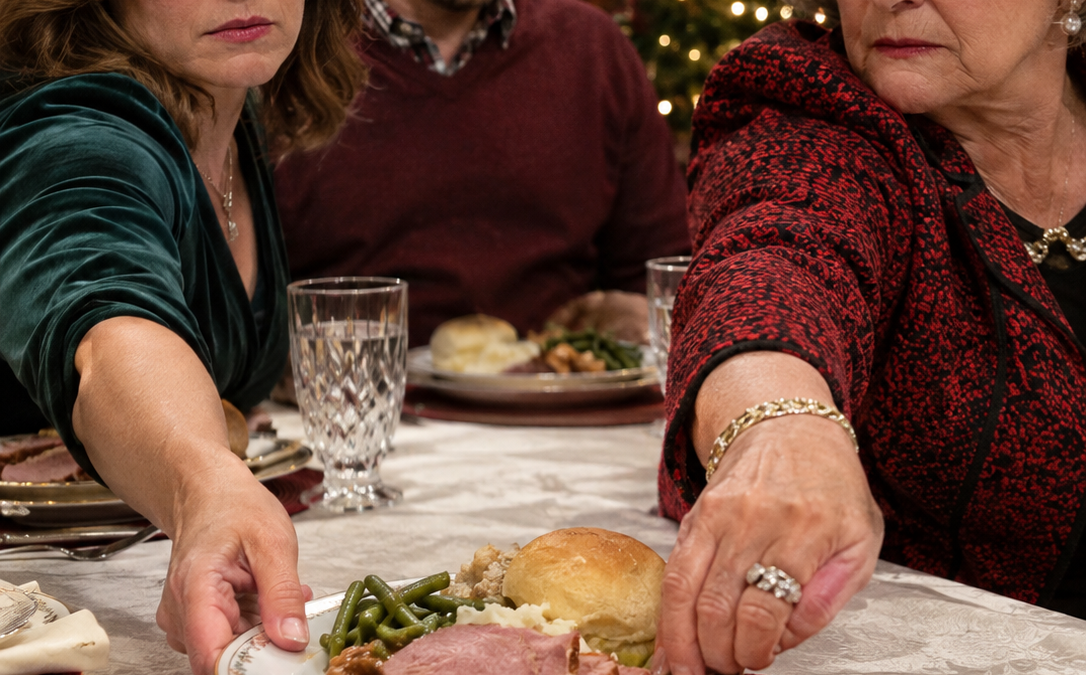
She had set out red place mats, folded green napkins, water glasses, and her good white dishes with the thin gold rims.
Bonita carried the plates herself.
One for Paisley.
One for Chad.
One for me.
Then she walked right past Junie.
Junie looked down at her place mat.
“Grandma?”
Bonita kept moving.
“Plates are for grandkids who behave.”
Nobody reached for a serving spoon.
I looked at Chad.
He stared at his empty water glass.
“Then we’re leaving,” I said.
Bonita put down the last plate.
“There’s no reason to turn this into a scene, Lindsay.”
I picked up my plate and slid it across the table to Junie.
“Eat.”
Junie’s hands had been folded together on the bare red place mat. She pulled them into her lap.
Before the plate reached her, Bonita stepped over and lifted it away.
“That’s yours, Lindsay. You behaved.”
Paisley sat beside Junie with ham already on her plate.
She looked miserable now, her eyes swollen from crying.
Junie stared at the slice of ham in front of her cousin.
I felt heat climb my neck.
My daughter had spent her Christmas Eve service giving away every dollar she had saved for those coats, and twenty minutes later she was sitting hungry at a family table because she had said the money was hers.
“Put the plate back,” I said.
Bonita set it in front of me.
“No.”
Chad finally looked up.
“Mom.”
Bonita glanced at him.
“Not on Christmas.”
That was what Chad always wanted when his mother pushed too far.
Peace.
Not on Christmas.
Not at Thanksgiving.
Not when somebody was tired.
Not when the family was already together.
There was always a reason to wait.
Bonita sat at the head of the table and picked up her wineglass.
I was reaching for Junie’s coat when Bonita tapped the glass with her fingernail.
“Before we eat, I want to recognize something special.”
Junie stopped beside me.
Bonita smiled at Paisley.
“Thank you to Paisley, who gave $212 to the coat closet from her own piggy bank.”
People clapped.
Paisley looked down.
Someone said, “That’s wonderful.”
Someone else told her she had a generous heart.
My purse hung from the back rail of my chair.
Inside it was the credit union receipt.
$212.00.
December 19, 2026.
I took Junie’s coat from the entry bench.
Nobody stopped clapping quickly enough to make it less ugly.
Junie came to me without saying anything.
I helped her into the coat and pulled the zipper up.
My fingers were shaking, so I missed the bottom catch once.
Bonita stood near the dining room doorway with her wine still in her hand.
“Lindsay, don’t punish everybody because Junie got confused.”
I buttoned the top button under Junie’s chin.
Then I looked at the table.
At Bonita.
At Chad.
Picking up where the Facebook post left off
At all eleven places, including the one where my daughter had been given a place mat but no plate.
“Junie rolled that money at our kitchen table. Merry Christmas.”
Bonita’s smile slipped.
It lasted only a second.
Then her face went smooth again.
“Take her home if that’s what you want.”
I picked up my purse.
Chad stayed in his chair.
That hurt more than I wanted anyone in that room to see.
I had expected him to dislike the argument.
I had expected him to ask me to wait.
I had not expected to walk out with our daughter while he remained at his mother’s Christmas dinner.
Junie held my hand all the way to the front door.
Outside, the cold hit hard enough to sting my nose.
I opened the passenger-side back door and helped her into the car.
She climbed onto the seat and pulled her coat close around herself.
I buckled her in.
“Are you hungry?”
She nodded.
“We’ll get you something.”
I closed her door, crossed behind the car, and got in up front.
For the first few blocks, Junie watched the Christmas lights through the window.
Then she said, “Mom?”
“Yeah?”
“I wrote my name on the back.”
I glanced at her in the mirror.
“On the envelope?”
She nodded.
“In pencil. From Junie K. And my age.”
My hands tightened on the steering wheel.
“Did Grandma see you write it?”
“I don’t know.”
That question stayed with me all the way home.
Did anyone else see whose envelope it was?
At 9:14 that night, my phone buzzed on the kitchen counter.
The family chat.
Bonita had posted a photo from 5:55 p.m., taken after the children’s service.
The manger basket was full of fourteen envelopes.
Right on top was a snowman drawn in black marker, with red mittens and a little dog beside him.
Junie’s snowman.
Bonita had added one line under the picture.
Paisley’s $212!! So proud.
Chapter 2: The Text About the Messy Snowman
Christmas morning, I had Bonita’s photo open before Chad finished his coffee.
Junie was still asleep upstairs.
I sat across from him at our kitchen table and enlarged the picture until the top envelope filled most of my phone screen.
“Look.”
Chad leaned closer.
The snowman had red mittens.
Beside him was the little dog Junie always drew with one ear bigger than the other.
“That’s hers,” I said.
Chad rubbed a hand over his face.
“I know what it looks like.”
“It looks like Junie’s envelope because it is Junie’s envelope.”
He stared at the screen.
We had come home the night before without him. Chad arrived almost an hour later, carrying the gifts we had left under Bonita’s tree.
He had apologized for staying.
He had not said his mother was wrong.
That difference had kept me awake.
I set the phone between us.
“Paisley said Grandma told her the $212 was hers before dinner. Then your mother thanked her for it in front of everybody. Now she’s posting Junie’s envelope with Paisley’s name under it.”
Chad looked toward the stairs.
“Keep your voice down.”
I counted to three.
“Junie already heard enough.”
He picked up his coffee.
“What do you want me to do this morning?”
“I want you to look at what’s right in front of you.”
He didn’t answer.
So I went looking for something harder to ignore.
I opened our message thread with Bonita and scrolled backward.
December 24.
December 23.
December 21.
Then I found Sunday, December 20.
12:15 p.m.
Bonita had sent the same message to Chad and me.
I turned the phone toward him.
Junie showed me her snowman envelope. Messy. A nice card is more respectful.
Chad stopped moving.
“There.”
He read the message without touching the phone.
“She saw it four days ago,” I said. “She knew Junie made a snowman envelope.”
“She could say there was more than one.”
“With red mittens and that dog?”
“Lindsay.”
“No. Don’t do that.”
He looked up.
“Do what?”
“Say my name like I’m the problem you’re trying to calm down.”
His mouth tightened.
I hated fighting with Chad.
He was usually the person who could pull me out of my own temper. He would tell me to count. I would tell him he was annoying. Then one of us would make coffee.
But his mother had denied our daughter dinner on Christmas Eve.
She had taken Junie’s $212 and praised another child for giving it.
And Chad was still trying to find a version that required nobody to confront Bonita.
My phone rang.
His did too, half a second later.
Bonita.
She was calling Chad.
He looked at me before answering.
“Hi, Mom.”
Her voice was loud enough that I heard it from across the table.
“Your wife is teaching that child to lie in God’s house.”
Chad closed his eyes.
I waited.
Bonita kept talking, too fast for me to catch every word.
Then Chad said, “Okay, Mom.”
Just that.
Okay, Mom.
My hands went flat against the table.
He ended the call a minute later.
I looked at him.
“You said okay.”
“I was ending the conversation.”
“You agreed with her.”
“I didn’t agree.”
“You didn’t disagree.”
He stood and carried his mug to the sink.
“Not today, Lindsay.”
Christmas morning.
Another reason to wait.
I picked up my phone.
“Fine.”
He turned.
“What are you doing?”
“I’m finding out when the church office opens.”
Hope Valley Lutheran’s website had a holiday notice across the top.
The church office was closed from December 25 through January 2.
Pastor Keith Sedlacek was out of state.
Tucson, according to the note under the Christmas schedule.
The next office day was Sunday, January 3.
Nine days away.
I stared at the dates.
Bonita had counted the Mission Fund basket.
Bonita had chaired that fund for eleven years.
If there was a record of what had been inside those envelopes, I couldn’t walk into the office and ask for it.
Not yet.
Chad came back to the table.
“Can we please give this a few days?”
“No.”
“Mom’s angry.”
“So am I.”
“She’ll cool down.”
“That doesn’t change whose money it was.”
He sat again.
I opened my email.
“What are you writing?”
“To Pastor Keith.”
“On Christmas?”
“He can read it when he’s back.”
Chad leaned back in his chair.
“You’re turning this into a church issue.”
“Your mother already did that when she credited the donation.”
I kept the email short.
I said Junie had donated $212 at the children’s service on Christmas Eve in a hand-drawn snowman envelope.
I said another child had been publicly credited for the gift.
I attached the December 19 credit union receipt.
Then I attached Bonita’s 5:55 photo.
I did not accuse Bonita of stealing.
I did not write about the empty plate.
I did not write about Christmas dinner at all.
I asked one question.
Was there a written count from the Mission Fund basket?
Before I sent it, I showed Chad.
He read the screen.
“You’re really doing this.”
“Yes.”
“Mom’s going to lose it.”
“She already told our daughter she didn’t deserve a plate.”
His eyes dropped.
That finally quieted him.
I sent the email.
For the rest of Christmas morning, I tried to make the house feel normal for Junie.
She came downstairs in flannel pajamas and opened her gifts.
She ate cinnamon toast at the coffee table.
She drew a scarf on a cardboard reindeer and forgot, for twenty minutes at a time, that Christmas Eve had happened.
I wanted those twenty minutes for her.
My phone stayed face down.
By noon, I had started wondering whether Bonita’s count had already been filed somewhere.
What did she write when she counted?
Did she write Paisley’s name?
Did she write Junie’s?
Did she record the bills?
Or had she simply moved a number from one child to another and expected nobody to ask?
At 1:08 p.m., my phone vibrated.
A text from Bonita.
I opened it.
Junie’s envelope came in empty. Don’t make her lie twice.
Chapter 3: The Sheet With One Signature
By Sunday, December 27, I had Bonita’s photo, her December 20 snowman text, and the Christmas Day message claiming Junie’s envelope had been empty.
What I did not have was the count itself.
At 10:17 that morning, Bonita supplied it.
She posted a photograph to the family chat with one line above it.
Record year! $1,486!
The picture showed a white Mission Fund count sheet on Bonita’s dining room table.
I was standing at our kitchen counter when it came through.
Junie was at the table behind me with a box of markers spread around her elbows. Chad had gone out to clear the thin crust of snow from the driveway.
I enlarged the photograph.
At the top, in Bonita’s handwriting, was the date.
December 24, 2026.
Below that:
Envelopes 14 — empty 0.
I stopped.
Then I opened Bonita’s Christmas Day text in another window.
Junie’s envelope came in empty. Don’t make her lie twice.
I looked back at the count sheet.
Empty 0.
I took a screenshot before Bonita could delete anything.
Then I kept reading.
The sheet listed donations by name and amount.
There was no Junie Kucera.
No Junie K.
Nothing close.
Then I found Paisley.
Paisley M. — $212 — 2 × $100, 1 × $10, 2 × $1.
I stood there so long that Junie looked up.
“Mom?”
“I’m okay.”
She gave me the look children give adults when they know that answer is incomplete.
I opened my purse and took out the credit union receipt.
December 19, 2026.
$212.00.
I had folded it once and kept it in the small zipper pocket because Junie had been proud of doing the exchange herself.
I laid it beside my phone.
Two hundred-dollar bills.
One ten.
Two ones.
The same amount.
The same bills.
There were no fives on Bonita’s sheet.
No twenties.
No fifty.
No loose change making up the difference.
It was exactly what the credit union had handed Junie.
Chad came in through the back door, stomping snow from his boots.
“You need to see this.”
He took off his gloves.
“What?”
I pointed to the phone.
He came over.
I enlarged the line again.
“Read the top first.”
He did.
His face changed.
“Empty zero,” I said.
He did not answer.
“Now read Paisley’s line.”
He leaned closer.
“Two hundreds, one ten, two ones.”
I set Junie’s receipt beside the phone.
Chad looked from one to the other.
“That’s what they gave her,” he said.
“Yes.”
He ran one finger slowly across the receipt’s folded edge.
For several seconds, neither of us spoke.
Then he asked, “Is Mom the one who filled this out?”
“Look at the bottom.”
The page had two spaces.
Counter One.
Counter Two.
Bonita’s name and signature were on the first line.
The second line was blank.
Chad stared at it.
“She counted alone?”
“That’s what this shows.”
He pulled out a chair.
I could tell he wanted to find some harmless explanation.
That was what Chad did when family conflict started. He searched for the version where nobody meant what they had clearly done.
“Maybe somebody else was there and forgot to sign.”
“Maybe.”
I said it because I did not know yet.
I wasn’t going to claim more than I could prove.
But I knew what was on the page.
Fourteen envelopes.
Zero empty.
$212 under Paisley.
No Junie.
One signature.
Junie slid out of her chair and came over carrying a sheet of printer paper.
“I made another one.”
She held it up.
A snowman.
The first thing she had drawn was the mittens.
Red, rounded, uneven.
Then the body.
Then the little dog with the oversized ear.
I looked at her.
“Did you always draw the mittens first?”
She nodded.
“You have to, or his arms look funny.”
Chad looked down at the drawing.
Junie set it beside the receipt.
“I made the church one better.”
“Better how?” I asked.
“The dog had a collar.”
I remembered that.
A blue collar, crooked across its neck.
I had watched her draw it at our kitchen table on December 20.
Bonita had seen it too.
Her own text proved that.
Junie went back to her markers.
Chad lowered his voice.
“What are you going to do?”
“I’m keeping everything.”
“For Pastor Keith?”
“For whoever needs to see it.”
He flinched a little at that.
I knew what he heard.
A record.
A challenge.
His mother being questioned by someone other than me.
That was the price of not letting Christmas Eve disappear into family history as another thing nobody was supposed to mention.
I picked up my phone again.
The family chat had filled with congratulations.
People praised Bonita for another successful year.
Someone sent three clapping emojis.
Someone else wrote that Hope Valley was lucky to have her.
Who believes a credit union receipt over the woman who has counted the basket for eleven years?
That question sat in my head longer than I liked.
Then I looked at Bonita’s own count sheet again.
I didn’t need anybody to take my word for it.
She had written the contradiction herself.
Monday morning, December 28, I brought the receipt to work with me.
Between patients, I opened the family chat on my phone.
I took screenshots of Bonita’s three messages.
The December 20 text about Junie’s messy snowman envelope.
The Christmas Day text claiming it came in empty.
The December 27 count sheet showing zero empty envelopes and Paisley’s $212 in the exact bills Junie had received.
I sent the screenshots to my work email.
Then I printed them.
Three pages came out of the printer in the staff room.
I put the receipt on top.
Folded everything into a plain manila folder.
And wrote one name across the tab.
Pastor Keith.
Chapter 4: The Award With the Wrong Name
By Wednesday, December 30, I had a manila folder full of things Bonita had written herself.
What I did not have was anyone at Hope Valley who could act on them.
The church office was still closed.
Pastor Keith was still in Tucson.
Then the church newsletter arrived in my email at 8:06 that morning.
I opened it while Junie sat at the kitchen table drawing another snowman.
Halfway down the page was Paisley’s picture.
Under it, in larger type, were the words:
Little Shepherd Award to Paisley Mohr, $212, presented at our Epiphany party.
I stopped scrolling.
The Epiphany party was January 6.
Three days after Pastor Keith returned.
They were going to put a framed award in Paisley’s hands in front of the church and thank her for Junie’s money.
Junie noticed I had gone still.
“What?”
“Nothing you need to worry about right now.”
She leaned sideways, trying to see my screen.
I closed the laptop halfway.
Junie frowned.
“Is it Grandma?”
I counted before I answered.
“One. Two. Three.”
Then I opened the laptop again and turned it toward her.
“I’m not hiding things from you.”
Paisley’s school picture was right there beside the announcement.
Junie read slowly.
She knew every word except “Shepherd.”
I helped her with that one.
When she finished, her pencil stopped moving.
The snowman on her paper had two red mittens and no face yet.
Junie stared at the newsletter.
“Maybe I put it in wrong.”
My chest tightened.
“What do you mean?”
“Maybe I put my envelope in the wrong basket.”
“You put it in right. I watched.”
She looked at me.
“You did?”
“Yes.”
I moved my chair closer.
“I watched you carry it up at the children’s service. I watched you put it in the manger basket.”
Junie looked back at her drawing.
“Then why does it say Paisley?”
“I don’t know yet.”
That was the part I refused to pretend I understood.
I knew what Bonita had posted.
I knew what the receipt showed.
I knew Bonita had texted four days before Christmas that she had seen Junie’s snowman envelope.
But I did not know what had happened between the moment Junie placed that envelope in the basket and the moment Bonita wrote Paisley’s name beside $212.
Junie picked up the red marker again.
She didn’t draw.
“Is Paisley in trouble?”
“No.”
“Because she said it was hers.”
“She’s nine.”
Junie thought about that.
“So Grandma’s in trouble?”
“I didn’t say that either.”
She looked annoyed.
Eight-year-olds do not appreciate adults who insist on being exact.
I touched the edge of her paper.
“What I’m saying is that you know what you did. Don’t change your memory because somebody older says something different.”
Junie finally added the snowman’s face.
I went back to the newsletter.
The announcement said the award would be presented at the Epiphany party at 6 p.m.
I took a screenshot and added it to the folder I had started at work.
Then I checked my email.
There was a reply from Pastor Keith.
The message had come in twelve minutes earlier.
Back Saturday. Sunday after second service. Bring what you have.
That was all.
No promise.
No opinion.
No sentence saying he believed me.
I liked that more than I expected.
He had been Hope Valley’s pastor only since September. I did not know him well enough to know whether he would challenge Bonita, and Bonita had chaired the Mission Fund for eleven years.
But he had given me a time.
Sunday, January 3.
Three days before the Epiphany party.
I showed Chad the email that evening when he got home.
He stood at the kitchen counter with his work bag still over one shoulder.
“So you’re meeting him Sunday.”
“Yes.”
“With Junie?”
“Yes.”
Chad set the bag down.
“Does she need to be there?”
“She made the envelope.”
“She’s eight.”
“Which is why I’m not making her explain this alone.”
He looked toward the living room, where Junie was watching television.
“I don’t want her stuck in the middle.”
“She’s already in the middle.”
He rubbed his forehead.
I kept my voice low.
“She thinks she might have put the envelope in the wrong place now.”
That got him.
His hand dropped.
“She said that?”
“This morning.”
Chad looked toward the living room again.
“What did you tell her?”
“That I watched her put it in the basket.”
He nodded once.
Then he moved to the table and lowered himself into a chair.
“What can Keith actually do?”
“I don’t know.”
That question had been sitting with me too.
What could the pastor do that I couldn’t?
He could see whatever records the church kept.
He could ask who counted.
He could look at the policy behind those two signature lines.
And maybe, if Bonita had turned Junie’s gift into Paisley’s award, he could stop the church from putting that certificate in Paisley’s hands.
I did not say all of that to Chad.
I simply said, “He can look at the church’s own records.”
Chad nodded.
For once, he did not ask me to wait.
That night, I put the printed newsletter announcement into the manila folder behind the receipt.
The folder was getting thicker.
Receipt.
Snowman text.
Christmas Day accusation.
Count sheet.
Newsletter.
I closed it and set it on top of the refrigerator, where Junie would not pull it down looking for drawing paper.
At 9:32 p.m., my phone buzzed.
Bonita.
I opened the message.
Embarrass Paisley at that party and you never sit at my table again.
Chapter 5: The Pastor Who Kept the Envelopes
On Sunday, January 3, I carried the manila folder into Pastor Keith’s office believing Junie’s envelope was gone.
Bonita had said it came in empty.
The photograph showed it on top of the basket.
The count sheet put the $212 under Paisley’s name.
But once the money was removed, I had assumed the envelope itself had been thrown away.
Junie sat beside me in a wooden chair with her hands tucked under her legs.
Pastor Keith sat behind his desk.
He had gotten back from Tucson the day before and still looked tired from traveling, but he did not rush us.
“Show me what you brought,” he said.
I opened the folder.
First, the December 19 credit union receipt.
$212.00.
Then Bonita’s 5:55 p.m. Christmas Eve photograph of the Mission Fund basket.
I enlarged the snowman envelope on my phone.
Red mittens.
The little dog.
Then I showed him the December 20 text.
Junie showed me her snowman envelope. Messy. A nice card is more respectful.
Pastor Keith wrote something on a yellow legal pad.
Next came the Christmas Day message.
Junie’s envelope came in empty. Don’t make her lie twice.
He stopped writing.
Then I gave him the screenshot of Bonita’s count sheet.
Envelopes 14 — empty 0.
And farther down:
Paisley M. — $212 — 2 × $100, 1 × $10, 2 × $1.
“No Junie line,” I said.
“I see that.”
I placed the credit union receipt beside the screenshot.
“The same bills.”
Pastor Keith looked at the receipt, then at the count sheet.
He did not tell me what he thought.
Instead, he asked Junie, “Did you decorate your envelope yourself?”
Junie nodded.
“With a snowman?”
“And a dog.”
“Anything else?”
She looked at me.
I kept quiet.
“The mittens were red,” she said. “And the dog had a blue collar.”
Pastor Keith nodded.
Then he pushed his chair back.
“I need to show you something.”
He opened the wide bottom drawer on the right side of his desk.
Inside was a stack of envelopes.
Bright marker.
Crayon.
Stickers.
Snowmen, stars, trees, sheep, candy canes.
Fourteen of them.
I stared.
“You kept them?”
“I pulled them out of the office recycling around seven on Christmas Eve.”
“Why?”
“For the Epiphany slideshow. We planned to photograph each child’s envelope and put the names up during the party.”
My throat tightened.
I had spent more than a week thinking the one thing that could settle this had been destroyed.
Pastor Keith set the envelopes on his desk.
Junie stood.
“Can I look?”
“Yes.”
She went through them carefully.
A green Christmas tree.
A purple star.
A red church door.
Then her fingers stopped.
“That one.”
She pulled out a white envelope.
The snowman had red mittens.
Beside him was the dog with the crooked blue collar.
Junie smiled for half a second.
Then she turned the envelope over.
Pencil writing covered the back.
Her handwriting was uneven and large.
From Junie K., age 8. $212. For coats.
Nobody spoke.
I looked at Chad.
He had come with us after all, though he had said almost nothing since we entered the office.
His eyes stayed on the envelope.
Junie touched the pencil words with one finger.
“I told you I wrote it.”
“Yes,” I said.
My voice came out rough.
“You did.”
Pastor Keith took the envelope gently and laid it beside the receipt.
Then he stood.
“The original count sheet is in the church safe.”
He left the office and returned a few minutes later with the Mission Fund binder and a single sheet inside a clear sleeve.
It was the same page Bonita had photographed.
Only this time I could see the bottom clearly.
Counter One: Bonita Kucera.
Her signature.
Counter Two:
Blank.
Pastor Keith opened the binder to a printed policy page.
He pointed to one paragraph.
“All Mission Fund cash gifts are supposed to be counted by two people, with both counters signing the final sheet.”
Chad leaned closer.
“So Mom wasn’t supposed to count alone.”
“No.”
“Does that mean the count is invalid?”
Pastor Keith chose his words carefully.
“It means the procedure was not followed.”
I appreciated that.
No speech.
No accusation.
Just the rule.
He wrote down the envelope wording exactly.
Then he took a photograph of the front and back.
“I’m going to call Bonita tomorrow.”
My stomach tightened.
“What are you going to say?”
“That the church has the envelope. That the record needs to be corrected before Wednesday.”
“And the award?”
“If the count is corrected, the announcement can be corrected.”
Junie looked up.
“Does Paisley still get the picture?”
Pastor Keith smiled slightly.
“We’ll worry about the right name first.”
Monday afternoon, he called me.
I was between patients at work when my phone rang.
“Lindsay, it’s Keith.”
I stepped into the staff room.
“How did it go?”
“I spoke with Bonita.”
I waited.
“She said her count was accurate.”
“After you told her you had the envelope?”
“Yes.”
I closed my eyes.
Pastor Keith continued.
“I asked her to correct the record privately before the Epiphany party.”
“And?”
“She declined.”
My hand tightened around the phone.
A minute later, he forwarded me the text Bonita had sent after their call.
My count is correct. Junie’s envelope came in empty. Present as planned.
I stared at the screen.
She knew the envelope existed.
She knew Junie’s name was on it.
She knew the back said $212.
And she still wanted the certificate presented to Paisley.
Will Bonita hand Paisley that certificate in front of everyone?
That question stayed with me for the rest of Monday.
Tuesday evening, Pastor Keith called once more.
“The party is still on,” he said.
“So is the award?”
“The program stays as printed.”
I felt sick.
Then his voice changed.
Plain.
Certain.
“Then the slideshow runs. I read every name on every envelope.”
Chapter 6: The Certificate in the Fellowship Hall
At 6 p.m. on Wednesday, January 6, Bonita stood behind the microphone in Hope Valley Lutheran’s fellowship hall with a framed certificate in both hands.
Paisley stood beside her.
There were about 120 people in the room.
Junie sat between Chad and me at one of the long tables near the middle.
Pastor Keith stood off to the side with a laptop connected to the projector.
Bonita smiled at the room.
“Paisley saved every penny of that $212 herself.”
Applause started around us.
Junie’s hand moved under the table until it found mine.
I held it.
Bonita looked toward Paisley.
“This is what we want our children to learn. Generosity. Sacrifice. Thinking of others.”
Paisley stared at the certificate.
She did not smile.
I looked at Chad.
His jaw was tight.
Since Sunday, he had seen Junie’s envelope with his own eyes.
He had seen her name on the back.
He had seen the count sheet with his mother’s single signature.
But he still had not said what I needed him to say to Bonita.
Not yet.
Pastor Keith stepped toward the microphone.
“Before we present the certificate, we have the Epiphany slideshow.”
Bonita’s expression changed.
Only slightly.
She handed the microphone over.
Pastor Keith clicked the remote.
The first envelope appeared on the screen behind him.
A Christmas tree in green marker.
He read the child’s first name and the amount written on the back.
Then another envelope.
A star.
Another.
A lamb.
Each one filled the screen for several seconds.
Each child’s name was read.
Parents smiled.
Children pointed when their artwork appeared.
Bonita remained beside Paisley with the framed certificate held against her waist.
Then the snowman came up.
I heard Junie inhale.
Red mittens.
The little dog beside him.
The crooked blue collar.
The picture was clear enough that nobody in the hall could mistake what they were looking at.
Pastor Keith did not hurry.
He reached to the table beside the laptop and picked up the actual envelope.
“This is the original.”
Bonita’s mouth tightened.
Pastor Keith held it up.
“On the back, in pencil, it says: ‘From Junie K., age 8. $212. For coats.’”
The room changed.
People stopped whispering.
Several heads turned toward us.
Junie shrank closer to my side.
I squeezed her hand once.
Bonita stepped toward the microphone.
“Paisley drew that snowman. Junie copies her.”
A few people looked at Paisley.
Paisley stared at the floor.
Pastor Keith kept the envelope in his hand.
I picked up my phone.
My fingers were steady.
I opened the December 20 message and stood.
“Pastor.”
He looked at me.
I held up the screen.
“This was sent to Chad and me on December 20.”
Bonita’s eyes went straight to my phone.
I read the message.
“Junie showed me her snowman envelope. Messy. A nice card is more respectful.”
A woman at the table behind us whispered something to her husband.
Bonita moved closer to the microphone.
“Children swap envelopes all the time, Pastor. I wrote what I was told.”
Pastor Keith looked at her.
“Who told you?”
Bonita did not answer that question.
Instead, she turned toward the room.
Her voice sharpened.
“Junie’s envelope came in empty. That child gave nothing.”
Junie’s fingers went rigid in mine.
I stood so fast my chair scraped the floor.
Chad caught my wrist lightly.
“Lindsay.”
I looked at him.
He let go.
I counted.
One.
Two.
Three.
Then I sat again.
Pastor Keith still held the envelope.
He glanced toward the laptop.
“Bonita, you sent Lindsay that same claim on Christmas Day.”
Bonita crossed her arms.
“Because it was true.”
“No,” I said.
She looked at me.
I held up the credit union receipt.
“December 19. $212.”
Bonita gave a short shake of her head.
“A receipt proves you had money. It doesn’t prove what went in that envelope.”
She had an answer for everything.
That was what made her good at this.
She never needed the answer to fit the last thing she had said.
She just needed it to last long enough for everybody else to get uncomfortable and move on.
For eleven years, apparently, that had worked.
Nobody in the hall clapped now.
Paisley stood beside Bonita with her arms hanging at her sides.
The framed certificate was still in Bonita’s hand.
I kept thinking about Christmas Eve.
Junie’s bare red place mat.
Paisley eating ham beside her.
Bonita lifting my plate away before Junie could touch it.
And Chad sitting there saying almost nothing.
Who in the family would speak first now?
I looked at him again.
His eyes were on his mother.
Pastor Keith returned to the laptop.
“I also want to show everyone the count record from Christmas Eve.”
Bonita’s head snapped toward him.
“That is not appropriate.”
“It is the church’s record.”
He clicked once.
The Mission Fund count sheet appeared on the screen.
The photograph filled the wall.
December 24, 2026.
Fourteen envelopes.
The list of gifts.
Paisley M. beside $212.
No line for Junie.
At the bottom, Bonita’s signature stood alone.
The second counter’s line was blank.
People leaned forward.
Pastor Keith pointed at the top line.
His voice stayed even.
“Your Christmas Day message said Junie’s envelope came in empty.”
Bonita said nothing.
He pointed to the count sheet.
“Empty: zero.”
Then he looked at her.
“Your hand, Bonita.”
Chapter 7: The Line Nobody Signed
“Eleven years I’ve counted that basket. I don’t make mistakes.”
Bonita said it into the microphone while her own count sheet covered the wall behind her.
One signature.
Fourteen envelopes.
Empty: zero.
Paisley’s name beside $212.
No Junie.
For a few seconds, nobody in the fellowship hall moved.
Then Paisley reached up and tugged Bonita’s sleeve.
Bonita looked down.
“Grandma, my envelope’s still in Mom’s car.”
The words were quiet, but the microphone caught them.
Bonita’s face went still.
Paisley looked toward the tables.
“Mom said I forgot it.”
People began turning toward Paisley’s mother.
She was sitting three tables away, one hand pressed against her mouth.
“Paisley,” Bonita said sharply.
“But it is.”
Paisley looked frightened now.
“I didn’t bring it inside.”
Junie squeezed my fingers.
I looked at Chad.
He had spent years trying to keep peace with Bonita.
Christmas Eve had shown me exactly how far he would go to avoid a fight. He had watched his mother leave our daughter without a plate. He had heard her call Junie a liar.
He had answered, “Okay, Mom.”
Now he pushed his chair back.
The legs scraped loudly across the floor.
Bonita looked at him.
“Chad.”
He stood.
His face had gone pale.
He pulled his phone from his pocket.
“Mom.”
“Sit down.”
He didn’t.
I had never seen him disobey her that plainly.
He opened the message thread.
“I was driving, Mom. You sent this to us both.”
Bonita’s hand tightened around the framed certificate.
Chad read aloud.
“Junie showed me her snowman envelope. Messy. A nice card is more respectful.”
Nobody interrupted him.
When he finished, he kept the phone raised.
“You knew what her envelope looked like four days before Christmas.”
Bonita stared at him.
“Chad, this is family business.”
“No.”
His voice was low.
“This is Junie.”
That hurt me in a different way from Christmas Eve.
He should have said it then.
I knew he knew that.
From the way he looked at Junie, I could tell he knew it too.
Pastor Keith stepped closer to Bonita.
“The certificate can’t be presented as written.”
Bonita looked down at it.
Her name was not on the frame.
Paisley’s was.
That had mattered enough for all of this.
Bonita held it for another few seconds.
Then she handed it to Pastor Keith.
He took it without comment.
A woman near the front stood.
I knew her as the council president, though I had never spoken with her beyond Sunday-morning greetings.
She looked at Pastor Keith first.
Then at Bonita.
“Our counting policy requires two counters and two signatures.”
Bonita lifted her chin.
“I have chaired that fund for eleven years.”
“And the policy still requires two.”
“I’ve never needed someone looking over my shoulder.”
“This sheet has only your signature.”
The Mission Fund binder was sitting on the table beside the laptop.
Bonita glanced at it.
The council president held out her hand.
“The binder, please.”
Bonita did not move.
“The council can address this formally Sunday,” the woman continued. “Until then, I’m taking custody of the Mission Fund records.”
Bonita’s cheeks had gone red.
“You’re taking my ministry away over a child’s drawing?”
“No.”
The council president pointed toward the projected sheet.
“I’m taking the binder because the required second signature is missing.”
Bonita looked around the room.
I wondered what she expected to find.
Someone willing to rescue her.
A relative willing to say Junie had made a mistake.
A church member willing to laugh it off.
Nobody did.
She picked up the binder.
Then she reached into her purse.
A small brass key came out with her hand.
She placed the binder and key in the council president’s open palm.
The woman closed her fingers around the key.
Bonita stepped away from the microphone.
Junie leaned toward me.
“Is Grandma leaving?”
“I don’t know.”
That was the question everyone seemed to be waiting on.
What did Bonita do now that everybody had seen?
She could apologize.
She could correct Paisley’s award.
She could tell Junie she was sorry for calling her a liar.
Instead, Bonita looked at Chad.
“You chose this.”
Chad’s mouth tightened.
“I chose my daughter.”
Bonita looked at me next.
I stood.
I did not want a speech.
I had spent almost two weeks collecting receipts and screenshots because Bonita had depended on everybody else being too uncomfortable to put them side by side.
The envelope had done more than any argument could.
Her name.
Her age.
The amount.
Junie had written all of it before anybody had a reason to fight about it.
Bonita picked up her purse.
I said, “Her name was on the back, Bonita. Where God could see.”
She stopped.
For one second, I thought she might turn around.
She didn’t.
Bonita walked past Paisley’s mother, past the tables, and through the fellowship hall doors.
Paisley watched her go.
Pastor Keith lowered the microphone.
Someone near the kitchen asked whether the cake should still be brought out.
It was.
Bonita was gone before anyone cut the first piece.
Chapter 8: The Correction in the Newsletter
On Sunday, January 10, Bonita still had one thing left from the Epiphany party.
Her title.
She had handed over the Mission Fund binder and key in front of 120 people, but the council had not yet voted on whether she would remain chair.
That happened after second service.
Chad and I did not sit in the meeting.
Pastor Keith had told us the council already had what it needed: the original count sheet, the written two-counter policy, Bonita’s messages, the envelope, and the photograph she had posted herself.
Junie and I waited in the fellowship hall.
She sat at a long table drawing coats on the back of an old bulletin.
At 12:18 p.m., Pastor Keith came through the doors.
Chad stood beside me.
Pastor Keith did not drag it out.
“The council voted to remove Bonita as Mission Fund chair.”
Chad looked down.
I asked, “And the counting?”
“She’s been removed from the counting list as well.”
Junie kept drawing.
I watched Chad’s face.
He had wanted peace with his mother for as long as I had known him.
Now there was no way to pretend the whole thing had stayed inside the family.
His mother had lost the position she had held for eleven years.
I touched his arm.
“You okay?”
He nodded once.
“No.”
That was probably the most honest answer either of us could have given.
Pastor Keith pulled a folded sheet from the folder in his hand.
“There’s one more thing.”
He opened it.
It was the draft for the next church newsletter.
Near the top was a short correction.
Correction: the $212 gift was given by Junie Kucera, age 8.
I read the sentence slowly.
No Paisley.
No careful wording that made the whole thing sound like a misunderstanding.
Junie’s name.
Her age.
Her gift.
I crouched beside her.
“Want to see something?”
She put down her marker.
I showed her the sentence.
She read it.
Then she looked at Pastor Keith.
“Are you putting that in everybody’s email?”
“Yes.”
“And on the paper ones?”
“Yes.”
She nodded.
“Okay.”
That was all she said.
I had spent two weeks wanting someone with authority to put the truth in writing.
Junie accepted it with one small nod and went back to drawing sleeves.
Pastor Keith sat across from her.
“There’s another question.”
Junie looked up.
“The Little Shepherd Award came with a fifty-dollar gift for the child who received it.”
She glanced at me.
I stayed quiet.
“The certificate was written for Paisley,” he said, “but the council wants to correct that too. The award belongs to you.”
Junie frowned.
“Fifty dollars?”
“Yes.”
“For me?”
“Yes.”
She looked at the paper where she had drawn three coats.
“What was the money supposed to be for?”
“Whatever the award recipient chose.”
Junie thought for several seconds.
Then she pointed to the drawing.
“Can it buy coats?”
Pastor Keith smiled.
“It can.”
“How many?”
He considered it.
“Probably two.”
Junie pushed the bulletin toward him.
“Then buy two more coats.”
My throat tightened.
“You don’t want the fifty dollars?”
She shook her head.
“I already gave money for coats.”
Chad looked away.
I knew why.
Christmas Eve had started because Junie had given away $212 and then been punished for saying so.
Now she was being offered something back.
And she was giving that away too.
No certificate mattered to her as much as the coats.
Pastor Keith wrote something down.
“Two more coats, then.”
Junie picked up her red marker again.
“Can one be purple?”
“I’ll see what we can do.”
That made her smile.
Later that afternoon, the corrected newsletter went out.
The line looked almost too small for everything it had taken to get there.
Correction: the $212 gift was given by Junie Kucera, age 8.
I printed a copy.
Not because I thought Junie needed proof anymore.
She had already held the best proof in her own hands.
But I wanted the correction kept with everything else.
The receipt.
The snowman text.
The empty-envelope accusation.
The count sheet.
The newsletter with Paisley’s name.
The photograph.
The new correction went on top.
Chad watched me close the folder.
“Are you going to keep all of that forever?”
“For a while.”
He nodded.
Neither of us had heard from Bonita since the Epiphany party.
No call to Junie.
No apology to Paisley.
No message asking whether Junie was all right.
That bothered me more than any angry text would have.
Junie had been called a liar in front of family and church members.
Paisley had been put onstage with an award for money she had never claimed to donate until Bonita told her it was hers.
Both girls deserved an apology.
By dinner, I had started wondering whether Bonita would give one.
And if she did, who would she apologize to first?
At 7:43 p.m., Chad’s phone lit up on the kitchen counter.
He looked at the screen.
“Mom.”
It went to voicemail.
For a while, he didn’t touch it.
Then he pressed play.
Bonita’s voice came through the speaker.
No greeting.
No mention of Junie.
No apology.
“Your wife turned my church against me.”
Chapter 9: The Envelope Left in the Car
Three days after the council meeting, Paisley’s mother came to our house carrying the empty certificate frame.
Paisley was with her.
She held a white envelope against her coat.
Chad opened the door, and his sister stepped inside without taking off her gloves.
“I should have brought this back sooner.”
She handed him the frame.
The printed certificate was gone.
Then she looked at me.
“And this was in my car.”
Paisley held out the envelope.
Her name was written across the front in purple marker.
I looked at her mother.
“She really never brought it inside?”
“No. It was under the passenger seat.”
Paisley opened the flap.
Inside was a five-dollar bill.
“That’s mine,” she said.
“I know.”
She looked toward Junie, who was sitting at the kitchen table.
Junie had stopped coloring.
Paisley walked over.
For a moment, neither girl spoke.
Then Paisley said, “Grandma said yours was mine now.”
Chad went completely still beside me.
Junie frowned.
“What?”
“At Christmas.”
Paisley twisted the envelope between her fingers.
“She said the big one was mine now.”
Her mother closed her eyes.
“Paisley.”
“That’s what she said.”
I counted before I spoke.
“Did Grandma tell you Junie gave the $212?”
Paisley shook her head.
“She said it was mine.”
Junie looked at the five-dollar bill.
“But you had your own.”
Paisley nodded.
“It was in the car.”
There was nothing angry in Junie’s voice.
That made it worse.
Paisley put the five dollars back in her envelope.
“I’m sorry.”
Junie looked at me.
I didn’t answer for her.
Finally she said, “Okay.”
Paisley’s mother took the frame from Chad and set it on our counter.
“I’m sorry too.”
She looked at Junie.
“You should never have been put in that position.”
After they left, Chad stood in the kitchen with both hands on the counter.
“Mom knew Paisley had forgotten hers.”
“We don’t know when she knew.”
He nodded.
I appreciated that he didn’t argue.
He had started being careful with facts too.
Then he looked at me.
“I’m going over there.”
“To your mom’s?”
“Yes.”
I did not ask to go with him.
This part needed to come from Chad.
He had spent years asking everybody else to bend so Bonita would not have to.
If Christmas Eve was going to change, he had to be the one to tell her.
He left that afternoon.
He was gone almost two hours.
When he came back, Junie was upstairs.
I was loading the dishwasher.
Chad took off his coat.
“How bad?”
He leaned against the counter.
“She thinks we’re punishing her.”
“For what?”
“For being embarrassed.”
I shut the dishwasher.
“What did you tell her?”
“That we’re not doing Christmas Eve at her house anymore.”
I waited.
He looked tired.
“I told her next Christmas is somewhere else. Here, my sister’s, wherever. Not there.”
That cost him something.
Christmas Eve at Bonita’s house had been automatic for years.
The same table.
The same dishes.
The same family schedule arranged around what Bonita wanted.
“And Junie?”
“I told her she doesn’t see Junie until she apologizes to Junie.”
I nodded.
“Directly?”
“Yes.”
“No apology to you instead?”
“No.”
“Or me?”
“No.”
He gave a tired half smile.
“I was very specific.”
I reached for his hand.
He held mine.
“I should’ve done it Christmas Eve,” he said.
“Yes.”
He looked at me.
I didn’t soften it.
He nodded once.
“I know.”
Bonita came to our house four days later.
She did not call first.
I saw her through the front window carrying a round tin decorated with painted holly leaves.
Cookies.
Chad was at work.
Junie was upstairs doing homework.
I opened the door but did not step aside.
Bonita lifted the tin.
“I brought these for Junie.”
“Okay.”
She held them toward me.
I took the tin.
Bonita stayed on the porch.
“I assume I’m allowed to give my granddaughter cookies.”
“Yes.”
She waited.
I knew what she expected.
An invitation inside.
Coffee.
A chair.
Some familiar little motion that would let both of us pretend enough time had passed.
Instead, I held the door.
“Did you come to apologize to Junie?”
Bonita’s mouth tightened.
“I came to make peace.”
“That wasn’t my question.”
“Lindsay, I’m trying.”
“So am I.”
Her eyes moved past me toward the dining room.
“You’re really keeping this going?”
“I’m keeping the boundary Chad gave you.”
She folded her arms.
“You’ve won. My church humiliated me. I lost the Mission Fund. Your daughter got her name in the newsletter.”
“Junie didn’t ask for any of that.”
Bonita looked away.
I held the cookie tin against my hip.
“Forgiving you isn’t setting you a place.”
Her face changed.
She understood exactly what I meant.
Christmas Eve.
The red place mat.
No plate.
Bonita stepped back.
“Tell Junie I brought those.”
“I will.”
She left without asking to see her.
That night, Junie ate one cookie after dinner.
Then she got out her markers.
I watched from the sink while she drew a table across a wide sheet of paper.
Long enough for fourteen plates.
She counted each one carefully as she drew.
When she finished, she carried the picture to the refrigerator.
She taped it up herself.
Fourteen plates.
None missing.
Chapter 10: The Plates Junie Set
By Easter Sunday, March 28, Junie had not sat at a family table with Bonita since Christmas Eve.
This time, the table was ours.
At ten that morning, Junie dragged a dining chair across the floor so she could reach the cabinet where we kept the dinner plates.
“I can do it,” she said when I reached to help.
“I know.”
She counted the plates before she took them down.
Then she started setting the table herself.
Paisley’s plate went first.
She carried it carefully to the chair beside hers and centered it on the place mat.
I watched from the kitchen doorway.
Three months earlier, Paisley had eaten ham beside Junie while Junie sat with folded hands and no plate.
Now Junie straightened Paisley’s fork and moved the water glass half an inch.
“Too close,” she said.
“To what?”
“The plate.”
I smiled.
“You’re in charge.”
She nodded seriously.
“I know.”
Chad came in carrying a bowl of potatoes.
He stopped when he saw the table.
“Need help?”
“Nope.”
He looked at me.
I shook my head.
Let her do it.
By then, Hope Valley had settled into a different routine too.
Bonita was no longer Mission Fund chair.
She was no longer on the counting list.
Two people counted every collection now, and both signed the sheet before it went into the binder.
The corrected newsletter still sat in my manila folder.
Correction: the $212 gift was given by Junie Kucera, age 8.
Junie had never asked to see it again.
The fifty dollars that came with the Little Shepherd Award had bought two more coats, just as she requested.
One of them was purple.
And in the church hallway, outside the fellowship hall, Junie’s original snowman envelope hung in a simple frame.
Front visible.
Red mittens.
Little dog with the crooked blue collar.
A small card beneath it gave Junie’s name and said the gift had supported the coat closet.
The back of the envelope was photographed beside it.
From Junie K., age 8. $212. For coats.
The church had asked before displaying it.
Junie said yes.
Then she asked if people could still see the dog.
They could.
At home, we had stopped talking about Christmas Eve every day.
That was progress.
But some things had changed permanently.
Christmas Eve would not be at Bonita’s house anymore.
Chad had not taken that back.
Neither had I.
Bonita had seen Junie once since the cookie visit.
It happened only after she gave Junie the written apology Chad had required.
I did not write it for her.
Chad did not correct it.
Junie read it herself.
Then she carried it upstairs and put it in the drawer of her desk.
She never told me what she planned to do with it.
I never asked.
When I invited Bonita to Easter dinner, the invitation had been simple.
No promises.
No return to the old arrangement.
She could come to our house, sit where we put her, and behave like someone who understood that Junie belonged at the table.
At 12:47 p.m., the doorbell rang.
Junie looked up from the place settings.
“That’s Grandma.”
“Probably.”
Chad opened the door.
Bonita stood on the porch holding a covered dish.
She looked smaller to me than she had at Christmas.
Maybe she wasn’t.
Maybe I had simply stopped arranging myself around her.
“Happy Easter,” Chad said.
“Happy Easter.”
Bonita stepped inside.
She handed me the dish.
“Carrots.”
“Thank you.”
She looked toward Junie.
“Hi, sweetheart.”
Junie looked at her.
“Hi.”
No hug.
No performance.
Bonita did not ask for one.
That mattered.
Paisley and her mother arrived a few minutes later.
Paisley carried her own Easter drawing for Junie.
The girls went straight to the table and started arguing about whether a rabbit should have pink ears or purple ears.
It sounded normal.
I had missed normal.
By one o’clock, food covered the kitchen counter.
Ham.
Potatoes.
Carrots.
Rolls.
Eleven people had fit around Bonita’s Christmas table.
We had fewer at ours that afternoon, but Junie kept checking the places like she was expecting an inspector.
Paisley came over and pointed at her plate.
“You did mine first?”
“Yes.”
“Why?”
Junie shrugged.
“Because I wanted to.”
Paisley accepted that answer.
So did I.
Bonita stood near the window while everyone else found a chair.
She did not head for the end of the table.
She did not tell anybody where to sit.
She waited.
Junie had one plate left in her hands.
I knew whose it was.
So did Chad.
His eyes met mine from across the room.
Neither of us spoke.
Junie carried the plate to the empty place in front of Bonita’s chair.
For one second, I saw Christmas Eve again.
The bare red place mat.
Junie’s hands folded together.
Bonita lifting my plate away.
That’s yours, Lindsay. You behaved.
I remembered walking out with Junie while Chad stayed behind.
I remembered Junie telling me from the back seat that her name was on the envelope.
And I remembered Bonita’s photograph at 9:14 that night, claiming Junie’s snowman belonged to Paisley.
Now Paisley had a plate.
Junie had a plate.
Bonita had one too.
Junie set the last plate down in front of her grandmother.
Bonita looked at it.
Then at Junie.
Junie adjusted the fork so it matched the others.
“Plates are for everybody who comes.”
Bonita lowered herself into the chair she had been given.
Junie walked back to her own place beside Paisley and sat down.
THE END







