My Neighbor Chainsawed My Late Husband’s Maple and Told 30 People It Was Dead—Then a Librarian Signed Up for Three Minutes at City Council
Complete story · 7 chapters · about 33 minutes · ending included
Chapter 1 · Chapter 2 · Chapter 3 · Chapter 4 · Chapter 5 · Chapter 6 · Chapter 7
Chapter 1: The Stump on Cedar Street
At 1:20 on Saturday afternoon, I came home from the library and found forty years of my life cut into rounds across my lawn.
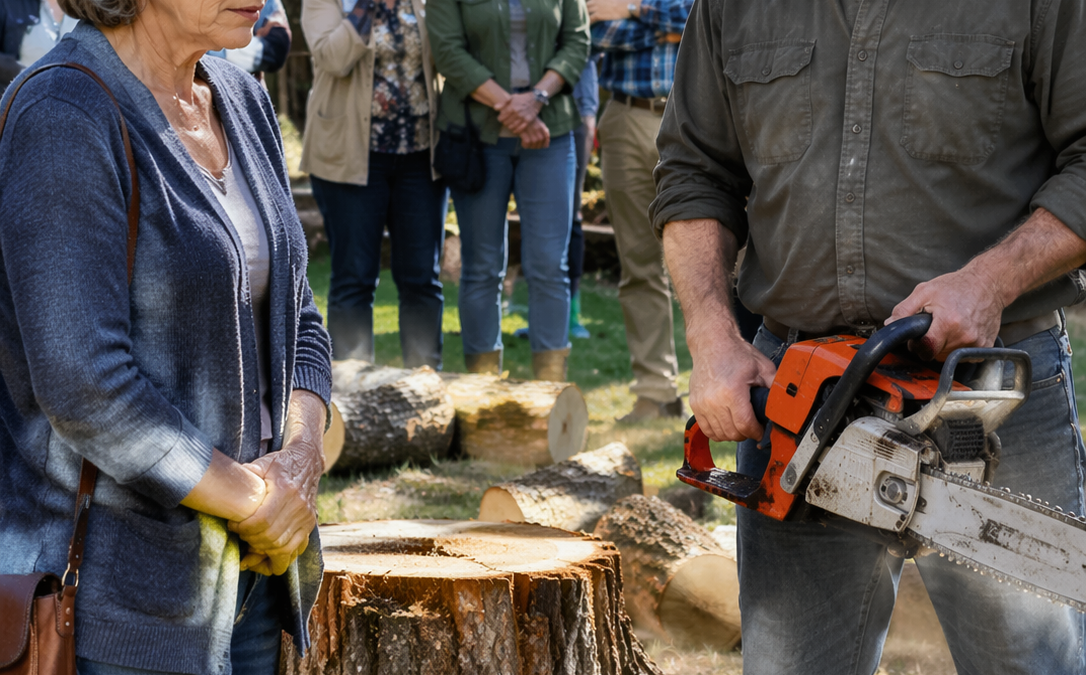
Jeff Norris stood beside the stump with a chainsaw in his hand.
“Pam,” he said, “I took care of that dead maple.”
“No.”
That was all I could get out.
The sugar maple had stood in the middle of my backyard since April 1985, when my husband, Hank, planted it with a shovel that bent at the neck before he finished the hole.
Now the trunk was gone.
By 2:00, thirty people from Jeff’s campaign gathering had crossed over from his new deck. They wore Coffee with Jeff name tags and stared at the stump.
Jeff looked at me, then at them.
“It was a dead tree for a dead man, Pam.”
Nobody told him to stop.
Rounds of pale wood lay across the grass like giant coins. Fresh sawdust covered the ground near the stump. The branches had been dragged toward Jeff’s side of the yard, where his new deck sat uphill from mine.
Leaves were everywhere.
Green leaves.
I had put my library bag down on the back step when I first came home.
Jeff had killed the chainsaw and set it on the grass.
He was fifty-nine and worked as a real estate broker. That fall, his face was also on yard signs all over Alder Bay because he was running for city council.
On his new deck, folding chairs had been arranged around two long tables. A cardboard sign near the stairs said COFFEE WITH JEFF.
Before the guests came down, Jeff had looked at the wreckage of my maple as if he had cleaned up somebody else’s trash.
“You should be thanking me,” he said.
I looked at the stump.
The trunk had been eleven or twelve feet inside my yard. I knew that without measuring. Hank and I had planted shrubs near the property line years ago, and the maple had never been close to it.
“What gave you permission?”
Jeff’s face changed.
Only a little.
The friendly campaign smile disappeared.
“It was dangerous.”
“You came into my yard.”
“I handled a problem before somebody got hurt.”
I stepped around him.
A fresh round was lying flat near the stump, nearly two feet across. Moisture darkened the cut surface.
I touched it with two fingers.
Wet.
Jeff picked up the chainsaw again.
“Your roof will thank me this winter.”
“My roof wasn’t under it.”
He gave me a tired look, as if I were making his afternoon difficult.
Then somebody on his deck called his name.
The smile came back before he turned around.
“There he is!”
Jeff lifted one hand.
“Be right up.”
I stood among the rounds while he carried the chainsaw toward his garage.
At sixty-three, after thirty-one years as a reference librarian, I had developed a habit that annoyed people who preferred loose answers.
I liked dates.
Measurements.
Sources.
If somebody told me a thing was true, my first instinct was usually to ask where it came from.
But I stood there staring at Hank’s maple and could not think of a single question in the right order.
I had stopped looking up much after Hank died.
That was the truth I did not tell anybody.
The yard had become a place I crossed instead of watched. I filled the bird feeder. I cut the grass. I picked up sticks after storms.
I did not stand under that tree the way I used to.
Hank had.
He knew which branch the cardinals liked in winter. He knew where the first buds opened. He could tell from the kitchen window when a squirrel had figured out a new route to the feeder.
After he died in 2023, I put some of his ashes at the maple’s roots.
The rest stayed in an urn inside.
At 2:00, the rest of Jeff’s gathering came down from the deck until thirty people stood in or near my yard, wearing their name tags.
I knew some of them.
A few lived on Cedar Street. Others I recognized from the library, the grocery store, City Hall.
They stared at the stump and the rounds scattered across the grass.
“What happened?” somebody asked.
Jeff had already given them his ugliest answer.
Now he gave them the respectable one.
He raised his voice enough for everybody to hear.
“It was dead, Pam. Hollow to the root. I did you a favor.”
A woman near the front looked at the stump and then at Jeff.
“Good thing you caught it.”
Somebody else murmured, “That could’ve come down on the house.”
A man in a blue name tag thanked Jeff for taking care of it.
Then another voice joined in.
“Very neighborly.”
Jeff gave them the modest smile of a man being praised for something he had not wanted praised.
I could have shouted.
I could have told all thirty people that he had crossed onto my property with a chainsaw.
I could have pointed at the green leaves scattered around their shoes.
Instead, I walked to the stump.
I knelt.
My knees pressed into fresh sawdust.
I put my palm flat against the cut wood.
It was cool and damp.
“Dead wood isn’t wet, Jeff.”
He laughed.
“Grief does funny things.”
Nobody answered me.
One woman looked down at her coffee.
Another gave me the soft face people had been giving me since Hank’s funeral, the expression that said they were willing to forgive almost anything if I was still sad enough.
Jeff had given them an explanation before I had given them proof.
That mattered.
I knew it even while I was kneeling there.
Thirty people had just heard him call the maple dead.
Thirty people had watched him turn cutting it into an act of kindness.
And they had heard him call it a dead tree for a dead man.
I was the widow on the ground with sawdust on my slacks.
I stood.
“I’m going inside.”
Jeff nodded as if that was best for everyone.
I picked up my library bag.
Then I saw something under one of the lower limbs.
Black plastic.
I moved the branch.
Hank’s trail camera lay underneath it.
Or what was left of it.
The housing was crushed on one side. The lens was gone. A jagged piece of plastic hung where the front panel had been.
Hank had strapped that camera to the fence years ago, aimed toward the feeder and the maple.
It did not connect to the internet. It did not send anything to a phone. It recorded video onto a card inside the camera.
I had not touched it since Hank died.
Seeing it broken felt almost worse than I expected.
I picked it up carefully.
A piece of plastic fell into the grass.
Jeff was already walking his guests back toward the deck.
Somebody called after me.
“Pam, do you need help?”
“No.”
That answer came easily.
Inside, I carried the ruined camera upstairs.
At the back of my closet was a shoebox where I had put the small things I had not known what else to do with after Hank died.
His old watch.
A pocketknife.
Two fishing licenses.
The tiny screwdriver he used on his glasses.
I lifted the lid.
Then I put the broken camera inside without examining it.
I closed the box.
Downstairs, voices drifted over from Jeff’s deck.
Thirty people drinking coffee.
Thirty people who had seen a stump and heard a story.
Who was going to believe a widow over the man those people had just thanked?
I stayed inside until the gathering broke up.
Near dusk, I went back outside with a ruler from the library.
It was twelve inches long, clear plastic, with black marks worn faint at one end.
I knelt beside the stump again.
The sawdust had begun to dry.
I placed the ruler across the wood and leaned close.
A sugar maple records its years in rings, each one a line between seasons.
I started at the center.
One.
Two.
Three.
I counted slowly, touching each ring with the edge of the ruler so I would not lose my place.
Fourteen.
Twenty-one.
Thirty-three.
The light faded enough that I had to turn on my phone flashlight.
Thirty-eight.
Thirty-nine.
Forty.
I sat back on my heels.
Hank had planted the tree in 1985.
Forty years.
Exactly where they should have been.
I put my palm on the center of the stump again.
The wood was solid all the way across.
No hollow.
Picking up where the Facebook post left off
Chapter 2: The Officer Who Called It Civil
Sunday morning, I called the police.
The stump was still solid. I knew that much.
What I did not have was proof that the crown had been alive when Jeff cut it, or proof that he had crossed my property line to do it.
An officer came to Cedar Street a little after ten.
He walked the yard with me, looked at the stump, looked toward Jeff’s deck, and wrote while I explained what I had come home to at 1:20 the day before.
Jeff came outside before the officer finished.
He had coffee in one hand.
No campaign crowd now. No name tags.
The officer asked him whether he had cut the maple.
“Yes,” Jeff said. “It was dead and dangerous.”
“Was it on her property?”
Jeff did not hesitate.
“I never crossed her line. That trunk was on my side.”
I looked at him.
“You know that isn’t true.”
Jeff shrugged.
The officer looked from one yard to the other.
There was no fence marking the property line between us, only the old shrubs Hank and I had planted years before.
“You have a survey?” he asked me.
“Not in my hand.”
Jeff smiled.
“I know where my lot ends.”
The officer wrote something else.
Then he told me the part I had already suspected.
“This looks civil.”
Jeff took a drink of coffee.
I asked, “Cutting down someone else’s tree is civil?”
“I’m taking the report, ma’am. I’m saying the ownership and property-line dispute is likely something you’ll need to address through civil channels.”
That was careful language.
I understood careful language.
I had spent thirty-one years finding answers for people who walked into the library wanting certainty where the record only offered procedure.
Still, hearing it in my own yard made me angry.
Jeff went back inside.
By noon, I had called Kevin Marsh.
Kevin was a certified arborist. He arrived that afternoon in work boots with a tape measure, a notebook, and none of the comforting language neighbors had been using on me.
I appreciated him immediately.
He crouched beside the stump.
He ran his fingers over the cut face.
He measured the diameter.
Then he walked around it twice.
“Wood’s sound,” he said.
“So it wasn’t dead.”
Kevin stood.
“I didn’t say that.”
I hated the answer because I knew exactly why he gave it.
He pointed toward the bare space where the crown had been.
“Where’s the brush?”
“Gone.”
“All of it?”
“Jeff had it chipped last night.”
Kevin looked toward the street.
“Branches too?”
“Yes.”
“Leaves?”
“Yes.”
He nodded once.
“A good stump doesn’t prove a live crown. I can’t swear to leaves I never saw.”
I crossed my arms.
“There were green leaves all over this yard yesterday.”
“Did you photograph them?”
I opened my mouth.
Then closed it.
No.
I had photographed the rounds.
The stump.
The chainsaw on the grass.
I had not taken a single picture aimed upward because there was nothing left to aim at.
Kevin wrote in his notebook.
“I can document what I see today. Sound stump. No obvious central hollow. But if somebody asks me under oath whether that tree had a live green crown Saturday morning, I can only tell them I wasn’t here.”
That afternoon, I went through my phone.
Then my computer.
Then the folder where Hank used to save family pictures by year.
I found the maple in birthday pictures, snow pictures, one photograph of a cardinal on the feeder.
The newest clear picture showing the full crown was two years old.
Two years.
I sat at the kitchen table staring at it.
The tree was green in that photo.
Hank was still alive.
That fact made the picture feel useless and unbearable at the same time.
By Monday, people started bringing food.
Casseroles mostly.
One neighbor brought baked pasta. Another brought chicken and rice in a glass dish with her name taped underneath.
They used the same voice people had used after Hank died.
Soft.
Patient.
“He told us, honey,” one woman said at my door. “He said it was dead.”
“I know what he told you.”
She touched my arm.
“I’m just saying maybe he really thought he was helping.”
Maybe.
That word followed me through the week.
Joyce Christensen came by Wednesday.
She was sixty-seven, retired from bookkeeping, and Jeff’s campaign treasurer.
She carried a covered casserole with both hands.
“Thought you might use this.”
“Thank you.”
She looked past me into the kitchen.
Not at my face.
“Joyce.”
Her grip tightened slightly on the dish.
“You were there Saturday.”
“Yes.”
“Did you see the tree before he cut it?”
Her eyes moved toward the yard.
Then toward Jeff’s house.
“I should get going.”
“Joyce.”
“I don’t want trouble on the street, Pam.”
She finally looked at me, but only for a second.
Then she left.
By Friday, more of Jeff’s campaign signs had gone up along Cedar Street.
JEFF NORRIS FOR COUNCIL.
One appeared three houses down from mine.
Another at the corner.
His smiling face seemed to follow me on my walk to work.
Saturday afternoon, one week after the tree came down, Jeff crossed onto my porch.
He waited until I came outside.
No neighbors.
No campaign volunteers.
No officer.
No smile.
“You’re making this into something it isn’t,” he said.
“You cut down my tree.”
“A dead tree.”
“You crossed my property.”
“No, I didn’t.”
“You told the officer that already.”
“And I’ll tell anybody else.”
I looked at him.
He leaned one shoulder against the porch post.
Then he said it quietly.
“It was a dead tree for a dead man, Pam.”
The words were worse without an audience.
At least in front of thirty people, he had been performing.
This time he meant them for me.
I wanted to answer.
Instead, my eyes went to the empty place in the yard.
For two years after Hank died, I had filled the feeder without really looking at the branches above it.
I had mowed around the trunk.
I had carried groceries past it.
I had stopped watching spring happen out there.
Jeff saw my face.
“That’s what I thought.”
He walked home.
I stayed on the porch.
I tried to picture the maple on Friday, the day before it was cut.
Were the leaves full?
Had any branch gone bare?
Had the crown thinned?
I could remember green on the ground after the cutting.
I could remember green leaves under people’s shoes.
But could I swear what the crown had looked like before Jeff started the chainsaw?
No.
That was the part that frightened me.
Maybe grief had done something to my attention.
Maybe I had turned my eyes away so completely that a forty-year-old tree could change in front of me and I would not know.
Is that what Jeff meant?
By October, I was tired.
Tired of casseroles.
Tired of signs.
Tired of looking for a picture I did not have.
At the library, Dylan Boone caught me near the reference desk.
“Fall bird count cards are due by October fourth,” he said cheerfully. “I’m trying to get every camera checked this year.”
Every card.
I knew exactly which camera he meant.
Hank’s old trail camera had been part of the library’s bird count before he died.
I had not told Dylan it was crushed.
I had not opened the shoebox since the day I put it there.
On Saturday morning, October 4, I took the box from the back of my closet.
I carried it downstairs.
At the kitchen table, I lifted the lid.
The broken camera sat on top of Hank’s watch and pocketknife.
I had already decided what I was going to do.
Return it.
Quit the bird count.
Be done with one more thing that belonged to Hank.
I reached into the box and picked up the wreck.
Chapter 3: The Camera Nobody Thought Survived
On Saturday, October 4, I carried Hank’s broken trail camera into the library in a paper bag.
Dylan Boone was at the back table sorting bird-count sheets.
He looked up when I set the bag down.
“I owe you an apology.”
“For what?”
I took out the camera.
One side of the housing was crushed. The lens was gone. Dirt still clung to a crack near the bottom.
“This was Hank’s. The maple came down on it. I should’ve returned it sooner.”
Dylan picked it up.
“I thought I’d just give you what’s left and quit the count.”
He turned the camera over in his hands.
“You try the card?”
“No.”
He found the damaged latch and worked a small tool underneath it.
“I figured the whole thing was dead.”
“Camera might be.”
The plastic gave with a sharp snap.
Dylan opened the compartment and looked inside.
Then he smiled.
“Card’s fine.”
I stared at him.
“What?”
He slid out the little memory card.
Five minutes later, we were sitting at a library computer.
There were thirty-seven dated video clips.
No audio.
Hank’s camera had been set to record when movement crossed the feeder or the maple.
Dylan opened the first clip from September 20.
A chickadee hopped onto the feeder.
Behind it, filling most of the frame, was the maple.
Green.
Not partly green.
Not a few surviving leaves.
A full green crown.
I put both hands flat on the table.
Dylan glanced at me.
“You okay?”
“Keep going.”
At 8:12 a.m., another clip started.
The feeder swung slightly.
Then Jeff Norris entered from the right side of the frame carrying a saw.
Two property stakes were visible near the shrubs.
Jeff stepped over them.
Into my yard.
I leaned closer.
He walked directly toward the maple.
The clip ended.
The next ones came in pieces.
Jeff moving around the trunk.
Branches shaking.
Birds scattering.
The green crown changing shape one section at a time.
I had spent two weeks wondering whether grief had made me blind.
Now I had to watch the answer.
At 9:47, the final clip opened.
Leaves filled the screen.
Green leaves.
The whole image lurched.
Then nothing.
Dylan stopped the video.
Neither of us spoke for a few seconds.
I looked at the timestamp.
September 20, 9:47 a.m.
Hank’s tree had fallen onto Hank’s camera.
The camera had saved the card anyway.
On Monday, October 6, I sat across from Nicole Guerrero in her office.
She was forty-seven, a property attorney, and she did not make promises she could not support.
She watched copies of the clips once.
Then she looked at me.
“That proves he cut it.”
“He told the officer he never crossed my line.”
“The stakes help.”
“He called the tree dead.”
“The crown helps.”
I waited.
Nicole folded her hands.
“Michigan drops triple to single if it was involuntary or he thought the land was his. What shows he knew?”
My relief stopped there.
I thought about Jeff telling the officer the trunk was on his side.
“He’s a real estate broker.”
“That isn’t evidence.”
“He built a deck this year.”
Nicole looked up.
I did too.
A deck.
A new deck.
A structure that close to neighboring property did not appear because somebody guessed where a line ran.
Nicole pointed at the memory card.
“I’m keeping this in my safe.”
I nodded.
Then I called Kevin Marsh.
Kevin came back to Cedar Street and measured everything he could measure without pretending he had seen what he had not.
This time, he also had the clips.
He appraised the maple at $18,400.
He warned me that an appraisal was an expert opinion, not a guaranteed number.
“A judge may trim it,” he said.
“I understand.”
I did.
I was already paying for answers that came with qualifications.
That was still better than free certainty from Jeff Norris.
I went home and stood at the kitchen window.
His deck rose uphill next door.
A deck needs a permit.
I had answered enough reference questions in thirty-one years to know what came next.
Find the record.
So I did not ask Nicole to do it.
I filed the records request myself on October 6.
Permit.
Survey.
Site sketch.
Anything submitted with Jeff Norris’s deck application.
Then I waited.
On Friday, October 10, the clerk at City Hall slid a packet across the counter.
“Copies you requested.”
“Thank you.”
I took it to a bench in the hallway.
The first page was the deck permit.
May 12, 2025.
Monday.
Jeff’s signature was at the bottom.
I turned the page.
Survey.
I found Cedar Street.
Jeff’s parcel.
My parcel.
The line between them.
Then I saw the notation beside the tree.
“24-inch sugar maple, live.”
I stared at that one word.
Live.
Four months before Jeff stood in front of thirty people and called it dead, his own filed survey called it live.
I followed the measurements.
The trunk was marked eleven feet inside my property line.
Not near it.
Not touching it.
Eleven feet.
Jeff had signed the packet.
What was I supposed to do with a signature dated four months before the saw?
I turned one more page.
It was a sketch of the new deck and the view toward Lake Michigan.
Jeff’s handwriting appeared beside an arrow.
The arrow ran straight through my maple.
At the bottom was the same date.
May 12.
I read the note.
“Remove maple. View corridor to bay.”
Chapter 4: The Mailer That Called Him a Hero
Nicole wanted the next step to be quiet.
“No meeting,” she said. “No confrontation. We send a demand letter and let the documents do the work.”
That suited me.
I had spent thirty-one years in a library. I believed in records, dates, and putting the right paper in the right hands.
I did not want a crowd.
I had already had one crowd.
On Saturday, October 11, I opened my mailbox and found Jeff Norris waiting for me again.
His face was printed on a campaign mailer that had gone to 1,900 homes in Alder Bay.
I carried it inside and put it on the kitchen table.
One paragraph described Jeff as a neighbor who acted when other people hesitated.
Then I reached the sentence about me.
“When a dead maple threatened a widow’s roof, I didn’t wait for City Hall.”
I sat down.
Widow.
He had used the word because it made the story cleaner.
He was the decisive neighbor.
I was the helpless woman whose dead husband’s dangerous tree had needed removing.
The mailer did not mention that the tree stood eleven feet inside my property.
It did not mention the green crown.
It did not mention his May survey calling the maple live.
And it certainly did not mention the sketch that said, “Remove maple. View corridor to bay.”
I called Nicole.
She listened while I read the sentence.
“So much for quiet,” I said.
“We’re still quiet,” she answered. “He’s the one printing.”
On Tuesday, October 14, Nicole sent the demand letter.
It named the Michigan statute.
It named Kevin’s $18,400 appraisal.
And it named the number that came from multiplying that appraisal by three.
$55,200.
Nicole did not attach the clips.
She did not attach the survey.
She did not attach the May sketch.
Jeff knew what we were asking.
He did not yet know everything we had.
At 4:36 that afternoon, my phone buzzed.
Jeff.
Sue me after November 4. Go public and it’s slander. I’ll remember the library’s budget.
I stared at the screen.
He had managed to fit the election, a threat, and my job into three sentences.
I forwarded the text to Nicole.
Then I took my phone to my director.
She was standing beside the circulation desk when I asked if we could talk privately.
Five minutes later, we were in her office with the door closed.
She read Jeff’s message.
Her face went pale.
“He actually wrote this?”
“Yes.”
She handed the phone back.
“Pam, the budget discussion is coming up.”
“I know.”
“You’ve got a few years left here.”
“I know that too.”
She rubbed one thumb along the edge of a folder.
“I’m not telling you what to do as a private citizen.”
That sentence told me exactly how worried she was.
“But?”
She looked at me.
“Could you wait?”
I thought of the mailer sitting on my kitchen table.
One thousand nine hundred homes.
I thought of thirty people thanking Jeff while I knelt at Hank’s stump.
Then I thought about the library.
My desk.
The reference shelves.
The children who came in after school and asked questions as if every answer in the world lived behind our counter.
I had given that place thirty-one years.
I did not like the idea that my last working years might become difficult because I refused to let a council candidate lie about a tree.
But the threat had already been written.
Waiting would not erase it.
“I’ll take vacation time Monday,” I said.
My director’s eyes closed briefly.
“Pam.”
“I won’t speak for the library.”
“You know people won’t separate you from it.”
“I know.”
That was the price.
I filled out the vacation request before I left work.
That evening, Nicole called.
“You’re really going?”
“Yes.”
“As a resident?”
“Yes.”
“Good. Keep it that way.”
I heard papers moving on her end.
“The council can’t award you a dime. Public records and dates. Three minutes, then sit down.”
“I know.”
“I mean it. Don’t argue with him. Don’t answer the room. Don’t turn it into a trial.”
“I’m a librarian, Nicole.”
“That is not the reassurance you think it is.”
I smiled despite myself.
“What do I take?”
“The public documents. The stills we choose. Nothing extra.”
“And the demand?”
“You can state the appraisal and what the statute allows a court to award. Be precise. The council isn’t deciding liability.”
I wrote down the order.
Jeff’s dead-tree statement.
The green crown.
His property-line statement.
The survey.
The mailer.
The May sketch.
Dates beside each one.
Three minutes.
I practiced at my kitchen table with the oven timer.
The first try took four minutes and twelve seconds.
The second took three forty-one.
I cut every adjective I could.
Third try: three fourteen.
I removed two sentences explaining Hank.
That hurt more than it should have.
The fourth time, I finished with six seconds left.
I looked toward the dark window over the sink.
Could three minutes undo a mailer sent to 1,900 homes?
I did not know.
But three minutes was what the rules gave me.
So I would use all of them.
Monday, October 20, City Hall was already crowded when I arrived.
The meeting started at 7:00.
By then, eighty residents had packed the room.
Some sat.
Some stood against the back wall.
Jeff was near the front, shaking hands.
I went to the sign-in sheet.
Under public comment, I wrote my name.
Pamela Rhodes.
Cedar Street.
I set down the pen.
When I turned, Jeff was beside the table.
His campaign smile was gone.
He looked at my name on the sheet.
Then at me.
He tapped the face of his watch with one finger.
“Three minutes, Pam.”
Chapter 5: The Librarian Who Signed Up to Speak
At 7:00 Monday night, the mayor opened public comment in front of eighty residents.
Jeff Norris sat near the front.
He had spent the past month being the helpful candidate who removed a dangerous tree from a widow’s yard.
He still had no idea Hank’s camera had survived.
When my name was called, I carried my folder to the lectern.
A clock on the table started counting down from three minutes.
I handed copies to the clerk.
“My name is Pamela Rhodes. I live on Cedar Street. I’m speaking as a resident.”
Jeff leaned back in his chair.
I opened the first page.
“September 20, after Mr. Norris cut my sugar maple, he told thirty people, ‘It was dead, Pam. Hollow to the root. I did you a favor.’”
A few heads turned toward him.
I continued.
“September 21, he told the officer taking my report, ‘I never crossed her line. That trunk was on my side.’”
Jeff stopped leaning back.
“October 11, his campaign mailed 1,900 homes this statement: ‘When a dead maple threatened a widow’s roof, I didn’t wait for City Hall.’”
I put the mailer down.
“Those are his words.”
The clock kept moving.
I held up the first still from Hank’s trail camera.
“This is September 20 at 8:12 a.m.”
The clerk had copies in front of her.
A full green crown filled the image behind the bird feeder.
The next still showed Jeff carrying the saw.
The property stakes were visible.
So was his foot crossing them.
Jeff stood.
“A camera on a fence? That’s been edited. She’s a grieving woman.”
The room stirred.
I did not look at him.
Nicole had told me not to argue with the room.
Public records and dates.
Three minutes.
Then sit down.
I turned the page.
“This is the survey filed with Mr. Norris’s deck permit on May 12.”
I pointed to the notation.
“It describes the tree as ‘24-inch sugar maple, live.’”
The room went quiet enough that I could hear paper moving at the clerk’s table.
“The survey places the trunk eleven feet inside my property line.”
I raised the copy.
“At the bottom is Mr. Norris’s signature.”
Jeff’s chair scraped.
“Fine. I made an honest mistake about a property line.”
This time several people turned fully toward him.
I still did not.
I pulled out the final page.
“This sketch was filed with the same permit packet.”
May 12.
Four months before the saw.
I read the handwritten note beside the arrow through my tree.
“Remove maple. View corridor to bay.”
Someone near the back said, “Oh.”
That one small sound traveled farther than a shout.
I looked at the clock.
Less than a minute.
I put Kevin Marsh’s appraisal on top of the stack.
“A certified arborist appraised the tree at $18,400.”
Jeff stared at me now.
I continued.
“Michigan law allows a court to award three times actual damages for cutting another person’s trees, subject to the law’s exceptions and what a court finds.”
I said the number carefully.
“Three times $18,400 is $55,200.”
The mayor raised one hand.
“Ms. Rhodes, this council cannot rule on a private claim.”
“I understand.”
Jeff had spent weeks acting as though City Hall belonged to him.
I had not come there asking City Hall to give me anything.
“A judge can decide. My attorney files tomorrow.”
The mayor nodded.
“Then please keep your remaining comment to the public record.”
“I came to correct the record.”
The clock showed three seconds.
Two.
One.
Zero.
I closed the folder.
Then I looked at Jeff.
“It wasn’t dead, Jeff. It was in your way.”
I sat down.
My hands were shaking.
I tucked them under the folder on my lap so nobody would see.
I had shown eighty people the last morning of Hank’s tree.
I had put my grief into a public meeting where strangers could examine it beside permit pages and timestamps.
And the council could give me nothing.
No ruling.
No money.
No tree.
The clerk called the next name.
“Joyce Christensen.”
I looked toward the aisle.
Joyce stood slowly.
Jeff turned around.
She had been his campaign treasurer. Careful Joyce, who never gossiped and had carried a casserole to my house without meeting my eyes.
She walked to the lectern holding a campaign ledger against her chest.
Jeff said her name under his breath.
“Joyce.”
She faced the council.
Then she turned toward him.
“You had me rake that tree, Jeff. Those leaves were green.”
Jeff’s mouth opened.
Joyce did not wait for an answer.
She set his campaign ledger on the clerk’s table.
The sound was small.
A flat book against wood.
Then she walked up the aisle toward the doors.
Jeff watched her go.
So did everyone else.
I sat very still.
Saturday afternoon came back to me in pieces.
Green leaves around people’s shoes.
The soft voices.
“He told us, honey.”
Joyce refusing to look at me.
She had known.
Whatever happened next, Jeff’s story no longer belonged only to him and the widow he called confused.
What would that cost him?
And what would correcting it cost me?
The meeting continued, but I did not hear much of the next speaker.
When public comment ended, Nicole met me in the hallway.
She had attended without sitting beside me.
“You stayed inside three minutes,” she said.
“Barely.”
“You said what mattered.”
People were filing out behind us.
Some looked at me.
Some looked away.
Then Jeff came through the doors.
He did not have his campaign smile.
He stopped in front of Nicole.
“Give me a number.”
Nicole did not reach for a business card or open her folder.
“It’s in the letter,” she said.
I left them in the hallway and went home.
Chapter 6: The Signs Coming Off Cedar Street
On Tuesday, October 21, Nicole filed the complaint in circuit court.
That mattered because until then, nothing had actually been decided.
The council meeting had corrected the public record. Eighty people had seen Jeff’s survey, his sketch, and the stills from Hank’s camera.
But the $55,200 was still only a demand.
No judge had agreed with me.
No court had ordered Jeff to pay a dollar.
That afternoon, Joyce Christensen came to my door.
She did not carry a casserole this time.
“I resigned as Jeff’s treasurer this morning,” she said.
I nodded.
Joyce looked toward the stump.
“I should’ve told you what I knew.”
“Yes.”
“I was there Saturday morning. He asked me to rake leaves away from the deck before the coffee event.”
She folded her hands in front of her.
“They were green.”
“I know.”
Her mouth tightened.
“I kept telling myself I didn’t know where they came from.”
I waited.
“I knew.”
That was all.
She did not ask me to forgive her.
I was grateful for that.
“I’m sorry, Pam.”
“Thank you for saying it.”
She nodded once and left.
Election Day was November 4.
I worked until six, walked to City Hall afterward, and found the results taped to the glass door.
People stood in small groups under the outside lights.
Jeff had lost.
I read the numbers once and stepped away.
He came out several minutes later.
Nobody stopped him.
He started walking toward Cedar Street.
I ended up half a block behind him.
The first campaign sign disappeared before he reached the corner.
A man pulled it from his lawn, folded the metal stakes together, and carried it toward his garage.
Two houses farther down, a woman yanked another Jeff Norris sign from her flower bed.
Jeff saw her.
She saw him seeing her.
Neither spoke.
By the time he reached our block, another sign was lying facedown beside a trash can.
Jeff kept walking.
I did too.
Losing the election did not give me my tree back.
It did not settle the lawsuit.
But for once, he had to walk past people making their own decisions about him.
A week later, Nicole called me into her office.
“His lawyer made an offer.”
“How much?”
“Thirty thousand.”
I waited.
“There’s a confidentiality clause.”
“No.”
Nicole leaned back.
“Pam.”
“No.”
“Listen first.”
So I did.
“A trial means legal fees. More expert work. More time. Kevin’s $18,400 figure is an opinion, and a judge may trim it. The statute allows treble damages, but Jeff will argue the exceptions. There is risk here.”
“I understand.”
“Thirty thousand is real money.”
“With silence.”
“Yes.”
I thought of the mailer.
One thousand nine hundred homes.
I thought of the thirty people standing around Hank’s stump while Jeff told them he had done me a favor.
Then his text threatening the library budget if I spoke.
“The lie was public.”
Nicole watched me.
“So the answer is no?”
“Yes.”
She picked up her pen.
“Then no.”
I left knowing I might spend more money and collect less.
That possibility bothered me.
I was not wealthy. I still worked because retirement required arithmetic, and arithmetic did not care about pride.
Thirty thousand dollars was not an insult.
It was certainty.
But the clause would have turned Jeff’s public lie into something I was expected to discuss carefully for the rest of my life.
I was done helping him control the wording.
The case never reached a hearing.
On Friday, December 12, Nicole called.
“Full amount.”
I sat at my kitchen table.
“Say it.”
“Fifty-five thousand two hundred dollars.”
“And the clause?”
“Gone.”
I looked through the window at the stump.
“No hearing?”
“No hearing.”
“No ruling?”
“No ruling. He’s settling.”
That distinction was important to me.
I would not tell people a judge had decided Jeff was wrong.
No judge had.
Jeff had signed an agreement to pay $55,200 before a court decided anything.
That was the record.
I signed what Nicole put in front of me.
Jeff signed too.
The payment came through.
No silence clause.
No finding from a court.
No victory speech.
Just a settlement and the number Nicole had written in that first letter.
That same month, the library budget passed.
My director came to the reference desk near closing time.
“I owe you an apology.”
“You were worried.”
“I asked you to wait because I was afraid he’d punish the library.”
“He tried.”
She looked down.
“You shouldn’t have had to choose between your job and telling the truth about your own property.”
I closed the reference book in front of me.
“No.”
She gave a small nod.
“I’m sorry, Pam.”
“Thank you.”
After she walked away, I finished shelving the last cart.
For weeks people asked me the same question in different forms.
What would I do with the money?
Pay bills?
Save it?
Retire earlier?
Fix the yard?
I never knew how to answer.
What did you buy with money from a tree?
The check represented forty years of growth cut down in one morning.
It represented Hank planting a sapling in 1985.
It represented a camera crushed under green leaves.
Money could measure damages.
It could not replace time.
In December, I stood beside the stump with my coat buttoned to my chin.
The yard looked larger without the maple.
Too open.
Jeff’s deck had the bay view he had drawn on his sketch.
I looked at that view, then at the empty space beside the stump.
I went inside and found Kevin Marsh’s number.
He answered on the fourth ring.
“Kevin, it’s Pam Rhodes.”
“Hi, Pam.”
“I have a question.”
“Go ahead.”
I looked through the kitchen window at Hank’s yard.
“How big a maple can you plant in that yard?”
Chapter 7: The Shoots Around the Stump
On Saturday, May 2, Kevin Marsh’s crew backed a truck into my driveway with a fourteen-foot sugar maple strapped upright in the bed.
I stood near Hank’s stump and watched them unload it.
The new tree was tall enough to make a statement and young enough to make me feel my age.
Kevin walked the yard with a tape measure before anybody put a shovel into the ground.
“Here?” he asked.
I looked toward the property line.
“Farther in.”
He moved the mark.
“Here?”
“That’s mine?”
“Clearly.”
I nodded.
“Then there.”
The spot was beside the old stump, well inside my line.
It also sat squarely between Jeff’s deck and the bay.
Kevin noticed.
He did not comment.
Neither did I.
His crew dug a wide hole and lowered the maple into it while I stood with my hands in my jacket pockets.
The trunk looked thin compared with Hank’s old tree.
The crown was still modest, its spring leaves only beginning to fill.
I would never see it become what the other maple had been.
That was simple arithmetic.
I was sixty-three when Jeff cut Hank’s tree.
Even if this one lived forty years, somebody else would stand beneath its full crown.
That hurt.
It also did not change my decision.
Part of the $55,200 settlement paid for that maple.
Jeff had wanted a clear bay view badly enough to draw an arrow through my tree four months before cutting it.
Now a new sugar maple stood in the same yard.
Inside my line.
Growing.
Kevin pressed soil around the root ball with his boot.
“Give it water even if spring stays wet.”
“I will.”
“And don’t love it to death.”
“I’m a librarian, Kevin. I follow instructions.”
“I’ve met librarians.”
He looked toward the old stump.
“You keeping that?”
“Yes.”
He nodded.
“Good.”
By noon, the new tree was staked and watered.
I went inside long enough to change shoes, then drove to the library.
Dylan Boone was waiting near the children’s section with a screwdriver in his mouth and a camera bracket in one hand.
“You’re late,” he said.
“By three minutes.”
“That counts.”
“For you, maybe.”
The children’s bird window faced a small garden behind the building.
For years, kids had pressed their noses to the glass whenever a sparrow or chickadee came close.
Now the settlement money had paid for a proper bird-watching station there.
A new camera.
A small monitor.
A feeder positioned where little faces could see it without climbing on chairs.
Dylan tightened the last screw and stepped back.
“Try it.”
I looked at the brass plate mounted beneath the window.
HANK RHODES.
That was all it said.
No speech.
No explanation.
His name was enough.
I touched the edge of the plate.
Dylan looked toward the feeder.
“He would’ve liked this.”
“Yes.”
That answer came easily.
A girl at one of the nearby tables had already noticed the camera.
“Does it record birds?”
Dylan turned toward her.
“Sure does.”
“Can I see?”
He waved her over.
Within five minutes, three children were gathered at the window while Dylan showed them how the camera worked.
I stood behind them.
Hank had spent years counting birds because he believed noticing them was worth doing.
Now children who had never met him would watch the same small movements.
A wing.
A beak.
A bird landing where nobody expected it.
I left Dylan explaining chickadees and drove home.
The new maple moved lightly in the wind.
For a while, I stood on the back step looking at it.
Then I noticed something near the old stump.
Red.
I went inside and came back with the clear plastic ruler from the library.
The same ruler I had used at dusk in September to count forty rings.
I knelt.
Red shoots were pushing up around the edge of the stump.
Several of them.
Small maple leaves had begun to open.
I touched one with the end of the ruler.
Jeff had called the tree dead.
He had said it in front of thirty people.
He had printed the lie and sent it to 1,900 homes.
He had told an officer the trunk was on his side.
He had called it a dead tree for a dead man.
Now red shoots ringed the stump.
Alive.
I did not need anybody else to see them.
Still, somebody did.
A board creaked above me.
I looked toward Jeff’s deck.
He stood near the railing.
His eyes went from the new maple to the shoots, then settled on me.
He said nothing.
I said nothing.
He went inside.
I stayed where I was.
After a while, I put the ruler down beside the stump and carried Hank’s old feeder out of the garage.
I had cleaned it in April.
For months after the cutting, I had not known whether I wanted it back in the yard.
That afternoon, I hooked it onto a new post beside the maple.
I filled it with seed.
Then I mounted the new trail camera on the fence.
This one faced the feeder and the young maple.
I turned it on.
A small green light blinked once.
No smashed housing.
No missing lens.
No shoebox.
I stood back.
The yard was still different.
Hank was still gone.
The old maple was still a stump.
Money had not changed any of that.
But I had bought a new tree.
I had put Hank’s name where children could see it.
I had kept the stump.
And now the thing Jeff had called dead was sending up red shoots in May.
I picked up the ruler and set it on the back step.
Then I sat in the chair beside the new maple.
Late light moved through the young leaves.
For several minutes, nothing came to the feeder.
I waited.
Then a chickadee dropped onto the edge.
It turned its head once.
Then again.
I looked up.
For once, I stayed there until the light went.
THE END







