My Neighbor Sent the Guests of 31 Barn Weddings Down My Private Gravel Road, Then Sued Me, 66, to Pave It. The Easement He Cited Expired in 2009.
Complete story · 7 chapters · about 30 minutes · ending included
Chapter 1
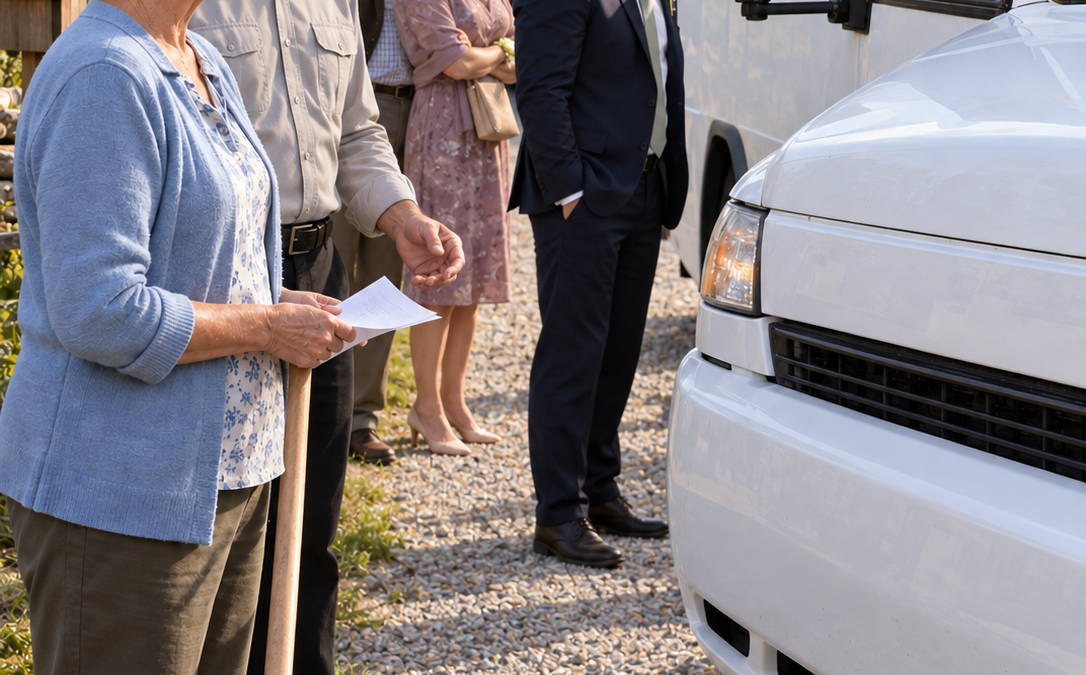
At 3:40 Saturday afternoon, two white wedding shuttles sprayed gravel into Roger’s lilacs.
It was September 12, 2026, wedding number thirty-one.
I stood beside my mailbox with a rake while the lead shuttle stopped.
Shane Halvorsen stepped down wearing a boutonniere.
The bride’s parents stood near him, and forty guests watched from the windows.
A man carrying papers came toward me.
“Colleen Lund?”
“Yes.”
He handed me a summons.
Halvorsen v. Lund.
Shane was suing me for $40,000 to pave my lane.
Before I could turn the page, Shane grinned.
“Forty thousand, Mrs. L. Pay it or move. Cheap old ladies don’t stop weddings.”
A guest laughed through an open window.
The bride’s mother looked away.
My face burned.
At sixty-six, I stood on my own gravel, dirt covering my shoes.
The rake handle pressed against my palm.
I wanted to ask Shane whether his father would have stood there laughing.
Earl had been Roger’s best friend.
But the bride’s father was watching me, waiting to see what I would do.
I kept my voice low.
“I’ll read it, Shane.”
Then I stepped back so the shuttle could pass.
Shane climbed aboard without another word.
The tires rolled through the spot where I had been standing.
I turned my face from the dust and kept the papers against my chest.
The second shuttle followed.
A woman at a window glanced down at the summons.
Then the glass slid shut.
I stayed beside the mailbox until the engines faded toward the barn.
Roger’s lilacs were coated gray.
Loose stones lay beneath the branches, where I had cleared them that morning.
I set the rake against the mailbox post.
My hands were shaking too hard to keep working.
The lane ran four-tenths of a mile from the county highway to the Halvorsen barn.
It was private gravel.
My gravel.
The farm also fronted the north town road, but Shane kept bringing wedding traffic past my house.
I looked toward the bend.
No shuttle was coming back yet.
I carried the summons inside and shut my kitchen door.
There was grit between the pages.
I brushed it onto the counter, then stood there looking at the little pile.
That was what had come into my house with his lawsuit.
I put the kettle on.
While it heated, I washed my hands.
A thin red groove crossed my palm where I had gripped the rake.
I held my hand under the faucet until the water ran warm.
Then I dried it and went back to the papers.
The first page had my name printed beneath Shane’s.
I had spent years writing names on recital programs.
A child’s name needed to be right.
I checked the spelling, the order, the piece the child would play.
Now my own name was on something I was afraid to touch.
I pulled out a kitchen chair.
Forty thousand dollars.
Shane had spoken loud enough for everyone riding in the shuttles to hear.
I could still hear the laugh.
I set the summons flat and pressed down its curled corner.
I wanted to understand what he claimed before I called anybody.
The kettle clicked off.
I poured the water, carried my cup to the table, and began.
The complaint used longer sentences than Shane had.
I followed them with my finger.
He wanted the lane paved, and he wanted me to pay.
The amount stayed the same however slowly I read.
I took a used envelope and wrote “$40,000” on it.
Under it, I wrote, “My lane.”
Then I stopped.
Those words would not answer a court paper.
I needed to know what the pages actually said.
By evening, the kitchen light was on and my tea had gone cold.
Music reached the house from the direction of the barn.
I closed the window above the sink.
Roger had handled the land papers.
After he died in 2022, I had kept what he left.
I knew where the household bills belonged.
I knew which drawer held the insurance papers.
But I had never read the old agreement about the lane.
Earl had used it after the dates and signatures stopped being something the men discussed.
Roger’s handshake had been enough between them.
Earl died in 2021.
Now Earl’s son had handed me a lawsuit beside the flowers Roger planted.
I brought the complaint closer to the lamp.
It referred me to Exhibit A.
I turned to the attachment.
One typed page.
At the top was a date from 1984.
May 14.
Below that were words about the land and the easement.
I recognized the lane from the description, though I had to trace the sentence with my fingertip.
The word “recorded” made my stomach tighten.
I had always believed that meant permanent.
Something filed away officially, beyond anything I could question.
I looked for a place where I had agreed to pave it.
Then I looked for Roger’s name.
I did not find what I needed.
Near the bottom was a document number.
I copied it beneath the dollar amount on my envelope.
That was something specific I could ask about.
I lifted the attachment to see whether another sheet had stuck behind it.
Nothing.
I checked the stack on the table, then the summons itself.
There was no second page of the old agreement.
I had been concentrating on the typed paragraphs.
Now I noticed the small footer.
“Page 1 of 2.”
I laid the sheet down.
Page two was missing.
Shane had chosen to leave it out.
I went to the piano and lifted the bench lid.
My red pencil lay beside the music, worn short from marking wrong notes.
I brought it back to the kitchen and drew a circle around the footer.
Inside that circle, Shane’s own Exhibit A said, “Page 1 of 2.”
Picking up where the Facebook post left off
Chapter 2
On Monday, September 14, Shane put a photograph of my lane on the venue page.
Above it, he wrote, “Our cheap neighbor wants brides to walk.”
My summons lay beside the phone, with $40,000 printed on the front.
I was still wearing my slippers.
The photograph showed the gravel past my mailbox, looking toward the barn.
My house was outside the frame.
Anyone looking at that picture could imagine a road belonging to Shane.
I moved my thumb away from the comment button.
I wanted to write that nobody had asked me to pave anything before suing me.
I wanted to put my name beneath his sentence.
Instead, I set the phone down.
My face felt hot, and I had not even left the kitchen.
“Cheap neighbor.”
He had put that where strangers could see it.
I picked up the phone again and saved a picture of the post.
Then I opened my messages.
I knew I had asked him to stop.
The exchange was old enough that I had to scroll past months of silence.
At June 16, 2025, I stopped.
It had been a Monday, just over a week after the first wedding.
My message was short.
“Please stop using my lane for wedding traffic.”
There was no joke in it.
There was no agreement to keep doing it until I complained more loudly.
His reply sat directly below.
“Easement’s recorded, Colleen. Take it up with my lawyer.”
I remembered standing in this kitchen when that answer arrived.
I had felt foolish for asking.
Roger had handled the papers, and Shane sounded certain.
I had let his certainty end the conversation.
Now I saved the exchange with the date visible.
My objection and his answer fit on the same screen.
I placed the phone beside the complaint.
Then I reached for my address book.
Allison Haugen’s number was under H.
I had taught Allison piano from 1999 through 2006.
Now Allison was thirty-eight and a real-estate attorney in Madison.
I kept my finger beneath the number while I dialed.
“Allison Haugen.”
“It’s Colleen Lund.”
“Mrs. Lund. Hello.”
“I need help with some land papers.”
My voice caught on the next sentence.
“I’ve been sued.”
Allison did not tell me to calm down.
“Do you have the complaint in front of you?”
“Yes.”
“Tell me the names at the top.”
I did.
Then I explained that Shane wanted $40,000 to pave my private lane.
“Can you send me photographs of the papers?” Allison said.
“Yes.”
“Include the attachments. Leave the edges visible.”
I looked at the page with my red circle.
“There’s an attachment that says it has another page.”
“Send what you received,” Allison said. “I’ll call after I’ve looked.”
We ended the call.
I cleared the tea mug from the table and spread out the complaint.
Taking the photographs made me handle the papers differently.
I straightened them instead of pushing them away.
I checked the corners in each picture before sending it.
Then I sent the June message and Shane’s new post.
I added one sentence.
“I asked him to stop before this.”
Afterward, I went outside.
A stone had lodged in the fork of a lilac branch.
I worked it loose with my fingers and dropped it onto the lane.
I wanted to spend the afternoon doing that.
Small work I understood.
Instead, I went back inside and kept the phone near me.
Allison called while I was sitting at the piano bench.
“I’m going to read a section aloud,” Allison said.
I carried the complaint to the kitchen table.
“All right.”
Allison gave me the place on the page.
I followed with my finger.
Shane, according to his complaint, “has applied to the county” to pave the lane.
Allison kept reading.
The application also sought an expansion to forty-five events a year.
“Forty-five?” I said.
“Events per year,” Allison said. “That is what he’s asking for.”
I wrote the number on my envelope.
I had been looking at what he wanted from me.
I had missed what he wanted permission to do afterward.
“Has the county agreed?” I said.
“The complaint says he applied,” Allison said. “I’m checking the county records.”
I heard keys clicking.
“The existing conditional use permit and approved site plan are public records,” Allison said.
“Those authorize only the north approach.”
“Then he isn’t approved to use my lane?”
“Using your lane violates that access condition,” Allison said.
“His pending forty-five-event amendment asks to substitute your lane as the approved approach.”
I waited with my pencil above the envelope.
Through the kitchen window, I could see the gravel beyond the mailbox.
Forty-five events meant more dates when I would have to watch for arriving traffic.
I wrote “per year” beside the number.
“There’s a permit amendment hearing on the agenda,” Allison said.
“When?”
“Tuesday, October 20. Six-thirty in the evening.”
I pulled the calendar toward me.
Allison named the City-County Building in Madison.
I wrote the place beneath the time.
“What does his application say about getting to the barn?” I said.
“Access is listed as ‘recorded easement, Doc. No. 1849317.’”
“That’s his claimed authority for substituting your lane,” Allison said.
My pencil stopped.
“That’s the number on the attachment.”
“Yes,” Allison said.
I put the envelope beside Exhibit A.
The digits matched.
Shane had used the same document for the lawsuit and the county application.
I could see why I needed to understand it before that hearing.
“What does that document actually say?” I asked.
“We have one page,” Allison said. “I need to see the complete document.”
“Does recorded mean I can’t question it?”
“It means it was recorded,” Allison said. “We still have to read its terms.”
I looked down at my name on the summons.
For the past two days, I had treated Shane’s papers like instructions.
Now I pulled a clean sheet toward me.
I wrote the document number at the top.
“Where do I ask for it?”
“The Register of Deeds in Madison,” Allison said. “Use that number.”
I added the office beneath it.
My hand was steadier than it had been beside the mailbox.
There was somewhere to go and something specific to request.
“Can I stop the shuttles while we sort this out?” I said.
Allison’s answer came without hesitation.
“Get every page, certified. Don’t put up a gate. Not yet.”
Chapter 3
On Thursday, September 17, I paid for a certified copy at the Register of Deeds counter in Madison.
The clerk slid two stamped pages toward me.
Document No. 1849317 was printed on the record.
The counter needed the number from Exhibit A to locate it.
Finding Roger’s land papers and arranging a ride to Madison had kept me until Thursday.
“Is this the complete document?” I said.
“Yes,” the clerk said. “Two pages.”
I moved my purse aside so I could lay them together.
The first matched Shane’s attachment.
The second had more typed paragraphs and signatures at the bottom.
I found paragraph six.
“This easement is granted for agricultural use only and shall terminate on December 31, 2009 (Thursday).”
I kept my finger beneath the date.
December 31, 2009.
I had come expecting language I would need Allison to explain.
That sentence was plain enough for me.
Agricultural use only.
An end date that had already passed.
I looked back at the document number to make sure I had requested the right record.
It matched the number I had brought.
“May I sit down?” I said.
The clerk pointed toward the chairs.
I carried the pages over without folding them.
My knees felt weak.
For days, I had pictured a bill I could not afford and paving trucks outside my house.
Now I had a stamped page saying the agreement had ended.
I was relieved.
Then I thought about the missing attachment, and I felt angry.
Shane had demanded money under this document.
The copy he gave me stopped before the paragraph I was holding.
I could not know why yet.
I knew I wanted Allison to see it.
I put the certified copy into my folder with the receipt.
Before closing it, I checked that the second page was inside.
Then I went to meet my ride home.
I was still carrying the folder when I saw the mailbox.
Roger’s cedar post lay across the ditch.
The box was down beside it, with dirt pressed against the door.
A shuttle had backed over the post and into the lilacs.
The tracks cut backward from the lane.
I stopped walking.
Three lilacs had been torn out.
Roger had planted them in 1991.
He had spaced them himself, standing back between holes to judge the distance.
I could still picture him with the shovel.
Now roots lay exposed above the dirt.
I set my folder on the car seat and went over to the nearest plant.
The branches dragged when I tried to lift it.
I put it down before I broke anything else.
My throat hurt.
I had been prepared to argue about gravel.
I had not been prepared to come home and find Roger’s work pulled out by the roots.
I checked the other plants.
Three.
I counted them because I wanted to tell Allison exactly what had happened.
Then I went back for my phone.
A note was tucked under the wiper on my car.
“Bill me. —S.”
I stood beside the hood with that scrap in my hand.
There was no apology.
There was nothing about the mailbox or the years those lilacs had grown.
I wanted Shane to come down the lane and look at them with me.
I wanted him to stand where I was standing.
Instead, I photographed the note before moving it.
Then I took pictures of the post, the tire tracks, and the damaged plants.
I crouched to photograph the roots.
When I stood, my knees ached and my skirt was dirty.
The folder was still on the seat.
I carried it inside before I did anything else.
At the kitchen table, I placed the note beside the certified copy.
I wanted to go out and drag something across the lane.
The mailbox post was already lying there.
I could picture myself pulling it into the road and waiting.
Then I remembered Allison’s instruction.
No gate.
Not yet.
I left the post where it had fallen.
That night, I opened Shane’s venue website on my computer.
I wanted to see what he was telling the people who came past my house.
I found the directions.
“Shuttles arrive by our private gravel lane off the county highway.”
I put my hand over the mouse.
Our private gravel lane.
He was giving my road to strangers in a sentence.
I printed the page with the website address showing.
Then I opened the wedding galleries.
The dates were listed beside the photographs.
The first wedding down the lane had been June 7, 2025.
I found that gallery and opened it.
My gravel was under the wedding party’s shoes.
The familiar bend appeared behind them.
I printed the photographs and moved to the next date.
Then the next.
I kept a pencil beside the keyboard and marked each gallery as I finished.
The printer stopped while I added paper.
I made tea and left it on the counter.
By the time I finished, I had counted thirty-one dated galleries.
Every photograph was on my lane.
People posed along it, stood in the gravel, and arrived by the route Shane advertised.
I stacked the printouts in date order.
There was more here than my word against his.
His directions named the entrance.
His pictures showed it being used.
I laid the certified second page beside them.
Would I block the road now that I knew what the agreement said?
I looked toward the dark kitchen window.
I still wanted to.
But I wanted Allison beside me when Shane had to answer for these papers.
I gathered the certified copy and the website printouts.
At the piano, I lifted the bench lid and made room beside the music.
I put the papers inside and closed it.
Then I returned to the kitchen calendar.
On October 20, beneath the hearing time, I wrote, “Oct 20 — speak.”
“I’m bringing page two, Shane,” I said.
Chapter 4
“If you put up a gate now, Shane could sue over cancelled weddings.”
Allison set my $40,000 complaint beside the certified copy.
We were at the desk in her Madison office.
“How many weddings?” I said.
“Every cancellation he claims you caused.”
My hands tightened around the folder on my lap.
“I have the paper saying it ended.”
“You do,” Allison said. “The committee needs to see it before you change anything.”
I looked at the photographs of the torn lilacs.
Waiting meant leaving the lane open after that.
“I want those shuttles out of my yard.”
“I know.”
Allison pulled a clean sheet toward her.
“Let’s count what Shane could claim.”
Allison wrote 2009, then 2026.
“Seventeen years, counting from 2009,” Allison said. “A prescriptive easement requires twenty years of adverse use.”
“So he hasn’t had enough time.”
“Correct. And Earl used the road with Roger’s permission.”
I nodded.
“Roger let Earl use it. They shook hands.”
“Permission isn’t adverse use,” Allison said.
I watched Allison underline the word “permission.”
I had been afraid that letting an old friend drive through had somehow given Shane my lane.
Allison turned the certified copy so I could see paragraph six.
“This agreement had its own end date,” Allison said. “We’ll put the complete document before the committee.”
Then Allison began typing.
The letter named my lane and withdrew permission to cross it.
My name appeared near the bottom.
Beneath it was a blank signature line.
Allison printed the draft and placed it between us.
“Do I sign now?” I said.
“After the committee sees the evidence.”
I put the unsigned letter in my folder.
Leaving that space empty was harder than I expected.
At the barn’s open house, Shane had a table near the entrance.
Small cards covered it.
“Save the Barn.”
I stopped beside the doorway.
People were drinking coffee and looking around the room.
Shane moved among them with the cards in his hand.
Dale Brekke stood near the front.
I knew Dale as the town board chair, a beef farmer who spoke slowly.
“The town supports this paving plan,” Dale said. “We want this venue to succeed.”
People nodded.
Dale spoke about the business the venue brought in and its tax base.
I waited for Dale to mention whose lane would be paved.
Dale did not say my name.
A woman beside me took a card and tucked it into her purse.
Shane spotted me near the door.
“Mrs. L. Glad you could see the support.”
“I heard Dale.”
“We’re trying to keep weddings here,” Shane said.
People nearby turned toward us.
I wanted to open my folder.
I wanted Dale to read the second page before saying another word.
But this was Shane’s room, with his cards on the table.
The hearing was where I had decided to speak.
I kept my folder closed.
Shane handed a card to the man standing beside me.
“Bring somebody Tuesday,” Shane said. “They need to see us.”
Then Shane took out his phone.
I was close enough to hear the call.
“Two buses,” Shane said. “To Madison on Tuesday evening.”
Shane gave the hearing location and confirmed the booking.
I looked at the cards people were carrying toward the door.
He was making sure the room would be full before I arrived.
I left without taking one.
On Monday, October 19, I went to the post office with my hearing folder.
I had been checking the papers before leaving home and carried them without thinking.
The September 12 bride’s mother was near the counter.
I recognized the coat before I looked at her face.
We stopped a few feet apart.
“Mrs. Lund?”
“Yes.”
“I have something for you.”
The bride’s mother opened a handbag and took out a folded sheet.
It was a printed shuttle email from the venue.
The directions included a sentence I knew.
“Shuttles arrive by our private gravel lane off the county highway.”
I held the email beneath the lobby light.
It was the same line I had printed from Shane’s website.
“They sent us that,” the bride’s mother said. “I thought you should have it.”
“May I keep it?”
“Yes.”
The bride’s mother looked directly at me.
“I’m sorry I looked away.”
I remembered standing beside the shuttle, waiting for somebody to object.
My throat tightened.
“Thank you for saying that.”
“I should have said something then.”
“You brought this now.”
The bride’s mother pressed the folded edge flat against my folder.
Then we stepped aside so another person could reach the counter.
I slipped the email behind the website printout.
The words had reached people who bought Shane’s wedding packages.
Now I had the copy one of those people received.
Outside, I sat in the car before starting home.
I pictured fifty people in the hearing room, holding “Save the Barn” cards.
Would fifty people believe a paper over a party?
I opened the folder and checked the stamped second page.
I could not make them listen.
I could put it in front of them.
At home, I laid my hearing clothes across the bed.
Then I checked the folder against the list Allison and I had made.
The certified copy.
Shane’s incomplete Exhibit A.
My message and his reply.
The website printouts and dated galleries.
I added the shuttle email.
A knock came at the front door.
Shane stood on my porch.
I left the folder on the kitchen table and stepped outside.
Shane leaned on the rail as though we were having an ordinary visit.
I stayed beside the door.
“The hearing’s tomorrow,” Shane said.
“I know.”
Shane glanced past me toward the kitchen.
I pulled the door closed.
“I’ll be there,” I said.
Shane kept his arm on the porch rail.
“After Tuesday, you pave it, or a judge makes you.”
Chapter 5
At 6:30 Tuesday evening, October 20, Shane stood before the committee in the City-County Building.
Fifty people had come to the hearing in Madison.
Couples held “Save the Barn” cards against their knees.
I sat beside Allison with my folder open.
Shane faced the Dane County Zoning and Land Regulation Committee and smiled.
“The easement is recorded. It runs with my farm forever.”
I put my thumb against the certified second page.
“Mrs. Lund never objected. She agreed for years.”
My face burned.
My objection was in the folder beneath my hand.
Shane gestured toward the people behind him.
“A handful of cars. My guests use the north lane.”
I looked at the stack of dated photographs.
Allison moved a finger down our list.
We would answer him in order.
The chair called my name.
I stood with the certified copy.
My knees shook as I walked forward, but I could carry a sheet of paper.
“Colleen Lund,” I said. “I own the lane in this application.”
I handed the chair certified page two, with the first page behind it.
“This is the complete document.”
The chair laid it flat.
I kept a copy so I could read without leaning across the table.
“Paragraph six,” I said.
I found the line and began.
“Access was limited to agricultural use,” I said. “The easement ended on December 31, 2009.”
Someone behind me lowered a card.
I waited while the chair checked the paragraph.
Allison passed out copies of Shane’s Exhibit A.
The footer was circled in red.
“Page 1 of 2.”
“This is what was attached to the complaint against Mrs. Lund,” Allison said.
A committee member placed the incomplete exhibit beside the certified record.
Shane leaned toward the microphone.
“That’s a technicality. Everybody’s driven that road for forty years.”
I reached for my printed messages.
“On Monday, June 16, 2025, I asked him to stop.”
I read my message.
“Please stop using my lane for wedding traffic.”
Then I read his answer.
“Easement’s recorded, Colleen. Take it up with my lawyer.”
I handed the exchange to the chair with the date showing.
“That was his reply to my objection.”
Shane’s grin was gone.
“Page two was a filing mistake. My lawyer left it out.”
I looked at the certified page resting in front of the chair.
I could not prove who had removed it.
I could show what the missing page said.
The chair asked Shane to wait while the committee reviewed the documents.
I stood back beside Allison.
Paper moved across the table.
One member held the text exchange beneath the light.
Another followed paragraph six with a fingertip.
I wanted to fill the waiting with explanations.
Allison touched the edge of my folder.
I kept quiet.
When the chair looked up, I brought forward the website printout.
“These are the directions on Shane’s venue website.”
I read the sentence exactly.
“Shuttles arrive by our private gravel lane off the county highway.”
I set it beside the text exchange.
“That is my lane.”
Then I laid down the thirty-one dated galleries.
The stack took more room than the directions.
“These are thirty-one wedding galleries,” I said. “Every photograph is on my lane.”
I opened the first one.
“June 7, 2025.”
I turned to another date and showed the same bend, the same gravel.
The chair asked me to leave the printouts for the committee.
I did.
My hands were empty when I stepped back.
I had spent weeks protecting those papers from spilled tea and folded corners.
Now the people deciding the application had them.
Behind me, a chair scraped.
Dale Brekke stood.
Dale still had a “Save the Barn” card in one hand.
“Shane, the town backed this because you told us that easement was current. That’s not what this paper says.”
Shane turned toward Dale.
Dale did not sit down immediately.
The town board chair looked at the certified record on the committee’s table.
Then Dale lowered the card.
I pressed my palms against my skirt.
At the open house, I had wanted Dale to read the missing page.
Now Dale had.
The chair asked whether I had submitted the complete set of evidence.
“Yes,” I said.
Allison and I returned to our seats while the committee discussed the application.
Shane remained near the front.
I could hear paper rustling behind us, where couples had been holding their cards.
I kept my eyes on the table.
The committee denied the amendment because Shane had failed to establish lawful access across my lane.
His existing conditional use permit remained effective, with its north-access condition.
Then the members voted to initiate compliance and possible revocation review.
The chair explained the steps.
Shane would receive written notice of the access violation and ten days to cure it.
If the violation remained unresolved, staff would submit an unresolved-violation report.
Only then could a separately noticed public revocation hearing follow.
I wrote “ten days” on the back of my list.
They had denied the amendment.
The paving plan Shane had presented as settled had failed.
A staff member addressed the room.
“Events using an unapproved access will be cited.”
Shane opened his mouth, then looked toward Dale.
Dale stayed seated.
The chair asked whether I had anything further to add.
I stood beside my chair.
“The road was a loan, and it came due in 2009.”
My voice reached the microphone without shaking.
I sat down, and Allison closed the folder.
There was still a wedding booked for Saturday.
What would happen when its shuttle reached the entrance?
I could picture dresses at the windows and a driver expecting an open lane.
But the committee had seen the complete agreement.
Shane could no longer tell them I had never objected.
Outside the hearing room, Allison found a flat surface for the letter.
The signature line beneath my name was still blank.
Allison checked the page, uncapped a pen, and signed.
Then Allison handed me the pen.
“Your turn, Colleen.”
Chapter 6
On Wednesday, October 21, I hung a wooden gate at the mouth of my lane.
Roger’s brass padlock lay on the post beside me.
The signed letter waited inside a clear sleeve.
I supported the bottom rail on blocks while I fitted the hinges.
My shoulders ached before I finished.
I stopped when I needed to and started again when my hands were steady.
Then I pulled the blocks away.
The gate swung across the entrance.
I closed it, fitted the brass padlock through the hasp, and turned the key.
Roger had kept that lock in the shed.
I had cleaned it at the kitchen sink that morning.
Now I tugged on it to check that it had caught.
I fastened a copy of the letter where someone approaching could read it.
My signature was beneath Allison’s.
The permission was withdrawn.
I stood back far enough to see the entrance from the road.
The wooden rails crossed the gravel where the shuttles had passed my mailbox.
I had wanted to do this when I found the lilacs uprooted.
Instead, I had waited until the committee saw the papers.
Now the gate was closed.
I put the key in my pocket and carried my tools inside.
On Friday, October 23, Allison forwarded an email.
The message contained an attachment and one word.
“Done.”
I opened the attachment.
Shane’s lawyer had filed a notice of dismissal.
Halvorsen v. Lund.
The $40,000 suit.
I checked the names before calling Allison.
“This means he isn’t asking the court to make me pave it?”
“That suit is dismissed,” Allison said.
I sat down at the kitchen table.
The chair made a noise against the floor, and I realized I had pulled it out too hard.
“All right,” I said.
I could not think of anything else for a moment.
Then I asked about the venue.
“The existing conditional use permit remains effective, with its north-access condition,” Allison said.
“The amendment was denied.”
“Zoning inspectors are checking the site and writing citations,” Allison said.
“So it hasn’t been revoked?”
“No. Inspections and citations don’t suspend the permit or mean it has been revoked.”
Allison explained the remaining steps.
“Revocation still requires written notice of the violation and ten days to cure it.”
“If it remains unresolved, staff must submit an unresolved-violation report. Only then can a separate public revocation hearing follow.”
I wrote that down.
I wanted to keep the decisions straight.
The amendment had been denied.
The lawsuit was dismissed.
The gate could stay locked.
After the call, I printed the notice and put it beside the original summons.
The amount on the summons had frightened me whenever I opened that folder.
I placed the dismissal on top.
On Saturday, October 24, at 2:15 p.m., a white wedding shuttle stopped nose-to-gate.
I was near the front window when I heard its engine.
Guests in dresses sat at the windows.
One leaned forward to see what was blocking the entrance.
The driver stayed behind the wheel.
I went onto the porch.
From there, I could see the brass padlock and the sleeve holding the letter.
The shuttle did not move.
A guest lifted a phone.
I wondered whether Shane had warned the driver.
Then I saw Shane coming toward the entrance.
His face was red.
He looked at the gate, then at me.
“Mrs. L.”
I stayed on the porch.
“Open it for this shuttle.”
“No, Shane.”
“There are wedding guests in here.”
“I can see them.”
The driver opened the side window.
“Where am I supposed to take them?”
Shane kept looking at me.
My fingers curled around the porch rail.
I wanted him to stop asking in front of people who had already dressed for a wedding.
I also wanted him to understand that waiting me out would not work.
I did not go down the steps.
Shane turned toward the driver.
“Use the north lane.”
The driver looked past Shane.
“Can this get through there?”
“Go around,” Shane said.
Shane pointed toward the farm’s other entrance.
I knew the north lane was muddy.
That was the lane Shane had wanted to avoid paying $58,500 to improve.
The shuttle pulled away from my gate.
A woman at a window looked toward the house as it moved.
I could not tell what the guests had been promised.
I knew what Shane’s directions had told them.
I stayed outside until the engine faded.
Then I went down to check the gate.
The letter was still visible.
The lock was secure.
I walked back without opening it.
The following week, Allison called with figures from Shane’s lawyer.
“Nine couples have cancelled,” Allison said.
I reached for a pencil.
“Nine?”
“He’s refunded sixty-one thousand, two hundred dollars.”
I wrote $61,200.
The wedding package had been $6,800.
I checked the multiplication on the paper beside the phone.
It matched.
I did not feel like celebrating.
Those couples had paid for weddings, and their plans were now coming apart.
But I was angry that Shane had kept selling access to my lane.
Even after the hearing, he had sent a shuttle to the locked entrance.
“Has he said anything about Saturday’s couple?” I asked.
“Nothing to me,” Allison said.
After we hung up, I put the figures in the folder.
I thought about the dresses at the shuttle windows.
What had happened to the couple after Shane sent their guests north?
I had watched them leave my gate.
I had not seen their reception.
Later that week, my phone rang while I was putting music back in the piano bench.
I set the pages on the seat and answered.
“Mrs. Lund?”
“Yes.”
“I was the bride on October twenty-fourth.”
I sat down beside the music.
“I wondered how you got along.”
There was a pause.
“We didn’t get along very well.”
I waited.
“Our reception sank in the mud,” the bride said. “The chairs kept going down. Guests were trying to find places to stand.”
“I’m sorry.”
“I’m not calling about your gate.”
My hand stopped moving against the edge of the bench.
The bride took a breath.
“I heard you used to teach music.”
“Yes,” I said.
“Do you still play the piano, Mrs. Lund?”
Chapter 7
Dale laid the town board’s decision on my kitchen table.
The paving plan was named near the top.
“The town has formally withdrawn its support,” Dale said.
I pulled the paper closer.
It was a short statement, with no request for anything from me.
“I should have read the agreement before backing him,” Dale said.
“Yes,” I said.
Dale nodded and left the copy with me.
I put it in the folder with the dismissal.
Later that week, I passed the north lane.
A sign stood near the entrance.
“Venue for Lease.”
I slowed enough to read it, then continued home.
On Saturday, November 7, I carried my music into the Primrose church hall.
The old upright piano stood against the wall.
I set the pages on its rack and tried a few keys.
One was louder than its neighbors.
I played the phrase again, more gently.
“That one still surprises people,” the bride’s mother said.
A box of kringle rested in her arms.
I took my hands off the keyboard.
“Where would you like this?” the bride’s mother said.
“The table looks ready.”
The bride’s mother put down the box and opened it.
The smell of pastry reached the piano.
“My daughter wanted something good waiting when people came in.”
There were chairs facing the place where the couple would stand.
No shuttle directions.
No cards asking people to save a business.
I could hear coats being hung near the door.
The bride came over before the guests took their seats.
I recognized the voice from the telephone.
“Mrs. Lund?”
“Colleen is fine.”
“Thank you for doing this.”
“I’m glad you asked.”
The bride glanced toward the chairs.
“I wanted to remember something besides the mud.”
“We’ll start with the music,” I said.
The bride smiled and went back to the doorway.
Allison arrived carrying a coat over one arm.
“Where do you want me?” Allison said.
“Beside the piano.”
Allison pulled up a chair.
I opened the processional and pointed to the turn.
“Here. Wait until I finish this measure.”
“I remember,” Allison said.
I looked at the hands resting beside the music.
Those hands had once been small enough that an octave was a stretch.
Now Allison had carried my papers into a hearing room.
I straightened the first page.
“Ready?” Allison said.
“Yes.”
The guests settled.
I placed my feet and rested my fingers on the keys.
Then I began.
The hall’s upright had a plain, warm sound beneath the louder note.
I kept the pace steady.
When I reached the bottom of the page, Allison lifted the corner.
The next line was waiting before I needed it.
The bride entered.
I watched the aisle only when the music allowed.
The couple had already been married.
This was the walk they wanted to remember.
Near the front, the bride’s mother pressed a napkin beneath one eye.
I played through to the end.
My hands stayed on the keys until the last chord faded.
Afterward, people moved their chairs toward the tables.
I stood to help.
The bride’s mother came beside me and took my hand.
“Your place is here.”
The bride’s mother drew out a chair near the couple and kept a hand on its back.
A plate of kringle waited beside a cup.
I sat down.
Someone else carried the folding chair I had been reaching for.
The bride leaned across and covered my hand.
I kept my eyes on our hands until my expression settled.
Then I took a bite of pastry while it was still fresh.
At dusk, Allison came home with me.
The three lilac whips waited beside the lane.
I had marked where I wanted them, near the places Roger’s plants had stood.
Allison carried the watering can while I lowered the roots into the holes.
We planted three.
I pressed the soil around each one with my hands.
The branches looked thin against the gravel.
I checked that they stood straight before moving to the mailbox.
The new cedar box was painted “LUND.”
Allison supported it while I fastened it to the post.
I stepped back.
Our name faced the road.
For a moment, I could picture Roger standing beside me, checking whether it was level.
I rubbed dirt from my thumb and reached for the tools.
Allison put a hand on my shoulder.
I stopped reaching.
We stood there together while I wiped my eyes with my sleeve.
Then I gathered the tools and carried them inside the gate.
The wooden rails swung shut.
I fitted Roger’s brass padlock through the hasp and turned the key.
Allison waited beside me.
There were no engines coming around the bend.
I put the key in my pocket.
“My home mattered, too,” I said.
THE END