My Sister Sent My 8-Year-Old to a Garage Folding Table While 26 Relatives Ate Christmas Dinner—Then She Read the Letter on the Stranger’s Plate
Complete story · 10 chapters · about 50 minutes · ending included
Chapter 1 · Chapter 2 · Chapter 3 · Chapter 4 · Chapter 5 · Chapter 6 · Chapter 7 · Chapter 8 · Chapter 9 · Chapter 10
Chapter 1: The Chair Set for a Stranger
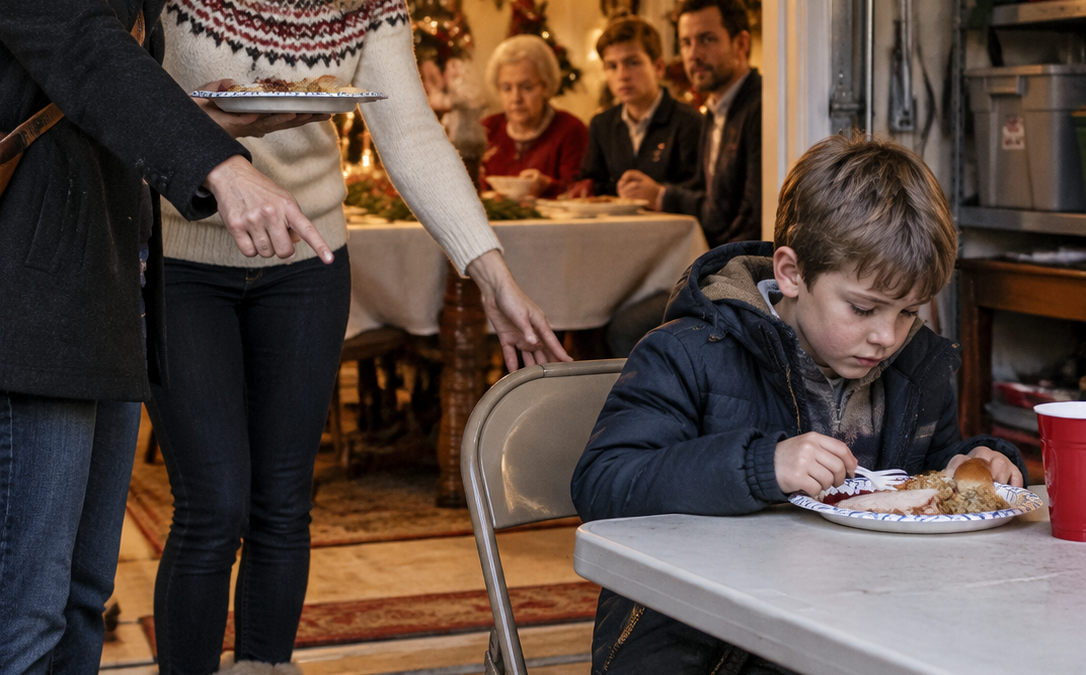
At 4:40 p.m. on Christmas Eve, my sister Brittany led my eight-year-old son past twenty-six place cards, handed him a paper plate, and sat him at a folding table in the garage.
The garage door stood propped open to the bright dining room.
I pointed at the empty chair near the end of the long table.
“That chair’s empty,” I said.
Brittany smiled.
“That chair’s for a stranger, Steph. Your kid can eat in the garage.”
Then she added, “He spilled at Thanksgiving.”
My mother, Kathy, kept her eyes on her soup.
I looked at the chair again.
It had a white plate, a folded napkin, and no place card.
In our family, that was the extra place for a stranger, a Polish Christmas Eve custom my father had kept even when there was no chance a stranger would come through the door.
Sam sat at the folding table with his paper plate held in both hands.
He had worn his good sweater because I told him Christmas Eve mattered.
His cheeks were pink from the cold walk from my truck, and he kept looking through the open garage door at the room where his cousins and aunts and uncles were finding their seats.
I could have argued.
I could have asked why a stranger rated a chair and my son did not.
I could have pointed out that Thanksgiving was weeks ago.
Instead, I picked up my dinner plate.
“He’ll need a coat.”
I carried my plate out to the garage and sat on the paint bucket beside Sam.
He pulled his folding chair closer to the table to make room for me beside him.
I put my plate on my knees.
The garage smelled of cold concrete, damp coats, and the little pine wreath Brittany had hung over the side door.
Inside, the dining room glowed with candles and strings of warm lights.
Someone had set out bowls of beet soup and pierogi.
A carol played softly from a speaker on the counter.
Sam looked at the food on his paper plate.
One roll, a spoonful of potatoes, and two pierogi.
He had not touched any of it.
“Are you cold?” I asked.
“A little.”
“I’ll get your coat.”
“It’s okay.”
He said it the way he said yes to teachers and thank you to cashiers.
Sam was eight, and he believed adults had reasons for the things they told children to do.
I had spent the drive from Scranton telling him we were going to Aunt Brittany’s new house in Clarks Summit, that Grandma would be there, and that Alex would be glad to see him.
I had told him there would be room.
My sister had bought the house after Jason got his operations job back.
She was thirty-seven, four years younger than me, and had made the dining room look like a picture from a holiday catalog.
She had laid out twenty-six place cards in neat handwriting.
Mine was beside Kathy’s.
Sam had no card.
Alex’s was near the center, where his mother could see him.
Brittany had a gift for making guests feel at home.
She could remember a cousin’s new job, compliment a neighbor’s scarf, and say someone’s name as if she had been waiting all afternoon to see them.
She worked part-time as a realtor and was president of the hockey booster group.
She knew how to make people feel chosen.
I knew how to check a circuit before I touched it.
I was a union electrician, forty-one, divorced, and used to being the person called when something stopped working.
Brittany knew that, too.
She had a way of treating that fact like a standing offer.
I had also come because Sam wanted to see his cousin Alex.
Alex was thirteen and played defense at Anthracite Valley Hockey Academy.
He was a polite kid who mumbled when adults praised him and noticed when someone was left out.
Sam had been talking about him all week.
The scholarship had kept Alex on the ice for three seasons.
I had paid it anonymously, and Brittany had never asked who the sponsor was.
I had arranged it through the academy because my father, Stan, had asked me to keep the boy skating.
The payments came from my Saturday overtime, money I could have used for other things.
I had never told Brittany.
She thanked the academy and praised the board.
I had let her.
Across the room, Alex glanced toward the garage.
He started to lift his hand, then Brittany called him to help carry a serving bowl.
He went without a word.
He had not seen where his cousin was sitting, or he had seen and did not know what to do.
I kept my voice low.
“You can eat.”
Sam picked up one pierogi and took a bite.
He chewed carefully, looking toward the doorway as if someone might tell him he was doing that wrong, too.
The dinner moved on without us.
Plates passed from hand to hand.
Kathy accepted more soup.
Picking up where the Facebook post left off
Jason stood behind Brittany for a while, listening as she talked to relatives.
He was thirty-nine and quiet, the kind of man who let a conversation end before it became an argument.
He looked out through the garage door once.
His eyes met mine, then moved to Sam’s plate.
He did not come over.
I kept my coat on.
The cold found the gap at my wrists whenever I moved my fork.
Sam ate half the potatoes and saved the second pierogi.
He said he wanted to give it to Alex.
“You can ask him later,” I said.
He nodded and folded the edge of the paper plate over the food.
By six, the dining room had grown louder.
People got up to refill drinks and bring dishes from the kitchen.
Nobody came into the garage.
The open door made it possible for them to see us, but it also let the conversation carry out in pieces: a question about the snow, a laugh from the far end of the table, Brittany asking who wanted coffee.
I looked toward the driveway.
My truck was parked near the garage, but six cars had boxed it in.
I could have asked someone to move.
I knew the answer would be that they would do it after the toast.
At about 6:15, Brittany stood near the dining table and tapped a spoon against her glass.
The conversations settled enough for her to speak.
“I just want to welcome everybody,” she said, smiling around the room.
She looked toward Alex.
“We’re especially proud of our boy. Alex’s scholarship, third year running.”
A few relatives applauded.
Alex ducked his head, embarrassed by the attention.
Brittany raised her glass and thanked everyone for coming.
She said they would have the proper family toast near eight, after everyone had finished eating.
This was only a short welcome.
The main toast was still to come.
I looked at Sam.
He had stopped eating to listen.
“Is that Alex’s hockey thing?” he asked.
“That’s what they’re talking about.”
“Good for him.”
I nodded.
Through the doorway, I could see Brittany accepting congratulations. She moved from one relative to another, smiling and thanking people for their kind words.
Nobody mentioned the sponsor.
Nobody mentioned the money.
Nobody mentioned the person sitting outside with an eight-year-old and a cold dinner.
Sam picked up his fork and finished the pierogi he’d been saving.
I pulled my coat tighter around my shoulders.
The driveway remained blocked, and the main toast was still planned for near eight.
I wasn’t leaving before then.
I looked toward my truck again, at the passenger side where the envelope had been sitting since December 20.
The renewal needed my signature by December 31.
I had not decided whether I would give it.
The renewal for Alex’s scholarship lay unsigned on my truck seat.
Chapter 2: The Scholarship Nobody Gave Her
From the garage, I heard Brittany say, “Alex earned that scholarship. Nobody ever gave this family a dime.”
The words carried through the open door while I sat beside Sam.
I kept my eyes on my plate.
Brittany had said things like that before.
At family dinners and rink events, whenever somebody asked how Alex had stayed at the academy, she made it sound as if the award had come from his talent alone.
I had never corrected her.
The first time I offered to help, Dad was being buried.
It was October 15, 2021.
The funeral had ended, and relatives were still gathered near the front of the church.
Brittany stood with Alex beside her.
He was young enough to keep his hands tucked into the sleeves of his dark jacket.
Dad had asked me to keep the boy skating.
He knew how much Alex loved hockey, and he knew Brittany and Jason were having a hard time.
Before he died, Dad had made me promise I would do what I could.
I had taken Brittany aside before the priest came over to speak with us.
“I can help with Alex’s hockey costs,” I told her.
“I can pick up more overtime.”
Her expression tightened, as though I’d insulted her.
“I’d pull him off the ice before I took your overtime money.”
She said it quietly, but not quietly enough to make it private.
The priest was a few steps away.
Alex was close enough to hear the edge in her voice, though he kept his eyes on the floor.
I didn’t argue.
Dad’s casket was still at the front, and I wasn’t going to turn his funeral into a fight over money.
I kept the promise anyway.
On August 9, 2022, I met with Gary Pallotta, the director of Anthracite Valley Hockey Academy.
He explained the private sponsor agreement and the amount required for a season: $14,000.
I signed it anonymously.
The form let me choose whether the academy could send correspondence.
I checked “no correspondence.”
I didn’t want Brittany to know, and I didn’t want thank-you calls or letters.
I wanted the money to reach Alex without becoming another conversation between my sister and me.
Saturday overtime covered the payments.
I took the extra shifts when they were available and planned the rest of my bills around them.
Sam wore skates from the academy swap bin.
I could have bought him a new pair, but I kept him in the used ones.
His feet were growing, and the used skates did the job.
I told myself there would be time to get him better ones.
For three seasons, I kept the agreement quiet.
Alex got to practice.
He played his games.
Sam watched him whenever I could bring him along.
And Brittany thanked the academy.
I was back in the garage, with the toast still going inside.
I could have walked through the door and told everyone who had paid.
I could have named the amount, the Saturdays, and the years.
But Alex was sitting at the table with his parents.
He was thirteen now, and I could see the back of his head beyond Brittany’s shoulder.
If I spoke, he would learn that the scholarship he thought he had earned came with a secret he had never been asked to carry.
I stayed where I was.
The toast moved on to coaches and hard work.
Somebody asked Alex to stand.
He shook his head, smiling down at his plate, and the relatives laughed kindly.
Then his chair scraped back.
He slipped out through the open door with a real fork in one hand and a napkin folded around a pierogi in the other.
He came straight to Sam.
“Here,” he said, holding out the fork.
“You need a real one.”
Sam took it carefully.
“Thanks.”
Alex set the pierogi beside Sam’s potatoes.
“You didn’t get much.”
“I got enough,” Sam said.
Alex glanced toward the dining room, then back at his cousin.
“I thought you might want some of mine.”
Sam looked at the pierogi.
“You can have half.”
Alex smiled.
“Keep it.”
He leaned one shoulder against the doorframe.
His eyes moved to me.
“I don’t like seeing you guys out here.”
I kept my voice even.
“Thank you, Alex.”
He shifted his weight and looked toward the dining room again.
“Mom said the award was for the best player. They watched everybody, and they picked me because I earned it.”
He said it without boasting.
It was simply what he believed.
I looked at his hands, still holding the empty napkin.
His mother had told the family that nobody had helped them.
Alex had heard the same story often enough to repeat it as fact.
Did he know anything at all?
“Your skating took work,” I said.
He nodded.
“Coach says I have to keep working.”
There was no challenge in his voice.
No hint that he knew who had paid the fees or why the money had been kept quiet.
He was proud, and he had every right to be proud of the work he had done.
I couldn’t tell him the truth in the garage while his mother toasted him.
I couldn’t make a thirteen-year-old choose between gratitude and the family story he’d been given.
Alex glanced toward the house again.
“I have to go back before Mom notices.”
He started inside, then stopped.
“Wait.”
He disappeared for a moment and returned carrying his old hockey stick.
The tape near the blade was worn, and the shaft had scratches from years of use.
“I don’t use this one now,” he told Sam.
“You can have it, if you want.”
Sam’s face changed.
He reached for the stick with both hands.
“Really?”
“Yeah. It’s still good.”
Alex leaned it against the folding table, careful not to knock Sam’s plate.
Then he went back into the dining room.
Sam ran his fingers over the worn tape.
I watched Alex disappear behind the door.
He had brought his cousin a proper fork and part of his dinner.
He had given Sam something he had once used himself.
He believed he had earned his scholarship.
He had never heard the truth.
Chapter 3: The Letter to a Stranger
I had never read a letter from Brittany about Alex’s scholarship.
That was my choice.
When I signed the sponsor agreement on August 9, 2022, I checked the box marked “no correspondence.” I didn’t want thank-you notes, updates, or family messages forwarded through the academy.
Gary Pallotta had respected that request.
For three seasons, I paid the $14,000 without seeing what Brittany told the academy or what she told the relatives who congratulated her.
I thought keeping the two things separate would make it easier.
Sam was still examining Alex’s old hockey stick when the garage door opened wider.
Brittany stepped outside, holding a dish towel in one hand.
“Those roasters keep tripping the breaker,” she said.
I looked toward the kitchen.
She pointed past me toward the electrical panel near the garage entrance.
“Since you’re out here. It’s what you do.”
She didn’t ask whether I minded.
She didn’t mention the dinner plate on my knees or the fact that her nephew had been eating beside the paint bucket.
She looked at me the way someone looks at a repair person they’ve already decided to hire.
“Which circuit?” I asked.
“The one by the kitchen. It happened twice.”
“Unplug something.”
Brittany gave me a small smile.
“That’s why I came out here.”
She turned toward the dining room before I answered.
I set my fork on the paper plate and looked at Sam.
“Keep that stick somewhere safe.”
He held it against his sweater.
“Can I take it home?”
“If Alex said you could.”
“He did.”
“Then it’s yours.”
Sam rested the stick against his chair and returned to his pierogi.
I stood, brushed a few crumbs from my coat, and headed toward my truck.
The six cars still blocked my way out. I could reach the passenger door, though, if I squeezed between the vehicles.
My electrical tester was in the truck.
So was the renewal packet.
I had carried the envelope home from the mailbox on December 20 and left it on the passenger seat. The deadline was December 31, and I still had not decided whether I would sign.
Until then, the envelope had been an obligation I could postpone.
Now Brittany wanted my hands on her electrical problem, and I needed to know whether I was going to keep paying for her son’s hockey.
I opened the passenger door and reached for my tester.
The envelope lay beneath a work jacket.
My name was printed on the front. Gary’s return address was in the upper corner. The academy’s mailing label had a December 20 date.
I pulled it out.
There was no reason to keep avoiding it. The board had sent the renewal, and my signature would decide whether the private agreement continued.
I sat sideways in the passenger seat with one foot on the driveway.
The envelope opened easily.
A folded note from Gary was clipped to the front of the packet.
I recognized his handwriting.
“Board ended the waivers. Read it before you sign.”
I stopped with the papers in my hands.
Gary had never been careless about the agreement. He was sixty-nine, nearing retirement, and had spent years making sure the academy followed the terms its sponsors signed.
If he wanted me to read something before renewing, I needed to know what it was.
I moved his note aside.
The first sheet was a letter.
The handwriting was Brittany’s.
I knew the shape of her capital letters. She wrote her grocery lists in the same narrow print, with the first letter of each name slightly larger than the rest.
At the top, she had written:
“Dear Friend.”
I looked toward the house.
Through the open garage door, I could see the dining room lights and the backs of relatives seated around the table.
Brittany was inside somewhere, probably checking the roasters or pouring another drink.
I looked back at the page.
The letter continued.
“Without you we would have pulled him off the ice. You’re a stranger, and you’ve done what my own blood wouldn’t.”
My fingers tightened around the paper.
I read the sentence once more, then lowered the sheet into my lap.
My sister had written those words to the person paying for Alex’s hockey.
She had admitted that the money was keeping him on the ice.
She had thanked someone she called a stranger for doing what her own family wouldn’t do.
She knew exactly what the award meant to her son.
She knew the cost of losing it.
And she had written that letter while I was taking Saturday overtime and putting Sam into used skates from the academy swap bin.
I looked at the signature at the bottom.
Brittany had signed her name.
There was no date beside it, but the letter belonged to the academy file. Gary had kept it with the renewal because the board had ended the waivers.
I had spent three years believing that staying anonymous protected Alex from a disagreement between his mother and me.
Now I was holding proof that Brittany had asked a stranger for help while refusing the same help from her sister.
I thought about the funeral.
Her voice had been quiet when she told me she would pull Alex off the ice before accepting my overtime money.
I remembered Alex standing beside her, his hands tucked into his jacket sleeves.
I had respected her refusal.
Then I had gone around it.
The letter made the garage feel different, even though nothing had moved.
Inside the packet were more sheets.
I could see Brittany’s handwriting on another page. There was a form beneath it, with printed lines and handwritten answers.
I didn’t turn them over.
I had opened the packet to understand the renewal terms, and I already had more than I expected.
The letter was enough to tell me that Brittany’s public story and her private words did not match.
What else had she written to a stranger?
I glanced toward the garage.
Sam was still beside the folding table. Alex’s old stick rested against his chair, and his paper plate was nearly empty.
Brittany appeared in the doorway.
“Steph? Are you coming?”
I folded the letter and placed it back with the other papers.
“I’m getting my tester.”
“Well, the food isn’t going to stay warm forever.”
She disappeared inside again.
I gathered the packet, including Gary’s note, and slid the file inside my jacket.
Then I picked up my tester and walked toward the electrical panel.
The breaker still needed fixing.
And I wasn’t finished reading.
Chapter 4: The Boy Who Stayed in the Dark
Brittany had found another use for me before I finished fixing the first problem.
I still had her letter inside my jacket when she called me down to the basement. The dining room was full of relatives, and she wanted the electrical problem handled before dessert.
“The kitchen keeps losing power,” she said. “Can you check the panel?”
I followed her downstairs.
The basement was finished, with a long counter, shelves of holiday decorations, and a laundry area tucked behind a half wall. Several relatives had gathered near the bottom of the stairs, carrying drinks and talking about the academy.
Brittany saw them and smiled.
“This is my sister Steph,” she announced. “She’s a union electrician. Lucky for us, we have somebody in the family who can fix these things.”
One of the relatives laughed.
Brittany gestured toward the breaker panel.
“She doesn’t mind helping. It’s what she does.”
I opened the panel and checked the labels.
Nobody asked if I had been hired. Nobody offered to pay me. Brittany had already decided that my work was part of the evening’s hospitality.
I could have told her to call an electrician.
Instead, I checked the circuits.
The academy came up in the conversation again.
One of the relatives asked how Alex had managed to keep his place there. Brittany stood near the stairs, pleased to have an audience.
“The board picked Alex out of two hundred kids,” she said.
A man near the laundry room nodded.
“He must be pretty talented.”
“He is,” Brittany replied. “They saw something special in him.”
I kept my eyes on the breaker labels.
The letter inside my jacket seemed to press against my ribs.
Without you we would have pulled him off the ice.
Those were Brittany’s words to the sponsor she called a stranger.
I tightened a loose connection cover and checked the load. I still hadn’t decided what to do with the renewal, and I wasn’t going to start an argument in the basement.
Brittany continued talking about Alex’s coaches.
I finished checking the panel and went upstairs to look at the appliances.
The roasters were plugged into the garage circuit.
I asked Brittany to unplug one while I checked the load.
She waved toward the kitchen.
“Just make sure everything stays on. People are waiting for dinner.”
I went back toward the garage.
At 6:50, the roasters tripped the garage circuit again.
I heard the refrigerator stop humming, followed by the little heater cutting out.
I reached for the switch and looked toward the folding table.
Sam was sitting in the dark.
His plate rested on his knees, holding only a cold roll and a few crumbs. Alex’s old hockey stick leaned against the chair beside him.
I walked over.
“Sam?”
He looked up.
“Aunt Brittany said not till dessert.”
I stared at him.
“Not until dessert for what?”
He pointed toward the dining room.
“She said I had to wait here until everybody finished eating.”
The heater was dead. His coat was still hanging near the side door, and his fingers were wrapped around the edges of his paper plate.
He hadn’t gone inside to ask for anything.
He had followed the instruction he had been given.
I crouched beside him.
“Come on. Let me see your hands.”
“They’re okay.”
I took them between mine.
They were cold.
“Put your plate down for a minute.”
He did as I asked.
I checked the electrical load and unplugged one of the roasters. The garage circuit came back when I reset the breaker.
The refrigerator started humming again.
The little heater clicked on, but I wasn’t satisfied with leaving Sam there.
I moved the remaining appliance load to the proper circuit and checked that everything was working safely.
It took a few minutes.
Sam watched me from his chair, his plate beside him.
When I finished, I turned toward the doorway.
Jason was standing there with a folded blanket.
He came over and placed it around Sam’s shoulders.
“Here, buddy.”
“Thanks, Uncle Jason.”
Jason rubbed the back of his neck.
“It’s been a busy night.”
I waited.
He looked at the heater, then at the dining room.
“Your aunt’s got a lot going on.”
That was all he said.
He didn’t tell Sam to come inside. He didn’t ask Brittany why an eight-year-old was eating in the garage. He picked up the empty roaster cord and went back into the house.
I looked at my mother through the doorway.
Kathy had come out with her soup bowl.
She glanced at Sam, then at me.
“It’s one night, Steph.”
I straightened.
“He’s eight, Mom.”
“I know how old he is.”
She looked uncomfortable, but she didn’t move toward him.
“Your sister has worked hard on this dinner. Don’t make it about you.”
I picked up Sam’s plate.
“Come inside and get warm,” I told him.
He shook his head.
“I’m okay.”
I didn’t argue with him.
I took his coat from the hook, helped him put it on, and guided him toward my truck.
The six cars still blocked the driveway, but the cab was accessible.
I opened the passenger door and helped him climb in.
Then I turned on the heat.
Sam held his hands near the vents. His cheeks slowly lost their cold pink color.
I sat beside him and took the file from inside my jacket.
The first letter was still there, folded along its original creases.
Beneath it was another page in Brittany’s handwriting.
I hadn’t turned this page over before.
The date at the top was August 2022.
Brittany’s handwriting covered several lines.
I unfolded the page.
“Please keep this quiet. I’m telling everyone he was picked.”
I stopped.
The sentence was short, but it told me more than the thank-you letter had.
Brittany hadn’t simply accepted the story other people told about Alex’s award.
She had planned the story herself.
She wanted the academy to keep the arrangement quiet while she told relatives that the board had selected her son from two hundred children.
She had written those instructions down.
I looked through the windshield at the house.
The dining room windows were bright. Shadows moved behind the curtains as relatives carried dishes and settled back into their seats.
Alex was in there somewhere.
He had given Sam his old stick because he thought his cousin deserved something nice. He had offered him food because he saw him sitting alone.
He believed his award came from his own hard work.
I couldn’t blame him for that.
The question was what I would do with what his mother had written.
Would I expose Brittany in front of her son?
Sam shifted in the passenger seat.
“Mom?”
I folded the application note and put it back into the file.
“Yeah?”
“Can I keep Alex’s stick in my room?”
“Of course.”
He smiled and looked down at his hands.
A knock struck the passenger window.
Brittany stood outside, her face tight.
I lowered the window.
She looked past me at Sam, then back at me.
“Get him out of sight. You’ll humiliate Mom.”
I kept my hand on the file.
She had finally noticed that we weren’t where she wanted us.
And she still wasn’t asking why her nephew had been sent there.
Chapter 5: The Form Signed in October
Brittany was still standing beside my truck when Sam opened the passenger door.
“Mom, I forgot something.”
He jumped down before I could answer and ran toward the garage.
“Sam, watch your step.”
He hurried through the open door, heading straight for the folding table.
Alex’s old hockey stick was still leaning against the chair.
Sam picked it up with both hands and carried it back.
“I don’t want somebody to take it,” he said.
I moved my coat aside so he could settle the stick safely in the truck.
“Put it behind your seat.”
He did, then climbed back into the passenger seat.
Brittany had already gone inside.
I looked down at the file in my lap.
The letter and application note were still near the front.
I had read what Brittany wanted a stranger to believe about Alex.
I still didn’t know what she had told the academy about her own household.
The last page was a printed financial form.
October 2, 2024 appeared near the top.
Below it were questions about family income and employment.
I followed the lines until I reached the section about Jason.
Spouse unemployed.
Household income $38,400.
At the bottom was Brittany’s signature.
I stopped there.
Jason had been laid off in 2022, but he had returned to work.
He had been rehired on March 6, 2023.
I knew because Brittany had called our mother that week.
She had been relieved that Jason was back as an operations manager.
Yet in October 2024, she had signed a form saying he was unemployed.
The household income figure was written beneath it.
I checked the signature.
It matched the one on her thank-you letter.
This wasn’t somebody else’s handwriting or an answer copied incorrectly.
Brittany had signed it herself.
Until then, I had assumed the need behind Alex’s scholarship was real.
She might have lied about the board selecting him from two hundred children.
She might have let relatives believe nobody had helped.
But I thought she had needed the money.
Now I wasn’t sure what I had been paying for.
I reached into my coat, pulled out my phone, and called Gary Pallotta.
He answered after a few rings.
“Steph?”
“It’s me. I opened the renewal packet.”
“Good. I hoped you would.”
“I have a question about the October form.”
There was a brief pause.
“Which section?”
“The household income section. It says Jason is unemployed.”
Gary didn’t interrupt.
“It also lists household income as thirty-eight thousand four hundred dollars,” I continued.
“That’s what the family certified.”
“Jason went back to work in March of 2023.”
Gary took a breath.
“Then you need to look at line nine.”
I found the paragraph.
It was printed beneath the signature section, in smaller type.
“What does it mean for the renewal?” I asked.
“False answers void the award,” Gary said. “The file can be sent to the sponsor.”
I looked at Brittany’s signature.
“Even if the boy earned his place?”
“The scholarship isn’t the same as admission to the academy. Alex’s playing is his own. The financial award has separate conditions.”
I looked toward the house.
“So if I don’t sign?”
“The renewal is your choice alone, Steph. Nobody can sign it for you.”
“And if I don’t?”
“Alex could lose the scholarship. His place at the academy would depend on what his family can arrange.”
I rubbed my thumb along the edge of the form.
“Is there another sponsor?”
“Not under this agreement. The board ended the waivers.”
I thought about the Saturday shifts.
I thought about the money I had set aside while Sam wore swap-bin skates.
“Do you understand what I’m asking?” I said.
“Yes.”
“I don’t want Alex punished for something he didn’t know.”
“I understand that, too,” Gary replied. “But I can’t change the conditions after a false certification.”
I thanked him and ended the call.
For a while, I sat with the phone in my hand.
Alex hadn’t asked me for anything.
He hadn’t known I was paying.
He had simply gone to practice, played his games, and believed the academy had chosen him.
The problem was between Brittany and the person who had signed the agreement.
That person was me.
Sam was busy checking the stick behind his seat.
“Mom, can I show Grandma?”
“Later.”
He nodded.
I put the phone away and gathered the papers.
I still had one conversation to have before the toast.
Brittany was in the pantry when I found her.
She was arranging serving dishes on a shelf, with a stack of clean napkins beside her.
The pantry door was open just enough for me to see the dining room beyond it.
I stepped inside.
“Brittany.”
She glanced over her shoulder.
“What?”
“I need to talk to you.”
“Can it wait? I’m trying to get dessert organized.”
“No.”
She set down a serving dish.
I kept my voice low.
“There’s an empty chair at the table.”
She looked at me without answering.
“Seat Sam there tonight.”
Her eyebrows lifted.
“What’s this about?”
“You know what it’s about.”
“He has a place to sit.”
“In the garage.”
Brittany turned toward the shelf and adjusted a stack of plates.
“Steph, don’t start.”
“I’m asking you once. Put him in that chair before the toast.”
She gave a short laugh.
“You’re still upset about dinner?”
“He’s your nephew.”
“And I have twenty-six relatives here. I can’t rearrange everything because you don’t like where he sits.”
“There’s an empty chair.”
“That chair is for a stranger.”
“You’ve said that.”
She closed the pantry cabinet.
I watched her face.
For a few seconds, I thought she might reconsider.
Then she looked directly at me.
“Jason hasn’t missed a paycheck since we got married. You’re jealous. Not at my table.”
I felt my fingers tighten around the folder.
Jason hadn’t missed a paycheck since they got married, she said.
But she had signed a financial form claiming he was unemployed.
She had also told the academy their household income was $38,400.
I could have put the form in front of her.
I could have asked her to explain the difference.
Instead, I gave her one more chance to answer the question I had actually asked.
“Will Sam sit at that chair?”
“No.”
She picked up the serving dish.
“Now, please. People are waiting.”
I stepped out of the pantry.
Brittany followed me, carrying dessert toward the dining room.
I didn’t stop her.
I went back to the truck and checked on Sam.
He was still in the passenger seat, holding the old hockey stick across his lap.
“Are we going inside?” he asked.
“Yes.”
“Can I bring Alex’s stick?”
“Keep it with you.”
He smiled and climbed down.
I reached inside my jacket for the file.
The thank-you letter was there, along with the application note and the signed financial form.
I took the unsigned renewal letter from the packet.
The signature line was still blank.
December 31 was the deadline.
I wasn’t going to sign it in the truck, and I wasn’t going to let Brittany decide what happened to it.
I found a paper clip in the envelope and attached the unsigned letter to the file.
Then I closed the packet and tucked it under my arm.
Through the open doorway, I could hear relatives moving their chairs.
Someone called for Brittany.
The toast was coming.
I had offered her a chance to make room for Sam.
She had refused.
I walked toward the dining room with the unsigned renewal clipped to the evidence she had written herself.
Chapter 6: The Plate Nobody Was Using
Near eight o’clock, Brittany stood at the head of the dining room table and raised her glass.
The short welcome toast she had given around 6:15 was long past. This was the main family toast, the one she had promised everyone before dinner.
The twenty-six relatives had finished eating. Plates were pushed toward the center, and several people had started on dessert.
Alex sat beside Jason, looking embarrassed by the attention his mother was gathering.
I stood near the empty chair reserved for a stranger.
Brittany smiled around the table.
“I want to say something about Alex’s renewal.”
A few relatives turned toward him.
“It’s automatic,” she continued. “When a boy earns something through hard work, merit lasts. The academy knows what he’s worth.”
Jason gave a small smile.
Brittany lifted her glass.
“Third year running. We’re very proud.”
Someone applauded.
Then Brittany looked toward me.
“Some children would rather spend their time with other interests. Steph’s kid is happier with the tools.”
A couple of relatives glanced in my direction.
I didn’t answer.
Sam was still near the garage with Alex’s old hockey stick. I had told him to wait there while I went inside.
Brittany turned back to the table.
“Anyway, we’re grateful the academy recognizes talent. Alex earned his scholarship, and nobody handed it to him.”
I picked up the file beneath my arm.
The unsigned renewal was clipped to the front.
I walked to the empty chair and placed the paperwork on its white plate.
The plate was meant for a stranger.
Brittany noticed the movement.
“What is that?”
“Your renewal.”
She stepped closer.
For a moment, she looked at the packet without touching it.
Then she picked up the top sheet.
She glanced at the academy heading and laughed.
“What’s this supposed to be?”
I said nothing.
She turned the page.
Her eyes moved down the printed lines until they reached the section marked Sponsor.
Her smile stopped.
She looked at the blank signature line.
“Who is this for?”
I pulled the thank-you letter from the file.
“Maybe you should read what you wrote.”
Brittany’s face tightened.
“Steph, this isn’t the time.”
I unfolded the letter.
It was addressed to Dear Friend.
I recognized the handwriting because I had already seen it in the truck.
My sister had written those words to someone she believed was a stranger.
I began reading.
“Without you we would have pulled him off the ice.”
A relative lowered her fork.
I continued.
“You’re a stranger, and you’ve done what my own blood wouldn’t.”
The dining room grew quiet.
I held the letter where everyone could see it.
“That’s what you wrote to the person paying for Alex’s hockey.”
Brittany reached toward the paper.
“Give me that.”
I moved it just out of reach.
“I’m not finished.”
I took the 2022 application note from the file.
The page had Brittany’s handwriting at the top and her signature below.
I read the sentence she had written.
“Please keep this quiet. I’m telling everyone he was picked.”
A fork stopped halfway to someone’s mouth.
At the far end of the table, Kathy looked down at her plate.
Jason turned toward Brittany.
Alex sat with his hands folded near his water glass.
He wasn’t looking at me.
He was watching his mother.
Brittany’s cheeks had turned red.
“That’s my son’s private file. You had no right.”
I kept the papers in my hands.
“You signed the agreement.”
“That doesn’t give you permission to stand here and embarrass me.”
I looked down at the application.
“You signed the release, too.”
She shook her head.
“You don’t understand what you’re looking at.”
I found the paragraph immediately above her signature.
It was printed in smaller type, but the words were clear.
I read it aloud.
“I authorize Anthracite Valley Hockey Academy to provide the sponsor with this application and supporting documents for review.”
I lowered the page.
“That’s the release you signed, Brittany.”
Nobody spoke.
She stared at the form.
“You had no reason to get involved in my son’s business.”
I looked toward Alex.
He was thirteen years old.
He had believed the academy chose him because he was good enough. He had never known about the payments, the anonymous agreement, or the woman taking Saturday overtime to keep him on the ice.
He had done nothing wrong.
I didn’t want to take his pride away from him.
But I wasn’t going to let his mother use his name to cover what she had written.
Brittany looked around the table.
“This is ridiculous. The board chose him. He earned his place.”
I held up the thank-you letter.
“Then why did you thank a stranger for keeping him on the ice?”
She looked at the paper.
Her mouth opened, but she didn’t answer.
One of my cousins shifted in her chair.
Another relative put down his glass.
Brittany turned toward the academy paperwork again.
“This doesn’t prove anything about Alex’s ability.”
“I didn’t say it did.”
“He worked for this.”
“I know he did.”
“Then why are you doing this?”
I placed the thank-you letter beside the application note.
“Because you told this family nobody ever helped you.”
Brittany’s eyes narrowed.
“You’ve always had a problem with me.”
I didn’t respond.
She pointed toward the garage.
“You brought your son here and made this into a performance. He has a place to sit. You just don’t like it.”
I glanced at the stranger’s plate.
The unsigned renewal still covered part of it.
There had been an empty chair for someone nobody knew, but my eight-year-old son had been sent outside.
Brittany followed my eyes.
“Don’t bring that into this.”
“You brought it into this when you decided where Sam belonged.”
Her voice rose.
“You’re ruining a child’s life because you’re jealous.”
She turned toward the relatives, raising her voice so everyone could hear.
“That’s what this is. Steph can’t stand that Alex earned something her own child didn’t.”
Alex finally looked up.
Brittany stood beside the stranger’s chair, her hand resting on the unsigned renewal.
The family had heard her thank-you letter.
They had heard her instruction to keep the arrangement quiet.
And she was still telling them I was the one hurting her son.
Chapter 7: The Stranger at the Table
Brittany still had half the room believing I had done this out of jealousy.
She stood beside the stranger’s chair, one hand resting on the renewal packet.
“Alex earned his place,” she said. “You can’t take that away from him.”
I looked around the table.
Some relatives were watching me. Others were watching Brittany, waiting for somebody to explain what they had just heard.
Jason hadn’t said anything.
He sat beside Alex, looking at the papers on the table.
I reached into the file and pulled out the October financial form.
Then I laid it beside the thank-you letter.
“This is the form you signed on October 2, 2024.”
Brittany’s expression changed.
“Put that away.”
I turned the page toward Jason.
“Read the employment section.”
He looked at Brittany before reaching for it.
She shook her head.
“Jason, don’t.”
He took the form anyway.
His eyes moved down the printed lines.
I watched him reach the section about his employment.
Spouse unemployed.
Household income $38,400.
Jason’s jaw tightened.
He looked at the signature at the bottom, then back at his wife.
“I’ve had a paycheck since March of 2023, Britt.”
Nobody moved.
Brittany reached for the form.
“Jason, you know what things were like when you were laid off.”
“That was before I went back to work.”
“I was trying to keep Alex in the academy.”
“You told them I was unemployed.”
She lowered her voice.
“You don’t understand what I had to do.”
Jason kept the paper in his hands.
“I understand what I did for a living.”
He looked down at the form again.
“I’ve been working since March.”
Brittany turned toward the relatives.
“Every mother lies for her kid. I did this for Alex.”
Her voice had lost the sweetness she used when people were watching.
“I wasn’t going to let my son lose something he’d worked his whole life for.”
Alex stared at his plate.
I could see his ears turning red.
Brittany pointed toward the renewal.
“He deserved that award. You know he did.”
I didn’t dispute his ability.
I hadn’t disputed it once.
But the form was still on the table, with her signature beneath the false answers.
My mother finally looked up.
Kathy had been sitting near the end of the table throughout the argument.
She had barely touched her dinner.
Now her eyes moved toward the open garage door.
“I saw where you put him, and I passed the soup.”
Brittany turned sharply.
“Mom.”
Kathy kept looking toward the garage.
“I saw Sam sitting out there.”
“You didn’t have to get involved.”
“I know.”
Kathy placed her spoon beside her bowl.
“I saw him, and I stayed at the table.”
I looked at my mother.
She had watched Brittany lead my eight-year-old past twenty-six place cards.
She had watched me carry my dinner outside.
She had seen Sam sitting beside a paint bucket while everyone else ate.
For years, I had accepted that Kathy didn’t like family disagreements.
I had told myself she wanted peace.
That night, I understood what her peace had cost Sam.
Brittany pushed her chair back.
“Are we seriously doing this over where a child ate dinner?”
Jason looked at her.
“You signed a form saying I wasn’t working.”
“Because I needed the scholarship.”
“You could have told me.”
“I was handling it.”
He put the form back on the table.
“You were telling people I hadn’t worked in over a year.”
Brittany looked around the room again.
Nobody came to her defense.
She turned toward me.
“And you. Who do you think you are?”
I stood beside the empty chair.
For three seasons, I had kept my name out of the academy’s paperwork as much as the agreement allowed.
I had taken Saturday shifts.
I had passed on things Sam needed so Alex could keep skating.
I had let Brittany thank the academy while I sat in the background.
The amount I had paid over those three seasons was $42,000.
I had never expected applause.
I hadn’t even wanted a thank-you.
But I wasn’t going to let my sister tell this family that nobody had helped her.
I looked directly at Brittany.
“I’m the stranger you set that plate for.”
Her mouth opened.
Nothing came out.
A cousin near the kitchen lowered her eyes.
Jason looked at the letter again.
Kathy’s fingers rested on the edge of her napkin.
Brittany stared at me as if she had never considered that the person she had thanked in private might be sitting across from her at Christmas dinner.
Then Alex moved.
His chair scraped against the floor.
His face was red, and he looked down as he reached for his plate.
“Alex, sit down,” Brittany said.
He picked up the plate.
“Alex.”
He didn’t answer.
He walked past his mother, carrying his dinner.
Brittany reached toward him, but he was already moving toward the open garage door.
Jason watched him go.
Nobody stopped him.
I stayed beside the table.
I knew what this could mean for Alex.
The academy had a separate agreement for the scholarship. The renewal was unsigned, and the financial form carried his mother’s signature.
He could lose the financial support that had kept him there.
He could also learn that the story he’d believed about his achievement wasn’t the whole story.
He had worked hard.
That part was true.
But what would this cost Alex?
I looked toward the garage.
He was still carrying his plate when he reached Sam.
Sam sat on the folding chair beside the paint bucket.
Alex glanced at the empty space beside him, then pulled the chair closer.
He sat down.
Sam looked at him, then at the fork Alex had brought earlier.
Without being asked, Sam picked it up and held it out.
“Here. You can use mine.”
Alex accepted it.
“Thanks.”
Sam shifted his plate to make room.
The old hockey stick rested against the table.
Alex placed his dinner beside Sam’s and began eating.
Inside, Brittany remained beside the stranger’s chair.
Outside, her son sat beside mine.
Chapter 8: The Plaque in the Rink Lobby
The family knew who had paid for Alex’s hockey, but the academy hadn’t made its decision yet.
The unsigned renewal was still in my possession.
On Monday, December 30, I drove to Anthracite Valley Hockey Academy and asked to see Gary Pallotta.
He met me near the front office. He was sixty-nine, close to retirement, and had the tired expression of someone who had spent too many years settling disagreements between parents and coaches.
“You brought it back,” he said.
I handed him the packet.
The renewal letter was clipped to the file. My signature line remained blank.
“I can’t sign it, Gary.”
He looked at the paperwork.
“Are you sure?”
“Yes.”
He didn’t ask me to explain. He knew what was in the file, and he knew what the board had changed.
“Once I submit this, the board will review the previous certifications,” he said.
“I understand.”
“Alex is a good player, Steph.”
“I know.”
“He may not be able to stay here without the award.”
I looked through the office window toward the rink. A few players were moving across the ice, their sticks tapping against the boards.
My father had asked me to keep Alex skating.
I had done that for three seasons.
I had also spent those years keeping Sam in used skates while I worked extra Saturdays to cover the payments.
“I can’t sign a false renewal,” I said.
Gary nodded.
He took the packet and placed it in a folder on his desk.
“I’ll send it to the board.”
I walked out without asking him to reconsider.
The academy had been part of our family conversations for years. Games, practices, equipment, schedules. Alex’s name had become connected to that rink.
Now I had returned the paper that kept the arrangement going.
On January 7, 2025, a letter arrived from the academy board.
The envelope was addressed to me.
I opened it at my kitchen counter while Sam ate cereal before school.
The first paragraph confirmed that the board had reviewed the October 2 application and the supporting documents.
The next paragraph referred to line nine.
False answers void the award.
The board had voided Alex’s scholarship.
The letter also explained that the Kroll family was responsible for repayment of the two seasons supported by the false financial certifications.
The amount was $28,000.
The board had arranged a payment plan through academy counsel. The repayments would not come to me personally. They would go into a fund I would direct.
I sat down with the letter.
Sam looked over from his cereal bowl.
“Is that about Alex?”
“Yes.”
“Is he in trouble?”
I folded the letter along its original crease.
“His mom made some decisions. He didn’t make them.”
Sam nodded, though I wasn’t sure how much of that he understood.
I called Gary later that morning.
He confirmed the board’s decision and explained that the award was finished. Without it, the Krolls could not keep Alex in the academy under the existing arrangement.
I didn’t ask him to make an exception.
I had already made my choice.
For three seasons, I had kept the payments going because Dad had asked me to help his grandson. I hadn’t expected a plaque or a family announcement.
I had wanted Alex to skate.
Now the academy had closed that arrangement, and the responsibility for what happened next belonged to his parents.
Gary also confirmed that the repayment plan would be administered through academy counsel.
I asked that the recovered money be held for a fund I would direct.
I didn’t have the final details worked out yet.
But I knew I didn’t want the money returning to the same family arguments that had created the problem.
Four days later, on Saturday, January 11, I went to the rink.
I hadn’t planned to stay long. I had a reason to be there, and I wanted to see how the board was handling the decision.
The lobby was busy.
Parents stood near the entrance talking about practice times. Children carried equipment bags past the benches. A few people recognized me from family games and holiday gatherings.
Brittany was near the trophy display.
She wore her usual winter coat, and her booster lanyard hung from her neck.
She was speaking to two parents when a board representative approached her.
I couldn’t hear the first few words.
Then Brittany looked down at the lanyard.
She reached behind her neck, unclipped it, and placed it in the representative’s hand.
Nobody applauded.
Nobody argued.
The parents nearby watched.
Brittany held her coat over one arm while the representative stepped away.
She had lost her position as booster president.
Then a custodian came toward the display wall with a small tool case.
He stopped in front of the plaque bearing Alex’s name.
Brittany noticed him.
“Are you taking that down now?” she asked.
The custodian glanced at the board representative.
“I was told to remove it.”
Brittany tightened her grip on her coat.
The custodian opened his tool case and took out a screwdriver.
He began loosening the screws.
One by one, they came free.
The plaque tilted slightly before he caught it with his other hand.
A father standing beside the entrance moved his daughter out of the way.
Nobody said anything.
Brittany watched as the custodian lowered the plaque and carried it away.
She stood with her coat folded over her arm and her hands empty.
I didn’t approach her.
I didn’t need to.
She saw me near the lobby entrance.
For a moment, her expression changed. I thought she might come over.
Instead, she turned toward the doors.
I left a few minutes later.
On the drive home, I thought about Alex.
He hadn’t written the application. He hadn’t signed the financial form. He hadn’t asked his mother to tell relatives that nobody had helped him.
He had given Sam his old hockey stick because he thought his cousin needed one.
He had brought him a fork and part of his dinner.
Now he had lost the academy that had been such a big part of his life.
I didn’t know where he would go next.
I hoped his parents would tell him the truth before he heard another version from someone at the rink.
That evening, my phone lit up on the kitchen counter.
Brittany’s name appeared on the screen.
Her message was short.
“Fix this or you have no sister.”
I stood beside the counter with the phone in my hand.
The board had made its decision.
The lanyard was no longer around her neck, and Alex’s plaque was no longer on the wall.
But Brittany still thought I was the person who had to fix everything.
Chapter 9: The Boy Who Asked for the Truth
Brittany’s message was still unanswered when Alex came to my shop with an envelope full of money he’d earned shoveling snow.
The academy had taken him off the roster, and his mother’s last message to me had been clear.
Fix this or you have no sister.
Alex stood near the counter, wearing his winter coat and holding the envelope in both hands.
“Can I talk to you?”
“Sure. What’s going on?”
He put the money on the counter.
“I want to play hockey.”
I looked at the envelope.
He had been shoveling driveways and sidewalks, saving what he could.
His fingers were red from the cold, and there was a small tear near the cuff of his glove.
“What’s this for?”
“The town club.”
He looked down at the envelope.
“I called them. It costs $1,900.”
I didn’t touch the money.
“That’s a lot of shoveling.”
“I’ve been saving.”
He pushed the envelope a little closer.
“I don’t want you paying for me anymore.”
I leaned against the counter.
“Alex, look at me.”
He raised his eyes.
“The ice time was yours. The paperwork wasn’t.”
He swallowed.
“I thought I got the scholarship because I was good enough.”
“You are good enough.”
“But Mom said nobody helped us.”
I didn’t answer right away.
He was thirteen.
He had spent three seasons believing his mother had told him the whole story.
Finding out that she hadn’t was something he would have to work through himself.
“You worked for every hour you spent on that ice,” I said.
“Nobody gave you those skills.”
He looked at the envelope.
“Can I still play somewhere?”
“The town club has a place for you if you want it.”
“I do.”
He had already made up his mind.
I went with him to arrange the registration.
He paid the $1,900 himself, using the money he’d earned shoveling snow.
He counted it carefully and asked for a receipt.
When we left, he folded the receipt and put it in his wallet.
“Can I tell Sam?”
“Tell him what?”
“That I’m playing again.”
Sam would be happy to hear it.
“I’m sure he’ll want to know.”
Alex smiled a little.
It wasn’t the same academy, and it wasn’t the same arrangement.
But he had found a way to keep playing without asking his mother or me to pay the bill.
I watched him walk toward the door.
He turned before leaving.
“Thanks, Aunt Steph.”
“You’re welcome.”
He nodded and went outside.
I didn’t tell him that his grandfather would have been proud.
He deserved to hear that from someone who had known Stan as well as I had.
By spring, Jason had moved out of the Clarks Summit house.
I learned that from Kathy, not Brittany.
Jason had taken some of his things and left.
He wasn’t making a public announcement, and I didn’t ask where he was staying.
A few weeks later, a For Sale sign appeared in the yard.
I drove past once on my way home from work.
Brittany’s curtains were still in the front windows.
The wreath she’d hung for Christmas was gone, and the porch looked bare.
I didn’t stop.
She hadn’t called to apologize for what happened to Sam.
She hadn’t asked how Alex was doing at the town club.
Her messages were about the money, the board, and what I could do to repair the damage.
One afternoon, she came to my house.
I was putting away tools when I heard the knock.
Brittany stood on the porch with her arms folded.
“We need to talk.”
I stayed in the doorway.
“What about?”
“Alex.”
“He’s fine.”
“He shouldn’t have to play at that little town club. He belongs at Anthracite.”
“He’s playing hockey.”
“You know what I mean.”
She looked past me into the house.
“You could still help him. You could sign again.”
“The board made its decision.”
“You’re the sponsor. They listen to you.”
“Not about a form you signed.”
Her face tightened.
“This is your nephew we’re talking about.”
“I know who Alex is.”
“Then do something for him.”
I held the door.
“He’s fine. You’re asking for you.”
Brittany stared at me.
“You’re really going to let this family fall apart?”
I didn’t answer.
She stepped closer.
“You’ve made your point, Steph.”
I had no more to say.
I shut the door.
For several seconds, I stood with my hand on the knob.
I knew closing that door might cost me my relationship with my sister.
I also knew opening it again wouldn’t change what she had done.
A few days later, Kathy came to my house carrying a covered dish.
She had made pierogi.
I let her in and cleared a space on the kitchen counter.
She removed the towel covering the dish.
“I made too many,” she said.
“You always make too many.”
She gave me a small smile.
Then she looked around the kitchen.
“I’ve been thinking about Christmas.”
I set down the dish towel.
“It’s a long way off, Mom.”
“I know. But I don’t want another Christmas Eve like the last one.”
Neither did I.
Kathy pulled out a chair.
“I’d like to host Wigilia at my house.”
I looked at her.
“Your house isn’t very big.”
“I know how many chairs I have.”
She said it without getting defensive.
“I can move a few things. We can make room.”
I thought about Dad’s old tradition.
The first star, the extra plate, and the idea that nobody should be left outside a family table.
“You want everyone there?”
“Whoever wants to come.”
I wasn’t sure the relatives would agree.
Some had watched Sam eat in the garage and said nothing.
Others had heard Brittany’s toast and believed her version until the paperwork came out.
Kathy picked up her phone.
She started with her sister.
I sat across from her while she made the call.
She explained that she wanted Christmas Eve at her house and asked whether they would come.
Her sister said yes.
Then Kathy called my cousin.
He asked what time dinner would be.
She told him they would work that out later.
He agreed, too.
One by one, the answers came.
Some relatives needed to check with their spouses.
Others said they would bring food.
Nobody asked whether Brittany would be there.
Kathy put her phone down.
“I think we can do it.”
I looked at the small kitchen and imagined everyone trying to fit around her dining table.
“Will there be enough room?”
“We’ll make enough room.”
She took the towel from the counter and folded it neatly.
Then she looked at me.
“Steph, bring the folding table.”
I glanced toward the garage, where it was still leaning against the wall.
“Why?”
Kathy looked at me steadily.
“We have a place for it.”
Chapter 10: The Folding Table Comes Inside
A year later, on Wednesday, December 24, 2025, I carried the folding table into my mother’s narrow Scranton house.
The legs caught against the doorway, and I turned it sideways to get it through. Kathy moved a small chair out of the way and held the door while I brought it into the dining room.
“Careful with that corner,” she said.
“I’ve got it.”
The table had spent most of the year folded against the wall in my garage after Brittany left it on my porch in January with no note. Its metal legs were scratched.
Kathy cleared a space beside her dining table. I opened the legs and checked the locks before setting it down.
She came over carrying Grandma’s cloth.
“Let’s put this on before anyone gets here.”
She spread it across the folding table, smoothing the corners with both hands. The cloth was cream-colored, with a narrow embroidered edge. Grandma had used it for family dinners long before Dad started setting an extra plate for a stranger.
Kathy tucked one corner beneath the table’s edge.
“There,” she said.
The folding table no longer looked like something we’d pulled out of a garage for a child who wasn’t welcome. It stood inside, beside the family table, with the same cloth we used for the rest of Wigilia.
The house was small. There wasn’t room for Brittany’s twenty-six place cards or the long dining room she had arranged in Clarks Summit. Kathy had two tables, a narrow kitchen, and enough chairs if people didn’t mind sitting close.
That was what we had.
Brittany wasn’t there. I hadn’t asked Kathy to call her, and I wasn’t going to spend Christmas Eve waiting for her answer.
The recovered money had gone where I’d asked the academy to put it. The board and academy counsel handled the repayments, and the money funded the Stan Wysocki Award.
The application was open to anyone who qualified. It wasn’t reserved for a particular family or a player already known to the academy.
A girl from Dunmore had won the first award.
Gary told me she had worked hard for her place, and her application had been reviewed under the same terms as everyone else’s.
I kept a copy of the award announcement in my kitchen drawer. I hadn’t framed it or put it on display. I liked knowing the money was helping a child whose name none of us had chosen in advance.
My own house had a new roof by then. The old shingles were gone, and the work was finished before winter. I could hear the wind moving over it that evening, but there was no leak to worry about.
I had other things to think about.
Sam came in from the kitchen with his new skates in their carrying bag. He was nine now, and he’d grown enough that the old swap-bin pair no longer fit.
“Where do you want these?” he asked.
“By the door until we’re ready to go.”
He set the bag down and looked at the two tables.
“Is this the one from Aunt Brittany’s garage?”
“It is.”
He ran his hand along the edge.
“It looks different.”
“Grandma’s cloth helps.”
Sam nodded. Then he went to the cupboard and brought out an extra plate.
He placed it at the end of the folding table, beside a folded napkin and a fork.
I watched him straighten the fork.
“Who is that one for?” he asked.
Kathy was in the kitchen, checking the soup. I looked at the plate.
“Whoever needs a place.”
Sam seemed satisfied with that answer. He went back to the cupboard for another glass.
The first relatives arrived before the sky went completely dark. They brought food and took off their coats. Kathy greeted them at the door, and people found seats wherever there was room.
Nobody asked why the folding table was there.
Alex arrived by himself.
He was fourteen now, taller than I remembered him at the Christmas dinner the year before. He carried a small paper bag and stood just inside the doorway until Kathy waved him in.
“Come on, Alex. You’re expected.”
He gave her a quick hug, then looked around the room.
“Hi, Aunt Steph.”
“Hi.”
He glanced at the folding table.
“Sam’s here?”
“In the kitchen.”
Alex set his bag on the counter and went to find him. A moment later I heard Sam laughing.
They came back together, talking about the town club and an upcoming practice. Alex had kept playing there. He paid his own way, and he no longer spoke about the academy as if it were the only place where hockey counted.
Kathy watched the boys for a moment.
Then she came to stand beside me.
“Wanting to be counted was never greedy.”
I looked at her.
She kept her eyes on the tablecloth and straightened a corner that didn’t need straightening.
“I should have said something that night,” she added.
I didn’t make her explain.
She had seen Sam in the garage. She had passed the soup. Now she had opened her house and made room for the table.
I put my hand over hers for a moment.
Then the doorbell rang.
Kathy looked toward the front hall. One of the relatives started to get up, but I reached the door first.
A man stood on the porch in a dark coat dusted with snow. He was older, with wet shoulders and a knit cap in his hands.
“I’m sorry to bother you,” he said. “My ride was supposed to get me home, but the roads are getting bad. I was told I might wait here until it lets up.”
Snow had gathered along the porch rail. Behind him, the street was turning white beneath the lamps.
“Come in,” I said.
He stepped inside carefully and stamped the snow from his shoes.
Kathy came up behind me.
“Are you all right?”
“Yes, ma’am. I just didn’t want to stand out there.”
“Then you’re in the right place.”
He looked toward the dining room, where the relatives had begun to move dishes around.
“I don’t want to put anybody out.”
“You aren’t,” Kathy said.
The man took off his coat. He explained that he was the grandfather of the girl from Dunmore who had won the Stan Wysocki Award. He had come into Scranton for the holiday, and the weather had left him without his ride home.
Sam noticed him from the folding table.
He looked at the extra plate, then at the man.
“That’s your chair,” Sam said.
The man hesitated.
“For me?”
Sam nodded.
“Grandma put the cloth on the table.”
The man smiled and walked over.
Alex moved his chair to make room. Kathy brought another bowl of soup, and I set a glass beside the plate.
The man sat down and folded his hands while Kathy said the blessing.
Sam settled into his own chair, his new skates waiting by the door.
The folding table stood inside under Grandma’s cloth, and the extra plate had a guest.
Nobody ate in the garage.
THE END







