My sister sold the quilt I’d sewn from my late husband’s shirts at a charity auction; she didn’t know what I’d kept.
Chapter 1 of 7
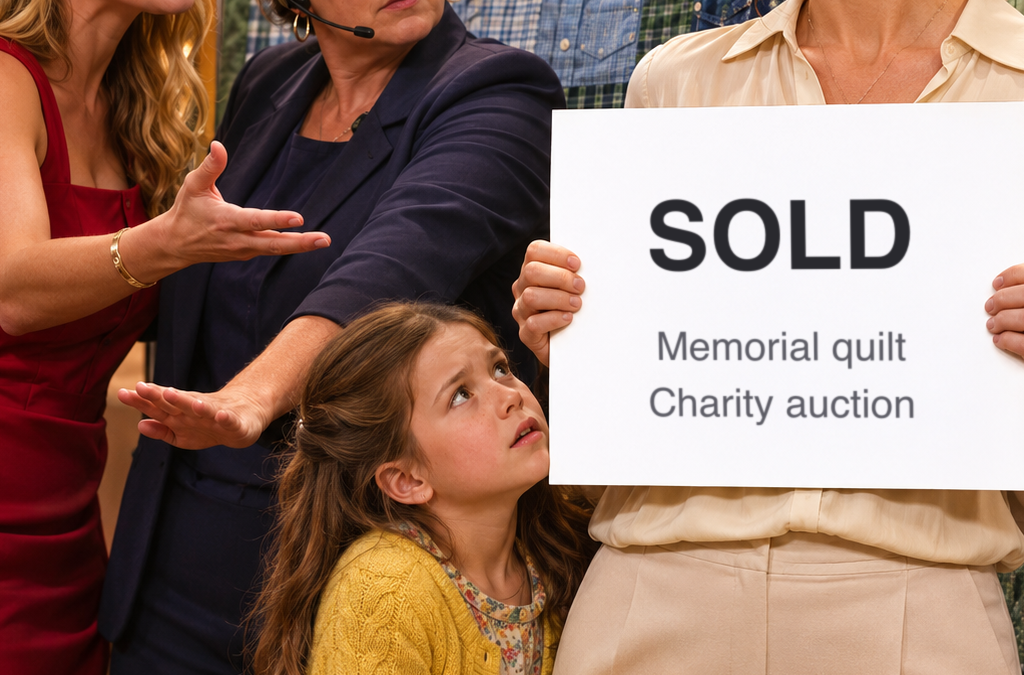
Emma touched the display rail beneath the SOLD card. The quilt hung beyond her fingers, its blue squares facing the aisle.
“Dad’s shirts,” she said. “Mom, why does that say sold?”
Paige leaned close enough that I smelled her perfume.
“Your daughter needs closure, not another box of scraps.”
Our mother looked down at the auction program.
I reached toward Paige’s crooked placard. One corner had slipped behind the rail. My fingers stopped before they touched it.
“Smile first,” Paige said. “They want a donor photograph. We can talk afterward.”
A volunteer waited nearby with a camera. Paige shifted toward me, leaving a space where I was supposed to stand.
“Who bought it?” I asked.
“We’ll get the name. Come on, Nora. Everybody’s been so nice.”
Emma stayed against my leg. She wore the yellow cardigan she’d picked because it had pockets big enough for crackers. One pocket bulged with the packet I’d given her in the car.
“I’m not posing,” I said.
Paige’s face barely changed. She turned toward the volunteer.
“Give us a minute? My sister just got here.”
The volunteer lowered the camera but remained within earshot.
Behind the rail, I could see Daniel’s green checked shirt. He’d worn it for school pictures because Emma said green made him look less tired. I’d kept the little chest pocket in its square.
“Don’t upset her,” Paige said quietly.
“She asked why her quilt was sold.”
“And you can answer without making this frightening.”
Emma looked up at me.
“Are they taking it home?”
“Stay here with me, honey.”
Paige glanced toward the volunteer again. “Children follow our lead. If you act like this is some terrible thing—”
“Helping my family never meant giving away my daughter’s memories.”
Mom’s mouth moved, but she said nothing.
Paige lowered her voice further.
“Mom was there this morning. She knows this wasn’t me sneaking around.”
“Then Mom can tell me why my quilt has a SOLD card.”
“Please don’t put her in the middle.”
“You just did.”
A couple coming down the aisle slowed near us. Paige greeted them with a little nod, the same one she used when clients interrupted her lunch.
“We’re sorting out a family misunderstanding,” she told them.
I watched them move on. I wanted to follow them out, put Emma in the car, and have this conversation somewhere nobody could hear.
The quilt would still be here.
“Who’s in charge of releasing the purchases?” I asked.
“Nora, let me handle the desk. You shouldn’t have to deal with that.”
“I’m asking who.”
“Carol. She’s right over there.”
Paige called her before I could. Her voice became bright enough to carry.
“Could we borrow you? We’ve got a little confusion about the family quilt.”
Carol came from the checkout table wearing a headset and flat black shoes.
“What’s the problem?”
“This wasn’t for sale,” I said. “Please stop whoever’s coming to take it.”
Paige answered before Carol could.
“It came through with me. There’s a collection receipt.”
“I let her bring it here.”
Carol looked from my sister to me.
“Are you saying you own it?”
“Yes.”
“And you didn’t agree to sell it?”
“Yes. I mean—no, I didn’t agree.”
My face felt hot. Emma pressed closer, and I hated that I’d tangled up the easiest answer.
Carol didn’t hurry me.
“Has anybody taken it off the display?” she asked.
“No,” I said.
“All right. I need to check what’s been processed.”
“Can’t you just remove the card?”
“Please leave it where it is. If someone has paid, I can’t undo that just because two people give me different accounts.”
Paige nodded as though Carol had confirmed everything.
“Exactly. We need a minute without an audience.”
“We can stay right here,” I said.
Mom stood close enough to hear us. She kept looking toward the checkout desk.
“What collection receipt?” I asked Paige.
“The one from your worktable.”
I opened my phone. Between fitting pictures and a grocery list, I found the image I’d taken that morning. I held it where only Carol could see.
“That,” I said. “Is that what she gave you?”
Paige leaned closer. Carol moved a little toward me.
Carol read the screen twice, then stepped between Paige and the display.
“Keep this here,” she told the volunteer. “Nobody wraps it yet.”
“Carol,” Paige said, “I brought what the desk asked for.”
“I’m checking it.”
Emma’s cracker packet made a small snapping sound inside her pocket.
“Can I eat these?”
“Yes, honey.”
“Even in here?”
“Yes.”
She opened them carefully, watching the quilt instead of the crackers.
Carol asked me to enlarge the photograph. It showed the carbon copy Paige had left on my worktable after pickup.
“That’s my name,” I said. “I didn’t write it.”
“Who completed the receipt?”
“Paige collected everything. I was in the back with a fitting.”
The words forged pickup receipt came out louder than I intended.
Paige’s eyes moved toward the volunteer.
“Can we please be careful what we’re calling things?”
Carol looked at me. “Do you still have this copy?”
“At my studio.”
I had photographed it while clearing my table at 11:20. Before that were my ordinary outgoing pictures: six repaired table linens, the B-17 tag, a note about a sleeve needing another press.
The quilt appeared in those, too.
I hadn’t examined the signature that morning. I’d been trying to clear space before my next customer.
“This is why I need a moment,” Carol said.
Her headset crackled. She listened, then checked a message on her phone.
Paige looked toward checkout. “They’ve already done their part. I don’t want a customer dragged into this.”
Carol looked up. “The buyer’s card has already been charged?”
She listened again, then said, “Don’t release anything. I’m coming over shortly.”
A volunteer brought her the checkout receipt. The amount was $2,400. Below it were the buyer’s name, Martin Price, and the time: 6:06 p.m.
We had reached the display two minutes after he paid.
“Please tell him there’s a hold,” Carol said. “I’ll speak to him myself.”
“Does that mean we can take it?” I asked.
“No. It stays with us while I check the accounts.”
Paige exhaled through her nose.
“So now someone who came to support the pantry gets embarrassed.”
“I’ll handle the buyer,” Carol said.
On Wednesday, I’d registered the quilt for exhibition at Maple Hall here in Dayton, Ohio. Carol had kept the original sheet we signed in the event binder.
That Saturday morning, Paige had collected it with the repaired linens. Mom had been there, too.
“I agreed to transport,” I said. “That was all.”
Carol nodded, but she didn’t promise me anything.
Paige came closer while Carol spoke to the volunteer.
“You know what this does to the honeymoon,” she whispered.
“I know what you asked me to lend you.”
“I’m counting on these proceeds. The balance doesn’t wait because you’re having a hard night.”
My sister had brought me so many emergencies that I knew their price before she finished speaking. I’d solved her emergencies until she mistook my help for permission.
“You could have left this one thing alone,” I said.
Mom finally looked up.
“Girls, please. People can hear.”
I looked at her instead of Paige.
“Were you at checkout?”
She rubbed her lips together.
“What did you tell them, Mom?”
“I told them you gave it to her.”
Chapter 2 of 7
“What did you actually hear me say?”
Mom followed me into the side corridor. The clock above the drinking fountain read 6:24. Paige stayed beside the doorway, where she could still see checkout.
“I heard you let her take it.”
“Take it where?”
“Here, Nora. Here.”
“Did you hear me say she could sell it?”
Mom looked toward Paige.
“I didn’t use the word gift,” I said. “Did you hear me use it?”
“No. But you were letting her collect everything.”
“You told the desk more than that.”
“I thought that was what you’d arranged.”
Paige stepped farther into the corridor.
“Mom believed we had an arrangement. I didn’t tell her what to say.”
“I’m asking what she heard.”
“And she’s answering. She thought you were helping me.”
Mom worried a peppermint against her back teeth. She always carried loose ones, collecting lint in the corners of her purse.
“You usually do,” she said.
Emma stood beside the drinking fountain, counting the crackers left in her packet. I wished Mom had waited until she’d finished chewing.
“Usually isn’t something I said this morning.”
“Nora, she wasn’t trying to hurt you,” Paige said. “She spoke honestly about what she believed. So did I when I entered it.”
“You both told strangers I’d agreed.”
“We’re your family. We didn’t think we needed to treat every conversation like—”
“What conversation?”
Paige glanced toward Emma and stopped.
Mom said, “I should have asked you.”
“Will you tell Carol that?”
“Can we discuss it first?”
“We are discussing it.”
Carol appeared with a man in a gray sport coat. He had a folded receipt and the careful expression of somebody approaching a stranger’s hospital bed.
“This is Martin Price,” she said. “He purchased the lot.”
“I’m sorry we’re meeting this way,” he said.
“I’m Nora.”
“I gathered that.”
His eyes moved briefly toward Emma, then back to Carol.
“I paid $2,400. I’m not asking anybody to rush her. But did you have permission to sell it?”
“That’s what I’m checking,” Carol said.
“I bought what was listed. If there’s a problem with that, I need to know.”
Paige’s voice softened.
“Of course. You shouldn’t have been put in this position.”
He didn’t answer her. He stayed facing Carol.
“Has the money gone out?”
“No. We haven’t distributed any proceeds.”
“Good. Then please leave it there until you’ve checked.”
I had expected him to demand his purchase. His patience made me more aware of what he’d paid, not less.
“Was this listed as a donation?” I asked.
“Consignment,” Carol said. “That was on the listing. Eighty percent to the consignor, twenty to the pantry.”
“So Paige would get—”
“$1,920. The pantry would get $480. Nothing has been paid out.”
“That’s the arrangement I read,” Martin said. “I’m fine with consignment. I need an authorized sale.”
Paige nodded.
“I submitted it under my name. I haven’t hidden that.”
Carol turned to Mom.
“Were you present when Nora agreed to that?”
“I was there when Paige collected it.”
“That isn’t what I asked.”
Mom’s peppermint clicked against her teeth.
“No. I didn’t hear an agreement about selling.”
Paige looked down the corridor toward the restrooms. She waited until Mom had finished before speaking.
“I relied on what I believed Nora had agreed to. Mom had the same impression.”
Carol looked at me.
“Tell me about pickup.”
“I had a customer in the rear room. Her dress zipper kept catching the lining. Paige came for the repaired table linens and the quilt.”
“Did you speak to her?”
“From the back. I told her everything was ready on the table.”
“Ready to bring here,” Paige said.
“Yes. To bring here.”
Emma had finished her crackers. A drinking fountain motor hummed behind her.
“I found the carbon receipt afterward,” I said. “I photographed it when I cleared the table. That’s what I do with outgoing work.”
“Did you read it then?” Carol asked.
“Not closely. I should have.”
“Nora,” Mom began.
“I’m telling her what happened.”
Carol nodded toward my phone.
“Those pictures help identify what came in. They don’t settle whether you gave it away afterward.”
“I didn’t.”
“I’ve heard you. I’ve also heard that you didn’t sign the receipt. I can’t settle that here just by looking at the photograph.”
Paige started to speak.
Carol continued, “Your submission says you had unrestricted authority to offer it. That’s your signed statement. For now, the release stays stopped.”
“Until when?” Martin asked.
“Until I’ve checked the records against these accounts.”
He nodded, though his jaw worked once before he answered.
“All right. I’ll be nearby.”
The gown occurred to me when Paige looked toward the upstairs landing. I’d brought it early for a fitting between event jobs.
“Our appointment,” she said. “I’m going to make another arrangement.”
“That’s your choice.”
“I need someone who can keep this separate.”
The unfinished work was worth $420. I had left room for it in next week’s schedule.
“I haven’t charged you,” I said.
“I know.”
“Your gown is upstairs. You can have it back.”
Paige moved toward the doorway, already looking at her phone. I stayed with Emma while Carol asked Mom to wait.
At 6:38, my phone lit up with Paige’s message.
“I moved the $420 fitting to someone else. I need my gown tonight.”
Chapter 3 of 7
At 6:38, I went upstairs for Paige’s gown. Mom stayed with Emma by the corridor window.
The fitting room still had my step stool beside the mirror. I carried the garment bag downstairs and gave it to Paige.
“The final fitting hasn’t been done,” I said. “The pins are where we left them.”
She opened the bag and checked the hem, then the bodice. She examined the zipper I’d replaced last month.
“Are the extra buttons in here?”
“In the inside pocket.”
She closed the bag without thanking me.
Two women waited near the foot of the stairs. One held a program with a business card tucked inside. Paige turned toward them.
“I’m sorry. You were asking about table arrangements.”
“We can come back,” the taller woman said.
“No, please. This is my sister, Nora. She does alterations.”
The woman smiled at me. “Beautiful work, I hear.”
“Thank you.”
Paige settled the gown against her side.
“We’re having a difficult grief moment tonight. My sister lost her husband, and the family donation became harder once she saw it here.”
“That must be painful,” the other woman said.
“It was something we’d arranged together,” Paige said. “But seeing somebody else purchase it—well. Her little girl’s upset.”
Emma stood down the corridor with Mom. She was trying to get water from the lower fountain without wetting her cardigan.
“I didn’t agree to a donation,” I said.
Paige kept her voice gentle.
“Nora, they don’t need the details.”
“You’ve given them some.”
The taller woman looked toward her friend.
“We were only asking about centerpieces.”
“I know,” I said. “I’m sorry. But please don’t take my daughter being upset as proof I agreed and changed my mind.”
Paige’s expression stayed pleasant. Her voice dropped.
“Could you at least tell them we’re working this out as a family?”
“Carol is checking what happened.”
“That makes it sound like—”
“That’s what she’s doing.”
The woman with the program said they would email about styling. Neither asked another question. Paige thanked them for coming and watched until they reached the ballroom.
“You didn’t have to do that in front of them.”
“You introduced it.”
“I was giving them context. They heard enough downstairs to wonder.”
“You could have said there was a disagreement.”
Paige glanced at the garment bag.
“I need to put this somewhere safe.”
She left toward the coatroom. Mom came over while Emma watched the water fountain bubble after its button was released.
“Those women might have hired her,” Mom said.
“I might have done her fitting next week.”
“That’s different.”
“How?”
“You have customers already.”
I had a canceled appointment now, with no guarantee anyone would fill it. Four hundred and twenty dollars would have covered groceries and part of my studio rent.
Mom lowered her voice.
“This is her first important relationship with a venue. She finally has somebody giving her a chance.”
“I didn’t ask them to stop giving her one.”
“Couldn’t you have let that little explanation go?”
“She said I agreed.”
“She needed to get through the conversation.”
Emma came toward us, rubbing a wet patch on her cardigan.
“The fountain spits.”
“It does,” I said. “Stay away from that one.”
Mom watched her pass, then leaned closer.
“Usually you can find a way around these things.”
Usually I could work late, skip lunch, or answer another urgent call. This time, Mom wanted me to stand there while Paige explained me away.
Carol joined us near the stairs. Paige returned a moment later without the gown.
“I need the family discussion kept out of client conversations,” Carol said.
“I’d welcome that,” Paige said. “People are asking me questions.”
“Send them to me.”
Mom said, “We’re concerned about her showcase work.”
“That’s separate venue business.”
“But it’s why she’s worried,” Mom said.
Paige looked at her. “Mom. Please.”
Carol waited.
“The June 6 bridal showcase,” Paige said. “I don’t want tonight’s disagreement treated as a conclusion about my work.”
“The $3,500 booking is unpaid,” Carol said. “And no work had begun. Our April 16 agreement lets me end it for a material misrepresentation about property or permission at our events.”
“I read it. But that hasn’t been established.”
“I haven’t said it has.”
“Then please hear my account before you make any decision.”
“I will.”
I stood beside Mom while the ballroom doors opened behind us. Someone inside was laughing about a raffle basket.
Carol turned to me. “You’ll need to let me hear both accounts.”
“I’ll wait for you to check.”
Paige looked at me.
“Can you tell her we’ve always helped each other? That this wasn’t some stranger taking your property?”
“We’re sisters,” I said. “I won’t confirm permission I didn’t give.”
Carol asked Paige to remain available and went back toward checkout. Paige followed far enough to ask where she should wait.
Mom stayed beside me.
“Please stop sending people answers for me,” I said.
“I’m trying to help.”
“Ask me first.”
She looked at my phone, still in my hand from Paige’s message.
“I thought if she saw what you were upset about, she could explain.”
“What did you send?”
Mom’s eyes moved toward Paige.
“I forwarded Paige the picture of your receipt.”
Chapter 4 of 7
At 6:53, Paige came back from checkout.
“Yes, I wrote your name.”
Mom looked toward Emma, who was examining a scuff on her shoe.
“You told me to finish the paperwork,” Paige said. “From the fitting room. You said I could have it, and when I asked about the receipt, you said to go ahead.”
“I told you everything was ready on the table.”
“That was before. I came to the doorway.”
“You asked whether the linens were in the bag.”
“And we talked about the quilt.”
A server passed with a tray of empty glasses. Paige waited until he was through the ballroom doors.
“You were busy. I wasn’t going to drag you away from a customer.”
“I authorized collection. I did not authorize you to sign for me.”
Paige glanced at Mom, then back at me.
“You’ve had me fill things out before.”
“Pickup slips. With your name.”
“You’ve asked me to handle deliveries, talk to suppliers. Half the time you say, ‘Just deal with it, Paige.’”
I had said that about a missing zipper order. About a courier who arrived during a fitting. Hearing my own words made me hesitate.
Paige saw the pause.
“I didn’t think this was different.”
“You knew whose name you were writing.”
“I thought I was doing what you asked.”
The corridor had grown warmer. Behind Paige, someone had propped the ballroom door open with a folded program.
“You saw the picture Mom sent,” I said.
“Yes. And you kept your inventory pictures. I’m not disputing those.”
“Then why—”
“Because you took those before I got there. They show what was on your table. They don’t show what you said afterward.”
Emma leaned against my side. I could feel the damp patch of her cardigan through my sleeve.
Paige lowered her voice.
“I knew you’d photographed everything. You always do. That doesn’t change the conversation.”
“There wasn’t that conversation.”
“Then we remember it differently.”
Mom made a small sound.
I turned to her. “Did you hear me tell Paige to write my name?”
“I was getting the other bag.”
“Were you close enough to hear?”
“You had that customer in the back. I didn’t want to stand there listening.”
“Mom.”
“I heard you both talking.”
“What did I say?”
She looked toward the drinking fountain.
“I couldn’t repeat every word. There were bags, and Paige was trying to get here on time.”
Paige stayed quiet. She didn’t need to add anything while Mom searched for an answer she could live with.
“Please don’t fill in what you missed,” I said.
“I’m not trying to.”
“You already did at checkout.”
Her face reddened. Emma lifted her head, and Mom stopped talking.
Carol returned from the ballroom with her phone against her ear. She finished the call a few steps away, then joined us.
“I need to hear both accounts without interruptions.”
“I’d like that,” Paige said. “I can write mine down.”
“Please do. What you say happened, including the permission you say you received.”
“Fine.”
Carol looked at me. “I’ll review the original venue records as well.”
“Here?”
“At 7:40 p.m., in the east foyer. There’s more room there.”
“That’s nearly an hour,” Paige said.
“It gives me time to get the records and cover checkout.”
“Will the buyer stay?”
“I’ll ask him. I need you, Nora, your mother, and Martin there before anything is released.”
I looked at the clock. It was just after seven.
“Can someone take Emma upstairs?” Mom asked. “There must be somewhere she can wait.”
Emma’s shoulder pressed harder against me.
“She stays with me,” I said.
“I meant somewhere comfortable.”
“Then we’ll find somewhere comfortable together.”
Carol nodded. “There are chairs along the foyer wall.”
I bent enough to see Emma’s face.
“You can stand beside me or sit nearby. Whichever you want.”
“Can I change my mind?”
“Sure.”
“Do I have to talk?”
“No, honey.”
She nodded and leaned against me again.
Paige watched Carol.
“I don’t want her having to sit through people calling me things.”
“Then keep your account about the adults,” Carol said. “I’ll do the same.”
Paige pressed her lips together, then nodded.
“I’ll send it shortly.”
She walked toward a small table near the coatroom. Mom started after her.
“Are you helping her write it?” I asked.
“No. I was going to see if she wanted water.”
Mom stopped between us. For once, I let her decide where to go.
Emma and I found a bench near the foyer. The cushion sank toward the middle, sliding us together.
“Grandma puts this kind of couch in the dog category,” Emma said.
“The what?”
“Where a dog would sleep if you had one.”
I laughed, and she looked pleased enough to say it again quietly.
For several minutes, we sat there. A man asked whether the restrooms were down the hall. Someone wheeled past a cart of stacked dessert plates.
Paige stayed at the table, typing.
I wanted to go over and read each sentence before she sent it. Instead, I stayed beside Emma, with the unfinished week waiting in my appointment calendar.
At 7:13, my phone vibrated.
Carol’s message read, “Paige has submitted a signed statement saying you authorized her to sign.”
Chapter 5 of 7
Carol reached our bench while the 7:13 message still lit my phone.
“I’ll read you what she submitted.”
Emma sat upright beside me.
Carol read from her screen. “Paige says you gave her the quilt that morning, then authorized her to complete the collection paperwork in your name while you finished a fitting.”
“She calls it an oral gift?” I asked.
“Yes. Followed by permission to sign.”
“That didn’t happen.”
“Is there anything else you want me to hear before we meet?”
“I said everything was ready to collect. That’s what she’s turned into this.”
Carol waited, but I had nothing else. No one had been standing beside me taking notes.
“I’ll bring the records to the foyer,” she said.
Paige approached as Carol left. She stopped far enough from the bench that I had to look up.
“Did she read it?”
“Yes.”
“Then you know I’m not pretending I didn’t sign.”
“You’re saying I asked you to.”
“Because that’s what happened from my side.”
“There aren’t two sides to what I said.”
Paige glanced toward the ballroom.
“A man has paid for this. The pantry has counted on its share. It isn’t only us anymore.”
“I know he paid.”
“Then you know why I can’t just shrug and say we misunderstood each other.”
She sounded tired. Anyone passing would have heard a younger sister trying to settle an unpleasant problem.
“You signed for a delivery,” I said. “You didn’t get permission to sell it.”
“I signed under the permission I had. Families do that without making appointments and drawing everything up.”
“Carol needs to hear from the person who brought it in.”
“She’s heard you.”
“She needs to hear me without treating his payment as my permission.”
Paige looked at Emma, then back at me.
“I wish we’d talked before this became everyone’s business.”
She left before I could answer.
Emma’s shoes hung above the carpet. She kept touching their toes together.
“Can we have dinner after?”
“Yes.”
“Something with a fork?”
I’d given her crackers and called it enough for now. At home, she liked to remind me that snacks weren’t dinner, usually while I ate cheese over the sink.
“Definitely a fork.”
Mom was near the coatroom when I found her. Emma came with me.
“Carol wants you at the review,” I said.
“I know. Paige told me.”
“Please come and tell only what you heard.”
Mom glanced toward the ballroom.
“Couldn’t we find somewhere private first? Just the three of us.”
“And say what?”
“I don’t know yet. Talk without everybody watching.”
“We’ve been talking.”
“We’ve been hurting each other.”
I let that sit. From the ballroom came the scrape of chairs and someone asking about leftover rolls.
Mom lowered her voice.
“Maybe there’s an amount we could offer the buyer. Something to smooth this over.”
“Whose money?”
“I haven’t worked that out.”
“I’m not paying to fix a sale I never agreed to.”
She looked at Emma, then away.
“I wasn’t asking you to.”
“You hadn’t worked that part out either.”
Mom’s face changed. I almost apologized for my tone.
Instead, I said, “If you assumed something, say you assumed it. Don’t make it something you heard.”
“I’ve already said I should have asked.”
“Tell Carol.”
Mom stood for a while without answering.
“All right. I’ll be there.”
She didn’t say what she would tell her.
By 7:32, Martin was waiting outside the east foyer. His sport coat was over one arm now. He looked toward checkout whenever someone came through the corridor.
“I’m sorry you’ve lost your evening,” I said.
“I’d rather lose some time than take home something I shouldn’t.”
“Thank you.”
“I still need an answer.”
“I know.”
He had kept his payment record. My phone held the receipt image I’d shown Carol, along with the photographs from my worktable. We waited a few feet apart while Emma chose a chair against the foyer wall.
Carol arrived carrying the event binder and a separate business folder. She went inside to a table near the windows.
“Give me another minute,” she said.
Paige joined us before that minute was up. Mom followed her.
Two bidders stood nearby discussing pickup times. Another guest stopped to ask Martin whether the desk was still open.
“I’m waiting on a release,” he said.
Paige answered before the guest could move on.
“There’s been a disagreement about a family arrangement. My sister gave me the quilt, and I entered it on that understanding.”
Martin looked at me, then at her.
“Carol’s checking that.”
“Of course. I want her to. But I also want you to know I didn’t simply take something from her house.”
The bidders stopped talking.
“Nora authorized me to sign the collection receipt,” Paige continued. “I relied on that. We’ve handled things informally for years.”
Mom stayed beside her.
“I understand you paid in good faith,” Paige told Martin. “So did I when I submitted it.”
I could have answered every sentence. Emma was watching from her chair, waiting for the evening to end.
“Martin,” I said, “what name is on your claim ticket?”
He frowned.
“The donor name. Not the payment receipt.”
He unfolded a cream ticket and checked it. I had never approved being named as a donor.
Inside the foyer, Carol looked up from the closed binder. The nearest bidder leaned closer to hear, and Carol turned toward the display.
Martin read aloud.
“It says this was donated by Nora Bennett.”
Chapter 6 of 7
“Before you release it, tell him whose permission you relied on.”
The foyer clock read 7:40 p.m. Martin stood between the table and the doorway, his claim ticket still open.
“Yours,” Paige said. “Your name stayed on it because you made it. That was credit, Nora.”
“I never approved that ticket.”
“You gave it to me afterward. You told me I could finish the paperwork for you.”
Carol looked toward the bidders waiting outside, then back at Paige.
“What authorized this venue to change a display loan into a sale?”
“The collection receipt recorded the release. Nora had already told me I could have it.”
“Release for what?”
“To bring here and enter. That was our conversation.”
Paige’s voice stayed even. Mom stood beside her, staring at the table.
“I understand why the earlier paperwork says something else,” Paige continued. “It was done before Saturday. People change their minds. I relied on my sister telling me she wanted to help.”
Carol looked at me.
“I didn’t say that.”
“I have two accounts,” Carol said. “I need to check what the venue accepted.”
I placed my phone beside the binder, the receipt photograph enlarged.
“B-17,” I said, pointing to the code. “It’s on the pickup receipt. Will you read that entry in your original sheet?”
Carol opened the binder. Paige leaned forward far enough to see.
“There’s a category key here,” Carol said. “B-series is borrowed exhibition inventory.”
She found the sheet we’d signed Wednesday.
“B-17. Memorial shirt quilt. Exhibition only. Return to Nora Bennett.”
Emma sat very straight against the wall.
Carol continued. “Conversion to sale requires the owner’s written approval, countersigned by Maple Hall.”
She checked behind the sheet, then the attached lot records.
“There’s no conversion attached.”
“The receipt was the later permission,” Paige said.
“It records collection under B-17.”
“Because that was its number. I didn’t invent a different number after she gave it to me.”
Carol compared the receipt with the original again.
Paige waited, then said, “A gift doesn’t stop being a gift because somebody hasn’t changed an inventory category. You accepted the receipt. A customer has paid.”
“You may claim a private gift. This receipt still did not authorize our venue to sell B-17.”
Paige’s gaze moved toward Martin.
“I wasn’t told another form was missing.”
“Your submission said you had unrestricted authority to sell,” Carol said. “This record required approval we never received.”
Mom spoke before Paige could answer.
“I didn’t hear her give permission.”
Paige turned toward her.
“Mom, you weren’t in the fitting room.”
“No. I was by the worktable.”
“Then you couldn’t hear everything.”
“I heard Nora say it was ready. I saw you collect it. That’s all I can say.”
Mom’s voice shook on the last words. One bidder looked down at her program.
“I didn’t hear permission to sign her name or donate it,” Mom continued. “I told checkout she’d given it to Paige because I didn’t want an embarrassing question. I thought Nora would go along.”
“You told me you understood,” Paige said.
“I thought I did. I shouldn’t have said I heard it.”
Carol waited until Mom stopped.
“Lot 26 is void. We will refund the buyer and return the display loan to Nora.”
Martin nodded once. My knees felt unsteady, but Emma was still watching Carol.
Paige spoke quickly now.
“The showcase is separate. No work on that has anything to do with this.”
“The agreement covers misrepresentation about property or permission at our events,” Carol said. “Your unrestricted-authority statement was material to this sale.”
“You’re treating a family disagreement as—”
“I am terminating the $3,500 styling contract under its misrepresentation clause.”
Paige closed her portfolio. The snap sounded sharp against the foyer’s low conversation.
“Can we discuss June privately?”
“No. That decision stands.”
“I have suppliers expecting to hear from me.”
Carol gave her a moment, but offered nothing more.
Martin handed over his cream claim ticket.
“I’ll wait for the refund confirmation,” he said. “I don’t need anything wrapped.”
The bidders moved aside when he stepped toward checkout. Neither asked Paige about styling. She remained beside the table, her portfolio pressed against her dress.
Mom crossed from Paige’s side.
“I heard what she said to you at the display,” she told me. “About Emma. I should have spoken then.”
Emma looked at her grandmother but didn’t get up.
“May I bring it to her?” Mom asked.
I looked at Carol, who nodded toward the rail.
“Yes,” I said.
Mom lifted the quilt free and carried the quilt to Emma. The green checked square folded over her arm; Daniel’s shirt pocket caught briefly against the edge.
Emma stood to receive it. She gathered it against her cardigan, nearly hiding the yellow.
Paige watched them.
“The honeymoon balance is still due,” she said quietly to me. “I have to find that money now.”
“My daughter’s memories aren’t your wedding budget.”
“I wasn’t asking for—”
“And I won’t do any more wedding alterations.”
My canceled appointment would stay canceled. If another seamstress needed measurements, Paige could arrange that herself.
Emma came beside me under the quilt.
“Dinner?” she asked.
“Yes. Somewhere with forks.”
She gave a tired little laugh. We left the foyer together, without waiting for Paige to answer.
Outside, Emma asked me to carry one trailing corner. We were heading toward the car when my phone vibrated. I kept walking.
Paige’s 8:02 p.m. text read, “Don’t come to the June 13 wedding.”
Chapter 7 of 7
On Monday, April 20, I crossed the remaining fitting out of my appointment book. Then I answered Paige’s text.
“Emma and I won’t attend. I won’t provide further alterations or money.”
I didn’t ask her to reconsider. Emma and I would spend that Saturday at the pool, then get dinner somewhere she could order for herself.
Mom called while I was opening the studio.
“Does the new seamstress have everything she needs?”
“Paige has her gown.”
“I meant, could you call and explain what’s left?”
“No. I’m not arranging someone else to do it.”
Mom paused.
“All right.”
I waited for the next request. None came.
Carol called before my first customer arrived.
“We issued Martin’s full $2,400 refund today,” she said. “The confirmation’s in your email.”
“Has he received it?”
“We’ve sent it back to his original payment method. His bank handles when it shows.”
“Thank you for calling.”
“I’m sorry this happened here, Nora.”
“So am I.”
Afterward, I opened the confirmation, saved it, and went downstairs to unlock the door. A customer was waiting with pants folded over her arm.
She wanted the original hems kept. I asked her to try them on.
On Wednesday, April 22, Carol emailed the corrected catalog link.
Lot 26 withdrawn.
Below that, the entry said the quilt had been supplied by Nora Bennett for display, not donation. There was no family explanation attached.
I read it once and closed the page.
Paige sent two messages that week about supplies from her gown. I answered where the extra fabric was and which package held the spare buttons. When she asked whether I would finally talk on the phone, I wrote back.
“Necessary arrangements by text or email only.”
She didn’t call again.
Mom asked to visit that Saturday. I said she could come at two, while Emma was at a friend’s house.
On April 25, she arrived without a shopping bag or a garment over her arm. She stood at the bottom of the porch steps until I told her to come up.
The chair beside mine had a split in its vinyl cushion. Mom sat carefully on the other edge.
“Emma’s not here?”
“No.”
“I brought nothing for her. I didn’t know whether that would be—”
“Okay.”
A lawn mower started across the street. Mom waited for it to pass the nearest stretch of grass.
“I’ve been trying to find a better way to say this.”
I stayed in my chair.
“There isn’t one,” she said. “I knew you hadn’t said yes. I thought you’d forgive me faster than she’d forgive me.”
The mower turned. Through the screen door, I could hear the kitchen clock.
“You let me keep asking you what you heard.”
“I know.”
“You watched me ask.”
Mom’s eyes filled.
“I kept thinking I could get you both out of there without making it worse.”
“For Paige.”
“Yes.”
She said it quietly, without adding my name.
I looked at the driveway. There was a chalk hopscotch square near the garage, most of it washed pale by rain.
“I needed you standing beside me,” I said. “Emma needed that.”
“I should have been.”
“You don’t get to use how often I’ve forgiven you as permission.”
“I’m sorry.”
I didn’t tell her it was all right. She waited a little, then wiped her face with a tissue from her purse.
“Is there a way I can still see you? Both of you?”
“Planned visits. You ask first, and sometimes I’ll say no.”
“All right.”
“Don’t forward my messages or pictures. Not to Paige. Not to anybody because you think they can explain me.”
“I won’t.”
“And don’t ask Emma to help us make up. No telling her Aunt Paige misses her so she’ll ask me to call.”
Mom looked down at the porch boards.
“I’ve done that before.”
“Yes.”
“I won’t do it again.”
She asked whether she could call the following week. I said Thursday evening would be fine.
At the steps, she stopped.
“I’m still going to the wedding.”
“I haven’t asked you not to.”
“I know. I just wanted to tell you myself.”
She left without asking me to sew anything, lend anything, or bring Emma home for a hug.
Thursday came. Mom called when she said she would.
After that, there were a few visits. Once, I said we weren’t available. She said she would ask another week.
She didn’t send me wedding updates. She didn’t arrive with something Paige needed fixed.
On June 13, Mom attended Paige’s wedding. Emma and I went to the pool with towels that never dried between swims.
At dinner, Emma ordered spaghetti and asked for the sauce on the side.
“You know that’s two foods you have to combine yourself,” I said.
“I like being in charge of the sauce.”
She used nearly all of it.
We went home sun-tired, with half her dinner in a takeout box. I didn’t open social media that night.
By Saturday, July 18, Mom had made several visits without stretching them past the time we’d agreed. That afternoon, she called while Emma and I were deciding on a movie.
“Could I come next weekend?” she asked.
“Sunday, maybe. I can do an hour after lunch. Let me confirm Thursday.”
“That works.”
She didn’t ask what we were doing instead of seeing her that evening.
Emma was waiting in the living room with two movie choices. She picked the animated one we’d already seen, then objected when I began quoting the opening.
“You’re doing the other movie.”
“Am I?”
“You always mix up those two dads.”
I made popcorn. Emma shook the bowl to bring the salty pieces up from the bottom.
The quilt lay across the couch. She pulled it toward her knees, passing over the green checks until she found the corner made from Daniel’s blue work shirt.
The cotton had softened along the seams. A little crease remained where the shirt cuff had once folded.
“Want some?” she asked.
“Popcorn?”
“The blanket, Mom.”
She lifted the edge, and I sat beside her. It covered our legs with enough left over for her bare feet.
The movie started while she found a comfortable place against my shoulder.
She tucked the blue square beneath her chin.







