My Sister Told 35 Relatives I’d Freeloaded Off Dad for 9 Years—Then Dad Passed a Shoebox Across His Birthday Table
Complete story · 7 chapters · about 36 minutes · ending included
Chapter 1 · Chapter 2 · Chapter 3 · Chapter 4 · Chapter 5 · Chapter 6 · Chapter 7
Chapter 1: The Toast That Priced My Father’s House
At 12:40 p.m. on my father’s eightieth birthday, my sister Cynthia took the microphone in front of thirty-five relatives and said, “Nine years rent-free, and he still can’t spell her name.”
A few people laughed before they understood she meant me.
Cynthia smiled toward the cake table.
“Let’s do the math. One thousand four hundred dollars a month for nine years. That’s one hundred fifty-one thousand two hundred dollars.”
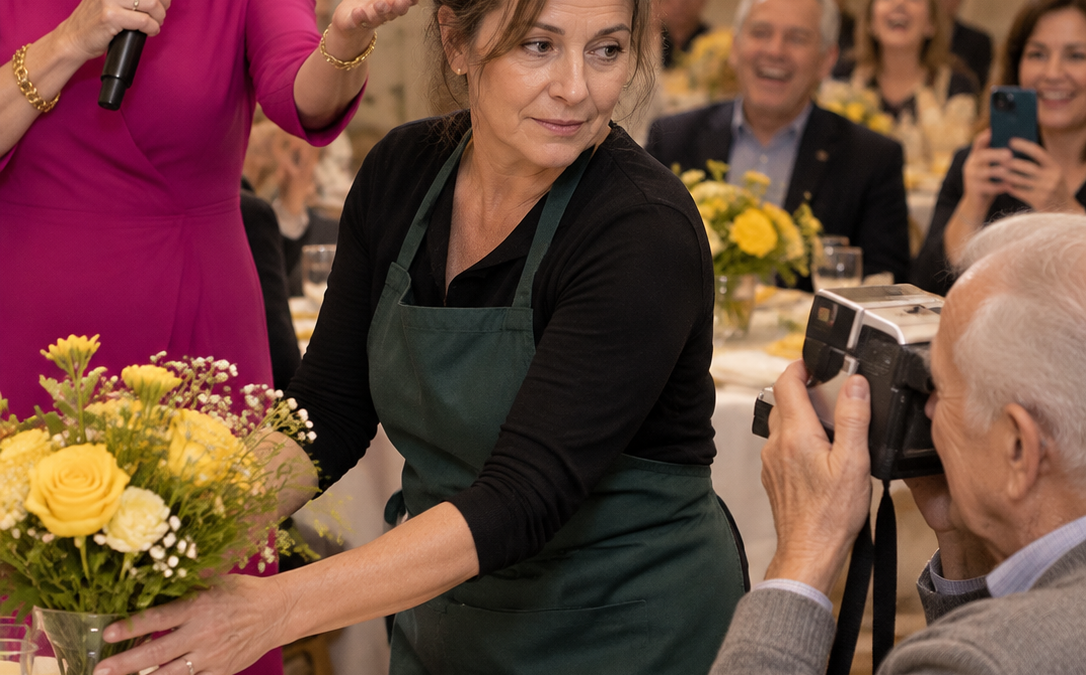
I was holding a glass vase full of yellow mums.
I set it in the center of the nearest table.
“Cake’s at three-thirty.”
That was my answer.
Cynthia’s smile brightened.
She had always talked as if a microphone had been waiting for her, even when there wasn’t one. At fifty-eight, she sold dental supplies out of Scottsdale and could make a room full of strangers feel like they had walked into the middle of her favorite story.
That afternoon, I was the story.
I was fifty-four years old and owned a flower shop in Madison. The centerpieces Cynthia was standing beside had come from my cooler that morning. Eight arrangements, no charge, because Dad liked yellow.
I had spent nine years keeping him in the house he knew.
Nobody at the parish hall had ever asked me what that cost.
Cynthia had apparently decided to tell them what I had gained.
Dad sat two tables away in his good gray sweater, looking pleased by the noise even when he didn’t understand why people were making it. He was eighty that day, a retired letter carrier who still folded his napkin into a neat rectangle and still knew exactly where the sugar belonged beside his coffee.
Names were harder.
Routines weren’t.
He had his instant camera hanging from a strap around his neck.
When I reached for the next vase, he lifted it.
“Tracy.”
I looked over.
He pointed the camera at me.
The little motor clicked.
A square photo slid out.
Dad held it carefully by the white edge while the image began to appear.
Then he looked at me.
“How do you spell you?”
That got another laugh.
Cynthia laughed hardest.
I kept one hand on the vase.
“T-R-A-C-Y.”
Dad repeated each letter while he wrote it on the back.
“T. R. A. C. Y.”
His handwriting had gotten larger over the years, but the letters were careful.
He added something underneath that I couldn’t see.
Then he slipped the photo into his shirt pocket.
Cynthia leaned toward the microphone.
“See? Nine years under the same roof, and he still needs help.”
A few relatives laughed again.
My cousin Shannon didn’t.
She stood near the coffee urn with her phone in one hand, watching Cynthia instead of me.
Shannon was forty-seven and worked as a home health nurse. She had no patience for pretty explanations, which was one reason Dad liked her. She told him what pill she was handing him and why. She never talked over him.
Across the room, Dad’s brother Harold sat with a brown folder beside his plate.
Harold was seventy-six, retired from a credit union in La Crosse, and read every document like somebody might hide a decimal point from him.
At least that was what I had always believed.
Cynthia turned slightly so Harold could see her.
“I fly in every month. Who do you think keeps him going?”
Nobody answered.
She reached down and lifted a folder from the chair beside her.
“There’s a listing here for four hundred twelve thousand dollars.”
The room got quieter.
She pulled the top page halfway out so people could see a photograph of Dad’s house.
My house too, in every ordinary sense except ownership.
The white two-story on the east side where I had moved back in nine years earlier. The same kitchen where Dad still put his cereal bowl in the left side of the sink. The same porch where he counted passing mail trucks out of habit.
Cynthia held up another page.
“And there’s a care-home assessment. A real place. Professionals. People who know what they’re doing.”
Her microphone voice softened.
“Not one cent of this is for me.”
I looked at Harold.
He didn’t look at me.
He was watching the folder.
That bothered me more than Cynthia’s speech.
Dad’s house had been in his revocable trust since 2014. In July 2022, while Dad was still competent to make the decision, he had named Harold as co-trustee with him.
Cynthia and I did not get account statements.
We did not get votes.
Dad had signed it that way.
And Harold’s signature alone could bind the trust.
I had never complained about that.
I had never taken money from the trust either.
Picking up where the Facebook post left off
I paid my own expenses. Dad paid his. I handled groceries when I was there, took him to appointments, fixed what I could, called someone when I couldn’t, and learned which mornings he needed three reminders before he put on clean socks.
I had never made an invoice for any of it.
Apparently Cynthia had decided that meant it had been free.
She started talking about “options” and “safety” and the yard at the care home.
I moved another centerpiece two inches to the left.
Shannon came beside me.
“You going to answer that?”
“No.”
“You should.”
“No.”
She looked at my face and stopped asking.
That was the thing about Shannon.
Blunt didn’t mean stupid.
At the far table, Dad stood up.
He moved slowly, one palm on the chair back.
I started toward him, but he waved me off.
“I’m good.”
He crossed the room toward Cynthia.
She saw him coming and spread one arm toward him like she was welcoming the guest of honor onto a stage.
“There he is. Birthday boy.”
Dad smiled politely.
He held out his hand.
Cynthia’s smile changed before their hands touched.
Only slightly.
Dad shook with the same courtly grip he had used on strangers at the post office.
Then he said, “You from the house people?”
Cynthia went white.
It lasted maybe one second.
Maybe less.
Then she laughed so loudly that three people near the kitchen turned around.
“Oh, Dad.”
She patted his hand.
“You’re terrible.”
Dad looked at her, still polite.
“I know you?”
Her fingers tightened around the microphone.
“It’s Cynthia.”
He nodded as if she had told him the name of a waitress.
“Cynthia.”
Then he looked back toward me.
“Tracy, where’s my coffee?”
“By your chair.”
He turned around and went back to it.
Nobody laughed that time.
I watched Cynthia recover.
She was good at that.
By the time Dad sat down, she was smiling again.
“That’s exactly why we’re having this conversation,” she said.
Harold finally opened his folder.
I saw the listing inside.
The same house photo Cynthia had just shown the room.
He took his glasses off, wiped them with his napkin, put them back on, and started reading.
My stomach tightened.
I knew Harold’s habits.
He didn’t hurry papers.
He read dates.
He checked signatures.
He asked questions.
But the room had just heard that I had taken $151,200 from Dad in free housing.
They had heard that Cynthia flew in every month.
They had seen Dad fail to recognize her.
And I had answered none of it.
I had chosen three words and a flower vase.
Cake’s at three-thirty.
At 12:47, Aunt Marlene came over and touched my arm.
“I didn’t know you weren’t paying rent.”
I moved a fallen mum petal off the tablecloth.
“There’s more to it.”
She waited.
I didn’t continue.
I could see the question in her face.
Then she went back to her table.
That was the price of staying quiet.
People filled in the blank themselves.
By one o’clock, two cousins were helping Cynthia carry paper plates to the serving table. Somebody asked Harold whether the care home allowed residents to bring furniture. Another relative asked if the house would sell fast at $412,000.
Dad sat with his coffee and took another photo.
He asked Uncle Harold how to spell Harold.
Harold spelled it.
Dad wrote it down.
Nobody laughed.
I kept setting flowers straight.
At 1:10, Harold motioned me over.
His folder was open.
The listing sat on top.
“You knew about this?”
“No.”
“Cynthia says you did.”
“She’s wrong.”
He studied me.
Harold always took his time before speaking. That afternoon, it felt different. It felt like he was waiting for me to make his job easier.
“You want me to stop the listing?”
“Yes.”
“Why?”
“He wants to stay home.”
Harold glanced toward Dad.
“That may not be enough.”
“It’s enough to him.”
“Tracy.”
I waited.
“If I’m going to refuse something that may be necessary, give me something I can use.”
“Like what?”
“A reason.”
I looked across the hall at Cynthia.
She was standing beside Dad now, explaining the care home’s garden to Aunt Marlene.
Dad was listening with the pleasant attention he gave strangers.
Cynthia caught me watching and lifted her eyebrows.
She thought she had already won.
Maybe she had reason to.
I knew what I had done for Dad.
Shannon knew pieces of it.
Dad knew it in the way he knew the coffee was by his chair and his camera belonged around his neck.
But Harold dealt in paper.
And Cynthia had brought paper.
At 1:15, someone from the kitchen rolled a cart of coffee cups toward the serving tables, and relatives began moving chairs and clearing space around the cake table for later.
I carried the last centerpiece over and set it beside the covered sheet cake.
Yellow mums.
Dad smiled at them.
“Pretty.”
“They’re yours.”
He touched one petal.
“From where?”
“My shop.”
He nodded.
Then he raised the camera again.
“How do you spell you?”
“T-R-A-C-Y.”
He wrote it down.
Across the table, Cynthia smiled at Harold.
Harold opened the folder one more time.
Then he took a pen from his shirt pocket and placed it beside the listing.
More than two hours until cake.
More than two hours until the room expected a signature.
I looked at the folder.
Then at Dad.
Then at Harold.
Was he really going to sign before anybody checked Cynthia’s story?
Harold rested two fingers on the pen.
“Three-thirty, Tracy. Unless somebody gives me a reason.”
Chapter 2: The Invoices With My Sister’s Name
I had until three-thirty, and all I had was my own word that Cynthia had not been flying into Madison every month.
At 1:25 p.m., I found her in the parish hall kitchen arranging stacks of napkins beside the coffee supplies.
She had traded the microphone for a manila envelope.
“Good,” she said. “I was looking for you.”
She held it out.
I didn’t take it.
“What is it?”
“Your move-out date.”
I looked at the paper inside.
October 31.
“That’s five weeks.”
“It’s plenty.”
“For what?”
“To get your things out of Dad’s house.”
Cynthia said it like she was moving a delivery appointment.
I folded the paper once.
She leaned against the counter.
“You’ve had nine years, Tracy.”
I looked at her.
“You said nobody asked me.”
“They didn’t.”
“You know why I moved in.”
Her mouth tightened.
Then she raised her voice just enough for two relatives near the kitchen door to hear.
“She moved in on him. Nobody asked her to.”
Aunt Marlene glanced our way.
Cynthia saw her looking.
That was the point.
I put the paper on the counter.
“Where’s Harold?”
“Why?”
“Need him.”
Her smile disappeared.
“He’s busy.”
“So am I.”
I walked out before she could stop me.
Harold was still at the cake table with his folder open and the pen beside it.
Dad sat three chairs away, turning his coffee cup slowly between both hands.
I pulled my phone from my apron pocket.
I had kept one message for nine years.
Not because I expected to use it.
I had kept it because some sentences told you exactly where you stood with somebody.
Wednesday, March 9, 2016.
Dad had forgotten a dentist appointment that morning and left the stove burner on after lunch. I had called Cynthia after closing my shop.
Her answer had come by text.
I opened it and handed my phone to Harold.
He put on his glasses.
The message was still there.
You moved in, you deal with him. I have a life.
Harold read it without speaking.
Then he looked at the date.
“Nine years ago.”
“She said nobody asked me.”
“She was angry.”
“She meant it.”
He handed the phone back.
“People change.”
“She didn’t.”
Harold closed one hand over the folder.
“She’s come since.”
“How often?”
He hesitated.
Then he said, “I’ve paid for fourteen trips.”
I stared at him.
“What trips?”
Harold frowned.
“The trips she made here.”
“She told you she came here?”
“She submitted expenses.”
“How much?”
Cynthia appeared at my shoulder.
“Harold, we still have setup to finish.”
He ignored her and opened the folder.
I stepped closer.
The first page wasn’t the listing.
It was an invoice.
Cynthia Kessler’s name sat at the top.
Below that was a date and a flat amount.
$840.
Harold turned to the next one.
Same amount.
Another date.
Another signature.
I felt something cold settle under my ribs.
“How many?”
“I told you. Fourteen.”
“Total?”
“Eleven thousand seven hundred sixty.”
I looked at Cynthia.
She crossed her arms.
“Flights aren’t free.”
“You flew here fourteen times?”
“I helped Dad.”
“When?”
Harold started sorting through the pages.
“Here.”
He tapped one.
“Saturday, June 7, 2025.”
My head lifted.
June 7.
Something about the date caught at me, but I couldn’t place it yet.
Harold kept reading.
“The one before that was March 22.”
He turned another page.
“December 14, 2024.”
Another.
“September 21.”
Cynthia reached for the folder.
Harold pulled it slightly back.
“I’m reading.”
“I know what they say.”
“I’m checking.”
He went through them the way he probably used to go through loan papers at the credit union.
Slow.
Date.
Amount.
Signature.
He had paid every one.
I looked at him.
“You never told me.”
“Why would I?”
“Because I live with him.”
“You’re not a trustee.”
That stopped me.
It was true.
The trust Dad had signed did not require Harold to send me statements.
I had never asked.
I took nothing from it, and I had thought that kept everything simple.
Apparently it had kept me blind.
Cynthia tapped her fingernail against the cake table.
“This is exactly what I’ve been saying. Tracy thinks living there makes her in charge.”
“No.”
“She thinks Dad’s money needs her permission.”
“No.”
“She thinks the house is hers.”
“It isn’t.”
Cynthia blinked.
I kept my eyes on Harold.
“It’s Dad’s.”
Dad looked up when he heard himself mentioned.
“Mine what?”
“Your birthday.”
He smiled.
“Good.”
Then he lifted his coffee again and took a small sip.
Harold returned to the folder.
I reached toward the stack.
“Let me see June 7.”
Cynthia moved faster.
She put her hand over the papers.
“You’ve seen enough.”
Harold looked at her.
“Cynthia.”
“She has no right to trust records.”
“That’s true,” he said.
I looked at him.
He didn’t apologize.
He simply lifted Cynthia’s hand away and turned the June 7 invoice toward me without giving it up.
The date was clear.
Saturday, June 7, 2025.
$840.
The description said travel and care visit.
Signed at the bottom.
Cynthia Kessler.
I tried to remember that Saturday.
June.
Early summer.
Dad’s tomatoes had gone in late because of the rain.
I had worked the shop until noon, then gone home.
Or had that been another weekend?
I needed more than a feeling.
Behind the invoices, the edge of the house listing showed again.
A second document was clipped behind it.
I could see only part of the heading.
Advance.
Then a number beneath it.
$186,000.
I reached for the page.
“What’s that?”
Cynthia snatched the folder off the table.
“Nothing to do with you.”
I looked at Harold.
“What advance?”
“We’re not discussing that now.”
“She just said none of this is for her.”
Cynthia hugged the folder against her chest.
“It isn’t.”
“Then show me.”
“No.”
Harold’s jaw tightened.
“Give me the folder.”
Cynthia stared at him.
She held on to it long enough for Harold to extend his hand again.
Then she gave it back.
Harold put it flat on the table and closed it.
“Three-thirty is two hours off.”
“You’re still signing?”
“If the care recommendation stands and the house needs to fund it, I have a duty to Dad.”
“He wants to stay home.”
“And I need more than that.”
I looked down at my phone.
March 9, 2016 had not been enough.
Nine years ago, Harold had said.
She’s come since.
Fourteen times, according to paper.
Fourteen signed invoices.
$11,760.
The latest one was June 7.
I knew that date bothered me.
I just had to find out why.
Where had Cynthia really been on June 7?
Harold opened the folder one last time and pulled out the invoice.
He held the bottom toward me.
Cynthia’s signature ran across the line in blue ink.
“She’s been billing me to care for him. Where’s your invoice?”
Chapter 3: The Photo From June 7
At 1:50 p.m., I had Cynthia’s June 7 invoice in my head and one weak thing against it.
I remembered tomatoes.
Dad’s two o’clock pill was still at home, nine minutes from the parish hall, so Shannon came with me.
Neither of us talked until I turned onto Dad’s street.
Then she said, “What happened June seventh?”
“I worked that morning.”
“And after?”
“Went home.”
“You sure?”
“No.”
That was the problem.
Cynthia had a signed invoice.
I had a Saturday in June that felt familiar.
I parked in the driveway and killed the engine.
“Tomatoes,” I said.
Shannon looked over.
“What about them?”
“I planted tomatoes with Dad.”
“When?”
“I think June seventh.”
“You think.”
“Yes.”
She grabbed her phone from the cup holder.
“Then we find something better than think.”
We went inside.
Dad’s pill organizer sat beside the kitchen calendar.
I popped out the two o’clock tablet, put it in a small paper cup for the drive back, then stopped with my hand on the counter.
June.
The calendar was still hanging there because Dad hated throwing them away before the end of the year.
I flipped back.
Saturday, June 7.
In Dad’s handwriting, three words filled the square.
Tomatoes with Tracy.
My pulse kicked.
Shannon leaned over my shoulder.
“That helps.”
“Not enough.”
Cynthia could still say she came later.
She could say Dad had forgotten.
She could say anything.
Then I looked toward the hallway.
Dad’s bedroom.
His closet.
The boxes.
I had dusted around them for years.
Nine plain shoeboxes stacked two deep on the shelf above his shoes, numbered in black marker.
Dad had started taking instant pictures in April 2016 after the memory clinic suggested a daily record.
One photo.
Whoever was with him.
A date.
A name.
Sometimes a few words about what they had done.
He treated those boxes like route books from his postal days.
Nobody touched them.
That was his rule.
Not even me.
Shannon followed my eyes.
“What?”
“His pictures.”
“What about them?”
“He dates them.”
Her face changed.
“Every day?”
“Pretty much.”
“You’ve looked?”
“No.”
“Why not?”
“He doesn’t like anybody in them.”
Shannon glanced toward the clock.
1:54.
“You want the truth or permission?”
I didn’t answer.
I went down the hall.
Dad’s room looked exactly as we had left it that morning.
Bed made.
Slippers lined up.
Camera charger on the dresser.
The closet door stood half open.
I reached up and pulled down the newest shoebox.
My hands felt wrong doing it.
That bothered me more than I expected.
I had changed Dad’s clothes after accidents.
I had signed pharmacy forms.
I had sat beside him through appointments where strangers asked him what year it was.
But this was his.
He knew these boxes were his.
Shannon stood by the door.
“You don’t have to.”
“I do.”
I lifted the lid.
The photos were packed upright by number.
I started near the back.
3,010.
3,011.
3,012.
Then I found it.
No. 3,015.
June 7.
I turned it over.
Dad’s block handwriting covered the white border.
June 7. Sat. Tracy. Tomatoes. Just us.
I sat down on the edge of his bed.
The picture showed me in an old green T-shirt holding a tomato cage crooked while Dad pointed at the dirt.
I remembered the rest now.
He had insisted the cages were too close.
I had told him tomatoes didn’t care about postal routes.
He had made me move them anyway.
Shannon took the photo carefully.
“Just us.”
“Yes.”
“That’s your invoice date.”
“Yes.”
I looked back into the box.
“Harold read three earlier dates.”
“You remember them?”
“September twenty-first. December fourteenth. March twenty-second.”
Shannon pulled out her phone.
I went through the photos.
September 21.
Dad had written my name.
Tracy.
December 14.
Shannon.
She held that one up and frowned at herself in the picture.
“I brought soup.”
Dad had written that too.
March 22.
Tracy.
Three dates Harold had paid Cynthia $840 for coming to care for Dad.
Three photos naming somebody else.
Then June 7.
Me.
Tomatoes.
Just us.
Shannon sat beside me.
“Four dates.”
“Four out of fourteen.”
“You only need one lie to start checking the rest.”
I looked at the remaining boxes above the closet shelf.
Eight more.
Years of Dad asking the same question.
How do you spell you?
I had always answered and moved on.
I had never wondered what happened to the pictures after he wrote on them.
Shannon was scrolling.
“Her page is public.”
“Whose?”
“Cynthia’s.”
She tapped her screen.
“June seventh.”
I leaned closer.
A photograph filled the phone.
Red rocks.
Bright sky.
Cynthia standing beside Bill with her arm around him.
The caption underneath read:
Sedona with my favorite people.
Shannon checked the date at the top.
“Saturday, June 7, 2025.”
I looked from her phone to Dad’s photo in my hand.
Cynthia had billed the trust $840 to care for Dad in Madison on the same Saturday her own public page put her in Sedona.
Shannon saved the post.
“Now we have paper on both sides.”
The answering machine in the kitchen beeped.
Once.
Then again.
Dad still used it because he liked coming home and pressing the big button.
I carried the June 7 photo with me.
The red light blinked.
One new message.
I pressed play.
A woman’s voice filled the kitchen.
“Hello, Mr. Goodwin. This is Lakeside Haven calling to confirm that we received the deposit from Cynthia Kessler. Your bed is being held for Sunday, October 5. Please have your family call us regarding arrival details and medication records.”
The machine clicked.
I stared at it.
October 5.
Eight days away.
Shannon’s mouth tightened.
“She already paid a deposit.”
“I didn’t know.”
“Harold?”
“Maybe.”
“Dad?”
I looked toward the hallway.
“He’d have told me we were going somewhere.”
Shannon didn’t answer.
I pressed stop.
The house suddenly felt different.
Cynthia wasn’t talking about options.
She had a date.
A bed.
A deposit.
And an October 31 move-out notice for me.
I picked up the paper cup with Dad’s pill.
Then I looked back toward his bedroom.
The nine shoeboxes were still there.
The evidence I needed was also the one private thing Dad had guarded for almost nine years.
If I took them into that parish hall, Cynthia would not argue about tomatoes.
She would argue about him.
His memory.
His dates.
His handwriting.
His ability to know who had been in his own house.
Thirty-five relatives would watch.
Harold would ask questions.
Cynthia would answer them for Dad if she could.
Could I use those boxes without turning my father into the thing being tested?
Shannon followed me back to the bedroom.
I put the newest box under my arm.
Then another.
Then another.
She took two without asking.
We made three trips to the flower van.
On the last one, I stood beside the open cargo doors with the ninth box against my chest.
Shannon looked at the stack.
“They’ll test him in front of everyone.”
I slid the last box beside the others and closed the van doors.
Chapter 4: The Pen Beside the Cake
At 2:40 p.m., I was back at the parish hall with nine shoeboxes locked in my flower van and one problem I could not lock away.
Dad might get one answer wrong.
One wrong answer in front of thirty-five relatives, and Cynthia would have exactly what she wanted.
Proof, at least to them, that he was too confused to stay home.
Shannon stood beside me near the kitchen doors.
“You can’t make him explain the dates,” she said.
“I know.”
“You can’t ask him who was there last June.”
“I know.”
“He might remember. He might not.”
“I know.”
She folded her arms.
“What are you going to do?”
“One question.”
“What question?”
“Something he already does.”
Shannon looked at Dad.
He was sitting with Uncle Harold, turning an instant photo over in his hands.
I watched him write on the back.
That was the part Cynthia did not understand.
Dad forgot names.
He forgot days.
He sometimes opened the refrigerator and could not remember what he wanted.
But he had routines buried deeper than names.
Mail went in rows.
Coffee went beside his right hand.
Pictures got dated, labeled, and put away.
I would not ask him to defend himself.
I would ask him one question.
Then I would let the boxes do whatever they could do.
Shannon lowered her voice.
“You know what happens if he misses it.”
“Yes.”
“Everybody watches.”
“Yes.”
“And Cynthia says the boxes prove nothing.”
“Yes.”
She waited.
I looked toward the cake table.
“I’m asking once.”
That was all.
Harold had the listing in front of him again.
The pen lay beside it.
Three-thirty was getting closer.
I needed Dad’s pill inside him before anything else happened.
I took the paper cup from my purse, brought him a glass of water, and put the tablet in his palm.
“Two o’clock pill.”
He looked at the clock on the wall.
“That’s late.”
“Very.”
“How late?”
“Forty minutes.”
He frowned at me.
“You’re slipping.”
“Apparently.”
That made him smile.
He swallowed the pill and handed me the empty glass.
Then he touched the camera hanging against his sweater.
“Did I get you?”
“Yes.”
“Good.”
I turned away before Cynthia could hear that and make another joke out of it.
I needed air.
I walked through the side doors toward the parking lot.
My van sat at the far end, backed against the curb.
Bill Kessler stood two spaces away from it with his phone pressed to his ear.
Cynthia’s husband had spent most of the party agreeing with whoever spoke last.
He was sixty-one, ran a car dealership that had been struggling for a while, and had already sweated through the collar of his shirt.
He had his back to me.
“No, I understand.”
He listened.
“I understand the date.”
Another pause.
“I’m asking for time.”
His free hand went over his forehead.
“Just until the property closes.”
I stopped.
Bill turned slightly.
“No, the full amount. One eighty-six.”
My eyes went to the van.
$186,000.
The same number I had seen behind the house listing.
Advance.
Bill kept talking.
“She’s handling it.”
Then he saw me.
His mouth stopped moving.
For a second, neither of us did anything.
The voice on his phone was loud enough that I heard a man say his name.
“Mr. Kessler?”
Bill ended the call.
He slid the phone into his pocket.
I waited.
He said nothing.
I didn’t ask.
Not yet.
I walked past him to the van and rested my hand on the back door.
Nine boxes sat behind it.
Bill watched my hand.
His face had gone pale under the heat.
“Tracy.”
I looked at him.
He opened his mouth.
Closed it.
Then he went back inside.
That told me enough to keep the number.
$186,000.
Cynthia had said, “Not one cent of this is for me.”
Her husband was begging a lender for time on exactly $186,000 until property closed.
I followed him in.
Cynthia was moving a chair.
She dragged it beside the cake table and angled it toward the room.
“For Dad,” she said brightly.
Nobody had asked.
She patted the seat.
“He shouldn’t have to stand through all this.”
Dad looked at the chair, then at her.
“I’m sitting now.”
A few people smiled.
Cynthia laughed.
“Later, Dad.”
She turned toward Aunt Marlene.
“The garden at Lakeside Haven is beautiful. Raised beds, walking paths, benches everywhere. He’ll love it.”
I stood beside Shannon.
“He hates walking paths.”
“I know.”
“He likes tomatoes.”
“I know.”
Cynthia heard that.
“They have gardens, Tracy.”
“He has one.”
Her smile thinned.
“Until winter.”
I didn’t answer.
She had the chair ready.
Harold had the pen ready.
The care home had Dad’s bed ready for October 5.
And outside, Bill had just told somebody that the property closing was supposed to solve a $186,000 problem.
Cynthia crossed the room toward me.
“What did Bill say?”
“Nothing.”
She studied my face.
“He talks too much.”
“He didn’t.”
Her eyes moved past me toward the side doors.
Toward the parking lot.
Toward my van.
I knew exactly when she understood.
Her expression changed.
Not much.
But enough.
“You went home.”
“Yes.”
“What did you get?”
“Dad’s pill.”
“What else?”
I looked at her.
She stepped closer.
“Tracy.”
“Cake’s still three-thirty.”
Her jaw tightened.
She walked past me and pushed through the side door.
Shannon started after her.
I caught Shannon’s wrist.
“Leave her.”
Cynthia stopped outside.
From where I stood, I could see her through the glass.
She looked at the flower van.
Then at the back doors.
Then at me.
She came inside again.
This time there was no bright microphone voice.
“What’s in the van?”
I said nothing.
“Those boxes?”
I said nothing.
Her eyes narrowed.
She knew.
Maybe she had seen Dad carry one before.
Maybe she had finally understood why he always asked people to spell their names.
Behind us, Dad lifted his camera toward Harold.
“How do you spell you?”
Harold answered slowly.
“H-A-R-O-L-D.”
Dad repeated the letters as he wrote.
Cynthia looked over her shoulder.
Then back at me.
“You think that proves anything?”
I kept quiet.
“He doesn’t know what day it is half the time.”
Shannon stepped beside me.
Cynthia pointed toward the parking lot.
“You bring those in, everybody starts asking him questions.”
“No.”
“They will.”
“I won’t.”
“You can’t stop them.”
“I can stop mine.”
Her face hardened.
I thought about the question I had chosen.
One question.
No dates.
No accusations.
No test he had to pass for thirty-five people.
Just one part of his own routine.
Cynthia glanced at the clock.
Then at Harold’s pen.
Then at the van.
I could see the calculation happening.
If those boxes stayed closed, she had the listing, the assessment, the invoices, and a room that had already heard me called a freeloader.
If I opened them, she would make Dad’s memory the argument.
Would her threat keep me from touching the doors?
Cynthia leaned close enough that only Shannon and I could hear her.
“Open those and I tell them he doesn’t know what day it is.”
Chapter 5: The Shoebox That Crossed the Table
At 3:30 p.m., Harold picked up the pen.
Cynthia stood beside the chair she had placed near the cake table. Thirty-five relatives were watching.
I opened the side door and brought in the first three shoeboxes.
Then three more.
Then the last three.
I stacked all nine on the cake table beside Harold’s folder.
Dad stood up.
“Those are mine.”
“Yes.”
He came closer and put one hand on the top box.
“You took them.”
“I did.”
His face tightened.
That hurt more than Cynthia’s microphone had.
I had broken his rule.
Now I had to use what I had taken without turning him into a witness who had to prove he deserved his own home.
I looked at him.
One question.
“Dad, who was here yesterday?”
He frowned.
For one bad second, my stomach dropped.
Then he reached into his shirt pocket.
He pulled out the instant photo he had taken the day before and turned it over.
His finger followed the writing.
“Tracy.”
I nodded.
“That’s all.”
Cynthia stepped forward.
“I fly in every month!”
Dad looked at her.
Then at the boxes.
He lifted the first one and held it toward her with both hands, as politely as if he were passing a casserole at church.
“Then you’re in here. Find yourself.”
Cynthia froze.
Nobody laughed.
Dad kept holding the box out.
Finally she took it.
Aunt Marlene came forward.
“So what are we looking for?”
“Cynthia,” I said.
That was enough.
The lids came off.
There were 3,127 numbered photos in those boxes, starting in April 2016.
Thirty-five relatives began taking stacks, roughly eighty-nine pictures apiece.
Dad watched them with a worried crease between his eyebrows.
“Careful.”
“We will,” Aunt Marlene said.
She sat down with her stack.
People started calling out names.
“Harold.”
“Shannon.”
“Tracy.”
“Bill.”
“Aunt Jean.”
“Me.”
Aunt Marlene suddenly held one up.
“Easter.”
She turned it over.
“April sixteenth. Marlene. Ham casserole.”
She laughed once.
“I brought that casserole.”
The date was right.
The name was right.
So was the food.
Another cousin found himself beside Dad’s mailbox.
Someone else found Shannon with a blood-pressure cuff.
Dad had recorded ordinary days nobody had thought were evidence.
One picture at a time.
Cynthia stood at the cake table with both hands flat against the lid of the first box.
Nobody called her name.
Five minutes passed.
Then eight.
Stacks changed hands.
People checked again.
No Cynthia.
Harold had stopped touching the pen.
He took off his glasses.
“I need to say something.”
The room quieted.
He looked down at Cynthia’s invoices.
“I paid these.”
Nobody spoke.
“Fourteen of them.”
He swallowed.
“Eight hundred forty dollars each. Eleven thousand seven hundred sixty total.”
He looked at Dad.
Then at me.
“I never checked one invoice.”
That cost him to say.
I could hear it.
Cynthia snapped, “He has dementia! He doesn’t know what he’s writing.”
Dad looked toward her voice.
Harold put his glasses back on.
“No. We’re checking one.”
He pulled out the invoice.
“June 7, 2025.”
I already had the photo ready.
I handed him No. 3,015.
Harold turned it over and read Dad’s writing.
“June 7. Sat. Tracy. Tomatoes. Just us.”
Shannon stepped beside him with her phone raised.
“And Cynthia posted this the same Saturday.”
She showed the screen.
“Sedona with my favorite people.”
Cynthia’s face changed.
“She spelled every one of those for him. She coached him.”
I looked at Dad.
He had already picked up another photograph someone had handed back.
He studied the writing as if the argument had nothing to do with him.
Then he looked at Aunt Marlene.
“How do you spell you?”
Marlene’s mouth opened.
I answered Cynthia.
“He asks everyone. In nine years, nobody spelled Cynthia.”
The room went still.
Harold turned toward Bill.
Bill had been standing near the kitchen doors.
His collar was dark with sweat.
“Bill.”
Bill looked at him.
“Where were you and Cynthia on June seventh?”
Cynthia said, “Don’t.”
Harold waited.
Bill rubbed his palm against his pants.
Then he looked at his wife.
“I typed them, Cynthia. We were in Sedona.”
Cynthia’s hand came off the box.
Nobody needed Harold to explain what that meant.
The June 7 trip had not happened.
Neither had the care visit Cynthia had billed Dad’s trust for that day.
Harold opened his folder.
He pulled the house listing forward.
Behind it was the page I had seen earlier.
He read from the top.
“Request for advance against future distribution.”
Cynthia moved toward him.
“Harold.”
He kept reading.
“One hundred eighty-six thousand dollars.”
Aunt Marlene turned toward Cynthia.
Someone behind me whispered, “She said none of it was for her.”
Harold looked at Bill.
Bill stared at the floor.
Cynthia said, “That’s separate.”
Harold picked up the pen.
I watched the pen lower toward the papers and braced for his signature.
Instead he wrote one word across the $186,000 request.
Denied.
He pressed hard enough that I could hear the pen drag over the paper.
Then he slid the listing and the denied request back toward Cynthia.
One by one, our relatives began returning the photographs.
They did not give them to Dad.
They handed them to Cynthia.
Stacks of labeled mornings.
Christmas dinners.
Doctor days.
Tomatoes.
Easter casserole.
She stood there while the pile grew in front of her.
Dad reached for one.
I gave it to him.
He checked the back, nodded, and tucked it into the correct box.
Harold gathered Cynthia’s fourteen invoices into one stack.
Nobody said the $11,760 out loud again.
They did not have to.
The number was sitting there now for everybody to see.
Cynthia had lost the listing.
She had lost the $186,000 advance.
Bill had admitted he typed the invoices.
What would the $11,760 cost her now?
Harold placed the invoices inside his folder.
Then he capped the pen.
“The house stays while he can. Monday, nine o’clock, bring a check.”
Chapter 6: The Check Cynthia Signed Over
By Monday morning, Cynthia had lost the house sale, the $186,000 advance, and most of the room at Dad’s birthday party.
She still seemed to believe a check could put everything back where it had been.
At nine o’clock on September 29, we sat around a lawyer’s conference table in downtown Madison.
Cynthia had a cashier’s check in front of her.
$11,760.
Fourteen trips at $840 each.
Trips she had billed to Dad’s trust.
She signed the endorsement line and pushed the check toward Harold.
“There.”
Harold looked at it before touching it.
Bill sat beside Cynthia with both hands around a paper cup of coffee. He had barely spoken since we arrived.
The lawyer slid the check into a folder.
Cynthia leaned back.
“So we’re done.”
Harold reached into his briefcase.
“No.”
He set another document beside the folder.
Cynthia looked down.
“What’s that?”
“My police report.”
Bill stopped moving.
Cynthia stared at Harold.
“You got the money back.”
“Yes.”
“So what exactly are you reporting?”
“False invoices.”
Her face flushed.
“I repaid them.”
Harold folded his hands.
“The district attorney decides what happens with the report.”
“You’re reporting your own niece?”
“Yes.”
Harold said it quietly.
That seemed to bother Cynthia more than if he had raised his voice.
She looked at me.
“This is what you wanted?”
“No.”
“Don’t lie.”
“I wanted Dad home.”
“That’s what you got.”
“For now.”
The lawyer cleared his throat and told Cynthia repayment did not erase what had already been submitted and paid.
Harold said nothing else.
He had apologized to nobody yet.
Maybe he was saving it.
Maybe he did not know how.
Outside the office, Bill’s phone rang before we reached the elevator.
He looked at the screen and went pale.
Cynthia saw it too.
“Answer it.”
Bill stepped away from us.
“Hello.”
He listened.
His shoulders dropped.
“No, I understand.”
Cynthia moved closer.
Bill turned his back.
“I said I understand.”
Another pause.
“When?”
He rubbed his forehead.
“The full guarantee?”
Cynthia closed her eyes.
I knew the number before Bill said it.
“One hundred eighty-six thousand.”
The elevator doors opened.
Nobody got in.
Bill kept listening.
“No. The advance was denied.”
He looked at Cynthia.
“No, there won’t be a property closing.”
His lender had called the guarantee.
The exact $186,000 Cynthia had wanted from Dad’s future share was now Bill’s problem again.
Cynthia walked into the elevator without waiting for him.
By lunchtime, the family group text started.
Aunt Marlene sent the first message.
Cynthia should step off the reunion committee.
Another cousin agreed.
Then another.
By 12:18, someone had removed Cynthia from the planning thread.
No speech.
No vote at a microphone.
Her name simply disappeared from the list of people organizing the next reunion.
I showed Shannon.
She looked at my phone.
“Fast.”
“Families are efficient when embarrassed.”
“That should be on a pillow.”
“No.”
She smiled.
Dad was home by then, sitting at the kitchen table with his camera beside the salt shaker.
Harold came over at two.
He brought the trust papers.
Dad was sorting unopened mail into three piles.
Harold sat across from him.
“Karl.”
Dad looked up.
“Yep.”
“I need to read you something.”
Dad pushed the mail aside.
Harold opened the trust to a marked page.
He read slowly.
The clause said the house was to remain available for Dad’s use while his doctor said he could live there safely with help.
Harold stopped.
Then he read that sentence again.
I stood by the sink.
Shannon leaned against the refrigerator.
Harold lowered the page.
“I should have read this before I entertained a sale.”
Nobody answered.
He looked at Dad.
Then at me.
“I didn’t check the invoices either.”
Still nobody answered.
Harold rubbed his thumb along the paper.
“I’m sorry.”
Once.
That was all.
It was enough.
Dad looked at him.
“For what?”
Harold’s face tightened.
“For being late.”
Dad nodded.
“That happens.”
Harold looked down at the paper.
Then he cleared his throat.
“The trust can pay for afternoon help.”
Shannon straightened.
“How many hours?”
“We start with four afternoons a week. We adjust if Karl’s doctor recommends more.”
Dad frowned.
“Help with what?”
“Whatever you need.”
“I need somebody to weed.”
I looked at him.
“Wrong season.”
He looked out the window.
“Spring comes.”
Harold almost smiled.
“I’ll authorize the care.”
That changed more than I expected.
Afternoons had been the hardest part of running the flower shop.
I had spent years leaving early, calling neighbors, shifting deliveries, and pretending one storefront was enough.
I had closed my second store for Dad.
I had never told Cynthia.
I had barely told anyone.
Now paid help could sit with him, make lunch, check his medications, and let me work a full afternoon again.
Nothing was fixed.
But something practical had finally been done.
At 5:16 that evening, the doorbell rang.
Dad was in the living room watching a game show with the volume too high.
I went to the front door.
Cynthia stood on the porch.
She held a white bakery box tied with string.
No microphone.
No folder.
No listing.
Just the box.
“What do you want?”
She lifted it slightly.
“Cake.”
“We have cake.”
“This is different.”
I looked past her.
Bill was not in the driveway.
“You alone?”
“Yes.”
“What’s in the box?”
“Lemon bars.”
Dad liked lemon bars.
Of course she remembered that.
Or somebody had told her.
I didn’t open the door wider.
Cynthia looked at me.
“Can I see him?”
I thought about saying no.
It would have been easy.
Cleaner.
She had lied about fourteen visits.
She had tried to sell his house.
She had put money behind the sale and called it care.
But Dad was still her father too.
And keeping her out forever would make the decision mine instead of his.
That was not what I wanted.
I opened the door only enough to stand in it.
Cynthia looked toward the living room.
Dad laughed at something on television.
She held the bakery box with both hands.
“What are the rules?”
That was the right question.
“Sundays at two. I stay in the room.”
Chapter 7: The Question He Still Asks
Dad stayed in his house.
That did not mean he got better.
By October, afternoon help came four days a week. Someone made sure he took his pills, ate lunch, and did not decide that forty-two degrees was good tomato weather.
He still forgot names.
Mine too.
Bill gave the district attorney his own statement about the invoices he had typed for Cynthia. Harold handled the calls after that.
I stayed out of them.
My job was Dad.
Cynthia came to see him twice that whole year.
The first visit was on a Sunday at two, exactly as I had told her.
I stayed in the room.
She brought lemon bars again.
Dad accepted one, thanked her, and talked for fifteen minutes about a mail route he had worked before either of us had gray hair.
Cynthia tried twice to remind him who she was.
He nodded each time.
Then he lifted his camera.
“How do you spell you?”
Cynthia stopped.
I was standing near the kitchen doorway.
She looked at me.
I said nothing.
Dad waited with his pen ready.
Cynthia swallowed.
“C-Y-N-T-H-I-A.”
He repeated each letter.
When the picture developed, he wrote on the back.
No. 3,261.
Cynthia. Visitor.
She saw it.
Her mouth tightened, but she did not correct him.
Dad slid the photo into his pocket and asked whether she wanted more coffee.
She stayed another twenty minutes.
Then she left.
Her second visit came months later.
Same rule.
Sunday at two.
I stayed in the room.
She did not bring up the house.
She did not bring up the police report.
She did not tell Dad how often she had supposedly been there.
She sat with him.
That was all I had asked her to do nine years earlier.
By spring, I reopened my second flower store.
I had closed it when Dad needed more of me and never told the family what I had given up.
It felt strange unlocking that door again.
The cooler smelled faintly stale even after two cleanings. The front counter had a pale rectangle where the register used to sit. One ceiling light flickered until I changed the tube myself.
I stood in the middle of the empty shop with my keys in my hand.
Then I started working.
Afternoon help meant I could stay through deliveries.
I could answer wholesale calls without checking the clock every four minutes.
I could book larger orders again.
Some days Dad came with me.
He liked the worktable in the back because I let him sort stems.
Carnations in one row.
Roses in another.
Greenery lined up by length.
He arranged them the way he had once arranged mail before a route.
“You’re putting those too close,” I told him one afternoon.
He looked offended.
“They have addresses.”
“They’re flowers.”
“Everything goes somewhere.”
I handed him another bunch.
“Then route these.”
He did.
On Sunday, September 27, 2026, Dad turned eighty-one.
We had his birthday at the shop.
Nine people came.
Harold.
Shannon.
Aunt Marlene.
A few cousins Dad still recognized some days and politely introduced himself to on others.
No parish hall.
No folder.
No microphone.
The cake sat on the cutting bench between buckets of mums.
Yellow again.
Dad wore the same gray sweater from the year before.
At three fifteen, he was sorting stems while everyone else drank coffee.
Harold stood beside him trimming leaves.
He had become careful in a different way over that year.
He still read everything slowly.
Now he also asked questions before signing.
Shannon handed me paper plates.
“You working at your own party?”
“It’s Dad’s.”
“You’re still working.”
“Yes.”
“Some things survive.”
I gave her a plate.
“Eat cake.”
Dad looked over.
“Cake?”
“Right there.”
“I knew that.”
“Sure.”
He came around the cutting bench and inspected it.
“Mine?”
“Yours.”
“Good.”
He ate a piece standing up.
Halfway through, he noticed his instant camera beside the ribbon scissors.
He picked it up.
I knew what came next.
I had known for ten years.
Still, part of me wanted one day when he would simply say my name.
Not read it.
Not ask for the letters.
Just know.
He raised the camera.
“Look here.”
I did.
The motor clicked.
A square slid out.
Dad shook it once.
“You don’t have to shake those,” I said.
“I know.”
He shook it again.
Shannon smiled into her coffee.
When the image came through, Dad turned it over and found his pen.
Then he looked at me.
“How do you spell you?”
The old joke had brought thirty-five relatives to laughter the year before.
Cynthia had used it to price nine years of my life at $151,200.
Now there were nine people in my flower shop, and nobody laughed.
I answered him the way I always did.
“T-R-A-C-Y.”
Five letters.
Dad wrote them carefully.
His hand was slower than it had been a year earlier.
T.
R.
A.
C.
Y.
He paused.
Then he wrote another word.
I expected a date.
Maybe flowers.
Maybe birthday.
Instead he turned the picture around and showed me the back.
No. 3,492.
Tracy. Mine.
I looked at him.
He was already checking whether his pen had leaked on his thumb.
“Dad.”
He looked up.
“What?”
I touched the edge of the photo.
“You wrote mine.”
“Yes.”
“What does that mean?”
He frowned as if I were making something simple difficult.
“You’re mine.”
Shannon turned away toward the coffee.
Harold lowered his eyes to the stems.
I did not ask Dad whether he meant daughter.
I did not ask him to prove he knew who I was.
He had spent a year forgetting me and still finding his way back through five letters.
That was enough for the day.
Dad pocketed No. 3,492.
Then he went back behind the cutting bench.
The mums were waiting in buckets.
He picked up three stems and lined them beside the carnations.
A minute later he looked around the shop.
“Whose flowers are these?”
“Mine.”
He nodded.
Then he held out his hand.
I gave him the next stem.
THE END







